
The Henry Williamson Society
Uncategorised
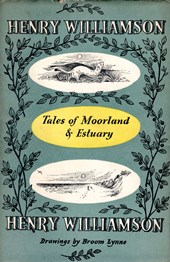
Tales of Moorland & Estuary
TALES OF MOORLAND & ESTUARY
 |
|
| First edition, Macdonald, 1953 | |
First published Macdonald, 16 March 1953, 12s 6d net
Illustrated by James Broom Lynne, with a vignette for each of the twelve chapter headings, two of which also adorn the dust wrapper
(Broom Lynne also designed the covers for A Chronicle of Ancient Sunlight.)
Panther, paperback, 1970, 6/-
Text as first edition
The book was incorporated into Collected Nature Stories (Macdonald 1970), with a new preface, slight revisions and a different order. The opening story, 'A Winter's Tale', was moved into the section for The Peregrine's Saga.
Macdonald Futura (Heritage series), paperback, 1981, £1.75
This edition, oddly classified as non-fiction, follows the text as set in Collected Nature Stories (i.e. 11 stories only), but without the illustrations
Dedication:
To Miss Imogen Mais
(Imogen being the daughter of HW's long-standing friends Petre Mais and his partner Jill.)
There is an accompanying letter to the dedicatee which explains the background to the stories within the book. This is the revised typescript:
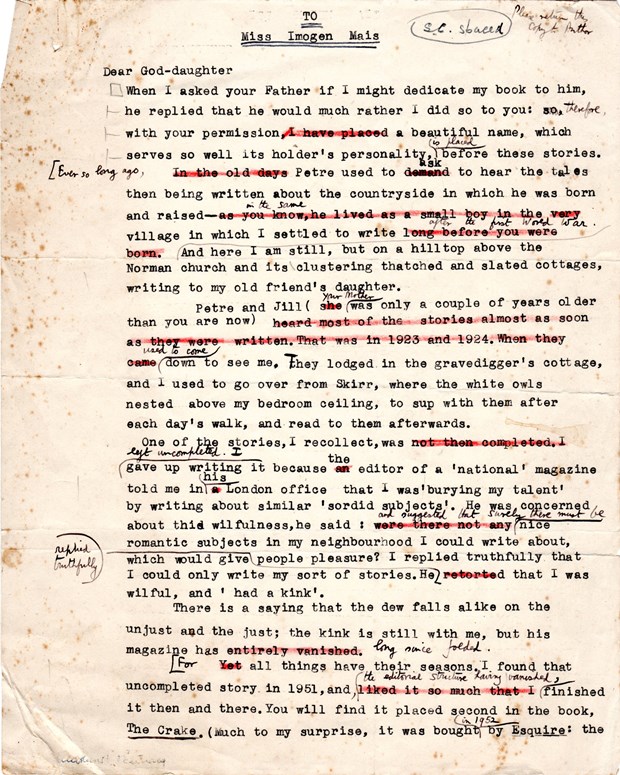


(Candlemas is the Feast of the Purification of the Virgin Mary, 2 February.)
Tales of Moorland & Estuary is a collection of twelve short stories – 'Tales' – several of which had already been published in the earlier Devon Holiday (1935), where they are part of the stories told nightly in 'Arabian Nights' style; the others had been previously published only in magazines, and a couple perhaps not previously printed ('perhaps' advisedly, as my research cannot be said to be exhaustive). It is interesting to note that on the day HW began to write Devon Holiday, Monday, 1 October 1934, he recorded in his diary:
Began DEVON HOLIDAY: Tales of Moorland and Estuary this day.
That sub-title was never used – and it now resurfaces as the charming title for this new book.
HW's choice of stories for this volume needs close consideration. This is no spur-of-the-moment, thrown-together selection to produce a book to earn money (although that was also a necessary factor!). These stories were chosen with care and are among the best that he wrote. Indeed, by any standard, they stand high in the ranks of the short-story genre. They also have either direct content, or allusion and allegory, about war and death, and so emphasise again the overwhelming influence of the war on HW's writing and psyche.
*************************
There is very little information within HW's personal archive about the writing of – or rather, the preparation for – this book.
At the beginning of 1952 HW was hard at work on Donkey Boy, the second volume of the Chronicle; the first volume, The Dark Lantern, had been published in November 1951. He noted on 6 February that while writing hard with the wireless playing music, he heard it dissolve into a long hissing silence (and thought a valve had gone): then a grave voice announced the death of King George VI. He finished the first draft of the novel on 27 February – 'at 3.30 am this morning' – and then began revisions to pull it into a coherent 'whole', noting that the first writing was always by necessity only a draft, as the pen (or mind) took its own course during the writing, so that earlier material had to be adjusted accordingly.
In his diary he notes:
Thursday, 13 March 1952: Macdonalds have taken it [Donkey Boy] for £750 advance.
Also Tales of Moorland & Estuary for £250 advance.
So I feel secure – except that since the budget [stocks have fallen drastically].
Tuesday, 1 April: Signed & returned to Macdonalds contract for Donkey Boy.
Also contract for Tales of Moorland & Estuary.
Thursday, 3 April: Macdonalds sent cheque: Donkey Boy £500
Tales of Moorland, £250
(The contract shows the remaining £250 advance for Donkey Boy was due on publication.)
The typescript for Tales of Moorland & Estuary was due to be presented by 30 June, but there is nothing to note this. At the beginning of June HW attended a West Country Writers' Association congress at Plymouth with Charles Causley, having given the latter a lift from his home in Launceston, where he noted that he 'talked with Frank Swinnerton, a dear'. (Swinnerton had been very helpful at the time of publication of The Gold Falcon and was a good friend.) But he found 'St. Ervine's talk on G.B.S. too long, though moving in parts'.
Two days later, on 5 June, he left for Ireland to stay with John Heygate and his third wife Dora (noted in brackets as 'Lady Heygate': Heygate had inherited the baronetcy in 1940 on the death of his uncle) at his Bellarena estate. This was the first time HW had been to Bellarena, and it had been a long time since he had seen Heygate. Problems arose, and Dora suggested that Christine join them, which calmed things down. HW returned on 25 June.
There is no mention of Tales of Moorland & Estuary until 2 January 1953, when a problem about the illustrations is revealed. HW was by then working hard on volume 3 of the Chronicle, Donkey Boy having been published in October 1952. His diary reveals the strain he was under:
Harvey of Macdonalds [Eric Harvey, their editorial director] writes rather severely that the illustrations done without my sanction or knowledge for Estuary Tales must stand. He wrote some months ago that if I didn't like them when I saw them (i.e. after revision) I needn't have them. They are now revised – they arrived on Xmas Eve & ruined it for me, partly – and are poor, unknowledgeable. The Filleigh Viaduct sketch particularly bad. Tunnicliffe in the Salar illustrations has this exactly. In the Tales, the same pool etc as in Salar is used in the final story, Where the Bright Waters Meet. It is, by this new illustrator, all imagined. The 'viaduct' is a few feet over the river – river with deep banks – with iron tubular supports etc. The Viaduct is described in the story, accurately, too. I wrote saying I would accept the others, but begged him to scrap the phoney bridge, & substitute a burning Bentley, & ghosts by it, instead. Whether he does or not remains to be seen. Meanwhile it is worrying, worrying, worrying. . . .
10 January 1953: Harvey wrote that he would get another drawing for 'Bright Water' in Tales of Moorland & Estuary. Greatly relieved.
16 March: Tales published today.
20 March: Good review of Tales by SPB Mais in Oxford Mail & News Chronicle.
31 March: Someone I met in connexion with James Farrar book – J. Wynne-Tyson – writes that he reviewed Tales for Observer – only short – & likes them very much.
BUT –
12 April: The Tyson review in Observer today upset me greatly. He says the book is patchy & I have a grudge against the human kind – this his reaction to my splendid tributes to Old-Mast-and-Yards in Crake, to Charley, & Stroyle George in Hero of Sands, & the sad Oodmall of Crown of Life. I was very upset – all my old doubts returned –
That this disturbed HW so greatly shows how important these stories were to him. It also stopped him short temporarily with writing the Chronicle. How easily is the creative equilibrium unbalanced. Jon Wynne-Tyson (self-styled 'King of Redonda' after John Gawsworth's death) was something of a hanger-on and a little too full of his own self-importance with small reason. However, three days later, HW's faith in himself and his work was restored:
15 April: A wonderful talk by Brian Vesey Fitzgerald on Tales of Moorland & Estuary on the West Regional BBC tonight. He praised all the nature books. I wrote him a warm letter of thanks.
11 June: George Painter had a fine review of Tales of Moorland in the Atheneum. Oddly enough, the editor (Kingsley Martin) was staying the same weekend as the issue, at Negley Farsons. I did not meet him. This was at Whitsun, nearly 3 weeks ago.
(There is no Atheneum review in the file, though there is a review by Painter in the New Statesman.)
*************************
I want to reiterate here the importance and worth of the tales in this collection, and that HW himself set great store by them. Those from Devon Holiday were a little overshadowed by the slapstick joking that surrounds them there – and the remainder were published in ephemeral magazines and essentially inaccessible to later readers. Here, as a cohesive collection, they take on a new and vivid life, and show HW's skill and power of imagination and structure. Broom Lynne’s vignettes head the considerations of each story.
A Winter's Tale:
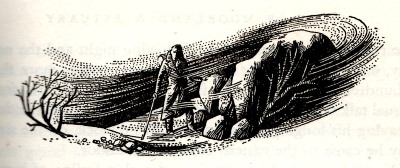
This story was originally published as 'A Night on Dartmoor' in Nash's & Pall Mall Magazine, February 1936. In his preface in Collected Nature Stories, where the story is placed in The Peregrine's Saga section, HW wrote that after the departure of 'Julian Warbeck' (Frank Davis, in 1922) he was able to get on with his writing in peace:
I put aside Dandelion Days & began to write a story, based on a walk during the winter of 1919/1920 to see a friend who lived near Dartmoor.
It is a chilling tale in both senses of the word! A few days before Christmas 1919 a young man sets out to walk from fog-bound London to spend the festivity with a friend at his house beyond Princeton deep on Dartmoor. 'It was a period of intense cold.'
The description of this young man with his army blanket etcetera immediately suggests to the reader that it is HW himself. Many readers in the past have fallen into the trap of believing HW really did walk from London to Devon, and HW tended to encourage this – but there is no evidence whatsoever that this was so.
The young man reaches Exeter, and quite late on Christmas Eve sets off to cross Dartmoor. One can, as always with HW, follow his progress on a large scale map. The description of the landscape – Dartmoor in winter: snow, wind, ice – is 'HW superb'. Lost in the dark and cold and at the end of his tether, our hero comes across a cottage and persuades the occupiers (reluctantly) to take him in. His reception and the behaviour of his hosts seem decidedly odd. As the night progresses our young man becomes increasingly nervous, hearing unexplained noises from a cupboard and the suspicious sudden appearances of his host. Half asleep, his mind imagines several horrors. Plucking up courage he eventually opens the cupboard, to find a large barrel inside from which these strange noises emanate. Prising off its lid, he sees the face of an old man peering up at him from the liquid inside, and is convinced he is himself about to be murdered by a pair of maniacs. As dawn breaks on Christmas Day he looks under the bed for something with which to protect himself and discovers an empty coffin there. He then understands the situation, but hurriedly prepares to go on his way.
As he leaves his host explains with dignified reticence that the ground has been frozen too hard to bury his wife's old father, and the only thing they could do was to pickle him in a 'og's-'ade' (hog's head – a barrel of ale) until the thaw came. The last paragraph gives the tale a perfect ending of humanitarian thought.
The Crake:
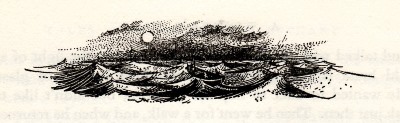
As HW explains in the preface to the Collected Nature Stories, the story appeared in Esquire (USA) in June 1953, where, to his extreme annoyance, it had been altered and hacked about without his permission.
However, the story had been written when HW first arrived in Devon – he states 1922 in his Dedicatory letter. Here is actually a more serious and considered variation of a story told in Chapter XI of Devon Holiday (1935): 'We encounter a Fearful Mystery, and experience a Frightful Horror, which nearly ends this Awful Book', which is a more slap-stick version of the Orca Gladiator story and had in itself originally been entitled 'Death to the Killer', and had already appeared in Golden Book Magazine (April 1933) and Storyteller (July 1933).
'The Crake' tells the story of fishermen in the Devon village of Appledore who are being terrorised by a dreadful portent of death, the Crake, so-called because of the terrible noise heard one night, and the deaths that come to be associated with it. It is certainly based on a real tale of superstition and dread. In the end the Crake is revealed to be an 'Orca Gladiator', a grampus, or killer whale. The local fishermen and other characters that appear in the story can be traced back to real men whom HW observed and knew in his early sojourn in 1920s Devon.
The story paints a vivid picture of the village of Appledore of the 1920s, with superb portraits of the men who lived there, particularly Old-Masts-and-Yards and his sole surviving son, Whistling Paddy. His other four sons had been killed at sea during the First World War. Whistling Paddy, indeed, had also been blown up and seriously injured. The hardships endured by the fishermen are evident. William Crang, the 'Hell-fire & Brimstone' preacher, is prominent. Also a young doctor who was compiling a natural history of the Two Rivers, who gives a lecture on the life cycle of the salmon: none other than Dr Elliston Wright, a well-known local naturalist who brought HW's first-born son into the world!
Whistling Paddy is sadly drowned, in effect by the Crake – Orca Gladiator – thus reinforcing the legend. His father, Old-Masts-and-Yards, then lives alone. He is often seen standing alone for hours on end by the local War Memorial, where he feels near his sons.
It is a sobering and salutary tale, yet uplifting in its sincere simplicity and told with consummate skill.
Towards the end of his life, suffering from dementia and living with us before going into the care of the monks at Twyford Abbey, HW was much troubled by thoughts of the Crake, and had to be frequently soothed. It was obvious that in his muddled state he was reliving this story of the portent of death.
A Hero of the Sands:

The opening vignette here about a Pekinese being attacked by an Alsatian wolfhound and rescued by 'the hero of the sands' is but a forerunner to the real story: one concerning Charley Ovey and his famous terrier, the Mad Mullah, and Stroyle George and his cattle-dog Roy. These are characters that have appeared in the early books about life in Georgeham and are well known to regular HW readers.
The two men meet in the street below the observer's window (HW, looking down from the window in his writing study over the garage at Vale House in Georgeham). The two dogs size each other up by continuously running round the two men. Male exchanges are phlegmatic, as tends to be the way with countrymen. The stand-off between the dogs continues until Roy suddenly seizes the Mullah (old and toothless) and turns him on his back. Stroyle George shouts at Roy, who lets go and disappears under the culvert that carries the little stream under the road – followed by the Mullah. Charley and George depart about their own business.
The two dogs follow the stream down to 'Cryde' (Croyde), the elderly Mullah some way behind, where Roy encounters the Pekinese 'Consuelo', of the opening vignette. Consuelo follows Roy down to the beach where it is again attacked by the Alsatian wolfhound. Roy panics. But the Mullah, coming behind, attacks the Alsatian, which retaliates with intention of killing him. Roy now attacks the Alsatian, which drops the Mullah to concentrate on his new opponent. The previous day's 'Hero of the Sands' again grabs the Alsatian's back legs, shouting to another to grab Roy's legs. But they do not part: and are finally separated by holding a burning newspaper under their noses, Roy becoming the four-legged 'Hero of the Sands'. The next day Roy again meets the Mullah in the street: where they are seen to be the best of friends.
(As will be seen – one reviewer attacked HW for his description of the 'Pekinese' (strictly, 'Pekingese'!).
Incidents of an Afternoon Walk:

Again the opening, together with a second amusing diversion, serves as a prologue to the main story, setting the story in real life: a walk following a 'runner' (small stream) which ends in a pond. Arriving at the pond we also arrive at a tale of the life in that pond: an observation involving frogs, a rat, and a heron – a story of spring mating, hunger, and survival.
This is actually a version of 'Some Marvels of Pond Life', printed in The Linhay on the Downs (1934), but smoothed with small revisions. The story was first published in The Bermondsey Book, August 1929, as 'The Drama of a Pond'. (It should not be confused with another story entitled 'The Old Pond'.)
The Heller:

This story had first appeared in the American Atlantic Monthly (May 1928), then in Cassells Magazine (September 1928), Argosy (1935), and the Daily Express (22 October 1935). It had further been published in Devon Holiday, Chapter IX.
It is set on the Braunton Marshes which lie between the town and the famous Burrows (a massive dune ecosystem) and flanked on its eastern side by the River Caen which runs into the estuary of the Two Rivers (Taw and Torridge).
HW, out on a walk down the wall, an earth bank which flanks the estuary and guards the marshes from flood, meets the marshman who lives at the toll-gate cottage. The flood tide is extra high and causing some slight flooding on the marsh. The marshman has a grievance: his brood of ducklings are being eaten by 'The Heller', which, after cursing it several times, the marshman identifies as 'that darned old mousey-coloured fitch' – in other words, an otter. At that moment it is seen, and the marshman fires at it with his ancient gun, but it escapes (to the relief of HW). But the marshman now sets a trap over the sluice to catch it, weighted so as to drown the otter once it is caught.
Later, as he wanders, HW sees the otter again – 'the biggest otter I had seen, with the broadest head' – and watches it play while the tide floods, slightly over-topping the sluices, and spilling over into the marsh. It is getting dark, and he hears a lot of squelching and odd noises coming from the marsh somewhere in front of him. Then he hears a noise which indicates that the otter has been caught in the trap.
The next day the marshman takes HW to retrieve the otter, its skin being worth money. As they return they find a large dead conger eel which has obviously been killed by the now dead otter. The marshman takes it home and cuts it open:
. . . then stared into my face with amazement and sadness, for within the great eel were the remains of his ducklings.
The otter, having killed the real 'Heller', had died in vain.
The Yellow Boots:

This extremely gory, superbly crafted, short story first appeared in The Old Stag (1926), but was not printed in the 1933 illustrated edition, instead being added into Devon Holiday, Ch. XVI, as 'The Story of the Poisoned Hounds', being the tale told at Lydford. The story was also printed in Argosy in 1928, and notably in the new West Country Magazine, in two parts, Summer and Autumn 1946.
The Inclefell Harriers are due to meet for the final hunt of the season, but inexplicably the Meet is cancelled. Rumours abound. Then it is officially announced that the hounds had all been put down for sheep-worrying. Even so it is all considered to be rather peculiar.
The scene shifts to Convict 76 – who had fought bravely in the First World War – newly escaped from Princeton Prison on Dartmoor, who (thinking himself in luck) finds a bag of hidden clothes, including a pair of yellow riding boots, and changes out of his conspicuous prison uniform. However, the clothes have been used to sabotage the Hunt by making a drag scent to lure hounds away from their legitimate prey by two renegade youngsters, one of whom is the daughter of the Huntsman. The young couple try to warn him but he does not listen. So, dressed in these clothes, Convict 76 finds himself hunted by the hounds bent on tracking the addictive smell of aniseed. But all will be well, he tells himself – he has a lucky talisman, a pin. This pin has been his protection against all evil.
This hunt is comparable to the last great Hunt in Tarka the Otter. The scene is set on Dartmoor, and we find Convict 76 struggling through the mire of familiar place names: Links Tor, the Great Kneeset, Cranmere Pool. But here, instead of being an allegory, it is linked openly to Convict 76's terrible experiences in the First World War, and how thoughts of his new bride had sustained him through it all.
He was so fatigued when he reached the Great Kneeset that he had to walk. His feet, with blistered toes and heels, felt as hot and heavy as they had felt when he had trench-feet, swelled and red as tomatoes. . . .
He staggered across the plash in the peaty hollow of an old tarn, hid by swirls of fog . . . [Cranmere]
. . . all dropped into darkness. He heard the whining of ricochets, saw the greenish flares quivering in the water-filled shell-holes . . .
He prayed with broken shouts, as he had prayed under the barrage at Festubert. . . .
He throws off the clothes that are impeding him – three hours of running have passed – and getting into an icy stream evades the hounds for a short while. But then, feeling for his lucky pin, he finds it is no longer there.
Ever since he had been blown by a high-explosive shell out of a communication trench in the Hohenzollern Redoubt, with burst sandbags and pieces of a shattered Coalie, his chum, a spectre had fretted his life. . . .
The thought of his wife had kept the spectre away; as afterwards, the companionship of the pin in his cell had been a barrier against the dark fears which came into his disrupted mind. When he knew that the pin was lost, Seventy-Six threw up his arms and wailed.
Struggling on, he now re-lives the time of his first leave home: and arrival back in London during a Zeppelin raid: 'The minenwerfen in the Salient had made a lesser noise.' The Zeppelin torpedo falls near his own house – sixteen houses are flattened, but his was still standing. 'Won't old Dol be surprised to see me . . .'
But he finds 'Old Dol' in bed with another man, and in sudden blind rage he had stabbed viciously with his bayonet over and over, killing them both. As the story ends, his mind relentlessly re-enacts the scene of his crime: in reality he is being attacked by the hounds who have finally caught up with him.
The next morning the errant daughter of the Huntsman is out for an early morning ride. She comes across bloodstained hounds who greet her eagerly – and sees
two shinbones sticking out of a pair of yellow boots.
The opening pages of the story now have an explanation.
The White Stoat:
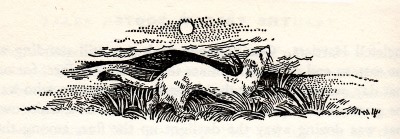
Again, this is a very early story, appearing in Atlantic Monthly in July 1929; in Passing Show, 14 April 1934; and gathered into Devon Holiday, Ch. VIII, under the buccaneering and much more descriptive (and apt) title 'Swagdagger Crosses a Field'. Both versions are hedged about with more or less nonsensical 'rigmarole' – although totally different in each case.
The reader finds that 'Mr. Ovey' of the original story becomes here 'MacShankles', and that our author has 'on sudden impulse sold his field . . . his sanctuary . . . which I loved . . . [and in which] I had planted trees, built a hut, dug a drive of sorts, and made a garden’. And what's more he has sold it to a Londoner, wearing a black Homburg hat (de rigueur in London but totally incongruous in the country).
Looking over the gate of his new field, MacShankles sees what he takes to be a piece of white paper blowing along and thinks a trespasser has been there and dropped it. He determines to padlock the gate and put up a warning notice. He does not realise that the white rippling object is actually a white stoat, which has a mate and a litter of young living nearby.
As the white stoat (Swagdagger) crosses the field on his way to the beech clump where his family are living he is attacked by a buzzard, but frightens it off by his hissing angry defence noises. This noise disturbs a pair of crows, then a rook, more rooks, and four magpies. All fly around in noisy cacophony, mobbing the white stoat. But the sentinel rook sees away in the distance, a far greater danger: Chakchek the Backbreaker – the peregrine falcon. Kronk the raven, King of the Crows, also appears.
More chasing involving all the birds occurs, until suddenly stoat and raven come face to face.
Raven and stoat remained still, brown and pink eyes fixed in the same stare. Instinctively, from the human point of view, the stoat is insane. He lives to kill; he drinks hot blood with frantic joy. Frustrated in his direct purpose, the white stoat's lithe and furious power blazed in his opaline eyes. . . .
But the birds are disturbed by MacShankles returning with his notice, and flee; all except the buzzard, which now attacks the white stoat, who sinks his teeth into the buzzard's leg, and they rise into the air struggling together; falling back down as the stoat wins an amazing aerial battle of life and death. He continues on his way.
But he is now seen by MacShankles – who recognises 'ermine', and potential money. He chases the white stoat into a woodpile, but Swagdagger has had enough and turns on what he perceives as a nasty smell with furious noises and attacks. MacShankles is then chased by the family of stoats, chattering in fury, into, through, and out of, his own field, with noisy accompaniment of the disturbed birds.
Back in the village, Macshankles, totally unable to cope with terrifying nature, meets up with our author and thankfully sells the Field back to its rightful owner.
The Dog who Ate His Punishment:
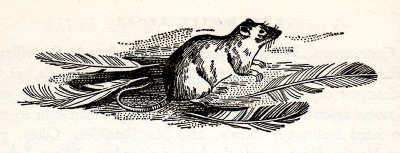
The story was first printed in Windsor Magazine, No. 468, December 1933:
 |
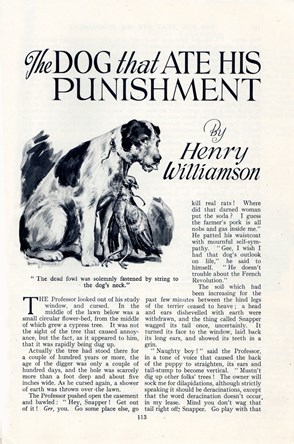 |
It then went into Devon Holiday, Ch. VI, and is revised for its appearance here.
HW introduces an American Assistant Professor of Comparative Literature staying in Devon on a research fellowship to write a book. This is Herbert Faulkner West, whom HW had met on his visit to the USA over the winter of 1930‒31, and who came to England, as in the story, in 1932. While here, he visited HW at Shallowford, where he wrote the percipient essay The Dreamer of Devon.
The actual story here, that the Professor's dog, Snapper, was accused of killing chickens and suitably punished, is purely fictional, but based on, or rather prompted by, HW's own dog, which on occasion did kill one of his neighbour's chickens – which HW had to pay for! The twist to the story is that a dead chicken was hung round the dog's neck to punish it – but he is beset upon by rats, who are of course the real culprits. The farmer shoots into the mêlée, luckily missing Snapper: nine rats dead altogether, six by the farmer, three by Snapper. Snapper is now considered a hero! The farmer's wife cooks up the chicken, carefully removing all bones, for Snapper's reward: thus he eats his punishment!
The Maiden Salmon:

This important and most interesting story forms the last chapter of Devon Holiday. Written in 1934 and arising out of HW's anguish over his thwarted love for Ann Edmonds, it embodies a similar style and atmosphere as his earlier book The Star-born, published in 1933 but actually written in 1922. The story of the life cycle of a salmon from egg to maturity (a maiden salmon), as watched and aided by the poet is linked with the love of a beautiful and elusive, seemingly human, maiden. It is a powerful 'above and beyond' metaphysical allegory, embodying the role of love as a muse and its effect on the creative personality. It ends with the poet's death and his meeting with the maiden:
The poet looked at the maiden, and knew that his search was ended – for on that brow was the sunrise of a new world.
Full details of the background to the story can be found in the entry for Devon Holiday.
Trout:

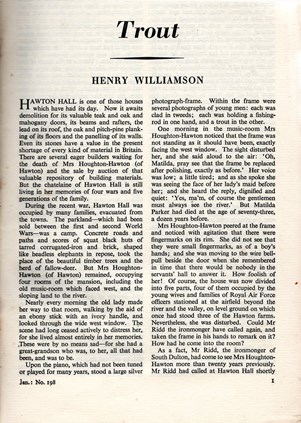
While writing Devon Holiday HW noted in his diary on 1 October 1934: 'Embodied short story TROUT'. However, the story was not included in that published book. It may have been deleted, as its central character was too recognisable: the book's publishers – Jonathan Cape – were very concerned about possible libel action at the time. In January 1951 a story entitled 'Trout' was published in Chambers Journal, where it is the opening story:
 |
 |
In his 'Dedication' to Imogen Mais HW writes:
Trout has been added-to, but only by the events of another war, which further reduced the family whose history is written in the person and memory of Mrs. Houghton-Hawton (not her real name) who is still living.
This poignant story – sad, but ending with hope – is perfectly crafted and superbly told: totally evocative of a time past – and lost.
The disguise of the little town which places the story is pretty thin: South Dulton and the River Dull are surely South Molton and the River Mole, within a stone's throw of Shallowford where HW lived in the 1930s. His description of the behaviour of its inhabitants is not very favourable!
A mile away from this town stands Hawton Hall, occupied solely by old Mrs Houghton-Hawton of Hawton, 'who has known four wars and five generations of her family.' This 'châtelaine' (how cleverly the use of such an old-fashioned word creates the desired atmosphere) lives within her memories: her sense of time and people a little out of synchronisation with reality. Throughout, everyone's manners are impeccable, despite their private thoughts.
The Hawton men, by tradition, had all fished for trout in their stretch of river and been formally photographed with rod and first catch. A large silver photograph frame containing several of these photographs stands proudly in full view on the piano in the music room – with one space left to fill. All the men depicted had been killed in various wars.
Her father-in-law had been killed with the Light Brigade in the Crimean War; his son, Alethea Houghton-Hawton's husband, had died of enteric fever in the South African War (as did Sidney Cakebread in Donkey Boy, which was being written at the same time as this book). Their son, an Observer in the Royal Flying Corps, had died in the First World War. The most recent photograph is of his son, Nigel (all the first-born are named Nigel), who had 'found a soldier's grave far from his native land . . . in the desert warfare with the Afrika Korps'; while his son, and Mrs Houghton-Hawton's great grandson, lives with Grannie and is just home for the Easter holidays, and is anxiously wondering if he would live up to the family tradition.
The demise of the male Hawtons is reflected in the decline of the river and its fish, and in the farms and timber of the Estate lands, gradually being sold off to meet the successive crippling death duties involved.
There is a chilling description of the death of the RFC Hawton, which blends into the plight of the present young Nigel, bothered by which fly to use as he attempts to catch his first trout under the rather useless guidance of the ex-chauffeur and a village worthy. Eventually, with excited surprise, the lad succeeds in landing a small but legal 3-oz fish.
On return home the lad hands the fish over to the housekeeper saying it must be cooked for 'Gran's dinner'. He has forgotten about the required photograph until, suddenly remembering, it is too late. The fish has already been cooked. He is terribly upset – but Gran – Mrs Houghton Hawton of Hawton – rises magnificently to the occasion, saying it is not too late, and that such an unusual photograph of the victor holding a plate on which the cooked fish sits will be a great talking point for many years to come.
Nigel's photograph indeed joins the others in the silver frame on the piano in the music room. We learn that the grown-up Nigel has emigrated to farm in New Zealand; the old lady, nearly 100 years old, lives alone with her memories.
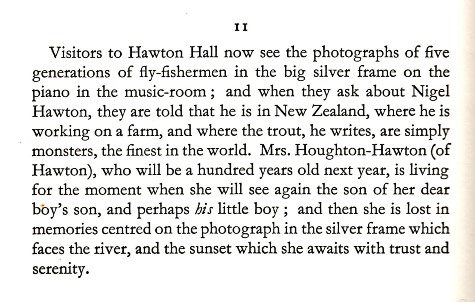
Incidentally, 'The Trout' was subsequently published in Best Fishing Stories, edited by John Moore (Faber, 1965) where John Moore states:
Henry Williamson is a man of Devon, and the rivers and streams in his books are the swift bright tumbling ones of his native county. Salar the Salmon was a successor to his famous Tarka the Otter, and in both books the naturalist and the novelist go hand in hand; the precise and accurate observation of birds and beasts and fishes is matched with the story-teller's imagination and the poet's vision.
Moore's selection also included 'Black Dog' from Salar the Salmon--- and the 'Iron-Blue' chapter from Plunket Greene's Where the Bright Waters Meet.
A Crown of Life:

This story first appeared in Nash's & Pall Mall Magazine, December 1935; then in Atlantic Monthly, January 1936; Fiction Parade and Golden Book Magazine, March 1936; Argosy, June 1936; The Adelphi, Vol. 22, No. 1, October–December 1945, where it was dedicated 'For Benjamin Britten', the composer (see the entry for The Adelphi).
This is another magnificent, extremely well-crafted, poignant and moral story. It paints a picture of village life exactly as it would have been from the viewpoint of a particular family who have lived there for five centuries. In particular it concerns Clibbit Kifft (from HW's early Georgeham era) and his most faithful dog, Ship. We read first of the history of the Kifft family – yeoman farmers struggling to make a living in their 'Frogstreet' farmhouse. (Frogstreet has a rather onomatopoeic ring of 'Plugstreet'.) At the time of this story the farm is very run down, the import of foreign corn being a major cause. (This is a constant theme in much of HW's writing, notably in The Flax of Dream and A Chronicle of Ancient Sunlight.)
Clibbit takes after his father, who treated him badly as a child: he drinks and has a temper: his appearance so odd that the village boys called him 'Oodmall' (scarecrow). HW's description of this man is remarkable in its detail and well worth reading. He gains a reputation for being cruel to animals. The only things not frightened of him were the house martins that nested under the eaves. The only person who is kindly is the Rector. The old grey cattle-dog Ship also remained faithful, despite constant kicks and blows. But in due course his older sons, unable to stand any more, leave; and his wife, also unable to cope any longer, eventually also leaves him to go and live with her brother. And so Clibbit lives alone.
The farm runs down and every animal on it develops a problem, including his old pony. Reported to the Bench for cruelty, the horse is ordered to be destroyed and Clibbit sent to prison for seven days. When he comes out of prison he appears lost, but Ship is glad to have him back. The last straw comes when he picks some late watercress for his own youngest child, living with his wife's brother at Vellacott Farm. He is rejected and told to clear off.
Clibbit went away without a word. His body was found the next day lying in Lovering's Mash, gun beside him, and Ship wet and whimpering. Watercress was found in his pocket.
With a verdict of 'felo-de-se' (self-murder) he has to be buried in unconsecrated ground. The grieving Ship disappears, but is seen at nights to be haunting the grave of its master. The Rector hears about it and is kind to the dog, taking it a biscuit early every morning on his way into the church. Christmas approaches.
On Christmas Eve the yews in the churchyard were black and motionless as dead time.
The climax to the story comes at the early morning Communion Service in the church on Christmas Day. As the village faithful take communion, the frozen, bedraggled and dying dog appears and manages to drag itself up to the Communion Rail, where the Rector is administering the Sacrament to his congregation. The Rector bends down and gives the dog something out of his pocket (one feels he is giving the creature part of the Sacrament), but the dog is already beyond life. The Rector blesses it saying:
'Be thou faithful unto death; and I will give thee a crown of life.' The sun rose up over the moor, and shone through the eastern window, where Christ the Sower was radiant.
(The quotation is from the Book of Revelations, Ch. 2, v. 10. Interestingly, the phrase is also used by Algernon Swinburne (1831–1909) in his poem Dolores: Swinburne being the poet quoted continuously by 'Julian Warbeck' (Frank Davis) in the Chronicle novels.)
Where the Bright Waters Meet:
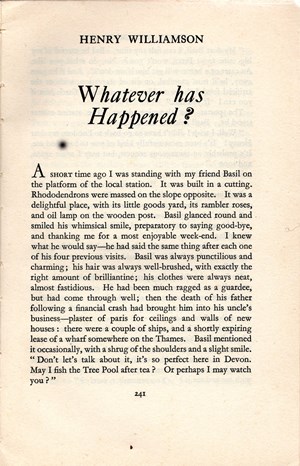
This story first appeared as 'Whatever has Happened?' in the Daily Express, 8 May 1935, and in Lovat Dickson's Magazine, March 1935:
 |
 |
The new title is taken from Where the Bright Waters Meet (1924), a classic book on trout fishing on the River Bourne (a tributary of the Test) by Harry Plunket Greene, a copy of which HW had at Shallowford, signed and dated 1930. HW included the chapter 'Iron-Blue' (about a particular blue dun fly – which also features in HW's story here) in an anthology he edited in 1966, My Favourite Country Stories (Lutterworth), thirteen years ahead of this present book – and thirty years ahead of the original story.
This short story is another masterpiece of the genre – this time with a twist and a very appropriate one with which to end the book. It is one of the very few (understated, but very chilling) ghost stories that HW wrote. That it was very important to him can be seen by the anguish he felt over the faulty illustration as noted above in the background section. It couldn't be just any old viaduct: it had to be the viaduct. This viaduct today carries the main road, and the scene that HW describes can be seen – briefly – as one speeds over it in a modern car.
The 'I' of the story (the author / HW) and his friend Basil catch a train to London (obviously from Filleigh Station, within a mile or so of HW's Shallowford cottage). But something is not right. The train crosses the viaduct that spans the Deer Park, and they vaguely wonder why they are not using the 4½ litre super-charged Bentley, such 'a pleasure to drive', for the journey.
The train was getting under way; we were passing the trees of the Deer Park on our right. Soon the tops of the firs and pines were slowly lowering themselves beside us. The cutting was dropping away; the viaduct over the valley was in front. We were now above the blue-green tops of the spruces. We sat on the right of the carriage, peering through the open window for a sight of the winding moorland stream with its fringe of alders and occasional great oaks, and of the thatched cottage far away at the end of the valley [Shallowford]. . . .
The viaduct of the Great Western Railway spanning the valley stands a hundred feet above meadowland and river. It rears itself on tall stone columns. . . .
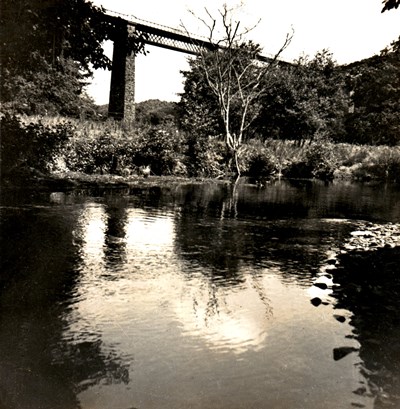 |
| The Fireplay Pool and viaduct in HW's Shallowford days |
They notice two men fishing in the river below – the author's stretch of river: they must be poachers. The train stops – oddly – on the viaduct and they alight and scramble down to where these two 'poachers' are fishing. They look familiar, and one is fishing in just the very same style as the author himself.
Then, as the description of the scene continues, they merge into the author and Basil (although they are also still the watchers) – and the former has caught his own tame Loch Leven trout, named Peter. The trout is being killed. This is all wrong, and the author runs shouting to stop it, in vain.
The scene dissolves. He climbs up a tree and finds all peaceful: and then spies, in its usual position behind a particular rock, the big trout he calls Peter. There is a hatch of fly, of Iron-Blue duns (thus the Plunket Greene) and there is a lyrical passage ending:
A hatch of fly, and the consequent rise of fish, was a sight I had never ceased to watch with thrilling excitement. The river was alive, its multitudinous life in balance under the sun! My nature drew life from the living water.
After a while the author sees Basil walking by the Viaduct Pool and, getting down from the tree, goes to meet him. They both admit they feel odd – possibly ’flu – and decide to get back to the house to rest, feeling increasingly ill and finding the sunlight and noise unbearable.
The house is packed with people. Outside there is a lorry on which lies a smashed and burnt-out motor-car. They hear people describing what has happened. The author feels increasingly distraught and suddenly finds himself in the middle of a car-crash:
I heard, in a series of swaying recessions, the words – blazing headlights – seventy miles an hour, or maybe eighty - a terrible noise as the car crashed into the telegraph pole at the bend of the road, breaking it in two – the car turned over and over, and burst into flames – charred almost beyond recognition.

*************************
Go to Critical reception.
*************************
First edition, Macdonald, 1953:

Front and back flaps:
 |
 |
Back cover:

Panther, paperback, 1970:
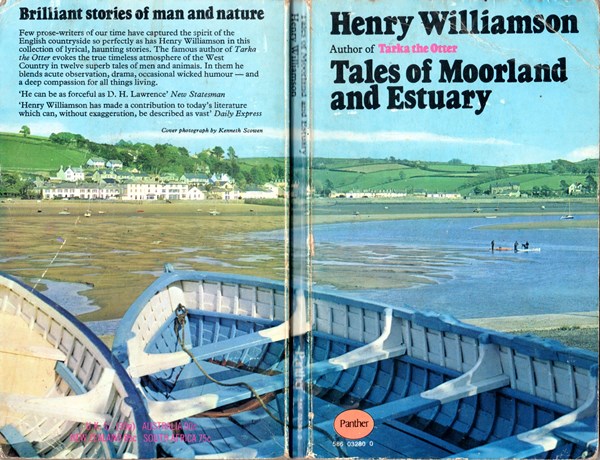
The lovely cover photograph is by Kenneth Scowen, and is tentatively identified as Instow, looking across the estuary from Appledore. Can anyone confirm this?
The flyleaf of this particular copy bears an inscription which clearly worked, as it is still in the archive!

Macdonald Futura, paperback, 1981:
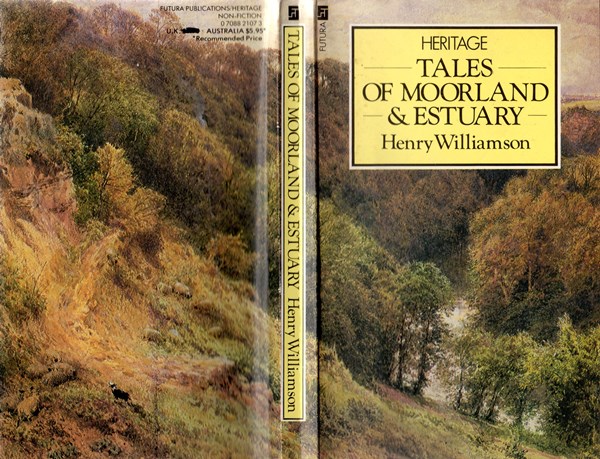
The wraparound cover is taken from a painting by Miles Birket Foster, 'A Dell in Devonshire', courtesy of the Victoria & Albert Museum.
*************************
Letters from a Soldier
LETTERS FROM A SOLDIER
Walter Robson
Edited & with an Introduction by Henry Williamson
 |
|
| First edition, Faber, 1960 |
Faber & Faber, 1960
Faber & Faber, second impression, November 1960
HW's Introduction is reprinted in Threnos for T. E. Lawrence and other writings, ed. John Gregory, HWS, 1994; e-book 2014.
HW's diary reveals the only the briefest of details about his involvement with this book:
1 February 1960: Posted off edited Tss of Letters from A Soldier to Mrs. M. Robson, The Paddock, Smeeth, Ashford, Kent.
17 March 1960: 'Retyping pages [of A Test to Destruction] – also writing Introduction to Letters of A Soldier which Faber are to do this year.
At the beginning of October 1959 HW received a letter from his one-time publisher (and close friend) Richard (Dick) de la Mare, one of the directors at Faber & Faber, informing him that they have a manuscript they would be grateful for HW's opinion on, if he would care to comment:
It consists of letters from a soldier to his wife, written during the last war, and ending with his death. They are extremely vivid letters and have great poignancy . . .
Dick offers four guineas for this work. HW was at the time in the throes of writing and rewriting A Test to Destruction (volume 8 of A Chronicle of Ancient Sunlight, published in November 1960), and notes 'working hard on 8, exhausted, retyping pages' – it is to his credit that, with that generosity of spirit for the work of the unsung war-dead, he agreed by return: the manuscript was immediately sent to him. A further letter from Dick dated 15 October 1959 shows that HW's report on the work was favourable and enthusiastic, and that therefore Faber plan to go ahead with publishing the book.
HW had evidently offered to do some 'slight' editing and to write an Introduction to the book, even though he was so heavily committed with his own writing. Dick accepted and suggested a fee of £25 for the work (which seems a rather small amount in view of the considerable work involved). Dick de la Mare's letters are formal but friendly, and they both end 'With love'. They include an invitation to attend a party, but which HW did not attend (replying possibly to a secretary); to which Dick commented, 'It did not surprise me.’ The earlier, serious rift between them had been healed, but only to some extent. The handling of the actual publication details of this Robson book was undertaken by another director, Alan Pringle, who ends his first letter:

HW was already in direct touch with Margaret Robson, the widow of the author, who was very appreciative of HW's support and help. Her letter of 2 November shows, in her calm and considered words, a good grasp of what was required, and there seems to have been a good rapport between them:

HW sent the TSS of the letters to Margaret Robson for her approval, and clearly with a few points to clear up, at the end of January 1960, which she acknowledged:

In another letter later that month Margaret Robson clears up HW's further queries, and includes a short extract from one of the more personal letters (which were not going to be published in the book). It is reproduced here, as it is a most moving testament to the love of this young couple – only married for two months, and then only together for two brief leaves, before Walter was sent abroad on active service in early 1943.

 |
|
Walter Robson (The frontispiece to Letters from a Soldier) |
The letters are full of interesting detail, and give a very good picture of army life in wartime as Walter moves from one theatre of war to another, as is shown by the Contents:

It is with some shock, despite knowing it was so, that one turns the page at the end of the book – after a most optimistic letter – to read the official notification of his death on 13 July 1945:

************************
HW's Introduction is an interesting update on his thoughts on war literature. He puts this Robson volume alongside James Farrar’s The Unreturning Spring, a book edited by him ten years previously.
Towards the end of his piece he mentions (really without any reason, except that he too was a stretcher bearer) a much decorated William Coltman. The following newspaper cutting filed in the Archive with the Letters from a Soldier material (not dated, but no doubt culled at that time) explains what occasioned this seemingly random mention:

At the very end of his Introduction HW gives the reason for young Robson's unexpected death: not killed literally in action, but most certainly caused by his war service.

*************************
That Walter Robson was held in high esteem by his fellow soldiers is shown by this typed copy of a letter from his Colonel:

On the reverse of this HW has written some 'personal notes' for his Introduction:

The book ends with a short POSTSCRIPT by his widow, Margaret, whose courage must be given its due equally with that of her soldier husband. The Postscript was lightly adapted by HW from an earlier letter that Margaret had sent him:


*************************
Letters from a Soldier was widely reviewed and critically well received. Sales must have been good, for Faber issued a second impression in November 1960. The dust wrapper for this new impression quotes from various positive reviews of the first printing, and a selection of these is given below, after the cuttings.
British Books merely noted its publication:

The Aylesford Review (Anthony Gower), Vol. IV, No. 1, Winter 1960‒61:
(This appears immediately below the review of In The Woods.)

Wester Morning News (anon.), 30 September 1960:

Eastern Daily Press (anon.), 14 October 1960:

The Times Literary Supplement (anon.), 21 October 1960:

Time and Tide (Penelope Mortimer), 22 October 1960:

Books and Bookmen (William Kean Seymour), October 1960:

The Listener (Roy Fuller), 6 October 1960:


The Observer (Christophee Sykes), 16 October 1960:

Sunday Times (John Braine):
His letters aren't conscious works of art; mostly they were written in the field with no time to hunt for the right word or to contemplate an effect. But he had the writer's – more than that, the poet's-eye. . . . There is only love and compassion – for the wounded men he tended, for the civilians caught up in the war, even for the enemy. . . . His story is uplifting; one is left with a curious sense of triumph.
New Statesman (Walter Allen):
He was a natural writer who responded to the scenes and people he met with an immediacy and vividness of apprehension reminiscent at times of the young D. H. Lawrence. With this went a singular beauty of moral character obviously unconscious of itself. These are a soldier's letters that stand side by side with Wilfred Owen's. I can think of no higher praise.
Guardian (Dan Jacobson):
They make a moving record of the man and his war. They reveal him to have been remarkably generous, gallant, and sensitive; and they reveal him to have been, too, a "born writer", if that phrase has any meaning at all.
Daily Mail (Kenneth Allsop):
This young working-class soldier was a natural writer. His letters spark and shine with the scenes of war – and peace – he saw about him. He was a man one would have liked to have known – but by the end of this book one does know him.
Evening Standard (anon.):
These are the fine and moving letters he wrote to his wife, whom he married less than two months before he was sent abroad.
Tatler (Siriol Hugh-Jones):
A superb and quietly heroic (at a time when such a thing is well out of fashion) collection of letters to his wife written by the author through his years as stretcher-bearer. . . . This is a fresh, immediate book, touching, humble, perceptive and, above all, brave.
Aberdeen Press and Journal (anon.):
These letters are something more than all this – they are the married love of a couple separated by war.
Birmingham Post (Gilbert Thomas):
A born writer; a choice spirit.
Belfast Telegraph (Jack Loudan):
There is humour mixed with sadness in Letters from a Soldier, one of the most unusual and best war books I have read.
*************************
First edition, Faber, 1960, front cover and spine:

Front flap:

Back cover:

Note that Faber published the last book listed above, by HW's son Richard, in 1959. It was runner-up to the John Llewellyn Rhys Literary Prize that year. Long out of print, a new illustrated e-book edition of The Dawn is My Brother was published by The Henry Williamson Society in 2015.
*************************
The Adelphi
THE ADELPHI
 |
HW’s contributions to The Adelphi to July‒September 1948
HW as owner and editor of The Adelphi, 1948‒9
Subsequent history of The Adelphi
HW was a contributor to this prestigious literary 'little magazine' over many years and became its owner/editor for a brief period ('"little magazine" is a term referring to a set of literary periodicals published between roughly 1912 and 1939 that are characterized by their small readership, financial fragility, and artistic innovation' – Oxford Research Encyclopaedia of Literature).
The Cambridge Guide to Literature (Cambridge University Press, revised edition, 1992) has the following short entry for the magazine:
Adelphi, The A journal founded by John Middleton Murry in 1923, appearing monthly at first and then from 1927 as a quarterly (under the title of The New Adelphi until 1930). Its purpose was chiefly to air the literary and philosophical views of Murry himself and of his friend D. H. Lawrence. Murry handed over the editorship in 1930 to Max Plowman and Richard Rees. Before it ceased publication in 1955 it had counted W. H. Auden, T. S. Eliot, George Orwell and W. B. Yeats among its contributors.
It omits to mention that in the late summer of 1948 HW took over this magazine as owner and editor, albeit for three issues only; neither is he mentioned as a regular contributor. As this is an important episode in HW's life, it is worth recording the total picture of his association with this influential literary magazine.
Also see AW, 'The West Wind Blows Again', in Words on the West Wind: Selected Essays from The Adelphi (ed. John Gregory, HWS, 2000; e-book 2013), which reprints the more important of HW's contributions together with other items that have a connection to him.
A fuller background to John Middleton Murry and HW's association with him can be found in HWSJ 35, September 1999, AW, 'Millennium Revelations', pp. 38-66: followed by an appraisal by Dr Wheatley Blench of Murry's essay on HW, reprinted from The Aylesford Review, Vol. 11, No. 6, 1959. Suffice to state here, to explain the remark in the Cambridge Guide to Literature, that John Middleton Murry and his wife, the writer Katherine Mansfield, were very close friends of D. H. Lawrence and his wife Frieda von Richthofen. The four had lived in a ménage-à-quatre in Cornwall until Lawrence had to leave the country at the outbreak of the First World War.
John Middleton Murry (1889‒1957) was a man of great integrity and intellectual ability, and a prolific writer. Murry was a pacifist, but worked in the Ministry of Information for the duration of that war. During the Second World War he ran the famous 'Community Farm' at Thelnetham near Diss, in Norfolk.
The Cambridge Guide to Literature is also slightly misleading, for Murry retained ownership and was the named editor of the magazine until he handed it over to HW: thus Max Plowman and Sir Richard Rees were 'sub-editors' rather than editors. During the Second World War this role was undertaken by J. P. Hogan.
The entry here will fill in details not covered elsewhere about HW's actual articles and connected items (which are shown in bold). James Farrar’s name appears several times: for a more detailed consideration of his work, see the dedicated page for his collected works, The Unreturning Spring.
*************************
HW’s contributions to The Adelphi to July‒September 1948:
HW's first (short) contribution was at a very early stage of the magazine:
Vol. II, No. 4, September 1924:
HW, 'The Doom of the Peregrine Falcon'


('The Doom of the Peregrine Falcon' was reprinted in Words on the West Wind: Selected Essays from The Adelphi.)
HW was himself still in the earliest stage of his writing career. His fourth book, The Peregrine's Saga, had appeared in November 1923. After this short piece there was then a long gap before he made any further contribution to the magazine, which came during the Second World War, when HW was running the Norfolk Farm, and had made contact and become personally friendly with Middleton Murry.
***************
Vol. 19, No. 4, July–September 1943:
HW, 'Fare Thee Well, My Poesy' ('Fare thee well' as meaning 'Goodbye')
HW working on the Norfolk Farm thinks back to his beloved Devon:
Sometimes I think, with the momentary illusion of poetic vision, How can Devon, my Devon, get on without me: [or rather] How can I get on without Devon?
The essay is an adroit mixing of the hard work of the Norfolk Farm and the idyllic Utopia of Devon.
***************
Vol. 20, No. 1, October–December 1943:
Adrian Bell, 'In Answer to Henry Williamson', pp. 7-9 (i.e. to 'Fare Thee Well, My Poesy')
Bell's own ideas on the subject. Adrian Bell, writer and farmer, and friend of HW, lived near Beccles on the Suffolk/Norfolk border.
HW, 'The Tragic Spirit', pp. 17-19 (This essay was first published in two issues of the Eastern Daily Press a little earlier in the year. It is collected in Green Fields and Pavements: A Norfolk Farmer in Wartime, HWS, ed. John Gregory, 1995; e-book 2013.)
HW had listened from his hospital bed (recovering from appendicitis) to Noel Coward, broadcasting 'as a national figure' songs and poems to the Forces. HW's thoughts include:
the passing of a thousand and more heavy bombers across the Norfolk coast was like the final scene in Götterdämmerung itself.
His thoughts go back to the First World War and (almost inevitably one feels) Wilfred Owen, and then to Hitler (fallen from the grace of that previous war): 'History will endorse what he wrote of others [quoted earlier in the essay] in 1919 to be his own indictment twenty years later.' This shows that HW was fully aware that his former admiration of the man was misjudged.
***************
Vol. 20, No. 2, January–March 1944:
HW, 'Seven Years After'
Changes noted from first seeing the Norfolk Farm.
***************
Vol. 20, No. 3, April–June 1944:
HW, 'Prospect and Retrospect', pp. 79-82
Having been writing a book – now finished – 'the eighth or ninth revision of a present-time chronicle' (i.e. the sequel to The Story of a Norfolk Farm) our author decided on the last day of January to go for a walk along the edge of the marshes. During this he manages to fit in the story of one of his children saving his younger brother (see The Children of Shallowford). This is another 'before and now' essay, but here covering the beauty of nature and decadence of man. One cannot write about beauty in the midst of war – and he ends by quoting Wilfred Owen: 'All the poet can do today is warn.'
***************
Vol. 20, No. 4, July–September 1944:
HW, 'The Harvest in the Corn Hall', pp. 124-129
Here he relates the story of the Oswald Mosley meeting (named here as 'Birkin' as in the later A Chronicle of Ancient Sunlight, while Lady Downe is 'Sunne') at King's Lynn in Norfolk at the end of 1938, an episode well described in The Phoenix Generation (Chapter 14, 'Birkin for Britain'). This early use of the noms-de-plume, as in his journal manuscript, is interesting.
Also of interest in this issue: on the back cover is an advertisement for books published by Andrew Dakers, HW's first agent, who had decided to set up his own publishing company. The books include: J. Middleton Murry, Adam & Eve: An Essay towards a New & Better Society; and Bridge into the Future: Letters of Max Plowman (who had been an editor of The Adelphi in the 1930s).
***************
Vol. 21, No. 1, October– December 1944:
HW, 'Withypool, June 1940', pp. 33-36 (reprinted in HWSJ 35, September 1999, pp. 69-72)
HW tells of a walk taken by him and the artist Alfred Munnings, who had a house in Withypool on Exmoor, Devon. A seemingly pleasant interlude in HW's nature lyric style, but he ends it harshly: 'A week later I was in prison having been arrested on my return to Norfolk under Regulation 18B.'
There are two problems here: first – HW was never in prison (he spent a weekend in Wells Police Station); and second – the walk actually took place on 22 September 1938. In 1940, before he was temporarily arrested, HW was working hard on the farm! HW later adapted this article to form a scene in the last volume of his Chronicle of Ancient Sunlight, The Gale of the World.
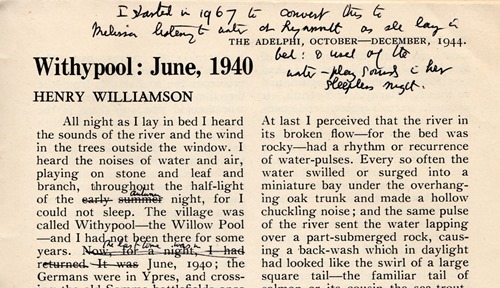
HW's note at the top of the page reads:
I started in 1967 to convert this to Melissa listening to water as she lay in bed: & used only the water-play sounds in her sleepless night.
In The Gale of the World this lovely passage describing the sounds of the river through the night is extended to a complete page (p. 292).
Also of interest: the same Dakers advertisement is on the back cover; while on the inside of the back cover is an advertisement for Faber books which gives an insight into farming and country books of the time. HW is well represented but A. G. Street takes the prize!

***************
Vol. 21, No. 3, April–June 1945:
HW, 'A Walk in Spring', pp. 130-34
A tale in the style of his early 'Village' books (nature-lyric): a walk on the North Devon coast (Baggy Point) with his fear of the cliff height – with village characters and behaviour regarding a donkey thrown down a well-shaft to get rid of it: moral.
On the back cover a full page advertisement for HW's The Sun in the Sands (Faber, March 1945):

***************
Vol. 21, No. 4, July–September 1945:
HW, 'Village Children of the 'Twenties', pp. 179-185
The familiar story of Ernie, son of Revvy Carter (HW's adjoining neighbour when he lived at Skirr Cottage, Georgeham in the early 1920s), and the 'sheep's nose' apples.
***************
Vol. 22, No. 1, October–December 1945:
HW, 'A Crown of Life', pp. 36-44
This is dedicated 'for Benjamin Britten': HW had become aware of Britten's music at this time and had approached him with an idea of writing the music for a proposed film of Tarka the Otter.
First printed in Nash's Magazine (December 1935), then the US magazine Atlantic Monthly in January 1936, and collected in Tales of Moorland & Estuary (Macdonald, 1953), this is a magnificent short story about Clibbit Klifft, again of the Georgeham era, gradually including his most faithful dog, Ship. Clibbit is imprisoned for a misdemeanour not his own fault, and later unhappily shoots himself. The dog grieves and disappears. The climax comes when the dying dog comes into the church during the Christmas Day service and creeps up to the communion rail, where the Rector blesses it:
'Be thou faithful unto death; and I will give thee a crown of life.’ . . . The sun shone through the eastern window, where Christ the Sower was radiant.
It is a very poignant story. (The bible quotation is from Revelations, Ch. 2, v. 10. Swinburne uses the phrase in his Dolores, 1866.)
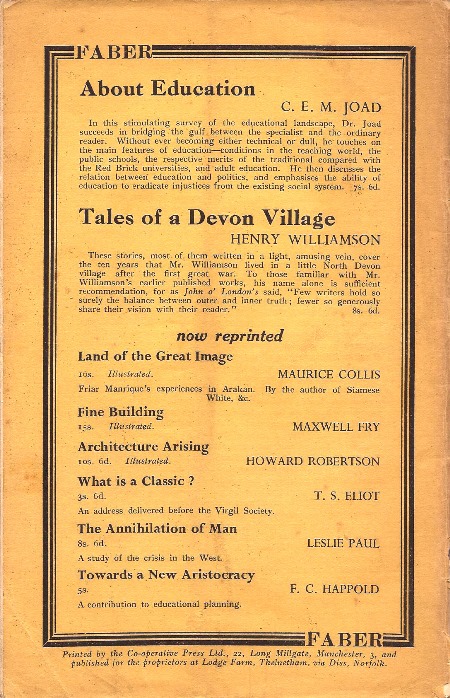
A Faber advertisement on the back cover includes Tales of a Devon Village (September 1945):
***************
Vol. 22, No. 2, January–March 1946:
HW, 'The Sun that Shines on the Dead', pp. 72-79
This article contains material from The Wet Flanders Plain (1928), recounting the visit HW made to the First World War battlefields when on his honeymoon in 1925, and a further visit in 1927.
***************
Vol. 22, No. 3, April–June 1946:
HW, 'The Sun that Shines on the Dead II', pp. 130-33
A continuation of the battlefields visit, ending rather hauntingly with words of Richard Jefferies:
What you seek is lost forever in ancient sunlight, which arises again as Truth.
This issue also has a story by James Farrar: 'Hayfield' (reprinted in Words on the West Wind). Flying Officer James Farrar, of 68 Night Fighter Squadron, was killed in action while acting as navigator of a Mosquito piloted by Fred Kemp on the night of 25/26 July 1944, when, on patrol over the Thames, they were ordered to intercept a V1 flying bomb. He was just a few weeks short of his 21st birthday.
***************
Vol. 22, No. 4, July–September 1946:
HW, 'Farming Story', pp. 186-88
An artist painting a peaceful pastoral scene on a farm is contrasted with the farmer at war with his work getting in the harvest. They each think the other is lucky and that their own work is harder than that of the other. It is a nicely-put and well-presented argument.
***************
Vol. 23, No. 1, October–December 1946:
It was this issue of The Adelphi that contained (from HW's viewpoint) James Farrar's all-important 'The Imagination to the Wraith', a short prose item addressed to the 'Wraith': Willie Maddison of the Flax of Dream novels – and thus HW himself.

HW does not give the date that this was written, but Christopher Palmer, in his Spring Returning: A Selection from the Works of James Farrar (1986), notes that it was 'Spring, Torquay, 1942.
One can imagine the shock HW must have felt on reading that: shock and then – what? – a profound emotion of empathy, of recognition of a like mind, a soul-mate? October 1946 saw HW at a very low ebb, as is shown in other entries in 'A Life's Work' covering this period (see particularly The Phasian Bird). War – death – loss – were foremost in his mind as he struggled to come to terms with the situation in the world and in his personal life. Unfortunately there is no copy of this particular issue in HW's archive, as there is no doubt that he would have written some comments in situ. It was sent to young Sue Connolly (Malcolm Elwin’s step-daughter, with whom at the time HW was enamoured).
However, the effect of Farrar's work on HW can be seen by the comments he wrote in his copy of the next issue of The Adelphi, which contained Farrar's essay 'Pale Blue Windows'. The realisation that someone had read his work and believed in him as a writer gave him back his faith in himself as a writer.
***************
Vol. 23, No. 2, January–March 1947:
HW, 'From A Wartime Norfolk Journal: Easter 1944', pp. 96-7 (reprinted in HWSJ 36, September 2000)
This powerful piece of writing is an important example of HW's thinking as he uses 'Easter' and its symbolism as a metaphor for the current situation: countries at war. It is essential reading for anyone wishing to understand HW's thinking.
This issue includes the essay by James Farrar, 'Pale Blue Windows'.
HW's file copy has a note on the front cover:

He also wrote at the head of the article by James Farrar:

It reads:
"When I died, I brought back the angels to you, dear Henry Williamson" says James Farrar. The calmness in my writing, the sense of eternity, came with this poet's death.
H.W. July 1947, in the hut.
***************
Vol. 23, No. 3, No. 4, and Vol. 24, No. 1 all contain poems by James Farrar.
***************
Vol. 24, No. 2, January–March, 1948:
HW, 'From 'A Chronicle Writ in Darkness', pp. 101-108
This is an extract from the journal that HW kept that he intended to be the sequel to The Story of a Norfolk Farm (1941), and which eventually became Lucifer before Sunrise (Vol. 14 of A Chronicle of Ancient Sunlight).
This extract covers Christmas 1941, the family and life on the farm at that time. It contains an important passage about his thoughts on Tolstoy's War and Peace. Altogether this is an important essay giving an insight into HW's thoughts. However, the article caused a rift between HW and Murry together with the then sub-editor J. P. Hogan. HW kept altering his article, to the point of holding up production of the issue, to the total exasperation of the Adelphi pair. Murry wrote a strong letter 'in sorrow and anger', complaining that HW knew very well how difficult things were with the magazine and how important it was to get it out before Christmas (see HWSJ 35, September 1999, p. 57). But he also says that he hopes this criticism will not make any difference to their valued friendship – and it did not.
This issue also includes a long and objective review of Oswald Mosley's The Alternative by J. M. Murry, Murry himself being a great thinker and a pacifist. It is an excellent analysis of this (to most people) controversial book.
***************
Vol. 24, No. 3, April–June 1948:
HW sent a copy of Murry's review of Mosley's book (as above) to Mosley himself, and here, (having gained his permission) introduces Mosley's letter of reply to himself, printed under the heading: ‘Mosley on Style’. Mosley seemed to think Murry had criticised his 'style' and defends himself. That seems a little churlish in view of Murry's very fair review – in which any such criticism is not apparent. It would however be a just criticism, for The Alternative is so obtuse in style that it is very difficult to read!
***************
Vol. 24, No. 4, July–September 1948:
The following must have been quite a bombshell to Murry's faithful subscribers:

HW, 'Birth of the Phasian Bird', pp 199-205 (reprinted in Words on the West Wind)
This is an extract from The Phasian Bird (Faber, November 1948) – soon to be published; but curiously the book itself is given no mention.
This issue also contains a poem by the West Country poet Charles Causley (as indeed do several past issues). Causley, whose superb work has never really received the recognition it deserves, was a friend of HW. Causley was made a CBE in 1986 and a Royal Society of Literature Companion of Literature in 2000. He died in 2003. There is a Charles Causley Trust, whose purpose is to keep alive his memory and promote writing in the community and region in which he lived.
***************
HW as owner and editor of The Adelphi, 1948‒9:
This 'bombshell' came about thus: HW had made a visit to London from 30 April to 4 May 1948 and, probably while delivering his article for this next issue of The Adelphi, he learned from J. P. Hogan that Murry was giving up the magazine. There is nothing whatsoever recorded in his archive about this, but evidently HW made an offer to take on the magazine himself. F. A. Lea, in Life of John Middleton Murry, merely states that Murry gave the magazine away – but frustratingly gives no further details!
Ann Thomas noted in HW's diary, Wednesday, 5 May (the day after HW's return) that:
HW acquires the ADELPHI by phone.
Presumably that was with Murry himself. The same day she approached the Chronicle Press in Ilfracombe (then printing A Braunton Guide, to which HW had contributed 2 articles, 'The Burrows 1938' and 'Baggy Hole, Revisited in 1945'), asking if they could print and supply paper for 5,000–10,000 copies of a quarterly magazine – the title is not mentioned.
There were then approaches to various publishers over the next few days to get quotations for printing the magazine: Macdonald, Dick de la Mare at Faber, and finally Stevens in Malvern, who were actually given the job. HW stated at some later point that he took over The Adelphi in order to give Ann a job that would make her independent. I think it has to be presumed that at this time they were not actually getting on very well. HW had written a 'despairing' letter to Murry the previous month which may have been about this (Murry's answer was very supportive: 'Dear man, I am perfectly certain that it can't be as bad as you imagine . . .’), and HW may have seen this as a solution to the problem. Ann could return to her own cottage near Malvern, and run the magazine from there, leaving him free.
HW probably did not realise just how difficult and involved such a project would be. There was an enormous amount of work involved, and although Ann did all the basic work, the overall responsibility still lay with HW. Apart from the actual physical properties of paper and printing, there was a big need to collect paid advertisements, which would contribute greatly with the running costs. There are several notes of HW visits to London to solicit these. As important, articles also had to be sought – and edited.
There is no note of when Ann returned to Malvern, but her notes in HW's diary cease in the middle of July: there is little mention of her after that. The reason for this is that it is now that HW met Christine Duffield, who called in at the Field while on a walking tour with her brother, presumably at the beginning of the school summer holidays – so, at the end of July. (Christine was either already teaching at a school in nearby Croyde, or was to start there that September.) The result: another headlong falling in love – and, quite quickly, marriage. Ann Thomas (then approaching 40, while their daughter was aged 15) was totally ousted. She continued to work on The Adelphi during the short time that HW remained its owner and editor, but it was a very bitter blow, for she had presumed that if HW remarried, it would be to herself.
***************
Vol. 25, No. 1, October–December 1948:

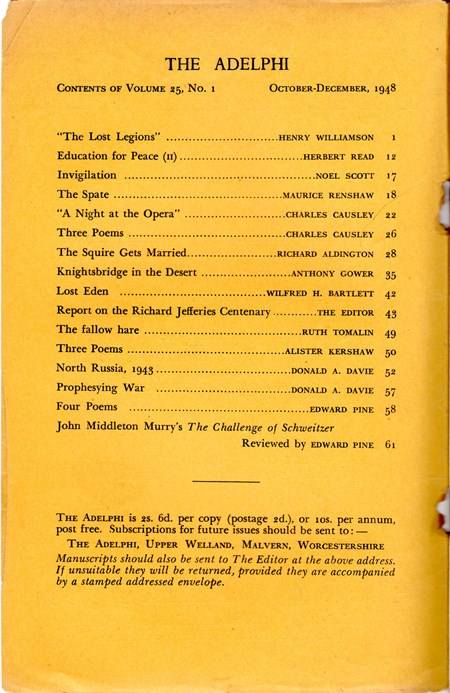
HW launched his first Editorial: “The Lost Legions” (reprinted in Words on the West Wind)
He explains that the title came from an essay by John Middleton Murry that he had read in The Athenaeum in the winter of 1919–20, when he had just been demobilised from the army after the First World War. It was a graceful gesture. But the point he is really making is that the essay refers to: 'The great book that will be written' to honour those who died in that war: meaning, a book to equal Tolstoy's War and Peace – which HW hopes and believes is what he will do: and, in due course, with his A Chronicle of Ancient Sunlight, did indeed achieve.
Here he pays, over several pages, honour and homage to James Farrar, incorporating some of the young dead airman's poems and essay extracts. Having discovered Farrar through the previous issues of The Adelphi, HW had written to the airman's mother and she had sent him all the work of her dead son. In due course he was to edit and publish all Farrar's work as The Unreturning Spring (Williams and Norgate,1950).
This issue also contains HW's very interesting 'Report on the Richard Jefferies Centenary' (July 1948) (reprinted in Words on the West Wind), which gave a prominence to a quite important literary occasion otherwise only reported locally (see HWSJ 41, September 2005).
It will be noted from the Contents that HW had mainly called on writers whom he knew for contributions:
Herbert Read's 'Education for Peace II' being a continuation of Part I in the previous issue. (Sir) Herbert Read (1893–1968), critic, poet, man of letters, served in the First World War and then became an Assistant Keeper at the V & A Museum, with an impressive list of published books. His thoughts here draw on Plato, Rousseau, and Tolstoy: all such ideas as HW himself thought to follow.
Maurice Renshaw (son of Sir Stephen Renshaw and brother of Margot/'Melissa') was a good friend, who had similar ideas and life-style to Middleton Murry, but in a smaller way.
Charles Causley has an amusing and charming essay and three poems.
HW had also persuaded his new friend Richard Aldington (best known for his Death of a Hero) to provide a piece from his new book, a biography of the eccentric naturalist Charles Waterton.
Anthony Gower, another friend (reviewer) also contributed.
Ruth Tomalin (who later became part of HW's life) has a poem, 'The fallow hare'.
Alister Kershaw (the Australian poet who came to Europe in search of HW, Aldington, and Roy Campbell – and never returned, becoming Aldington's amanuensis) has three poems.
Edward Pine, ex-RAF Intelligence, has four poems. Eddie Pine, a classicist, was a teacher of HW's son John at Westminster Choir School before the Second World War. At the time these poems were published he was teaching HW's youngest son Richard at St Michael's Choir School, Tenbury. Eddie also reviews J. M. Murry's The Challenge of Schweitzer.
Publishers’ advertisements include support from Faber on the back cover:

Note the book by Richard Perry at the foot of the advertisment – he had worked briefly on the Norfolk farm (see the consideration of Book Two of Lucifer before Sunrise, where he is named 'The Inquiline' – yet another time-waster): one wonders what HW's thoughts would have been!
There were also advertisements placed by Putnam (including their new edition of 'The Nature Books', HW's early nature books); and Andrew Dakers.
***************
Vol. 25, No. 2, January–March 1949:
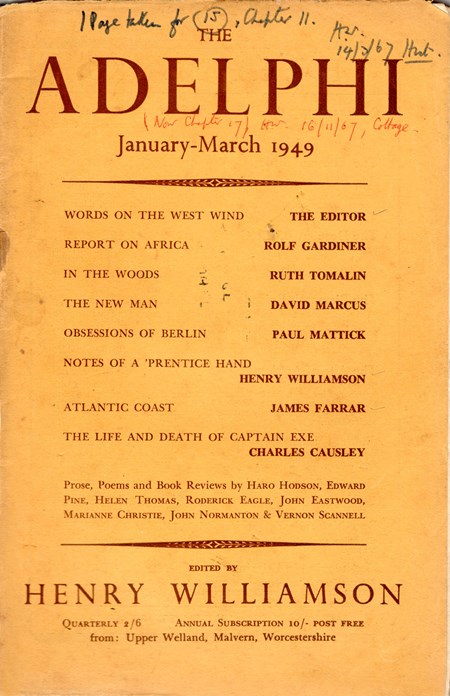
HW now began the first of his editorial essays 'Words on the West Wind' (all of which are reprinted in the collection Words on the West Wind), in which he relates, in easy and charming prose, the story of his sons camping in the Field at Ox's Cross, and how they imitate an owl to call another, and then ending this fun with a cuckoo call: all quite hilarious! It is all typical HW writing, wandering from one subject to another, letting his reader share his world. This ends with a selection of books he has been sent for review.
The issue also includes his 'Notes of a 'Prentice Hand' (reprinted in Words on the West Wind), an autobiographical piece on his early writing days. It is a passage from this essay that the cover MS note refers to, for use in The Gale of the World:
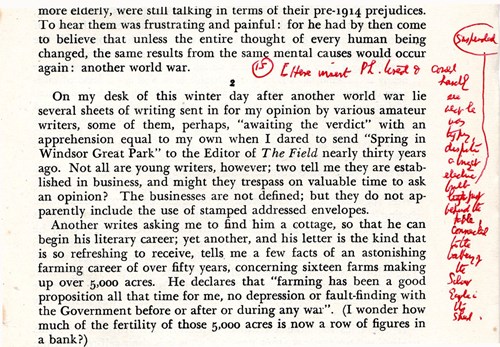
HW's red ink note reads:
15 [Here insert Ph[illip] tired & could hardly see what he was typing despite a bright electric bulb suspended just behind the table, connected to the battery of the Silver Eagle in its shed.'
(This passage in number 15 – the last volume of the Chronicle, The Gale of the World – eventually becomes:
But sleep was broken by perilous thoughts, so he got up; and having connected a long lead from the car battery to a 12-volt bulb suspended from the ceiling, began to scribble rapidly. [p. 169]
And it continues, as Phillip writes:
If there be any young writer, survivor of the Second World War, who aspires to write a War and Peace for this age, to him I send my thoughts this frozen January night.)
There is an important section in 'Notes of a 'Prentice Hand' on what was to be his answer to War and Peace. There is also another essay by James Farrar, 'Atlantic coast' (reprinted in Words on the West Wind).
***************
Vol. 25, No. 2, April–June 1949:
('No. 2' is an error – this was actually No. 3)

Note HW's note: the value seems a little exaggerated!
The contents page has pencilled MS notes indicating the payment made to contributors:

HW's 'Editorial' continues 'Words on the West Wind' and his chatty book reviews – which include Adventure Lit Their Star, Kenneth Allsop's book on the little ringed plover. Allsop, who first met HW in 1935 as a young lad, became a well-known national broadcasting personality in due course. The two men remained friends until Allsop took his own life in 1973, although the relationship was not without some stormy problems.
HW, 'A Note on Tarka the Otter' (reprinted in Words on the West Wind)
This gives 'The Original Ending' to the book.
The item is followed by a poem by Ruth Tomalin, 'Otters Passing'.
***************
Then, as abruptly as he had taken on the magazine and with equally as little background information, HW passed it on to George Godwin (about whom there is no information). But again one can deduce the reasons here.
HW had married Christine Duffield in April 1949 (postponed from January), and they then went on an extended honeymoon visit, mainly staying with Richard Aldington on the south coast of France. This made even a work relationship with Ann Thomas totally untenable. (Ann went on to become a teacher and, after the death of her mother Helen, carried the torch for her father, Edward Thomas, another very troubled man.) Also the work involved on the magazine, even with Ann bearing the basic workload, was considerable – and HW had now embarked (at long last) on the Chronicle of Ancient Sunlight series. He needed all his attention and stamina for that mammoth work, particularly as its birth was attendant with several difficulties, not the least of which was an irrevocable split from his long-standing friend and publisher Richard de la Mare.
Middleton Murry was understandably upset by this abrupt disposal without any consultation with him, for he had entrusted the magazine to HW thinking it would be continued in the same spirit that he had nurtured for those previous twenty-five years. But the magnanimous Murry did not allow this to mar his critical appreciation of the Chronicle in due course. Despite increasing illness, he wrote two long essays of appreciation of HW's work, published posthumously. He died in 1957. (See The Aylesford Review, Vol. 11, No. 2, Winter 1957‒8: 'The Novels of Henry Williamson'; and his longer essay with the same title in Katherine Mansfield and Other Literary Studies, Foreword by T. S. Eliot, Constable, 1959. This latter essay is now available as an e-book, The Novels of Henry Williamson, HWS, 2013.)
***************
Subsequent history of The Adelphi:
Vol. 25, No. 4, July–September 1949:
(Editor, George Godwin)

HW, 'Words on the West Wind' (continued): This episode relates the 1949 honeymoon trip to France noted above.
The issue also contains:
Charles Causley, 'Man into Fox: A note on Henry Williamson as a nature writer', pp. 279-82 (reprinted Words on the West Wind):
. . . no-one, in the history of letters, has written of the English countryside: its sky, its sun, its flowers, its animals (I include the two-legged ones) like this amazing man. . . .
Williamson is a great writer, and more universal, than Richard Jefferies. His prose has the crystal quality, the calm, that one associates with the best of John Clare . . . Williamson sees the world . . . with a child's clear eye.
Ann Thomas has a review section: 'Country Bookshelf'.
The Editor has two articles, notably 'Man on Earth' – and one can sense already a change of tone in the overall content.
***************
Vol. 26, No. 1, Autumn 1949: Autumn Book Number 1949:
HW is still fronting the magazine with the next instalment of 'Words on the West Wind', opening:
The holiday in France could have been a wonderful, had it not been for that damned motorcar. . . .
(This is the 2-litre Aston Martin, bought in Botesdale in 1946, and a constant source of problems! HW's son Richard Williamson gives a brief background to the car as a postscript contained in Words on the West Wind, ‘That Damned Motorcar’.)
There is also a review by HW: Faust, by Von Goethe, translated by Bayard Taylor (Euphorion Books, 12s. 6d.) (reprinted in HWSJ 42, September 2006, p. 37.) This is important with regard to HW's thinking about Goethe, and links to his thought process in general, as explored in AW, 'A Dual Heritage', HWSJ 42, September 2006, pp 5-34.
An advertisement for the book appears on p. 114, and George Godwin, in 'The Common Reader' (pp. 80-7), examines, among others, Albert Schweitzer's address on Goethe at the Frankfurt-am-Maine celebrations, and reproduces a passage from this address on p. 71. All three items were also reprinted in HWSJ 42, September 2006.
I commented in that journal:
There seems to be a pre-destined connection between this upsurge of interest in Goethe (due to the bicentenary anniversary) at the time HW set out on his own odyssey to reflect truly the various aspects of the modern age: A Chronicle of Ancient Sunlight.
George Godwin continued his 'Man on Earth', and started a further long philosophical 'essay': 'The Lake of Memory: A Novel in four Books: (I) The Sacred Ship', pp. 22-63.
***************
Vol. 26, No. 2, January–March 1950:
HW, 'Words on the West Wind' still fronts the magazine. This section, 'Crossing the Alps' ‒ in the Aston Martin ‒ is quite hair-raising! They were en route to see his Italian publisher, Bompiani, in Milan. It ends: (CONCLUDED):

A Faber full-page advertisement, opposite the opening page and HW's essay, includes HW's Scribbling Lark (1949):

Much of the rest of the magazine, some 50+ pages, contains the second part of Godwin's 'The Lake of Memory'. This is followed by 'Book Reviews', including Ann Thomas’s column, 'Country Bookshelf'.
***************
That is the last issue in HW's archive, but the magazine, as stated by The Cambridge Guide to Literature, continued until 1955.
**************************
The Phasian Bird - Critical reception
Back to The Phasian Bird main page
Appendix I: Henry Williamson's notes for the writing of The Phasian Bird
Appendix II: The American edition
Critical reception:
Current Literature, 5 November 1948:

Eastern Daily Press ('Jonathan Mardle'), 10 November 1948 (a long review, only a photocopy exists in the archive):
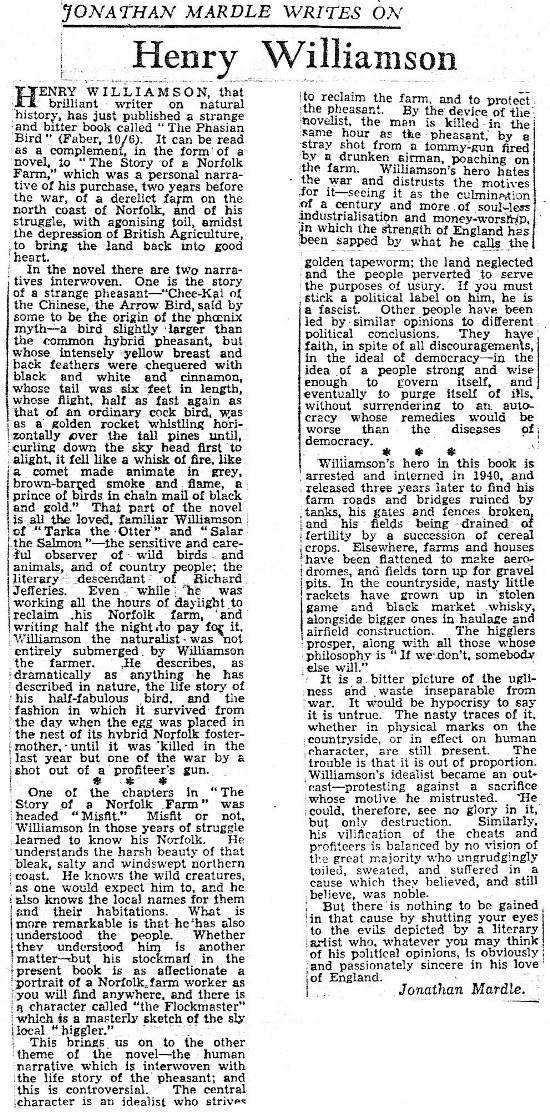
This gave rise to a letter:
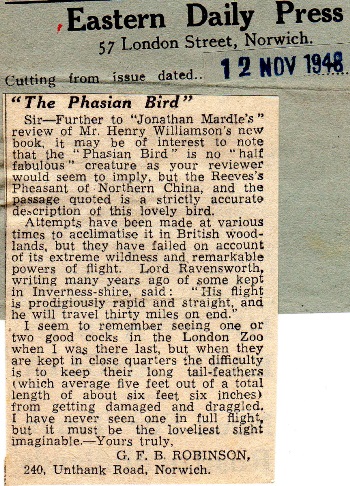
Daily Telegraph, 12 November 1948:
It is as well that Henry Williamson can write with affection and interest about animals: human beings disillusion him to the point of anger. “THE PHASIAN BIRD” is the story of a Norfolk farm during and just before the war. A hybrid golden pheasant is reared by a man who farms by old-fashioned methods, and commits suicide. It becomes a symbol to his successor, who adopts new methods only to be deviated by a neurosis and eventually murdered, his death coinciding with that of the beloved bird. It is an unusual study in natural history and psychology, full of bitterness against this urban civilisation – an extraordinary story, told with subtlety and style.
Evening Chronicle, 13 November 1948:
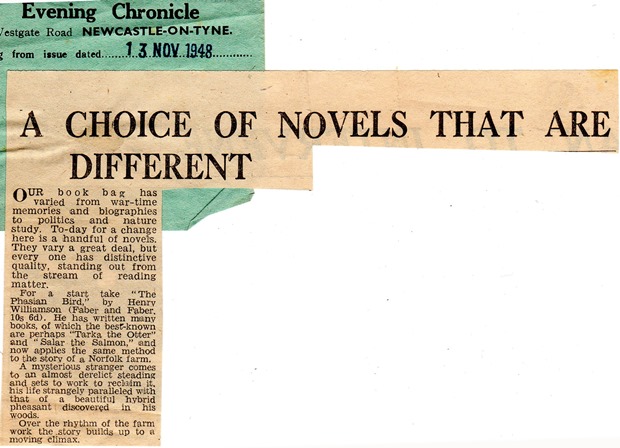
Reynolds News (Arthur Calder Marshall), 14 November 1948:
At the mention of “Tarka the Otter” and “Salar the Salmon” Henry Williamson's face does not light up with pleasure. Famous as a nature writer, he prides himself on his human stories, such as the Flax of Dream series. In THE PHASIAN BIRD he makes the best of both worlds. He tells the story of the last ten years from the point of view of a hybrid pheasant. I cannot say how true to wild life Chee-kai, this startling and lovely bird, may be. But I accept Mr. Williamson's presentation, because it is both beautiful and precise.
Farmer and Stock Breeder (B. T. Darby), 16 November 1948:
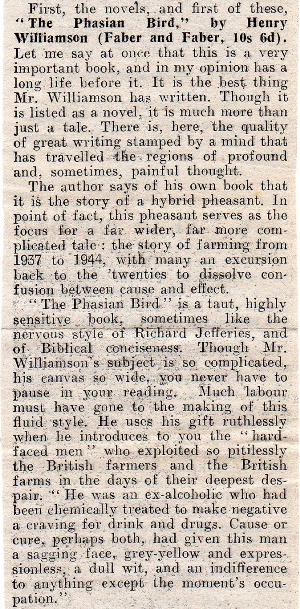
Manchester Evening News (Julian Symons), 17 November 1948:
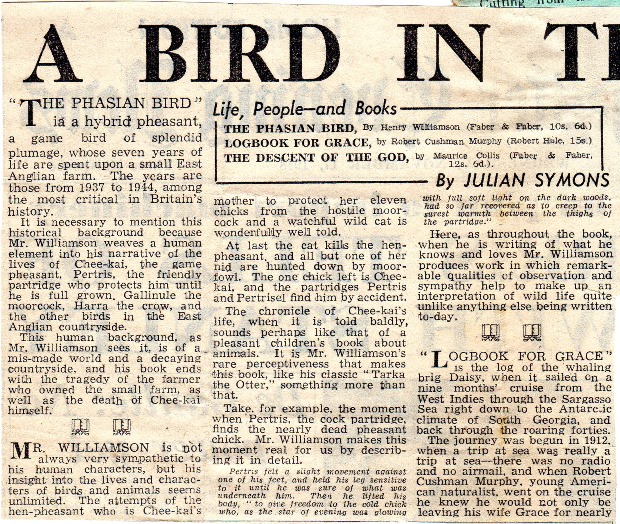
The Sunday Times (J. W. Lambert), 21 November 1948:
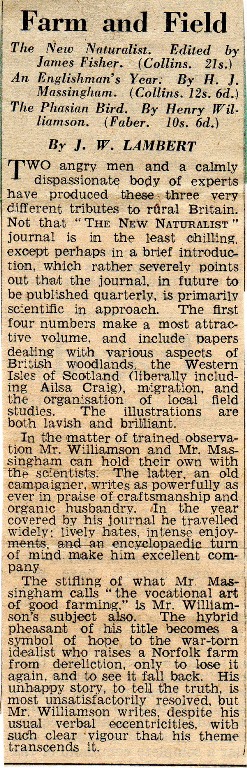
Tatler, 24 November 1948 (the item covers more than just the book, but is, sadly, unattributed):
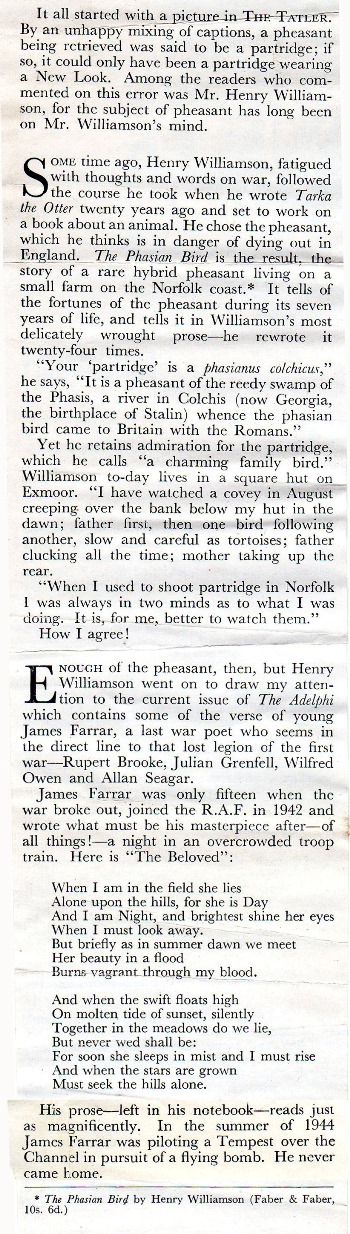
Isis (A. Felix Waley), 24 November 1948:

News Review, 25 November 1948:

Daily Mail (Peter Quennell), 27 November 1948 (after reviewing at length Concluding, by Henry Green, Quennell turns to The Phasian Bird):
For more conservative tastes there is The Phasian Bird. Provided you can stomach the literary convention by which wild animals bear romantic names – though in this instance they are not credited with almost animal thoughts and feelings – you will enjoy Henry Williamson's pheasants, partridges, geese and hares and gamecocks. For he has an enviable descriptive gift, and writes of English fields and woodlands with the sober passion of a working farmer.
Irish Independent, 29 November 1948 (photocopy only in archive):

The Scotsman, 9 December 1948:
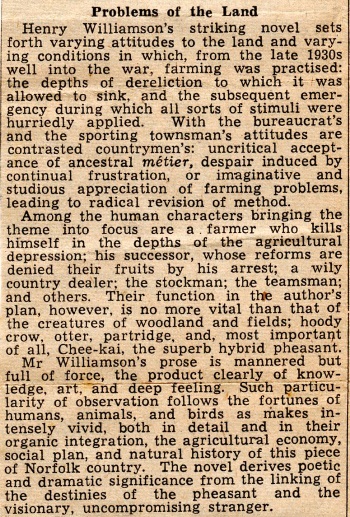
Evening Standard (George Malcolm Thomson), 1 December 1948:
Mr. Williamson, as most people know, brings to the nature novel a rich vocabulary and a fine imagination. In The Phasian Bird, his birds and animals are, in fact, more interesting than his humans.
The life, struggles and death of the Phasian bird (a superb hybrid pheasant) enthrall the reader and become for Wilbo, a politically muddled farmer, a symbol of hope which he carries with him when he is imprisoned during the war as a suspected enemy of his country.
The Listener (George D. Painter), 16 December 1948 (note HW's markings here: this long review was almost certainly the first contact between these two men. HW turned to Painter for advice when he began to write – very soon after this – the first novel of his Chronicle of Ancient Sunlight series. Painter worked in the manuscript department of the British Museum, and championed HW's work. He was the author of several prestigious biographies, including those of Marcel Proust and Chateaubriand.):

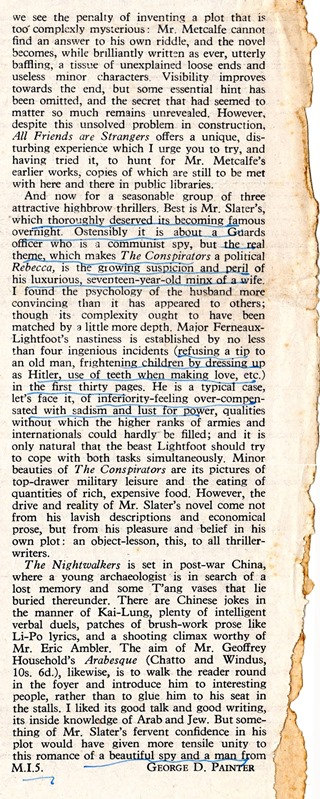
Punch, 29 December 1948:
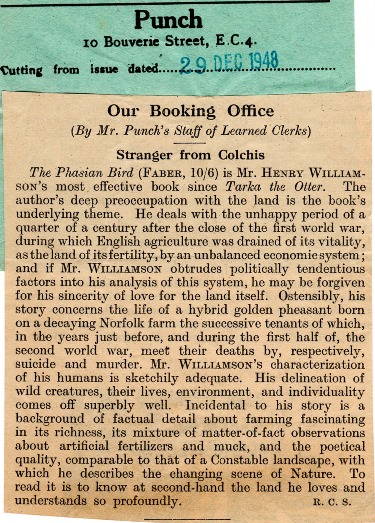
Source not named (lost) (S. P. B. Mais); photocopy only in archive:

The Times Literary Supplement, 1 January 1949:
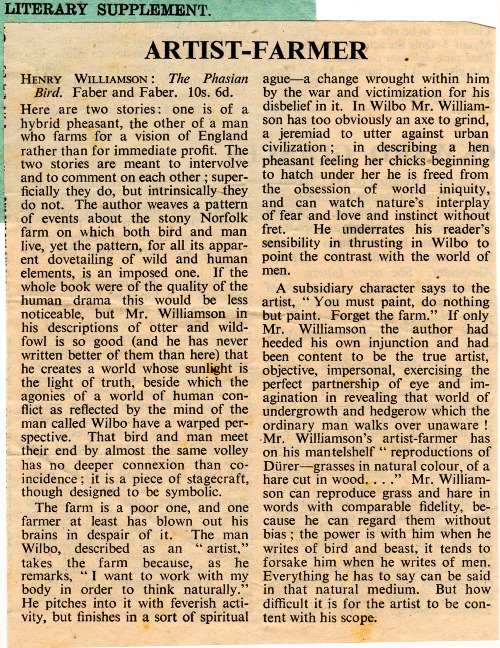
Sphere, 15 January 1949:
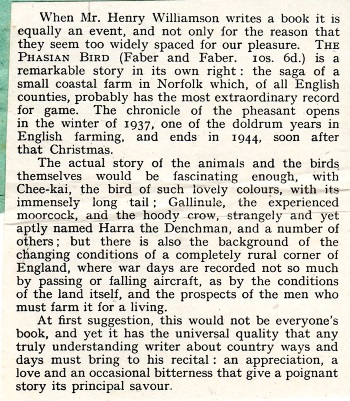
*************************
Readers should also consult Prof. W. J. Keith, The Rural Tradition: A Study of the Non-fiction Prose Writers of the English Countryside (University of Toronto Press, 1975), chapter 11, ‘Henry Williamson’ (this was reprinted in HWSJ 31, September 1995, pp. 90-101). Prof. Keith, as HW also, had been a President of the Richard Jefferies Society before leaving to take up a post in Toronto University. At the time of the reprint of his HW essay in the HWSJ he asked that it be pointed out that his essay had been written long before any biographical information about HW was available and therefore the occasional 'fact' is inaccurate – but that does not detract from his overall views. He writes of The Phasian Bird:
A book which, despite its title, is better interpreted as a modern parable than as an animal story. . . . The story of the golden pheasant, a symbol, like Lawrence's phoenix, of hope in a new world to be born out of the ashes of the past and to recreate the best features of that past – is counterpointed by the story of Wilbo, another of Williamson's masks, upon whose land the Phasian bird finds shelter. . . .
But the death of the symbolic bird, apparently without issue, represents a darker ending, and one which is emphasised by the impressive descriptions of a ruined countryside against which the closing events take place.
*************************
American edition: Little Brown & Company (The Atlantic Monthly Press), October 1950
Source not named (W. G. Rogers); photocopy only in archive:

Saturday Review of Literature, 28 October 1950 (with error in title):

New York Times, 15 October 1950:
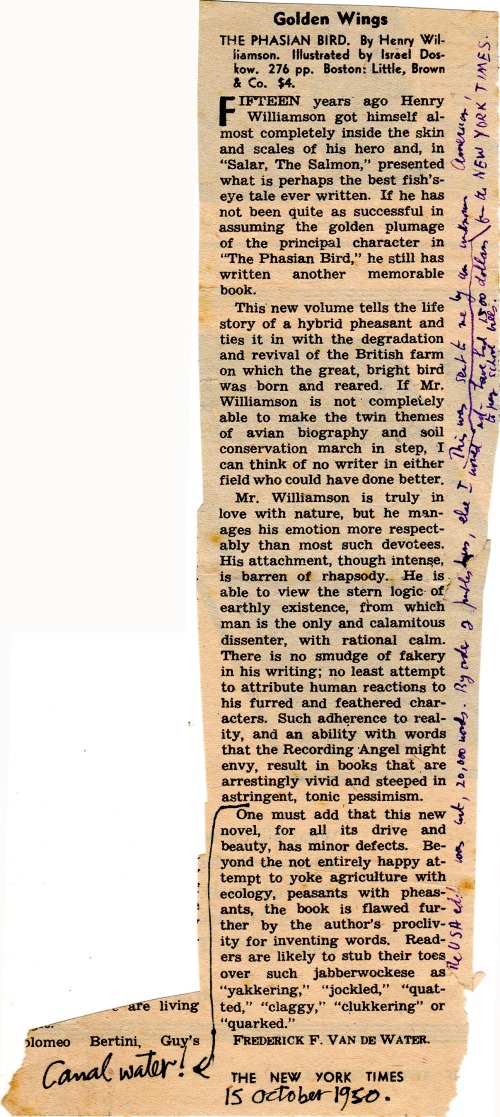
HW's note reads: 'This was sent to me by an unknown American from the NEW YORK TIMES. The USA edition was cut, 20,000 words. By order of publishers, else I would not have had 1500 dollars to pay school bills.’
Christian Science Monitor, 4 November 1950:
Chicago Tribune, 5 November 1950:

Washington Post, 24 December 1950:
New York Herald Tribune, date not known (the end of the heading and the last two columns have been torn off, and follow after this scan:
*************************
The following item gives an interesting insight into how HW's writing was perceived by one critic. Anthony Gower reviewed several of the Chronicle volumes.
Books and Bookmen (Anthony Gower), October 1963:
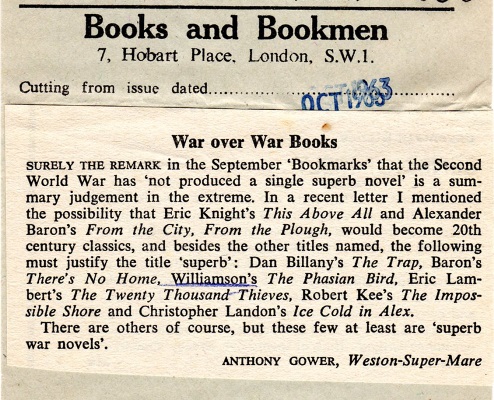
*************************
First edition, Faber, 1948:

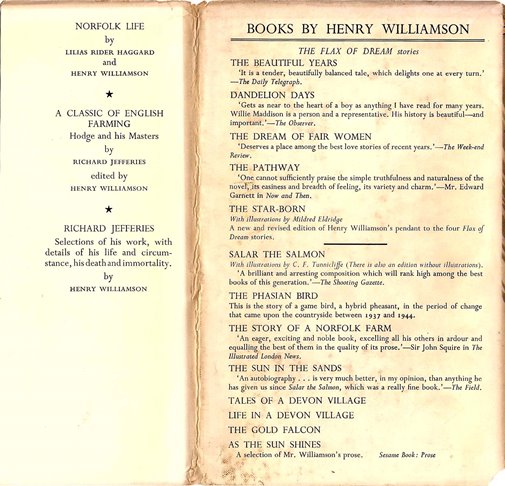
Little Brown and Company (Boston, US), An Atlantic Monthly Press Book, new edition,1950:

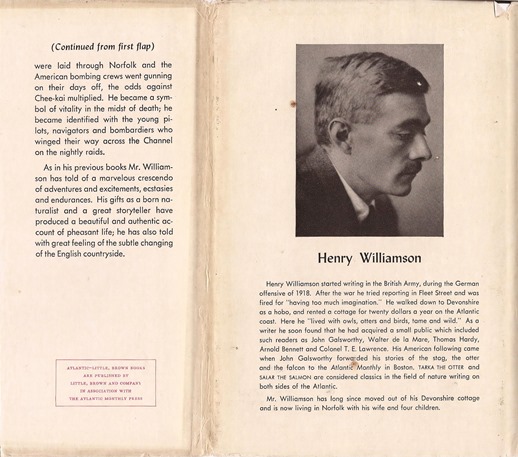
The Boydell Press, County Library Series,1984. Very unfortunately the cover illustration is NOT of a Reeves' pheasant but of an ordinary game pheasant (The HW Literary Estate were not consulted on the matter and were rather horrified at such cupidity!):

*************************
Back to The Phasian Bird main page
Appendix I: Henry Williamson's notes for the writing of The Phasian Bird
Appendix II: The American edition
The Phasian Bird - Appendix II
Back to The Phasian Bird main page
Critical reception and book covers
Appendix I: Henry Williamson's notes for the writing of The Phasian Bird
Appendix II:
The American edition of The Phasian Bird
 |
|
The American edition was published by Little, Brown and Company (Boston) in October 1950 as ‘An Atlantic Monthly Press Book’, at $4.00. The text was considerably revised, giving a very different aspect to the book, as is shown in a 'revision' file copy of the book. The dust wrapper painting by Mildred Eldridge was retained within a black frame (reduced in size, but shown in its entirety), and the book additionally contained attractive line illustrations by Israel Doskow as chapter-heading vignettes.
The title page quotation in the UK edition, 'The letter killeth . . .' was deleted, and this edition instead carries a 'Dedication'. HW's note for the dedication is written in his file copy of the UK edition:
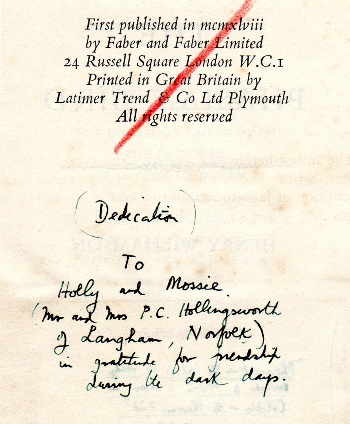
The dedication as it was published:
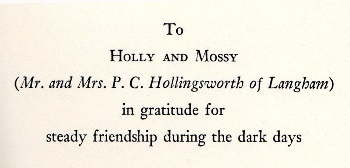
HW further revised this, perhaps for some future edition:

Major and Mrs P. C. Hollingsworth – Holly and Mossy – were good friends of HW during the Norfolk Farm era, where they had a fruit farm nearby. However they are not mentioned anywhere within his personal papers until, when writing this book, he notes that he visited them two or three times. Although no further details are given, presumably HW was checking details for the book.
This American edition also has a definition of the word 'Pheasant' – probably to act as an explanation of the word 'Phasian' in the title.
This is the note pasted into HW's file copy of the UK edition in preparation for the US edition:
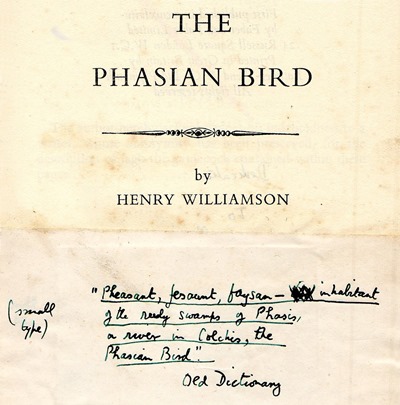
And as it was published, on a page to itself:
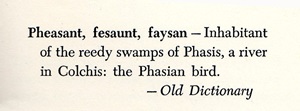
When HW received a copy of the finished book, sent to him at Christmas 1950 by the publisher, he was much distressed to find that a short passage – a line – been omitted within the vital climax, as this note he wrote in the copy shows:

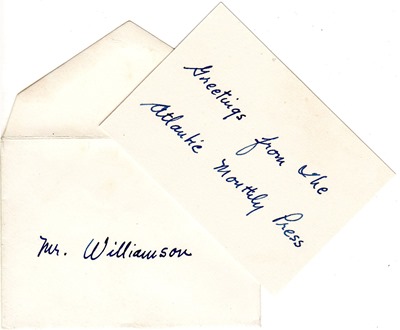
He corrected the penultimate page of the book accordingly:
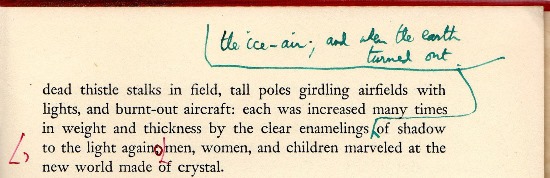
It can be deduced from his note that HW had realised that these words were missing at a very late stage, and certainly after the final proofs had been returned to the publisher. He must have written post haste with the correction . . . but too late, the book had already gone to print.
*************************
The American editor concerned with the book was Edward Weeks of The Atlantic Monthly, well-known to HW from his earlier contributions to the magazine, and it would seem from one or two small clues that he asked for (that is, demanded) these revisions. There was a long gap between the time when HW first sent typescript copies of the text and the book’s eventual appearance. Correspondence about this is not present in the archive, other than one letter post-publication concerning royalties.
(HW's writings for, and the background to his involvement with, the Atlantic Monthly can be found in Atlantic Tales, ed. John Gregory, with explanatory afterword 'Both Sides of the Water' by AW, HWS, 2007; e-book 2013.)
Matthews (Henry Williamson: A Bibliography, 2004) has analysed the alterations very succinctly:
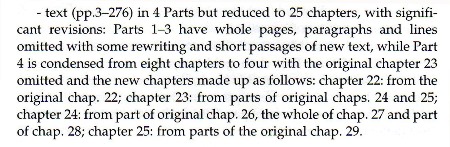
While this is useful, it does not really clarify the matter sufficiently for the researcher or reader. It is what HW deleted and changed that matters – and the end result, while basically remaining the same story, is a very different book to the first (UK) edition. Mainly, as will be seen, all references to Wilbo's imprisonment are removed and the farm is given its actual 'A' status, instead of being run-down due to Wilbo's enforced absence.
Apart from the original manuscript notebooks, typescripts and galleys already held at Exeter University, in the archive there is a file copy of the book that HW used to mark up these various revisions, including the changes in the preliminary pages already mentioned above. This gives a most interesting insight into how the author set about the task of editing and changing his own work.
The pagination is different from the start: the UK edition text begins at page 11, the US edition on p. 3. The first correction is in the first line: altering 'western' to 'eastern', probably due to an original misreading of the author's handwriting. But that hardly seems a major problem!
PART ONE:
Correction, or revision, is minimal, mostly one-word elisions or additions, or small changes such as a comma to a semi-colon. On UK p. 15 (US p. 7), where 'the village dealer' is mentioned, the name 'Flock' is added and the last phrase of the sentence removed.
In Chapter 3, three lines about the First World War are deleted (UK p. 33; US p. 25) and a similar reference in Chapter 7 also (UK p. 81; US p. 73).
PART TWO:
Chapter 8, two phrases regarding 'sweated labour' and 'to the detriment of'' etc. deleted, (UK p. 89; US p. 79).
Chapter 11 (UK p. 119; US p. 109): a sentence inserted in place of elision marks:

Chapter 12 (UK p. 124; US p. 114): a paragraph to be inserted half way down page. This is typed in brown on a page from a small notebook and pasted in at this point in the file copy.
(para) When the guns had moved away to the first stand, the newcomer, who had been watching from behind a tree on the hillside, walked down to where the stockman was standing. He picked up the broken boxes, and saying, “We'll want every bit of stuff that will rot down for compost”, went to the bullock yard and trod them into the dung.
“H'm” said the stockman.
(One line space)
(UK p. 129; US p. 119) last two lines of the top paragraph deleted.
PART THREE:
Chapter 16, UK p. 167 half way down, and top paragraph on p. 168 deleted from US. The section concerns the locals' suspicion of Wilbo's behaviour, especially the aggrieved moneylender:
“Who was the foreigner trying to suck in by such squit?”
('Squit' is a much used word in Norfolk!)
UK p. 171: at top, paragraph about British tobacco and Post Office Savings habits of the Stockman deleted (presumably meaningless to US readers).
UK p. 172; US p. 158/9: Paragraph inserted about how the Flockmaster got his name. Then UK pp. 174-5 and top 176 – all to do with the Flockmaster – deleted (US p. 160).
UK p. 178, bottom 6 lines and top 179 – deleted.
At Chapter 18 (UK p. 188 onwards) 'the driver' and 'the farmer' are replaced with the name 'Wilbo' from then on: removing an irritation present for the reader of the UK edition. 'Harcourt' (a neighbouring farmer) is also given his name at this early stage.
UK p. 189; US p. 173: a nice phrase inserted:
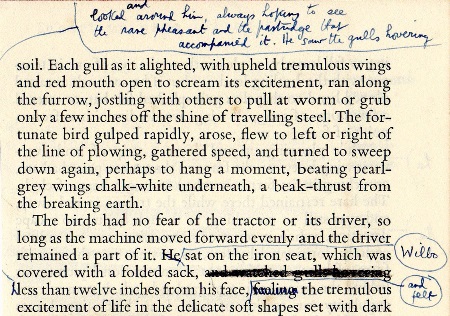
UK p. 190-1; US p. 175: para deleted and new words inserted:
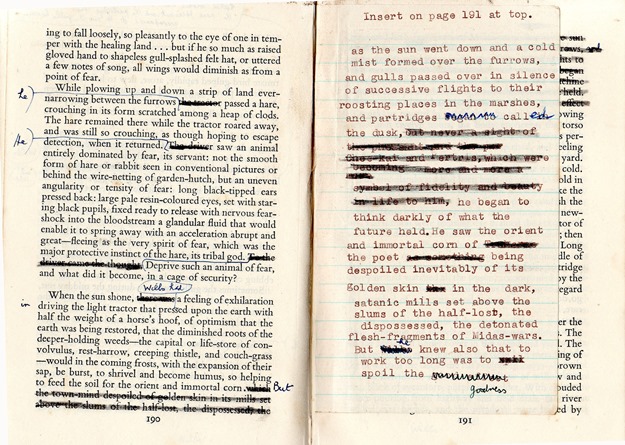
Note the phrase 'the orient and immortal corn': HW wrote an article for the London Evening Standard with the title ‘Immortal Corn’ (26 April 1939) and uses this quotation; the material was later used in Lucifer before Sunrise. He misquotes Thomas Traherne (1636?‒1674) as writing ‘the wheat was orient and immortal corn’; Traherne’s Centuries of Meditations actually reads: ‘The corn was orient and immortal wheat . . .’ The Evening Standard articles written between 1939 and 1941 were collected in Heart of England (ed. John Gregory, HWS 2003, e-book 2013).
Chapter 20 (UK p. 211; US p. 194): another deletion and replacement, removing: 'For now that war had come, the new farmer was the subject of much talk and suspicious regard in the locality.' And the following paragraph; this was replaced with:
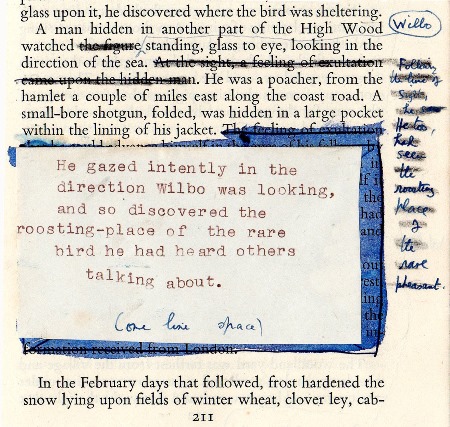
However, the US edition file copy has its own short addition marked in red ink MS, showing that HW planned to put back some indication of the suspicion Wilbo was held in in any future edition.
UK pp. 218-9; US p. 200: further small deletions / additions, mainly clarifying text – all fairly typical of HW's continual honing of his work.
But now begins the real change to the book: Wilbo is NOT arrested or imprisoned.
UK pp. 223-4, top of 225: text concerning arrest of Wilbo – deleted. US p. 205 continues straight on with 'The Pightle' text. ('Pightle' is a Norfolk dialect word for small area of land – probably derived from 'parcel of land'.)
From now on all references to Wilbo's imprisonment are deleted and text adjustments made to cover this. An example is UK p. 227:

The US edition (US p. 207) has 'She forgot to close the gate behind her' added – so allowing the turkeys to escape! The text from halfway down UK p. 231 to end of Chapter on 232 is deleted.
PART FOUR:
Chapter 22 (UK p. 240): bottom 4 lines and top 4 of p. 241 deleted and new text inserted.
However, the file copy of the US edition has a short red-ink MS addition showing local suspicion that Wilbo was a spy (US p. 219).

UK p. 243: ¾ page deleted and new text inserted (US p. 221, and another red-ink MS note here), and then several small adjusting deletions / insertions to the end of that chapter (UK pp. 246-7; US p. 225):

Chapter 23 (UK p. 248-56): entirely deleted except for one paragraph inserted later:
The pencil note is NOT HW's writing – and I am fairly sure it will be that of Edward Weeks, the US editor. The whole chapter is 'blued' out as above.
So Chapter 24 (UK) becomes Chapter 23 in the US edition: opening with those great words:
Day after day with coarse diapason . . .
as of a great organ with all the lower stops out at once. And HW actually uses that phrase 'organ diapason' later in his description of Bach’s Mass in B minor (UK p. 280; US p. 240).
UK p. 261; US p. 230: the paragraph about the Italian prisoners-of-war on the farm from UK p. 249 now inserted:
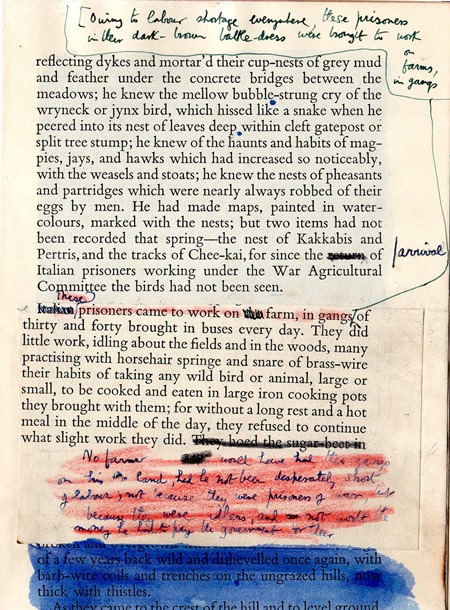
UK pp. 262-4 and top of 265 deleted. This is the passage about the dangerous handling of the yellow chemical.
And much deletion and alteration over UK pp. 265-7, covering the visit of the doctor: in the US edition he has come to treat Wilbo's wife and merely makes a social call on Wilbo – and so sees the painting of Chee-kai on the barn studio wall. In the US edition Wilbo is not portrayed as in a depressed state. But again, here there is a short red-ink MS note for further future revision. And within this passage (US p. 231) there is the possible supposition of the source of Chee-kai, no longer anonymous but given as a ‘stray from the woods of Merton’, an estate held by the 'Earls of Walsingham' (and so making a link to Sir Stephen Renshaw, as can be seen elsewhere in this era in the Chronicle novels).
These adjustment deletions continue UK p. 268-9; US p. 232-3. In the UK edition Chapter 24 ends on p. 270; while the US continues after a 'one line space':
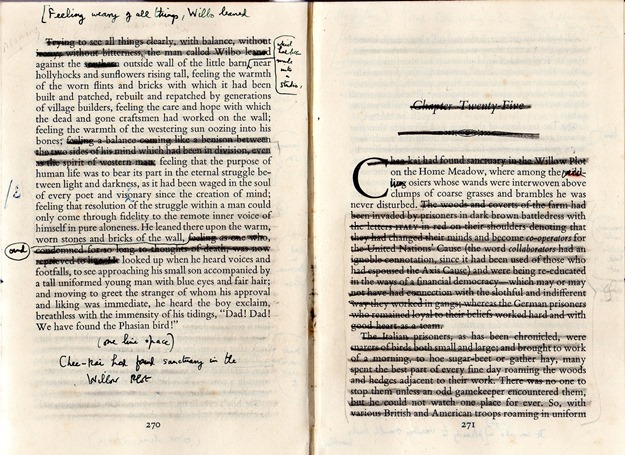
Chapter 25: UK p. 271 and on to p. 272 are deleted (see above – losing the Italian prisoners poaching, as no farmer to stop them!), picking up with new insertion (US, bottom p. 233):
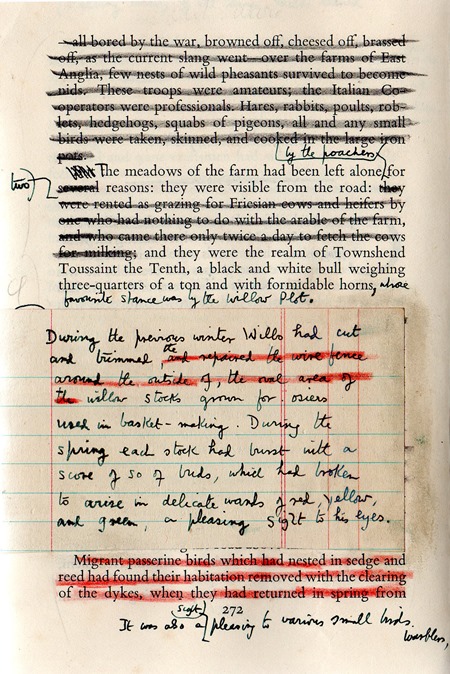
The grandly named fierce bull 'Townshend Toussaint the Tenth' (UK p. 272) is downgraded to a 'dozing Frisian bull' (US p. 237; American spelling, changed from 'Friesian'). It is doubtful anyway whether many English readers would have picked up on the reference to the famous 'Turnip' Townshend – an agriculturist from another era!
Also deleted is the rather obtuse metaphysical paragraph about the friendship between Wilbo and the airman-poet (UK p. 277; US p. 237).
Paragraphs about the war-strain of pilots (UK p. 278-9; US p. 238) are deleted, leading directly to the scene of the record of Bach’s Mass in B Minor listened to by Wilbo and the American airman-poet. HW has written on this page in pencil MS note: 'Weeks wanted to cut this Bach scene.' This is one of the clues that the revisions were demanded by the American publisher.
And for the US edition HW now intersperses a passage about Chee-kai – actually from UK p. 311, making a very effective cross-reference here, and adding to the emotive power of this already powerful passage:

Chapter 26 (UK p. 284-94) is headed: 'Omit this Chapter entire'. This again is in what I presume is Weeks' handwriting – and 'blued' out. This contains the scene where Wilbo paints the Flockmaster. Thus the US Chapter 24 begins at the end of UK Chapter 26, with a new short insertion to cover the omitted passage:
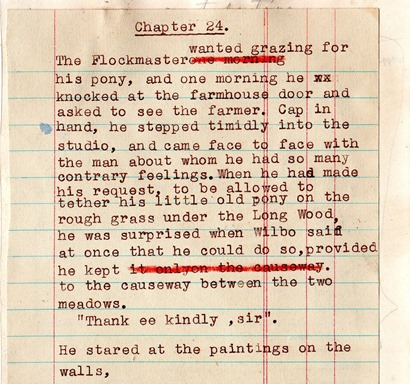
Most of UK pp. 296-7 deleted and adjusted, and continuing with the text from UK Chapter 27, p. 298 (US p. 244) with some small changes (for example, 'plowed for sugar-beet' instead of 'winter wheat') up to the end of UK Chapter 27 (p. 305), where UK Chapter 28 is deleted from p. 306 to near top of p. 315: the description of Wilbo watching Harcourt's shoot and information about shoots in relation to farming income (evidently not of interest to American readers!) and picking up at the point where radar notes returning bombers (US p. 251).
Far out over the North Sea, the unseen tentacles of the locating systems . . .
and the inevitable crash of the Flying Fortress bomber, and so death (never stated outright) of its poet pilot (UK p. 316; US p. 253).
So: UK Chapter 29 (p. 317) becomes US Chapter 25 (p. 254).
One useful change here is the list of rather silly fictional village names (top of UK p. 320), now given their real names (US p. 257):
UK edition:
US edition:
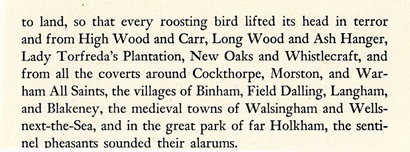
Some further revision on UK p. 322; US p. 259:
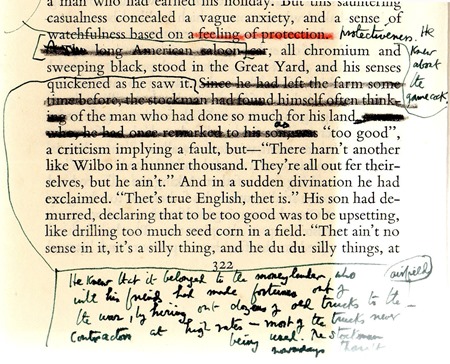
Then at the end of that passage in the US edition HW has added another red ink note (US, p. 261). It would be a useful addition for any future edition.
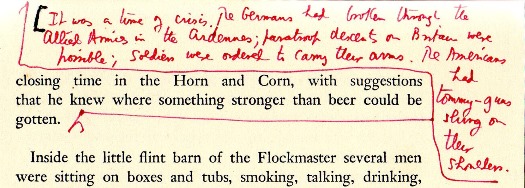
There are minor revisions on UK p. 324: then the last 5 lines of p. 325, all p. 326 and two thirds p. 327 are deleted: so removing the passage about the Americans wanting to 'get me a kraut' and Wilbo being a 'Jarman' and a 'fifth columnist'. Picking up again (US p. 263) with: 'Meanwhile . . .' – but the phrase 'the subject of the talk' is changed to a more natural 'Wilbo and his son'.
A further exchange about the 'fifth-columnist' excised (UK p. 329; US p. 264).
In US p. 265, HW has red-inked through the sentence about the soldiers being ordered to carry their weapons with them at all times as this is the sentence he wants taken back to p. 261 as in above scan.
Apart from the exclamation 'Christ!' deleted (UK p. 336; US p. 271) (were Americans that prurient?), there is no further revision at all. HW stood by his original description of the death of both Wilbo and the magnificent Chee-kai.
However, much distress was caused to HW by a missing line (UK p. 275; US p. 275). Coming at the very climax of his book, it must have been very frustrating indeed, and one can well imagine that some shouting and holding of his head in his hands ensued.
UK edition:

US edition:
*************************
These revisions change the whole tone of the book. Perhaps some future publisher will reissue The Phasian Bird using this US version, which can be seen as the definitive edition, and modern readers can see its superb quality.
*************************
Back to The Phasian Bird main page
Critical reception and book covers
Appendix I: Henry Williamson's notes for the writing of The Phasian Bird