
The Henry Williamson Society
Uncategorised
Devon Holiday
DEVON HOLIDAY
 |
|
|
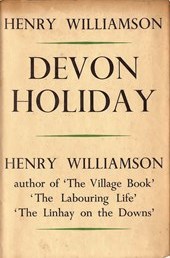
First edition, Jonathan Cape, 1935 |
First published Jonathan Cape, 24 June 1935 (2500 copies), 7s 6d
(actual date deduced from review information)
On the title page:
‘And how’
Early American Saying
 |
|
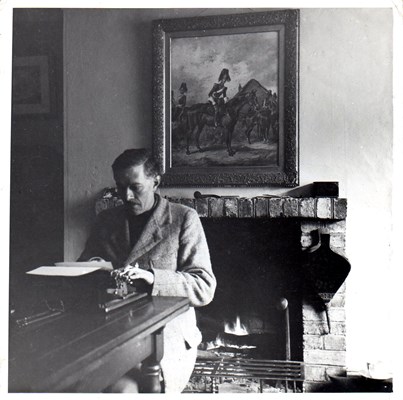
The narrator at work, at Shallowford – perhaps on this very book. The self portrait hanging above the fireplace is by Leicester Hibbert (1826-1909, Queen's Bays), Loetitia's grandfather. |
The narrator (quite openly HW) and four friends wander about the lanes and moorland of Devon, talking and telling tales as they go, with a great deal of bantering fun. But it is so much more than just a hike over Exmoor and Dartmoor: it is a conversation, wide ranging and quirky, which HW leads, and to which we are all privileged to listen – and in so doing learn quite a lot about HW himself. It is coupled with six excellent (if somewhat barbaric) short stories. HW has used his skill to blend several events – real and imaginary – to provide a credible setting for a series of yarns to be taken in ‘the holiday spirit’.
That this book fits the original synopsis sent by Ann Thomas to Alexander MacLehose in January 1933 rather than the book commissioned by him (On Foot in Devon) will become obvious. (HW’s contract with Cape in 1928 for three ‘continuous prose’ works took precedence over the arrangement HW made with MacLehose.) The original synopsis read:
A personal account of many walks through Devon – along the north coast by the Severn Sea from the Somersetshire borders, down the Atlantic coast to the beginning of Cornwall, wanderings on Exmoor by Dunkery and the high hills, and along the marshy banks of the river Barle; and over the great range of the high downs to the valleys of the Taw and Torridge, and all the way up to Dartmoor and its lonely green wastes of enchantment. Three friends, whose peregrinations this book describes, provide a dialogue which is a commentary on themselves as well as the scenes they pass. One is a visiting American, the second a native Devonian, and the third is a visitor who has made Devon his home. The result is a lively book, and one full of the sort of information that is not usually found in more orthodox guide books.
Certainly a large amount of this present book was written originally in early 1933 at a rate of two or three thousand words a day: Ann Thomas noting in the diary on 29 January 1933 that the book was finished. That was the book intended for MacLehose for his ‘On Foot’ series, but which HW then handed over to Cape instead, with all the ensuing to-do; but which didn’t get published until two years later. (I regret that I have not studied the two sets of MS/TS deposited in the HW archive at Exeter University to check exactly the cross-over history of these two volumes, but that is the outline course of events.)
These two volumes should really be read in tandem: together they cover a very generous area of Devon, while the crossing over of the imaginary companions in Reel I of On Foot in Devon with those that actually accompany (albeit disguised) the narrator in Devon Holiday make an obvious connection.
*************************
HW’s diary records the sequence of events thus:
Ann Thomas returned to Shallowford (she has been living with her sister in Tenterden, Kent) and:
Monday, 1 October 1934: Began DEVON HOLIDAY: Tales of Moorland and Estuary this day. [That last part of the title becomes important several years later!] Wrote it over the skeleton pages relict from On Foot in Devon dictated to the faithful A.T. 2 years ago.
2 October: Wrote. Embodied short story TROUT. About 15000 words of book all rewritten & rearranged by the evening.
(‘Trout’ was obviously later deleted – there is here only a passing reference to trout in chapter II; a story entitled ‘Trout’ appeared in Chamber’s Journal, January 1951, but if this is the same story then it had been updated to include reference to the Second World War.)
3 October: 30,000 words of devon holiday done. New ideas; plenty of fun.
4 October: 45,000 words of D.H. done. It is funny & interesting. Quite warmed up to work, but tired with working 12 hours a day.
5 October: Wrote more of D.H.
6 October: About 60,000 words done. Tired.
On 8 October he caught an 8lb salmon amid great excitement, and sent a telegram to C. F. Tunnicliffe to come and work on drawings – ‘Tunny’ caught the overnight train, arriving at 8 a.m. the next morning! He stayed a couple of days and after he had gone –
12 October: I started work again, 80,000 words done.
13 October: Worked continuously.
14 October: Worked all day & half the night.
15 October: Worked all day & at 11.30 pm wrote the last words. I am sad it is over. I feel it is lovely, light, full of fun & joie de vivre, & just the right touch everywhere. A new sort of book: I feel it is the real me, outside of all old sadness & blight & retarding influences. About 110,000 words, with the short stories – maybe a bit longer. Read the end to Gipsy in her bath, & we both thought & said & felt it was lovely. . . .
18 November: This day finished the sixth revision of DEVON HOLIDAY, a book which I told myself during writing that I would not revise it.
At this time HW was rushing about going back and forth to see Ann Edmonds at her home in Bickley (S.E. London); also to visit Ann Thomas at Tenterden in mid-Kent; and often calling in to see Victor Yeates at his home at Mottingham (also S.E. London, just north of where the Edmonds lived). Then Yeates was taken into a nursing home on the coast. It was on one of these driving forays that when he visited Yeates, thinking to discuss Yeates’s current work, that he learned his friend had died two days before. He then spent considerable time and energy writing an obituary, and getting as much publicity as possible for his friend’s work.
A file copy of a letter from HW to Wren Howard, one of the directors of the publishers Jonathan Cape, dated 1 December 1934, shows that all was not well between author and publisher. HW complains first about The Linhay on the Downs, which Jonathan Cape had called ‘a miscellany’ and which HW felt was actually a personal record (that is, autobiographical). (Those following these bibliographical entries will be familiar with this background.) Then it was about Cape’s initial reaction to Yeates’s book Winged Victory, which had upset him; but particularly now it was to their reaction to Devon Holiday:
Here is the description of it. The enclosed is the gist of it; it aint a miscellany, nor be it a collection of short stories without a dull page; and revised carefully, and put out just right, it should be liked by at least half of those who love nickel, bevelled moons rising in the west.
This latter comment presumably refers to a point they are both aware of!
HW's synopsis reads:
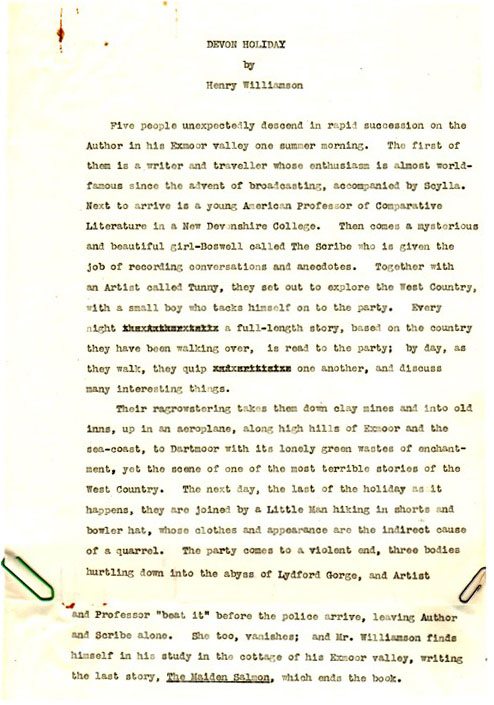
In February 1935 HW sent a postcard to another close friend, T. E. Lawrence, first telling him about his work on Yeates’s typescript ‘fragment’ called ‘Family Life’ – then:
In my next book, potboiler, there is a long account of a meeting on the Berengaria between me, a nameless friend, and G.B. Everest, an ‘expert mechanic and authority on skycloclartactic impulses in supermarine craft.’ Garnett reported that it seemed dragged in to the book. So it was. The whole book was dragged in and dragged out also. . . . It is called DEVON HOLIDAY and I hope it will amuse 10% of readers, but doubt it.
The book, however, was having further problems. Cape took the advice of lawyers over possible libel actions on several points in the typescript, adding to the increasingly sour relationship between author and publisher. In another letter to T. E. Lawrence, dated 10 May 1935 (this is the famous ‘last’ letter), HW, all his joy in the book having evaporated, wrote:
Mr. Rubinstein [the lawyer] found 15 possible libels in D. Holiday, so the page proofs have been cut about awful, and will swallow up all profits if any I guess. [This refers to a standard contract clause whereby the author has to pay for any excessive changes at proof stage: which in those days of manual typesetting added considerably to costs.]
However, a list of Rubinstein’s queries shows only 12 points and most appear (to me!) to be rather nit-picking minor items of little consequence; HW obviously made some slight adjustments to the text. It would not seem that Jonathan Cape, a somewhat austere man, understood HW’s rather joking attitude. Of course, he might have been showing HW who was actually in charge!
HW went on to state that he would like TEL to see the proofs of this book, and also wanted advice on, and discuss, his further work on behalf of Victor Yeates (the film script he was preparing for Winged Victory and how to deal with the typescript of ‘Family Life’, unpublishable in its present form).
It was while returning from sending a telegram in reply to this letter that TEL met with his motorcycle accident and his subsequent death. This was a severe blow for HW. (Details of the relationship between these two men will be dealt under the entry for HW’s book Genius of Friendship.)
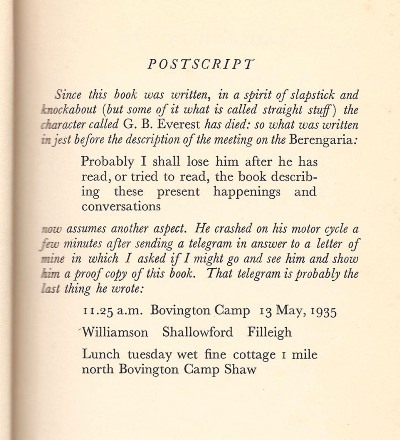
Apart from the trauma to HW’s sensitive emotions, the event caused a further problem over Devon Holiday, which by then was being printed, and which contained the section about Lawrence. HW hastily prepared a ‘Postscript’ to counteract his jocular remarks about ‘G. B. Everest’ – who would surely have been recognised from HW’s description anyway, and certainly became so now! This ‘Postscript’ was added to the front of the book and really, although it was not meant as such, acts as a dedication:
HW had now lost two close friends one after the other: Victor Yeates at the end of 1934 and now, six months later, T. E. Lawrence. His father-in-law, Charles Hibbert, had also died on 26 April 1935 which created its own problems within the Hibbert family, with which HW of course found it necessary to deal.
His 1935 diary is blank after the death of T. E. Lawrence – almost as if his own life had ceased – and the publication of, and, as will be seen from the Critical reception page, the very good reaction to, Devon Holiday is unrecorded.
*************************
The text of HW’s file copy of Devon Holiday has a considerable amount of manuscript revision, and at the front he has written ‘For New Edition’. As can be seen from the hand-corrected and revised list of books, he has inserted The Dark Lantern but not Donkey Boy; it would seem from this, therefore, that the revisions were made in around 1950-51. The original Postscript, at the beginning, has been torn out and crossed through (though still with the book); so clearly it was not to be used. Essentially, though, the revisions are minor ones – just tinkering with the text, such as HW so loved to do. My view is that Tales of Moorland and Estuary, published in 1953, was originally intended to be a new revised edition of Devon Holiday, but that he – or his publisher – decided that the ‘farce and knockabout’ (as HW categorised the book in his list of books) was no longer appropriate; and so Tales of Moorland and Estuary became a straightforward book of short stories. Sample pages showing some of HW's revisions are illustrated below:
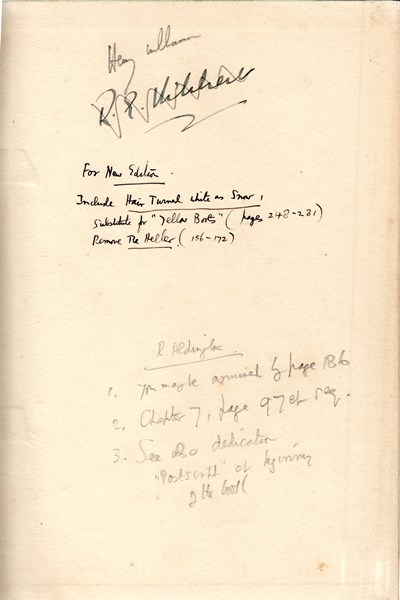


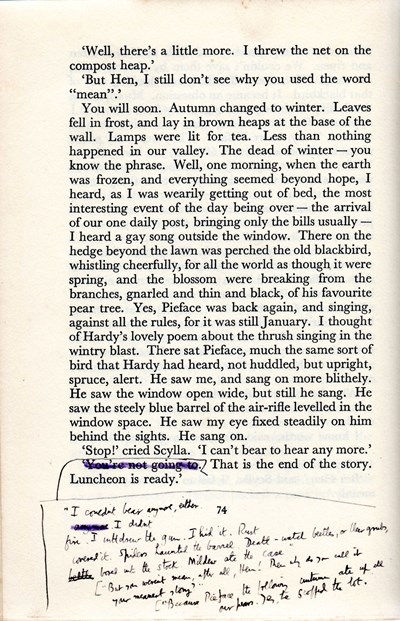
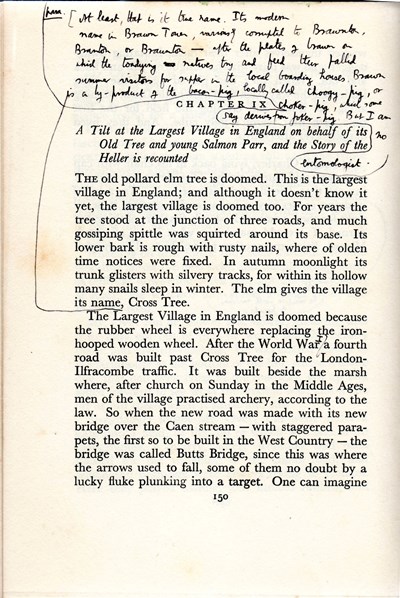
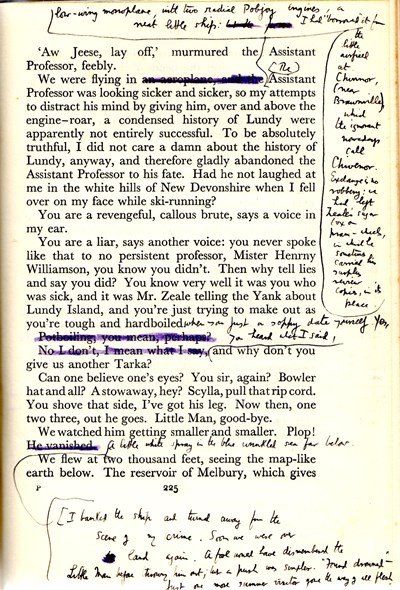
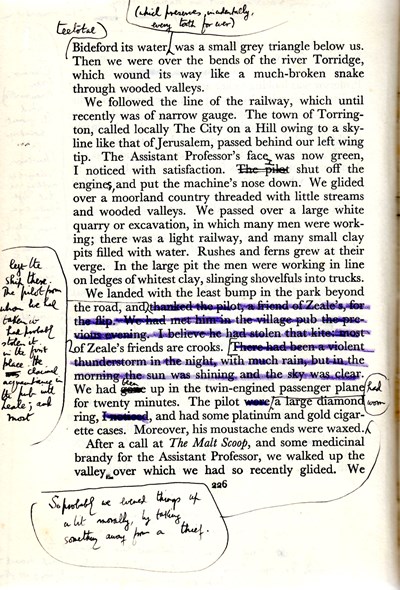
*************************
Each chapter in the book is given a narrative subtitle. Each one is a gem of almost Victorian proportions and they are included here for your enjoyment.

Using this map the reader should be able to locate the places mentioned within the pages of Devon Holiday, including the special Lynton-Barnstaple railway.
Chapter I
A Stagnant Existence one Summer Morning is Interrupted by a Telephone Call, the arrival of Zeale and Scylla, the Assistant Professor of Comparative Literature, and the Scribe, with whom we set out for a Holiday
(Some considerable detail is necessary here to explain these characters and put things into context.)
The reader is plunged headlong into this story, which is told in the first person: the narrator is ‘I’ – and ‘I’ is an undisguised Henry Williamson. On instructions of a telegram he interrupts his work on the river , where he is making dams and preparing egg-hatching pools for salmon (as indeed HW was in real life at this time), with
unshaven chin; my trousers wet to the knees from wading in the river, were tied up with string off the grocer’s weekly parcel delivered from the market town that morning.
His instruction was to make a telephone call from the village post-office at a particular time – this telephone being probably about half-a-mile distance across the fields from his house (as in real life). His ears are blasted with a ‘bright metallic New York voice’ which complains about lack of hotel amenities in England (no hot water, central heating, etc. etc.) and gives details of a whirlwind tour of the West Country (Glastonbury next stop), but demands to know more of the ‘real’ England, suggesting that HW write a ‘real’ book about the place. But what, muses our author, would these New York socialites make of ‘real’ Devon, knowing that their ideas were far from reality.
Two points to make here: firstly, HW is using an incident which relates to his stay in New York in 1930-31, when he knew a lady with just such a voice, who phoned him on several occasions; you can find her in The Gold Falcon.
Secondly – and more importantly – we have been given a cleverly hidden concept: What is reality? And the book proceeds to explore this elusive commodity, confounding and contradicting expectations and having a great deal of fun while so doing.
Our narrator returns to his work. But almost immediately he is interrupted again. Two friends arrive accompanied by three small children. The children are his own: Windles (Bill), aged 8; John, aged 6; and Margaret, aged 4. We soon learn that there is also a baby, Robert. This is exactly as the family was in 1934.
The two friends are, first, M. F. H. Zeale – Masterson Funicular Hengist Zeale: ‘Recognizable anywhere’. Indeed he would have been to anyone who knew HW’s background, but probably not to the average reader: he is, in fact, HW’s friend, S. P. B. (Petre) Mais, a prolific writer, who had proposed HW for the original MacLehose book, On Foot in Devon. And HW’s fictional name is a wonderful play on Petre’s long set of initials: M. F. H. is also short for ‘Master of Fox Hounds’, thus incorporating Mais’ enthusiasm for the sport of hunting. Mais has appeared in various previous books (and will in future ones!) – as had HW in his. (See Robert Walker, 'S. P. B. Mais – Henry's Longest Literary Relationship' (HWSJ 49, September 2013, pp. 35-53.)
Zeale has with him a person called ‘Scylla’. This fictional Scylla is a combination of Mais’ partner Jill (they were not man and wife) and his daughter by his actual (defunct) marriage, Priscilla (whom HW pursued at this time as an alternative to his thwarted love for the ambitious and unattainable Ann Edmonds), who patently was not interested in HW.
Masterson and Scylla have arrived for what we are told was a pre-arranged walking holiday. For our narrator it is an almost intolerable interruption of his writing-self life.
But Loetitia now arrives with another visitor. Loetitia is of course HW’s real-life wife and the mother of his children, as he tells us. The visitor with her is
dear old Herb, Assistant Professor of Comparative Literature at the New England college . . .
In other words, Herbert Faulkner West from Dartmouth College, New Hampshire, USA, whom HW had met on his visit to America over the winter of 1930-31, and who had visited England the following year, staying at Shallowford from 7-14 March 1932, where he prepared and later published his short monograph The Dreamer of Devon, published later that year.
Then yet another person appears:
Her cheeks and neck and hands were browned by the sun, her fair hair was bleached fairer by summer light, deep blue eyes, and teeth like a film-star. She was slim, she looked strong and happy.
This person is apparently a freelance journalist who wants to interview HW. Masterson Zeale suggests she becomes HW’s secretary.
Pinning down the ‘Scribe’ (as she is called throughout the book) is more problematic. We know the actual scribe in real life is Ann Thomas; but, although there is much of Ann Thomas in this character, the description is certainly not of her: Ann had dark hair and features accordingly. It would seem that the ‘Scribe’ is actually a mixture of several women, including Barbara Sincere from his 1930-31 visit to New York (again dark) and Barbara Krebs (the German girl who stayed in Georgeham for a while and again with whom HW was briefly ‘in love’). Barbara Krebs fits that Scandinavian description and indeed she visited HW briefly around this time, as also did Barbara Sincere. Ann Edmonds is also a large part of the multi-faceted personage, but of course ACE (from her initials) – or ‘Barleybright’ as HW thought of her) – was never one of his scribes. It would seem that HW is paying tribute to all of them in one fell swoop. But the Scribe is actually a fairly shadowy creature without a very definite personality, and she does change in fact from one person to another in the middle of the book, as I will show in due course, which is an interesting psychological thought!
As they are all gathered, our narrator gives in and they set off on the proposed walking holiday, minus the younger children, who are to stay behind to look after Baby Robert (who was actually born September 1933). Windles is allowed to accompany the grown-ups.
It needs to be stated here that this walk – or series of walks – did not actually happen like this in real life. Walks were indeed taken with all the characters individually at various times but this particular group of people were never gathered together at one time. HW puts them together solely for the purpose of making his story lively, and to contrast their (his own) varying reactions to all they see and hear. So indeed the author is part of every one, each in their individual turn!
Chapter II
We walk up the Valley, practising Cruelty to Horseflies, discuss the ways of Trout and Men and Otters
The ‘Valley’ is that of the River Bray, which runs through a meadow adjoining Shallowford, and they are walking northwards upstream through the Deer Park belonging to Castle Hill, home of Lord Fortescue. They are plagued by horseflies as they walk and make switches from bracken to whisk them off: a true detail of country life which few writers would include. They do indeed discuss trout – and poachers.
Masterson Zeale has the role of ebullient truculent critic. We read: ‘Zeale and I had been friendly, with reservations, for the past eleven years.’ We are taken through this friendship, and are reminded of their first walk together, when the writer Michael Arlen was discussed. But – although it is all done in a spirit of fun and affection – HW does rather put his friend down here, which might have further strained their friendship when it appeared in print.
HW remembers seeing otters in the valley, but on this day they only see water-ousels (dippers) and kingfishers, and a sickly salmon.
Coming to the road they continue upwards (it is quite steep there) until they come to the quarries where stone is blasted. Strangely he says little about the grimness (still there) of that seemingly sunless grey area, but conveys the poisoned atmosphere with reference to dead salmon.
Chapter III
We Walk on the Moor, discuss Buzzards and an early version of Tarka the Otter, and descend upon a Farmhouse for a glorious repast
They watch buzzards, and HW tells a tale which involves making a grisly fire-shield from three bodies found on a gamekeeper’s gibbet and dried out (a total fiction), which then drifts into corrections made on an early draft of Tarka the Otter by a Master of Otter Hounds (William Rogers of the Cheriton Otter Hunt). They meander on to the Moor (Exmoor).
They continue to Challacombe and then take the path north which leads up to Pinkery (or Pinkworthy) Pond which is described ‘a tarn, a mere, a lake’ and continue on ‘across high wet ground where purple grass grew in large tufts, called The Chains.’ This wild area was one of HW’s favourite places for walking. They are now quite a long way from Shallowford (no wonder young Windles gets rather tired!): this walk would never have been taken in its entirety – the more usual procedure would have been to take the car to where one leaves the road for the Moor, but that would have spoilt the atmosphere he is creating.
They end up in a farm where they are given good wholesome farm fare (where the blueberries remind him of his trip to Mastigouche – a Canadian fishing trip made with his American publisher in autumn 1930 – and the wild cry of the loon), and a bed for the night.
Chapter IV
We talk of Things which are because the God of Golden Song is not always Perceived as the God of the Golden Sun, with quotations from a Local Preacher’s Literary Efforts, ending with the Story of Piercing Eyes
We hear about the life of the farm hostess and her dead religious husband and other tales of religious peculiarities, which in turn leads to a pamphlet diatribe against the ‘Hartland Point Monster’, which is in fact the life-saving fog-horn. Then more pamphlet diatribe about treatment of children (rule with the rod) and that by changing our clocks we have displaced God’s own time and foreseeing worse to come: ‘these writings are not entirely in harmony with the modern world.’ This goes on into problems with cocks, hens, dogs fouling and/or fowling!
The final ‘yarn’ here concerns buying a picture at an auction, or rather a farm sale, which took place in a small crowded upstairs room, in competition with ‘Piercing Eyes’, with a preliminary spat over the opening of a window for air (by HW) and the immediate slamming it shut by Piercing Eyes, repeated several times. The bidding begins and rapidly escalates upwards from one shilling to an exorbitant three guineas. Meanwhile the room is gradually collapsing under the strain of weight and movement of people, until at the climax it gives way and all are deposited in the room below amid a pile of rubble. The picture hangs in his dining room today. But we get an insight into HW’s mind and modus operandi:
Of course you’ve realized that the story, except the atmosphere, is highly coloured, like the picture I bought – I am a chameleon, and take colour from my subjects.
There is also a moral sting to this little tale. Piercing Eyes was not an unpleasant villain – with the picture were some texts which turn out to have been the work of his brother, of whom he was very fond, from when he was a schoolboy. Our narrator gives them to the man and they part as friends. HW’s final last word is to casually admit that the floor had not collapsed – he had added it to make the tale more interesting – and notices that Masterson has fallen asleep!
Chapter V
It rains, and by way of a Dwarf Railroad, we travel home, where Greengages are Eaten, and the Meanest Story in the World is recounted
Our walking party have now reached the East Lyn River which runs so steeply down the north Devon coast to the Bristol Channel, or Severn Sea (and which features so strongly in the later Chronicle of Ancient Sunlight series). It starts to rain so they wait for the special narrow-gauge railway train from Lynton to take them back to Barnstaple. This delightful little train features in several of HW’s books. On arriving at Barnstaple another, London mainline, train would take them back to the little station of Filleigh near Shallowford: the viaduct across the northern end of the Park carried the railway in those days – today it is the main road.

Back home they gorge themselves on greengages, and HW continues to think his rambling thoughts aloud and gets to ‘My Meanest Story’, which is the tale of blackbirds stealing his hard-won fruit, or rather pecking enough holes in his pears to ruin them for winter storage. One bird, ‘Pieface’, was crafty and could not be frightened off. A gun was brought out and used several times, but Pieface escaped. Eventually only one pear was left, but Pieface got that too. Then he disappeared. But in the middle of winter he is there, suddenly singing his delightful song. The gun was brought out again – but here the story ends.
Chapter VI
We eat a Ham cooked in the Virginian manner by Loetitia, and hear the Story of The Dog that Ate his Punishment
(This story was previously published in Windsor Magazine, December 1933 – see illustration below.)

They eat a meal of ham first boiled and then roasted with Demerera sugar as Loetitia had learned to do when she joined HW in America in the spring of 1931.
We ate with the ham crab-apple jelly, roast potatoes, and cabbage cooked at twenty pounds pressure to the square inch in the steam boiler. . . . We drank lemonade made by Loetitia from lemons – none of the boughten bottled stuff – and after a salad, we took turns to dig the scoop into a Stilton cheese . . . eaten with slightly sweetened biscuits . . . But it is company that makes food good to eat.
Our narrator reads them his story (typed up by the Scribe) about the dog that ate his punishment. Apparently the Assistant Professor had a Jack Russell terrier, a pup named Snapper, which is accused of killing the neighbouring farmer’s chickens – who brings the dead birds along as evidence and for which the Assistant Professor pays increasing amounts. The problem is that the Professor is busy writing, and so instead of taking the dog for a walk he lets it out to run where it will. He has been writing a book on the French Revolution, which is to be a masterpiece, for the last ten years; meanwhile adversely criticising every other book written on the subject. (HW is really sending himself up here about his own proposed ‘war and peace’ work which he cannot begin.)
Snapper is severely punished for killing these chickens and has a dead one tied round its neck. Again he is let out alone. Later he is found next to the chickens but surrounded by rats, many of which he has killed. It is these rats that have killed all the chickens. The farmer shoots the rest of them: and his wife cooks up a large amount of dead chicken for the canine hero to feast on.
This is all told over several pages with a great deal of detail and humour. But if you have paid attention to my tale you will recollect that the said Professor only stayed at Shallowford for one week – so no way can this story apply to him!
An entry in HW’s diary for 6 January 1933 – in Ann Thomas’s handwriting (HW was away) states:
Mr. Slee shows me a chicken killed presumably by Bill – later on investigation he finds another in our garden among the laurel-bushes by stables.
19 January (again AT’s hand): Paid Mr. Slee 17/6d for 2 laying pullets & one chicken killed by Bill recently. [‘Bill’ being HW’s terrier!]
Chapter VII
A Scene on the S.S. ‘Berengaria’ at Southampton Docks one Winter Morning is dragged into this Book, following which we all visit the Free Fishing of South Molton, and hear some other Rogues Talking
Scylla remonstrates with our narrator for not telling the truth in his stories:
Dearest Scylla, an author’s stories are intended solely for entertainment.
This leads him to state that he has only one true reader.
Who is he? I am not certain that I know anything about him; we meet only on rare occasions . . . He is one of the best living prose writers in English, and also an expert mechanic and road-racing motor cyclist, an authority on Homer, old buildings, desert warfare, motorboats, a number of wisdom’s pillars, and the virtues of uncooked vegetable food in a cottage. His favourite nut is the pecan nut from Florida. He has several names, the least-known but not the least distinguished of which is G. B. Everest.
[This is, of course, T. E. Lawrence – HW had referred to TEL in a very early letter as ‘Mt. Everest to my Snowdon’: the initials G. B. refer both to the pseudonym ‘Shaw’ that TEL used and the fact that TEL was very friendly with the G. B. Shaw: quite a clever and complex little riddle!]
HW launches into a detailed description of being seen off on his voyage to southern USA by ‘G. B. Everest’ and another unidentified friend (this was John Heygate). Of course, as you can see, his description is so full of clues (as is his mea culpa style ‘Postscript’ explanation added after TEL’s death) that any discerning reader would have known exactly to whom he was referring. (Indeed, it was an open secret as soon as the book appeared.)
To lighten the mood they, all nine of them, set off in HW’s Silver Eagle Alvis for nearby South Molton, a market town still old-fashioned and ‘real’.

But even now he slips in a rather bitter passage about the state of England and what was being said in 1914:
It was unanswerable, it was true, the battalion roared its cheering; and most of the battalion is on that foreign soil today . . . but in 1934 the same sort of thought, coming from Mr. Baldwin, is merely chilling.
An awareness of things to come is beginning to creep into his mind.
They go to look at the weir below the town where they find two interestingly crafty characters who tell them this is the town’s free fishing. They are quite happy to relate the various ways of poaching salmon!
Rather than have tea there indoors they return to the valley for a picnic by the river at Shallowford with the children singing songs until it is time for them to go to bed.
Chapter VIII
We go to Barnstaple where M. F. H. Zeale interests himself in Fake Antique Furniture, before proceeding to Halsinger Down with its Drunken and other Autobiographical Memories, and Windwhistle Spinney where we Overhear some Authentic Local Speech, arriving at Ham village for food and the Story of Swagdagger Crossing a Field
(This story was published in Atlantic Monthly, July 1929, and Passing Show, April 1934.)
They take the bus into Barnstaple with another dig at Masterson Zeale en route, and again when they arrive: first about the prodigious amount of writing etc. that he gets through (implying that it is therefore of poor quality), and second about his enthusiasm for antique furniture, which HW suggests is fake.
They set off on their walk
up and down combe . . . onwards and upwards to Beara Down Cross – Beara means Little Wood – and so to a wild high place where many little tracks cross and disappear amidst ferns and thorns and sheep. The westering sun dazed and glorified us. This was Halsinger Down, a small cousin of Exmoor . . . [Halsinger Down is directly east of Georgeham, on the other side of the main Ilfracombe road.]
HW remembers the day his eldest son was born, when he got drunk with his brother-in-law Robin, and includes his somewhat apocryphal tale of nursing Windles for months when Loetitia was ill after the birth (her own version of this merely involved a couple of days at the most!) while he wrote Tarka the Otter.
Going west they go across the main Ilfracombe road, and what was then the railway bridge, and on up the lane to Spreycombe (Spreacombe) with a lovely paragraph of memories:
The galleries of the iron mines are still to be seen in the hillside; the long-eared owls and buzzards still nest in the pinewood and spruce plantations; pigeons still clap their wings as they fly in to roost; the stream still holds trout. But the mine buildings are gone, and with them the white owls that I found nesting there in the year of my first boyhood visit. A whole book could be written about that valley, memories of faces now vanished for evermore, when I used to come here with you and you and you, and we made fires to boil a kettle, and poached an occasional rabbit, and explored the mine galleries and – but enough – it is eternity now, it is all about me in the sunshine, as dear Jefferies wrote in his beautiful Story of My Heart [‘you and you and you’ refers to Mary Graham Stokes and her brother, and 1922 adventures].
They continue on up to the top of the hill and Windwhistle Spinney and the field. This is Ox’s Cross and HW’s own Field. A trapper appears with attendant tale. They continue on down the hill (into Georgeham) and Charley’s pub (Charley Ovey and the ‘Lower House’). A tale is told about (against) J. B. Priestley, who was not an admirer of HW’s books, especially after his portrayal in The Gold Falcon: and presumably even less so after this rather unnecessary little dig! (NB: HW did not burn his reviews scrapbook, as he states here.) This passage would no doubt have been one of those that concerned the publishers’ libel lawyer!
They have a happy time in the Lower House, where Charley tells a tale about pig-killing and subsequent supper, and they sing songs. Then we are told the story ‘Swagdagger Crosses a Field’: one of HW’s classic stories. Swagdagger is an white stoat and his adventures as he crosses a field next to HW’s own field are extreme as he is attacked by every bird of prey in the area, one after the other, including a buzzard which captures him but which he manages after a hard fight to kill, and also by Mr. Ovey (prominent in this tale), who is finally chased by Swagdagger’s entire (huge!) family right back down the hill into the village: while Swagdagger and family go off and enjoy their normal happy lives.
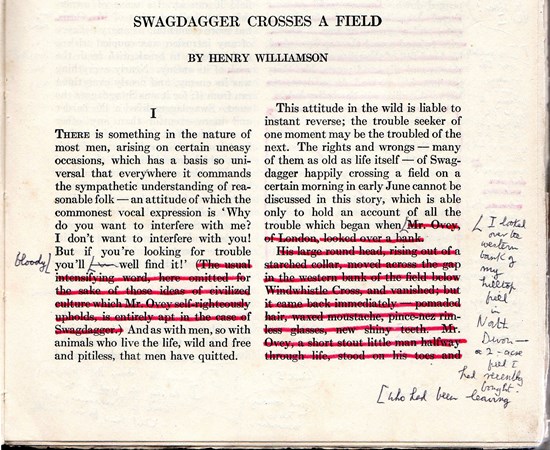 |
| HW's revisions to the Atlantic Monthly story for another version (though not that in Devon Holiday) |
Chapter IX
A Tilt at the Largest Village in England on behalf of its Old Tree and young Salmon Parr, and the Story of the Heller is recounted
(‘The Heller’ was first published in Atlantic Monthly, May 1928; then Cassell’s, September 1928, and the Daily Express, 22 October 1935.)
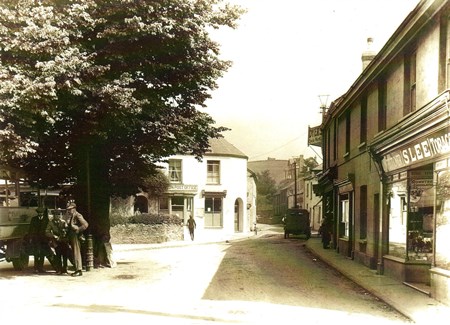
‘The largest village in England’ is Braunton, shown here with it's 'old tree' – Slee's shop is still a presence in the village today:
After we have learned its story we continue to the sea-wall where we learn the tale of the marshman and the Heller, which is out to catch his ducklings. Strange noises are heard. The Heller is an otter and HW watches it playing. But the marshman is determined to catch this ‘Heller’: he traps and kills it. On the way back they find a huge conger eel – killed by the now dead otter. Cutting this eel open, the marshman finds his dead ducklings in its innards. A rather fierce and sad tale: another HW classic.
Chapter X
The next day we walk on the Santon Sands, explore the Lighthouse, and Consider Various Dangers in both Life and Literature
HW lies naked and (for once) happy on Saunton Sands but as his friends approach he sees the Scribe is not with them:
It seemed that I had known her always. She was the perfect companion with whom only the fewest words were necessary. So wild birds lived. Ah, if only she and I were alone with the sun in the sands.
They are disturbing a ring-plover (lovely little bird), so move away. But HW remembers an earlier summer when with two friends he had been there and seen a merlin’s nest: ‘Where are those two friends, I thought, and for a moment the sunlight seemed terrifyingly blank.’ (I think HW has to be referring here to Eve Fairfax (real name Mabs Baker) and Julian Warbeck (real name Frank Davis) – his friends from the immediate post-war era who feature in The Dream of Fair Women and the later Chronicle of Ancient Sunlight.)
They walk to Airy Point (the south-western edge of the sands) and out on to ‘The sandbank known as the North Tail; across the channel was the South Tail.’ It is a dangerous place, and we are treated to various escapades our narrator has survived. They explore the lighthouse– this is no longer there, but see Tony Evans's two articles: 'The Braunton Lighthouse' (HWS Newsletter, March 2011) and 'Light on The Pathway' (Part 1; Part 2), HWSJ 33, September 1997, p. 37 for details.
 |
|
A walk out to the Dutchman's Wreck on Saunton Sands. The only positive identifications are Petre Mais (3rd from right), with his partner Jill on his right. Second left may be HW's wife Loetitia. |
Then the Scribe reappears. She recognises this as the place where Willie Maddison was drowned (in The Pathway). Our narrator explains his ideas expounded in that book. (Note here that when the Scribe comes back she is not actually the same person: it is very subtly done and needs to be read with great care to spot it. HW is playing games with his readers!)
They are then ferried across the estuary, by a fisherman’s boat which has to be signalled for, to Appledore, where the next day is the Regatta.
Chapter XI
We encounter a Fearful Mystery, and Experience a Frightful Horror, which nearly ends this Awful Book
(This story, concerning an Orca Gladiator, or killer whale, first appeared as ‘Death of the Killer’ in Golden Book Magazine, USA, April 1933 – see illustration below.)

So our little group are in Appledore for the Regatta: we are given a potted history of Lord Northam who owns the area and again meet The Snowflake (as in On Foot in Devon where it is illustrated), but now Lord Northam’s ‘cream and scarlet yacht’. From the Regatta advert we learn there will be:

We learn that ‘Red Hake’ is the name for salmon taken in the close season (that is, illegally). We also meet again Jimmy Kift, who features in earlier stories, leading the banter in the pub. As they leave we are given one of HW’s superb verbal paintings:
It was a fine night, without wind, the tide on the ebb lapping the bottom of the quay wall. Voices came distinct across the estuary from the lighted houses on the shore across the water [the village of Instow].
Talk ceased in the group outside the chandler’s shop. Their lives were regulated by the tides; and the fishermen went out in their boats two hours before low tide and shot their drafts from the sand and gravel ridge until the tide was too strong for them to haul on their two hundred yards of weighted net. Tonight, however, the habit was disturbed by their thoughts of the Regatta tomorrow, and the fine night made them linger awhile. Other voices were audible along the length of the quay, above which rose the masts and rigging of ketches against the sky. The creak and knock of the ferry-boat’s sweeps could be heard with the noises of the tide.
But strange noises are heard; then chaos, as screams for help are heard: the ferry boat has suddenly sunk and one man has lost a leg. The recovered boat is seen to have been stove in. However, the next day the Regatta opens as planned, with its attendant noisy fun.
Having told us in advance, sotto voce, that the advertised performing sea creatures will ‘that very afternoon take part in the biggest fight in the history of the estuary since Hubba the Dane . . . perished in battle with Harold the king of the Saxons’, our author over several pages narrates the events that lead up to this primeval scene with the master hand of the seasoned story-teller.
Lord Northam, with all the panache and bravado of a circus trainer, has arrived and introduces his tame sea-creatures by pet name, which are allowed off the yacht down their special slipway and are desporting themselves in the water, occasionally returning for a thrown fish.
But ‘’erring ’ogs’ are spotted: a ‘herring-hog’ is a porpoise as we’ve been told in several stories in earlier books – a creature hated by the fishermen. Worse is to come:
a tall and sharp fin [drew] a straight line towards the boats. With awful suddenness it grew taller, and a black length of back was seen awash behind a blunt head as big round as a cartwheel. The head came out, shining smooth and black, with two patches of ghastly whiteness above and behind two tiny little eyes. . . .
The monstrous thing rose beside the vortex made by its rushing turn, within ten yards of our boat. We saw its belly and underparts of white, stretched inside a hide glistening with blubber. The great barrel of its blunt head split into a wide mouth, with twelve pairs of curved teeth set like marquee pegs in the bones of the jaw.
Lord Northam, while exhorting everyone to stay calm, is heard to say: ‘My God, it’s an Orca Gladiator!’
This monster kills and eats the porpoise and then spots the tame sea lions and gives chase. In turn, they face it and, twisting and turning, evade it in a scene of First World War dog-fight proportions. Eventually the walrus manages to bite and wound the whale’s flipper and hangs on to it in threshing water. All disappear under water. The walrus reappears dripping blood and exhausted; there is no sign of the tame sea lions.
As the tide goes out so they reappear one by one. With the next tide the body of Orca Gladiator is flung on to the pebble ridge (which protects the famous golf course). When it is cut up nine porpoises and two wild seals are found inside its bony framework. It is buried in the sandhills.
A fearsome tale! As the next chapter opens Scylla says in puzzled tone that she was at the Regatta, and hadn’t seen anything like that. Our story-teller is indeed a teller of stories!
Chapter XII
We explore Hercules Promontory, and hear Various Stories, including one of a Very Famous Modern Writer, and the Mystery of the Scribe’s Identity is Solved, but not Revealed
The pace slows and the reader is allowed to recover after the gladiatorial excitement. The party have moved westwards: conversation over High Tea (ham, boiled eggs, cut-rounds – a plain traditional Devon dough-bun – and cream with jam) pokes fun (again) at J. B. Priestley (no wonder the lawyer was anxious!), who is said to have no sense of humour. Also we are told that Loetitia has a tale about a faithful and perfect housekeeper, Martha, but who, forever taken for granted, eventually ‘loses her cool’ and upends a plate of soup on the head of His Lordship, leaves his service and lives out her life in reasonable comfort.
Then we hear another story about a child dying for want of green vegetables, who then lived with a lady in Georgeham who ran a naturist’s boarding house. Our Scribe turns pink. We have been told who she (now) is supposed to be. If the present reader has followed with care all the links from the beginning of ‘A Life’s Work’, then they will be aware of the names of all the girls HW had known during this period. But to give you another clue: Barbara Krebs, who had lived with the Georgeham naturist and vegetarian Miss Johnson in 1929 and had done a certain amount of work for HW, made a visit to Shallowford in 1933!
Chapter XIII
We enter the Valley of Monks, and Observe much Water Beauty
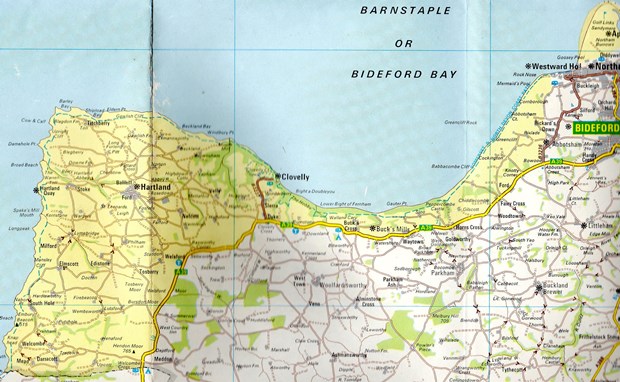
In tandem with On Foot in Devon the scene has moved west to the area around Hartland. Our story-teller relates seeing ‘the most remarkable fish jump’ he has ever had the good luck to see. They are in the Valley of the Monks (Hartland Abbey – further details can be found in the On Foot in Devon entry), with its tiny stream. It is a lovely lyrical passage, ending with HW’s ideas about learning by imitation. The narrator hints at a story he is planning in his head but is not yet ready to tell – certainly not to Scribe as it concerns another maiden.
Chapter XIV
We fly in an Aeroplane, while the Assistant Professor gets a Bit Sick, but recovers later at an Inn, and we explore some Clay Mines, after which we fly to Dartmoor, endure a Bombardment of Live Shell, and reach Cranmere Pool
So our little group of walkers find themselves in an aeroplane flying over Lundy – the small uninhabited island that lies a short way off the coast (19 miles due west of Morte Point) and which can be seen from HW’s haunts around Ox’s Cross. During the flight the little man with a bowler hat (who has miraculously materialised) is thrown out – much as Mrs Ramrod is thrown off Morte Point in On Foot in Devon. Back over land and Bideford, they see the River Torridge ‘winding its way like a much-broken snake through wooded valleys’ and follow the line of the railway south. (Today this is known as ‘The Tarka Line’ in honour of HW.) Landing, they take up their walk again and visit the clay pits. (These clay pits feature in Tarka the Otter.) Returning to the plane, they continue southwards past Okehampton (on the north-west edge of Dartmoor). The plan is to walk to the famous Cranmere Pool (again featuring in Tarka). The route passes through an artillery range (it still does): and HW is immediately back in the war.
Womp-womp-womp-womp. The heavy detonations of the salvo smote the air of the valley. It was a strange sensation, that of being two personalities at the same time: one in the past, the other in the present. . . .
With a mild shock one realized that twenty years ago the British Expeditionary Force was falling back in exhaustion before the right wing of von Kluck’s army-group, and we were waiting orders to go overseas. . . . How hot was that August sun. . . . How we longed for that burning sun three months later, standing all day and all night in the flooded trenches of Ypres.
Now the whining of the shells almost drew the heart out of the breast for those vanished scenes and faces. Tears started to my eyes . . .
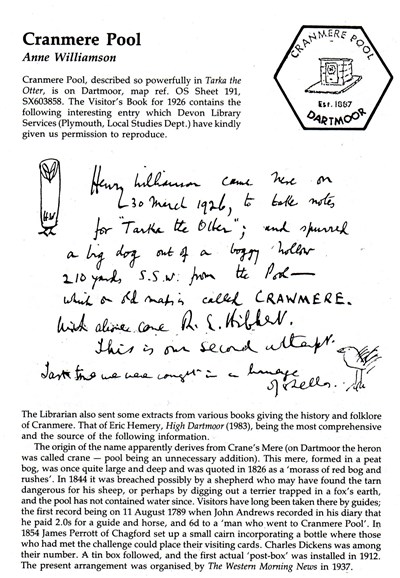
Our story-teller then remembers his last visit, eight years before, with Robin (Hibbert – his wife’s brother) and the problems of writing his great masterpiece (but once again exaggerating the number of drafts!).
 |
|
HW’s 1926 visit to Cranmere Pool, from HWSJ 22, Sept. 1990, p. 38; The entry is topped by HW's owl sign and tailed by a robin sketch (for Robin Hibbert) |
Chapter XV
We visit Cranmere Pool, where the Assistant Professor recounts his Adventures while Riding the Rods and Driving a Team of Huskies, after which several Stories are told, we are Caught in Fog, we Proceed by Compass Bearings and imagine many soft-boiled eggs, we reach our Destination and we eat Hard-boiled Eggs
|
|
| Lydford is bottom left; Cranmere Pool to its east, circled in green |

With some difficulty (it is indeed quite hard going, and not for the faint-hearted) the party reach Cranmere Pool on Dartmoor, with its famous tin post-box and visitor’s book, and the author again remembers his previous visit. We are told of the various rivers that start their journey from the Great Kneeset and companion hills, running in many directions. But they must proceed west as their destination is Lydford, the way is difficult, and it is already 4 o’clock. As they walk the Assistant Professor tells of his daring adventures of train journeys (‘riding the rods’) and sledding with Eskimos (though neither tale should necessarily be believed!).
Our story-teller embarks on a wild tale involving a drunk man covered in ‘snartlegoggers’ (seemingly cockroaches!) and continues thinking up plots for short stories until they, with difficulty in fog and darkness, arrive at Lydford: longing for weak tea and ‘softly-boiled eggs’, only to be given strong tea and hard-boiled eggs, but with ‘Devonshire’ cream – the implication being that cream is cream is cream. (Lydford is the scene of HW’s impassioned visionary tale The Star-born.)
Chapter XVI
The Story of the Poisoned Hounds
(First appeared as ‘The Yellow Boots’ in The Old Stag, 1926, but was omitted from the 1933 edition – so evidently HW had already decided to move it to here: an example of the complicated crossover of time and events.)
A story has been promised and here it is told: the tale of the Inclefell Harriers, Convict Seventy-Six, and the Yellow Boots. Some of the characters in this tale are traceable to HW’s friends of his early Devon years who lived at Lydford. (For those unfamiliar with this background, see Tony Evans, ‘The Radfords of Ingo Brake’ HWSJ 36, September 2000, pp.7-25, and also sketch map of Lydford on p. 27).
(One should remember here that The Star-born, set in Lydford, was actually published in 1933, and HW had taken C. F. Tunnicliffe there so that he could get material for his illustrations for that novel. This all adds to the complications of teasing out HW’s juggling of time and material.)
This tale is a magnificent example of the macabre, and its total reality puts it miles above Conan Doyle’s tale of ‘The Hound of the Baskervilles’! It also contains several moral undertones, as well as yet again highlighting HW’s inability to escape from the war.
The story opens by telling us that the meet has been cancelled: the reason reluctantly and circuitously revealed – the hounds have all been put down because they are said to have worried some sheep and are deemed dangerous. We are also told that the Master of the Hunt and his daughter will not attend the Ball that evening. This all seems very suspicious to some and we eventually arrive at the real story.
Escaped Convict Seventy-Six finds the clothes hidden by two young people who are out to confuse the hounds on the hunt planned for the following day. They have laced a pair of boots with aniseed; they plan to get up very early next day and use them to plant a false trail and lure the hounds away from their quarry. Convict Seventy-Six ignores the pleas of this pair to remove the boots when they discover him that morning. Inevitably the hounds pick up his scent, and finally after a long and exhausting run, when he thinks he has found refuge in ruined Redford Farm, they attack him. The convict is an ex-soldier of the First World War and he relives in his mind a fierce, graphically described, attack; and as he dies he also relives his own crime, equally graphically described – which was to kill his wife and her lover whom he found in bed when he arrived unexpectedly home on leave.
Two days later the girl, Miss Mollie Incleden, daughter of the Master of Hounds – and the young lady who instigated the false trail prank that had gone so disastrously wrong – gets lost out riding and ends up with a lame horse at the ruined farm. She goes over to look at a heap of stones:
Several red-muzzled hounds came to her and leapt up affectionately. They remained by her, two of them licking her face, while she lay pale and still in a fainting fit caused by the sight of two shinbones sticking out of a pair of yellow boots.
Chapter XVII
The Little Man joins the Story, we Discuss the Habits of Water, a Catastrophe is narrowly Averted, and the Party appears generally to Deliquesce.
The Little Man in a bowler hat has popped in and out of this book (as did the strident Mrs Ramrod in On Foot in Devon) and he is reprised here, having miraculously survived being thrown out of the aeroplane, as an ardent follower of our author’s books.
Little Man and Masterson Zeale start an impassioned argument about whether rivers which swing from side to side, in the past ‘swung’ or ‘swang’. HW here is poking fun at pedantic argument over grammar. These two fall one hundred feet off a bridge into Lydford Gorge (the stunning setting for The Star-born). Scylla plunges after them. The Scribe decides the fun is over and leaves. And the Assistant Professor has to catch the boat to return to the USA. But as the story-teller continues round the gorge alone, he sees, ‘below the great cauldron of the Bell Cavern’ (the Devil’s Cauldron), the three who have plunged to its depths, very wet but alive and well. ‘My friends, it is time to quit.’
But before he does, our author describes the gorge at its best, and in his best lyrical manner, and then he continues walking – out on to and over Dartmoor; and his words certainly make one want to follow in his footsteps.
Walk withersoever you will – the more intelligent you are, the happier you will be, so long as you walk: England is yours, if you behave, and remember that your neighbour is yourself.
This chapter ends with a farewell to his ‘dear Scribe’, whoever she is (and one suspects that each of the possible candidates would have taken that mantle onto herself – in actual fact it is Ann Edmonds, who never was his scribe!):
To you, my dear, I dedicate The Maiden Salmon, for you inspired it, you are Love.
Last Chapter
THE MAIDEN SALMON
(This story was first published in Nash’s & Pall Mall Magazine, illustrated by C. F. Tunnicliffe, in December 1934. This prestigious literary magazine started out as Pall Mall Magazine in 1893, and amalgamated with Nash’s Magazine in 1914. There were various problems and it finally ceased publishing in 1937. Sadly, I have not found a copy of this magazine in HW’s archive. A letter from A. D. Peters (HW’s literary agent) dated 4 July 1934 states that Nash would pay forty guineas.)
‘The Maiden Salmon’ is a symbolic (allegoric) tale: once more death proves the only cathartic end for an unrequited love. It is the story of a poet, who carefully prepares a safe haven hatchery for salmon eggs, watches first one (a special one which he always recognises) and then many actually hatch, and the poet carefully protects them during the various stages of growth. Various vicissitudes overtake his special ‘first-born’ fish until its inevitable death, or rather, transformation to another (better) world.
The idea for this story had come to HW, as he recorded in his diary, while he was staying with Charles Tunnicliffe in early 1934 to sit for his portrait. He had just been made aware that his love for Ann Edmonds was not going to be allowed to flourish. In the Memoranda section at the beginning of his 1934 diary he wrote:
Story of salmon at Torcross
Salmon = poet’s soul = Bb
Marked by polt in river Dart. Smolt marked.
Fisherman = girl’s father
Then, soon after his return from the visit to Georgia, USA (as related in The Linhay on the Downs), by which time he had actually got over his ‘love anguish’ (although his hopes were fleetingly reignited on meeting again), he recorded:
26 May 1934: Began short story The Maiden Salmon.
28 May: Did some more of The Maiden Salmon.
29 May: Ditto
10 June: Motored with AT [Ann Thomas, having spent 10 days with HW, was returning home to Tenterden] . . . to see J.H., whose father is dying, at Salt Grass [the father’s home at Lymington, Hampshire]. We drank champagne, I read The Maiden Salmon . . .
The story carries elements of The Star-born, of Tarka the Otter, of The Gold Falcon, from the past and, of course, of the future, the next great book he is in fact constantly preparing in his mind – Salar the Salmon.
Over about two years the poet watches over his young fish. But they are stalked both by a cannibal trout, and a ‘mullhead’ (HW’s diary refers several times to having seen a cannibal trout in his stretch of the river), and eventually one night the mullhead gets into the safe haven and eats them.
Lying on the grass in grief, he notices a beautiful young girl who gazes sadly into the water, noting ‘they are gone’ before disappearing. Seeing something glinting in the water he dips in his hand and discovers it is a tiny gold star. Next to it he also notices a tiny fish, and knows that the ‘first-born’, which the poet always recognised and knew for itself, has survived the slaughter.
Two years pass: the poet visiting every day. The fish becomes a smolt, and when it is big enough he lifts it from the protected pool and attaches that tiny gold star with silver wire to its rear fin – and releases it into the stream to go off and find its destiny.
There was, he knew, in the salmon, a beautiful natural memory of place, pool, bend, fall, and quality of water – which to him was divine.
Another two years pass. All this time the poet has been writing, slowly and painfully, an epic.
The poet was almost to the climax of his epic, but he could write no further: he suffered mental anguish through doubt and confusion, which led to distrust of his inspiration, believing it to be self-delusion, his thoughts due to physical inactivity or frustration.
A line in his poem seemed to stand out on the page,
His tears are clouds these many centuries
and beyond that sorrowful truth he could find no pathway.
(That passage reveals to the reader HW’s naked thought about his own creative process with its self-doubts. It is of intense interest too that the ‘quotation’ of his own line are words that he carved into the lintel of his Writing Hut above the fireplace. ‘The Maiden Salmon’ is as much – perhaps more – an allegory about himself as a writer as it is about unrequited love.)
That night he dreams of his salmon and knows that the time for its return has come. He walks along the coast until he arrives at the shingle bank (guarding the river by which the fish left for the sea). The fish are certainly returning and men in their fishing boats are waiting for them. He waits and watches fearfully. A new boat and crew appears:
rowed by an old man, his two sons, and his daughter. The poet watched her . . . Her thick fair hair, bleached by the sun, was clustered short of her shoulders. Her arms and legs were bare, golden-brown in the sun, she laughed with her brothers, tossing back her hair, she was strong in her maiden grace. . . . he thought he had never seen a brow so candid, or eyes so direct and clear, as though with the sky’s clarity.
Readers of On Foot in Devon will recognise this as the girl HW met at Torcross on the south coast of Devon while researching his material for that volume, and with whom he fell immediately in love – Ann Edmonds.
Now we have a scene very reminiscent of Tarka the Otter as the old man (father of the girl) sees a salmon and gives a similar ‘Tally-ho’ betrayal, as he waves his hat in the air to direct attention to the fish. A single salmon gets caught in the net.
The poet saw a yellow sparkle in the sunlight, and his sight was instantly blackened.
. . . It was small-mouthed, silver-frosty, scarcely spotted – a maiden fish, said the fisherman, who did not notice the gold it bore on its pennon-like fin.
The death of the fish is graphically described.
The poet stood beside the salmon, waiting with bowed head during the agony and betrayal of the spirit’s innocence by forces of life which he knew were irresistible and inevitable . . .
The poet stood there, his eyes seeing not the steady glance of the maid beside him, nor anything mortal while he drowned in a sea deeper than any Atlantic.
The poet returns to his sanctuary:
On the hill above his hut stood the poet . . . His work was done, his life fulfilled, and now he might enter the everlasting stream of time beyond the end of the world.
He prepares his hut for his final departure:
He sat before the wan flames hovering out of the peat, heather of olden time, that was yet sunshine and air and salt of the earth, arising again in flame for the service of another form of life . . . he waited . . . The flame was sinking, and soon he would be free to go.
A pale visitant was now within the hut . . . the visitant was Dawn.
The poet arose, and turned to the door . . . which opened of itself . . . a form appeared before him. . . . [with] the eyes of a sky-maiden. She took his hand and pressed it warmly. . . . her other hand held open [and in it] the golden star and the silver link. . . .
In the eastern sky the Morning Star, Eosphoros the Lightbringer, glowed with its white fires. Joyfully the song of water arose in the valley. The poet looked at the maiden, and knew that his search was ended; for on that brow was sunrise.
*************************
The dust wrapper is a classic typographical design typical of Jonathan Cape's books published in the 1930s:


Scribbling Lark
SCRIBBLING LARK
 |
|
| Faber & Faber, 1949 |
First published Faber & Faber, November 1949 (7s 6d)
Matthews (Henry Williamson: A Bibliography, 2004) states there were 5000 copies.
On the surface this story tells us of a hilarious tongue-in-cheek romp. Set in the mid-1930s, Zig and Zag are two monkeys who escape from the confines of a zoo (identifiable as Regent's Park Zoo) – a virtual prison camp – together with an old and condemned cart-horse amid a great hue and cry from officialdom. The trio meet up with a cockney character who aids and abets them, and takes them to his 'farm' where he looks after them along with his other animal friends. And in due course our crafty cockney has the brilliant idea of entering the trio for the Derby. To avoid recognition the fugitives, with many complicated manoeuvres, are disguised: the old grey cart-horse with indelible scribbles as on the egg of a yellowhammer (once known in the country as a 'scribbling lark'). The two monkeys become one single jockey. By hook and by crook, against all odds and with a great deal of mayhem, the trio do indeed win the Derby.
 |
|
Yellowhammer eggs, actual size (20mm long) . . . |
 |
|
. . . and enlarged (from Richard Williamson's boyhood collection; a time long before egg-collecting became illegal under the Protection of Birds Act 1954) |
Beware dismissal of this book as a mere childish scribble and imaginative lark, however. There is a hidden meaning in the scribbling, an allegory of Orwellian proportions – but where Orwell's oppressed become in time the new oppressors, HW's characters achieve a happier state. This book deserves study of its underlying message in order to come to an understanding of HW's vision of life as it should be: a Utopian world where there is equality for the underdog and ultimate success for the outsider: a racing term, but a word of double entendre here. For is not the condemned nag comparable to HW himself – an outsider, and 'over-scribbled' indeed?
It is also a very moral tale from every turn and twist of the story line.
Although on the surface a funny book to read, this volume (in many ways echoing the earlier The Star-born) actually reveals HW's deeper philosophy, and should be read as such.
*************************
Dramatis personae:
To clarify the story-line here is a list of the main characters who appear in the plot.
Zig and Zag: two monkeys – of the Simian tribe from (or of) Simia ('Simia' being the Latin word for the ape genus which includes chimpanzees – an African ape resembling man). Being intelligent and imaginative they have learned several human traits including a vocabulary of English words. Zig is cleverer and dominant; Zag is submissive and artistic.
Prince: an old cart-horse from the stable adjoining the zoo, used to taking produce to Covent Garden market, and about to be condemned, sold to the 'knackers yard' and killed for meat trade. As the story develops Prince is given various camouflage treatments, and his name is changed accordingly to 'Electric Wonder Boy', 'Charcoal King', and finally the 'Scribbling Lark' of the title.
Tommy Topp: a crafty cockney, retired and ex-alcoholic jockey, and very kindly man, who now drinks only 'cocoa' – a drink so stimulating for both Tommy and his menagerie that it seems rather suspect! (One is reminded of the 'cocoa-drinking' Coneybeare, who threads in and out of various volumes in A Chronicle of Ancient Sunlight.) Tommy Topp has a farm of sorts hidden away in the forest near Epsom, where the Derby is held. One feels there is a distinct element of 'Bert Close', of the so recent Norfolk Farm era, in Tommy.
Constable Copp: a stereotype of the bumbling copper.
Charles James: 'Charley-boy', a vegetarian fox who refuses to touch fur or feather on sporting grounds, as fox-hunting has been stopped in his area. He is not hunted, so in turn he does not hunt.
Oocuck: a cuckoo who, ashamed of the parasitism of his species, sings his name, and flies, backwards. To atone for the sin of his species, he has also built a large communal nest in which all the small song-birds might lay their eggs and raise their young in safety.
Little bantam hen: a very fussy and lonely little bantam hen without a mate, inclined to hysteria, who thinks she is laying fertile eggs which will turn out to be wonderful chick offspring of which she will be so proud; but is very disillusioned by what she actually gets. (There are distinct shades here of the famous 'Little Red Hen'!)
There are many other subsidiary characters who all add to the overall amusement and pathos/bathos of this rumbustious tale.
*************************
In the archive is a small pocket diary for the year 1948, the pages of which are completely empty apart from two, in which HW has made notes for a book called here 'Old Horse':

Then HW's diary over the New Year in 1949 notes:
I went to Yorkshire to see Christine Duffield with whom I had lived happily as my wife since October 1948. We were to be married soon. At York Station I realised the marriage might not take place.
HW had met Christine (who was then teaching in Bideford) that summer, when she and her brother called at his Field when on a walking tour of North Devon. At this point she had returned home to her mother for Christmas to break the news of her imminent marriage. Her mother was very possessive, and hysterically proclaimed this would kill her; and so Christine broke things off. HW fled to the Sutcliffes at nearby Wakefield. (The Sutcliffes, husband and wife plus a brother – Yorkshire industrialists – had rescued HW in the summer of 1945 when he had tried to commit suicide in the sea off Putsborough Sands. They had become firm friends.) At Wakefield:
I occupied my wasted hours in forcing myself to write Scribbling Lark, a child's story of an old horse.
He next went to Botesdale in Suffolk, where his first wife and family were living, noting he was 'distraught' – and where he continued to write this quite extraordinary book. There is nothing to suggest what the catalyst was for beginning the book at that particular time. (It should be stated that after a short while the situation between HW and Christine – and her mother! – was resolved, and the marriage did go ahead on 13 April 1949.)
I would comment here that although HW himself calls it a 'child's story' (as above), and although it superficially appears so to be, that is not really the category it comes under, as should become clear. HW often tended to do himself down, to his own detriment – especially if he had hoped for understanding of his actual purpose.
There is no clue as to why he wrote the book at that particular time; BUT, there is clear evidence in his archive that the genesis of the book was much earlier than 1949, and that its catalyst lay in a very serious subject, for in his archive there is a 4-page quarto (old paper sizing) printed pamphlet, published by the International League against the Export of Horses for Butchery, which consists of:
a) An article 'Reprinted from The Field, March 17, 1934’, headed:
Old Horses for Butchery or Slavery
The Urgency of the Exportation of Horses Bill
This is a plea for the Exportation of Horses Bill to be implemented, which would prevent horses being exported for slaughter.
b) 'Old Horses for Butchery or Slavery', a letter supporting the above from Brig. Gen. Sir George Cockerill, C.B., from The Field, 14 April 1934.
c) A copy of 'A Bill to Amend the law with respect to the exportation of horses and for purposes connected therewith'.

Although this is concerned with old horses being sent abroad alive, under the most appalling conditions, the underlying thesis is of 'old horses being sent for slaughter for monetary gain' – which was to be the fate of Prince as Scribbling Lark opens. The Exportation of Horses Act was finally passed in 1937.
There is also a cutting from The Times, dated 4 March (unfortunately the year has been cut off but presumably around the same time), containing three letters in support of this Bill, headed by one from A. J. Munnings, R.A., Arts Club, London, W.I. This is the famous painter of horses, later Sir Alfred Munnings – a friend of HW. Another is signed 'DORCHESTER' (i.e. Lord or Earl), while the third is from the Director of the National Equine Defence League. HW has written at the top of this cutting: 'The Old Horse'.

The subject has obviously caught his sympathy and imagination, and we can sense his intention: this is reinforced by another small and VERY pertinent cutting pasted on to the first page of the four-page pamphlet:

So there, in 1934, is the basis of the plot for Scribbling Lark. Two further points must surely have some bearing here. In A Chronicle of Ancient Sunlight we read that Phillip, during his years of service in the First World War, had a horse called Black Prince, of whom he was very proud and fond. It is more than likely that the 'Prince' in this story is a homage to that horse. Secondly, there is a considerable amount of farming practice subtly interwoven into this story that arises from HW's late experiences on the Norfolk Farm.
Confirmation of the above, if that is needed, comes in a copy of Scribbling Lark that HW gave to Eric Harvey, managing director of Macdonald (publishers of A Chronicle of Ancient Sunlight), probably at some point in the late 1950s or early 1960s, when the traffic in old horses was again in the news. HW hoped, in vain, to persuade Harvey that Macdonald should publish a reprint. HW has amended both the half title and title page as follows:


And he also pasted into the book the following note:
 |
| (Images provided courtesy of Ted Wood) |
The London Zoo, where the opening scene of this book takes place, was created in 1826 by Sir Stamford Raffles to promote worldwide conservation of animals and their habitats, and was situated in Regent's Park. In the 1930s it was (by today's standards) a rather cramped and dismal place for its captive animals (HW first studied otters at that zoo in the early 1920s). Scribbling Lark ends with a brief reference to Whipsnade Zoo, where the animals are to live happily ever after. In 1926 to mark the centenary of the London Zoo, Sir Peter Chalmers Mitchell, ZSL Secretary 1903-1935, decided to create a more natural extension to the zoo, and for that purpose bought the derelict Hall Farm on the Downs at Dunstable (Bedfordshire), at the cost of £480 12s 10d (an extraordinarily precise sum!). Work commenced on roads and fences for enclosures. In 1928 a few exotic pheasants arrived, along with such animals as muntjac deer, llama, wombat and skunk. In 1932 the collection of animals was boosted by the purchase of a collection from a defunct travelling menagerie: some of the larger animals were walked to the zoo from Dunstable railway station! HW does not use this amazing detail. Whipsnade was officially opened on Sunday, 23 May 1931, with 38,000 visitors on the first day; the main attraction was a brown bear enclosure.
There is one further point: it is evident that HW has quite detailed knowledge of the Epsom area. Although there is no actual evidence that this actually happened, we read in Donkey Boy (Vol. 2, A Chronicle of Ancient Sunlight) – and this must surely be an episode from real life – that young Phillip, when his mother has scarlet fever, goes to stay with his Aunt Viccy (Victoria, née Maddison) and Uncle George Lemon who live at Epsom. While he is there the Derby takes place, and we read of the adults going off in all their finery. Phillip goes off on his own, gets lost in the woods, finally reaches a gypsy camp, and then on to the racecourse itself where he watches the Derby. This is an episode that would have made a great impression on HW, who would be able to recall every detail of the event and the terrain. HW's topographical details in Scribbling Lark are all very accurate.
There are two further known HW connections with Epsom. First, he records a visit there on Sunday, 25 May 1913: 'Sun 100 in shade. Went to Epsom. Saw Uncle Harry [Henry Joseph] and Aunt Mary [Mary Leopoldina] & Mrs. Williamson & her daughter' [his mother and sister? Otherwise unknown!]. Also in 1913, he applied for a permit to visit Holwood Park (one of his 'Preserves'), the said permit being written out and signed by the Dowager Countess of Derby.
It is interesting, therefore, to realise that this story had actually been in HW's mind since the early/mid 1930s. What brought it to fruition at this particular point in his life has to remain unknown. It seems an unlikely task for him to commence, when the promise of a new and happy life-plan has suddenly been demolished!
In recent time Scribbling Lark has not been given much notice within HW's total opus. As already noted, HW recorded in his diary that he had begun 'a child's story of an old horse'. Dan Farson (Henry, 1982) quotes from a letter HW wrote to him in 1950, in which he describes the book as 'my cigarette-card storyette', while Farson himself refers to it as 'a minor whimsical exercise'. I would translate 'storyette' as meaning 'short story', as in 'novelette'. Right at the beginning of this story the monkeys find a cigarette-card of a jockey on a horse and ponder over it. HW probably had such a cigarette card from a series on jockeys and horses – perhaps even Derby winners. He did collect these cards, and there still remains a selection of First World War cards, although many others will have disappeared into the pockets of the various children! Hugoe Matthews in his definitive Henry Williamson: A Bibliography (2004) dismisses the book as 'mostly just daft'.
Even on a superficial level, such dismissal is a gross misjudgement from any and every aspect. It is no more a children's book than Tarka the Otter ever was (interestingly the very similar Salar the Salmon was never so labelled!). Certainly the book can be read as an amusing and rollicking tale – a spree, an escapade of hilarious proportion with HW's imagination run riot. But most of the humour is very subtly hidden within the narrative (which needs reading in full to appreciate it all), and is way above the level of children. Over and above that aspect, the book has a considerably serious context.
This becomes obvious if one compares Scribbling Lark with the very similar George Orwell's Animal Farm (1945) and (although more serious) Nineteen Eighty-Four (1949): books that are given the highest critical praise as satirical allegories.
Animal Farm, subtitled 'A Fairy Tale' is a fable of animals who, in a revolt against their human masters, take over the Manor Farm owned by Mr Jones, led by the pigs planning to run things on egalitarian principles (i.e. communism); in due course the pigs get corrupted by power and under their leader Napoleon (representing Stalin) a new tyranny is established. The book is taken seriously as an indictment against Stalin's Russia. (Interestingly the book was originally offered to Faber but was rejected by T. S. Eliot, a director of the firm, who was quite happy to accept HW's book.)
Nineteen Eighty-Four follows basically the same theme, but portrayed rather more seriously, with humans carrying the story message line. Both are considered to be satirical allegories. A satirist tends to assume some moral norm by means of a tale of wickedness or folly. Dr Johnson's definition of satire was: 'a poem [literature] in which wickedness or folly is censured'; in other words, the use of ridicule or irony in order to expose vice or folly.
Using that criterion one can further differentiate Animal Farm as comic satire and Nineteen Eighty-Four as horrific satire. Into the latter category one can also place Aldous Huxley's Brave New World (1932) – the modern forerunner of this particular type of satiric attack – although that accolade really belongs to Jonathan Swift's Gulliver's Travels (1726).
Scribbling Lark is surely akin to this overall aspect of Animal Farm. However, unlike the latter's pessimistic end, HW's tale is one of optimism: the underdog, the outsider, can achieve success over the actions of the moneyed folly and the attitude of social norms (then much more rigid than now of course), and as the last chapter tells us: 'All Ends Better than Well'. HW highlights the iniquities of animal captivity (the Regent's Park Zoo was a dismal prison in those days – and remained so until well after the Second World War) and he lampoons the folly of the racing world. It also incorporates HW's basic tenet – the search for and possibility of a perfect world; a Utopia – his thinking for a better world for mankind in general, which lies at the heart of the Chronicle of Ancient Sunlight series of novels which he was at this point now beginning to write.
And the thought occurs to me: is Scribbling Lark in some way a prequel for that series?
*************************
The scene opens in the monkey cage of the Zoological Gardens (Regent's Park Zoo). The cage is occupied by two monkeys, Zig and Zag.
The monkeys had wild hairy bodies, and their black faces held glittering angry eyes, while their black noses looked as though they had not grown much except for the nostrils.
Zig and Zag are not happy at their confinement. They are angry and hurt by the noisy grinning crowds of onlookers – the 'everlasting street-faces'. Significantly, we read how these monkeys could, and did, think but such thoughts are only disturbing.
They ran and pranced and swung about their cage in order to find relief from their thoughts.
(HW here describing his own psyche?)
Being intelligent they, particularly Zig, for Zag is the slower of the two, have picked up some English which they can understand very well, but only speak a few words. We learn these are mainly swear words. (HW taught all his children swear words – to the despair of his wife Loetitia – convinced that it would put them off swearing!) Their aim is to escape, and so they keep themselves fit and strong by constant exercise.
Next to their cage, behind its rear wall, was a stable and yard, into which the monkeys could just see from the bare top branch of a tree. In it was an old horse, head hanging down, fixed into the shafts of a 'long-tailed cart'. Zig overhears two men say that the old horse, who has given 'twenty faithful years of service' (and indeed saw service in the First World War) is about to be sold to the slaughter house. The carter, who has looked after Prince every day, feeding, watering and grooming him, feels that the horse is a part of him, and is understandably upset.
Meantime Zag has found a cigarette card, which he chews, but Zig rescues it and looks with great interest at its illustration of a jockey in cap, blouse and boots. While he ponders, the day ends:
Mournful howlings and groan-like noises were now coming from the various caged beasts and birds of the Zoological Gardens. Another useless day was nearly gone, another useless night was beginning.
First thing the next morning – 'another dull London day', and not knowing it would be the day they had been longing for – Zig gives Zag an English lesson, repeating something he has learned from a rude little boy peering through their cage bars.
First he pointed to one ear, then the other ear, then in succession to an eye, to his nose, and finally at Zag, while he said slowly as he pointed to each feature, ‘Ear – ear – eye – nose – you.’
Zag repeats this erudite aphorism, learning it by rote!
During that morning a film crew arrive. The intention is to manipulate the film and make the animals look as if they were talking. They decide Zig and Zag are perfect for their purpose and persuade the Keeper to let them out of their cage. The two monkeys cooperate fully and all is (in fine film crew terms) 'Okay, Fine, Wizard, Terrific.' The two Simians most obediently put themselves back into their cage, going immediately into their tree house night quarters and keep very quiet. Lulled by all the distractions and the quiescent monkeys, the Keeper goes off with the film men without locking the door.
The monkeys take the opportunity to escape and get into the next-door stable, but a whistle blast tells them the escape has been discovered. They hide in the chimney of an ancient copper. At the end of the day Prince is brought back, unharnessed, given drink and food, and shut in for the night. The pair clamber down and Zig sits on Zag's back, as is his habit, to think. To Zag's discomfiture he is heavy and falls asleep. But after a while Zig comes up with an idea: Zag can be the saddle while he, Zig, can wear the torn jacket hanging on a peg with the old broken clay pipe in its pocket in his mouth and wearing the hat, he will look like a human.
Just as they are ready to leave a policeman (Constable Copp) appears – but he finds nothing amiss and continues on his round. But then he hears the stable door open and sees the horse and
what seemed to be a small man with very thin legs, clad in a flapping ragged coat … pushing the horse down the lane.
The policeman blows his whistle:
Zig and Zag, crouching together on Prince, heard the sound, and their hairy feet banged into Prince's sides, to make him go faster. But Prince ambled on as before, for he was old and was not used to going any faster.
They come to and cross the main busy road and gain a 'shadowy park' and after a bit down a path under trees 'they disappeared into the darkness, where they were safe for the time being.'
 |
| The Regents Park/Covent Garden area of London |
Very early the next morning the horse, hearing noises, moves off of its own accord. At the locked gate, a keeper, thinking it is a rider (albeit an odd-looking one) on a horse, unlocks the gate and lets them through. Prince knows the way to Covent Garden Market – where all is bustle and noise.
‘This must be the jungle,’ whispered Zig.
Feeling hungry they decide to steal some nuts – but a voice warns them not to. The voice belongs to Tommy Topp, ex-alcoholic, ex-jockey. Tommy Topp befriends them and leads them to a stable for safety, and makes them comfortable.
And with that, the little bow-legged man in check cap, check coat, yellow waistcoat and stock-tie, natty buckskin breeches and thin canvas leggings fastened with pearl buttons, and thin brown boots, went out, closing the door behind him.
He returns later having borrowed a long-tailed cart in which the two monkeys are to lie hidden, while he drives the cart pulled by Prince down to his farm in the country. He tells them they are 'Simians' from Simia – part of the British Empire:
‘The British Empire's under the flag, and all's free where the old flag waves, so you are by rights free citizens of the empire.’
In the evening they set off, 'over a bridge crossing the Thames' and down the 'Old Surrey Road'. (So – over Waterloo Bridge and down the A24.)
Meeting up (rather fortuitously!) with Constable Copp, who was immediately transferred after the publicity and is as unobservant as ever, Tommy Topp bluffs him, but in his effort to bamboozle the policeman he calls the horse 'Sparkler' – to which Prince refuses respond, it not being his name. Zig calls out the name ‘Prince’, nearly giving the game away, Prince then moves off and they escape.
Soon after midnight they came to open country beyond ragged hawthorn hedges looming darkly in the mist that lay over silent fields.
Turning down a lane which wandered about … [they] continued down a rutted track between trees which led to the forest, and his little farm [Old Kennels Farm] in a clearing, where only owls called under the stars shining in the sky.
(Presumably this is Ashtead Forest, 2 miles north of Leatherhead and 2 miles north-west of Epsom Downs.)
So began a happy period for the four friends.
 |
| The area round Epsom |
We now move into 'farm mode' – HW's so recent occupation! Tommy Topp has an old plough and contrives some harness, setting the Zoo trio to work to plough the field for carrots and beans. The resultant erratic ploughing is like someone writing their name, says Tommy Topp: Zig thinks this the greatest compliment he could be paid! And in due course the carrots have to be weeded – a task at which the monkeys excel (unlike all the weeding that took place on the Norfolk Farm!).
Excellent bread is baked by the mother of the local charcoal burners. (Again, there are several references to very nourishing 'wheaten bread scones' in the Norfolk Farm books.) Tommy Topp's diet is:
Stone-ground wheaten bread, with farmhouse butter, cheese, onions, apples, figs, dates, bananas, nuts, and cocoa.
The bread is delivered by Charles James (Charley-boy the fox) 'brought up as a cub with fox-hound puppies at the old kennels which is now my farm premises'. As fox-hunting has been disbanded in the district, Charles James has, out of honour, given up fur and feather and has become vegetarian. He is well-camouflaged in the red-brown bracken under the silver birches, where the monkeys cannot see him: very nervous and suspicious he does not come forward until sure all is well. He remains uncertain until Zig and Zag search for fleas in his coat, which he loves.
In April a strange bird arrives, calling: 'Oocuck! Oocuck! Oocuck!' Oocuck the cuckoo is a reformed character too. Ashamed of the habits of his species, and so as to deny his origin, he calls his name backwards and also flies backwards 'away from the memories of the past' (a phrase loaded with significant psychological undertones for HW himself).
We are told of other less pleasant birds of the Corvidae family:
Black Matt, the common crow
Pickall, the magpie
Jarrvoice, the jay
Pincher, the daw
Wottafice, the rook – including an amusing reason for the white patch on his face!
All attack the nests of songbirds (as they do). To counteract this act of barbarity, Oocuck has built a huge communal nest where all the small songbirds can nest in safety – although he has problems accommodating all the varying types of nests, and materials of the individual species. He is helped (hindered) in his task by the lone neurotic little bantam hen, who scratches and scatters Oocuck's work. Tommy builds the bantam her own nest in his old piano, safely out of harm’s way, where she happily lays sterile eggs and dreams of the wonderful chicks that will hatch out.
The mystery of the disappearance of the zoo trio continues to dominate the 'newspapers and the news bulletins of the British Broadcasting Corporation'. One paper offers a reward – first £500, quickly raised to £1,000 (a fortune in the mid-1930s!). Constable Copp is the subject of great interest to all and sundry, and he now determines to claim this vast reward. He gets his two boys to go out on their bicycles and start looking for:
any queer, tumbledown-looking old farm building or small-holding in the country at the end of the Old Surrey Road.
Meanwhile:
A great idea was born at Old Kennels Farm [causing great excitement among its various inhabitants] . . . the idea was to lead Prince to the race-course beyond the Forest and to enter him for a race and win some money.
This quickly develops into entering Prince for the great Derby itself.Tommy Topp proceeds to think the scheme out:
‘A werry bold scheme indeed and fraught with difficulties for the trainer, if you see my meaning.’
The main such difficulty of course is that Prince is old, slow, and a cart-horse! However Tommy Topp persuades himself that, despite odds 'longer than ten thousand to one' Prince would be 'the first outsider' to romp home. But he muses that what he really needs is an event to distract the other 'hosses' during the race, like when:
‘one Derby Day a woman jumps out from under the rails and grabs a bridle at Tattenham Corner' [an allusion of course to Emily Davidson, the suffragette, who in 1913 was killed doing this].
Foxy Charles James gets an idea, but being so nervous he can only stutter it out inarticulately; after a while kind, patient Tommy Topp cottons on to his daring plan: to get a pack of 'foxdogs' (Charles James’s old foxhound kennel mates) to chase Charley-boy across the track; all the highly expensive thoroughbred three-year-olds would respond to this wondrous sight and race after them, leaving just one 'hoss, steadily forgin' ahead to the winnin'-post.'
So the plan progressed, madcap idea succeeding madcap idea, until all is finalised. Prince was to be made over to another colour in case he was recognised. 'Intensive training of Prince was begun the next morning.' He is fed on carrots and the cocoa he has come to love. This makes him very lively! Tommy Topp decides to call him 'Cocoa King'.
Racing colours for the jockey-to-be Zig are to be 'carrot with cocoa hoops', made from material found in Tommy Topp's old 'treasure chest' tin trunk. But Tommy realises Zig on his own will be too small and that he must ride on Zag's shoulders: the 'breeches and shirt must be fitted to cover the two on'm.'
The problem of disguising Prince is more complicated. Oocuck flies off to the nearby school and returns with two indelible copying ink pencils which they take apart and proceed to scribble all over the front part of Prince, but then they run out of the purple lead.
Prince was an odd sight, the forepart of him looking, as Oocuck said, like a scribbling lark's egg, which was grey with thin purple lines all over it, a pattern which cuckoos which specialised in laying in scribbling larks' nests found hard to copy.
But that is not going to be good enough: the Derby was a smart race:
The King and Queen with the Princesses would sure to be looking on from the Royal Box.
Tommy Topp thinks charcoal will do the trick, and goes to see the charcoal burners in the forest. The master-burner says the dye from young (green) walnuts would make a better dye, and tells Tommy he is welcome to pick a sackful from the tree next to his cottage. This is a job for Zig and Zag; but so they are not seen it has to be undertaken at night. Tommy cautions them to be careful not to be seen (and so recognised – with the large reward claimed!) and to keep in the tree tops. To make sure they are safe Charles James decides to follow them.
The pair begin to pick the green walnuts, but are so exhilarated by being free in a tree that they excitedly start to play tag, waking up the birds who make loud protest noises, which in turn makes the dog bark. The master-burner is alerted and appears at his door, dressed, with gun and horn of powder in hand. (This is very reminiscent of a similar scene in Tarka the Otter, when the otter is after ducks on the marsh farm in the Great Winter.)
Charles Fox now allows himself be seen. The master-burner thinks the fox is after his hens (as far as he is concerned, a fox does not change its nature), and so sets the dogs after him. But he hears the sound of a hunting horn, ghostly in the night air, blowing the 'Gone Away' call. This terrifies the master-burner who rushes back to hide under his bedclothes muttering fearfully: 'The ghostly huntsman has come agen.'
The monkeys go on playing, and by the time they go back they have forgotten all about the walnuts. On their return they find many dogs in the cottage drinking cocoa. Tommy Topp has a hunting horn and he has been training the dogs ready 'for the Great Day'. Hence the sound heard by the master charcoal burner! Worrying about Charles James, Tommy Topp is unconcerned.
'There is a hollow tree he knows of to climb up into if things go wrong!'
(Again this is an incident that occurs in one of HW's very earliest stories.)
A comment about counting one's chickens before they are hatched upsets the little bantam hen, and to cause a diversion should she have hysterics Tommy Topp suggests that someone should play the piano.
We learn now that Zag has secretly always wanted to be a concert pianist. Monkeys from the zoo had once been taken to a concert at the Albert Hall where Sir Thomas Beecham had conducted a performance of Tchaikovsky's Piano Concerto. This had been for a scientific experiment to record the reaction of the monkeys and their seats had been wired up to a machine. Most of the monkeys had fooled about but:
Zag had registered wave after wave of consistent feeling of high emotional value.
Zag was indeed highly musical. But he was also very shy and nervous. The two monkeys start to play: Zig fooling – Zag serious. And we find now a most moving phrase (emphasised in bold below) summing up what music means to the soul:
Zag touched a note with a paw, then another note, a third note; his second paw went forward, and struck notes in time with the first. They were the simplest harmonies, and discovered by chance … and he played on roaring up and down the scale . . . His music was a simian rune of melancholy for the forest he had never seen but only felt in his bones and in his blood.
All then join in: 'It was a wonderful party', only ended by the little bantam hen asking for less noise as it was disturbing her (non-existent) chicks.
Feeling very sorry for the bantam, Oocuck steals some eggs from the nest of Pickall the Magpie that are on the point of hatching, exchanging them for the bantam's sterile addled eggs. So the little bantam hen hatches out five magpie chicks. The bantam boasts that, with their 'handsome black and white feathers', all take after their father who had won a prize at Crufts Show the previous year. But Charles James knows a magpie when he sees one! (Later the young magpies behave like the thieving magpies they are, and the little bantam hen washes her feathers of them – and joins a gipsy band!)
Prince is duly covered with the charcoal and so becomes black – and is given a new name: 'Electric Wonder Boy', because, as Tommy Topp explains, the bookies will be 'electrified by the sight of him!'.
The day of the Derby is nearly upon them. But at this point Constable Copp's two lads look through the cottage window and see the two monkeys, and so rush off back to London to report, with the £1,000 reward in sight!
However, Tommy Topp spotted them and secretly (so as not to alarm the rest) decides to bring forward his plan of action. They are to leave immediately, and all is hastily loaded up into the long-tailed cart, including the bird menagerie together with fussy – and now bossy – little bantam hen and her five magpie chicks.
Tommy Topp goes on ahead, dressed:
in his best suit, with smart Newmarket leggings, buckskin breeches, waisted coat with slanting pockets and full skirt, stock tie, and natty cap pulled to the side of his head.
They are to rendezvous at the charcoal burner's cottage. Oocuck follows Tommy and is shocked to overhear him telling the charcoal burner to go and phone the newspaper men and tell them where to find the missing monkeys. They are to meet him at The Horseshoe Inn.
The cart and its many occupants arrive and all proceed to The Horseshoe Inn. Tommy now covers Prince with cocoa, and so he becomes a dark chestnut. Everyone else has been hidden under sacks. The press van arrives and two men with cameras alight. They are the same men who had filmed the monkeys at the zoo before they escaped. Tommy Topp announces himself, but the men want proof. Tommy says they must go somewhere quiet. Zig and Zag are horrified to hear this apparent betrayal, but Tommy whispers to them to keep quiet and all will be well. To prove the monkeys are genuine Tommy gets them to repeat the previous fun they had with the camera at the zoo.
The men hand over a cheque for £1,000 and want to rush off to get the story into print. Before they leave, however, Tommy Topp has a long secret conversation with them, which ends with them roaring with laughter. When they have gone Tommy moves everyone back into the forest where they will not be seen and explains why he had acted as he had.
They make camp – and Zig and Zag get into their garb and with difficulty practice as the (single) jockey.
They looked a strange sight, for the tops of the riding boots were drawn up to the top of Zag's thighs, while his feet ended half-way down their leather lengths. The boots were too big altogether. The breeches were tucked well down into the boots; even so, they had to be fastened at the waist of them round the middle of Zig sitting on Zag's shoulders, which meant that Zag's head and face were covered when they were buttoned up.
In order to see, Zag made three small holes in the front flap of the breeches, two for his eyes and one for his nose. . . . but if Zig on top suddenly stretched himself, it pulled the holes [out of place]. Zig would have to keep very still . . .
Tommy Topp, worried about the horse getting undo attention because of its name, changes Prince's name yet again – this time to Charcoal King. He suddenly remembers that he meant to shave Zig and Zag – but there is no soap! After much thought aloud he solves the problem by getting them to plaster on their faces chalk from the ground (like a lady using powder) mixed with a jar of honey to make it stick.
‘Plaster it thick on your mugs, boys, and then lay on the chalk and who would know you from any other son o' Adam? Yippee!’
They proceed forward at lunch time, Tommy knowing that the 'great multitude' would be busy eating and getting ready for the big race – the Derby. But Prince is already hot, and the charcoal is beginning to run – and a scout bee smells the honey on Zig's face and flies off to alert the hive.
Constable Copp's two lads also spot them but luckily don't recognise them, just finding the jockey a curious sight. Tommy Topp frightens them off by offering them magic mushrooms which will make them look like his 'son' the jockey! They then return with their father, who is fairly easily bamboozled by the crafty Cockney. The hive bees also now find Zig's honeyed face, and he has the appearance of a huge brown beard.
Because he is delayed by Constable Copp, the Derby starts before Tommy Topp is ready. All the three-year-old thoroughbreds get off to a great start – leaving 'Charcoal King' to lumber on well behind. Because of the bees Zig cannot see where he is going so Zag, underneath, has to guide him through the eye-slits in the breeches!
Tommy Topp is now very anxious about his plan: will Charles James and the ‘foxdogs’ be released at the right moment to lead the race horses completely astray? He has persuaded the two newspapermen to transport them in their van and to let them loose at Tattenham Corner – then they will get 'THE scoop of the century!' The men have immediately seen the possibilities: Walt Disney might even get involved,
and so many dollars come to the country that the United States would soon be owing Britain money.
(Scribbling Lark seems to be set just pre-Second World War: probably, with its references to the ‘young Princesses, around 1937, when the Princesses Elizabeth and Margaret would have been eleven and seven respectively. Britain had borrowed heavily from the US during the First World War in order to finance the war effort, and was deep in its debt still.)
But Charles James and the foxdogs have indeed done their work.
And when the distant roar suddenly sank away, and a strange silence fell upon all the great crowd of people, Tommy Topp knew that a million-to-one chance might have been pulled off. He sat down on the turf, feeling weak and giddy with the strain. . . .
A cloud of dust in the north-western distance and the remote tonguing of hounds was all that was left of the race. Every [expensive thoroughbred] horse had leapt the railings, taking its jockey with it. On the course hubbub broke out everywhere.
The bookmakers, who had been preparing to flee the scene (‘ready to put on their running shoes’!) in case the favourite should win and they be out of pocket, now relax.
A booming loudspeaker asks the crowd to stay still and keep calm – an unknown horse is still running. Tommy Topp rushes to the Race Stewards and, knowing that the charcoal will have sweated off, tells them the name of the unknown horse is (now!) Scribbling Lark.
But Prince is tiring rapidly, slowing down and bumping his jockey about, while the bees are beginning to sting here and there. A woman carries a placard on which is printed:
THE WICKED SHALL BE DAMNED.
(Again, reminiscent of an early very funny story of HW’s, involving placards with the letters spelling MISSION written on them – which never get round to spelling the word correctly!)
Horse and riders lumber on with increasing difficulty, accompanied by some loudspeaker comments interspersed with records – each hurriedly taken off as unsuitable and inflammatory ('Mad dogs and Englishmen'; 'Boiled Beef and Carrots'). French Farce comes to mind!
THEN:
the rough vulgar voice [of the tannoy] was removed for a voice more familiar to all who took their sport upon the air.
HULLO, LISTENERS, THIS IS BAYMAN BEDRENDING SPORTSCASTING FOR YOU . . .
(For those unversed in the sporting commentary of the time, this is actually the very well-known and greatly loved sports broadcaster Raymond Glendenning (1907-1974) – noted for his horn rimmed glasses, handlebar moustache and his fast-paced, excitable, somewhat plummy broadcasting style. Some years after Scribbling Lark was published he was the narrator in the famous 1952 film Derby Day, starring Anna Neagle, Michael Wilding, Googie Withers and John McCallum.)

Horse and jockey are tiring rapidly, although Zig and Zag continue to push Prince forward in erratic manner, vividly described:

While all the 'society crooks' hurriedly get rid of their ill-gotten pick-pocketed and lucrative gains!
However, as Scribbling Lark is pushed past the winning post he collapses. The crowd turns ugly (and the 'society crooks' take the opportunity to retrieve their stolen loot), and the police form a cordon, while the Chief Constable calls for the owner or the trainer. Tommy Topp comes forward and kneels by the collapsed Prince, with woebegone Zig and Zag standing nearby.
‘Open your eyes, old horse. You done very well, my beauty. . . . You can be proud o' yourself; you broke a record, Prince.’
Tommy Topp accepts full responsibility for everything, asking that the innocent two 'little fellows' should go free. However:
A gentleman with thoughtful eyes and handsome face, beautifully dressed in a quiet manner, turned to the Chief Constable and said, ‘I know this man. He used to ride for me once upon a time.’ The speaker was the Senior Steward of the Jockey Club. [This is actually Lord Derby himself.]
The honorary veterinary surgeon of the course is sent for to help Prince, who soon recovers and is taken off to rest in a nice stall full of hay. Tommy Topp and the two monkeys go before the Jockey Club Committee to explain. Tommy is totally honest and makes a good impression. But proceedings are interrupted:
A footman in livery approached his lordship [Lord Derby, the Senior Steward], bowed slightly, and held out a note on a gold tray. It bore the Royal Coat-Armour.
The King wishes to meet them. The audience, including the Queen and the two Princesses, is very cordial (though our trio were all nervously scared). When presented:
Zag stepped forward, bowed low, took the King's hand, shook it, and said humbly, 'Ear, ear, I knows you,' bowed again, and stepped back in his place.

'And so All Ends Better than Well' (the heading for chapter 35, the last).

*************************
The review file is not very big and most of the reviews are short: one assumes critics were a little puzzled by this rather odd tale. There is nothing from the main-stream press: whether reviews did not exist or were just not kept is not known. Only one reviewer comes anywhere near grasping the true content.
Socialist Leader (Janet Wilson), 26 November 1949; three books are reviewed, the other two being: Maurice Collis, The Great Peregrination (Faber, 25s), a biography of 16th-century traveller Fernando Mendes Pinto, a book 'for those seeking wisdom and knowledge by which to end the conflicts and sorrows of the centuries'; and Millie Toole, Resurrection Road (Dent, 9s.6d) – very obviously a 'socialist' novel, but the reviewer wishes it had had more depth.

Liverpool Daily Post ('R.B.'), 12 December 1949:

Daily Record & Mail (Glasgow), ('J.D.L.'), 14 December 1949:

Yorkshire Evening Press, 15 December 1949; is in similar vein to the above.
The Scotsman, 15 December 1949; also includes: Frank Swinnerton, The Doctor's Wife Comes to Stay (Hutchinson, 10s. 6d.); Elizabeth Bowen, Encounters (Sidgwick & Jackson, 7s. 6d);Osbert Sitwell, The Death of a God (Macmillan, 8s. 6d.):

Bournemouth Daily Echo ('J.D.H.B.'), 17 December 1949; a retrospective and interesting piece (one wonders what HW's father and critical Aunt Maude thought of it!):

Liverpool Evening Express, 20 December 1949:

Horse and Hound, 24 December 1949; note the high moral tone!

Bridlington Free Press, 31 December 1949; in similar vein to other short reviews.
John O'London's Weekly (Sarah Campion), 23 December 1949; in a total column of 10”x 6”, Scribbling Lark gets 6 lines at the end:
a slight, determinedly arch tale about two monkeys confusingly called Zig and Zag, who escape and live with a remarkable menagerie, all of whom thrive upon cocoa.
The Lady, 12 January 1950:

Gloucestershire Echo (Lady Margaret Sackville), 18 January 1950; includes: Christopher St John, Edy, Recollections of Edith Craig (Muller, 10/6) (Edy being Ellen Terry's daughter); Frank Swinnerton, The Doctor Comes to Stay (Hutchinson, 10/6); Holbrook Jackson, The Complete Nonsense of Edward Lear (Faber & Faber, 12/6). The latter item ends:
Happy are they who can breathe that unpolluted air, where nonsense, true nonsense, makes nonsense of our nonsensical pompous activities.
And so leads into –

Sydney Morning Herald (Australia) ('L.V.K.') , 3 June 1950:

*************************
The designer of the dust wrapper is unattributed.


Richard Jefferies - Book covers
Back to Richard Jefferies main page
Book covers:
The dust wrappers below are given in the same order that they are covered on the Richard Jefferies main page.
The Amateur Poacher (Cape, 1934, The Travellers’ Library, No. 202)
Wild Life in a Southern County (Cape, 1934, The Travellers’ Library, No. 203)
The Gamekeeper at Home (Cape, 1935, The Travellers’ Library, No. 205)
These were in the uniform wrapper of Jonathan Cape's 'Travellers' Library' series, and each had the same back cover.
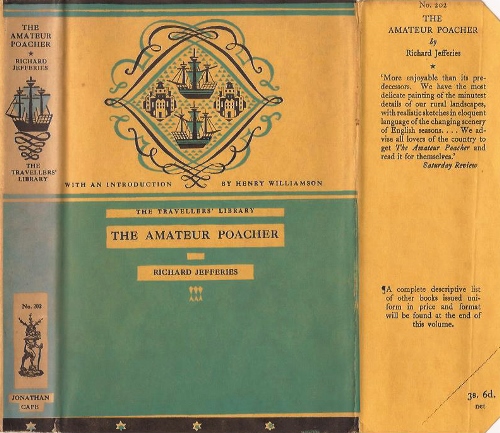
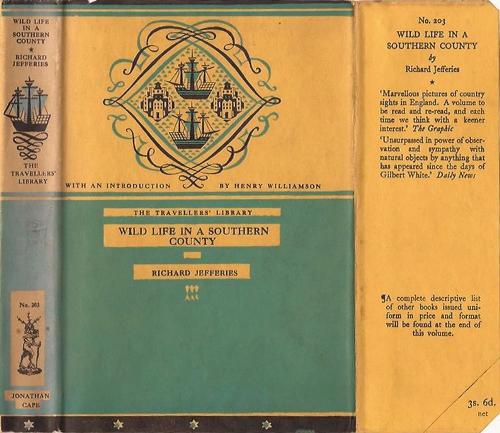
*************************
Richard Jefferies: Selections of his Work, with details of his Life and Circumstance, his Death and Immortality (Faber, July 1937; revised reprint 1947)
The first edition:
Faber reprinted the title in their 'Faber Library' series in 1940 - the copy in the Archive is well worn!
The 1947 revised edition:
*************************
Hodge and his Masters, revised by HW, with a Foreword (Methuen, 1937)
*************************
A Classic of English Farming: Hodge and His Masters (Faber 1946, reprinted 1948)
*************************
Bevis: The Story of a Boy (Dent, 1966, Everyman’s Library, No. 850; first published in 3 vols, 1882)
*************************
An Anthology of Modern Nature Writers (Nelson, Modern Anthologies, No. 6, May 1936)
Nelson reissued the anthology in 1948, in their new ‘Argosy Books' series’, of which this was the second. The series was intended for 'those who value quiet ample writing refreshing to minds weary of the alarums of our time. Their main purpose being to answer the need for intelligent pleasure, books have been specially chosen that have a marked unity of mood and style.'
*************************
Back to Richard Jefferies main page
Richard Jefferies
RICHARD JEFFERIES
HW’s ‘Introductions to’ and ‘Selections of’ the writings of Richard Jefferies (1848–1887)
 |
|
| Richard Jefferies | |
Henry Williamson and Richard Jefferies
Richard Jefferies Centenary Celebrations, June 1948
Henry Williamson and the Richard Jefferies Society
The Amateur Poacher (Cape, 1934, The Travellers’ Library, No. 202)
Wild Life in a Southern County (Cape, 1934, The Travellers’ Library, No. 203)
The Gamekeeper at Home (Cape, 1935, The Travellers’ Library, No. 205)
The above all have the same 5-page Introduction by Henry Williamson
Richard Jefferies: Selections of his Work, with details of his Life and Circumstance, his Death and Immortality, by Henry Williamson (Faber, July 1937; revised reprint 1947)
Hodge and his Masters, revised by Henry Williamson, with a Foreword (Methuen, 1937)
A Classic of English Farming: Hodge and His Masters (Faber 1946, reprinted 1948)
Bevis: the Story of a Boy, Introduction by Henry Williamson (Dent, 1966, Everyman’s Library, No. 850)
Richard Jefferies was born at Coate Farm, near Swindon, Wiltshire, with a farming and country background. He was always a loner roaming the countryside, but he did not want to follow his father and become a farmer. Instead in 1864 he became a journalist on the North Wiltshire Herald and, after his marriage in 1874, began to write books to supplement his income. This is not the place for biographical details of his life: readers wanting to know more should consult appropriate sources.
Jefferies’ love of all country matters was innate, but his life was always a struggle. He first came to the notice of the general public with a long letter in The Times on the plight of the agricultural worker.
His many books include a handful of slightly ‘gothic’ style novels of which the best known is Amaryllis at the Fair (1887). But his main body of work covers rural scenes and subjects: The Amateur Poacher (1879); The Gamekeeper at Home (1880); Hodge and his Masters (1880); Greene Ferne Farm (1880); The Open Air (1885); After London (1885), a somewhat apocalyptic vision of future disaster caused by industrial life and a plea for a return to a more natural life, the only true way to exist; and Field and Hedgerows (1889 published posthumously).
He remains best remembered perhaps for two particular works: Bevis, the story of a Boy (1882), a fictionalised and idealised version of his own young life; and the extraordinarily mystical outpouring of thought in The Story of my Heart (1883).
Jefferies struggled with debilitating tuberculosis for many years, finally succumbing in 1887, aged 38. He is buried in Broadwater Cemetery near Worthing in Sussex, very near that other great naturalist and writer, W. H. Hudson.
*************************
Books on Jefferies often feature a frontispiece with variations of this well-known portrait, either as a photograph, drawing or etching:
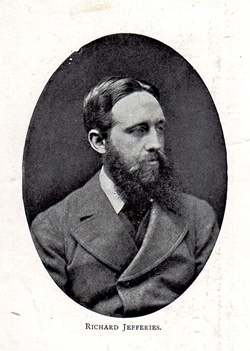 |
 |
The title page of Charles Hibbert's ('Pa' – HW's father-in-law) copy of the first edition of The Story of my Heart:

Pa gave the book to HW, who annotated the half title thus (though Pa had not lived at Chalfont Park for very many years):
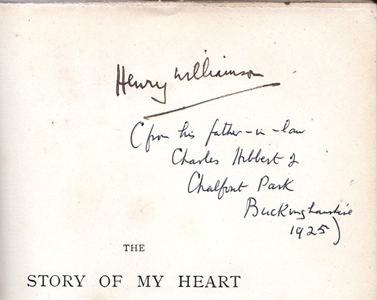
Pa's book plate, showing the family motto and crest:
HW at Jefferies' grave, when he visited with Gipsy in August 1936:
 |
 |
Henry Williamson and Richard Jefferies:
HW’s connection, appreciation of and affiliation to the work and spirit of Richard Jefferies began at a very early age and continued throughout his life; Jefferies’ influence is diffused and evident in much of his work. Practical evidence of this can be found in HW’s editing of some of his mentor’s work, and this is gathered here under one umbrella – although most will therefore be out of sequence in the overall chronological time-scale of HW’s ‘Life’s Work’ – in order to give emphasis to this very important area.
Jefferies’ influence on HW has been well documented. For example, see particularly: Dr Wheatley Blench, ‘The Influence of Richard Jefferies upon Henry Williamson’, Part I, HWSJ 25, March 1992, pp. 5-20; Part II, HWSJ 26, September 1992, pp. 5-31 (Part II is scanned in two sections; Section One and Section Two). There are many other references within the HWSJ, particularly the special issue, HWSJ 41, September 2005, which contains several major items concerning HW and Jefferies, and indeed W. H. Hudson).
It had all started at a very young age. HW’s grandfather (Henry William Williamson senior, 1834–1894) had had a copy of the first edition of Bevis, published in three volumes. He had given this to his eldest son, William Leopold (1865–1946, HW’s father) who in his turn had given it to his son, HW, when he was about ten years old. HW frequently referred to the joy the book gave him as a young lad. The books still exist, but are now very fragile. The first volume is inscribed:
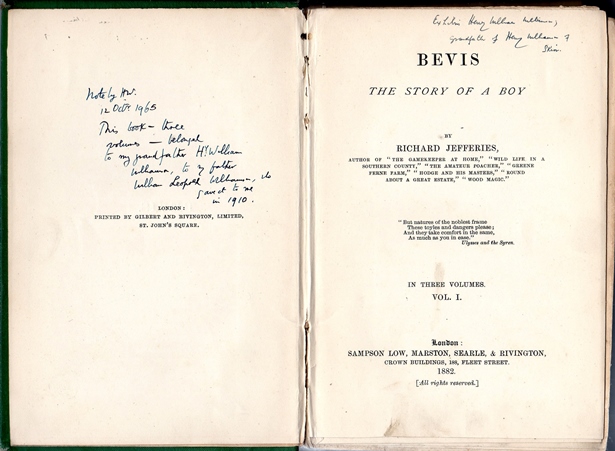
The inscriptions enlarged:

HW had also read at least some other books by Jefferies, and when he left school in the summer of 1913 was disappointed that the Jefferies books he had asked for as his prestigious Bramley Prize (for an essay) were instead two huge volumes of The Bible in Art. He wrote in his schoolboy 1913 diary that he intended to get Jefferies books with any money left over (but I don’t think that occurred!).
In early 1919, still in the army and stationed in Folkestone, it was his discovery of a copy of Jefferies’ The Story of My Heart in a second-hand bookshop, at a time when he was much traumatised in the aftermath of the war, which was a turning point in his life. He found himself in complete empathy with all Jefferies’ thoughts, giving him the determination to follow in Jefferies’ footsteps and reinforcing his intention to become a writer himself.
This volume was not in his archive and was thought to be totally lost; but recently somebody made contact as owner of the book, and very kindly loaned it so it could be verified. Carefully trying to work out its provenance via tiny details in the archive, it would seem that HW sent this book to his ex-headmaster at Colfe’s Grammar School, Mr. E. V. Lucas, and that at some point afterwards it was sold on. HW had illustrated the flyleaf of his copy in this fashion – doodling, perhaps, while his mind should have been on service matters!

HW left the army in September 1919 and began work seriously on his first novel. In 1920 he began keeping a ‘Journal’ in a large (folio-sized) second-hand alphabetised ledger into which he poured all his thoughts, ideas and plans for stories etc. He dedicated this Journal to Richard Jefferies, and decorated the cover with further drawings of his barn owl totem:

Evidence of the influence of Richard Jefferies abounds in his early writing, where the mystical Romantic elements are evident, together with the interest in nature and the influence of our ancestral and mystical past.
In 1930 HW was given (by his friend and fellow-writer Jan Mills-Whitham) a copy of Edward Thomas’s biography Richard Jefferies: His Life and Work (Hutchinson, 1908), which Thomas dedicated to W. H. Hudson.

Jan Mills-Whitham's inscription:
On the next page HW noted in pencil:
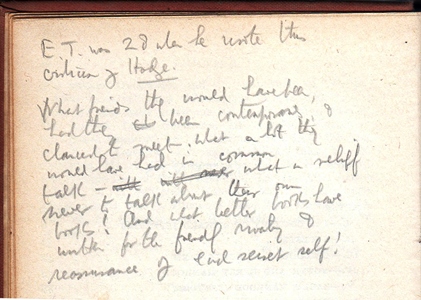
Thomas's biography is a useful, well-written and sensitive work, taking the reader through Jefferies’ life and writing. The final chapter, ‘Recapitulation’, particularly grasps the essence of his subject. It also contains a handy chronological bibliography.
HW also had copies of Walter Besant’s Eulogy of Richard Jefferies, written immediately after Jefferies’ death in 1888; Henry Salt’s Richard Jefferies: His Life and His Ideals (1894); and various other works. By this time he also had a very good collection of Jefferies titles, as illustrated below. Many of them came from the library of his father-in-law, Charles Hibbert, who had a complete collection of first editions of Jefferies titles (along with many other excellent natural history works).
*************************
There is no clear archival evidence to reveal what actually led HW to edit Jefferies’ writings, other than that he would have had a natural urge to bring his great mentor to the fore. His 1929 diary notes re ‘work in hand during March’ to include:
3. Preface to Gamekeeper at Home
4. Read Jefferies & prepare Introduction to his selected essays.
For some reason this work was delayed until 1934, when a very friendly (and clear) letter from Jonathan Cape dated 30 May shows that the idea had been discussed:
As to the Jefferies introduction; the fee is ten guineas and I want it to be not less than twelve hundred words, but you can of course make it as long as you like. I would like the introduction to be one which deals with WILD LIFE IN A SOUTHERN COUNTY, THE GAMEKEEPER AT HOME and THE AMATEUR POACHER. It could then be applicable to all three books. If you prefer, or find it easier, to write three introductions, one for each book, that would suit my purpose equally well – in fact rather better. There would have to be approximately a thousand words for each in length and I could offer you twelve guineas for the three.
(Note how carefully Cape is setting out these terms: he intends no repetition of earlier problems he has had with HW!)
HW baulked at writing three separate Introductions, and we find the same Introduction by him, dated June 1934, appearing in three separate Jefferies’ titles published by Cape:
 |
|
| Jonathan Cape, 1935 |
The Amateur Poacher
Cape, 1934, The Travellers’ Library, No. 202
Wild Life in a Southern County
Cape, 1934, The Travellers’ Library, No. 203
The Gamekeeper at Home
Cape, 1935, The Travellers’ Library, No. 205
This Introduction was reprinted first in Cape’s house magazine Now and Then, No. 49, Winter 1934 (in the same issue as their rather low-key advertisement for The Linhay on the Downs) and, later, in their anthology Then and Now (Cape, 1935).
The first page of HW's TS Introduction:
 |
 |
It was also reprinted in an abridged version in The Literary Digest, summer 1947.
*************************
In 1937 HW made a far more major foray with:
 |
|
|
First edition, Faber & Faber, 1937 |
Richard Jefferies: Selections of his Work, with details of his Life and Circumstance, his Death and Immortality
Faber, July 1937; revised reprint 1947
For this HW wrote a substantial ‘Introduction’ in two parts: I, ‘The English Genius’ (pp. 11-30); and II, ‘To the Two types of Jefferies’ Readers’ (p. 31). (Part I of this ‘Introduction’ is reprinted in Indian Summer Notebook, ed. John Gregory, HWS, 2001; e-book 2013.)
There is also an ‘Epigraph’, where HW explains his own route through Jefferies’ work. At this time HW was at a crossroads. Life as he knew it was in a great state of flux. It is obvious here that he was transferring his own feelings on to those of Jefferies (as he also did with T. E. Lawrence at this time). Jefferies had found great difficulty to begin his great work – HW found it impossible to begin his: both men are concerned with facets of ‘Ancient Sunlight’. Jefferies had fought his ‘three giants of disease, despair, and poverty’: HW was fighting his own giants – giants arising from his own traumatic past of the First World War and now the future looming of another World War. He had visited Germany, seen what was going on, and now was in the process of leaving Devon for the farm he had bought in Norfolk. There is no doubt that he was in a great state of turmoil and confused thought.
There are brief notes at the beginning of each section, each containing two or three selections covering most of Jefferies’ books: thus bringing a large area of Jefferies’ total opus to the notice of readers in one volume. Here is what he wrote about Bevis:

His choice of selections offers a comprehensive coverage of Jefferies' books:
 |
 |
The book also had a scattering of photographs, three of Jefferies, with one of his memorial bust, and also four photographs taken by HW himself (or his wife). HW had his own copies of various photos of Jefferies.

The photograph above, in the Bevis extract, shows HW wandering at Coate Water, and is captioned: ‘Bevis’ New Sea, where the Nile flows into Fir-Tree Gulf, January 1937’.
HW states that he made a visit to Coate Water in 1925, the year he got married. There is no actual evidence of this visit, but as his bride was also a lover of Bevis then they quite possibly did make a visit during that year. But certainly in 1936 he and his wife Gipsy, and their eldest son Windles, called in on 27 August after a visit to the Norfolk Farm, and HW recorded in his diary, ‘bathed in Jefferies’ lake at Coate’.
In January 1937 HW made a further visit, again calling there with his wife on his way back to Devon (this time after a difficult session with Ann Thomas at Tenterden, who had told him she was about to marry someone else). He recorded that he took photographs for his book of selections from Jefferies’ writing. However the photograph ‘Coate Water Today’ must have been taken on the August 1936 visit, as HW states there were ‘Thousands of people were swimming, boating, walking about’:
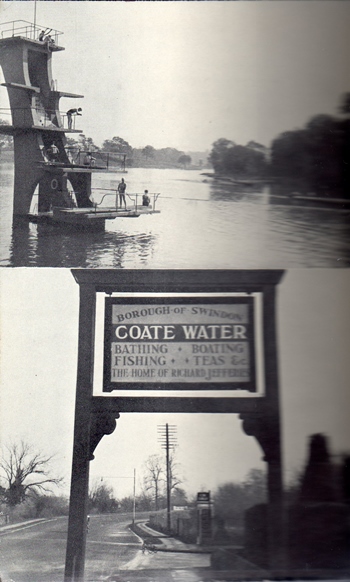
Hardly thousands! – HW was seeing it with regret for Jefferies’ idealised portrait in Bevis, where the two adventurous boys had this momentous ‘sea’ to themselves.
The other photographs in HW’s Selections are ‘Coate Farm (thatched in Jefferies’ time) today’:
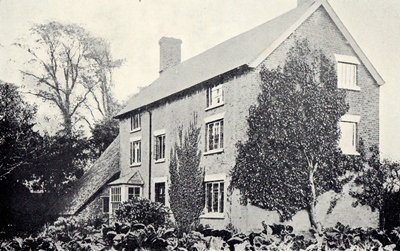
‘Roman earthwork above Liddington’:
It was climbing that earthwork – Liddington clump – that inspired Jefferies’ writing in The Story of my Heart:
I was utterly alone with the sun and the earth. Lying down on the grass, I spoke in my soul to the earth, the sun, the air, and the distant sea, far beyond sight.
In his short introductory paragraph to his selection from this important work, HW wrote:
It is, for me, one of the most beautiful and most noble books in the world.
HW’s selection includes the passage that contains the words he wrote at the front of his 1920s ‘Richard Jefferies Journal’:
It is eternity now, I am in the midst of it. It is about me in the sunshine; I am in it, as the butterfly floats in the light-laden-air.
HW’s equivalent of Liddington Clump was Caesar’s Camp – the ancient hill fort overlooking Folkestone, where in 1919 he first read The Story of my Heart, and where on ‘Peace Night’ 1919 he had his own mystical experience. Jefferies’ book affirmed his own life’s purpose.
He notes that there was a time when The Story of my Heart was considered ‘dangerous’ for a young impressionable youth. It hardly seems possible that such visionary thought could be so labelled.
HW’s book Richard Jefferies: Selections went into several editions over the years. The 1947 new edition, also published by Faber, has an additional extract: ‘A Pageant of Summer’ from Life in the Fields.
*************************
Also in 1937 HW produced a new edition of:
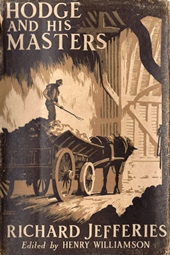 |
|
| First edition, Methuen, 1937 |
Hodge and his Masters, edited by HW, with a Foreword
Methuen, 1937
Here HW edited Jefferies’ text to a high degree: changing the order of chapters, leaving some out, ‘cut and pasting’ others (that is, moving passages of actual text around within chapters) and changing the headings. He felt this would make the book more acceptable to ‘modern’ readers, but it is known that Jefferies’ closest adherents resented (understandably) this interference with the master’s work. The book has a nice selection of 10 photographs which had all previously appeared in The Farmer’s Weekly.
HW’s Foreword opens: ‘This is a rich and beautiful book of England.’ He states that Jefferies was too overworked and too ill to do the book justice: that if Jefferies had had time and energy to correct it, he would have done what HW has now done – and he goes on to tell readers what that is. (As HW himself became a farmer from 1937 to 1945, his editing of this volume was particularly apposite.)
The frontispiece features an evocative portrait of 'Hodge':

In 1946 HW produced another edition of Hodge and his Masters (sadly without the photographs), giving it the new title of A Classic of English Farming: Hodge and His Masters (Faber 1946, reprinted 1948). Inside his copy of the first edition of the book, he wrote:

For this new edition, the introduction for the original Methuen edition was first amended:

and then re-written:

Note, though, that the actual new printed introduction has considerable further alterations!
*************************
In 1965 HW was asked by Encyclopædia Britannica to write (at short notice) an article on Richard Jefferies, as they had an unexpected chance to replace ‘our present inadequate article’. HW composed a short tribute forthwith.

*************************
Then in 1966 HW wrote an Introduction for a new edition of:
 |
|
| Dent, 1966 |
Bevis: The Story of a Boy
Dent, 1966, Everyman’s Library, No. 850
(First published in 3 vols, 1882)
HW's Introduction opens: ‘“Moony Dick”Jefferies as some called him in boyhood . . .’, referring to Jefferies habit of ‘mooning’ or ‘roaming’ around the countryside, on his own and avoiding contact with others. Bevis is one of those classic stories of boyhood – as HW notes: ‘Bevis and his friend Mark are the heroes; and what adventures they have!’
Those adventures include a mock battle between Caesar (Bevis) and Pompey (a boy called Ted) which they call ‘The Battle of Pharsalia’ – which develops into a real fight; Bevis runs off and eventually gets himself on to a secret island where after some time he is found by Mark. (One is reminded of HW’s scene in The Beautiful Years, when Willie runs away after the death of Jim Holloman: further evidence of Jefferies’ influence on HW’s early writing.)
The scene of the book is based on Coate Water, and is an idealised version of Jefferies boyhood. It is a vivid story of how a child’s imagination takes him into his own world. HW writes here, 'Clear sight is the base of all good writing . . . the true artist sees clearly and with wonder. . . . It is this quality that makes Bevis a book almost unique in its class.'
We are given a map of Bevis’ ‘New Sea’ as a frontispiece:

*************************
In 2005 the Henry Williamson Society marked its ‘Silver Jubilee’ with a ‘Special Issue’ of the HWSJ (no. 41, September 2005), almost entirely devoted to the two men who so greatly influenced HW: Richard Jefferies and W. H. Hudson. Apart from reproducing a great number of items from HW’s archive, this issue includes an excellent article from a talk given by a member of the Richard Jefferies Society, the poet Richard Stewart: ‘Henry Williamson’s Debt to Richard Jefferies’.
*************************
In 1936, HW produced an anthology, not just of Jefferies (or even Hudson) but a whole array of extracts from writers on the natural world. It seems appropriate to include that here.
 |
|
| First edition, Nelson, 1936 |
An Anthology of Modern Nature Writing
Nelson, Modern Anthologies, No. 6, May 1936
HW’s Introduction gives brief but interesting notes on each of his chosen authors, and his list makes an interesting appraisal of natural history writing (as did his ‘Reality in War Literature’ essay on the First World War):
The anthology was reissued in 1948 in Nelson's new ‘Argosy Books' series’, of which this was the second. The series was intended for 'those who value quiet ample writing refreshing to minds weary of the alarums of our time. Their main purpose being to answer the need for intelligent pleasure, books have been specially chosen that have a marked unity of mood and style.'
The eclectic nature of his selection is shown by the Contents pages:
 |
 |
Pasted on the inside cover of HW's copy of his anthology is this cutting about his forthcoming broadcast 'Red Deer'. The reaction of readers of Cruel Sports to the talk is not known. The text of the broadcast features in Goodbye West Country – interestingly, in different working versions in parallel text; and is collected in Spring Days in Devon, and other Broadcasts (edited by John Gregory, HWS 1992; e-book 2013):

(There are other HW anthologies over the years: total coverage of every item is impossible.)
*************************
In 1958 HW was made a Fellow of the Royal Society of Literature (FRSL). (For background, see Anne Williamson, Henry Williamson: Tarka and the Last Romantic (1995), and Fred Shepherd, ‘A Visit to the Royal Society of Literature’, HWSJ 32, September 1996, pp. 35-6.)
The following year he was invited by the RSL to give the prestigious Wedmore Memorial Lecture on 9 October 1959. His title was 'Some Nature Writers and Civilisation', his chosen authors being chiefly Richard Jefferies and W. H. Hudson, the two writers to whom he felt most indebted. This is an important item within HW’s total oeuvre. The essay was printed in Essays from Divers Hands, Vol. XXX (the annual Transactions of the RSL) (OUP, 1960), and reprinted by OUP as a single pamphlet item at the author’s request (it is thought there were about 100 copies). (The essay is included in Threnos for T.E. Lawrence & other writings, ed. John Gregory, HWS, 1994; e-book 2014.)
(See 'Some Nature Writers and Civilisation' for further details about this lecture.)
*************************
There are a considerable number of cuttings concerning Jefferies in the archive files, but many of those are to do with Jefferies’ life and philosophy and do not really concern the immediate subject here. They reflect the intense interest in Jefferies held by HW throughout his life.
Hodge and His Masters, 1937
There are a handful of reviews which interestingly compare HW’s edition with Samuel J. Looker, Jefferies’ England (Methuen 7/6d), and so highlight the rivalry between them.
The Friend (William Graveson), 3 December 1937:
Looker’s book contains a selection of about thirty essays grouped according to the seasons . . . a sympathetic introduction and a useful bibliography, illustrated by Will Taylor.
Hodge . . . first published 1880, revised by the well-known West Country author, Henry Williamson, . . . The keynote to the book may be found in Williamson’s exclamation, “Bravo, Jefferies, you’ve given us a whole countryside last mid-century.” . . .
The value of the book is in its portraits of farmer and labourer, squire and parson, mademoiselle the governess; and of the trials and pleasures of the countryside folk.
Cornhill Magazine, December 1937; Contrasts Looker’s book to HW, rather favouring Looker as the better volume. On HW:
One may question the propriety of [HW’s] revision . . . but at least the revision is done with loving knowledge in the hope that new readers will be found for this very interesting account of more than fifty years ago.
New Statesman & Nation (Robert Waller), 4 December 1937; A ten-inch column which is purely a review of Looker’s book but refers to HW’s Selections:
It is fifty years since Jefferies died. Two books have commemorated his jubilee. The first was Henry Williamson’s selection reviewed in these pages a few weeks ago. [Not in file!]
[This reviewer makes it clear that he prefers the Looker volume. Looker] describes the nature of this change [between early & late RJ] without the fantastic comparisons and claims which spoilt Mr. Williamson’s work.
Manchester Guardian (A.W. Boyd), 3 December 1937; A long column reviewing ten books of varying natural history subjects headed as ‘The English Scene’ (Jefferies heads the list). It again compares the Looker and HW volumes, but merely notes both have been published, and then continues with thoughts on RJ himself.
Oxford Times, 21 January 1938 (22” column):
‘Dr. Jekyll’s Notebook’ by Jekyll Junior
Farming Sixty Years Ago
[A review of Hodge: a thoughtful and detailed article, highlighting and analysing the problems of farming, continuing:]
But now a new edition of “Hodge” revised and edited by a great admirer of all that Jefferies wrote, has just appeared. Mr. Henry Williamson has taken the old work as though he had taken a series of separate articles, and dealt with them as he feels Jefferies himself might have done. . . .
Mr. Williamson’s revision deserves only praise, for he has carried it out with such sympathy with Jefferies’ outlook and such understanding of his method of writing . . . that [indeed] the author might have done the work himself. . . . It is a story of the English countryside then and now, and for ever.
British Weekly, 19 December 1940 (12” column); subheading, presumably as publisher: ‘St. Hugh’s School, Bickley, Kent’: print is as a newspaper. The general tone of the reviewer of five books here under heading title ‘Land and People’ is that books on country life will strengthen the reader in these dark days and difficult times. HW gets:
It is good to note the addition to the Faber library of [Richard Jefferies: Selections of his Work] . . . This book was a marriage of true minds, and now is a good time to issue it in a cheap edition.
************************
The 1947 reprint of Richard Jefferies: Selections of his Work quite interestingly got quite a wide coverage, although some of these were very brief. Here is a selection of those that had more interesting comment.
Daily Herald (John Betjeman), 20 May 1947 (‘Betjeman on Books’); A slick column in typical ‘Betjeman’ vein – in total a 30” column:
If it were not that there are so many books worth mentioning . . . I would spend all this column in praise of Richard Jefferies. . . .
Henry Williamson’s selection and notes on him have been reprinted . . . on chemical green paper. [War economy restrictions] Despite a hectoring preface, “if you don’t like Jefferies, you are no good”, this is a learned, sensitive, enthralling selection. It shows the two sides of Jefferies – the portrayer of natural downland scenery and wildlife, the speculation on eternity and man’s purpose in creation. . . . This is a book I shall hold on to after I am sold up.
Oxford Mail (S. P. B. Mais), 15 May 1947:
There are few writers for whom I have a deeper respect than Jefferies and Williamson. . . . The astonishing thing about this book [Selections] is its modernity. . . . It tackles all the problems that still perplex the family and tackles then with very unusual good sense.
Mais goes on to remind readers of HW’s Hodge and his Masters, and recommends that both should be read: even though the reader has little time and there are many more exciting books out there!
Nature (E. John Russell), 3 May 1947 (12” column): A very reasoned account of the book’s raison d’être and HW’s handling of it; praising the inclusion of Jefferies’ long letter to The Times and its subsequent crushing criticism in the Liverpool Mercury.
John O’London’s Weekly (John O’London, nom de plume – whom at this time not known), 31 October 1947: There is a whole page under the regular heading ‘Letters to Gog and Magog’ (mythical giants who were considered to be in the service of the devil): ostensibly it is a review of HW’s 1947 revised reprint of Selections, under the heading of ‘Jefferies as Prophet’; it gives a considered and wider critique of that concept, questioning its validity, and noting that HW had compared Jefferies with Hitler: ‘The description, I’m afraid, does not square with the facts.’ (And no, of course they didn’t in 1947: the words were written in 1937, when, although naïve, they were valid in the context understood by HW. Certainly both HW and his publisher Richard de la Mare should have realised the problem the phrase could create in 1947.)
His [Jefferies, but one suspects that the reviewer means equally applicable to HW!] desire to be a prophet did him honour. But in Jefferies the power of observation and feeling was greater than the power of thought. He may be for Mr. Williamson and some others the “prophet of an age not yet come into being”, but to many people his teaching will not seem to be true. That fortunately does not debar them from enjoyment of his best work.
I am, gentlemen,
Yours faithfully, John O’London
Sphere, 10 May 1947:
Richard Jefferies: Prophet
Richard Jefferies, essayist and observer of nature, was a lyrical and impassioned writer with a love and accurate knowledge of natural history. His outstanding work The Story of My Heart, has brought him immortality, but the Victorian world in which he lived labelled him as a mallard [sic – malade] imaginaire, a poverty-stricken neurotic. We now know better, realising that Jefferies was a prophet crying in the wilderness of the industrial age, the theme of whose whole work was the burning hope for a better, truer, more sunlit world for mankind. Henry Williamson has since his youth been devoted to the personality of Jefferies and now as Richard Jefferies (Faber & Faber, 8s. 6d.) he gives selections from his work and some further details of his life. This book will introduce Jefferies to a yet wider public, and in so doing does a service to literature for his prose belongs to our literary heritage.
*************************
Click on the link for illustrations of the various dust wrappers to the titles covered here.
*************************
Go to:
Richard Jefferies Centenary Celebrations, June 1948
Henry Williamson and the Richard Jefferies Society
Winged Victory
WINGED VICTORY
Victor M. Yeates
 |
|
|
First edition, Jonathan Cape, 1934 |
|
First published Jonathan Cape, 24 June 1934, 10s 6d
Second impression. Although dated November 1934, it is likely that publication was actually early in 1935, for the memorial 'Tribute to V. M. Yeates’ by HW, written following Yeates’s death in December 1934, is dated January 1935.
Harrison Smith & Robert Haas, New York, 1 October 1934, $2.50
Jonathan Cape, reprint, 1961, with new additional ‘Preface to the New Edition’ by HW, 25/-
World Book Club, abridged edition, 1963, 18/-
Consul Books, paperback, 1964, 5/-
Sphere Books, paperback, 1969, 6/-
Rizzoli, Milan, 1969 (Italian edition, title Alta quota)
Mayflower, paperback, 1974, 60p
Buchan & Enright, ‘Echoes of War’ series, paperback, 1985, £5.95
Grub Street, paperback, 2004, £9.99
(This page is created with due acknowledgement to Gordon Atkins’ definitive biography Winged Victor: A Biography of Victor Yeates, Springwater Books, 2004; e-book 2014.)
Dedication:
To
HENRY WILLIAMSON
at whose suggestion this book was begun, with whose
encouragement and help it was written and ended.
Victor Maslin Yeates (born on 30 September 1897), living in Blackheath, attended Colfe’s Grammar School, where he was in Buff House with HW. He is mentioned in HW’s 1913 diary, for instance where he notes that they went to the local ‘Hippo’ (Hippodrome) together two evenings running! They were both in their house team for football and cricket and, above all, the Harriers (the school’s cross-country running team). They were both also in what was known as the ‘Special Slackers Class’ – that is, not cramming for entrance to university but learning commercial skills, including bookkeeping and shorthand. (Many of HW’s entries in his 1913 diary are ‘coded’ in shorthand, although it isn’t Pitman’s.)
Yeates features in HW’s early novel Dandelion Days (1922 – part of The Flax of Dream tetralogy), which relates life at ‘Colham School’ (which equates to Colfe’s), where he is part of the final very moving ‘Bagman’s Outing’.
On leaving school in summer 1913 (Victor actually still only 15, HW was 17) they went their separate ways: HW to be a clerk in the Sun Fire Insurance Office in the City, while Victor became a bank clerk. There is little evidence of any continued contact, but it is known that they did meet occasionally.
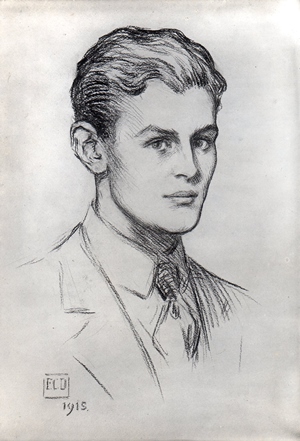 |
|
Yeates aged 18 HW's own copy of a charcoal portrait that Yeates had originally suggested be used as a frontispiece in 1934 |
Being two years younger, Yeates did not join up until late November 1915 (two months after his 18th birthday), when he was placed on the Reserve List, becoming actively enlisted on 24 February 1917 as a private in the OTC (Officers’ Training Corps) at Berkhamsted Training Camp. At the end of three months' training he was transferred to the Royal Flying Corps (RFC) in May 1917.
Yeates’s training, which was not without its dramatic moments, continued until February 1918: by then he had logged about twelve hours of dual flying instruction and fifty-three hours of solo flying, of which the last thirteen hours were in a Sopwith Camel – a tricky plane to fly, particularly by a novice pilot.
 |
| Victor Maslin Yeates – his passport photograph |
Yeates had married in July 1917, aged only 19 and while still training, to the total disapproval of his (admittedly very difficult) parents. In due course he and his wife Norah had four children: Mary, born September 1918; Joyce (Joy), born 1919; Guy, born 1922; and Rosalind, born 1927. The family lived in extremely difficult circumstances at 569 Sidcup Road, Mottingham, in south-east London, very near the childhood homes of both Yeates and HW. (Norah never remarried after Yeates's death in 1934; she died in 1982.)
Yeates, after completing his training, was sent to France in February 1918 and joined 46 Squadron, flying Sopwith Camels. The German Spring Offensive began just over a month after his arrival, and he flew intensively, many operational flights consisting of the unpopular (because highly dangerous) ground strafing of attacking enemy troops. There was no let up and the strain on pilots was tremendous. In August 1918 he was transferred to 80 Squadron, but the end of that month saw him hospitalised, and he was invalided back to England suffering from Flying Sickness D (for Debility), brought about by the strain and conditions of constant flying and sorties. He was given one month’s sick leave, which was further extended to 7 November 1918, when he was transferred to TDS Fairlop as an assistant flying instructor, being finally discharged on 23 May 1919. In Yeates's seven months in France he had flown 110 operational sorties, and had a total of 188 hours. Gordon Atkin states:
He had been shot down once (by machine-gun fire from the ground), had four forced landings and had crashed three times whilst attempting to land back at the aerodrome and all these events are faithfully described in [Winged Victory].
He had shot down two enemy aircraft himself, had a share in three other successes, and had, with Capt. MacLaren, brought down a balloon in flames. The term 'ace', a description Victor would have derided, is used to define a pilot who had shot down at least five enemy machines. As the British treated a shared victory as a whole victory for each of the indiviual pilots where more than one was involved, Victor is regarded as one of the aces of the war.
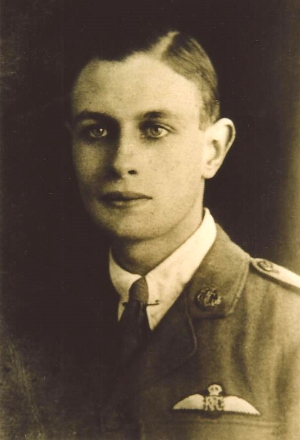 |
| Yeates in 1918 |
Yeates’s experiences as a First World War pilot with the RFC (which became the RAF on 1 April 1918) became the basis of his book Winged Victory, where he gives his hero (based on himself) the name of Tom Cundall.
Entering into an aviation venture for which he had to borrow quite a lot of money, he was made bankrupt when his partner absconded with all the money. Devastated, he had to resort to a mundane job to keep his family. But his health gradually deteriorated, and in the late 1920s he was diagnosed with tuberculosis – the result of lung damage from his wartime flying.
Unable to cope with a normal job, he decided to try his hand at writing and so began the work entitled ‘Adjustment’. The first contact with HW about the book came on 21 March 1933 just as HW was about to set off on his visit to South Devon to gather material for On Foot in Devon. HW was in turmoil over the problems of this book and the fact that both his wife and his secretary (Ann Thomas, daughter of the poet Edward Thomas) were pregnant. In South Devon he was to meet the young Ann Edmonds, with whom he would fall precipitously in love, with all its attendant problems (see the entries for On Foot in Devon and The Linhay on the Downs).
HW’s short diary entry for 21 March includes:
Had letter from Yeates (old school fellow) about his novel.
He must have sent an immediate reply, for on 29 March (on return home from South Devon) he recorded:
Yesterday Yeates sent the TSS of his novel ‘Adjustment’ – I read as far as the waitress in heaven, and then stopped bleakly.
But again he wrote encouragingly to Yeates:
Your flying book is magnificent and will be a success. . . . Will send you detailed constructive criticism & suggestions on minor additions, amplifications, excisions, later on. Am certain I can get it published for you. Genuine congratulations. Yours, H. Williamson
Yeates had a relapse at this time and was back in hospital. He found HW’s further criticism hard to take, especially after the apparent initial enthusiasm (although some of this depression would no doubt be due to his illness). Basically HW pointed out the book was not really any good (it meandered about with no clear story line) and Yeates would be far better off writing a novel based on his actual RFC experiences. Despite a lot of grumbling, Yeates set about rewriting the book.
HW did send ‘Adjustment’ to Putnam’s (diary entry for 29 June 1933) but it was, as he had known it would be, rejected outright.
Yeates worked hard on the new version, calling it ‘This Tassel Gentle’ (a quotation from Romeo and Juliet, which has reference to a trained falcon). By 4 September 1933 he had finished it and sent it to HW, saying it was the first of a trilogy. HW pointed out it would be better as the first part on a single book. HW had now begun to call in to see Yeates occasionally at his home in Mottingham while on his frequent visits to visit the Edmonds family at nearby Bickley (a bit further south-east), and on Wednesday, 8 November recorded:
Went to see Yeates about This Tassel Gentle.
And on 10 November:
Part II of Tassel Gentle is magnificent.
The following day:
Took Yeates cheque for £50. He is very ill, poor fellow.
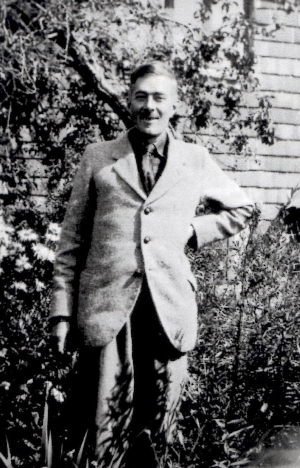 |
| Henry Williamson, c.1934 |
He told Yeates this cheque was an advance on the book. HW was in contact with Jonathan Cape about the book, and saw to it that Yeates was given good terms in the contract. (Cape did reimburse HW.) Yeates signed the contract with Cape on 20 November.
HW had sent Yeates a copy of his book The Gold Falcon, inscribed ‘To the Tassel Gentle from the Gold Falcon’. His diary entry for 25 November states:
Yeates says the G.F. reveals me as a great poet . . . Also that Cape objects to title of This Tassel Gentle, & also length. Damn Jonathan! [Jonathan Cape] I specially warned him against interfering in an unborn work . . .
HW now suggested ‘A Test to Destruction’ (a title he eventually used for Volume 8 of A Chronicle of Ancient Sunlight, depicting the end phase of the war and the first months of peace), but Yeates came up with first ‘Wings of Victory’ – still not acceptable – and then the final (inspired) ‘Winged Victory’.
It is difficult to tell exactly how much work HW actually put into the book – but he made a considerable number of suggestions. In the early stages Yeates seems to have accepted HW’s alterations and additions, but in February 1934 when HW altered Part 3, Yeates wrote to him (no doubt suffering from exhaustion with the effort of writing when so ill):
NO NO NO NO NO NO NO I can’t go on like this, I must write my own stuff.
He would accept HW’s comments and criticisms, but was adamant that he must write it himself. HW (quite patiently for him) explained why and what he had done, and eventually Yeates went over it again, though he altered some of HW’s insertions. However, Gordon Atkin, biographer of Yeates, has examined the exercise books in which the book was painstakingly written by hand, and has stated that there seems little evidence within them of any wholesale revision.
Apart from Tom Cundall, the other chief character in Winged Victory is his fellow pilot and friend ‘Bill Williamson’. Although just about all of the other characters in the book have been identified with their real-life pilot counterparts (Atkins relates these in his biography), there is no one to fit Bill. HW had suggested that Yeates use a fellow pilot as a confidant and steadying influence – an alter ego. (Surely HW as he would have liked to have been – he frequently stated he had wanted to be in the RFC and, of course, he had made himself, as ‘Manfred’, a pilot in The Gold Falcon.) This ‘Bill Williamson’ plays the same role for Tom Cundall in Winged Victory as ‘Spectre’ West does for Phillip Maddison in the Chronicle. At the end of Winged Victory, on Tom Cundall’s final operational flight, Bill Williamson is shot down and killed. Devastated, Tom Cundall is returned to England, physically and mentally a broken man. It is, in my opinion, quite evident that this last section of the book is HW’s writing.
In February 1934, just before leaving for his extended visit to Georgia in the United States, HW wrote to T. E. Lawrence enthusing about Yeates’s book:
. . . What I must tell you is that one of the characters in an early novel [of mine], named Yeates, has written a MARVELLOUS novel about a group of characters, RFC and later RAF, in the war. . . . I rearranged the last parts of the book etc, and rewrote the climax, merely suggesting and cutting and altering his stuff: it’s really his. It’s a great book I swear . . .
HW continues, giving a long résumé of the plot, and then asks if Lawrence will read the book in proof and send a few words to Cape that can be used for promotional publicity. He adds that he would never ask such a thing on his own behalf.
Just before HW sailed, Yeates wrote:
Farewell, farewell, farewell. Thou goest to the warm south. O fortunate tu! I sit here and cough and cough and cough. [He signed himself ‘Wingless Victor’.]
HW did try and suggest at some point that he could help Yeates to go to Africa, but such a trip was actually obviously beyond him.
On arrival in New York, HW spoke to his publisher Harrison Smith (of Smith and Haas) about Winged Victory, and he agreed to take the book in due course on his recommendation. HW had also taken a copy of his friend John Heygate’s new book, which they also accepted: ironically, his own new book was turned down, a huge blow.
After HW’s return at the end of May 1934, TEL wrote to say that he had read a proof copy of Winged Victory and found it ‘admirable, admirable, admirable’.
Winged Victory was published on 24 June 1934. It is thought that HW wrote the ‘blurb’ (Yeates declining to do so). Yeates sent HW a copy of the book, inscribing the dedication page as follows:

Gordon Atkins relates immediate and positive review coverage. But despite good sales Yeates grumbled (no doubt very worried about money for his family) that the actual income was small. He had perhaps not grasped that the author’s percentage from sales tends to be very small – despite the very good terms HW had made sure Cape gave him.
Pasted into HW’s copy are these two cuttings of reviews used as blurbs (perhaps from the dust wrapper of the second impression?):
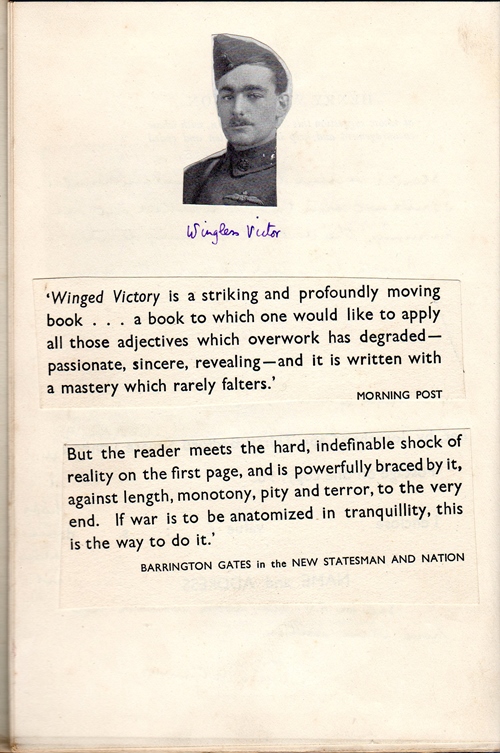
HW also pasted in the following set of portraits:

Quite why he did so is not known, for they bear no relation to Yeates's fellow pilots! 'Wingless Victor' – how Yeates signed some of his letters to HW – is not a photograph of Yeates; 'Zulu' Lloyd (Southern Rhodesian-born Major George Lloyd) served with 60 and 40 Squadrons; Major (later Group Captain) L. W. B. Rees was with 11 and 32 Squadrons; 'Beale' bears no resemblance to the photograph of Captain S. P. Smith in Gordon Atkins' Winged Victor, on whom Beale is based; while 'Mac' is not a photograph of the redoubtable Canadian ace Captain D. R. MacLaren. The central figure captioned ’Bill’ is the same photograph that HW pasted into his own copy of The Gold Falcon, and is actually of Major Lanoe George Hawker, VC, DSO: the first ace of the Royal Flying Corps, whose exploits were exceptional and who was killed in a dogfight with Leutnant Manfred von Richthofen on 23 November 1916. There is quite a likeness to HW!
HW urged Yeates to start writing again immediately, which he did, despite all his problems: this was ‘Family Life’, which was never published.
HW requested that the Royal Literary Fund give help to Yeates, which they did with a grant of £50. In November HW also gave him £25, saying it was a return of a grant he himself had once received. He also thought Winged Victory would make a good play, and obtained Yeates’ permission to work on this.
On 23 November Norah Yeates informed him that Victor was ill again, and in the Fairlight Sanatorium near Hastings. This was seemingly to have a month’s bed rest to recuperate. In mid-December HW visited Ann Thomas at Tenterden for the weekend. On the Monday he went to see Yeates at the sanatorium – to learn that he had died the Saturday before, on 15 December 1934.
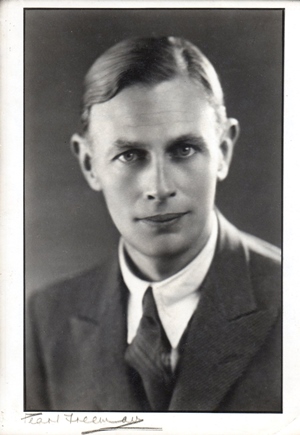 |
|
HW's copy of a studio portrait of Yeates, taken in November 1934, the month before he died |
HW then did what he could for the family, but Yeates’s wife had by that time taken against him, possibly as a target for her angry grief. (She had always particularly objected to his turning up with his secretary/mistress.)
HW wrote a short obituary for The Times, and pasted the cutting in his copy of the book:
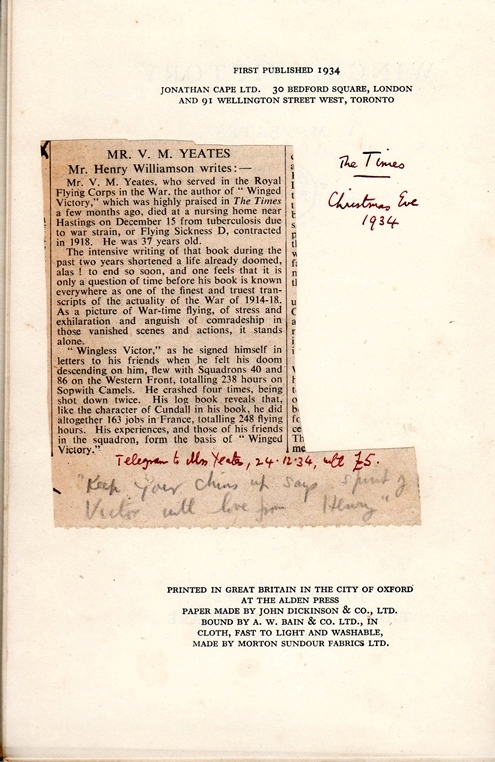
HW also pasted in a cutting of a letter he had written to the Saturday Review of Literature in response to their review of the American edition:
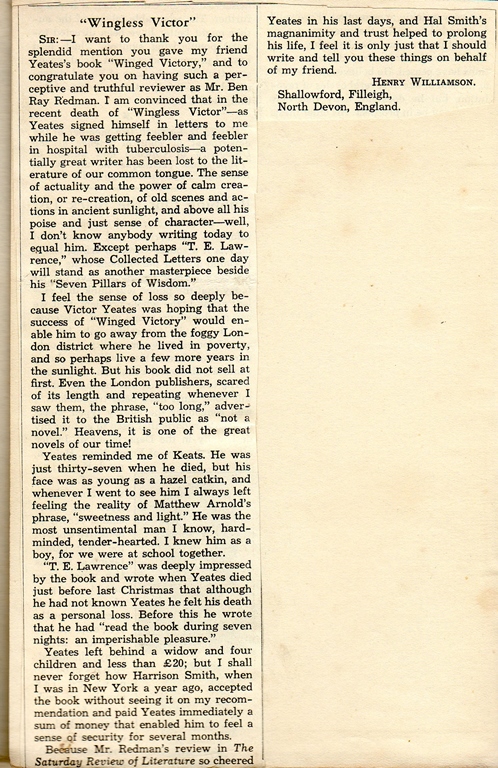
But mainly he wrote a long ‘Tribute’ for John O’London’s Weekly, which was published in January 1935. He organised a second printing of Yeates’s book, which now included his ‘Tribute’, which appeared in early 1935.
(HW’s ‘Tribute’ together with the new 1961 Preface were reprinted in Threnos for T.E. Lawrence and other writings, compiled and edited by John Gregory and published by the HWS, 1994; e-book 2014 (pp. 93-100), which includes Yeates’s citation on Colfe’s Roll of Service.)
At the time of Yeates’s death HW also informed T. E. Lawrence, who wrote back kind and supportive words, again praising the book and wishing he had done more about it.
HW now, apart from his own complicated personal and writing life, engaged himself in turning
Winged Victory into a play, and in revising the ‘Family Life’ MS into publishable form (which it certainly needed): it portrays a most dreadful picture of Yeates’s own background.
Eventually he contacted T. E. Lawrence on 11 May 1935, asking if he could visit him to discuss these two projects as he drove past on his way to London. On Monday, 13 May TEL left Bovington Camp to send HW a telegram in reply, inviting him to come to lunch on Tuesday, 14 May (the following day). As he returned from sending that telegram he met with his motorcycle accident – dying a few days later.
Later that year HW made a joint dedication to these two friends, whose tragic deaths were entwined in his mind, in his book Salar the Salmon.
Yeates had already appeared as a school friend of Willie Maddison in the very early Dandelion Days (1922), and when HW began to write A Chronicle of Ancient Sunlight, Yeates becomes ‘Tom Cundall’, school friend of Phillip Maddison in Young Phillip Maddison (Vol. 3, 1953), so making a direct association to Yeates’s own fictional name in Winged Victory. ‘Tom Cundall’ also appears briefly in How Dear Is Life (Vol. 4, 1954), A Fox Under My Cloak (Vol. 5, 1955) and The Golden Virgin (Vol. 6, 1957), although the incident in the last, where Cundall shoots down a German airship, is purely fictional.
Whatever HW may or may not have contributed to Winged Victory (and there is no doubt in my mind that his input was considerable, although it is known that Norah Yeates was reluctant to admit it), the book is based on Yeates’s own experiences, and was achieved under the most appalling circumstances. It is also evident that HW did everything he possibly could to help his old school friend, both in practical matters to do with the writing and production of the book, and in promoting it after publication; but also in offering his encouraging support to the terminally ill Yeates.
HW continued to remind the public of the book, endeavouring to ensure that it was not forgotten, as this letter to The Sunday Times in 1958 illustrates:
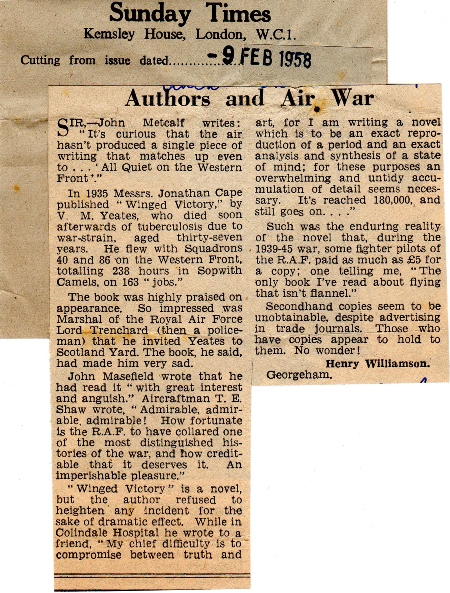
Indeed, it may have been this letter that stimulated a further public demand, for the blurb in the new edition states that 'this classic of war in the air has become a connoisseur's item. The Library Association has evidence that demand for it continues and in deference to their suggestion this new edition has been prepared.' Jonathan Cape published the new hardback edition on 28 October 1961, with an attractive dust wrapper. Not only did this edition retain HW's original Tribute, it contained a new Preface by him. He took as much care over this as with any of his writing, as this draft shows:

As Atkin says in Winged Victor,
Williamson had not forgotten Victor after twenty-seven years and was still keen to do all he could to publicise the book. With this new edition available, he arranged for this friend, the well-known journalist and broadcaster Kenneth Allsop, to write an article on its rebirth in the Daily Mail which chose it as its 'Book of the Month' for October 1961 and included an interview with Williamson on the background to how the book came to be written. . .
At Williamson's suggestion, the newspaper article was followed up by an interview with Kenneth Allsop on the popular BBC television programme 'Tonight' which was broadcast on 27 October.
The new edition sold out in less than a month, and Cape rushed through a reprint, with a further printing in 1962. The Bookseller reported:
In the years that followed there have been various paperback editions, some regrettably (to the knowledgeable) showing an SE5a on the cover rather than the Sopwith Camel featured in the book. Winged Victory came out of copyright in 2004, seventy years after Yeates's death, and, while there are no print editions now current, there are two e-book editions available.
*************************
I won’t give a full synopsis here of Winged Victory, which is considered to be one of the few classics of the aerial combat of the First World War. I do strongly recommend that you read it for yourself. While the print edition is out of print, secondhand copies are fairly easily obtainable; it is also available as an e-book.
The novel is closely based on Yeates’s own flying experiences in 1918, and most of the characters had their counterpart in real life. An indispensable aid is Gordon Atkins’ biography Winged Victor: A Biography of Victor Yeates (Springwater Books, 2004; e-book 2014), in which these characters are identified. By comparing Yeates’s flying log book with the text, Atkins confirms that many of the flying scenes described in the book actually happened to Yeates.
The book covers the period of the 1918 German Spring Offensive and the Allied Forces’ rally in August that was the beginning of the end of the war: a very difficult time.
The flying scenes are authentic and magnificent. The feeling of comradeship among the men is inspiring, covering the whole range of emotion and thought that churns round men’s minds in those circumstances. But the mood gradually changes: the optimism of the opening passage when Tom Cundall first arrives at the Front becomes more sombre – and eventually disillusionment sets in.
There is a great deal of difference between the end of Phase Two of the book as Tom Cundall goes on leave:
He had forgotten how lovely England was . . . how real was his love of England.
and the end of Phase Three (the end of the book), when Cundall returns to Blighty, this time sent home with Flying Sickness D, and mourning the death of his friend:
This was England. Wandering lanes, hedged and ditched; casual opulent beauty; trees heavy with fulfilment. This was his native land. He did not care.
*************************
Jonathan Cape, 1934:

Harrison Smith and Robert Haas, New York, 1934:

The title page to the American edition, the only edition to bear this quotation from Romeo and Juliet. The phrase 'this tassel gentle' was Yeates's first preferred title for Winged Victory:

Jonathan Cape, new edition, 1961, with its evocative panoramic dust wrapper of a flight of Sopwith Camels:
Front and rear flaps to the 1961 edition:
 |
|

Other editions:
 |
 |
|
|
World Book Club, abridged edition, 1963 |
Consul Books, paperback, 1964 |
 |
 |
|
|
Consul Books, paperback, 1966 reprint |
Sphere Books, paperback, 1969 |
 |
 |
|
| Rizzoli, Milan, 1969 | Mayflower, paperback, 1974 |
 |
 |
|
| Buchan & Enright, paperback, 1985 | Grub Street, paperback, 2004 |
The cover for Gordon Atkins' biography Winged Victor (2004; e-book 2014) is included here as it bears a specially commissioned picture of Yeates's Sopwith Camel no. D6585:
