
The Henry Williamson Society
Uncategorised
The Lone Swallows
THE LONE SWALLOWS
 |
|
| First edition, Collins, 1922 | |
First published Collins, 1922
(Matthews states: ‘?July 1922’ – HW’s copy is inscribed: ‘Author’s private copy. 27/8/22’)
Dutton, USA, 1926
Major new revised edition illustrated by Charles F. Tunnicliffe, Putnam, 1933
Various other editions with more minor changes – see Hugoe Matthews’ Henry Williamson: A Bibliography
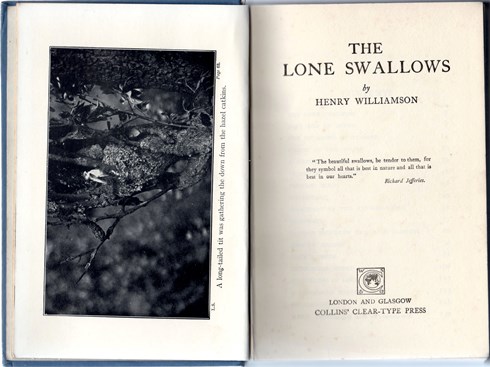
‘The beautiful swallows, be tender to them, for they symbol all that is best in nature and all that is best in our hearts.’
Richard Jefferies
Quotation on the title page of the first edition. Later editions omit the quotation and state: ‘Dedicated to Richard Jefferies’.
The Lone Swallows is HW’s second published book, coming between The Beautiful Years and Dandelion Days. The book is a collection of nature essays, most of which had already been published in newspapers and magazines: they are HW’s first attempts to ‘describe the common sights and sounds of the English countryside’, as he stated in his own ‘Compiler’s Note’ that fronts the first edition.
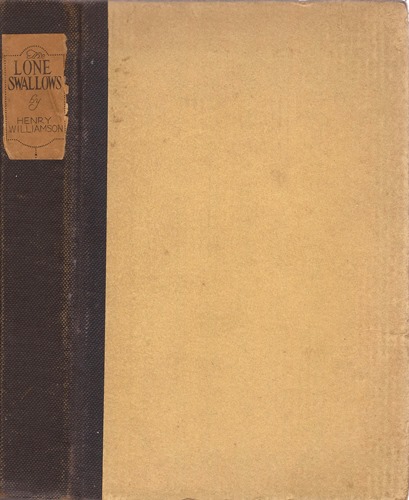
The first edition had no jacket as such – the covering being a flimsy fragile transparent paper wrap, very quickly disintegrating (one archive copy still has this intact).
HW offered the dedication to Lois Martin, a girl he had met towards the end of 1921 (and who was the immediate consolation for Doline Rendle’s aloofness), almost certainly in London where he appears to have spent Christmas, returning to Georgeham on 14 February – seen off by his mother and Lois. His 1922 diary proper opens: ‘WILLIAM LOVES LOIS’. Lois was ‘small, red, musical’ and was the basis for Diana Shelley in The Pathway. Lois was actually very clearly not really interested in HW but kept him dangling. Having not heard from her for a month since returning to Georgeham he received a letter on 17 March: ‘I love you very dearly, you know.’ The diary entry for 21 March states: ‘Wired Lois the dedicatee of “Lone Swallows”. She replied “By all means”. Damned ill-bred & callous.’ Returning to London on 29 March to see her (at the Tomorrow Club), he found that she was ‘two-timing’ him, and was utterly miserable and ill; and that ended the relationship. It would thus appear that the role assigned to Diana Shelley in The Pathway is greatly enhanced from the real life situation. Returning to Georgeham, he immediately met Mary Graham Stokes and rest of the family, which is noted in his diary on 8 April: Lois no longer occupied his thoughts.
Richard Jefferies, it might be argued, was a far worthier and apposite dedicatee.
The stories of the first edition, by default, have to have been written before the end of 1921, so, apart from those items written for the Weekly Dispatch (six short ‘Country Week’ pieces and the ‘On the Road’ column – collected and edited by John Gregory in 1969, with HW’s approbation, and published by the HWS in 1983; e-book 2013), these stories do indeed comprise HW’s earliest published writings.
These pieces, combining short tales of country adventures with beautiful descriptive phrases, realism with poetic simplicity, are a charm of prose poems of lyrical and minutely observed details. They have a freshness that belies their period flavour: they also hold a message that is perhaps even truer for us today than it was when they were written nearly 100 years ago.
HW sets out in that original ‘Compiler’s Note’ a short but very clear statement of his thinking, his burning vision, of that time: perhaps the only really clear statement he made. It is this credo that underlies the whole of The Flax of Dream, but where (perhaps because of its lengthy novelised form) it becomes diffuse and frequently unclear. One tends to read those novels for their own sake rather than for any covert message. Here it is stated with clarion clarity, although it has little apparent relevance to the actual stories in this book (except perhaps one). But if you want to understand HW’s thinking at this time – and indeed all his life, for this underlying message is reiterated in the later series, A Chronicle of Ancient Sunlight – it helps to have read this introductory statement:
My own belief is that association with birds and flowers in childhood – when the brain is plastic and the mind is eager – tends to widen human sympathy in an adult life. The hope of civilisation (since we cannot remake the world’s history) is in the fraternity of nations, or so it seems to myself, whose adolescence was spent in the war; the hope of amity and goodwill of the nation is in the individual – in the human heart, which yearns for the good and the beautiful; and the individual is a child first, eager to learn, but unwilling to be taught. Therefore it would appear that the hope of civilisation is really in the child. Sometimes heredity may be too great a handicap, but a sweet environment is a gradual solvent of inherited vice; at least it will prevent hardness, whence springs un-understanding, and hate.
Possibly HW, sandwiching this book between the first and second volumes of The Flax of Dream, presumed readers would apply this message to the other work. Indeed, in his own mind, he may have made no difference between the various books: they were all whirling around in his mind at the same time.
Matthews, in his Henry Williamson: A Bibliography (2004) , gives the basic original publication source for several of the pieces, but a little flesh can be added to those facts from perusal of HW’s intimate folio-sized journal of the early 1920s, which I refer to as his ‘Richard Jefferies Journal’ (RJ Journal) as it is dedicated to Richard Jefferies (see AW’s biography Tarka and the Last Romantic, p. 71-2, where the title page is reproduced). The influence of Richard Jefferies’ writing and philosophy on HW, particularly at this early stage of his writing career, has been well documented over the years and hardly needs reiteration here. HW took the title of this book from his mentor, as we see from the title page quotation, and his opening essay ‘The Lone Swallows’ tells us of the so very early arrival of the first two swallows of the year, joyously celebrated by all.
In 1920 HW, aged 24, was still living at the family home at 11 Eastern Road, and had been working as an advertising canvasser on The Times from early January, and working hard on his first novel in his spare time – using a room in the house next door belonging to his maternal grandfather in which to work. He had met Doline Rendle (a cousin of Mabs Baker, with whom he had been in love in 1919, who was the model for Eve Fairfax in The Dream of Fair Women), and was now in the throes of desperate unrequited love for this beautiful, sympathetic but aloof twenty-year-old girl. He first mentions Doline in the RJ Journal on 17 April: ‘I am constantly thinking of a girl I met who is more like me than anyone I have yet met.’ By 1 May, ‘she is the one [I have been waiting for]’.
One of the earliest references in the RJ Journal to any of the stories included in The Lone Swallows is 17 May 1920, where there is a long essay entry headed ‘The Night’, opening:
Against the deep blue of the sky a little money-spider was taking a line from one veined hazel leaf to another. . . .
The Journal entry dated 1 November 1920 states: ‘Austin Harrison has published “The Night” in this month’s English Review.’
HW must surely have been very gratified. The English Review was a prestigious literary journal, founded in 1908 by the well-known writer Ford Madox Ford, who published among others, Thomas Hardy, Henry James, H. G. Wells, Wyndham Lewis, and the poems of D. H. Lawrence. Ford’s successor was Austin Harrison, who was to resign in 1923. (In 1937 this magazine was absorbed into the National Review.) HW’s essay caught the attention of the poet John Helston, who sent him the MS of a poem in gratitude – and they certainly became friends at that time, as there are a couple of slim volumes of Helston’s poems in the archive.
This story becomes ‘Midsummer Night’ in The Lone Swallows (LS, 1922, pp.136-144). It is not altogether word for word, but there are really only very minor changes from the RJ Journal MS. The printed essay is dedicated ‘To G.E.R.’ – i.e., Gwendoline (Doline) Rendle – although by the time the book was published the ‘Doline’ episode was over.
In his ‘Compiler’s Note’ HW ends: ‘It was on a Sunday in May 1920, in a tramcar at Catford, a south-east suburb of London, that the seed of this thought [as quoted earlier] was sown by the sight of children returning to the slums after a day in the country. How eager they were: and how their parents were happy! Immediately afterwards, in a visionary fervour . . . I wrote “London Children and Wild Flowers”, which Austin Harrison published, with Walter de la Mare as god-parent.’
‘London Children and Wild Flowers’ (LS,1922, pp. 68-81) evolved from a real event described in a long entry (over 3 foolscap pages) in the RJ Journal, dated 2 May 1920, which opens: ‘Went into Foxgrove this evening’: but first the poignant entry for May Day itself:
I went near the long-tails’ nest (poor old Charlie – killed at Beaumont Hamel in 1916 – “gone like the celandine from the meadow” – used to call them “long-tails”) . . . [These are long-tailed tits.]
In the margin is a note in red-ink (one of a series that HW wrote in 1947) explaining that this is his cousin Charlie Boon: this again emphasises that constant background of war and death in his mind. The next day he went into Foxgrove, one of his childhood haunts, and after an opening descriptive passage noted:
. . . All the paths are beaten by the passing of many recent feet, and what bluebells are left by the swarming hordes from Deptford, Woolwich, Camberwell and Shoreditch are either lying crushed into the leaf-mould or dropped on the paths. . . .
At Southend Pond hundreds of people were waiting for the trams [all carrying bluebells] . . . and all their faces were happy. . . .
And I thought “You little slum creatures, so happy and joyous, gazing at your bluebells and your minnows, you have been happy. I – selfish, egotistical I – was angry because you had been in the woods. But I am glad, because you dwellers in the smoke and the grime have been very happy. The atmosphere of the tram seemed quite different and I felt tranquil and serene as I proceeded to my home.
This story was published by Austin Harrison in The English Review (May 1921) as ‘The Passing of the Blossom’, dedicated to Walter de la Mare. Just before he had left London for Devon in mid-March 1921, HW had been to an ‘At Home’ at J. D. Beresford’s – Beresford, a well-known writer and respected critic, member of the Tomorrow Club, in his position as reader for Collins publishers, had recommended and arranged the publication of HW’s first book by his firm. (‘At Home’ gatherings were a convention of society in those days.) HW’s journal entry (not dated but about 12 March 1921) states:
A few celebrities present, including Walter de la Mare, J. C. Squire, Storm Jameson, Violet Hunt, Rose Macaulay, St. John Ervine, May Sinclair, and Mrs. Dawson Scott . . . Walter de la Mare is a nice fellow; he didn’t know much about nature study; he didn’t know the difference between a coltsfoot and a celandine. However, his poetry is, I think, really beautiful; he is one of the rare ones. I got permission to dedicate ‘The Passing of the Blossom’ appearing in the May English Review to him.
Walter de la Mare wrote to HW on 26 April: ‘I am looking forward very much to “The Passing of the Blossom” and proud to be its godfather’. And after its publication:
. . . What a delight it has been to have, & read, your paper in the English Review. It is – if I may say so – a fresh and living piece of writing, & the first I hope, of many. The only quite insignificant criticisms that occur to me – if you will forgive them – are ‘the little poet’. Somehow it doesn’t seem to be a compliment to the long-tailed tit; and the ‘dear children’ – the word here hasn’t quite body enough. The whole thing is delightful in thought and feeling; I do hope you will let me know when more of your work appears. It’s a proud godfather that writes; & he treasures the owl. Yours very sincerely, Walter de la Mare.
Such kind encouragement from such an eminent writer must surely have been balm to HW’s constant anxiety and extreme nervous state. HW also went to a party given by Walter de la Mare, there meeting his son Richard, who was to become a great friend, his best man at this marriage, and in due course, his publisher.
On 2 July 1920 HW noted, ‘Wrote essay on The Meadow Grasses’. This essay (LS,1922, pp. 82-95) is dedicated (To B.E.H.T.), who I think is the mother of Terence Tetley, the great friend of his youth – Mrs Neville of the later Chronicle of Ancient Sunlight – with whom HW found much solace during his young days, her nearby flat being a place of refuge from home problems. This story is very lyrical, very rural (mixture of Richard Jefferies and Thomas Hardy). The ending is wistfully longing:
I have come to know other meadows now, but they can never be the same. I lie in the flowery fields, seeing the quaking-grass against the sky, and a wild bee swinging on a blue columbine, while a lark rains joy from on high. These return, these are eternal; and with them a voice that is silent, a colour that is faded.
8 November 1920: Rough notes for Essay on Autumn (Foxgrove).
This was 'Days of Autumn' (LS, 1922, pp. 166-181), another lyrical essay based on a meadow, but in a different mood.
On 23 December HW recorded, ‘Austin Harrison is publishing “Swallow Brow” in February.’ On 23 January his entry includes: ‘One morning when little Doline was brushing her hair . . .’.
‘Swallow-Brow: A Fantasy’ appeared in The English Review (I think March issue) and opens: ‘That morning as she brushed her hair little Jo . . . her real name was Mary . . .’
In the early novels of The Flax of Dream Mary (Ogilvie) is based on Doline Rendle, and the journal entry above reflects this – but in The Lone Swallows this essay (see LS, 1922, pp. 182-195) is actually dedicated ‘(To P.T.)’; (‘P.T.’ is not known to me). The story itself is indeed a fantasy – for sad little Jo has a conversation with a swallow which comforts her, and tells her that:
One day, when you are older, someone will come to you, and he will tell you that you are beautiful. He is great friends with the owl, who calls to him at night. But at present he is only a little boy. . . . His name is Willie and he is nine years old.
The swallow gives her a gift – the gift of a swallow-brow (her eyebrows are described like swallows wings).
Interestingly this story contains characters named as Great-uncle Sufford, and an artist named Mr Norman and his daughter Elsie – characters in the The Flax of Dream novels. Indeed, this charming little (rather Victorian) fairy-tale essay is actually what would probably be called today a ‘prequel’ to the The Flax of Dream.
On 7 January 1921 the journal reads: ‘Arthur Beverley Baxter, the Canadian author & literary editor of the Daily Express is friendly towards me’, and on 17 January: ‘Arthur Beverley Baxter is a good fellow. He has taken 3 articles of mine for the Daily Express and paid for them beforehand.’ [That was indeed very kind and generous.] These first articles were headed ‘In the Country’. The first one of these (22 January 1921) is pasted into the RJ Journal (but is not included in LS). The Daily Express printed more than 20 of HW’s articles during 1921, of which eight or nine reappear in The Lone Swallows.
A journal entry under an opening date of 12 March 1921 is long and covers several days. It also covers several diverse subjects, including the entry about the Beresford ‘At Home’. Towards the end of this we find: ‘I am now in Devon. I’ve left London; all my eggs are in my one basket of literature, and I’ve got £12 in the bank. Meanwhile I work.’(Somewhere, I know, I appear to have stated that HW arrived in Devon on 21 March: that was obviously a typing error for ‘12’ – although the former is more romantic!) Two days later (14 March) he wrote:
I do my own cooking in a “double cooker” – God bless the man who invented double cookers. Tonight I stole a lot of pine logs belonging to the Rector; at the moment of writing they are sizzling in my fireplace – an open one. The Rector is a curious fellow; he never visits his parishioners [de rigueur at that time] (they despise his ‘riverence’ – say that he is ‘no gennulmun’) and runs a small commercial lorry for profit. His wife is not pretty; she wears a great fur coat in the warm weather, paints her cheeks and eyelashes, and has an objectionable lap-dog that squeaks at me. It is brown and looks like a cross between a rat and a spider in a potting shed.
This rector appears as Rev. Garside in The Pathway, with whom Willie exchanges opposing opinions.
27 March 1921: Today I am happy for an essay of mine entitled 'Spring in a Devon Village' appeared in The Saturday Review. I met Gerald Barry of the editorial staff during the first night of Mackenzie’s bad play ‘Columbine’. A nice fellow, and a lover of the countryside.
This story is entitled ‘Lady Day in Devon’ in LS (pp. 8-13): Lady Day is 25 March, Feast of the Annunciation. That has always seemed an awkward title, and that it would mean nothing to many readers, especially in the USA, is shown by its new title of ‘March Day’ (Dutton edition, 1926), while in the 1933 illustrated edition it becomes ‘Spring in Devon’.
But on 21 March HW had recorded: ‘I saw a pair of swallows, a solitary pair. They are at least 3 weeks early.’ A week later, 28 March: ‘Today upon Baggy North side I saw a solitary pair of swallows. I will write a paper on the thoughts I had.’ Towards the end of April he wrote:
One of my best things “The Lone Swallows” is with the Saturday Review. I wrote it for ‘Mary Ogilvie’ [Doline Rendle] now at Cambridge and miserable. I’m here and happy. I pursue her no longer, hence miserable letters from her.
(But this story is not dedicated to Doline. As stated, her dedication is attached to ‘Midsummer Night’, written in May 1920 when his romantic feelings for her were blossoming. ‘The Lone Swallows’ essay has no dedication.)
This essay opens: ‘Along the trackless and uncharted airlines from the southern sun they came, a lone pair of swallows . . . The last day of March had just blown with the wind into eternity.’
Note the perfect phrasing of that last sentence. The six and a half pages of this paean of praise of these birds of delight, as ‘Light of heart the wanderer watched and waited’ for more swallows to arrive to add to this uplift of heart and mind, ends on a sombre note:
. . . two dark arrowheads fell with mighty swoop from heaven, arrowheads that did not miss their mark. There was a frail flutter of feathers in the sunshine, a red drop on the ancient sward . . . The peregrine falcons had taken the lone and beloved swallows.
Sudden death was never far from HW’s deepest thoughts, especially at that time still so close to the recent horrors of the First World War and the fear of imminent and undeserved death. This story is surely an allegory, not just of the war, but of the death of his romance with Doline (the little ‘swallow-brow’ maiden).
This is the story (LS, 1922, pp. 1-7), of course, that gives The Lone Swallows its title. It appeared in The Saturday Review May issue: on 8 May HW wrote: ‘Gerald Barry, of The Saturday Review, writes that I will do great things, and that the “Lone Swallows” to be published next week, is a ‘glorious thing’.
The Saturday Review, founded in 1855, was one of the most influential and prestigious journals of the time. Originally political, it had by this time broadened to a more literary slant with contributions from literary lions such as Thomas Hardy, H. G. Wells, Max Beerbohm, and G. B. Shaw (as drama critic).
There follows a long gap in the RJ journal: the next entry is dated April 1922:
Nearly a year has elapsed since my last entry. Much has happened. . . . ‘The Beautiful Years’ got some good reviews (it was published last October) and at Xmas had sold about 750 copies.
‘Dandelion Days’ was finished last September, and is to be published this coming autumn. With Collins I have a nature essay volume called ‘The Lone Swallows’.
One way and another, I don’t think HW could really grumble about a lack of attention or success in these early days!
In the spring of 1922 (the first date mentioned in his RJ Journal is 8 April) HW met Esther Graham Stokes, a very well-to-do lady recently widowed, who with her family had moved to Georgeham. HW immediately fell in love with one of the daughters, Mary, aged 16½, but indicates that the mother was in love with him. This family mainly appear in later books, and I will give them more attention then: but HW dedicated ‘Peregrines in Love’ (To E.G.S.) (LS, 1922, pp. 130-35). This story was first printed in The Field,on 16 July 1921 (yet another prestigious journal). HW comments in the RJ Journal (not dated, but soon after 18 April 1921):
Sir Theodore Cook, Editor of The Field, likes my short paper ‘Peregrines in Love’. But, he writes, it must be submitted to his ‘falconry expert’ before publication.
Well, it obviously passed muster! I have always presumed that ‘E.G.S.’ must be the mother, Esther, but her eldest daughter (who appears later as ‘Queenie’) was also named Esther, while her son (the youngest child), known to be a ‘faithful shadow’ of HW, was Edward (see HWSJ 47, September 2011, Edward Stokes, ‘The Owl Club’, pp. 76-84 for the interesting background) – so ‘E’ actually could also refer to either of them.
Mary Stokes’ dedication is attached to ‘A Seed in Waste Places’ (LS, 1922, pp. 212-16) which is at heart a story about having and losing a dream or a wish (to catch a dandelion seed is supposed to grant your wish will come true).
An interesting point here is the speed with which HW attached their names to these stories – as stated above, the book was already in the hands of the printers when he first met the family. Those dedications have to be proof stage insertions.
‘Winter’s Eve’ (To T.H.H.T.) (LS, 1922, pp. 196-203): – in the 1933 revised edition this is stated clearly as ‘Terence Tetley, in memory’ (see LS, 1933, p. 214). Terence Tetley was one of HW’s greatest boyhood friends. He is part of ‘Jack’ in The Flax of Dream, and appears as Desmond Neville in the Chronicle of Ancient Sunlight series. Terence accompanied young ‘Harry’ on many of his excursions into the countryside bird-watching and egg-collecting. They remained friends but became more distanced during the war, and he fades out altogether afterwards, after a major quarrel.
HW picks out this essay for mention in his ‘Compiler’s Note’ of the first edition, which shows how important it was to him to remember this friendship, even if it had ended sourly. In the 1933 edition there is a footnote within the essay (attached to the fact that barn owls were more common than wood or brown [tawny] owls) which states:
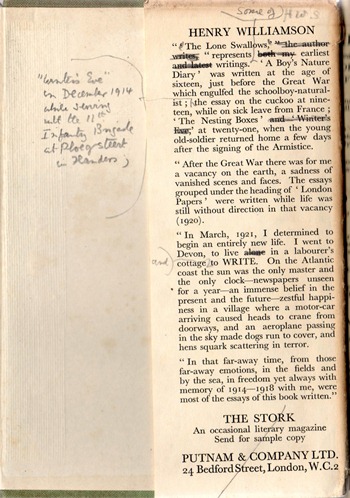
* This was written in the winter of 1914/5 while in Flanders. . . .
(But see also the scan of the ‘blurb’ of the back-flap of the 1933 edition at the bottom of this page.)
That cannot be substantiated, and I feel is very unlikely. In his ‘Notes to the New Edition’ (1933 edition), he states it was written ‘at twenty-one’ (which muddles the dating anyway!) and again there is no corroboration, except that he was 21 on 1 December 1916, and the following year during his long convalescence at Trefusis House in Cornwall (still aged 21!) is when (I am sure) he did begin to write – quite possibly suggested as a therapeutic measure for the breakdown he was obviously suffering. Or perhaps the 1918 ‘after the Armistice’, as stated on the 1933 ‘blurb’, is the true date.
Certainly HW is recalling an episode from his younger days, and although in the story the narrator is on his own, no doubt he and Terence did have similar experiences together. The story is about owls, tawny and barn. But the narrator has once found a dead barn owl, shot. ‘An owl rarely dies immediately.’ That reference to Flanders, attached to barn owls, is possibly likely to have been placed as a metaphor for those comrades he had seen shot to death in the Front line, who also would not have necessarily died immediately: the owl, ‘a beautiful bird [now] a wasted bundle of bones and feathers, flung among the thorns.
‘Ernie’ (LS, 1922, pp. 204-11) is possibly the most Arcadian story in the book. It opens with a straightforward description of Skirr Cottage (in Georgeham, North Devon). Then Ernie enters the story:
A funny little fellow, about two and a half years old, with yellow curls and solemn brown eyes. . . .
Dirty face, wet boots, disturbing voice, everlasting questions, and possessive boastfulness.
Within the short seven pages of this story, about 1500 words only, we know Ernie as a living person. He is a mischievous faun, an innocent Pan living in the imaginary world of childhood: his flute being his incessant voice. Its strength is its simplicity and its truth. It happened just as it reads.
Ernie was the young son of the couple living in the cottage adjoining Skirr – in the little row below the church, set back and separated from the road by a small walled garden in front. Their name in HW’s various writings about Georgeham is ‘Revvy’ Carter (& Mrs Revvy Carter) – real names Mr and Mrs William Gammon.
One of the most powerful stories in the book is ‘Tiger’s Teeth’ (LS, 1922, pp. 96-115), told to HW by ‘Muggy’, one of the great characters of that corner of North Devon where HW went to live in March 1921. The story is dedicated ‘To J.S.’ – that is John Smith, who is Muggy himself. Matthews notes this story as being printed in Wide World Magazine in1922, but there is no mention of this in the RJ Journal.
The tale tells how John Smith and his friend ‘Tiger’ and Tiger’s brother Aaron – blacksmiths by trade, cliff-scalers (for birds’ eggs) by choice – decide that dead lambs are being killed by ‘thay ravens’, a species actually protected by law, and as they can make money by selling raven fledglings to a collector, then decide to raid the nest situated half-way down the cliffs at Baggy Point. (Baggy Point was one of HW’s most favourite haunts. Today there is a plaque at the entrance commemorating this fact.)
The climax of the story tells how, after a perilous descent, Tiger manages to get the fledglings but his holding rope becoming out of action he has with the greatest difficulty to climb back up, and to save himself at the last overlap has to use his own teeth to hold on and haul himself over the last and most dangerous jutting ledge. Safely back at the cottage with some beer inside them, a noise frightens them, and in the ensuing scuffle the fledglings escape. Thus they lose their bounty – but not their pride! This is basically a true story, although the detail of the teeth may possibly be an exaggeration!
‘The Change: A Fantasy of Whitefoot Lane’ (dedicated ‘To J.R.’) (LS, pp. 217-235) is an extra-ordinary story in all senses. A man stands at the edge of a wood (in Whitefoot Lane) and is approached by another. The first man talks of things from the past although he appears a young man, and after describing how the area had been years before, idyllic woodland but now built upon, tells of love lost to him because of his own (idealistic) egotism. The girl had died. He blamed himself.
What was there left? To recreate that love and cruelty, and write out of my sorrow and folly!
(the underlining is editorial)
The figure fades and leaves the second man alone.
Memory ceased. . . . with a vague mournfulness I turned . . . never again would I go back among those poor trees, where in the cruel days of youth’s sweet hopes had been crushed like a wood-anemone under careless and unknowing feet.
Whitefoot Lane was a road that HW often took as a boy on his way from his home in Eastern Road, Lewisham, to his country haunts of Shroffield (The Seven Fields of Shrofften, as they are called in his novels) and Southend, and beyond. The man in the story is called Julien (hence the dedicatory ‘J.R.’): HW certainly actually knew a man of this name – there is the briefest of mentions of him within HW’s personal papers. But there is surely no ‘stranger’ in this story. HW himself stands there and confronts his younger self. All he can do to atone for the past is to write.
Two photographs of Whitefoot Lane (past and present) were printed in HWSJ 31, September 1995 (p. 41), courtesy of stalwart and knowledgeable HWS member (and dear friend) the late Brian Fullagar, in his essay ‘The Lewisham of Henry Williamson’.
*************************
Some mention must be made of the various major editions of this book, for they could cause confusion to the uninitiated (see Matthews’ Henry Williamson: A Bibliography for a full list).
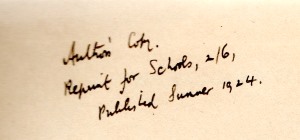
The first change was fairly straightforward: Collins' undated edition (but 1924), in their 'The New World Series', omitted ‘The Outlaw’ (The Lone Swallows, 1922, pp. 116-129), the supposed fake story of the peregrine falcon at St Paul’s Cathedral (it was never reprinted), and ‘The Change’ (but this returned in later editions). HW marks his cutting of ‘Peregrine Falcons in London’, pasted into the RJ Journal, as ‘Fake’, but somewhere he repudiates this ‘false’ story, so one doesn’t know what to believe! Today, when peregrines regularly nest on cathedrals and high-rise buildings, I think we could certainly easily accept it as a ‘true’ story. This small, pocket-sixed edition was intended for use in schools, as HW noted in his own copy of the edition:
Then, also in 1924 (but also undated), the book was divided into two parts, quite straightforwardly, and again for use in schools, the two small volumes being entitled The Incoming of Summer (containing the first thirteen essays) and A Midsummer Night (containing the remaining sixteen). The fact that these three books were printed for school use probably explains why so few copies have survived – today they are extremely scarce and much sought after by collectors.
The Dutton USA 1926 edition (which was the third of HW’s titles to be published by them), was subtitled ‘And Other Stories of the Country Green’, which had previously been used in the UK in 1923 as the subtitle to The Peregrine's Saga. It had a most charming cover, and each story begins with an artistic dropped capital cartouche. The contents are more or less the same as the second Collins edition, and so need no additional annotation.
Collins reprinted The Lone Swallows in their pocket 'Kings' Way Classics' series in 1928 (no date is given in the book), which contains two new stories, ‘The Crowstarver’ and ‘Birds in London’, stated to be replacing the earlier dropped ‘The Outlaw’; and reissued it the following year in their 'Collins' Pocket Novels' series.
‘The Crowstarver’ is an important story, more important than perhaps is apparent. It tells of a poor lad earning a few pence by scaring the crows off the farmer’s field. Recent research has shown that it is set in HW’s childhood haunt of Aspley Guise in Bedfordshire, where his mother’s relations (the Turneys and Leavers) lived, and where he used to spend holidays with his cousins Charlie and Marjorie. The crowstarver is based on Jim Holloman, a lad who lived across the road from the Boons, and with whom Charlie and young Harry were friendly. HW used this name for Jim Holliman in The Beautiful Years (who is a cross between Richard Jefferies and HW himself). The story here ends:
For between that vision of green wheat and singing larks and sunshine [of innocent childhood days] lies an immense darkness and corruption, a vast negation of all beauty . . . Its viewless shadow lies over the spinney today, and somewhere in that shadow wanders the ghost of the crowstarver, dead in the war, with that old wraith of myself, in the well-loved places.
Jim Holloman was killed in the First World War (that ‘immense darkness and corruption’), as indeed was HW’s Cousin Charlie. Their names are carved on the Aspley Guise War Memorial. HW has given them immortality in his writing. A group of HWS members recently visited the village and walked round all these old haunts, the house where the family had lived and including the field where Jim had scared off crows and sheltered in the little spinney in the middle. We paid our due homage at the War Memorial.
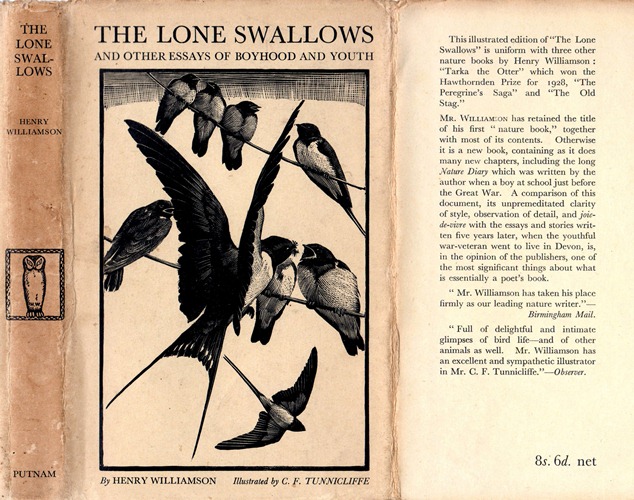
By the time of the 1933 edition HW’s publishing contracts were becoming complicated. He had left Collins and was with Putnam, run by Constant Huntingdon, who had by then published The Old Stag and the first edition of Tarka the Otter, with a further 1932 edition of the latter illustrated by C. F. Tunnicliffe. (Tunnicliffe’s association as an illustrator of HW’s work properly belongs under the entry for Tarka the Otter.) Huntingdon decided to make a uniform edition of HW’s nature writings, all to be illustrated by Tunnicliffe. This new illustrated edition of The Lone Swallows has 23 full page wood-engravings and 35 vignette chapter head and end line drawings. The order of the stories is totally changed from the previous editions, and are in categories more like chapters.
It was not just a revised reprint however. There are 27 stories from the original book, but some have new titles (for instance, 'The Crowstarver' from the 1928 Kings’ Way Classics edition is retitled 'Boy') and 16 stories from elsewhere, including some from the 1923 Peregrine’s Saga, but also a major new item: ‘A Boy’s Nature Diary’ (The Lone Swallows, 1933, pp. 78-108).
This story is copied, almost exactly word for word, from a prose diary (there is also a separate accompanying ‘factual’ list diary) that HW kept as a lad in 1913 in two school exercise books, recording all his visits to his various ‘preserves’ – privately owned woods and parks for which he had written to the owners and obtained permits of entry – for the purpose of bird watching and egg collecting. This gives the names of his school friends and their occupations and quarrels. It is an extremely important document of HW’s youth. The printed story only covers the first notebook – HW states the rest was lost. Not so! Both books still exist in the archive.
Another major addition to the 1933 edition was ‘The Country of the Rain’, a series of six essays titled by the months from November to April, which had first been published as ‘The Countryside Month by Month’ in New London Magazine, November 1930–April 1931.
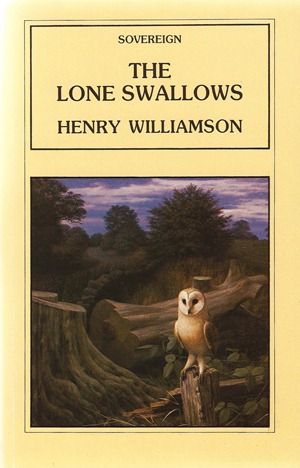
The illustrated Putnam edition was reprinted several times in the post Second World War period. A further reprint paperback edition was published by Alan Sutton in 1984.
On the front cover of the Collins 1929 ‘Pocket Novels’ edition is a printed ‘blurb’ which sums the book up very well – even if it was for advertisement:
There is adventure in The Lone Swallows as well as descriptive passages of great beauty; there is life and movement as well as stillness and peace, and its realism will command the attention of the reader from beginning to end. For these twenty-nine pen pictures are not dry-as-dust descriptions of objects of nature, not dull accounts of Nature’s processes, but masterly sketches of Nature as seen through the eyes of a true Nature lover. The writer’s style, almost poetic in its simple beauty, will command interest and arouse a desire to know more of the wonders of Nature.
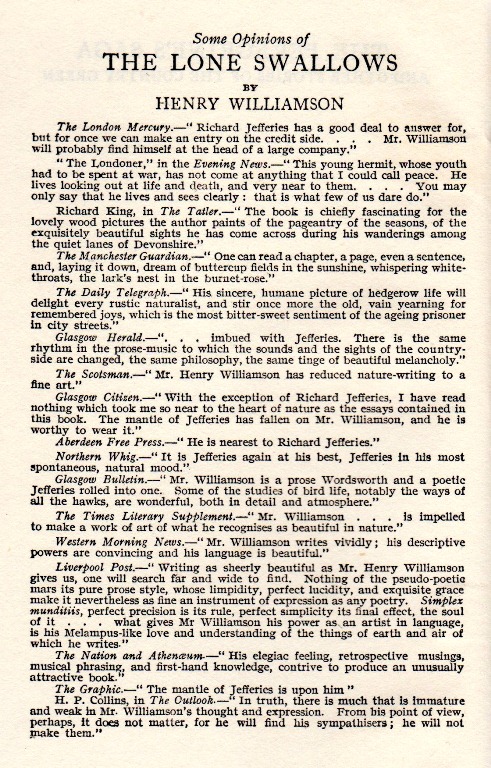
Reviews of the Collins first edition are not in the archive (early cuttings were not kept). Some idea of their content can be discerned from a page printed at the front of The Peregrine’s Saga (1923) which gives quotes (reproduced at the bottom of this page).
There is a goodly selection for Dutton’s 1926 US edition, of which a sprinkling are recorded below. This was the third of HW’s books to be published by Dutton (the first was The Dream of Fair Women, 1924; the second, The Peregrine’s Saga, 1925), so HW was still a ‘new’ author to American readers. Unfortunately the source for these reviews was written in HW’s tiny handwriting in green ink on a dark brown background, and they are now more or less illegible.
A book to satisfy the lover of good writing, as well as those who know and love the woods and fields . . .
Henry Williamson’s “Lone Swallows” will delight the lover of graceful, sensitive, melodious prose with its word pictures of scenes and wild life in Devonshire and will fascinate the nature lover with the poetic descriptions and interpretations of the secrets of Nature. . . .
A collection of essays on nature, with now and then a poignant element of human nature thrown in. Written with a sure hand, colourful, authentic, it is a book that makes for tranquillity of mind. The pure poetry of the prose style gives especial pleasure. . . .
New York Tribune, 5 September 1926, after a long paragraph of praise:
Yet . . . There is not enough variety to give flavour, not enough point to hold the attention. Each sketch might be the prelude to some more important undertaking, a lovely portion, but not a fulfilled whole. One may expect more interesting achievement from the author in the future, for he is a writer of discernment with a limpid and lucid style, and a talent for choosing fine strong words.
St Paul News, Mississippi, at the end of a six-inch column:
It is all very well for a person to be a lover of nature, but such an affection does not always mean that you can make your impressions of interest to another. Mr. Williamson, however, is able to do just that, and the steady flow of words is like a little brook wandering amidst the reeds and rushes . . . nothing lovelier and more dainty could well be written. The volume is a credit to the author and the publishers. (Earlier the writer had praised the jacket: ‘the dainty covering of gray and silver’.)
From an unidentified Omaha newspaper:
A little volume for the nature lover. Observations of a man who goes around with his eyes open to the wonders and beauties of nature. . . . He] just notes and describes quaint habits, queer ways, little things the unknowing might see without noting. Done in prose that is literally poetry, so fine is its touch, so simple its wording. He writes of outdoors in Devonshire, where he has noted the ways of sea fowl and land fowl alike, and has preserved them for the reader, conveying the tenderest and finest reaction of human emotion to the wild life of outdoors.
The number of reprintings and the numerous editions show the importance and popularity of this apparently simple volume.
A page in the preliminaries of the first edition of The Peregrine’s Saga (Collins, 1923) was devoted to extracts of reviews of The Lone Swallows:
*************************
The first edition, Collins, 1922 (there was no dust wrapper):
The front cover and title pages of the three very scarce Collins 'The New World Series' books [1924], printed for use in schools:

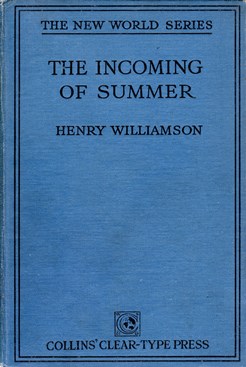
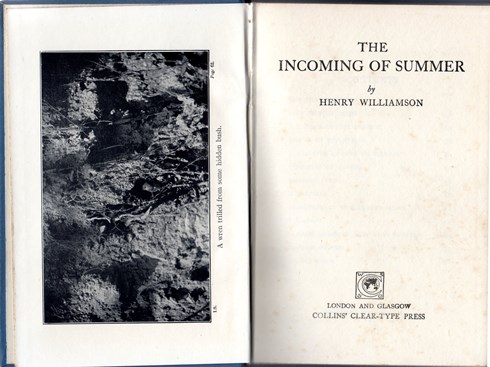
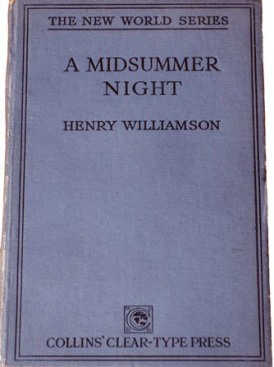
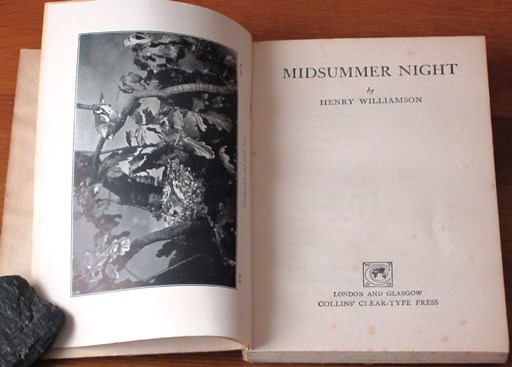
The dust wrapper and end papers of the first US edition, Dutton, 1926:
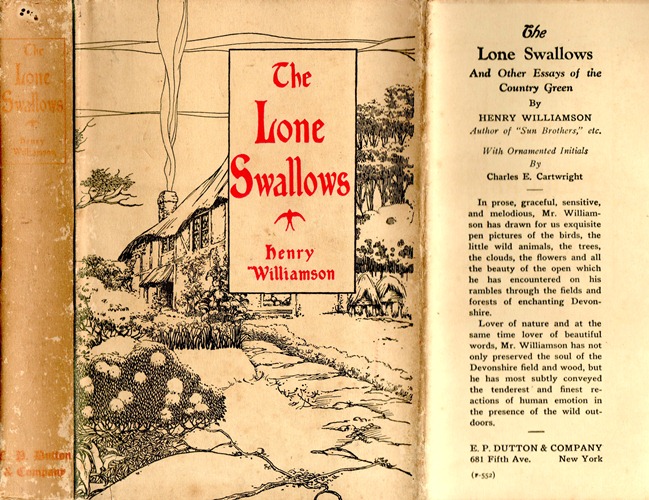
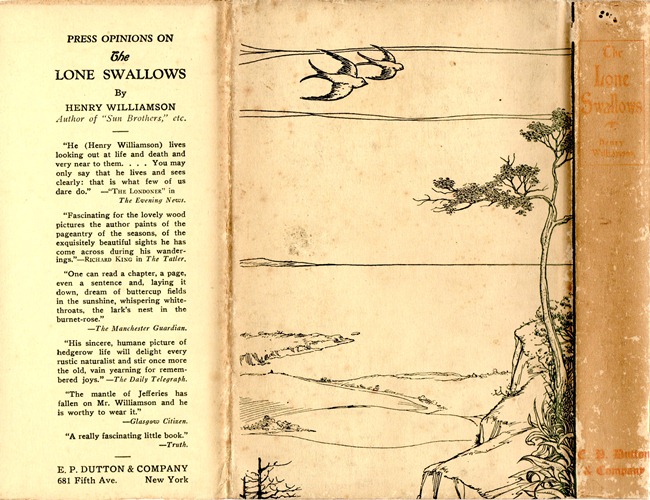

The spine and front of the Collins 'King's Way Classics' edition [1928]:
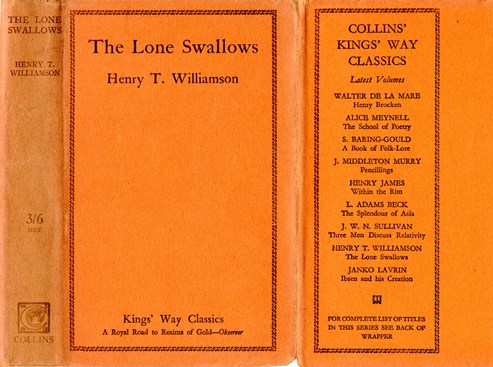
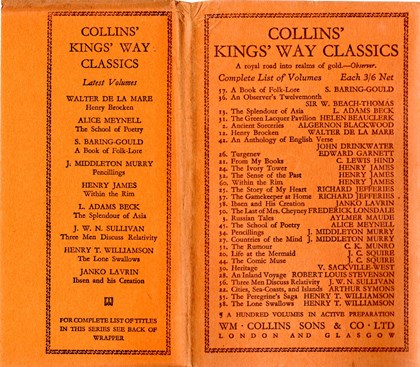
The dust wrapper of the 'Kings' Way Classics' edition, front and back - note the consistent error: 'Henry T. Williamson':
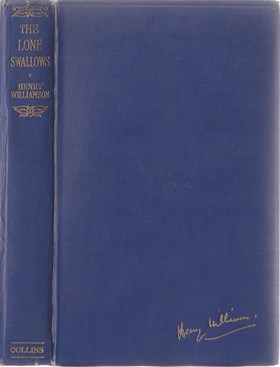
The spine and front of the Collins 'Pocket Novels' edition [1929], with HW's facsimile signature imprinted on the front:
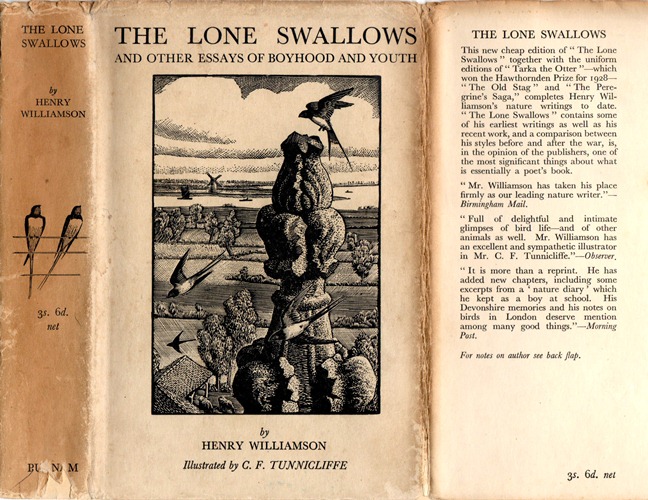
The dust wrapper of the first illustrated (cheap) edition, Putnam, 1933:
HW's pencilled amendments to the 'notes on author' on the back flap of his own copy:
Putnam's 1946 reprint – this superb Tunnicliffe cover illustration of a swallow feeding its young was not included in the text of either the 1933 or 1946 edition:
The Tunnicliffe edition was last reprinted in 1984 by Alan Sutton, using this attractive cover illustration:
Back to 'A Life's Work' Forward to 'The Peregrine's Saga'
The Star-born
THE STAR-BORN
(A pendant to The Flax of Dream)
(The book supposedly written by Willie Maddison in The Pathway. As such HW’s name did not appear on the title page as the author – although it was on the spine and the dust wrapper!)
 |
|
| First edition. Faber, 1933 |
Some first edition page proofs
First published by Faber & Faber, 1933; with wood-engravings by Charles Tunnicliffe
Limited edition of 70 copies, Faber & Faber. As the trade edition, but bound in full vellum stained a light green, and with a signed certificate leaf
Revised edition published by Faber & Faber, 1948; with drawings by Mildred Eldridge
The 1933 edition was re-issued in 1973 by Cedric Chivers (Portway Reprints series) 'at the request of The London & Home Counties Branch of the Library Association'
Originally written in 1922-4, the book was published in 1933 with virtually no revision of the original ms: but there was radical revision for the new edition in 1948.
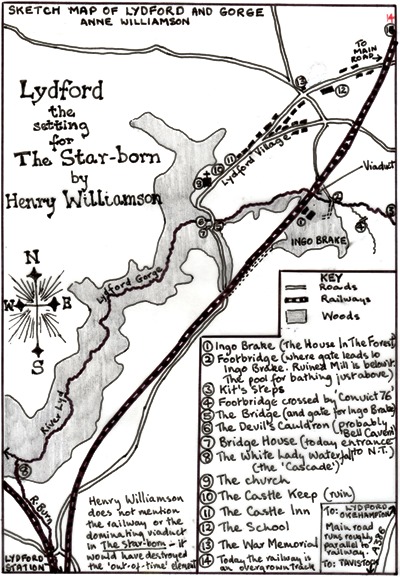
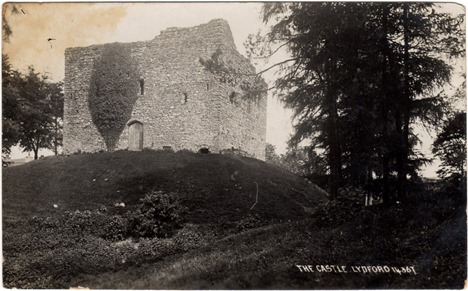
The story, a 'celestial fantasy', is set in the real world at Lydford in Devon, on the edge of Dartmoor, and its gorge and castle keep. As always with HW the descriptions of the scenery and natural world are superb, but there is the added dimension of another world – a Spirit world – inhabited by the Wind, Water and Air Spirits with ‘Quill’ the archetypal bird spirit. The Star-born is first a real baby, the son of Esther and brother of Mamis, who is spirited away one night by a barn owl (owls feature large in this book) to live with the owls in the ruin of the Castle Keep, to learn the wisdom of the universe and fulfil his real destiny. Then as an adult, totally unversed in any consciousness of the real world, he is returned (naked) to impart this wisdom to the humans of this world. Allowed to take one Spirit with him to help him in his task, he chooses the outcast, Wanhope. Arriving back at the place he had come from, he is taken in by Esther and the now grown-up Mamis, who is betrothed. They sort out his total ineptitude and unpreparedness for the world of humans and name him (Mr) Starr. But Esther has deep misgivings about his story.
Starr tries to put right the wrongs he finds around him, including chastising the schoolmaster for caning a boy, and taking all the boys out onto the moor. This reinforces the ‘education’ theme of The Pathway – indeed it is the underlying message of The Flax of Dream. There is a grand scene where Starr summons Mamis to the Gorge and gives what is virtually a ‘sermon on the mount’ on the evil of the world. But whatever he does to right wrong is misunderstood.
His message is unheard – he is powerless, and so is taken back to that world ‘Beyond’, in a most extraordinary scene which is more like the climax of a great operatic work in its effect. Accompanied by Wanhope he walks off through the snow into the moonlight, to find a joyous band of friends, Poets (of whom one can recognise Richard Jefferies, Van Gogh, Shelley, Byron, Beethoven). Wanhope becomes a stranger and is revealed at the last with a crown of thorns around his head:
And as the Star-born looked, he saw buds swelling out of the thorns, and from the buds broke white blossoms.
As he leaves, so Esther finally and tragically realises that he is indeed her lost son, and she wanders after him, calling his name. She is later found dead in the snow, ‘but on her dead face was a smile of deepest peace’.
*************************
 |
 |
Basically The Star-born is a book about good and evil, about what we are doing here on earth and why, contained within the more obvious context of the second coming of a Christ figure – the ‘Khristos’ factor – to earth. The whole book is mystical and visionary. Henry Williamson uses the concept of stars (an important theme in much of his work) and one born from the stars – from ‘Beyond’ – within which to present his ideas. Its content, or the meaning of its content, has an elusive, almost obtuse quality that perplexes and sometimes bewilders the reader. But that was indeed HW’s purpose: in some notes written on 20 December 1922, entitled ‘Phantasy’ (as he referred to the work at first), he stated: ‘The air of bewilderment, of eeriness, must be over everything. The whole action must be thrown as far away from the reader as possible’. (These notes can be found in facsimile in HWSJ 36, September 2000, pp. 56-7.)
Henry Williamson, through a local girl, Gwen Dennis, had met and become friends with the Radford family, who lived at Lydford. He was invited to stay with them early in 1922, and subsequently became a frequent visitor. Some of the elements of The Star-born and its characters are drawn from that friendship (for full background information on this, see Tony Evans, ‘The Radfords of Ingo Brake, Lydford’, HWSJ 36, September 2000, pp. 7-25). Mamis, however, is mainly drawn from his early love for Doline Rendle, whom he met in 1920, having had an intense affaire with her cousin Mabs Baker ('Eve Fairfax' in The Dream of Fair Women, the third volume of The Flax of Dream tetralogy). Unsurpisingly, Doline's mother did not intend her to marry a penniless author; she was destined for another – hence in the book Mamis marries Robert! Clearly the extraordinary scenery and atmosphere of Lydford and its gorge had a great effect on HW, and allowed his imagination to conjure up the surreal scenes which he then wrote into The Star-born. It is very possible that the writing of this book exorcised the troubles of his mind and psyche arising from his war experience, although of course it may be that he was recovering anyway by then.
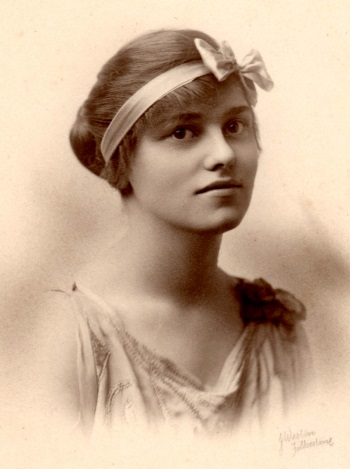 |
| HW's early love, Doline Rendle, aged 20 |
The Star-born is a strange – I think one might say truly ‘extra-ordinary’ – story which moves backwards and forwards between the down-to-earth real world of Lydford village and the famous gorge of the River Lyd, on the western edge of Dartmoor, and a surreal world of spirits of nature who inhabit a further dimension unsensed by most human beings, but here shown as real identities, playing their part in the unfolding mystery (‘mystery’ as in the old sense of ‘mystery play’).
The history of the book itself is almost equally strange. When it first appeared in 1933, Henry Williamson tried very hard to maintain the idea that it was a book really written by Willie Maddison (the fictional hero of the four books of The Flax of Dream) and that he himself was merely the guardian and presenter of this book – Willie’s literary executor as it were. Thus his name did not appear on the title page as the author! Instead, he wrote an involved introduction to explain the complicated circumstance of this made-up background, which can only have served to add further confusion for his readers at the time. Although he removed this introduction from the radically revised edition of 1948, he still tried to maintain the illusion that the book was written by Willie Maddison.
This first edition was illustrated with woodcuts by Charles F. Tunnicliffe, who in May 1932 had written to the publishers of Tarka the Otter suggesting himself as a possible illustrator for a new edition of the book. HW had invited Tunnicliffe to visit and to work directly from the actual sites described. 'Tunny' (as HW came to call him) was soon hard at work and the resultant new edition was published to great acclaim. There quickly followed companion editions of The Lone Swallows, The Old Stag, and The Peregrine's Saga. (Interestingly, Tunnicliffe had little knowledge of birds of prey at this time, and HW suggested he visited a falconer to see falcons at close hand. A letter written by Tunny after this visit was headed with a superb drawing of the head of 'Sonia of Solva', and expresses his overwhelming emotions at the beauty of this peregrine.)
Tunnicliffe was asked to illustrate The Star-born, though he was unsure that he could capture the 'celestial fantasy' nature of the work. However, on 10 December 1932 Tunny arrived by train at Shallowford and two days later HW drove him across to Lydford in his open Alvis Silver Eagle sports car, where they stayed with the Radford family for a few days so that he could get details of the location exactly correct. His later letters reveal that he was very worried about his ability to capture the ‘other-worldliness’ of the Spirits, such a subject being totally foreign to his down-to-earth nature, but he rose superbly to the task. Tunnicliffe was a prodigious worker and on 28 December HW received a letter enclosing a set of draft illustrations in pencil and ink for the book. There is no doubt that the wood-engravings he finally created complement and enhance the text in an exceptional manner. The book itself was superbly produced, and used a heavy cream paper that enabled the engravings to be reproduced to a high standard. Most reviewers commented on his skill, though several had reservations about the ‘spirit’ ones. The subject perhaps made them uncomfortable.
As seen in The Pathway (the last volume of The Flax of Dream), Willie is writing this book and throughout there are several short passages from it, as that story builds to its climax, when Willie is tragically drowned in the estuary of the ‘Two Rivers’ (the Rivers Taw and Torridge in North Devon), and apparently burns his manuscript in a vain attempt to attract attention and help when he finds himself marooned on a sandbank out in the middle with a fast rising turbulent tide surge. That evening Willie had read the whole of his manuscript to three people: his cousin Phillip, a somewhat wild young man called Julian Warbeck, and the local vicar, Mr Garside (each representing a different aspect of humanity): all of whom found it remarkable and wonderful. Phillip and Julian are supposed to have reconstructed the manuscript from charred pages rescued from the tide’s edge the following day by Mary Ogilvie, the simple beautiful country girl who had loved Willie since childhood, and from their own memory of that final reading, and from Willie’s original notebooks found later, which contained many of his ideas for the book. Although it has a validity within the fictional scenario created by its author, it surely cannot have been literally believed by anyone.
*************************
The true history of the book has its own poignancy. For the real birth of this book goes back to Henry Williamson’s earliest days of writing – a time when he was in a state of nervous exhaustion and tension, trying to make sense of the world in which he found himself, and to make sense of his own thoughts and feelings about that world. His experiences of the war marked him for life, particularly the 1914 Christmas Truce, when he discovered that German soldiers also thought they were fighting for God and their country, and ‘Right’. Henry never forgot his dead comrades. Although The Flax of Dream does not directly deal with the war itself (his nerves were still far too raw for him to cope with that), much of what he felt at that time can be seen in the character of Willie Maddison in the last two volumes, those dealing with the post-war period.
When Henry Williamson was demobilised in the autumn of 1919 he had already begun to write seriously. At the beginning of 1920 he started to keep a Journal in a large folio book in which he recorded his most intimate thoughts. This journal is dedicated to the memory of Richard Jefferies, whose mystical work The Story of My Heart had been the catalyst that catapulted Henry through the barrier of his own diffident psyche when he had read it in early 1919, while on army duties in Folkestone. Feeling that Jefferies thought as he did was a revelation, and he determined to follow in his footsteps.
This journal reveals the turmoil that Henry Williamson was in at that time. Still in a state of nervous exhaustion and breakdown from the prolonged effects of the war on his highly-strung personality, and in the throes of metamorphosis as he struggled to become a writer, this vulnerable young man was trying to make sense of the world, and to sort out his thoughts and feelings about Christianity, and the role of Christ and God. It is these thoughts, raw and troubled, that are the genesis for what was to become The Star-born.
Apart from Richard Jefferies’ writing, Henry Williamson was greatly influenced by his Aunt Mary Leopoldina, his father’s sister. This interesting and educated young lady had a strong personality and was also highly imaginative. She had written two books published around 1910, neither more than short-story length, but of extraordinary visionary quality, both set in Greece where she had spent some time at the turn of the last century. As previously stated, one of these stories is the direct source for Henry Williamson’s overall title The Flax of Dream, and for several other elements within the tetralogy itself: the other, Voices of the Visions of the Night, is about a solitary and unhappy man in an idyllic landscape keeping vigil over the sleeping world. He is visited by a star, which in fact is seven (a mystical number) spirits (angels) descending from heaven to give him solace and bless him, to give him understanding and hope. All the elements from this story can be found in The Star-born.
Another potent influence on HW at this time was the metaphysical poet Francis Thompson, a volume of whose visionary poems was given to him by his aunt Mary Leopoldina in the early part of the war. The importance of the poet to HW is highlighted by the inscription he inserted into his own copy of The Star-born (shown below), and which exactly illustrates the theme and spirit of this book. Thompson’s metaphysical thought ‘my spirit’s deepening gorge’ is epitomised by Lydford Gorge, a physical split in the landscape. That God’s spirit can be found in all nature was the clarion call of the Romantic movement: hence HW’s Water, Air, Quill, and other spirits – all can be seen as aspects of God’s spirit, and as such they make a parallel to Christian thought.

When in early 1922 HW made friends with the Radford family, Lydford and its spectacular gorge was then still in private ownership (today it belongs to the National Trust). It was a wild and Romantic area, almost gothic in its atmosphere (and really still is). It is not difficult to imagine beings from an unseen world living there. HW was inspired to conjoin all those turbulent milling thoughts about genesis and eternity, the meaning of life and the role of Christ, into a story set in this very earthly, yet equally unearthly, landscape. Around this time he wrote a short and fairly simple two-page synopsis of his ideas for the story:

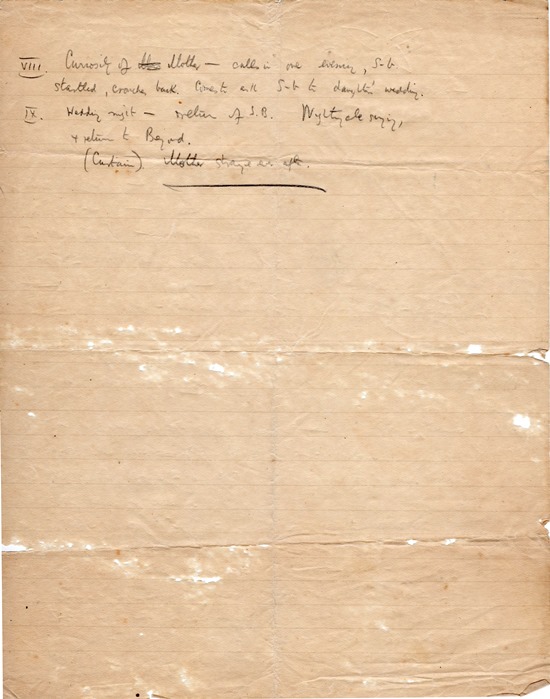
Gradually over the next year, this original idea was developed until the full manuscript of 160 pages was produced between February and April 1924. By then the first two volumes of The Flax of Dream had been published and the third, The Dream of Fair Women, was finished and at the printers. (It was published in June 1924.) In that volume Willie Maddison is seen to be writing ‘The Policy of Reconstruction, or, True Resurrection’.
As will have become obvious, HW, as is Willie in The Pathway, was at this point in his life distinctly of ‘the Left’, adhering to a socialism bordering upon communism. Some of this tendency was due to his reading and following of Richard Jefferies, who was particularly vehement on behalf of agricultural labourers (who led a very grim life in the second half of the nineteenth century). But it was also a fairly common reaction among those who had been in the war. HW, along with many others, believed that one of the prime causes of war was capitalism and the politics that went with it. Thus to take the opposite stance and think in terms of the good of the masses must be the correct path. In particular he was influenced by the work of the French writer Henri Barbusse, whose war book Le Feu had been a sensation when it appeared in 1917, and was greatly admired by HW. Barbusse was also an extreme left-wing socialist leaning towards communism. (Bernard Shaw was a prominent writer who also held such views – HW had met him at The Tomorrow Club in 1920.) That HW thought in this way can be seen in the thoughts of Willie Maddison, who constantly quotes the philosophy and writings of Lenin in the two post-war volumes of The Flax of Dream, much to the irritation of those who neither like nor understand him!
But during the period – covering several years – that HW was writing The Flax of Dream, he had matured as a person and as a writer. For various reasons he was moving away from the heavy ideology of Lenin: ‘The Policy of Reconstruction’ was no longer of vital importance to him. If he had so wanted he could easily have devised a way for Willie to retrieve the ‘lost manuscript’ from Folkestone – but he chose not to: ‘Policy’ was dead. Instead, as the final volume opens, Willie is seen to be writing a new version of his book on the redemption of the world, an allegory called The Star-born. But there was to be quite a long gap between the publication of The Pathway in 1928 and that of The Star-born itself in 1933. That must have made it all the more confusing for his readers at that time!
When The Star-born did finally appear, the text, most unusually for HW, for whom rewriting was a compulsion, followed almost exactly that full manuscript version written in April 1924, without revision. (This does rather beg the question whether Star-born was always intended to be the book involved: ‘Policy’ was always so very thin in concept as to be almost non-existent.) However, because of this lack of revision, the book contained juvenile phrases which really were not worthy of his present status (and which certainly irritated some critics). This was particularly odd as he had by then revised the three early Flax of Dream volumes because of this problem. This was not resolved until he made a radical revision for a new edition published by Faber in 1948, illustrated so beautifully by Mildred Eldridge, who really caught the spirit of the book in her drawings.
The fact that a new edition of this book came out after the end of the Second World War was not an accident. HW thought its message as relevant at that time as it had been to the First World War. In 1969 he thought it equally relevant to the new world-wide movement for conservation of nature and (with myself as assistant) planned a further major edition. But this did not come to fruition. It occurs to me now that perhaps he actually wanted a new edition at that time to enhance the message of his last great work, The Gale of the World, the final volume of A Chronicle of Ancient Sunlight, published in 1969. There are certainly many comparisons that can be drawn between The Gale of the World and a combination of The Pathway and The Star-born.
At the end of 1969 HW wrote a note which is pasted into the front of the 1948 edition that we were working from, which includes the following:
The unseen world is the real world. For all visible things on the planet were once “only imagined”. So what one sees with the physical eyes are, as it were, static and terminated. But as Mosley wrote in prison, in that marvellous book The Alternative (i.e. “Europe a Nation, or perish”) in 1942-43, ‘the purpose of life on earth is to create beauty, under the fostering hand of the Creator’.
Today, as I write this piece, 29 October, European Union has arrived.
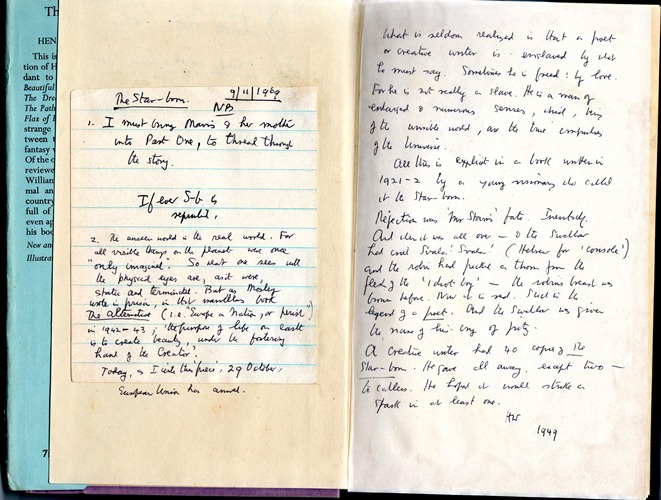
One of the great strengths of The Star-born is the description of the scenery of Lydford Gorge and the village with its ruined castle keep (still there to this day), with all the detail of the natural life found therein: ferns and flowers, blossom and birds, stars and streams, creatures and cascades, animals and arbours.
But there is also a surreal dimension – an ‘above and beyond’ quality, which lifts the book far above an ordinary tale of natural history. In an explanatory note written in 1932, HW included the following points for an overview of the book:
Time: not stated, all clock-time, days, weeks, months, etc, ignored.
Story is meant to be on the verge of 4thdimension as it were; cf simplicity of Einstein . . .
Place: not stated, but locally is drawn roughly from Lydford Gorge & ruinous Castle Keep on western edge of Dartmoor.
Theme: the mind of a poet (natural man who is himself, unaffected by social strata, unaffected by ‘education’) . . . who grows and finds strength with the ‘spirits’ – a marvellous or ‘ideal’ childhood.
The book certainly has an elusive quality that perplexes and teases the senses. One is never quite sure whether one is in the real world or whether one has stepped through some invisible barrier into a further dimension, where the primeval spirits of an ancient lost civilisation abide. It is very subtle, like a gentle mist obscuring the real world where shapes of unseen others are dimly seen and heard: shadows that move just outside the actual line of sight. In fact The Star-born is an enigma. The book could be seen as a dream, and thus fits into the ‘dream-narrative’ writing idea I have examined elsewhere. (AW, ‘Save his own soul he hath no star’, HWSJ 39, September 2003, pp. 30ff.) Note that Francis Thompson’s poem encompasses ‘my dream’, and HW refers to Thompson’s death as ‘dream-tryst’.
The concept of good and evil has occupied the mind of philosophers since the time of Plato, who deemed it the ‘polarised opposites’ theory. This was taken up by the early ‘romaunce’ writers, and then Chaucer, Shakespeare, and epitomised by the Romantic writers, who greatly influenced HW (particularly Shelley and Blake, whose influence absolutely pervades The Star-born). HW was well versed in all these concepts, as I have shown in various articles in the HWS Journal (see in particular HWSJ 36, September 2000, ‘A Daffodyl in the Grasses of Mankind’).
It is probably true to say that HW did not entirely pull off what he set out to create, that in his efforts to obscure, or hide, his true meaning, he possibly lost his way in his own nebulous clouds, for The Star-born does contain many superficial flaws. However, that does not detract from the sincerity and truth of his prose, the force and delicacy of his descriptions, his power to delight and enchant us with this metaphorical and metaphysical tale: a story at one and the same time simple and complicated, entertaining and thought-provoking: an allegory that has much to offer modern society. But the book is open to gross misinterpretation, while HW’s own explanations, as always, only add to confusion of thought.
Read in the true spirit that it was written, you will find it breathtaking in its scope: for The Star-born is a window that allows us to see HW’s vision for a perfect world. A world he yearned for but knew neither would, nor could, ever actually exist. That neither Willie Maddison nor the Star-born succeed in their chosen (allotted) tasks is not an accident: HW knew that Utopia cannot exist in the harsh realities of this world, unless there are great changes – a re-birth – in the mind of mankind: all mankind. One could say: ‘When will they ever learn?’
Although the book is at once a message of hope and one of warning, it does not have to be read on that level. As with all good fairy tales, it is also a charming whimsical tale which tells the story of a lonely imaginative boy lost in his own world of make-believe. Make of it what you will: for Willie Maddison – and thus for HW himself – it was the ‘Truth’.
HWSJ 36, September 2000 was almost totally devoted to The Star-born; for example an excellent synopsis of the story-line can be found in Brian Sanders, ‘The Light of Khristos’ (pp. 5-6) and AW, ‘A Daffodyl in the Grasses of Mankind’ (pp. 28-49).
*************************
Some first edition page proofs:
The title and contents page, with early pulls of Tunnicliffe's woodcuts on very thin india paper pasted in – in the published book these lovely vignettes have changed places:


Chapter 11 sees the first appearance of Mamis, daughter of Esther and sister to the Star-born. The inspiration for the character of Mamis was Doline Rendle, an early love of HW's. Tunnicliffe made a woodcut portrait of Mamis, originally intended to be placed opposite to the first page of this chapter. In the event it was never used . . . though Mamis is remarkably similar to the studio photograph of Doline.
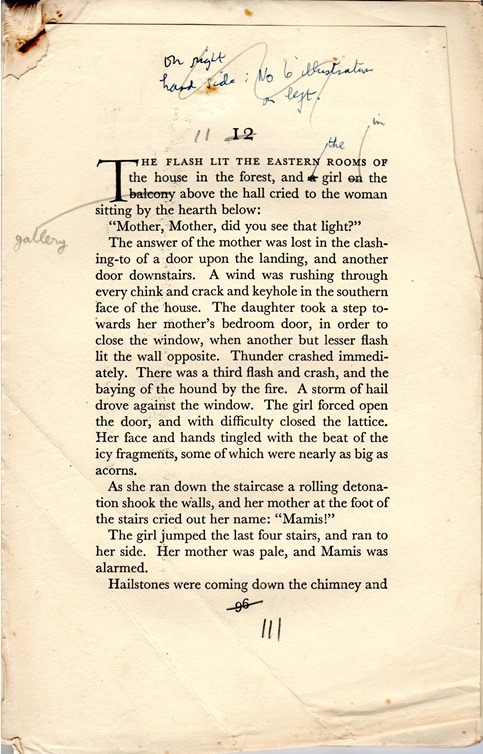
At the end of the book the Star-born is met by spirits, a band of friends:

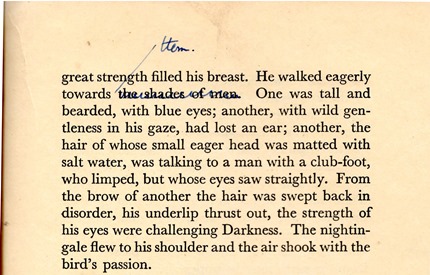
Interestingly the manuscript corrections were not for the first edition but for the 1948 revised edition. The friends are not named, but HW certainly intended them to be identifiable. Tunnlicliffe's excellent woodcut aids recognition:

HW later wrote this explanatory note:

*************************
What did the critics make of this strange allegoric tale in 1933? Remember that it came after the huge success of Tarka the Otter and The Pathway – and that two war books had also been published. I stated in my 1995 biography (p. 153) that no review cuttings for The Star-born existed, but I have since found them (in 2000) at the home of HW’s first wife after she died, still in their Durrant’s Press Cuttings envelope. Most grasped some of its content but also were puzzled by it – understandably.
The Observer (Basil de Selincourt), 14 May 1933 (a long review of 35 column inches):
. . . This star-born book of his is well worth reading for the wealth and fineness of its contact with beauty and nature; and also because it finds Mr. Williamson and leaves him in the meshes of a great dilemma, the great dilemma – the old dilemma of the struggle for life. He tells the tale, the fairy tale – celestial fantasy he calls it – of a new redemption. We certainly need one; no man of sober feeling can fail to appreciate the motive which has led Mr. Williamson to write as he has. Nevertheless, although I have been touched by his book deeply, I must admit I have also been exasperated by it. . . . [de Selincourt enjoyed the nature, was somewhat bored by the various spirits, and exasperated by ‘Weary Wee’ and the baby talk, and was worried by the association with ‘that great friend of mine’ the barn owl.]
. . . The main purpose of Mr. Williamson’s allegory – I suppose an allegory must have a purpose – is to find in the reader’s heart that tender point at which he feels kinship with everything that lives.
[It becomes rather obvious, as de Selincourt wanders around the problem of killing to survive, which all nature does, that he has rather got off the point of the book itself, and never gets back onto it.]
Evening Standard (Howard Spring), 18 May 1933, headed, ‘Mr. Williamson mingles the spirit of St Francis with the manner of Winnie the Pooh’:
“The Star-born” is the outcome of profound feeling about a thing which has baffled the understanding of many men: the presence of pain in the world. . . . But having stated the problem, Mr. Williamson has no contribution to make to its solution or understanding. He has felt and not thought [but states that no-one has ever solved this problem]. But I do complain of the queer jumble of the beautiful and the banal which go to make this book. . . . I could not take kindly to the sentiments of St. Francis of Assisi annotated with extracts from “Winnie the Pooh”. . . .
Having imbibed from a spirit called Wanhope . . . the Star-born is hurled somewhat heartlessly back into mortality, to sink or swim. He appears in a Devonshire village, innocent as the angel . . .
[unfortunately the end of this review is too tattered to read – other than ‘A strange book ---']
John O’London’s Weekly, 27 May, 1933: the end is missing, so the writer unknown – but possibly/probably by Sir John Squire himself. The review reveals straight away that the real writer of The Star-born was not Willie Maddison, but Henry Williamson (but surely only the most naive would have thought otherwise!):
Mr. Williamson has contemplated his shadow for so long that he begins to believe it is someone else’s shadow. . . . Here is the same conflict between greatness and weakness as is present in all of Mr. Williamson’s works; the personal emotions overwrought and out of focus, the descriptive writing as the best of his master Richard Jefferies. Observation of everything [in nature] with a genius of the senses . . . but an inability to see within, to distinguish between the rhetoric of a mood and a sigh of Truth. . . . The complete lack of humour is hard to believe. . . . As for the Star-born himself . . . he has failed to make him anything more than a nuisance. A Messiah of this sort might very well be a nuisance to the conventional, but he would surely have more power than this ineffectual person. . . .
It is strange that all Mr. Williamson’s books have the same failure, the same ineffectual figure at the heart of them. Maddison in “The Pathway” is the only unconvincing person in the book. He is, in fact, not a person, but an embodiment of an incomplete ideal. In this fantasy he appears again, a half-realized theory among living people. He fails at last in his mission; but there is no irony in that, for he was created to be a failure. . . .
Mr. Williamson has not found himself yet . . . but that he will succeed seems certain.
Sunday Referee (Edward Crickmay),14 May 1933:
The work is supposed to have been written by Maddison who . . . believed it would be a revelation of truth. This latter large general proposition may not be examined here; but that The Star-born contains a full measure of that artistic truth which is also beauty cannot be questioned. It is a superb allegory of spiritual life developed through a multitude of earthly symbols. The texture of the book is that of a dream . . . [one cannot analyse it without damage but . . .] Mr. Williamson has found a really lyric voice . . . here, freed from the necessity of social realism, he rises to magnificent imaginative heights.
The Sunday Times (H. C. Minchin), 14 May 1933:
One closes this book with mingled feelings of admiration and perplexity. The author has a fine perception of beauty, as well in language as in scenery. Mr. Williamson – for the authorship, despite some preliminary mystification, is, of course, his – is known as a sensitive and observant naturalist, and these pages are permeated by the ripe knowledge of what, as an observer, he has felt and seen. But there is a jarring incongruity between this admirable exactitude and other features of the narrative which are chimerical rather than legitimately fantastic.
We do not experience such jolts and jars in reading "The Ancient Mariner", with which in its strong humanitarian feeling this story is comparable. We can accept Mowgli as a denizen of the jungle and a familiar of the beasts; we can see the she-wolf carrying him off; but to read of a little boy being spirited up the chimney by an owl, and being brought up by it in an "ivy-mantled tower", is a severe strain on the most willing suspension of incredulity. "Sonny" grows up in companionship of the spirits of the air, land, and water, and of a mysterious being called "Wanhope", who seems to be closely akin to Mr. Hardy's "Pities", but is eventually seen as crowned with thorns.
However, when Sonny is restored to earth and to a mother and sister who are strangely attracted, but do not recognise him – nor he them – the story begins to grip us. There is charming subtlety in the interactions of this very lovable trio. Poor Sonny is constantly coming into collision with the harsher realities of this our life, and the women are constantly hurting themselves in trying to protect him. Just as they are on the verge of recognition, the "star-born" vanishes; and his mother, who has sought to restrain him, is found lying dead in the snow.
Her death seems purposeless enough; and Mr. Williamson might reply, such is often the case. But on this occasion it appears unusually so. There is a hint, however, that Sonny's disappearance is due to grief at the loss of his sister, who had married six-foot-two of sporting Devon manhood, which drove him to a last plunge in a beloved stream. But all is left vague and indeterminate.
What a beautiful book, one feels, Mr. Williamson might write, if he would realise that it is a true instinct which bids us recoil in just dislike from that which is chaotic, and, while not shackling his imagination, would refrain from overstepping the bounds of fantasy.
The Times Literary Supplement (unsigned), 11 May 1933:
. . . The story is allegorical: and the allegory, it is clear, has a very real meaning for the author. But the reader is faced with many interpretations . . . he may probably conclude that, for anyone except the author, the pieces will not fit – the key to the puzzle is incomplete.
The Star-born, part figment of Esther’s dreams and part her still-born child [misinterpretation] . . . brought up among the spirits . . . until he was old enough to return . . . with a mission to mankind – not until he was fit enough to do so, for he was ever that, nor was the hopelessness of his mission ever in doubt. . . . the Messiah who does not understand his own message.
The Times (unsigned), 16 May 1933:
. . . The Star-born is a human child who has died at birth [not quite correct] and was brought up in a world peopled by owls and the abstract spirits of fish, flesh and fowl. After a period in which he learns, as it were from the inside, all the workings of Nature, he returns to the world of men to be rejected of men. Mr. Williamson does not elucidate his allegory: but he stimulates thought and wonder by the expression of a difficult creed – the creed of Maddison who wrote “in the period of despair which beset the youth of Europe immediately surviving the Great War.”
Morning Post (E.B.O.), 16 May 1933:
[After a lucid resumé of the plot peppered with a few comments this review ends] . . . But man must collaborate with ever-increasing kindness – that is the “moral” of a book which lifts us out of life’s littlenesses for a few immortal moments again and again.
The Daily Mail (T.C.M.O.), 18 May 1933:
When you are tired of the dust and the dirt of the mechanical age into which we have allowed ourselves to be driven, find a signpost to new life in the books of Henry Williamson. . . . who has sent out as memorable a tetralogy – “The Flax of Dream” – as has been presented by any author of today.
Williamson’s books are the greatest indictment of modern war that the soldier-writer generation has produced. And yet the war hardly comes into them. Now . . . is the book that everyone who knows Mr. Williamson’s work will have expected and hoped for. . . . And the thoughts and their expression could have come from no-one else in this generation.
But this is not a book for every reader! Unless you have known the fire that quickens the conscience towards your fellow man you may not find Mr. Williamson’s points to your taste. . . .
Western Morning News, 11 May, 1933 – headed: ‘DEVON TRAGEDY RECALLED’
[After a long introductory passage and several quotes throughout] . . . The story certainly is wistful and unusual, yet entrancingly set on Dartmoor, principally in the ruined castle keep of Lydford village and the gorge of the river Lyd . . .
“The Star-born” is enriched with many full-page wood-engravings by C. F. Tunnicliffe, whose design and craftsmanship . . . lend distinction . . .
[The very last paragraph reveals the reason for the somewhat obscure heading – it is referring to a new edition of The Old Stag (Putnam’s, 5/-) and the ‘tragedy’ is that of the red deer Stumberleap, swept away in the swollen river: based on a real ‘famous thunderstorm’ when the river rose many feet in an incredibly short time, and the deer was swept out to sea, along with of course 15½ couple of hounds.]
Birmingham Post (unsigned), 16 May 1933 (this short succinct review is quoted in full – the writer fully grasped (though a trifle overflowingly!) the essentials of the book and HW):
Knowledge, for Mr. Williamson, is the quest of human happiness and truth, and all the roads of his life have led towards that end. Step by step he has formed and manifested the belief that if we would restore our sense of eternal truths and elemental verities, the way lies not in the conservation of material things, but by conserving the spiritual home of all humanity and by the protection of living things – a belief that the countryside holds everything needed for the satisfaction of man’s wants, whether mental, physical or spiritual. All that most men make much of has little meaning for him, and throughout his works he has always professes the same active faith, crying of the inevitable ruin that awaits a busy though aimless generation which has learnt to control every force but the tumult of his own soul.
The “Star-born” is a final summation of his beliefs, and a broken-hearted lament because the Kingdom of Heaven is by no means at hand. An extravagant fantasy, conceived and executed with a magnificent integrity of feeling, it baffles description. One is tempted to leave it quiet, for to get the best from it the work needs to be approached in a spirit of sympathy and understanding equal to the author’s. Beyond the mere story are deeps of truth and a subtle beauty so gravely and delicately drawn as to be almost impossible of analysis. From the race of man a child is taken by Spirits of the Earth; he returns to bear the Light, living in human form on the Earth awhile. Failing in his purpose, and mocked and derided, he finally departs to join that immortal company of strangers who, likewise, suffered and were persecuted when carrying the Light among men. It is a strange spiritual adventure, rendered beautiful in a prose which has the essential quality of poetry and is an inspiration to all whose eyes are not closed to the world of simple things.
The very few reviews in the archive for the 1948 edition are thin and little more than a notification of the publication of this new work: however, it may be that others do exist?
*************************
A strange coincidence
A Dutton Broadsheet dated 14 July 1928 (these weekly ‘Book News’ broadsheets are 12” wide x 21” long) announcing (in an item at the bottom of the page accompanied by a photographic drawing) ‘HENRY WILLIAMSON WINS HAWTHORNDEN PRIZE’ included also the following item written by Duke N. Parry:
‘ARE THE STARS INHABITED?’
‘Sir Francis Younghusband Not Only Believes They Are But Says They Must Be’
This is in fact a review for Life In The Stars by Sir Francis Younghusband, who believed that these higher beings, being ‘finely sensitive to excellence they would be finely sensitive to evil’ – and ‘Music must play a fundamental part in the lives of these higher beings’, and much else. The reviewer ends: ‘the author thinks it possible that the life hereafter will carry men and women to life on the stars as their reward of virtue’.
This cannot have influenced HW’s own thoughts (The Star-born being finalised in 1924), but it is a strange coincidence here.
*************************
The cover of the 1933 limited edition, with the signed certificate:


The dust wrapper for the 1933 trade edition, featuring Tunnicliffe's marvellous wood-cut of a barn owl and skull, not printed in the book:


The 1948 revised edition:


Cedric Chiver's 1973 re-issue of the 1933 edition, published for the library market:

Back to 'A Life's Work' Back to 'The Pathway'
The Weekly Dispatch
THE WEEKLY DISPATCH
(HW’s contributions to this Sunday newspaper)
 |
|
| Privately printed edition, 1969 | |
 |
|
| Reprinted, HWS, 1983 | |
 |
|
| E-book edition, HWS, 2013 |
Introduction to the 2013 e-book edition
Collected, edited and printed by John Gregory, 1969 (7 copies only)
Reprinted by the Henry Williamson Society, paperback, 60 pp, 1983
Revised edition, e-book only, HWS, 2013
This small booklet comprises the articles that HW wrote for The Weekly Dispatch during the period July 1920 to 2 January 1921 when employed by the editor Bernard Falk, and carefully gathered together by John Gregory in 1969, with HW's approval. The background to this ‘labour of love’ is explained in the introductions to the 1983 and 2013 editions.
Having been demobilised on 9 September 1919, HW subsequently found it very difficult to adjust to civilian life, although he was already writing hard. He was in a state of deep nervous tension, verging on breakdown, from his experiences in the First World War and found life in the family home with its restrictions and criticisms extremely irritating. His maternal grandfather, Thomas Leaver, a director of a large stationery firm in Rosebery Avenue, in the Holborn area of London, approached (via a colleague, Vansittart Bowater, of the paper firm) Lord Northcliffe of The Times newspaper, and obtained for HW a job as a canvasser in the Classified Advertisement Department. HW did not find this work congenial, but it did provide him with a good introduction to Fleet Street and the ways of that world.
He was soon placing short items in various newspapers, and in July 1920 was given the chance to produce ‘On the road’ a short weekly column of ‘light car’ notes in The Weekly Dispatch; he supplemented these with other stories, some real and some made-up, and a few nature sketches under the title of ‘The Country Week’.
However, The Weekly Dispatch was in financial difficulty and unfortunately (or possibly fortunately!) HW was dismissed, the work finally drying up as the year turned into 1921. His journal records that he was paid £2/2/- (2 guineas) a week, which would seem to have been quite a good rate. HW wrote an evocative essay of his time as a novice reporter, ‘The Confessions of a Fake Merchant’, which was first published in The Book of Fleet Street (1930), edited by T. Michael Pope, and reprinted in HWS journals nos. 8 and 9 (1983/84).
This collection is of great importance in the hierarchy of HW’s writing career, and we are indebted to John Gregory for the patience, time and diligence with which he has pursued his self-appointed task of collecting together, not just this slim volume, but over many years the major part of HW’s articles and essays published in a variety of publications on an amazing range of subjects: giving us an equally amazing series of book titles.
The Weekly Dispatch articles are interesting as illuminating, as if snapshots, life in 1920, but particularly they give us an insight into HW’s growth as a writer.
The collection was revised and reissued by the HWS in 2013, with a new introduction by John Gregory, as an e-book, with the new title of On the Road, this column forming the major part of the book.
HW stuck cuttings of some of these early efforts in newspapers such as the Evening News and Observer, as well as the Weekly Dispatch – some amusingly marked ‘true’ or ‘fake’ – in his ‘Richard Jefferies’ journal, in which he recorded his thoughts from February 1920 to mid 1922, as illustrated below:


********************
(The Introduction below is from the e-book edition published in 2013, and is a revised version of the original.)
Henry Williamson, who wrote over fifty books, is best known today to most people as a ‘nature writer’ – author of the classic books Tarka the Otter and Salar the Salmon – and to others as the author of the 15-volume A Chronicle of Ancient Sunlight, a magnificent panoramic history of the first half of the twentieth century, and the First World War in particular, viewed through the character of Phillip Maddison.
On the Road collects his very earliest published writing, as a green young journalist on the Weekly Dispatch, which he joined not long after he was demobilised from the army.
Henry, who was born in 1895, served throughout the First World War, being present at the famous Christmas Truce in 1914 as a private in the London Rifle Brigade, and ending the war as a lieutenant in the Bedfordshire Regiment.
We know that even while Henry was still in the army he had begun to write. He was not demobilised until September 1919, almost a year after the Armistice, ten months during which life must have seemed lonely and flat, both for him and hundreds of thousands of other young men then in the armed forces. Joining the army, and going to war often straight from school, it was the only adult life that many had known. Henry has described how, during the latter part of that period after the Armistice, when he was with the reserve battalion of the Bedfordshire Regiment, then stationed at Cannock Chase in the Midlands, ‘I discovered myself as a writer, and spent my days in my asbestos cubicle writing, and reading Galsworthy, Shakespeare, Shelley, and Richard Jefferies . . . I wanted to write the truth as I had seen it . . . so I stayed in my cubicle, eating biscuits and making tea.’ Not surprisingly this behaviour was not condoned by his immediate superiors, and it hastened his departure from the army.
Henry left the army with not very much – his new Norton motorcycle, a Brooklands Road Special which cost him seventy-nine guineas, and what was left of his gratuity after buying it, together with a small disability pension. He also left the army, in his own words, ‘without the least intention of doing any work for a living, except by writing my own kind of writing’.
Henry used to write at night, in his uncle’s old bedroom in the house next door to his parents, and would loaf about during the day, much to his father’s annoyance and frustration – perhaps understandably, for as far as he could see his son was a wastrel, doing no work and earning no money. However, Henry’s gratuity did not last long – he either spent it or lent it to friends (and never seemed to be paid back) – and this hastened his advent into Fleet Street, for until he could make money by his kind of writing some kind of income became a necessity.
His first job was obtained partly through the efforts of his grandfather, Thomas Leaver, and this was as a canvasser for the Classified Ads department of The Times, owned by Lord Northcliffe, in January 1920. The job must have lasted some six months – six months of tramping the streets of the suburbs of north London, during which time, Henry says, he ‘adopted a humble and almost obsequious manner, creeping into the offices of estate agents, and trying to avoid having the junior clerks come towards me as though I were an important client’.
Exactly when he left this job is not clear, but Henry mentions it as being ‘towards the heat of the year, after a holiday in my Devon cottage’. The Manager of Classified Ads approached him and asked if he knew anything about light-cars. ‘No,’ Henry replied, ‘but I’ve got a racing motorcycle.’
That was experience enough. The word was that Northcliffe – the Chief – was not pleased with the light car notes then appearing in the Weekly Dispatch, and a replacement was required. The word had gone out.
The ‘light car’ was exactly that, in those early days of motoring. They were, together with cycle-cars, seen as a preferred alternative (as offering both some shelter from the elements and side-by-side companionship) to the motor-cycle and sidecar combination. They were really no more than motorcycles on four wheels, fragile-looking devices, usually powered by motorcycle engines. Many of the light car manufacturers that sprang up after the war provided what were very basic cars indeed, with the purchaser expected – and indeed expecting – to do his own maintenance and running repairs. They had a light chassis, thin spoked wheels – motorcycle wheels – and more often than not a pressed fibreboard open body which might, if you were lucky, survive a rainstorm without disintegrating. Light cars were subject to a reduced tax, and the theory was that they would be cheap to build, very economical to run, and so provide motoring for the masses. Most of the post-war light car manufacturers, woefully under-capitalised, vanished as quickly as they had arrived, and the light car as a class was killed stone dead by the arrival of the Austin 7.
The editor of the Weekly Dispatch at that time was Bernard Falk, a much respected newspaper editor. There were three Dispatch newspapers: the Daily, the Evening, and the Weekly, the last being a Sunday paper, all owned by Lord Northcliffe. Henry has written well and amusingly of this period, both as fiction in The Innocent Moon (1961; the ninth volume in the Chronicle series), and in a fascinating essay, ‘The Confessions of a Fake Merchant’, which first appeared in 1930 in an anthology called A Book of Fleet Street. In the essay Henry describes how he first approached Falk:
‘So you’re from the Chief, are you?’ he asked, looking at me doubtfully. ‘Sit down, won’t you?’
I sat down.
‘You’re going to write a column on Light Car Notes, aren’t you? The Chief sent you, didn’t he?’
‘Yes, I replied. ‘But I can write about anything.’
The confidence, the arrogance, of youth! In The Innocent Moon, Bernard Falk is called Bernard Bloom, and the Dispatch the Weekly Courier. Bloom sat in a glass-built cage inside the Courier office, which was just a single room on the third floor of Monks House – Northcliffe’s famous Carmelite House in real life – where the three papers were produced. Bloom is likened by Phillip Maddison to a jackdaw, ‘with black hair and prominent nose; although there the resemblance ended, for he had loose cheeks and altogether a loose look on his face, reminding Phillip of a clown whose melancholy reflections came with a sense of fun’.
Henry started work at the Dispatch in the second week of July 1920, on a Tuesday – as it was a Sunday paper, Sunday and Monday served as the weekend. Presumably therefore it was Tuesday, 13 July. Falk offered him a choice of remuneration: either seven guineas a week, or to go on space, the space rates being three guineas a column, or four guineas if on the article page. Henry chose to go on space – he thought, misguidedly as it turned out, that he would earn more.
There were four news reporters under the News Editor, a young man whose name in The Innocent Moon is Harry Ownsworth. Phillip’s fellow reporters were North and Singates, and a woman writer named Vivienne Lecomte. In ‘The Confessions of a Fake Merchant’ their (presumably) real names are given as Gordon West and Singleton Gates, while the woman writer is nameless, but damned as ‘the pathetic little woman reporter’.
Four reporters for a national newspaper doesn’t seem very many, but this dearth wouldn’t have been obvious to the readers of the Weekly Dispatch, for contributions from the same reporter could and did appear variously in the same issue as ‘From our own correspondent’, ‘From our special correspondent’, under his initials, under his full name – or without any credit at all. The weekly routine would be for the News Editor to cut out news items or good stories from other newspapers during the week, and send his reporters out on ‘follow-up’ stories.
They had from Tuesday to Saturday to produce the material, for Saturday morning was when the Weekly Dispatch became alive, a proper newspaper, and took over the Daily Dispatch’s news and subbing rooms. The editor, as Henry describes it, moved ‘about the building with nerve-strain making his face haggard in the electric light, while the writhing worms of paper fell from the tape-machines and the building was periodically filled with the basement roar of the rotary printing machines, and damp proofs were trodden flatter and scattered further around the feet of the sub-editors sitting in shirt-sleeves around the “subbing” table, and the reporters grew drabber and more mutinous’.
Henry relates his story well: of his scoop interview with Cecil Parkin, the Lancashire bowler, and of how this story – in The Innocent Moon at least – appeared on the front page of the early Northern edition; of going to Nottingham to interview an old woman aged 101, who had been flying in an aeroplane; of interviewing a schoolmaster in Lincolnshire, who had appeared in the Saturday Daily Dispatch, condemning the clothing of modern girls, and especially the V blouse. This particular story had been accompanied by an out-dated photograph showing the teacher with a fierce Kaiser moustache; whereas Henry found him to be a ‘mild, clean-shaven old gentleman’ with entirely reasonable views which had been distorted. Henry, having promised him that he would correct this false impression, rushed back, and was received with ‘the usual question from the editor, whose face, with its suggestiveness of a jackdaw, peered round his glass office, “What have ye got?”’ He glanced at Henry’s article, dropped it, and ‘dejected his head as he shuffled back into his cage. “You can’t write against the Daily,” his voice said plaintively. “Don’t you know the Chief owns the Daily? What else have you got?” “Old woman flies,” said Henry. “That’s better. Send it upstairs to the News editor.”’
On looking again at the teacher article, Henry realised that by taking out a few words, and adding a few negatives, it could be turned into an attack on flighty mothers. Writing ten years after the event he said: ‘Even now I am filled with shame at the thought of the dear old man, reading his Weekly, seeing himself with Kaiser moustaches, denouncing flighty mothers! I got thirty shillings for that article.’
Henry was not, it has to be said, a very good news reporter, and much better at making up stories, such as the pigeons of St Paul’s being raided by a peregrine falcon – ‘harmless stories, and easy to do’, he called them.
A more sobering story is also related in ‘The Confessions of a Fake Merchant’: ‘One Saturday afternoon the News editor said to me, “The Doncaster police have just rung up and said that a man living at Hoxton tried to cut his throat opening a mail bag after the races. He was a bookie, who had lost all his dough. Go and see his wife at this address and get a story.”’ So Henry went, and to his horror found that the man’s wife had not heard the news – ‘“What do you want to know for?”’ she asked, again and again. ‘I said her husband had met with a slight accident. There was no story in it for me. An ex-soldier trying to keep a family together by making a book; obviously an amateur, cutting open a mailbag lying under all eyes on the station. But that aspect was not news.’
However, for a reporter paid on space, his start was promising: four articles in his first week, five in his second, including his column on light cars, ‘On the Road’, for which he received two guineas weekly. His star seemed to be in the ascendant, but alas, it fell just as quickly. From August onwards, apart from ‘On the Road’, there are very few identifiable contributions by Henry. Of course, if the stories bore neither initials nor name, it is almost impossible to identify them positively, and I think we shall never know accurately the full extent of Henry’s writings in the Dispatch.
While it quickly became clear both to Henry and his employers that he was not cut out to be a news reporter, there was one small indicator of where his future would lie: he persuaded Bernard Falk to let him write a short sketch, to appear on the 4-guinea article page under the heading of ‘The Country Week’. ‘Looking back,’ Henry commented, ‘I am sure he consented out of kindness. This little feature appeared once or twice on the middle page, tucked away in one or another of the corners.’
At the time things were not going well at the Weekly Dispatch. The newspaper world was as cut-throat then as it is now, and competition fierce. Henry, in his diary, as quoted in ‘The Confessions of a Fake Merchant’, wrote: ‘16 September, 1920’ (he had been there just two months) ‘Great gloom in the W.D. office today. The paper isn’t making enough money, so economy must be rigidly enforced. The editor called us all in and said that two of us must go; he was sorry, but – I hear unofficially that I am one of the two. I do believe they think that I have independent means. Ye Gods! If only they knew. Anyhow, perhaps it’s best that I should go. The editor, whom I like more and more, says that he will take my Light Car Notes until after the Motor Show, and advises me to write fiction. Good! Now I shall begin to write.’ In The Innocent Moon the other reporter to go was named as Vivienne LeComte, described as a spinster halfway through life, who was seldom visible in the office, being on space for special woman-appeal articles. Phillip asked Bloom how the fact of two unsalaried reporters leaving would cut down expenses – it is not known whether Henry did the same.
The Motor Show was held at Olympia between November 5 and 13, but in fact Falk was perhaps more generous to Henry than he need have been, and continued to take his ‘On the Road’ column until the first Sunday of the new year of 1921. In March that year Henry left London for Devon, and his thatched cottage beneath the church in the small village of Georgeham; and in October, his first novel, The Beautiful Years, was published – his course was now set.
Let Bernard Falk have the last word on Henry’s Dispatch days. In his autobiography He Laughed in Fleet Street (1937) Henry has a paragraph to himself:
Before he began to write the nature studies, which deservedly brought him fame and praise, Henry Williamson stayed with the Dispatch for a while. Having regard to his specialised talents he was scarcely in a suitable medium, and my inability to print all his nature contributions rankled, I dare say, in his soul. If I am judged, not by what I left out, but by what I put in, then he has no cause for complaint, and the image he retains of me, if not flattering, should, at any rate, be friendly. Like himself, I was a victim of limited choice. How much rightful use of the space of a popular Sunday paper should enraptured observation of animal life command? My own fancy had a liking for the company of badgers, stoats, weasels, beavers, moles and other inhabitants of the country night, but hard news is uncompromising, and will only make room for its kind. At such times a weaver of supple and melodious prose, whose theme is the busy freedom of the humble fauna couched in the earth, falls by the way, and with bitter heart must watch the columns fill with more commonplace excitements.
*************************
Nearly fifty years later, in 1969, two young and enthusiast readers of Henry Williamson’s books, one in his late teens, the other in his early twenties, met – as much through serendipity as anything else – and had become friends because of their common interest. One was Stephen Clarke, later owner of Clearwater Books, who specialised in Henry’s first editions. He was the youngster, and lived in London. I was the other, living at the time just north of Birmingham. We were both bibliophiles, even at that tender age, and passionate about Henry’s writings. It was a magical time, with Stephen inviting me down to stay, and showing me round Lewisham, Eastern Road, Keston Ponds – all the London Chronicle haunts, while we spent long weekends exploring Williamson country in North Devon and Norfolk.
We collected Williamson’s limited editions, when we could afford them – fortunately they were very much cheaper then! – and talked of producing something ourselves. We knew of very few other people with a similar interest, so few indeed that they could be counted on one hand. We corresponded frequently, swapping news of, or newspaper articles by, Henry that one or the other of us had discovered (though it was usually Stephen), exchanging newly discovered identities of places and characters in the Chronicle – an exciting game this – and generally sought out anything and everything written by him.
And so, in due course, having come across ‘The Confessions of a Fake Merchant’, it seemed such an obvious thing to do, to ‘rediscover’ the originals of the articles that Henry had written about – we could collect them, even produce our own limited edition to circulate freely among our small circle of like-minded friends. George Harris would be sure to want one, and there was Richard Russell, and John Gillis and dear old Arthur Witham, who was then the tenant of Shallowford. Six would be enough, then. That would make it a pretty scarce item on the collectors’ market, we thought with satisfaction! But what about copyright? Ah, yes, perhaps we’d better write to Henry. Perhaps the idea would be stillborn after all. So I wrote to Mr Williamson, explaining that this was a non-profit making exercise, and asking for his permission. And, wonder of wonders, it was granted – and he wanted a copy too!

So off I went to the British Museum Newspaper Library at Colindale, and ordered the Weekly Dispatch for 1920 and 1921. I thought I knew roughly where to start – there had been enough clues in Henry’s writings. The large bound volume arrived, and I began turning the fragile pages carefully.
What were the headlines? Germany was protesting over the terms of the Armistice; the second race of the America’s Cup had been postponed because of a lack of wind – this was between Shamrock, the British yacht owned by Sir Thomas Lipton, of tea fame, and Resolution, the American yacht, which, after both yachts had won two races, eventually won an exciting deciding race; there had been a train crash, an earthquake in Los Angeles, Ireland was simmering, and the Troubles would arrive with a vengeance within months – and Air Marshal Sir Hugh Trenchard, the father of the Royal Air Force, had got married.
And then there, on the inside column of an inside page, was ‘On the Road’, signed HWW – his first column of light car notes.
And on the sports page, there too was ‘Parkin on Bowling’ as the lead feature, with Henry Williamson’s name at the bottom! 15,000 extra copies of the paper were sold in Lancashire on the strength of that interview, Henry was told by the editor.
 |
 |
All just as Henry had described. On to the next week’s issue, and yes – no byline this time, but there was the flying Granny, and the poor headmaster, complete with the out-of-date, stern photograph with fierce Kaiser moustache – by ‘Our Special Correspondent’ and ‘Our Own Correspondent’ respectively! I later found the first mention of the centenarian Mrs Sissons in the Daily Express for the previous Thursday, 22 July 1920, in which there was a photograph, with a caption, showing the intrepid Granny Sissons sitting proudly in the cockpit of a two-seater Avro, with a huge beam on her face. The Dispatch’s news editor had obviously seen this, sensed the possibility of a further story, and passed it on to Henry for him to follow up: and while a flying Granny might not be news today, and perhaps a rather easy target for humour, remember that commercial flying was in its early infancy then, and fatal accidents were reported in the press with alarming regularity. On the next page was the story ‘Laying A Kent Ghost’, with Henry’s initials again. Was this the first of his made-up news stories?
On the 1 August, tucked away in a corner, appeared the first of the short ‘Country Week’ articles that Henry had persuaded Falk to include.
This was all heady stuff to me. I knew that in all probability I was the first person to have seen these in forty-seven years. (Although the fact that perhaps no-one else had wanted to, or perhaps ever would want to, never occurred to me!)
The final item in the Dispatch that could positively be identified was published in the 2 January 1921 issue – the last in the ‘On the Road’ series, although by then it had even dropped its title.
The booklet of collected articles was duly completed – not as nice as I had hoped, but, financing it totally myself and committed to selling them at cost, £45 was all I could run to – it was a large sum for an articled clerk earning £3 a week!
I sent a copy to Henry, as he had asked, together with a letter floating another idea, a collection of his Eastern Daily Press articles during the Second World War (which in 1995 were published by the Henry Williamson Society as Green Fields and Pavements), and he sent a postcard, acknowledging receipt of ‘the brave little book’:

These were indeed kind words – for although at only 7 numbered copies the booklet is one of the scarcest items of Williamsoniana around, it is also almost certainly the most unattractive, the cheap card wrapper the colour of cardboard. (And note the date on the postcard: ‘Hallowe’en 1914’, with the year corrected: this was anniversary of the night that the London Scottish – the London Highlanders in How Dear is Life – first went into action at Messines ridge in 1914: was Henry there in his mind even as he wrote this?)
The Henry Williamson Society reprinted Contributions to the Weekly Dispatch for a wider audience as their very first publication, in 1983. Now re-titled On the Road – for the core of the collection is Henry’s motoring column on light cars – the Society is very happy to make it available as an e-book.
John Gregory
2013
*************************
The Pathway
THE PATHWAY
(Vol. IV of The Flax of Dream)
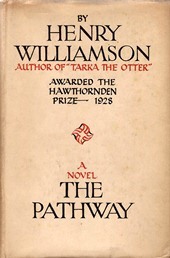 |
|
|
First edition, Jonathan Cape, 1928 |
First published Jonathan Cape, 1928
Dutton, USA, 1929
Many reprints, some with small revisions, but no major revised text
Currently available from Faber Finds
This is the fourth volume of The Flax of Dream, and represents ‘early manhood’ in HW’s original scheme.
Oh, if only I may be able to write it as I conceive it. How great and noble a book it will be!
I must live to write it, - I must, I must, I MUST.
(Entry from HW’s ‘Richard Jefferies Journal’, March 1921, at the end of a long entry about 'The Bludgeon' (i.e. The Pathway) just before going to live in Devon, and in a great state of nervous tension.)
. . . I stopped a moment to climb the hedge and breathe the shining west wind, and to lose myself in the vast colour and light of the sky. Down there, where water gleamed in the plains behind the sand-hills, lay Wildernesse Manor, scene of my book about an ex-soldier of the Great War, who tried to alter the thought of England. All my hopes were in that book. I hoped it would change the pattern of the European mind.
(Extract from The Children of Shallowford, first edition, Faber, 1939, p. 15.)
*************************
When The Pathway was published in October 1928, four years had passed since the appearance of volume III of the series, The Dream of Fair Women, and much had changed in the interim. While out with the otter hunt in the summer of 1924, HW had met Ida Loetitia Hibbert and they married in May 1925. HW’s main energies were put into the enormous task of preparing and writing Tarka the Otter, but in addition, to earn enough money for his family to live on (a son was born early in 1926), he was writing articles which were sold in Britain and America.
HW was by now an experienced and established writer. This is evident in the quality of the writing in The Pathway (compared with the first versions of the previous three volumes), even though it appears to have been written in fits and starts. This volume was never revised, except for very minor and small corrections and additions, and it was the quality of this volume that made HW realise that the first three needed radical revision to bring them up the same standard.
The business file for 1928 reveals that the background to publication was quite complicated (a recurring problem, often due to HW’s own interference!). Collins had published the first editions of the first three volumes of The Flax of Dream and the two intervening nature volumes. But due to a problem, HW had already broken with them and moved to Putnam (who published Tarka the Otter) and he was technically under contract to them. This was complicated by the fact that HW’s friend (and best man) Richard de la Mare (son of the famous writer) worked for Faber & Gwyer and was hoping to obtain this latest work. Meanwhile HW’s agent, Andrew Dakers, reported that Putnam finally refused to pay the £100 advance for which HW was asking (which seems extraordinary after the success of Tarka), thus releasing HW from contractual obligation to them – but that Jonathan Cape were happy to do so. Thus it was Cape who published The Pathway on 28 October 1928 – the same day that HW’s second son was born.
HW set the Ogilvie family home, Wildernesse, in Braunton Marshes which lie between Braunton Burrows and the sea and the estuary of the Taw and Torridge rivers, with ‘The Great Field’ nearby. That this was one of his most loved areas is obvious in his evocative and superb lyrical descriptions. The heroine here is Mary Ogilvie, now based on his wife, Ida Loetitia: Sufford Chychester is based on her father, Charles (‘Pa’) Hibbert. (The Hibberts were closely related to the famous Devon Chichester family – hence the fictional name.) The parson, Garside, is the Georgeham incumbent at that time and Miss Goff is a well-known local character, Miss Hyde. There are several articles within the HWS Journal which give great detail of the real life characters and places: particularly see Tony Evans’s ‘Light on The Pathway’, HWSJ 33, September 1997, pp. 25-41, scanned here in two parts: Part 1; Part 2.
HW was still in post-war trauma (which never actually left him) and articulates in this volume many of his thoughts about the war and its causes, a factor which many critics picked up on at the time as excellent. He was at this time of far-left political persuasion. His thinking about the causes of war and its aftermath (the hollowness of the phrase ‘a land fit for heroes’ – when in reality ex-soldiers were left jobless and destitute) led him, in common with many ex-soldiers, to follow the beliefs of Lenin. He was originally influenced by Richard Jefferies’ socialist principles (mainly on behalf of agricultural workers), but particularly towards the end of the war by the writings of Henri Barbusse, whose left-wing politics and anti-war book Le Feu greatly influenced him. This thinking is incorporated into Willie Maddison’s philosophy in The Pathway – notably in the discussion between Willie and the Rev. Garside. Interestingly HW wrote to T. E. Lawrence on May Day 1928:
. . . I’m NOT an established writer. I am a thin, hesitant creature on whom sometimes descends a falcon spirit, and sometimes that of a moaning dove. . . .
I’ve tried to put this Hamlet in an art form, in ‘The Pathway’ which I finished last week, thank God. After 7 years. . . . [then a mention of the imminent Hawthornden Award, possibly to be awarded by the P.M. --] I feel rather a sneak, because ‘Pathway’ I suppose is Bolshy to the core. An attempt to reconcile Jesus and Lenin. . . . [note again that reference to Hamlet]
HW was overjoyed in June 1934 to receive a letter from the Poet Laureate, John Masefield, who wrote to say how much he had enjoyed The Pathway, that very few modern stories had such power and that he was thrilled to find himself mentioned and quoted. HW pasted this letter into the front of his own copy of the limited edition of the book, with a second letter received later (neither is dated). The latter states that Masefield had now read the previous volumes of the tetralogy and that the work is an ‘astonishing achievement’, and that although he had read Tarka the Otter and HW’s other books, these novels are on a far greater scale and yet are ‘so delicate’. Masefield wondered if they had possibly passed each other, or even met, in the war, ‘on the line of the Ancre’. There is a third letter in the archive, again undated, in which Masefield urged HW to write some poetry as he felt he had more in him than could be uttered in prose.
*************************
Three and a quarter years have passed since Willie Maddison left Folkestone, and The Pathway opens on a very different scene, with a description of a bitterly cold winter night – a description very reminiscent of ‘the Great Winter’ scene in Tarka the Otter, Henry Williamson’s great masterpiece published in 1927, just immediately prior to writing this book.
We are in ‘Wildernesse’, the family home of Mary Ogilvie, her widowed mother Constance, and sister Jean, and their older relatives, Mr Sufford Chychester and his spinster sister, Miss Edith Chychester. The family is completed by Benjamin, the rather harum-scarum illegitimate offspring of one of Mr Chychester’s three sons, all killed in the first year of the First World War. Constance Ogilvie has two younger children who are mainly away at school. Her beloved oldest son, Michael, was also killed in the war.
Jean returns from a visit to friends across the estuary bursting with the exciting news that on the way back she had met up with a man she recognised as Willie Maddison, and that she has asked him to supper. Willie has returned to live in Devon and has isolated himself in Scur Cottage to write a new version of his book on the redemption of the world, now an allegory entitled The Star-born. Henry Williamson himself went to live in North Devon in 1921, renting a cottage in the village of Georgeham which he named ‘Skirr’.
The reader knows of course that Mary has always been in love with Willie, but she now has a serious admirer, Howard Wychelhalse. Things are complicated by the fact that Jean is secretly in love with Howard, but in her turn is being pursued by the son of a local farmer. Another friend, Diana Shelley, descended from the great poet (Willie’s hero), is also in love with Willie.
The Pathway is divided into four sections representing the seasons, and the story follows the attributes connected with them: Winter, a time of dormancy and unawareness, the freshness and expectancy of Spring, swelling to the warmth and ripeness of Summer, then dropping to the sadness of Autumn.
The human storyline leads us through the intimacies of the life of the countryside of that very beautiful area of North Devon, the estuary of the ‘Two Rivers’ (Taw and Torridge), the inland marshes, and the wild sand-dunes of the Santon Burrows (Braunton Burrows). Here Mary is shown in her true worth, shy in spirit, the stalwart worker for her family and the sensitive lover of the beautiful things of nature, birds, flowers, insects and stars.
Willie is always totally obsessed with his thoughts of the troubled world and the book he is writing, a surreal allegory, peopled on one level by real people of this world and on another by spirits from an unseen world, and where a Christ-figure – the Star-born - comes back to earth but whose ideas are rejected by the world. Willie’s constant articulation of his thoughts make him a difficult person for those about him to be with, and his ultra-sensitive nature means he swings from exaltation to despair, and takes hurt at every remark made by everyone else and is misunderstood nearly every time he speaks himself (exactly expressing HW himself!).
However, in high summer Willie declares his love for Mary and she shyly admits she has loved him from her earliest days. The highlight of the summer is the Otter Hunt Ball, and the family make up a party, including Willie Maddison. The weather is about to break with a storm; Mrs Ogilvie is voicing to herself her deep worries and misgivings about the relationship of her daughter with a man about whom she is beginning to hear disquieting rumours. So ominous rumblings, literally and metaphorically, are in the background. The storm that eventually breaks that night heralds the end of the summer happiness.
After the storm we enter ‘Autumn’, and have a totally different scene and atmosphere. Willie’s tortured spirit is not destined to find an idyllic peace and happiness with Mary. Thwarted by the disapproval of the Chychester family and other local worthies, he decides to leave Devon. His cousin Phillip appears on a walking tour with the flamboyant poet, Julian Warbeck. Overnight, Willie reads to them, and the local parson, Mr Garside, the whole of his now finished manuscript of The Star-born. They are all completely overwhelmed by its beauty and Truth.
Willie packs up and leaves, calling at Wildernesse to say goodbye to Mary, but is not allowed to; and so, leaving a message which Mrs Ogilvie does not deliver, continues down to the estuary where he plans to get a fishing boat to take him across to Appledore. Unknown to him the fishing season ended the previous day: no boats will come. (But Mary knew this, and if his message had been delivered she could have warned him.) As he waits on a tidal island in mid channel, the tide rushes in. To try and attract attention, Willie lights a fire with the only means he has – his manuscript of The Star-born. The following morning Mary walks on the shore and, finding charred pages of his manuscript, realises the inevitable. Willie has been drowned as his hero Shelley had been similarly drowned in Italy many years before. Mary, very dignified in grief, joins with Phillip and Julian on the shore around a huge fire the men have made, as was made for Shelley: and they mourn his death.
*************************
The book was very well received – indeed many followers of HW’s writing today say it is their favourite HW book. But, as always, HW tended to do himself down by saying that the book had not done well. The pile of reviews is enormous and tells a different story: further, suffice it to state that Jonathan Cape reprinted the book four times in the first year, while Dutton in the States reprinted it ten times between February and June. It came, of course, hard on the heels of the award of the Hawthornden Prize for Tarka the Otter in June 1928, and the attendant literary excitement. Even so, the book did seem to puzzle some reviewers. There was a big difference between those who understood and grasped and were sympathetic to its message and those who did not.
It is difficult (impossible!) to encompass here the large number of reviews in HW’s archive, some of them very long. It would almost constitute a book in itself. This can only give a small flavour, but it does enhance our understanding of this very important, and (perhaps today) under-rated and under-estimated book, and of HW himself – for he is indeed Willie Maddison in essence. The detail related in many reviews reveals the impact that this book had on so many established and experienced critics: a factor that may make modern readers open their minds to its message.
(Undated reviews below were certainly written soon after publication. They were possibly cut out by HW himself or sent direct from Dakers – i.e. not from a cutting agency, which always dated cuttings).
J. C. Squire (Sir Jack (John) Squire), a noted critic, who had sponsored HW for the Hawthornden Prize), wrote a long review in The Observer (no date on cutting). He opens with noting the leap in style from ‘the early and callow novels’:
‘The Pathway’ is a very remarkable book, and the man who could write it was born to be a novelist. . . . The book will not appeal to everybody . . . It is about a young man of genius whose war experiences have left him restless, neurotic, visionary, passionately impatient of the cruelty and obtuseness of the world . . . it is about nature and man in North-west Devon. . . . The action is largely psychical; ordinary things . . . are charged with emotion and dramatic suspense. . . .There are, when Maddison harks back, very fine glimpses of the war, particularly one of the Truce of Christmas 1914. There are soaring and blissful passages about nature and fierce outbursts against war. . . . What is not convincing is the climax, which is inadequately precipitated: the ending is a fine tragic ending in its way, but we do not see why it should have come just then.
Arnold Bennett in the Evening Standard and also the Glasgow Evening News (no date), ‘Books and Persons’:
One had anticipated ‘The Pathway’ with unusual interest [due to Tarka] . . . it must be read. But Mr. Williamson has still to learn a few things about the novelist’s supreme job of being continuously interesting. He is a bit too ruthless with the reader. . . .
Mr. Williamson is without doubt a novelist, though perhaps excessively (for an artist) preoccupied with the spiritual consequences of the war. . . . he makes pictures which – I should say – have in their line never been surpassed. The opening scenes . . . are masterly . . . in landscape [he] is a creator of loveliness. But . . . too much of [metaphysical ‘other-world’ insertions] . . . The final tragedy is not made plain. At the crucial point the author has, in my opinion, funked his big scene.
‘The Pathway’ is a novel richly worth quarrelling with. The author’s gifts are authentic and dazzling. He has yet to show himself the master of them.
[On the fly leaf of a file copy of the book, HW, noting that it was queried by J. C. Squire and Arnold Bennett as ‘obscure’, justifies his ending: ‘I claim that the end is not fortuitous: but the cumulative and cumulating episode in a series of ironic and tragic relationships: . . . Actually it is credible, actual, and ironic . . .’ HW goes on to explain his reasoning – that the hero – shown as a bit of a ne’er-do-well – is true to HIS purpose – but self-righteous Mrs Ogilvie does not keep HER promise and thus, by defaulting, causes the death of this ‘unreliable’ visionary. This criticism obviously worried HW. It does seem a strange point to have queried, even as mildly as it was. The end is surely inevitable, given HW’s central thesis.]
Edward Garnett in Now and Then (no date) – succinct and percipient:
[the story is told] against a great background of living nature, of shore and sandhills and marshland, in wind, rain and sun, with the ebb and flow of the estuary tides and of the sea breaking on the river bar. The book’s atmosphere is permeated with these influences, hidden and visible, of nature’s life . . . Mr. Williamson, a follower of Richard Jefferies, is the only living novelist who has created a hero and heroine endowed with this love of wild things and this larger sense of nature’s infinity. Maddison, this ‘queer young man’ . . . his passionate heterodox thoughts and feelings provide the book’s arguments, his strangeness and alienation from his fellows, its tragedy. . . .
Maddison, an ex-officer, has come back from the War and its hellish futilities to find people carrying on the same, unchanged in heart, glorifying the old idols. Maddison stands for the host of men broken and deranged by the War, men without ‘prospects’, who could find and could fit into no place on returning. . . .In Maddison’s pathetic figure, this nature-lover, disciple of Shelley . . . who is slightly touched in the head by man’s inhumanity to man, Mr. Williamson has created a figure of vital interest to all.
One cannot sufficiently praise the simple truthfulness and naturalness of the novel . . . [but] it is too full, too copious in flow, too rich in detail . . . . but for such an original book . . . we must indeed be thankful.
The Times [undated and unsigned]:
A remarkable novel . . . nor is Maddison’s idealism and fierce rebellion against cruelty in any form ever less than interesting. Mr. Williamson appears generally in sympathy with his philosophy – which might be called Christian communism. He will be regarded according to the reader’s temperament [to some a Christ-figure, to others a pathetic being – BUT the author’s] conception is original and he has lived up to its standard in his execution. Think what we will of Maddison, we are not likely to forget him in a hurry.
O. F. Theis in The Illustrated Sporting and Dramatic News (Nov. 24, 1928) in a regular column ‘Men and Events’, a long full-page article titled ‘Nature, Human Nature, and Mr. Williamson’:
‘The Pathway’ . . . a curious book, full of high imagination and also of incredible immaturities. . . . It is particularly in his reflections on the late war that Maddison is most effective. He went through it and it seared his soul. In point of fact, it was the war that gave him his peculiar angle on life. . . . [Article illustrated by a photograph of HW by E.O. Hoppé.]
L. P. Hartley (cutting source not named):
‘The Pathway’ is an extraordinary book. . . . Maddison is the hero of the story, a visionary, an idealist, a poet. His nerves have been ruined in the war, and he is full of bitterness against the condition of things that made the war possible. He is engaged on a prose-work, which apparently advocates some sort of Return to Nature . . . his ideas cease to be convincing directly he formulates them. . . . But as a man, of the stamp of Shelley, or Alyosha¹, fired and consumed by urgent spiritual longings, he is much more convincing: he has the tiresomeness of the fanatic and the impracticability of a saint. He would have been a hopeless husband . . . But it is his presence which gives the book its essentially English and Romantic and Gothic character. ‘The Pathway’ . . . is like a landscape by moonlight, full of mysterious distances and objects of varying visibility. And yet it is not indefinite or woolly. There are half-a dozen characters very sharply drawn, scores of separate scenes that are as individual as a melody. And the emotion and expression of emotion have a flute-like quality (birdlike I will not say) sad and touching and pure. . . . Only in the dénouement does it fail . . . Shelley has already been mentioned too much – and to recite Swinburne in the neighbourhood of the corpse in the highest degree theatrical, a conclusion unworthy of a beautiful, moving, and original book.
[¹ ‘Alyosha’: a reference to Alyosha Karamazov – the youngest brother (and hero) in Dostoievski’s The Brothers Karamazov, a novice in a monastery, sent out into the world to do good. His role in the novel is as ‘messenger’ and he is depicted as kind, loving, sensitive, an almost Jesus-like character. It is thought he is based on Dostoievski’s friend Vladimir Solovyov, the Russian philosopher and poet who is known to have given away his clothes to poor people in the street. L. P. Hartley is paying HW a great compliment by this comparison; he has also exactly pinpointed in his use of these metaphorical examples HW’s purpose.]
J. B. Priestley, ‘A Bookman’s Week’ in the Evening News:
‘The Pathway’ is . . . beautifully written and the whole background of the North Devon coast is wonderfully observed and described. . . . If the whole story were as exquisitely presented as the natural background, Mr. Williamson would have written a masterpiece. . . . the beginning has sheer beauty and the end is quite moving but between the two it sags badly. [Maddison] is half-baked. He has all the trappings of a prophet without a prophecy . . .
There is no evidence that Mr. Williamson is a man of ideas, and he will be well-advised to assume he is not when planning his next novel. I hope he is planning a next novel, because he can write.
Sylvia Lund, in Time and Tide (undated), had a wry slant:
‘The Pathway’ is a grave, beautiful and fascinating book. . . . Its story is simply the progress of a love affair between a man without a penny, who praises Lenin to the vicar and denounces war at an Otter Hunt ball – and Mary Ogilvie with her elder brother a dead soldier and her little brother a cadet at Dartmouth and her mother . . . indomitably convinced of the soundness of her family tradition.
There are many more reviews of the English edition but all are in similar vein. However, it was publication of the American edition by Dutton in February 1929 that gained massive attention. The book was reviewed across the length and breadth of the USA – every publication seems to have taken note of it. This was attended by an amazing literary storm created by the director of E. P. Dutton & Co., John Macrae, who put forward The Pathway as (the only credible) choice for ‘The Book of the Month Club’ committee; but the committee, to Macrae’s total incredulity, rejected it in favour of what he (and many others) considered a hack work. Macrae decried this whole system, exposing it as based on rampant and corrupt monetary gain. (For further details about this affair, see AW, ‘The Amazing Storm that attended “The Pathway” in the USA’, HWSJ 20, September 1989, pp. 34–37. This journal also contains other ‘Flax’ material, including a reproduction of a full page broadsheet of review quotes on The Pathway.) This controversy, combined with Dutton's advertising campaign, made critics and reviewers look at the book closely right across America.
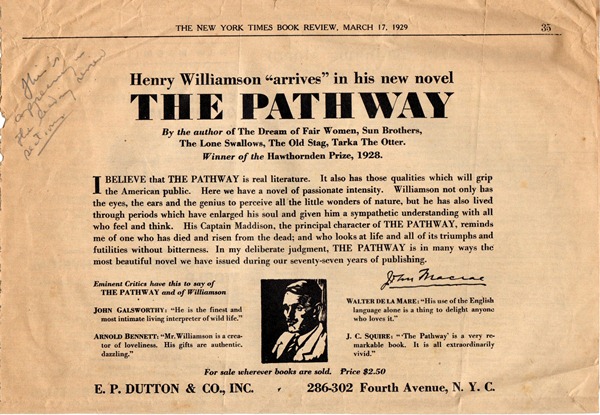
Edward Weeks, in his ‘Bookshelf’ column in Atlantic Monthly (interestingly also reviewing here Memoirs of A Fox-Hunting Man by Siegfried Sassoon), after an introductory paragraph regarding HW’s past literary history and association with the Atlantic Monthly – for the background of this and full articles, see Henry Williamson, Atlantic Tales, HWS, 2007; e-book 2013 – continues:
‘The Pathway’ is set in Devon, the countryside where, since the armistice, Williamson has dwelt in a hermit’s stronghold . . . His knowledge of birds and beasts, of trees and stars and flowers, might have been inherited from W.H. Hudson . . .
The story has to do with a modern Shelley . . . [who] can be suspected of having much in common with the author. The Shelley [Maddison] is ‘a creature of light’, a mystic, erratic and profound in his approach to the business of life. And, like Shelley, his contradictions of the established order brings suffering to himself . . .
Marguerite Kerns, Grand Rapids, Michigan, 10 March 1929:
A Shelley-like idealist, half poet and half saint, is the hero . . ., an exquisite, troubling piece of fiction that takes its charms from Mr. Williamson’s unsurpassed eye for nature and its imperfections from his over-sensitiveness for the sufferings of human nature.
‘The Pathway’ though [set well after the war] is essentially a war book, one of the powerful emotional argument for peace . . . Maddison finds himself odd man in a pastoral little community chiefly because he wants to apply too literally the Christian principle of universal love and brotherhood. . . . he is contentious about nearly all the things that the men and women about him accept as settled conventions.
Aaron Marc Stein, New York Evening Post (no date):
Mr. Williamson is a mystic who does not hesitate to identify himself clearly with the Romantic movement. His novel is an attempt to express in prose the images and ideas which inform the verse of Blake and Shelley. It is an extraordinarily successful attempt, and its success as a novel is directly attributable to the fact that Mr. Williamson is a poet . . . Maddison [has] that innocence of Blake and Shelley which is conscious of itself as a direct intuitive contact with the cosmic reality . . .
Leila E. Bracy in Detroit Free Press (a very long review):
. . . [Maddison] is set apart from all the world and is a sort of modern Shelley. He is impatient and wrathful against wars and the sort of patriotism that plants the seeds of war by glorifying it. He is impatient against Christians . . . who lack charity and mould children in a stern pattern besides refusing to tell the truth about life. . . .
The story of Maddison is in a sense the story of Christ – the story of every reformer who dares to oppose the existing regime.
‘R.B.’ in an unnamed paper:
[For the persevering reader] his reward will be some of the most subtle and musical prose that one is likely to find in contemporary literature. . . . Above all, his sympathy will be stirred by the carefully wrought picture of Maddison, the young poet . . . His mysticism is received as the groping of an immature mind or attributed to shell shock, his vision of the Christos considered an insidious and revolutionary doctrine, opposed to capitalism. He is alone and misunderstood, a tragic and futile figure, tortured by his inability to make others perceive his vision, and doubting often whether his vision is not a chimera . . .
Williamson’s mystic is a miserable and futile figure, but at times ecstatic and sublime. One may not agree with his poetic vision of the world but one can not fail to sympathise with his brave but ineffectual struggle to realise it. . . . [This novel] stands out for its sincere earnestness, for its magical creation of atmosphere, for its beautiful prose.
John Chamberlain, New York Times Book Review, 10 March 1929 (again in a long and detailed review), headed ‘Mr. Williamson’s Portrait of a Mystic’:
Here is a remarkable thing: a novel about a mystic . . . and it is Mr. Williamson’s supreme achievement that he has not made himself ridiculous. . . . For his saintly protagonist, William Maddison, is a creature so sensitive . . . [and] is the sort of person that the world calls insane if he fails . . . and is honoured as a prophet if he succeeds. He is like Shelley, like William Blake, like Spinoza, like Jesus; he believes so intensely in compassion, in the “Light of Khristos”. . . . [But] there is much more than a saintly figure in ‘The Pathway’. The detail is magnificent – opulent – yet restrained by the dictates of an artistic conscience that insists upon line-by-line clarity. . . .
Maddison is an ex-army officer who has seen the corpses rotting in the fields of France. He has fought the war for God and Britain, only to [become totally disillusioned with war and to] realize that the German soldiers opposite him are fighting for God and Germany. . . . he reacts from the war with violence. He takes Shelley seriously; he takes the historic Jesus seriously.
The end is tragedy . . . for Maddison is torn to pieces mentally by the conflict between his vision of what life should be [and what it inevitably is]. At the last he is drowned, as Shelley was drowned. . . .
Herschel Brickel, Weekly Book News (February 1929), on the cutting of which someone from Dutton, possibly John Macrae himself, has written, ‘One of the most important New York Critics’:
‘The Pathway’ is the book of a man who has looked upon the world and found it full of cruelty and beauty. . . .The poet’s [Willie Maddison] god is Shelley, who like him, beat his wings in vain against a world too hard . . . any man [not willing to accept the cruelty of the world] must inevitably come to disaster. The poet . . . thought also of the spirit of Christ . . . [he] had seen from the trenches what the war was like . . . on one occasion seen the British and German soldiers fraternising at Christmas, even exchanging gifts across the barbed wire of No-Man’s Land . . . this expression of brotherly love . . .
‘The Pathway’ – the title itself is to be interpreted symbolically – is a tragic book, as the realisation of the futility of protest against cruelty must always be tragic, but it is by no means lacking in beauty. And no matter how seemingly useless the sacrifice made by Maddison [as has been made by many such before] it is a sacrifice that will go on being made for ever.
Alice Beal Parsons, in New York Herald-Tribune, 3 March 1929:
This is a beautiful and distinguished book. One can disagree with Mr. Williamson on every page, yet go away with a heightened perception of life. . . . It is the part of the poet and mystic to try to pierce the darkness with his own peculiar light. The saint as hero has always aroused intense opposition, whether in real life, like Shelley, or in the pages of a book, like Dostoievsky’s idiot.
Arthur Busch, ‘Page After Page’ Brooklyn Citizen, 10 March 1929; his review is headed ‘Henry Williamson’s “The Pathway”, a Noble Book Which Grasps, and Holds, Elements of Christ, Shelley, Hardy, and the mysticism of Blake’:
Every now and then an authentic cry comes out of the wilderness, a beautiful cry, clear and disturbing, to bid us follow the pathway to truth and beauty and to make us feel ashamed of the mess we’ve made of the world. . . .
In the central figure . . . Mr. Williamson has symbolised the travail and pain of the hopeless idealist who goes through this short span with the cruelties and the hypocrisies of civilisation tearing deep wounds in his soul. He is a Shelley and a Christ . . . Maddison [it would appear] is the author himself; a young man who went through the tempering fire of the World War and was kindled by the mysticism of Jefferies and Blake. . . . It is out of such a state of mind that we get poetry and glimpses of the beauty which lies beyond unseen by our mortal eyes. In the face of realism . . . Williamson may be accused of immaturity; his point of view is often adolescent, often hopelessly idealistic. . . .
. . . the style of Williamson’s writing. The prose wells up often into lyric poetry; in it is the music of Nature, crystal clear and pure. I know of no modern writer whose ear is so amazingly attuned . . . his perception remarkable and his ability to render in prose, positively uncanny.
And so I say that, in spite of its shortcomings, ‘The Pathway’ is a noble book, for in it deep and abiding love sings its song with passionate sincerity. . . . There is in it the spirit of Christ and Shelley and Thomas Hardy and the mysticism of Blake.
Zona Gale, in a long review in The Bookman (New York, September 1929), wrote:
For its four hundred pages The Pathway gives one sensation: that of hands groping against walls, of the actual slow flow of a current towards its cataract; of the malady of isolation; of old hunger for something beyond “the known” . . .
That is but a sample (though a good sample!) of the many cuttings. But there is one more worth noting, found among a selection of short mentions of the 1969 Faber paperback edition of which most English newspapers, although reveiwing it, give no more than cursory attention. It is unsigned, and from the Sunday Statesman, Calcutta, 21 December 1969. It is percipient and interesting in the light of ‘time passed’ (forty years and another World War):
‘The Pathway’ is the fourth novel in Henry Williamson’s study of childhood, youth and early manhood, which together forms ‘The Flax of Dream’. Willie Maddison, now a veteran of the First World War, comes to the windswept Taw estuary in North Devon, in a vain attempt to express in writing the full impact of his years in the trenches and the horror of Verdun and the Somme. The older generation still clings to a Rupert Brooke vision of war, and fully endorses the terms of the Versailles Treaty. Maddison’s ideals have not been dimmed by experience, but rather redirected; yet the generation gap has become insurmountable.
Williamson portrays in Willie Maddison a ‘lost generation’, whose tragedy is much greater than that of Wilfred Owen or Edward Thomas, for they are the generation who survived; only to find that ‘a world fit for heroes’ was a mere illusion. Maddison is at once an individual and a representative, the four novels forming the chronicle of a generation’s dilemma and one man’s tragic response.
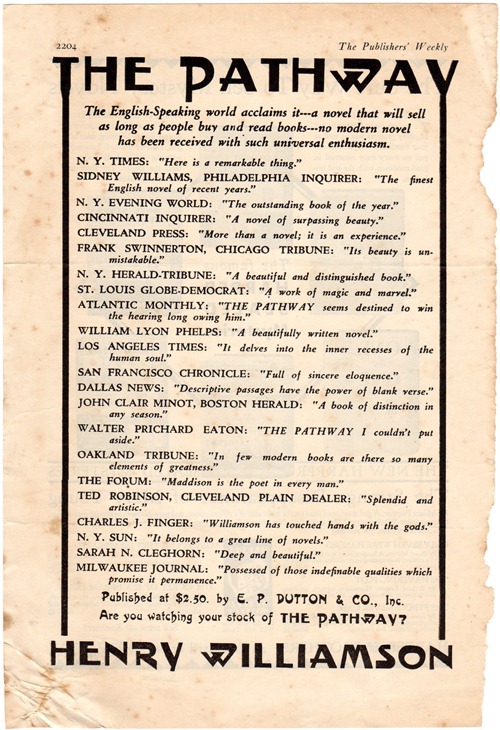
*************************
The dust wrapper for the first edition, front and back, a classic Jonathan Cape design:
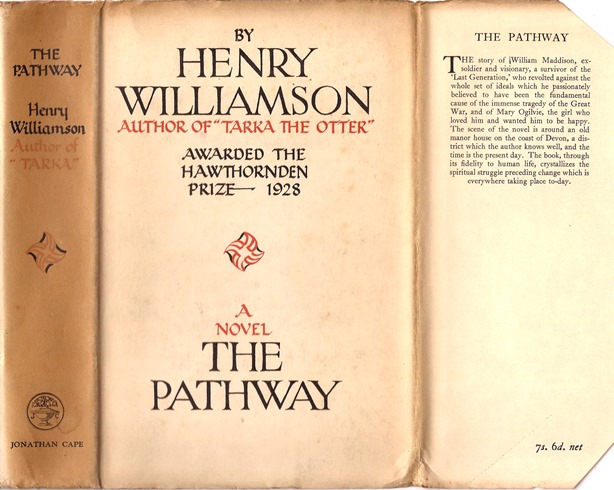
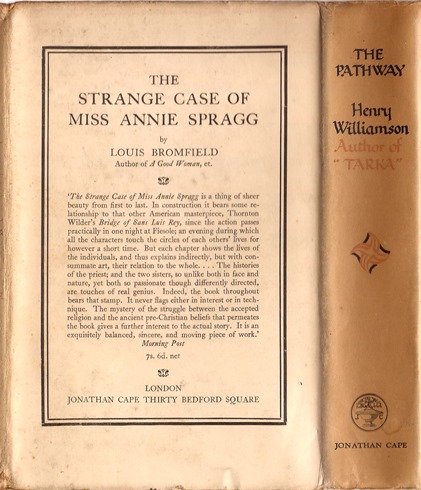
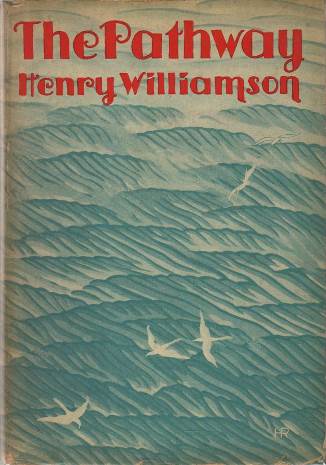 |
| First US edition, Dutton, 1929 |
Some other covers of different editions of The Pathway are shown at the bottom of The Flax of Dream page.
Back to 'A Life's Work' Back to 'The Dream of Fair Women' Forward to 'The Star-born'
The Dream of Fair Women
THE DREAM OF FAIR WOMEN
A Tale of Youth after the Great War
(Vol. III of The Flax of Dream)
 |
|
| First edition, Collins, 1924 | |
First published Collins, June 1924 (750 copies)
Dutton, USA, 1924
Revised edition Faber & Faber, 1931
Dutton, USA, 1931
Many subsequent reprints
Currently available from Faber Finds
This is the third volume of The Flax of Dream, and represents 'Youth' in the author's scheme.
The first edition was dedicated:
To my Friend, J. D. Beresford, Book III. of "The Flax of Dream."
HW had met J. D. Beresford (himself a prolific author) at The Tomorrow Club in 1920. Beresford was also a reader for W. Collins Sons & Co. Ltd, the publishers, and HW sent him a copy of his first typescript. Beresford saw the promise that this foretold and recommended that The Beautiful Years should be published by Collins, thus launching HW on his literary career.
For the 1931 revised edition the original subtitle 'A Tale of Youth after the Great War' was dropped, and the dedication modified:
To J. D. Beresford, who helped the young writer much;
coupled with the name of Walter de la Mare –
friends seldom seen, but well loved.
Walter de la Mare, whom HW again met through The Tomorrow Club, also gave the young writer a great deal of encouragement, and HW became close friends with his son, Richard de la Mare, who, as a director of Faber & Faber, became HW's publisher in due course.
The background to this novel is again based on true events: and thus, apart from being a rattling good tale, it is a powerful social history document that captures the piquant essence of its time. Henry Williamson, then in the army, was stationed at Folkestone during the first seven months of 1919 as an adjutant overseeing details of men returning from the Front, and he himself had a tempestuous and unhappy love affair with the wife of a fellow officer, whom we now know to be a lady called Mabs Baker. Mary Ogilvie is based here on a beautiful young girl, Doline Rendle, whom HW met in London and by a strange coincidence lived in Folkestone and was actually related to Mabs Baker! After the Mabs debacle, HW fell in love with Doline but she kept him at a distance – to his despair at the time. But she was very supportive of him during this early period of writing, and she remained a friend throughout his life. Most of the characters appearing in the novel are based on people living in Folkestone at that time, and have been identified, including the Mayor, who is portrayed as rather a pompous idiot. Naps Spreycombe can also be identified in real life while the flamboyant Julian Warbeck was HW's somewhat wild friend and near neighbour in London, Frank Davis. The Peace Day celebration is an exact record of what happened in Folkestone on that day as can be verified by newspaper reports of the event. HW must have been very disappointed that no-one ever seemed to notice this extraordinary account of a most historic event.
Further details of the background of The Dream of Fair Women (and there are plenty!) can be found particularly in HWSJ 39, September 2003, and the booklet Recreating a Lost World: HW and Folkestone 1919-20 (text by AW, published by HWS; also available as an e-book), both of which contain a wealth of detail, photographs and documents giving the background to this important era and book, and references to further articles.
When HW was writing these early volumes he was still a bachelor living pretty rough in the tiny Skirr Cottage situated next to Georgeham church. The village people found him strange ('mazed'), whilethe local gentry greatly disapproved of him. His general behaviour tended to be a little wild: he rode his Norton Brooklands Road Special motorcycle very fast and noisily around the narrow Devon lanes, had unusual friends (Frank Davis lived with him for a while in Skirr Cottage and tended to drink too much and be argumentative – declaiming Swinburne's poetry to all and sundry: he was also a shell-shock victim). HW did not conform to any idea of a 'gentleman' or an ex-officer: he was very gauche, swam naked in the sea, walked about all day in shorts and barefoot, then wrote all night, or often slept out in the fields. He did not belong anywhere: he was an outsider. Yet, in his writing he was at the core of everything and everybody.
In the first edition the book was divided into three sections: 'The Weaver and the Flax', 'The Scarlet Thread', and 'The Broken Web', which all devolve from a passage in The Incalculable Hour by J. Quiddington West (the pseudonym of HW's Aunt Mary Leopoldina Williamson) and follow the theme and idea of weaving life's web. In the revised edition of 1931 HW changed the title of the first section to 'The Policy of Reconstruction, or, True Resurrection', which although it may have stated more directly what the author wanted to say, does not have quite the same poetic ring! That title was originally given to the whole series, and it is now the title of the book Willie is writing, that he thinks will change the world.
The first edition states at the end that it was written: 'London–Devon: November 1919–November 1923', while the revised edition (both Faber's and Dutton's) states 'Manhattan Island, Fall, 1930'. The Faber flyleaf states: 'Written in the autumn of 1930 in New York city . . . '. In fact HW revised this book in three weeks while on an extended visit to America. Behind that, of course, lies another story – well ahead of our present concern and we will come to it in due course.
HW tells us in his 'Surview and Farewell' essay in The Labouring Life (1932), when mentioning the Great Drought of 1921:
There was the Great Drought, which lasted from April until late summer; this was described, as an actual and symbolic background, in The Dream of Fair Women, a work which on appearance was treated by most of the critics as a strange bird is usually treated in the village [Georgeham].
When The Dream of Fair Women opens, the First World War is over. HW avoids any direct portrayal of the war itself in this early work: he was still too close to this shocking era to be able to write about it – that was to come later. Very early in the book the hero (Willie) cries out to himself:
Despite the praying men continued to die and to be maimed . . . No man wanted to die, yet the bones of the slain girdle the earth . . . [War is wrong] . . . when I am stronger I will make all men hear my voice.
The splendid bitter days of the war were often recalled as he lay on the shell beach in the sun.
It is the summer of 1919. Willie has survived the war, has left the army and is living in a more or less derelict cottage overlooking the sea on the North Devon coast: his only companions are his dog, Billjohn, and an assortment of injured animals and birds. He is disillusioned and bitter about the war and its causes and aftermath. We soon learn that his views are decidedly of the left and embrace those of Lenin. Withdrawn and remote, he sees himself as a prophet of the future and is determined to write a book that will show all this and put the world to rights: the book being 'The Policy of Reconstruction, or True Resurrection', which examines what Willie sees as the iniquities of the educational system, the causes of which he feels have led directly to the recent war.
His hideaway is discovered by a beautiful young woman, Evelyn Fairfax, visiting the area accompanied by a supercilious army officer, Pat Colyer (who appears to have a shady secret), with a fast and powerful car. Evelyn (or Eve), who lives in Folkestone, knows Willie's Cousin Phillip, who has been recently stationed in that town and has told her of his cousin's whereabouts.
Willie falls instantly in love with this earthly Eve, in what is virtually a 'Garden of Eden' – the untouched wilderness of the North Devon coast and marshes, the dunes of 'Santon' (Saunton/Braunton) Burrows, and the estuary of the 'Two Rivers' (the Taw and Torridge). Eve does not discourage him, indeed she leads him on, playing him as a fish caught on the end of a line, but she soon reveals that she is a married woman and has a five-year-old daughter, Jonquil. Also, it is obvious that she has several other men vying for her attention and affections. But their affaire rapidly develops, although with a lot of see-sawing of emotions, sincere on Willie's part but artificial on Eve's.
After a few weeks, hearing that her husband has returned home from duty abroad, Eve abruptly returns to her home in Folkestone, telling Willie of this in a letter after she has left. Willie determines to follow and, taking the train, he arrives in Folkestone on the morning of the day set aside to celebrate 'Peace Day' – 19 July 1919 –and finds the town in an uproar of panoply and celebration.
Among the many extraordinary characters assembled in Folkestone – including Quillie, the young daughter of Eve, and Elsie Norman and her friend Mary Ogilvie enjoying a relaxed post-war holiday by the sea – we meet the flamboyant Lord 'Naps' Spreycombe, heir to the Earl of Slepe, and the wild red-haired would-be poet Julian Warbeck, an ardent follower of the poet Swinburne.
Willie is welcomed into the Fairfax household as a guest by the forbearing Major Lionel D'Arcy Fairfax, where he is torn by guilt and jealousy and despair as Eve dispenses her favours on every male that appears (and to his dismay it becomes clear that her entourage has included Cousin Phillip). But Eve's promiscuous behaviour is not done out of malice. She is very mixed up and is desperately unhappy herself from a troubled childhood and a rape experience as a young girl, the perpetrator being Lord Naps' father. She is deeply insecure and desperate for attention.
Again the story line is embellished with extraordinarily beautiful descriptions of nature in all its moods, interspersed with a series of hilarious moments, while the historical detail of Peace Day is woven in as a poignant background. Willie lives in the shadow of the war and his dead comrades. One of the great scenes in the book is the moment that Willie climbs up to the tumuli known as Caesar's Camp high above Folkestone on the night of Peace Day to commune privately with his thoughts about the dead – not just of the recently ended war but throughout history. This is of course a direct connection to Richard Jefferies' book The Story of My Heart, which HW found in a bookshop in Folkestone in early 1919 and which confirmed his own beliefs and determined his ambition to be a writer. Willie's tortured mind, scarred by the horror of war, struggles to find a way to communicate his ideas to mankind through his book 'The Policy of Reconstruction' – although the content of this is always somewhat obscure (one might say to the point of being non-existent).
Throughout the frenetic activity Mary Ogilvie stands calmly and faithfully on the periphery and again, like a leitmotif in music, there is a final scene between her and Willie, this time on the Downs above Folkestone, with lyrical and tender undertones. We have learnt that her home is in North Devon.
As The Dream of Fair Women comes to its climax, Major Fairfax is recalled to duty and departs for 'the East', leaving Eve on her own, but asking Willie to look after her as she is very vulnerable. The supercilious Pat Colyer is revealed as a complete bounder and imposter, while Eve's youngest and most inexperienced victim, the young Peter White, commits suicide out of despair, leaving a long desolate letter. Horrified at the thought (and the scandal), Eve is distraught. After a final scene with Willie on the beach late at night when he comforts her, she returns home, only to flee with the flamboyant Naps Spreycombe.
Willie, having slept for over twenty-four hours, returns to the Fairfax house, where Quillie tells him her mother has gone away in Naps' motor. In despair but resigned, Willie, leaving his manuscript there for Eve to read and then return to him, also departs – to be true to his own soul. But as we learn later Eve (a woman, a temptress who had infiltrated that Devon 'Garden of Eden') loses for Willie, the would-be saviour of the world, the manuscript of his magnum opus 'The Policy of Reconstruction, or True Resurrection'. An allegorical connotation surely meant by HW, that can be seen more clearly with the (eventual) publication of The Star-born – the book that Willie is writing in the next volume of The Flax of Dream.
The complication of the added passage 'Valediction' in the revised edition (in later editions the title of the passage was revised to 'Post War' and then later removed altogether), need really only concern students of literature and purist collectors. With it HW was seeking to solve the problem of the fact that the different editions, and particularly the fact that the fourth volume, The Pathway, appeared before any of the revised versions of the earlier three volumes, which confused American readers especially.
*************************
 |
 |
|
| Studio portraits of Henry Williamson, taken in 1922 | ||
 |
|
HW's inscription to Loetitia in the copy of The Dream of Fair Women that he gave her |
************************
INTERLUDE
There follows an explanation of the interval between The Dream of Fair Women and Vol. 4, The Pathway – a précis of HW’s various postscript passages 'Valediction', 'Post War' and 'Lost Generation' which explain what happened in the time interval between the two novels.)
When Willie Maddison left Folkestone on that traumatic day, he went to see the only person he thought would understand him, his cousin Phillip Maddison, living in south-east London. Willie was in a state of post-war breakdown. But after a while he went to France to work as a labourer attached to the War Graves Commission. Here he gradually regained both his physical and mental strength. Back in London, Julian Warbeck became the friend of Phillip. Their story is told elsewhere [in A Chronicle of Ancient Sunlight, still many years in the future here – but very obviously already well planned], but Willie was destined to meet them one last time.
Since Willie Maddison never returned to Folkestone, and Eve Fairfax never answered the letter he wrote her, he never knew what happened to his manuscript 'The Policy of Reconstruction, or, True Resurrection', left behind in 9a The Paragon when Eve eloped with Naps Spreycombe. It has vanished for ever.
William Maddison, likened by many who knew him to that noble spirit Hamlet, was haunted – not as the Prince of Denmark, by the ghost of a murdered parent – but by the ghosts of ten million murdered men of his own generation – the lost generation. That he continued to follow his pathway will be seen in the final volume.
The reference to Hamlet in the above paragraph is not fortuitous. HW revised this volume in New York in the autumn of 1930 shortly before he gave a lecture, ‘Hamlet and the Modern World’ (relating Hamlet to the First World War and its literature), at Dartford, Yale, and Harvard in early 1931. (See HWSJ 45, September 2009, where this episode is thoroughly explored.)
A small number of review cuttings of the 1924 first edition exist.
Yorkshire Post, 22 August 1924:
The present volume . . . gives us William, hurried early by the war into the full heritage of manhood, still the bewildered seeker but with a firmer hold on life to help him through the pain of his first mature love. The book is more than a faithful transcript of 'Youth After the Great War', [it's sub-title] it has some of the qualities of permanent Art . . . [Against which HW has written 'damn good!']
But the Glasgow Bulletin, 30 August 1924, is headed 'A Promise Unfulfilled'.
Nottingham Guardian, 18 October 1924, headed 'Beauty and Sentiment':
. . . 'his mind is a chaos of pure beauty'. We admit the chaos, he is as bemused a character as one could meet . . . the beauty of his mind is equally faint and cloudy. . . . The book is rather incoherent: the author aims at writing something that might become significant, but his achievements lose themselves too often in vapid sentiment.
A single USA 1924 review in The Republican, 14 December 1924, states (with some pomposity!):
To the rapidly growing group of English writers capable of employing the novel for imaginative purposes, may be added the name of Henry Williamson . . . [This book] reveals talent of a fine quality but falls short of being a work of substance . . .
One can understand why HW felt it was necessary to completely revise these early works as time passed and he became more proficient in the craft of writing – and, post 1928, famous. By the time of the revised version HW was an established writer of some renown. But the odd timing of the various revised volumes threw some reviewers completely, especially in the USA, some thinking it was an entirely new book.
The Sunday Times, 7 June 1931, opens with 'It completes but does not conclude' (the last volume, The Pathway, being already published):
To my mind this new instalment is by far the best of the four. There are no baffling moments, there is a dramatic story which moves fast . . . It is a fine and sincere piece of work and by no means without its excitements . . .
Glasgow Herald, 11 June 1931:
Public opinion has already fairly well crystallised regarding the worth of Mr Williamson's tetralogy, of which the first, second, and fourth volumes have appeared at intervals during the past four years. The third instalment will do little to alter formed judgments. Some critics see in the work only posturing and wilful eccentricities of style; while others are thrown into ecstacies by Mr Williamson's gorgeous yet precise descriptions of wild nature in North Devon. Yet it seems obvious that the one sure and indisputable triumph of "The Flax of Dream", as the completed tetralogy is called, is the portrait of Willie Maddison, complete, satisfying, and altogether admirable.
Mad Willie is the supreme example of a square peg in a round hole of our twentieth-century civilisation. Motherless, he is reared by a father who has accepted the British public school creed with unquestioning veneration, and cannot understand his imaginative son's moral timidity. Bullied at home and flogged at his almost public school because he will not lie in the Procrustean bed, Willie grows to young manhood with a talent for easy prevarication, and with a reprehensible indulgence in abstract thought. After the war, a sophisticated veteran of 22 years, he puts convention and the life of cities behind him, retires to a tumbledown hut in Devon, and lives a Crusoe-like existence, surrounded by his spaniel pups, his otter, his jackdaw, kittens, crow, jay, and seagull. He lets his beard grow, sleeps on bracken, and cuts away the legs of his trousers with a pocket-knife, while he studies Jefferies and writes his magnum opus "The Policy of Reconstruction, or True Resurrection".
From this romantic simple life he is seduced by Evelyn Fairfax, a charming young married woman of somewhat promiscuous habits. He is dragged into the vortex of her lovers, for the most part drunken young-old men making up for the years lost in Flanders. The characterisation is remarkably incisive, from the grave, honourable husband, Willie's beguiled friend, to the deserting bank clerk who poses as a famous flying ace. None of the principal figures, however, is to be preferred to the irrepressible Jonquil, Evelyn's five-year-old daughter, with her swift moods and her adult vocabulary. She shares with the Willie Maddison of "The Beautiful Years" the rare distinction of being a real child, not the orthodox angel or urchin of popular fiction. It is easy to understand how Mr Williamson's idealism, in conjunction with a peculiarly ruthless realism, should repel many quite intelligent readers; but those who fail to go right through the four volumes have missed an experience that is unique even in these days of catholic production.
Sunday Referee, 14 June 1931:
In his new novel . . . completes the tetralogy which has perhaps awakened more interest in the literary world than any series of novels since the 'Forsyte Saga' [AW: Oh! If it had been known that HW and JG were related, what comparisons would have been drawn – and still need to be!] [This book] is the work of a scrupulous and sensitive artist, some of the descriptive passages are superb in observation, colour, and rhythm . . .
The Times, 9 June 1931:
We doubt whether even fervid admirers will unanimously agree that he has done well to intercalate [this book] into the story of William Maddison . . . One fails to see what interest there is in the events described . . .
Yorkshire Post, 16 June 1931:
. . . It is difficult to see where the author's distinction really lives. That he has distinction is not in any question. [Eve] is flesh and blood and – yes – spirit, an actual woman. The Shelley soul in Maddison makes itself felt as you read.. . . Mr. Williamson is a writer . . . who is nearly 'wonderful' – but, to my mind, not quite.
American reviews of the revised 1931 edition abound (though some are syndicated across various main towns and states). Many reviewers were confused by the sequence of publishing – and possibly the significance of the post-war scene was lost on them, particularly the detail of the Peace Day celebration on 19 July 1919 (a date that may even seem odd to us today!).
American Review, October 1931:
Mr. Williamson has completely rewritten this story of the period immediately after the World War, and has improved it in its organisation and style . . . Maddison is not a satisfactory protagonist for a drama as sweeping as this . . . however hard Mr. Williamson tries to convince the reader that Maddison is a sort of Christ-Shelley, destined to lead the world into brighter times, he cannot escape the charge that his hero is guilty of the awful sin of self-pity . . . [AW feels that was exactly HW's point – Willie is not destined to change the world – no-one could – see The Star-born section.]
The Nation (New York City), 2 September 1931:
This is Henry Williamson's first novel, now entirely rewritten. [Readers will] find here the same individual, the same poetic spirit, the same lover of nature in all her varied forms, the same twentieth century romanticist . . . [it is] however, uneven in quality . . . The last two parts . . . while moving and engrossing, lack real distinction . . .
The Evening Sun (Baltimore), 29 August 1931:
Henry Williamson belongs to the naturalistic school of English novelists. His sensibilities, which comprise a penetrating interpretative understanding of subtle human emotions, include an unusually profound knowledge and deep love of the elements and of nature in her various manifestations . . .
Union (San Diego), 27 September 1931 – an excellent résumé and grasp of the work, which ends:
. . . [the author in extracts from 'Policy . . . '] states definitely his point of view, which is, briefly, that man will be unhappy and alone until he has turned from the civilization of cities, productive only of war, poverty and sterility, and found again unity with God in nature. This message is implicit in every book Mr. Williamson writes.
Eagle (Brooklyn), 13 September 1931; Headings are: 'Henry Williamson's Adventuress-Isolde' [an interesting insight at this stage of HW's writing]; and 'Idyll Plus Disillusion':
Henry Williamson is always doing something out of the ordinary. This time he has re-written . . . The result is grimly idyllic . . . Thus this strange, at times eerily uncompromising romantic, who will not, however, allow the facts of life to lie stored away in mothballs, sets before us a lovely scene . . . Only an Englishman would have destroyed his idyll. Maddison is a misfit who insists upon creating his own purgatory by trying to wish into being the things that are found only in dreams. [AW: And that captures HW's own problem throughout his life.] . . . ah me, he [HW] has such a beguiling way of writing. He carries a reader along by the music of his prose and the delights of his imagination, and if he has not led us very far into the sunlight of revelation, at least he has given us a fascinating experience.
The June 1968 Faber paperback attracted a fair amount of attention, albeit mostly brief, of which the most interesting is:
The Times, 24 August 1968:
A stage in the spiritual history of William Maddison – cousin of Phillip Maddison . . . After the Armistice . . . he is engaged in writing 'The Policy of Reconstruction . . . ' – a document both mystical and autobiographical . . . Oddly compulsive fiction – descriptions of the countryside and country life extremely beautiful and evocative, dialogue absolutely unspeakable.
An American review of the 1931 revised edition, from an unknown source, has a little-known portrait of a brooding HW:

*************************
The scarce dust wrapper for the first edition, front and back:


Other editions:
 |
| First US edition, Dutton, 1924 |
 |
 |
|
| Revised edition, Faber, 1931 | Revised US edition, Dutton, 1931 |
Some other covers of different editions of The Dream of Fair Women are shown at the bottom of The Flax of Dream page.
Back to 'A Life's Work' Back to 'Dandelion Days' Forward to 'The Pathway'