
The Henry Williamson Society
Uncategorised
Tarka the Otter
TARKA THE OTTER
His Joyful Water-Life and Death in the Country of the Two Rivers
With an introduction by
The Hon. Sir John Fortescue, K.C.V.O.
 |
|
| 1st trade edition, Putnam, 1927 |
Dedication:
To William Henry Rogers
The publishing history of Tarka the Otter is extensive, and complicated with various editions and numerous reprintings, some with only small changes in the text (Hugoe Matthews’ Henry Williamson: A Bibliography devotes nineteen pages to this book). A selection of the most important is given here.
The book first appeared as a limited subscription edition of 100 copies bound in full vellum, privately published, printed by the prestigious Chiswick Press, in August 1927, price three guineas.
This was followed by a further limited edition of 1000 copies published by G.P. Putnam & Sons, also printed by Chiswick Press, bound in half brown cloth/cream buckram, October 1927, price one guinea.
First trade edition: Putnam, October 1927 (7/6d), with jacket by Hester Sainsbury
(six reprintings in 1928, a further five in 1929 – and many more in due course)
Dutton, USA, February 1928 ($2.50)
First illustrated edition by Charles F. Tunnicliffe, Putnam, 1932 (5/-); reprinted many times
Penguin Books 1937 (and subsequently Puffin, 1949 onwards – a diary entry for 14 February 1948 in Ann Thomas's handwriting records that HW, in response to a letter from the publisher, agreed that Tarka the Otter should in future be published by Puffin instead of Penguin)
Incorporated into The Henry Williamson Animal Saga, 1960
The Nonesuch Press, 1964, a new edition, illustrated by Barry Driscoll
The Bodley Head, 1965 – and a new ed. 1978, with Introduction by Richard Williamson (HW’s son) and 16 colour photographs by Steve Downer taken on location during the Rank film production.
Webb & Bower, 1985, with new Introduction by Richard Williamson, and lavishly illustrated with photographs by Simon McBride of the area and scenes in the book.
The Folio Society, incorporating most of the features of the 1932 first Tunnicliffe illustrated edition, cased, October 1995 (for which Anne Williamson wrote an Introduction, ‘Henry Williamson: Dreamer of Devon’, printed separately in trade magazine Folio, Autumn 1995, pp. 18-26).
Foreign editions abound: for example, German, French, Italian, Swedish, Czechoslovakian, Russian, & Japanese (in the last language particularly, reprinted in large numbers over several years); examples of dustwrappers are given on the Overseas editions page.
Tarka the Otter has never been out of print in the eighty-six years (as at 2013) since the original publication and is currently selling over 2000 copies every year. In an editorial for HWSJ 16 (1987 – a special edition for the 60th anniversary of the publication of Tarka), I noted that 18,000 copies had been sold in 1984 and 11,000 in 1985. The Russian edition (1979) alone was 75,000. It is impossible to put a figure on the total number of copies sold, but I would suggest it has to be at least four million.
Tarka the Otter was awarded the Hawthornden Prize for Literature in 1928 and is considered one of the great classics of English literature. It is currently available in the Penguin Modern Classics series.
In 1978 the book was recorded as an audio-book read by Sir David Attenborough.
In the early 1980s I was approached by Dr Graham Wills, on behalf of Devon County Council, asking if the HW Literary Estate would be willing for a ‘Tarka Trail’ to be set up along the route taken by Tarka in the book, to make a tourist attraction. This involved several right of way paths and defunct railway lines. We were only too happy to cooperate in such a scheme, which is now a thriving feature of the countryside of North Devon.
There is also a ‘Tarka Line’ railway running between Barnstaple and Exeter, which passes several famous ‘Tarka’ landmarks, including the well-known Junction Pool. Since then, many other enterprises have taken advantage of the use of the name for commercial purposes, some of which would probably have amused the author (and some not!).
*************************
Tarka the Otter follows the birth, ‘joyful water-life’ and inevitable death of a male otter – Tarka, the Water Wanderer – in the ‘country of the two rivers’, namely the Rivers Taw and Torridge in North Devon which share a common estuary beyond Barnstaple, and the famous Braunton Burrows (extensive sand-dunes, until recently a National Nature Reserve), but also ranging the length and breadth of Exmoor and the coast from Lynmouth and round back to Baggy Point, the brooding cliff next to the Burrows, and by following the Torridge inland, across to Cranmere Pool on Dartmoor.
Tarka was born in ‘Owlery Holt’ (a ‘holt’ is the name given to dry holes amongst tangled tree roots in river banks that are an otter’s resting places) near Canal Bridge (actually an old aqueduct, very picturesque) on the river Torridge near Torrington (still a most magical place today). The opening of the book sets the scene:
Twilight over meadow and water, the eve-star shining above the hill, and Old Nog the heron crying kra-a-ark! as his slow wings carried him down to the estuary. A whiteness drifting above the sere reeds of the riverside, for the owl had flown from under the middle arch of the stone bridge that once had carried the canal across the river.
Below Canal Bridge, on the right bank, grew twelve great trees, with roots awash. . . .
That opening word ‘Twilight’ has been changed from the original ‘Dimmity’: both Sir John Fortescue and T. E. Lawrence thought ‘dimmity’ a little precious: but HW retained it elsewhere in the book! I have explained elsewhere that I see a big similarity about those twelve great trees to the opening of W. H. Hudson’s Far Away and Long Ago,where Hudson has twenty-five Ombu trees growing in a row (HWSJ 41, September 2005, Anne Williamson, ‘A Purple Thread’, pp. 39-49, see p. 47). Hudson, after Richard Jefferies, was one of HW’s most important influences.
We find in the opening scene many of the creatures that frequent the river and are to provide a thread running through the tapestry of the tale, for example, Old Nog, the white owl, and Halcyon the kingfisher. There had been an otter hunt that morning and we learn straight away of:
Deadlock, the great pied hound with the belving tongue, leader of the pack whose kills were notched on many hunting poles. . . . Deadlock was the truest marking hound in the country of the Two Rivers.
But the Master sees that the bitch otter that Deadlock snaps at is heavy with young and calls off the surly hound – for towards the end of the book Deadlock is described thus:
And there Deadlock, his black head scarred with old fights, sat on his haunches, apart and morose . . .
Later that night, the bitch gives birth in Owlery Holt and so Tarka and his two sisters come into the world. Her mate is around, but in due course the Hunt comes through again and a kill is made: the dog-otter that was Tarka’s father has succumbed.
Soon we meet ‘Marland Jimmy’, an old dog-otter who lives in the clay-pits of Marland Moor and is given that name by the clay-diggers, who see him frequently. Marland Jimmy is a great character – but who sadly ends his life frozen to death in Horsey Mere during the Great Winter.
We share in Tarka’s early months of growth and his wanderings, his fears and his joys, but always from the point of view of the otter, without sentimentality. It is as truthful a portrait of a wild animal that there can ever have been written.
We meet the poachers after salmon, and learn that ‘Shiner’ gets bitten by Tarka and loses a finger-tip. A small cameo here, the poachers play a larger role when HW writes Salar the Salmon in due course.
The little family group are joined by an elderly bitch-otter, Greymuzzle. The group drift down the river and come to the ‘Long Bridge’ at Bideford:
In front twenty-four arches, of different shapes and sizes, bore the long bridge. . . . which monks had built across their ford two centuries before the galleons were laid down in the shipyards below to fight the Spanish Armada. [Tarka had to] swim hard against the tide pouring between the two piers.
A new strong dog-otter appears and mates with Tarka’s mother: Tarka is chased away – his mother no longer caring about him, and so Tarka –
was alone, a young male of a ferocious and persecuted tribe whose only friends, except the Spirit that made it, were its enemies – the otter hunters. His cubhood was ended.
But Tarka meets a young small female with a white tip to her tail. ‘White-tip’ and Tarka play together, he enamoured, but an older dog-otter chases him off, biting him, and Tarka drifts down to the estuary and the Burrows (an extensive area of sand dunes which we have first met in The Pathway), where he finds Greymuzzle: and after a while these two mate.
There follows a chapter describing Baggy Point, the dark promontory dominating the skyline north of the Burrows, with all its myriad associated forms of life, where Greymuzzle prepares to have her young. We meet characters from earlier stories: Kronk the raven and Chakchek the One-eyed (‘a small dark star twinkled and swept to its orbit, twinkled and poised on its perch’) are using the air currents that sweep up the cliff-face. Kronk gives a warning. He has seen a man climbing down, jumping across the boulders still smothered by the tide. The man reaches the tiny beach and enters the cave that runs back into the cliff. This is Seal Cavern – and here the man finds a young seal. The mother is near and apprehensive. The man also sees an otter making a bed of dry grasses and seaweed. The seal is uneasy. The man takes out a whistle made from an elderberry stick and plays a few notes on it. This calms the seal, and she allows the man to touch her. The man is, of course, HW.
The finest scene in the book is possibly chapter nine, ‘The Great Winter’, where the arctic wind ‘pours like liquid glass’ over the Braunton Burrows and the Great Field, and a magnificent Greenland falcon and Bubu the Terrible, a snowy owl from the Arctic, arrive ‘in the time of ice and fog’ to hunt the few creatures still able to move.
And the sky was to the stars again – by day six black stars and one greater whitish star, hanging aloft the Burrows, flickering at their pitches; six peregrines and one Greenland falcon. A dark speck falling, the whish of the grand stoop from two thousand feet heard half a mile away; red drops on a drift of snow. By night the great stars flickered as with falcon wings, the watchful and glittering hosts of creation. The moon arose in its orbit, white and cold, awaiting through the ages the swoop of a new sun, the shock of starry talons to shatter the Icicle Spirit in a rain of fire. In the south strode Orion the Hunter, with Sirius the dog-star baying green fire at his heels. At midnight Hunter and Hound were rushing bright in a glacial wind, hunting the false star-dwarfs of burnt-out suns, who had turned back into darkness again.
There is more in that passage than just the actual description. It has allusion to HW’s book The Star-born, already written but not to be published for a few years yet, and so the passage takes on the whole ethos of that book. The cross-referencing of various threads in HW’s early work has to be taken into account in any analysis of his writing. So we find that Tarka the Otter not only has a hidden ‘war’ theme but also a theme of redemption.
Sadly, Marland Jimmy gets frozen into the ice. Driven by hunger due to the frozen land and water, Tarka and Greymuzzle, who has a puny cub, find a farm where duck are kept. But Tarka gets caught in a trap: Greymuzzle bites through his claws to free him but she is caught by the farmer and killed. Tarka escapes.
Tarka was gone in the mist and rain of the day, to hide among the reeds of the marsh pond – the sere and icicled reeds, which now could sink to their ancestral ooze and sleep, perchance to dream; . . . The south wind was breaking from the great roots the talons of the Ice Spirit . . .
The ‘First Year’ ends with a strange cameo. For one brief paragraph an ‘I’ enters the story.
And when the shining twitter ceased, I walked to the pond, and again I sought among the reeds, in vain; and to the pill I went, over the guts in the salt grey turf, to the trickling mud where the linnets were fluttering at the seeds of the glass-wort. There I spurred an otter, but the tracks were old with tides, and worm castings sat in many. Every fourth seal was marred, with two
toes set deeper in the mud, They led down
to the lap of the low water, where
the sea washed them away.
HW is referring here to his tale of the rescued otter which had lost its two claws in a trap and had then run away, to be searched for in vain. An odd mixture of fact, fiction, and myth: obviously deliberately included despite its peculiarity of the intrusion of ‘I’ into the tale.
The second part of the book ‘The Last Year’ opens on Dartmoor, with HW’s magnificent phrase:
Bogs and hummocks of the Great Kneeset were dimmed and occluded; the hill was higher than the clouds. . . .
and continues with lyrical description of the area that surrounds the famous Cranmere Tarn, or Pool. It is spring, and Tarka makes his way back down the river in joyous mood reflecting the spirit of rebirth of the season. As he travels he picks up the scent of White-tip and hears her cry. She is distressed as that morning hounds had been through and she had lost her cubs as she fled from a terrier, and her mate had been killed. White-tip stays with Tarka briefly, but then he travels on alone arriving at Junction Pool, a famous landmark on the River Taw.
The Otter Hunt with huntsmen and hounds is an ever-present menace with increasing crescendo and intensity, like a tumultuous storm getting closer and closer, from the very first rumblings of disaster early in the book when Tarka’s father is killed.
Now it is the turn of White-tip to be hunted. As she flees so she meets up with Tarka again. Then Tarka becomes the hunted animal. There follows a detailed description of the actual hounds as they work the river, with name after name, each with its own characteristic, like some roll-call to arms. They are indeed as a marching army going into battle.
Tarka hides in Spady Gut, a drain guarded by a wooden gate that controlled the flow of water. But the hounds are aware of his hiding place and the Huntsmen close in. Bite’m the terrier is sent in and gets hold of Tarka’s rudder. A Huntsman grabs the terrier and hauls it out still clamped onto Tarka’s rudder. Tarka twists and bites the Huntsman, who drops both animals: hounds close in but Tarka bites Deadlock and makes his escape into the rush of the turning tide. Bite’m is pulled with him but then lets go. Tarka, though wounded, is free. This is, of course, as a prelude to the final scene.
Recovering as he swims on down the river, Tarka eventually meets up with White-tip again.
Each was pretending not to see the other; so happy were they to be together, that they were trying to recover the keen joy of meeting.
But they are disturbed by a man with a dog out ferreting and White-tip disappears, while Tarka gets chased off. Alone, he continues on up to Exmoor, and chapter fourteen opens with another of those great sentences:
When the bees’ feet shake the bells of the heather, and the ruddy strings of the sap-stealing dodder are twined about the green spikes of the furze, it is summertime on the commons. Exmoor is the high country of the winds . . .
Dodder is a parasitic plant which spreads long thin red shoots like a giant red spider-web to enable it to cover and feed on gorse and bramble. There follows a lyrical description of the moors that HW loved so well. A branch of his forebears came from the area, and he felt this was his spiritual home. So we roam over the Chains and Pinkworthy (‘Pinkery’) Pond, Hoar Oak Hill and the East Lyn Water, meeting the creatures and plants that inhabit this wilderness. This area was also to be the setting of his last great book, The Gale of the World, volume 15 of A Chronicle of Ancient Sunlight.
As the chapter ends, Tarka finds a quiet hiding place to sleep. He awakes to the sound of yet another hunt. Deadlock is prominent in this hunt, close on to Tarka at every turn. They are both thrown down the torrent of the Glen Lyn, and although Tarka escapes he is seen and given away again by a man standing on the bridge who
took off his hat, scooped the air, and holla’d to the huntsman . . .
Tally-ho!
This is ‘Pa’ Hibbert. The melee continues until Tarka gets down to Lynmouth where he is confronted yet again by Deadlock: sinking his teeth into Deadlock’s neck, the otter pulls the hound under water. The huntsman grabs the drowning Deadlock and hauls him out of the water – Tarka lets go and escapes out into the Severn Sea – another prelude of the inevitable ending.
Tarka gradually makes his way back round the coast, passing the lime-kiln at Heddon Water, past Combe Martin Bay and on across the dreaded Morte Bay where the tide rips at Bag Leap. He lands on The Morte (another of HW’s favourite places – very like Baggy Point) to rest awhile. Then he continues onto Woolacombe Sands and going ‘up a steep bank to the incult hill, pushing among bracken, furze, and brambles, . . . he reached the top of Pickwell Down.’
Interestingly, this route was to become extremely well known to HW: once he had bought the Field at Ox’s Cross and built his Writing Hut, this was the way that he took to get up and down the cliffs to the beach at Black Rock. No doubt he was already using it at this earlier stage in his life. Indeed, as the otter continues it comes to where:
The stream flowed below a churchyard wall and by a thatched cottage, where a man, a dog, and a cat were sitting before a fire of elm brands on the open hearth. . . .
The cottage door was pulled open, the spaniel rushes out barking. A white owl lifted itself off the lopped bough of one of the churchyard elms, crying skirr-rr. . . . Striking a match the man saw, on the scour of red mud, the twy-toed seal, identical with the seal that led down to the sea after the Ice Winter.
That of course, is Skirr Cottage, situated next to the church in the village of Georgeham – and the man is HW.
Tarka continues, passing Cryde (Croyde). He is actually following the scent of White-tip, whose trail he has been following since climbing the cliff to Pickwell. He crosses the sandhills of the Burrows and returns to Horsey Marsh and on to Ram’s Horn Pond, the scene of the frozen winter earlier.
Chapter seventeen again opens with one of those set-piece phrases:
All day the wind shook the rusty reed-daggers at the sky, and the mace-heads were never still.
A short scene of human fishermen, then Tarka swims out to catch himself a fish, but Old Nog catches a salmon – many times his own weight but ‘it was a fish, and Old Nog was a fisher.’ As Tarka drifts past Old Nog he hears a whistle: ‘Hu-ee-ic!’ It is White-tip. ‘Her cry was like wet fingers drawn over a pane of glass.’ (Try that – it is exactly so!)
White-tip is with two cub otters, and the four of them work together to catch themselves a fish, but the cubs are not experienced enough. White-tip and Tarka mainly play together. On the next tide they all fish and eat well: then –
Tarka and White-tip stole away on the ebb to the sea, leaving the young otters to begin their own life.
The scene changes to Beam Weir, above Canal Bridge where Tarka had been born.
Black bits of old leaves turned and twirled in the flooded weir-pool above Canal Bridge, like the rooks turning and twirling high in the grey windy sky.
The river is in spate and the salmon are leaping. Tarka and White-tip catch a fish, found later by the water-bailiff, ‘with bites torn from behind its shoulder – the mating feast of otters.’ Thus the coupling of the two otters, so unobtrusively placed into the story.
The winter passes: the otters had moved down to the estuary again but now White-tip knows where she is going – back to the Twin-Ash Holt above Orleigh Mill, where she was born. There is a detailed description of the area, and Old Nog and Halcyon the Kingfisher are brought back into the centre of the story. Then five dark shapes are seen:
White-tip had brought her four cubs from the Twin-Ash Holt. . . . Tarquol, the eldest cub, was following White-tip, for he liked to do his own hunting; and it was in the Pool of the Six Herons that the strange big otter, who chased him in and out of the piers, never biting or sulking, was to be found. . . .
Tarquol swam near Tarka; the cub was lithe and swift as his parent . . .
At Canal Bridge they
played the old bridge game of the West Country otters, which was played before the Romans came. . . . Tarquol followed Tarka out of the river and along the otter-path across the bend, heedless of his mother’s call. [but] Tarka went on alone . . . and slept, while the water flowed, and he dreamed of a journey with Tarquol down to a strange sea, where they were never hungry, and never hunted.
But in the real world he awakes to ‘Joint Week’, when Otter Hunts join together to go out every day for a major war on otters. In the Tunnicliffe edition this chapter is headed by a full page wood-cut of Deadlock sitting ‘on his haunches, apart and morose.’ We have the Cheriton, the Culmstock, the Crowhurst (Kent and Sussex), the Courtney Tracey (Wessex) and men of the Dartmoor hunts.
So we have arrived at the final last long hunt, in which for forty pages and nine hours Tarka and the hound Deadlock are pitted against each other’s strength and wits as they run and swim and chase and flee the length and breadth of the rivers. Again Tarka is given away by the old grey-bearded man standing on New Bridge. But Tarka has a rest at Sycamore Holt – where Tarquol is also resting. The hounds find them, the two get separated and the hounds go after Tarquol, who puts up a tremendous and courageous resistance, creating mayhem in a farmyard, until he is finally seized by Deadlock and killed in a melee of hounds. Tarka’s son is dead.
Tarka is found again and the hunt continues. The hours are counted off like the striking of a mighty clock – there is a sense of doom reminiscent of Christ’s hours on the cross. Tarka rests.
At the beginning of the eighth hour a scarlet dragonfly whirred and darted over the willow snag, watched by a girl sitting on the bank. Her father, an old man lank and humped as a heron, was looking out near her. She watched the dragonfly settle on what looked like a piece of bark beside the snag; she heard a sneeze, and saw the otter’s whiskers scratch the water. . . .
For two minutes the maid sat silent, hardly daring to look at the river. The dragonfly flew . . . and settled on the water it seemed. Tarka sneezed again. A grunt of satisfaction from the old man, a brown hand and wrist holding a hat aloft, a slow intaken breath, and,
Tally Ho!
At the beginning of the ninth hour Tarka is tiring, he rests, then is seen again, but again escapes. The tide has turned. Hounds are called off, but just as they were leaving Deadlock sees the otter and leaps down the bank. They disappear under water: the hound only to surface in death – Tarka to be seen no more:
And while they stood there silently, a great
bubble rose out of the depths, and broke, and as
they watched, another bubble shook to the
surface, and broke; and there was a
third bubble in the sea-going
waters, and nothing
more.
A most dramatic ending for a most extraordinary book: a book written with the utmost care and attention to detail and based on months of meticulous observation. HW walked every foot of the ways that Tarka takes, and out of that familiarity he was able to write with a truth and freshness that is astounding. All the scenes in the book are real places and can still be seen today – most with very little difference from when HW himself walked those pathways. Today, following the ‘Tarka Trail’, it is possible to walk or cycle and follow that same mystical path that was HW’s vision. (There is a list of places and map references of ‘Tarka’s Route’ in HWSJ 16, September 1987, pp. 16-18.)
*************************
I would point out the setting of the print of those last lines of both ‘THE FIRST YEAR’ and ‘THE LAST YEAR’ sections, as shown above. This form, so redolent of a poem, is unfortunately lost in most of the subsequent editions. (I think such form in poetry was still well into the future – post Second World War?)
The innate poetic element in HW’s writing was recognised by Ted Hughes, Poet Laureate, in the address that he gave at HW’s Memorial Service at St Martin’s in the Field on 1 December 1977, stating that he had read Tarka the Otter when aged eleven,
and for the next year read little else. I count it one of the great pieces of good fortune in my life. . . . I recognised even then that it is something of a holy book, a soul-book, written with the life blood of an unusual poet. . . . In the confrontations of creature and creature, of creature and object, of creature and fate – he made me feel the pathos of actuality in the natural world. . . .
It is not usual to consider him as a poet. But I believe he was one of the two or three truest poets of his generation.
*************************
Back in 1921, HW had not been living in Georgeham in North Devon very long when a man he had met who lived nearby, an ex-soldier badly lamed from an injury in the war, approached him to help with the rescue of an orphaned otter cub whose mother had been shot by a local farmer. HW refers to this cub in one or two early items, but mainly the story of this incident was first written up as ‘The Man Who Did Not Hunt’, which was published in Pearson’s Magazine (USA) in March 1923, and for which HW was paid 18 guineas (£18/18/-). The story was then reworked and published as ‘Zoë’ in The Peregrine’s Saga, where the man is called Captain Horton-Wickham – fairly certainly a real name, as HW refers to him many years later in a diary entry, recalling his early friend (see AW, Henry Williamson:Tarka and the Last Romantic, p. 83). HW certainly played some part in the care of this young otter cub.
HW had also read The Life of an Otter by J. C. Tregarthen (1909) and thought he could have written a better story, as he confided in a letter to T. E. Lawrence (8 March 1928).
Having decided so to do, in order to gain accurate material HW took to following the local hunt, the Cheriton Otter Hounds, who hunted along the local rivers, the Taw and Torridge and their tributaries, whose waters meet in the estuary beyond Barnstaple. HW also spent some time at a zoo (not specified, but presumably Regent’s Park) where he could watch otters at close range, noting particularly how much they actually played with water.
When out with the Cheriton Hunt one day in the early summer of 1924, HW found himself walking next to a dark-haired, strikingly beautiful girl and her elderly father. HW quoted a phrase from Richard Jefferies’ famous story Bevis, and found both the girl and her father knew the book well. They were Charles R. Hibbert, one of the Hunt officials, and his daughter (Ida) Loetitia.
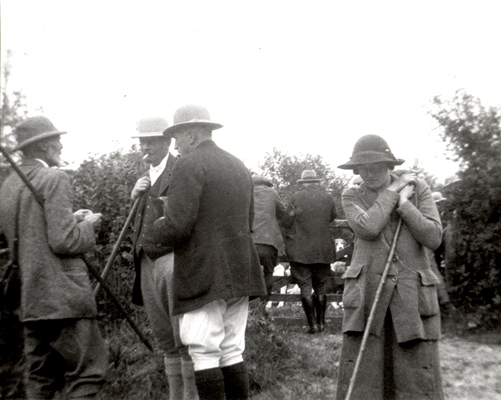 |
| 'Pa' Hibbert (far left) and Loetitia (right) at an otter hunt |
HW decided that here (at last) was the perfect companion to share his life. He proposed at the Hunt Ball on 24 August 1924, and they were married on 6 May 1925. Charles Hibbert features in Tarka as the man who raises his hat and cries ‘Tally-ho!’ to betray Tarka’s resting place during the last hunt: Loetitia (whom HW always called Gipsy) is the shy beautiful girl who sees the dragonfly settle on Tarka’s nose – and does not betray him.
At the time of his marriage HW had five books published, to increasing critical acclaim.
Their honeymoon was spent, after a few days on a farm next to Dunkery Beacon on Exmoor, visiting the battlefields of the trenches of the First World War, so bringing to the fore HW’s feelings about his own war experiences. I feel that these are inevitably bound into an underlying hidden theme to be found in Tarka (as into many of those short stories in volumes already published, as I have noted) making Tarka not just a superb tale about an otter but, further, an allegory of that war.
When, shortly after their honeymoon, Loetitia found she was pregnant, it was decided that Skirr cottage was too small and primitive. They arranged to rent Vale House just a few yards up the road. HW then settled down in earnest to write his otter saga. Today there is a blue plaque on Vale House announcing that Tarka was written there.
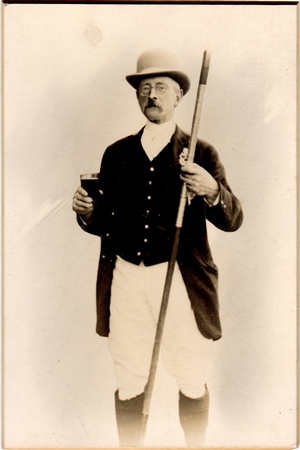
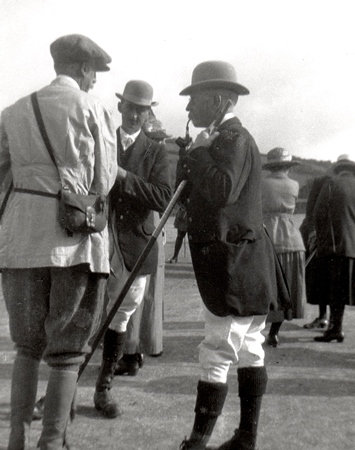
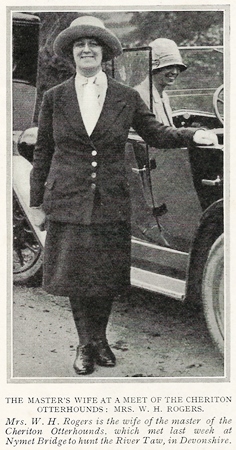
HW received a great deal of support and help from the Master of the Cheriton Otter Hounds (the ‘COH’), William H. Rogers. It is obvious that he was friendly with the family, visited their lovely home at Orleigh Court, and presenting copies of his books to Rogers’ daughters. HW worked in several real-life incidents to be found in Rogers’ Records of the Cheriton Otter Hounds (1925), although HW had probably been told these stories before the book appeared. A full account of the COH can be found in Tony Evans’ most interesting article ‘Chasing the Cheriton’ (HWSJ 37, September 2001, pp. 5-37), which shows many locations to be found in Tarka as still existing today. Several of the names HW gives the hounds in his story, and including their various characters, can be found among the various lists of COH hounds that appeared over the years: although ‘Deadlock’ would appear to be HW’s own name – although his character can be traced to a real hound. (The hound who took the part of Deadlock in the Rank film, who had make-up applied to change his features correctly, was a lovely friendly and rather lazy hound: he was called ‘Deadloss’ by us all!)
One story from the COH annals tells of a long hunt which started at 7.30 a.m. and continued until 6.30 p.m. which, although HW changed the details to fit his own tale, is the basis for the long, last hunt endured by Tarka.
William Rogers was also most helpful in matters of Hunt etiquette and ambiance: matters that HW was most anxious to have absolutely correct, so that he could not be criticised over details by the hunting fraternity. In recognition of this most generous support HW dedicated Tarka the Otter to William Rogers.
 |
 |
|
William Henry Rogers, Master of the Cheriton Otter Hounds (on the right in the lower photograph) |
 |
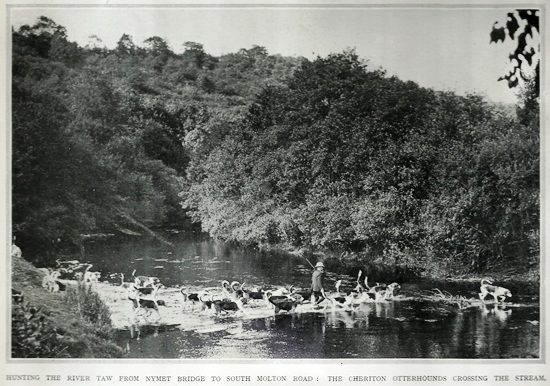 |
|
The two photographs above are taken from 29 September 1928 issue of The Illustrated Sporting and Dramatic News (kindly provided by Glyn Shingler) |
HW and Loetitia were invited to the wedding of Rogers' daughter Bridget, where the following photograph was taken; though the news item, about the author's success, made no mention that the couple were attenting a wedding, perhaps leading readers to believe that he always dressed in this manner, with 'faultless Lincoln Bennett'!
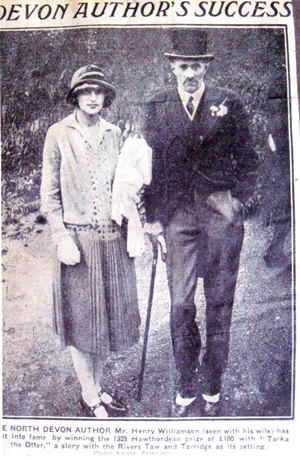
HW was also a great admirer of The Story of a Red Deer by Sir John Fortescue, younger brother of the Earl Fortescue, whose family seat was nearby at Castle Hill, in the tiny hamlet of Filleigh, North Devon, on the southern edge of Exmoor. In early 1925 HW asked Walter de la Mare if he would approach Sir John on his behalf to ask if he would be willing to write an introduction to Tarka. This approach proving successful, in due course HW sent off a typescript copy of his book to Sir John.
A letter from Sir John (from Windsor Castle, where he was librarian) dated 4 May 1925 (two days before HW’s marriage to Loetitia Hibbert – thus HW probably received it on the morning of his wedding, giving him much needed confidence) states:
I return your story . . . I read it once & liked it well; twice & liked it better. I am willing to write a little introduction for you . . . but I think the book striking enough to stand without need of any such prop. You have taught me more about otters than I ever dreamed of, & of many other creatures besides otters . . .
Sir John does suggest HW avoids ‘outlandish words’ and gives a couple of examples (‘autochthonic’ being one!). Sir John was currently writing a multi-volume History of the British Army and his work as Royal Librarian was quite arduous. One letter refers to ‘editing George III’s papers, & there are tens of thousands of them’. Another has a ‘PS’ written across a corner:
I reckon that my history has brought me in ¾d a line gross. I could never make my living with my pen – you can. [Permission to quote from Sir John’s letters was given by the Fortescue Estate at the time of my HW biography.]
On return from the honeymoon trip to the battlefields HW was busy honing and refining his story. The file of business letters shows that he was also looking for the best publishing deal possible, once again taking this on himself instead of leaving it to his agent, Andrew Dakers. I have already explained the problems that arose with Collins (see The Pathway entry), his original publishers. By September 1925 HW had placed this new book with Selwyn & Blount, but then Richard de la Mare (who had been best man at his wedding) warned him that the firm was in financial difficulties, and he withdrew. The book was finally placed with Putnam (who were also publishing The Old Stag).
HW now went over all the details again, walking the river banks, visiting the various places where the major scenes were set and undertaking a great deal of revision to his tale. He noted details such as the plants growing in various places, and made diagrams of terrain to aid him with descriptions. For instance he walked up to Cranmere Pool (a remote, wild, boggy area high on Dartmoor, only reached with some difficulty) accompanied by his wife’s younger brother (Robert, but known as ‘Bin’ as if ‘Robin’: he features in the future Chronicle novels as ‘Sam’).
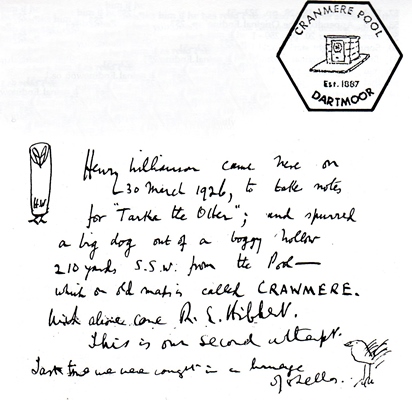
Pages of HW's notebook drafting passages and containing notes for Tarka:
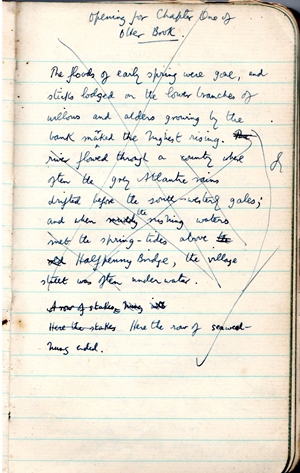
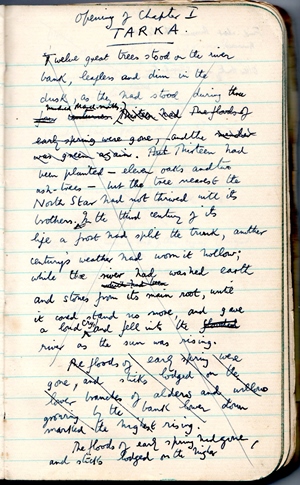
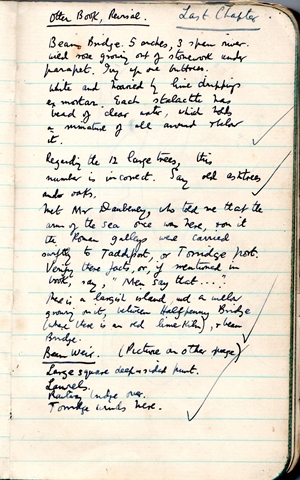
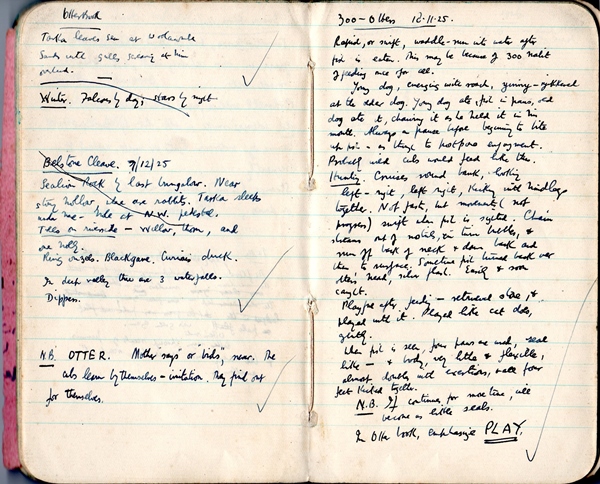
Sir John sent the manuscript of his ‘Introduction’ in mid-August 1926, and HW certainly had a ‘finished’ typescript of the book at that time.
In November 1926 HW was staying with his friend S. P. B. Mais in Hove, Sussex. Mais had taken him to see Wilfred Meynell at nearby Greatham (see The Old Stag entry). But HW also went to see John Galsworthy who also lived nearby at Bury, obviously feeling depressed about the reaction he was receiving to his (as yet unpublished) otter book. This was probably a reaction from having finally sent it off to the publishers. He was understandably tired. The Old Stag had just been published and reviews of that were only just appearing. After HW left, Galsworthy wrote (with extraordinary kindness) two letters: one of encouragement to HW himself, the other to recommend HW’s writing to Edward Garnett, well-known critic and man of letters, publisher’s reader for the publisher Jonathan Cape, and who had established such writers as Joseph Conrad, D. H. Lawrence and E. M. Forster. Galsworthy stated: ‘He can see and he can write . . .’
This introduction was to have momentous significance in due course, for Garnett was a close friend of T. E. Lawrence (‘Lawrence of Arabia’). But the immediate response was that HW sent Garnett a copy of The Old Stag. Edward Garnett was immediately supportive.
To add to the difficulties that attended setting up the contract with Putnam in the first place, HW compounded the situation by continually prevaricating and trying to add clauses to cover every situation, while objecting to every suggestion. Constant Huntington and the book’s designer T.M. Ragg, or ‘TMR’ as he often signed himself, must have been very patient!
HW wanted Putnam’s to commission maps of the area roamed by Tarka, to be used as endpapers, from Thomas A. Falcon, an artist who lived in Braunton (Devon – HW’s nearest town). Falcon took a great deal of trouble, and HW loved the finished result: but Ragg stated that the thick lines when compressed down to the book size would be too ‘heavy’, and at the last minute (to HW’s chagrin and embarrassment for Falcon) he did not use them. (These maps were reproduced in HWSJ 16, September 1987, pp. 20-21, with accompanying note by AW, p. 19)
HW in his turn did not like the sample page Ragg sent, writing on it ‘I do not like this at all.’ He added that he wanted a simple and austere style, and a quiet and dignified binding.
The chief complication however was that HW, despite his extreme impecunious status, had decided to have a special de luxe limited edition of his book to be sold by private subscription. He concerned himself very closely with the details and was personally responsible for selling the copies. He had a prospectus printed which he sent out to as many people (friends, acquaintances, etc) as he could think of. This used up an enormous amount of time and nervous energy.
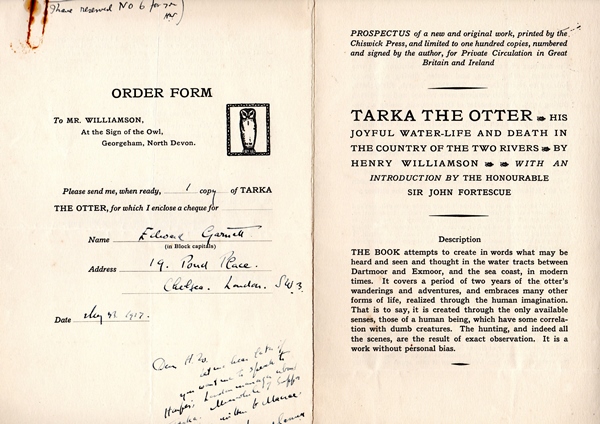
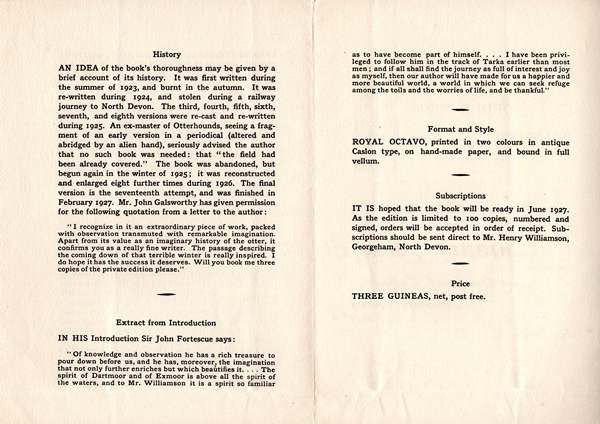
This limited edition of 100 copies, printed at the prestigious Chiswick Press, bound in full cream vellum and hand-made deckle-edged paper, was published in August 1927, price three guineas. Copy No. 1 was presented to Sir John Fortescue, the second retained for himself, third was bought by his mother, and the next three were bought by John Galsworthy, one by Walter de la Mare,, Edward Garnett, Siegfried Sassoon, another by Frank Swinnerton – and so the list went on. But sales slowed down and Putnam’s wanted it out of the way before they produced the trade edition. At one point Huntington urged him to send out a reminder letter to those who had not yet bought. Some of the money due came straight to HW, some went to Putnam: HW (obviously worried about money) inevitably began to wrangle about invoices, convinced he was not receiving his full dues: Huntington and others patiently reassured him.
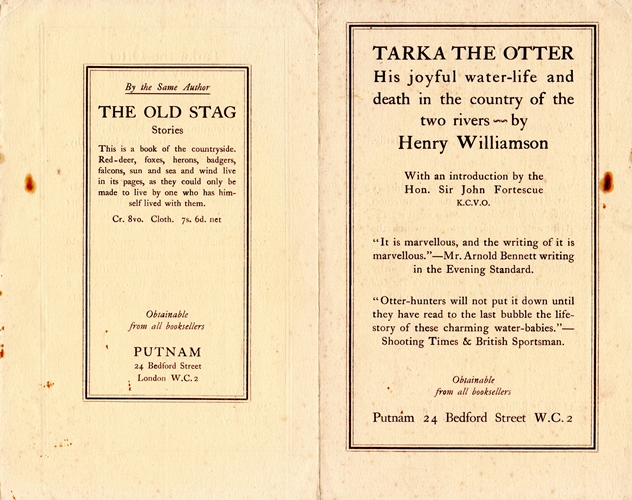
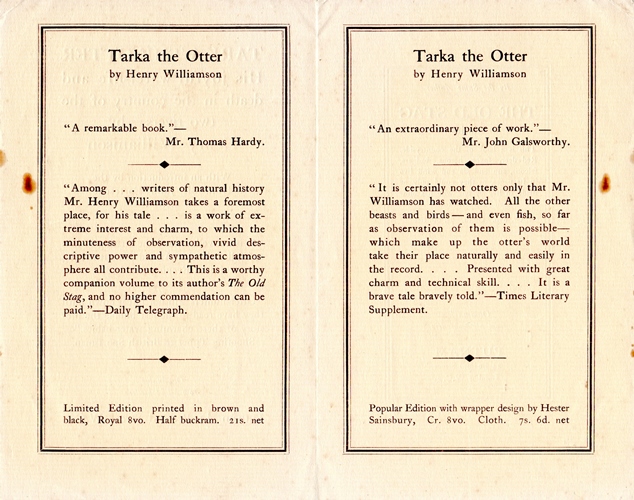
The second limited edition (1000 copies, half brown cloth/cream buckram, price 1 guinea) and the first full trade edition were published in October 1927. Putnam produced their own prospectus for these two editions:
Three days later no reviews had appeared and HW was very anxious and wrote in a notebook:
I say I don’t care what happens to it . . . But really I am alert as a falcon for appreciation.
So Tarka the Otter was launched. In fact reviews were favourable but there was not the immediate outcry that HW was so obviously hoping for. But Putnam took out advertisements for the book over the Christmas period, and the book was getting noticed:

When Dutton followed with the American edition early in 1928, the reviews there were very enthusiastic. (See Critical reception page.)
Soon after publication HW, en route on his motorcycle to see his Uncle Henry Joseph Williamson in Bournemouth, stopped for a rest in Dorchester. Realising he was outside Max Gate, the home of Thomas Hardy, with great trepidation he knocked at the door. He was invited to lunch – and before he left was asked to sign the visitors’ book. Afterwards he sent a copy of the limited edition (probably the one guinea version) to Hardy, who wrote to Putnam’s to say that he thought Tarka ‘a remarkable book’. HW recorded that he found Hardy ‘olde, olde’: two months later Hardy died.
Edward Garnett had (with great kind thought) sent round copies to several people suggesting they review the book and also, unknown to HW, had sent a copy to his friend T. E. Lawrence, then in India, stationed at Karachi with the Royal Air Force (supposedly incognito). At the beginning of February 1928, HW received a letter from Garnett enclosing a long and detailed critique of Tarka by TEL. TEL was under the impression that this was the author’s first book and that he was encouraging a novice:
I shouldn’t have written so much if the book was not, in my judgement, particularly worth writing about. . .
Very many thanks for sending it to me. It has kept me sizzling with joy for three weeks. The best thing I’ve met for ever so long. Fresh, hopeful, fecund, and so, so, careful. It is heartening to see a writer caring much for his words and chasing and chiselling them with such firmness. I hope he likes it well enough to persevere, for I shall look forward to reading him again: - apart from Tarka which I’ll read many times yet.
(The full text of this letter from T. E. Lawrence was first published in Men in Print: Essays in Literary Criticism by T. E. Lawrence, ed. Prof. A. W. Lawrence (Golden Cockerel Press, 1940): reprinted in Henry Williamson, Threnos for T.E. Lawrence & Other Writings, ed. John Gregory (HWS, 1994; e-book 2014). For the full correspondence between HW and TEL see: T. E. Lawrence: Correspondence with Henry Williamson. Letters, vol. IX, ed. P. & J. Wilson, with Prologue, Epilogue and notes by Anne Williamson,limited edition,Castle Hill Press, 2000.)
HW felt that Lawrence was a kindred spirit: he replied calling him his ‘twin psyche’, explaining the background to the writing of Tarka and sending a copy of The Old Stag. The two men began a regular correspondence and later TEL visited HW at Georgeham. (See Genius of Friendship, to be covered in due course.)
In mid-April 1928 HW received an even more gratifying letter: from Alice Warrender, founder of the Hawthornden Prize for Literature, announcing that the prize for 1928 ‘for the best imaginative work of the year’ had been awarded to Tarka. The judging committee consisted of Miss Warrender, Mr. Robert Lynd, Mr. Edward Marsh, Mr. Laurence Binyon, and Sir John (Jack) C. Squire. (Robert Wilson Lynd, 1879-1949, Irish writer, an urbane literary essayist and strong Irish nationalist, moved to London in 1901; Edward Marsh, 1872-1953, patron of the Arts, especially poetry – he helped Flecker, de la Mare, D. H. Lawrence, Graves & Blunden – published 5 volumes of Georgian Poetry (1919-22), literary executor of Rupert Brooke; Laurence Binyon, 1869-1943, poet and art historian – worked at the British Museum as Keeper of Printed Books; Jack Squire, 1884-1958, critic and poet, founded The London Mercury, a prestigious literary journal, in 1919 (HW wrote several items for this), knighted in 1933.)
HW was naturally elated. He sent a postcard to his wife’s maternal grandmother, Sarah Augusta Hibbert (Loetitia’s parents were cousins, both Hibberts), who lived in stately style on the outskirts of Barnstaple and who had been quietly encouraging, stating: ‘One has arrived.’
The prize was awarded on 12 June 1928 at the Aeolian Hall in London, presented most appropriately by John Galsworthy. HW and his wife stayed with Galsworthy and his wife for the occasion. Investigating background at the time that I wrote my biography of HW, it became apparent that, totally unknown to either of the two men, Galsworthy and HW were actually related, sharing a common ancestor, William Bartleet, a needle-manufacturer from Redditch (see AW, ‘Biographical Matters’ (HWSJ 32, September 1996) sub-heading ‘Frankley Hagley: an examination of the relationship between John Galsworthy and Henry Williamson’, pp. 50-55) It is interesting that both men wrote a long series of novels which (standing back) are about different branches of the same family. HW felt some competitiveness towards Galsworthy as a writer, and noted that he felt he could write better novels than The Forsyte Saga. But Galsworthy was unfailingly supportive of the younger writer.
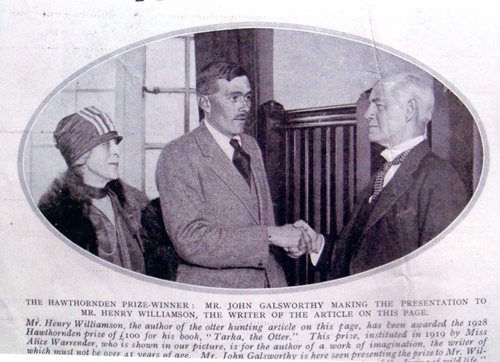
Newspaper reports reveal that in his speech Galsworthy described Tarka the Otter as:
a truly remarkable creation. It is the result of stupendous imaginative concentration, fortified by endlessly patient and loving observation of nature. Henry Williamson has received as yet infinitely less credit as a writer then he deserves. He is the finest and most intimate living interpreter of the drama of wild life, and he is, at his best, a beautiful writer.
Miss Warrender is also reported as having made a delightful speech but: ‘the shy young man retreated from the platform without making a speech.’ This was remarked on in several reports, and obviously considered a little odd.
Miss Warrender had asked HW not to tell anyone about the prize so he had not even informed his publishers, who were now in some embarrassment (and somewhat put out) that they had not got a new printing ready to cover the immediate rush of sales. However, they wasted no time in advertising the book in their weekly Putnam Book News on two consecutive weeks, with Windles also getting in on the action:
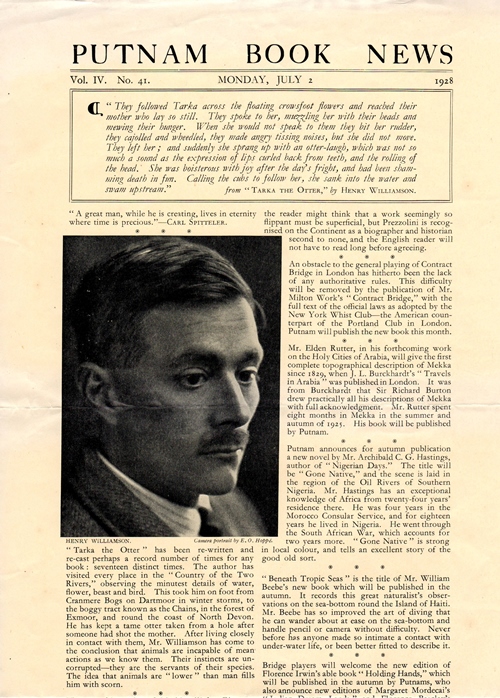
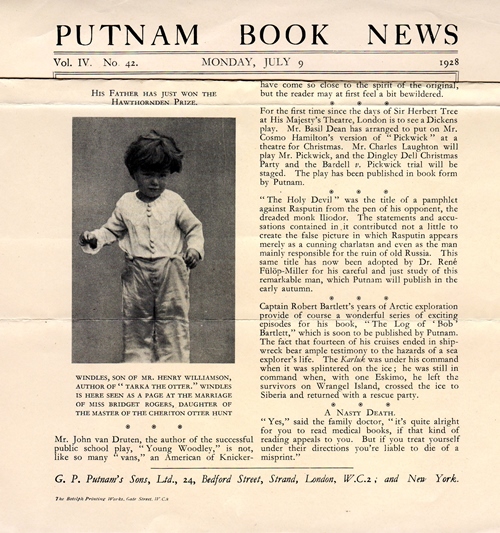
The Hawthornden Prize brought HW recognition and fame. With the prize money of £100 HW bought a field on the hill above Georgeham at Ox’s Cross, where he built himself a Writing Hut which was to be his workplace and refuge for the whole of his life; he planted the boundaries with Monterey pines.
In May 1932 a young artist, Charles F. Tunnicliffe (1901–1979), approached Putnam with a proposal. He had read and enjoyed Tarka, and (apparently at his wife’s suggestion) sent some aquatints of otters with the proposal that he should illustrate a new edition. Constant Huntington put the idea to HW, who agreed, and on 24 May Tunnicliffe arrived at Shallowford (where by then the Williamsons were living) to meet HW and to see Tarka country for himself, and to start work on the illustrations – to be wood engravings.
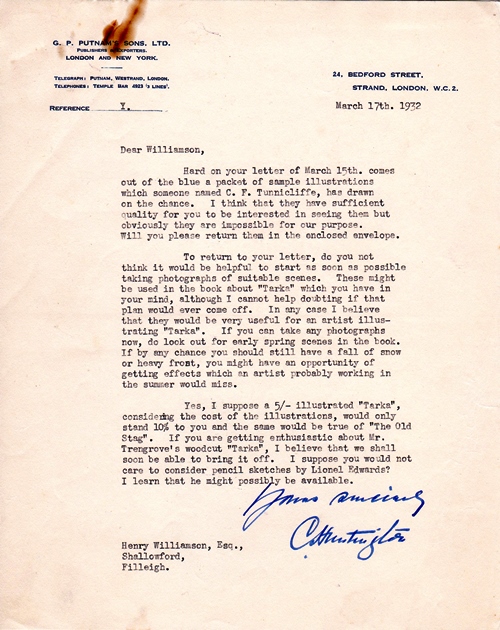
After spending a few days at Shallowford, Tunnicliffe set off to work directly from the various scenes that occur in the book. This was the first book illustration task that he had undertaken, but his skill as craftsman and his talent for portraying the countryside and all its creatures were a perfect complement to HW’s words.
By 8 June Tunnicliffe was back at his home in Macclesfield, writing to report progress and enclosing prints of Rams Horn Pond with swallows, and of the honorary whip probing the holt with his pole. He continued to work and write to report progress enclosing prints of completed work. The two men collaborated very closely, as a large file of letters reveals.
On 15 July Tunnicliffe returned to Torrington, to work on the river there, especially at Canal Bridge, the birth and death location of Tarka. On Sunday 17 July, HW drove over to meet him and they went on to Dartmoor, where they walked up to Cranmere Pool, so that the artist could get that location absolutely correct.
Just over two months later, in a letter dated 12 August 1932, Tunnicliffe indicates that the work for Tarka was finished. But in the interim it had been arranged that Tunnicliffe would further illustrate new editions, to be uniform with Tarka, of The Lone Swallows, The Old Stag, and The Peregrine’s Saga, and that letter shows that he was already working on The Old Stag, for he enclosed six rough sketches.
The Charles Tunnicliffe illustrated Tarka was published later that year with 23 full page woodcuts and 16 line drawings as ‘tail-pieces’: the illustrated The Old Stag appeared in February 1933; The Lone Swallows later that same year; and The Peregrine’s Saga in February 1934. (There were many reprints of these books, including, in 1945, a new uniform limited edition of 500 copies each.) Tunnicliffe had never before drawn falcons at close quarters. HW sent him off to a professional falconer in August 1933. The artist was totally overwhelmed by this bird, sending HW a letter headed with his first sketch of the head of a peregrine (see AW’s biography, Henry Williamson: Tarka and the Last Romantic, p. 150) which is so powerful that the bird seems alive.
Tunnicliffe also illustrated the first edition of The Star-born. The surreal nature of the subject rather troubled him, and he wondered if he would be able to cope with it. On 12 December 1932 HW drove him over to Lydford Gorge so that he could work from the actual location. The artist rose superbly to the task and his wood-engravings complement the text in exceptional manner. Charles Tunnicliffe went on to be one of the great artists in the genre of bird painting, but he always recognised that it was his work illustrating HW’s books that first brought him fame.
*************************
Back to 'A Life's Work' Forward to 'Tarka the Otter: Critical reception' Forward to 'Tarka the Otter: the film and opera'
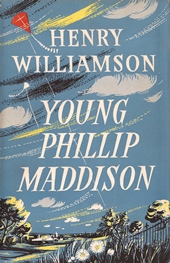
Young Phillip Maddison
YOUNG PHILLIP MADDISON
(Volume 3, A Chronicle of Ancient Sunlight)
 |
|
| First edition, Macdonald, 1953 | |
First published Macdonald, (seemingly at the end of November) 1953 (12s 6d net)
(‘net’ meant that the book could not be sold for less than the publisher's set price – the Net Book Agreement benefited both publisher and author. Today the author only gets percentage on the discount price sold to the bookseller, thus greatly diminishing his income.)
Panther, paperback, 1962
Reprinted by Macdonald, 1984
Zenith, paperback, 1985
Sutton Publishing, paperback 1995
Currently available at Faber Finds
Dedication:
To John Heygate
(A close friend since 1928, author of several books, Heygate inherited a baronetcy & Irish estates from his uncle in 1940.)
Young Phillip Maddison continues the story of Phillip as he proceeds through school. In real life this school was Colfe’s Grammar School, to which HW had won a scholarship, as did Phillip at the end of the previous volume, Donkey Boy. The school itself features rather nebulously here: it is not given a name until after Phillip has left, when we read in the next volume that it is called ‘Heath’s Grammar School’ (Colfe’s was in Blackheath, Lewisham). HW had already written in great detail of life at the school in the earlier Flax of Dream series, where it is Cousin Willie Maddison, who attends Colham School, set vaguely in the ‘West Country’.
The fact that it is the same school in both series is very well disguised, a quite amazing juggling tour de force. We are told right at the end of Young Phillip Maddison that the two ‘separate’ head-masters are ‘twin brothers’ – a neat device accounting for their similar appearance and habits. Obviously HW enjoyed this little tongue-in-cheek ploy!
Young Phillip Maddison concentrates on Phillip’s life outside school with his family and friends, and all the details that beset this sensitive, rather wayward and unpredictable boy, whose keen interest in nature is strengthened as he grows older and is able to explore the surrounding countryside. The book takes us into the heart of the life, thoughts, and feelings of a young lad growing up in Edwardian England, yet it is not ‘dated’. Everything is immediate and fresh and absorbing.
*************************
HW started work on this third volume of A Chronicle of Ancient Sunlight in May 1952 on return from a short visit with his wife Christine (and child) to his first wife, now living at Bungay in Suffolk. HW was under a great deal of strain, as always at a time of intense writing. At this point he recorded in his diary that the novel was tentatively titled:
‘The Windflower’ – ‘Not I but the wind’ (?) quote from D.H. Lawrence.
It is indeed a Lawrence quotation. It comes from ‘Song of a Man Who has Come Through’ (poetry volume Look We Have Come Through,1917):
Not I, not I, but the wind that blows through me!
A fine wind is blowing the new direction of Time.
It does not seem a very appropriate title for a book about childhood, and there is no indication as to why HW chose this. It is interesting that he was choosing a poem of Lawrence’s. That he was remembering it from a long time before is evident from the hesitant ‘(?)’. Lawrence tends to be known for his novels but he also published several volumes of poetry, and was considered one of the Georgian poets. There is a volume of Georgian poetry (Georgian Poetry 1918-1919, ed. Edward Marsh) in HW’s archive, given to him by Frank Davis (on whom Julian Warbeck is based in the Chronicle) in 1921. (HW states somewhere that he stole this from Frank – but it is signed ‘To Bootie from Frank (well-fed) 1921’.) It does not contain this poem but another one from Lawrence’s 1917 volume. So the little mystery has to remain unsolved.
At the end of May HW recorded that he was giving up writing for the summer as he was too tired and needed a break. At the same time that he was working on this book he was also dealing with the compilation of Tales of Moorland and Estuary, which was published in March 1953. In the interim he had a holiday in Ireland, staying with John Heygate at his Bellarena estate (for further details see my biography Henry Williamson: Tarka and the Last Romantic, pp. 272-76). On 2 October he recorded: ‘I re-started Book III.’ Writing continued without let-up; on 8 December he had ‘finished part I of Book III, “The Wind’s Will” after working most of last night & today. Exhausted.’ And continues to write without break – ‘I wrote all through Christmas’, and, in the notes section here: ‘Have done about 180,000 words of Book III.’
4 January 1953: I finished Chapter 17, ending in death of Sarah Turney, this morning, having got up at 4 a.m. I finished at 1.30 p.m. A very easy scene, simply written – it wrote itself. I was remembering my own grandmother Henrietta Leaver (née Turney) death.
Two days later he noted he was ‘Reading for first time “Fathers & Sons”. Very good. Turgenieff in 1860 didn’t know why women got so nervous & flabby. Or did he?’ The ‘father and son’ theme is very prominent in HW’s work – and is particularly noticeable in this volume. HW had also read Edmund Gosse’s Father and Son (1907) earlier, as he mentions it in his book On Foot in Devon (1933), where he is quite bitter about the effect of the ‘grim man of God’ and his effect on his son.
On 9 January he recorded: ‘Working. I like the book now. But it goes on for ever! I type in daylight, write by hand at night.’
He thought about changing the title to ‘An Edwardian Youth’ but for the fact that Edward VII dies halfway through: so as ‘An Edwardian Boyhood’ it became the title of Part One. But very soon his diary indicates that he is writing far beyond the present Young Phillip Maddison and is into war scenes:
I fear the book will run to nearly ¼ million words. In an age of television & motoring!
In the middle of April he again went to Bungay (where his first wife lived, while Christine & ‘Poody’ then went off to her mother’s at Ripon, Yorkshire) where he re-arranged the book’s content, revealing that another working title at this time was ‘Goodbye My Bluebell’.
On 4 June there is an entry which he indicates actually belongs to 22 June: ‘My novel was finished some days ago, or weeks; sent off for typing; corrected; and taken down to Malcolm Elwin on Monday 15 June.’(Elwin was his immediate editor at Macdonald’s; he lived across the fields from Ox’s Cross at the bottom of the cliff below Pickwell Down – next to Black Rock.)
An interesting snippet here: HW watched the coronation of Queen Elizabeth II on a television that was set up at Georgeham Village Institute – ‘a tiny set about 10” x 12”’ – so very difficult to see. He tried to get the councillor in charge to put it up higher but to no avail! (No doubt earning further black marks locally!) Afterwards he had a drink at the King’s Arms – ‘now a nice pub’.
15 June: I have not the slightest qualms about Young Phillip Maddison, a title suggested by Eric Harvey [a director at Macdonald] after John Heygate had proposed the name to be part of the title. I had many alternatives, the last of which was The Way to Wine Vaults Lane . . . I had to end at part 5, & leave out the original part 6, 4 August – 12 February, 1st return of the soldier. That will now be part I of the sequel. [Note that Part 5 also disappeared from the published volume – some firm editorial handling evidently took place!]
I know that Y.P.M. is good, sound, basic.
I wrote a new beginning last revision of all, the oak on the hill in fog: & the story wove in from that . . . Many incidents are true of my life, such as the Valentine, Mr Pye disliking me . . . & his kneading of the breasts of Helena Rolls at his magic lantern display. Also Peter Wallace, the bespectacled boy, fighting like that; & the incident of Alfred Hawkins (his real name) & many others.
By the beginning of October proofs had been read and revised. John Middleton Murry also read a set of proofs and liked the book which greatly encouraged HW. On 8 October there was a visit by Marjorie Turney to the Field:
She’s just the same: and so am I – “Polly Pickering” of the novels. She said I was a witty, comic boy. Quite a surprise to me!
By 26 October he has already finished chapter I of How Dear Is Life (note that this title was established from the start).
HW does not record the date of publication of Young Phillip Maddison, but from the date on reviews it would appear to have been towards the end of November 1953. The turmoil of its writing is not present in any way: it flows through itself and could never have been otherwise!
************************
As this volume opens it is spring 1908; Phillip is nearly thirteen years old and he is wandering home from school across ‘The Hill’ in a fog. It is the Eve of St Valentine’s Day and he is planning to send a secret Valentine card to Helena Rolls, the pretty daughter of the rather aloof family who live at the top of the road, in the only house with a turret. (A symbolic metaphor which HW did not have to imagine: it was actually so! Still there in the late 1960s, the house was subsequently demolished.)
The secrecy of this undertaking is complicated, and compromised, by the fact that he asks cousin Polly (his ‘Gaultshire’ cousin who is visiting) to draw a picture for him, which gives rise to spiteful teasing by his sister Mavis, with whom Phillip constantly bickers. The consequent furtive delivery of his card through the Rolls’ letterbox is aborted by the somewhat lecherous Mr Pye, intent on the same errand.
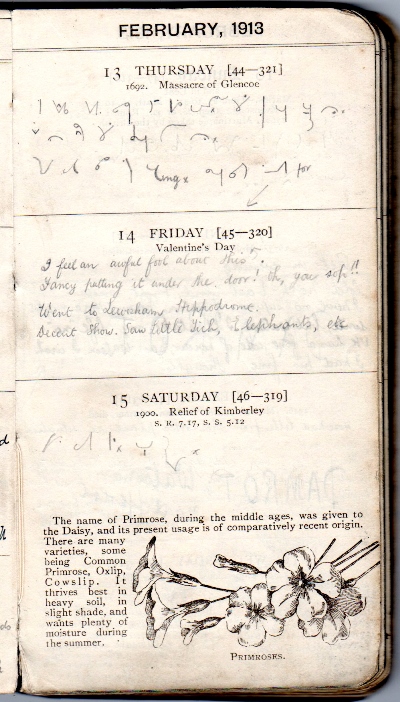
This incident is recorded in HW’s ‘Schoolboy Diary’ in shorthand code (so no prying eyes could read it!), but in February 1913, when HW was actually seventeen. The fictional version is obviously embroidered to give it more impact, but we are indeed taken right into the feelings of an uncouth youth stumbling through the first stirrings of calf love.
Phillip meets up with Horace Cranmer, the lad who comes from the poor home in Skerrit’s Road, who at fourteen is still at the Wakenham School, but is about to start work in the tanning yard at Bermondsey. The struggle of Cranmer’s life is a thread which is worth following in these early volumes. It illuminates the hardships of the poor – as does Theodora Maddison’s work as suffragette and defender of the poor – impinging on the main thrust of the novels: a sub voce background. So we are aware of it without being aware of it: very subtle.
Another boy who features prominently is Peter Wallace, who, being a good fighter, protects the timid Phillip Maddison from bullies and is prepared to fight on his behalf – although that has its repercussions in due course.
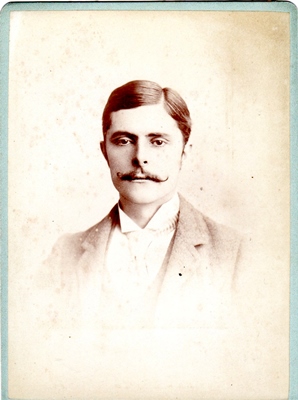
Threaded into this early part of the novel is the business of Phillip dressing up in his best clothes – his ‘Etons’ (handed down from his cousin) – in preparation for a photograph, to be properly taken in a studio. This is accompanied by teasing from Mavis, much nervous fussing from Phillip (but he takes the opportunity to fumble among Polly’s clothes), and emotion from his mother:
‘You must look your best for your photograph tomorrow, you know.’
Even his father is suitably impressed, wondering jocularly whom the strange boy is who has appeared in the house!
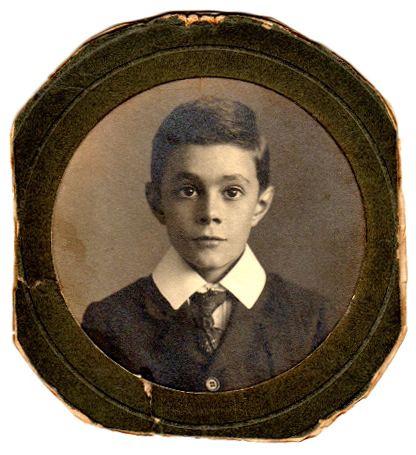
This is the photograph that was taken: how proud his mother must have been.
Richard Maddison is a frustrated man in many senses of the word (we note that he secretly looks at books with ‘tasteful’ artistic photographs of ladies, and he lechers after younger women). His mundane and disappointed lot in life is summed up in the sentence:
For twenty-five years Richard had been going to and from the City, and in that time, as he had estimated one recent evening while compiling his diary, he had crossed upon the flag-stones of London Bridge, in the roar of iron wheel-bands and horse’s hoofs on granite, approximately on fourteen thousand five hundred occasions.
Richard longs for a life beyond this hum-drum daily bind and grind, which he resents. The fact that he lodged at ‘Joy Farm’ before he got married has a hidden metaphoric symbolism for his married life. But he does not actually have too bad a life: he escapes on his bicycle and has several personal occupations. The main problem is probably lack of money – he cannot afford to live the life of a gentleman. He has never recovered from the peculiarities surrounding his marriage, while he greatly resents the presence of his in-laws living next door. His wife is always running back to her Papa, who gets the attention that should be due to himself.
Cycling is prominent. Richard Maddison now has a Sunbeam (replacing the revered Starley Rover) while Phillip has a second-hand Murrage’s Boy’s Imperial Model. (Murrage’s is Gamages – then a famous London store.) Father and son go off for cycle rides to various local haunts – Richard’s favourites from his earlier life, and all known to be places that HW visited frequently as a boy. But these jaunts are never really happy occasions, for Richard is always upset by something Phillip does, or does not do.
One tiny detail placed into one of the cycle rides is an echo of HW’s early and important story of the picking of bluebells by the local populace:
Some traps stood outside the Bull by the tram-stop. The ponies’ heads were held by ragged boys and men; but the cyclists went on, bells tinkling, swiftly among the gleaming tramlines. Here and there on the wood-paving bluebells lay, scattered amidst bits of paper and orange peel, banana skins and squashed horse dung.
A problem arises over Mavis and a boy called Alfred Hawkins, who are caught lying in the grass together. Mavis has been shown as being a little precocious in her behaviour with her father, who is conscious that he is in danger of responding. Phillip and Peter Wallace challenge Alfred, and Peter beats him up. When this is discovered, Phillip cowardly runs away, and is later caned by his father, who then overhearing what the trouble was about, turns on Mavis. She, terribly upset, runs away and is not found until nearly midnight. The estrangement from her father runs deep, and Mavis holds this, very bitterly, against Phillip for all her life. The psychology of this incident is very cleverly manipulated throughout the rest of the Chronicle.
Phillip obtains The Scout, Volume 1, No. 1 (the Scout Movement was indeed formed in 1908), and totally absorbed takes up scouting, first in his own way, making his own ‘Bloodhound Patrol’ with Cranmer, Peter Wallace, Lenny Low, the rather unpleasant Ching, and a newcomer, Desmond Neville, who becomes Phillip’s best friend, along with his mother Mrs Neville (parted, as we learn later, from an unpleasant husband). Desmond Neville is based on the great friend of HW’s youth, Terence Tetley, and all the various scenes concerning him that occur throughout the Chronicle are firmly based on real life, with very little embellishment.
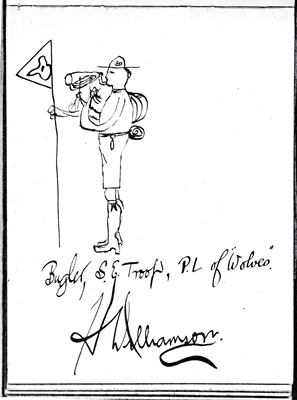
The enthusiasm and fun of this new activity of scouting is portrayed with exact and authentic detail. After a while the boys join the official Scouts (except poor Cranmer, already working but not wanted anyway) under local scoutmaster, Mr Purley-Prout. There is great fun in the scenes of the Whitsun Camp, but Purley-Prout, unfortunately interested in little boys sexually, takes Lenny Low into his tent and interferes with him, giving him money. When this inevitably gets found out, Purley-Prout has to leave the district. (Such a lenient solution is highlighted by the spate of revelations of cover-ups of this kind of behaviour in our own recent times.)
As Phillip becomes adolescent he has the first stirrings of sexual feeling, and this is shown in various scenes of fumbling experiments (some with his willing Gaultshire cousin Polly Pickering – i.e. HW’s Bedfordshire cousin, Marjorie Boon) which are contrasted with the attitudes of adult moralising. But there is always the overshadowing, awful example of Phillip’s uncle, Hugh Turney, shown to be rapidly deteriorating as syphilis spreads through his system. But talk of sex is taboo. It cannot be openly mentioned: in the early years of the twentieth century the constraints of Victorian morals still hold in these middle-class circles.
Hetty once again takes her children to Hayling Island for two weeks. Philip no longer finds it quite as exciting but makes his own entertainments, which include several visits to the ‘Merry Minstrels’ show where a beautiful fair-haired girl:
. . . with pink frock and large pink hat with pink ribbons hanging down it, sight of whom made him forget Helena Rolls.
The Williamson family visited Hayling Island for their two weeks’ summer holidays for several years in the early 1900s. (For further background see Robert Walker, ‘Henry’s Hayling Holidays’, HWSJ 46, September 2010, pp. 15-28.) A later holiday at Whitstable is a total disaster, due mainly to the tidal mud stinking of sewage!
Phillip catches scarlet fever, an extremely dangerous infection in those days. He is sent away to the fever hospital for isolation, the normal practice. That would have been a daunting experience for a young lad. The description of this event, with its attendant Lunatic Asylum scene, is one of those ‘social history’ markers that are woven through the novels and shows how grim life could be in those days. Hetty takes him to Brighton to recuperate. There is no evidence that young Harry ever caught scarlet fever, but the disease was a real threat until after the Second World War. He probably actually had measles or some such rather badly.
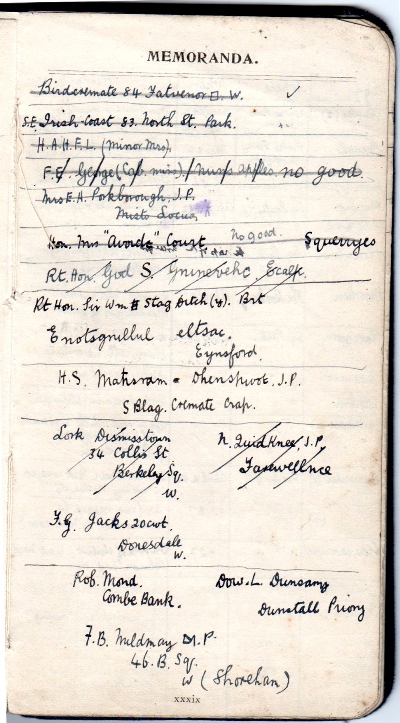
The chief occupation – and pleasure – of HW’s young life lay in his wanderings in private parks and woods, for which he gained permits by writing to the owners. He learnt a great deal by talking to the gamekeepers of these various ‘preserves’ as he called them, and it was possibly where he gained his objective view about nature ‘red in tooth and claw’ which is so obvious in those earlier short stories.
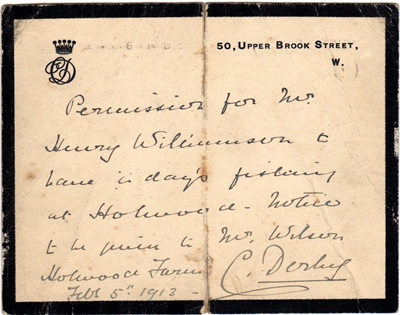
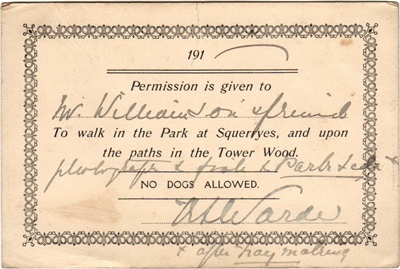
In 1913 he kept a ‘Schoolboy diary’ (printed by his grandfather’s stationery firm) and further recorded every visit he made in school exercise books. This ‘Boys Nature Dairy’ was printed verbatim in the 1933 edition of The Lone Swallows. It shows the promise of the writer-to-be, not least the tenacity of purpose involved. He made a code to hide the names of those he had written to for permits from prying eyes.
This is all part of Phillip’s boyhood in this novel: a most vivid and charming ‘remembrance of time past’. The rivalries of the boys, their quarrels and intense friendships, joys, worries, and emotions make an intense bond with the reader.
(Much background can be found in HWSJ 38, September 2002, pp.10-58, and HWSJ 44, September 2008, pp. 4-70, both of which contain various articles illustrating HW’s early years and how these fit into his writings.)
As Young Phillip Maddison continues, there is great excitement as Charlie Turney, brother of Hetty, who had left home many years before after a violent quarrel with his father and has been working in Canada and South Africa, now returns home (he says in time to see the coronation of George V: Edward VII died on 6 May 1910 – the date of the coronation was 22 June 1911). He brings his wife Florence (Florrie), previously a singer, and children Petal (the same age as Mavis, thus born 1897) and the younger Tommy: accompanied by accoutrements of African life, including Kimberley, a black boy. Charley and family stay with the Turneys, but once the euphoria of reunion is over the old animosity between father and son soon resurfaces. Inevitably, there is speculation as to whether Kimberley is Charley’s son, but precocious Petal tells Phillip that it can’t be proved.
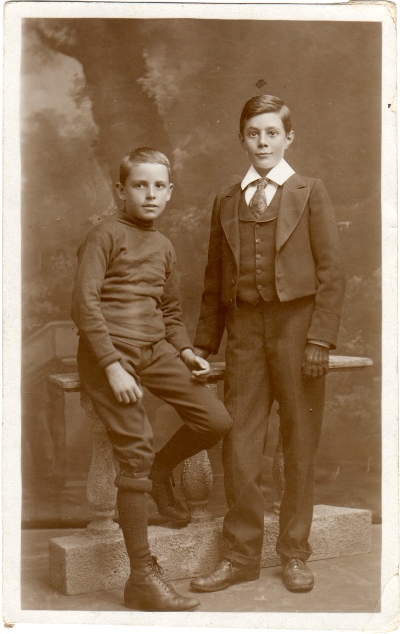 |
| HW and his South African cousin, Tommy Leaver |
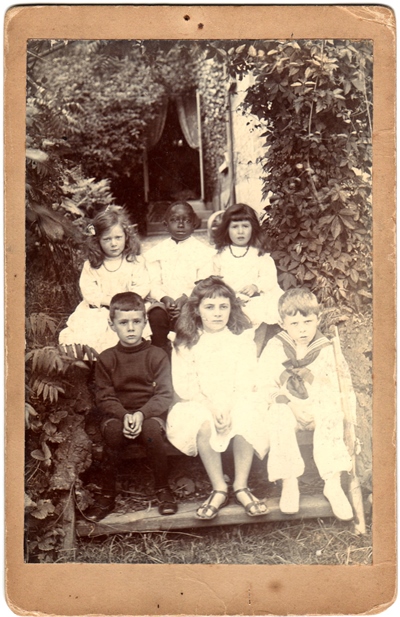 |
| Family group, with Kimberley |
Charley, out of kindness to Hugh, takes him to Brighton, the old holiday haunt of the Turney family, the is, ‘Mama and the five children’, ‘The Old Man’ only joining them at the weekends. He invites Gerry, whose father had died in the Boer War, and Phillip to go with them. It is not an entirely happy outing, Hugh being rather distraught at his own situation. He wants to be left alone to write out his thoughts – to be a great novel on ‘the maniac power of fathers over their sons . . . the hidden malaise of modern society’: obviously HW’s own thoughts on the subject. However, the boys enjoy themselves with the usual seaside attractions of that era and have a jolly day.
 |
| HW's uncle, Hugh Leaver |
When the (perceived) problem over Kimberley surfaces, the rather histrionic Florrie tries to commit suicide. The ensuing quarrel between Charley and his father upsets his mother so much that it brings on a stroke, from which she dies. After a bit Charley decides to move out of his father’s house: Phillip tells him that Joy Farm is to let (reminding Richard of his own very happy time there before the cares of marriage and family life overwhelmed him), and so the unrepentant family move there and find it very congenial. However, restless Charley decides they should return to South Africa, but first plans a trip to New York for himself and Florrie, booking passage on the Titanic.
One of the most intriguing and evocative scenes in the book is the ‘Jaunt to Belgium’, related towards the end. We learn that Mavis is attending the Ursuline Convent at Thildonck, Wespaelar (and has been for some time), and as she is not allowed to travel home for the Easter holidays, Thomas Turney, now free to travel, decides to take Hetty and Uncle Joseph, together with Phillip and Petal, who is to attend the convent herself (while Tommy is to be sent to boarding school in Brighton). Thomas Turney is paying for this, and for the education of others of his grandchildren (but not the Maddisons).
The journey is described in some detail (including a little fairly innocent and awkward sexual liaison between Phillip and Petal). But when they reach the convent all is softness and smiles. Phillip meets Mère Ambroisine, who had known his mother when she had attended the school. Needless to say, this is all based on real life. HW’s mother had indeed attended the Convent at Thildonck, where the Mother Superior had been Mère Ambroisine.
The goodness and sweetness of the nuns (Ambrosia – food of the Gods and divinely fragrant: one feels HW must have made the name up for this purpose, but that was her actual name within the religious community) envelops Phillip and shows him as his true inner self. Phillip is very conscious of the importance of the moment, as was obviously young Harry. It is a moment of stillness at the centre – a moment to be savoured before the real world takes over again and Phillip becomes his normal perversely naughty self. This is a quite interesting point within the overall theme of the novel: goodness begets goodness.
(For an excellent article on the background to Thildonck Convent see Tony Jowett, ‘A Jaunt to Belgium’, HWSJ 39, September 2003, pp. 85-96.)
As the family party return to England they see the news-bill headline announcing that the Titanic has sunk (on the night of 14/15 April 1912). But after the first panic, there is a message to say that Charley had missed the boat and had sailed to America on another. Thomas Turney pronounces one of his pompous sayings, this time with unintentional irony: ‘I always said Charley would be late for his own funeral.’
Phillip is invited to stay with his cousin Willie Maddison at the family home at Rookhurst, thus reprising the visit of Phillip which appears in Dandelion Days. Here this exciting holiday is glossed over in one paragraph. Possibly HW felt it difficult to maintain the strange schizophrenic mirage.
The end of Phillip’s schooldays looms. We are told about Mr Graham, the historian, once a pupil at the Heath School, who took a keen interest in everything that the boys did, especially the sports. Mr Graham was Leland Duncan, a distinguished local worthy, who indeed took an interest in the boys, and was very kind to HW. (See HWSJ 38, September 2002and HWSJ 44, September 2008 as before.) And finally we meet ‘The Magister’, as the head was known: as irritated with Phillip as his twin had been with Willie, understandably!
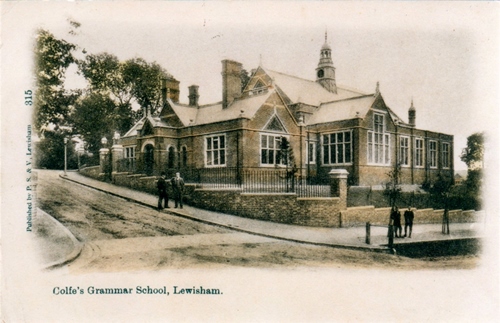
Phillip’s future has to be resolved. Out of sheer nerves and lack of any social experience he messes up an interview with his Uncle Hilary, who wanted him to farm in Australia. Instead his father arranges for him to have an interview at the Moon Fire Insurance Office, where he himself works. Phillip has a new suit for the occasion. He is told he will be taken on, on probation, on the following Lady Day, 25th March, at a salary of £40 a year. That date, to Phillip’s elation, was still two months away: he could continue his country pursuits.
The final scene of the book involves the ‘Bagmen’ – the name given to those boys in the ‘Commercial Class’ (that is, not going on to university). Note that Phillip does not learn shorthand – but HW certainly did! As the boys leave school, so they have a final ‘Bagmen’s Outing’, together roaming the countryside haunts of their boyhood, those places that have threaded the tapestry of these first three volumes of the Chronicle: Whitefoot Lane, the Seven Fields of Shroften, Cutler’s Pond, etcetera, remembering past excursions. They end up at the Hippodrome, where there is a girl with pink stockings and shoes with pink bows (‘pink’ was obviously the epitome of feminine charms!) . . . Phillip wants it to go on forever but:
It was over, his boyhood was over.
The phrase echoes the one that HW wrote at the end of his 1913 ‘Boy’s Nature Diary’ after the end of the First World War:
And Finish, Finish, Finish, the hope and illusion of youth,
For ever, and for ever, and for ever.
At home Phillip tells his father he had been to the Seven Fields: Richard, lost in thought, remembers his brief honeymoon there with Hetty, and then Phillip’s difficult birth. Phillip looks at the book written by Mr Graham that is given to all boys as they leave. Hetty comes in with her darning, and for the briefest of moments, the three are at peace with each other.
*************************
Index to 'The London Trilogy':
Between 2000 and 2002 Peter Lewis, a longstanding and dedicated member of The Henry Williamson Society, researched and prepared indices of the individual books in the Chronicle of Ancient Sunlight series, with the first three volumes being indexed together as 'The London Trilogy'. Originally typed by hand, copies were given only to a select few. His index is reproduced here in a non-searchable PDF format, with his kind permission. It forms a valuable and, indeed, unique resource. The PDF is in two sections:
'The London Trilogy': An Index — Aerated Bread Company to Maddison, Theodora
'The London Trilogy': An Index — Maddison, Phillip Sidney Thomas to Zoo
*************************
There is quite a large file of cuttings but an entire lack of any from the major newspapers, which is somewhat puzzling. The book cannot have been totally ignored by them – so I have to presume that these were placed elsewhere and have disappeared. It would be useful, if anyone has any knowledge of any such reviews, if they would let us know via this website.
The North Devon Journal Herald (F.H.K.),17 December 1953:
Mr Williamson’s new novel is in every sense a continuation . . . carrying it forward from puberty to adolescence, and setting it down at a convenient place for pausing as Phillip himself is taking leave of school.
But the book is not primarily concerned with . . . school . . . the action is directed away from the classrooms and towards the family circle. . . .
In young Phillip himself the change is more noticeable. Adolescence has begun, and here we are given a penetrating study of the uncertainties and frustrations of the boy-youth.
In Mr Williamson’s writing may be found a clear understanding and a keen observation of human behaviour. The irritation of one nature chafing against another is described with such realism that one can feel the friction. This is no pleasant fiction of middle-class living in the late Edwardian era, but a story full of the very matter of life.
Eastern Daily Press (Adrian Bell), 11 December 1953:
Liveliness is also a characteristic of . . . This relates the life of the son of Richard and Hetty during his grammar school days in the reign of Edward VII. It is a tale as full of incidents as the life of a high-spirited boy can be. Incidents . . . that are shattering at the time begetting family tensions and troubling neighbourly relations. There are feuds with gangs of boys on the wasteland on the edge of the suburb, the emotional disturbances of earliest awareness of the other sex, scouting and contacts with nature. Much of the story read to me like fitful recollections of my own boyhood, whereby I judge Mr Williamson good and true to life.
Recorder (James Hanley), 10 December 1953:
Young Phillip Maddison is . . . third volume of this tremendous study of a human being. . . . [it] is a comprehensive story in itself, of the boy, Phillip. . . . had been a dear little child, innocent, loving and ardent, but something has gone wrong in his relationship with his father . . . and now he has developed into a personality of rather grievous complexity, always in scrapes, sometimes unwittingly, but more often because he could be quite extraordinarily naughty.
Being highly imaginative his defaults exceed those of normal children. . . . There emerges an individuality, complex, passionate, disobedient, cowardly, a liar and yet with all his faults, somehow lovable.
How well Mr Williamson conveys all the secret thoughts and doings of small boys, living lives that are all heights and depths, and never a humdrum centre. Magically he suggests the era by subtle description; the types of road, the makes of car and bicycle, the prices of commodities, the fashions of the day, as well as by the thoughts and conversations of the many characters, both child and adult, in this long and deeply fascinating book. This is a world of the past, yet how it lives?
Sphere (HW has added the name: Vernon Fane), 16 January 1954:
[HW’s] long new novel about the life of an English middle-class family . . . is a sincere if verbose account of childhood in one of the new London suburbs of Edwardian days and it is worth your attention for two reasons: one, that Mr Williamson writes about boys with almost as great a perception as Mr Booth Tarkington in the past, and two, that, being the naturalist he is, he cannot help making even the smallest passage of a country glimpse other than an enchantment.
St Martin’s Review (marked by HW as by William Kean Seymour), January 1954:
. . . now we have a further 416 pages of the saga . . . in which the father-burdened boy is carried on to his school-leaving and imminent clerkship in the Moon Insurance Co. I say “father-burdened”, for here, as in “Donkey Boy” we see what can spring in character-development from a state of emotional frustration existing between the parents. Poor Richard, the father, is a psychological mess, harbouring grievances against the world, turning inward on himself; lonely, punitive in spirit, making an article of faith out of his lonely bicycling and cold baths: pompous and admonitory in expression and, all in all, a “pain in the neck”. . . . [This also reacting on Hetty and the three children.] . . . That is the psychological “set-up” but within that framework is a rich pulsating story. The marvel . . . is the exactitude of his recollections of the London scene when Edward VII was King. Steam buses and “electric theatres”, the first L.C.C. trams . . . but also the suburban green fringe, now lost in housing estates. [with all the naturalist’s detail] . . . There are tragic streaks in this new novel, and some matters are discussed with refreshing frankness. A design emerges from this “Maddison Saga” – like a magic mirror in which we may see the little London suburban world of Edwardian humanity.
Current Literature (Allen Street), December 1953:
Love in the sexual sense is not a subject that is considered fit for conversation or discussion among the characters of . . . in Edwardian England among respectable middle-class characters who live on the fringes of suburban London. Mr Williamson draws in meticulous detail the drab, genteel environment in which Phillip grows up, his youthful zest for life unquenched, in spite of frequent cataclysmic despairs and his ever-present fear of his father. It is this father-son theme which is the core of the book, and from the unhappy relationship that exists not only between Phillip and his father, but which existed also between Mr Maddison and his father can be traced the distortion and warping of character that begins even in early childhood. Phillip’s father is a pitiful figure drawn with merciless clarity of outline by the author. He dominates a story which is essentially sad in its picture of frustrated lives and buried hopes, but is relieved by the joyful spring-like moments that occur in every boy’s life and which are here described with sympathy and insight.
Yorkshire Evening Press (S. P. B. Mais), 26 November 1953:
Henry Williamson, as I have always maintained, is something of a magician. I am quite sure that no other writer could have kept me interested in the thoughts, feelings and actions of a 13-year-old boy of the Edwardian period for over 400 closely packed pages. . . .
The curious thing is that there is practically no story. Everything the boy does is grist to Mr Williamson’s mill, and he meanders along in so leisurely a fashion that our patience is often tried. . . . The outstanding merit of this very satisfying story is that we see life through the eyes of a boy in his early and middle teens.
There is no attempt to make Phillip a hero. . . . It is Phillip’s reaction to the life of the country, the seasons of the year, his father, mother and friends that absorb our attention. . . .
The interest and excitement, which are very real, lie in watching the growth of the boy’s mind and soul, and this is developed with a certainty of touch and quietness that mark the true master of his craft.
This Maddison saga is solid and built to last. The tempo may be slow, but the result is an enchantment which will, I believe, be shared by every reader who has not forgotten his or her own youth.
Mais also wrote a much shorter review for the Oxford Mail, 4 December 1953:
He takes us back 50 years to watch the spiritual and physical development of an unduly sensitive and awkward 13-year-old boy of the Edwardian era, suffering frustrations under a too rigid father and a spoiling from an over-fond mother. The merit of this extremely detailed story is very high.
John O’London’s Weekly (Richard Church), 11 December 1953:
Henry Williamson has none of the art of the two writers already discussed [William Cooper and Margery Sharp]. He is rather more the naturalist, turning his observant eye from field and hedgerow to the human scene. . . .
The fidelity to literal fact is astonishing. The reader recognises again and again little details that recall incidents and objects now loaded with trailers of memory. . . .
But Mr Williamson continues in laborious prose style. .. we must take his work as we find it, amorphous, pedantic, but remarkably faithful in its recollection of scene, mood, and relationships.
The Scotsman (unnamed), 7 January 1954:
[some preliminary remarks] . . . In the earlier novels the circumstances which conditioned the outlook of Phillip’s parents were described, and now here we see some of the consequences – the boy’s secretiveness, his frustrations. His outlook is transformed when he can escape to the country. . . .
Mr Williamson makes this contrast moving, and the scenes of family life are done with sensitive understanding. Despite these virtues, however, the novel fails to grip the imagination . . . and too much of the narrative seems tedious and plodding.
Manchester Evening News (Julian Symons), 10 December 1953:
Henry Williamson is famous for . . . he is less well known as a novelist . . . a truthful and sympathetic portrait of childhood.
Truthful, for young Phillip Maddison is not altogether a likeable boy . . . But sympathetic for Mr Williamson convinces us that Phillip is an essentially innocent and idealistic boy: a little precocious perhaps, but thwarted chiefly by a lack of understanding in his home. . . .
. . . The merit of Mr Williamson’s portrait is that he shows Richard Maddison as pompous and dull, yet manages to convey also his awkward good intentions and genuine affection for Phillip. . . .
. . . the accumulative effect of many everyday occurrences is to create a rounded portrait of a prickly, sensitive young boy. That is something rare in contemporary fiction.
Liverpool Daily Post (Brother Savage – i.e. a member of the Savage Club to which HW belonged), 28 November 1953. A book about Winston Churchill heads the list of this review column but HW gets a good percentage of the space:
Henry Williamson, farmer as well as novelist, has settled in Devonshire again after a lengthy sojourn in Norfolk, and the fact that he has been writing prolifically ever since he returned there shows that he feels thoroughly at home in the West. . . .
The mental and emotional development of young Phillip . . . but Phillip Maddison has a life of his own . . . the author of “Tarka the Otter” has not been claimed as “our best living Nature Writer” for nothing.
Irish Independent (I.H.), 6 March 1954:
The Only Son
This novel reads very like an autobiography, the story of an Edwardian boyhood, describing those well-remembered seasons, disturbing, awakening years, the scars of which . . . will remain for a lifetime. . . .
One conclusion that can be drawn from this novel is that children brought up in the city and its suburbs suffer from a nameless blight, a handicap not described in any medical book and the victims of which generally never know that they have had it. Much truth there is in this theory. Phillip the boy only felt at peace within himself and real happiness when he discovered the interests that were to be found in field and hedge and tree. . . .
The Birmingham Post (R. C. Churchill), 22 December 1953:
. . . There is a loving detail about the record of the boy Phillip in the years before 1914 that makes an ordinary existence of hopes and frustrations youthful joys and fears, remarkable interesting.
Calcutta Statesman (unnamed), 17 January 1954:
In “Young Phillip Maddison” Henry Williamson has attempted a very difficult task indeed: a simultaneous presentation and representation of an adolescent boy living in a London suburb towards the beginning of this century. One is swung, with the author, between an understanding of his hero, to a faintly malicious view of him, and back through varying layers of common sense and text-book psychology to a genuine, if suspicious, appreciation of his trials and tribulations. The subject is interesting; few writers have attempted such a piecemeal stripping of that particularly situated generation that holds so many positions of diverse importance at this moment.
Evening News Glasgow (T.O.), 5 February 1954:
. . . [HW] is now dealing with Phillip rather than his worried, self-tortured father, Richard. The son is introspective but happier than his parent and in him the love of Nature has found an unhindered outlet. This enables Mr Williamson to combine his own brilliant descriptive powers in this direction with Phillip’s growing vision. . . .
. . . One breathes here genuine country air combined with acute human observation. Undoubtably one of the best novels of the passing year.
Egyptian Gazette, Cairo (Laurence Meynell), 6 December 1953:
THE WEEK’S NOVELS [headed by Young Phillip Maddison]
The enchantement (sic) which distance is said to lend to the view certainly falls like a spell over . . .
It is a long, closely knit book, mainly concerned with the small details of family life. The principal character is young Phillip Maddison, whose emergence from grubby boyhood into adolescence is tenderly and touchingly represented.
Gas lamps, bicycles, and Marie Lloyd on the ‘halls’ set the tone of this seemingly artless yet actually very skilful tale. . . .
Paisley and Renfrew Gazette (G. H. Bushnell), 6 February 1954:
Brilliant Story of the Past
. . . [a halcyon period which few novelists have dealt with adequately] This story . . . is superlatively good; a brilliant painting of a day that had gone. . . . It is a grand story, which holds the reader from page to page and at the end makes him cry for more. . . .
. . . With a masterly touch that arouses great admiration Mr Williamson reveals why and how that search was doomed and in doing so adds another great novel to his name.
Three items deserve full viewing as follows:
Oldham Evening Chronicle (H.W. – surely not our HW!), 11 December 1953:
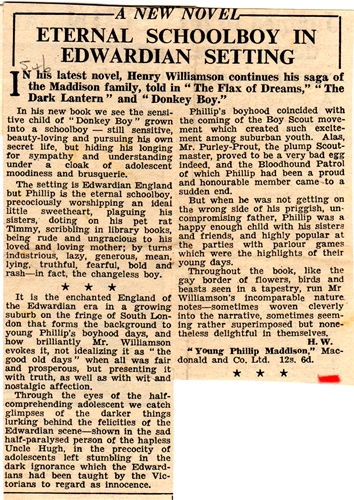
An odd historical curiosity:
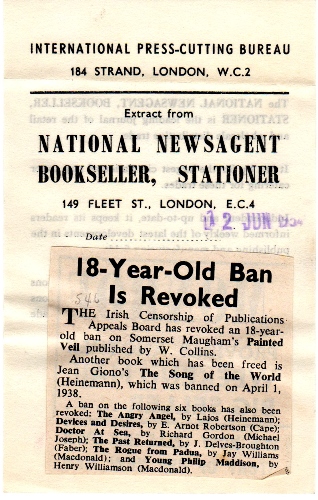
And a final superb review from a local source:
Beckenham Advertiser (Ben Newing), 11 November 1965:
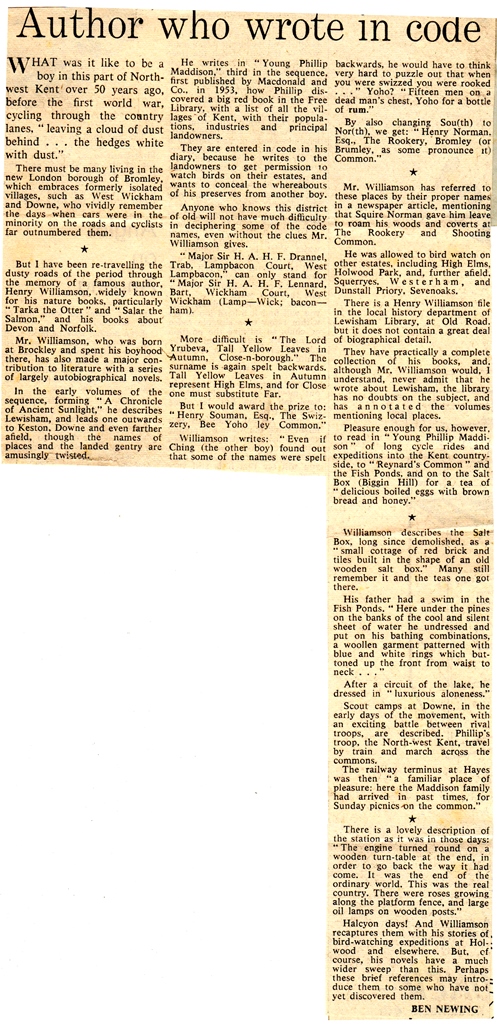
**************************
The dust wrapper of the first edition, Macdonald, 1953, designed by James Broom Lynne:
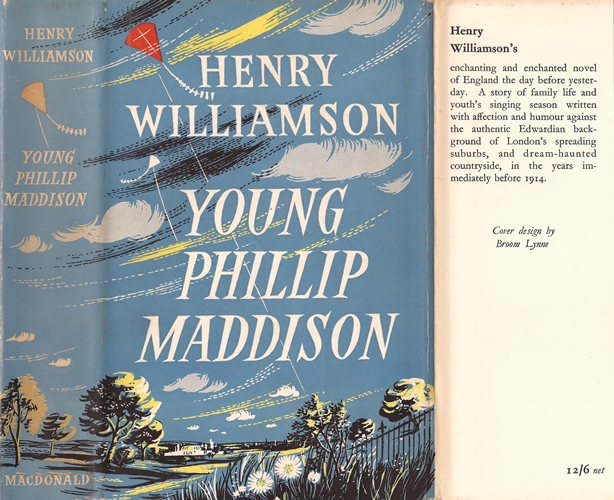
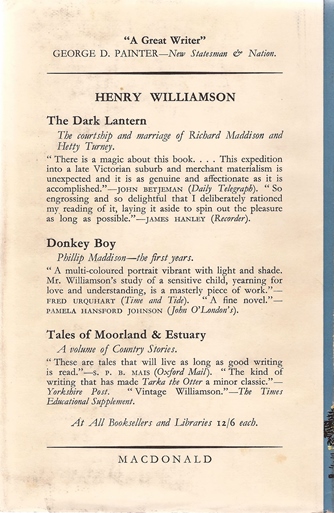
Other editions:
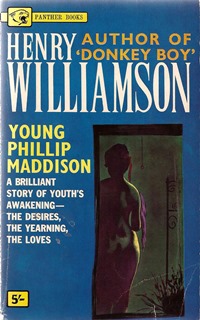 |
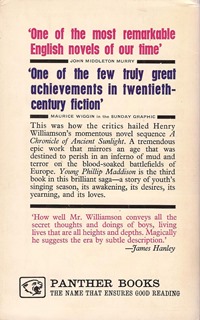 |
|
| Panther, paperback, 1962; and back cover | ||
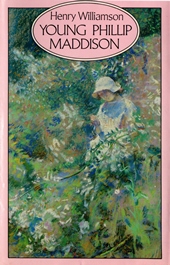 |
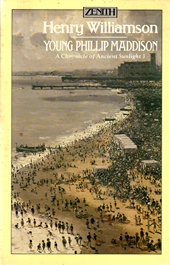 |
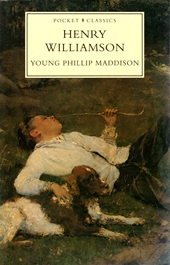 |
||
| Macdonald, hardback, 1984 | Zenith, paperback, 1985 | Sutton, paperback, 1995 |
Back to 'A Life's Work' Back to 'Donkey Boy' Forward to 'How Dear Is Life'
A Soldier's Diary of the Great War
A SOLDIER’S DIARY OF THE GREAT WAR
Published anonymously, but by Douglas H. Bell
With an Introduction by Henry Williamson
 |
|
|
First edition, Faber & Gwyer, 1929 |
|
 |
|
|
First US edition, Duffield & Co., 1930 |
Douglas Bell, artist: sketches and watercolours
Faber & Gwyer, 1929, 7s 6d net
Douglas Bell’s inscription to HW is dated ‘Easter 1929’. Easter in 1929 was over the weekend 29 March – 1 April, and so publication would have been about then. HW’s ‘Introduction’ is dated ’28 December, 1928’.
Duffield & Company, New York, 1930
In Ian Waveney Girvan’s A Bibliography and A Critical Study of the Works of Henry Williamson (Alcuin Press, 1931, Limited Edition, 420 copies), this book is described thus:
It was revised and annotated by Henry Williamson and his share in the collaboration was so considerable that it . . . should be considered as a Williamson item.
That is being somewhat unfair to Captain Douglas Bell, MC, whose story is told in the book through his own diary entries. HW certainly helped in preparing and editing Bell’s manuscript for publication, and sent it off to his friend Richard de la Mare, then at Faber & Gwyer, with his personal recommendation; and indeed, he wrote a substantial fourteen-page introduction for the book; but to claim it as 'a Williamson item’ is being perhaps a little perverse.
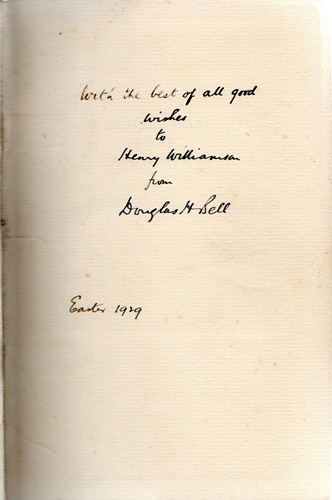
Douglas Herbert Bell had been a fellow pupil of Colfe’s Grammar School although somewhat senior to HW, having been born in 1890, and their paths would not have crossed there. After leaving school Bell went on to Christ’s College Cambridge, and was shortly employed in the Hong Kong and Shanghai Bank. At the time the First World War broke out he was already enlisted in the London Rifle Brigade as a Territorial soldier (as was HW), and went out to France on 4 November 1914 on the troopship Chyebassa – as did HW. They parted company when HW was invalided back to England with severe gastroenteritis and trench feet in January 1915.
Commissioned in the field in March 1915, Bell undertook officer training in France, and was then posted to the 2nd Battalion, Queen’s Own Cameron Highlanders, which was in the line in the Ypres Salient. Wounded in the leg at Hill 60, just south of Zillebeke, Bell was invalided back to Blighty on 27 April ('Good old Dover!'). Following a period of leave, Bell was briefly with the 3rd (Reserve) Battalion, Queen’s Own Cameron Highlanders, stationed at Invergordon on the Cromarty Firth, Scotland, before transferring to the 1st Battalion on the Western Front; he was wounded at Lone Tree during the Battle of Loos in September/October 1915. Bell's convalescence was spent at Torquay, South Devon; these various postings are reflected in his album of sketches, reproduced below. On 5 January 1916 he married Norah, 'a glad day'. By May Bell was back in France, where he took part in the Somme battles. In August 1916 Bell transferred again, joining the RFC. In his Diary he explains why:
August 13th. During June [1916], before leaving the mining area, a notice had come round asking young officers to volunteer for the R.F.C. in view of the great contemplated expansion of this branch [the appalling casualty rate among pilots clearly not being mentioned]; and I was so sick of trenches (and trench mortars) that I had sent in my name, on the principle of anything for a change.
On 10 November Bell was awarded his 'wings' and became a qualified pilot; not long afterwards he joined a squadron at Savy, sixteen kilometres north-west of Arras. Bell does not identify the squadron, but it would have been either No. 5 Squadron or No. 13 Squadron, both of which were based at Savy during the Battle of Arras in April 1917 and both equipped with the obsolete 2-seater BE2e aircraft that Bell describes. They were slow and cumbersome machines, but ideal for reconnaissance duties and in particular artillery observation – the observer watching for the fall of shells and using a primitive wireless set to call corrections to the gun batteries. It was a dangerous occupation, for it required steady flying, which left the aircraft vulnerable to anti-aircraft fire ('Archie') and to attacks by far superior enemy aircraft.
 |
|
BE2e Designed by Geoffrey de Havilland in 1911, the BE (Blériot Experimental) series of aeroplanes were built by the Royal Aircraft Factory at Farnborough. The BE2e was developed in early 1916. Powered by a 150 hp Hispano-Suiza engine, its maximum speed at 6,500 feet was 75 mph, taking nearly 24 minutes to reach that altitude. By April 1917 it was completely outclassed by fast and well-armed German fighters such as the Albatross, and in that month alone the RFC lost no fewer than 60 BE2s of various marks. |
In May 1917 Bell broke his collar-bone in an accident when taking off, following which he was returned to England: 'I was sent home for a long rest, and in November 1917 resumed flying at [Worthy Down, near] Winchester, as instructor to observers. There I remained until the end of the war.' The final entry in his Diary reads:
November 11th, 1918: Thank God the end of the awful blind waste and brutality of war has come, and let us pray it may never return. Man prays to God, because he instinctively feels there is a Power outside himself, yet the answer to such prayer depends on man himself. After this lesson, is man too little-minded and forgetful to banish the things that cause war?
I am feeling rather ill and depressed, in spite of all the rejoicing around me; immeasurably relieved, glad to be alive, and glad we have won, but tired and a little sad.
In Colfe’s Grammar School and the Great War 1914-19, edited by Leland L. Duncan (Printed for the Governors, The Worshipful Company of Leathersellers, 1920), Bell’s entry in the Roll of Service reads:
BELL, Douglas Herbert (1900-3). Joined 2.4.08. Lance-Cpl., London Rifle Brigade; Lieut., 1st Battn. Queen’s Own Cameron Highlanders. Temp. Captain, R.A.F. Served in France. Thrice wounded.
He was awarded the Military Cross ‘for distinguished service in the field.’ – London Gazette, 3.6.16
Bell resigned his commission in 1920, taking up an appointment in Mincing Lane (the London home of the wholesale trade in tea, etc.) but developed sleeping sickness and became unfit for work; he then decided to turn his hand to writing.
HW and Bell met up again at a Chyebassa re-union dinner in November 1926, and later Bell asked for help with his book of his war service. (The London Rifle Brigade had embarked on the SS Chyebassa, a ship formerly belonging to the British India Steam Navigation Company, on 4 November 1914, landing at Le Havre the next morning. Post-war London Rifle Brigade re-unionsof 'the originals' were named after the ship that took the battalion to war. See The 'Chyebassa' re-union dinners.)
HW’s ‘Introduction’ can perhaps seem a trifle condescending at times, though presumably Bell was happy with it. For instance he states:
To many these pages will appear entirely true; to almost as many they will be typical of the War . . . [but] . . .
But for HW the diary was all too brief and prosaic: for him, Bell had not captured the essence of the war. HW gives his own (brief yet powerful) description of what life in the trenches was really like – as opposed to Bell’s view that ‘it was a picnic’. He was of course awaiting the publication of his own imminent first venture into that war-writing zone (The Wet Flanders Plain). Bell’s book, although perhaps a little simplistic in its approach, is today considered one of those giving real detail of the war and well worth reading.
A Soldier's Diary of the Great War was published in the United States in 1930 by Duffield & Company as In Spite of All Rejoicing: A Soldier's Diary of the Great War, again anonymously. The copy that Bell gave to HW is inscribed:
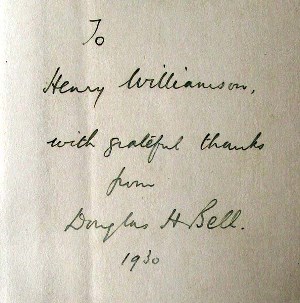
HW portrays Bell, first as a rifleman and then as lance-corporal and corporal, as ‘Douglas’, in How Dear is Life and A Fox Under My Cloak (vols 4 and 5 of the Chronicle of Ancient Sunlight series), and indeed dedicates that latter volume to him.
Bell subsequently wrote seven historical books chiefly on naval subjects, including Elizabethan Seamen (Longmans, 1936) and Seamen of Britain (Thomas Nelson, 1943). The first title is in HW’s archive, together with Drake was My Captain (Frederick Warne, [1952]), a story for boys:
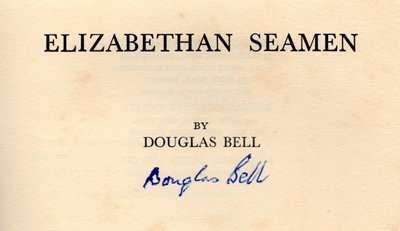
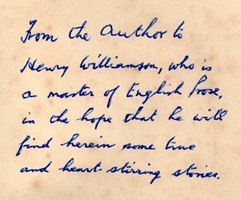

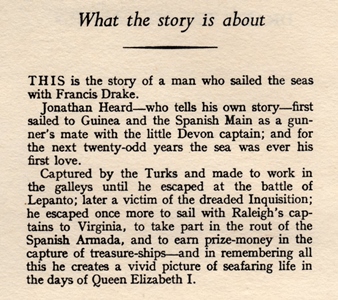
Douglas Bell died on 17 September 1964; he had been suffering from Parkinson's Disease for a number of years, and in 1960 had been seriously injured when hit by a car while out walking, an accident from which he never really recovered. HW’s diary entry for 21 September 1964 records:
Attended funeral of Douglas Bell, Old Colfeian, . . .
HW’s ‘Introduction’ to A Soldier's Diary of the Great War is reprinted in Threnos for T. E. Lawrence, and other writings, compiled and edited by John Gregory, HWS, 1994; e-book 2014.
*************************
There are just two reviews in the Literary Archive, the second only being discovered amongst other papers in late 2020; this perceptive review is particularly interesting as it is by Jack Squire, editor of the monthly literary magazine The London Mercury:
The Times, 11 April 1929:
The first notable volume describing personal adventures of the late War . . . since Mr. Blunden’s Undertones of War [but not so good]. It is however a fine and vivid narrative, bearing the signs of truth and the impress of a frank and gallant spirit. [There follows a résumé of the text.]
Mr. Henry Williamson lends the author his distinguished name to set upon his title-page; but though his introduction is in some respects a striking piece of writing, it cannot be said that it does him any other service. Evidently he feels that the stuff of the diary is not strong enough and does not sufficiently illustrate the horrors of war. In this spirit he proceeds to rewrite the Ploegsteert scene, making of its dirty peacefulness something so ghastly that it would almost serve for the Salient . . .
Mr. Williamson is entitled to his own opinions, but he seems to have chosen an unhappy occasion to voice them here, on the pages of a man who writes, after being twice wounded . . .
The Observer (J. C. Squire), 19 May 1929:

*************************
The dust wrapper of A Soldier's Diary of the Great War:


The front of the dustwrapper for the US edition:

*************************
Douglas Bell, artist: sketches and watercolours:
Douglas Herbert Bell was a keen amateur artist, and in HW’s archive there is this charming sketch, drawn in 1914 and later given to HW, of Keston Ponds:

In 2017 an album of Bell's sketches was donated to the Society by Peter Lazare, who wrote in his accompanying letter:
My connection with Douglas Bell is that we were neighbours from the time that my family moved to Crowcombe Heathfield in 1953, when I was three years old. He would have been about 60 then and struggling with Parkinson's, and so he seemed remote to me, though kindly. Later in childhood I loved making models of sailing ships (schooners and at least one clipper) and I remember DH coming to attend the launch ceremonies at our garden pond.
The sketches date from the First World War, many of them being drawn in pencil on a sketch pad during the short time he was in Scotland with the 3rd (Reserve) Battalion, Queen’s Own Cameron Highlanders, in 1915. A few, of a slightly later date, are of the area around Torquay, sketched while he was convalescing there after being wounded at Lone Tree. Bell had experienced – and shortly would again – some fierce fighting in the trenches, and surely found consolation and some peace of mind sitting in the solitude of the countryside with his sketch pad. The sketches, with some water colours, have been pasted in the album, which is reproduced here in its entirety (it measures 11 x 8½ inches). Bell's pencilled captions are given below each page.

|
|
|
Upper: 'Cromarty Firth and Invergordon from Glen Glass' DB,15 Lower: 'Foreshore, Evanton' DB,15 |
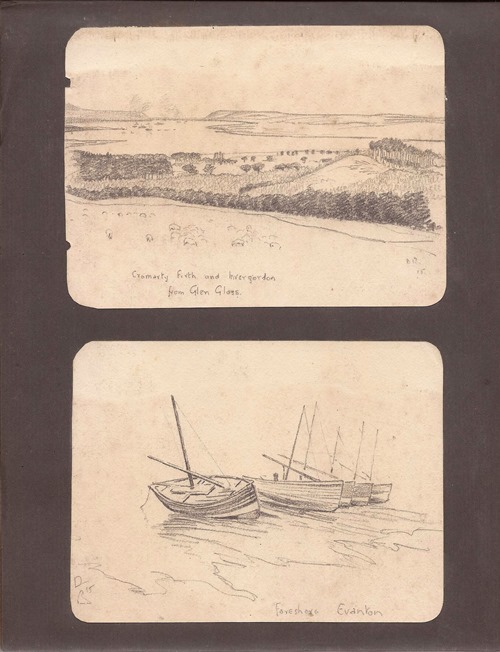
 |
|
Upper: 'Loch Glass' DB,15 Lower: 'View from Ben Wyvis Hotel, Strathpeffer' DB, '15 |
|
|
|
Upper: 'Ben Wyvis and Fyrish' DB,15 Lower: 'Glen Glass' DB,15 |
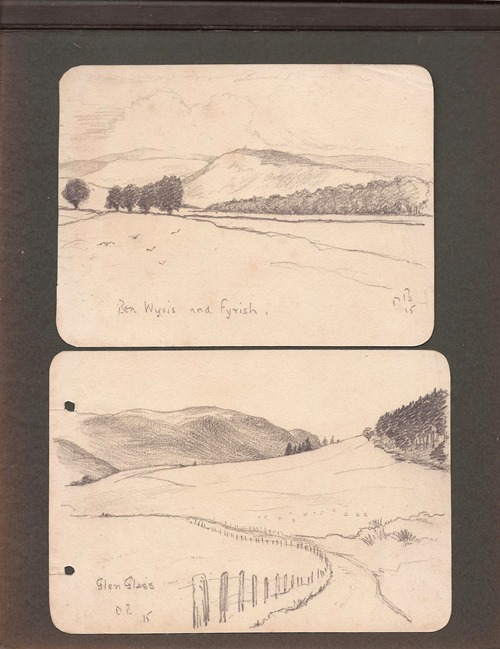
 |
|
Left: 'Black Rock Gorge, River Glass' DB,15 Right: 'Falls at Corriemony' DB,15 |
 |
|
Left: 'Black Rock Gorge, River Glass' DB,15 Right: uncaptioned DB 1915 |
 |
|
'Entrance to Cromarty Firth, The Sutors' Douglas Bell, July 1915 [The Sutors are the opposing headlands at the entrance] |
 |
|
'Cromarty Firth' Douglas Bell, 1915 [though the date looks like 1910] |
 |
| 'Cromarty Firth' DB, 191? [illegible] |
 |
| 'Milton Bridge, Ross-shire' DB, 1915 |
 |
| 'Practising in the Woods, Invergordon' DB, 15 |
 |
| 'Kildary Parish Church, Ross-shire' Douglas Bell, 1915 |
 |
| 'Invergordon' Douglas Bell, 18/7/15 |
 |
|
|
'1st London General Hospital Captain McIver, Royal Sussex 16 Nov. 1915' |
Douglas Bell delineavit Cameron Highlanders
|
 |
|
|
'Lieut. Brooks 8th Queens' |
Douglas Bell delineavit 18/11/15 1st Cameron Highlanders |
 |
| 'A Soldier of Fortune, after Meisonier' DB, 16/11/1915 |
 |
| Uncaptioned, unsigned |
 |
| 'At Dittisham, Devon' Douglas Bell, 11 Dec. 1915 |
 |
| 'Near Brixham, Devon' Douglas Bell, 11-12-15 |
 |
| 'Cliffs at Daddy Hole, Torquay' Douglas Bell, 12/12/15 |
 |
| 'Chapel Hill, Torquay' Douglas Bell, 13-12-15 |
 |
| 'Cockington Church, S. Devon' Douglas Bell, 12/12/15 |
 |
| 'From the Bishop's Walk, Torquay' Douglas Bell, 12/12/15 |
 |
| 'Cockington, S. Devon' Douglas Bell, 13-12-15 |
 |
| 'From the Bishop's Walk, Torquay' Douglas Bell, 17/12/15 |
 |
| 'Cheddar' Unsigned, undated |
 |
| 'High Street, Winchester' Douglas Bell, 1918 |
Loosely inserted in the album is this single sheet; unsigned and undated, it is presumed that the pen-and-ink drawing and the poem are by Douglas Bell:

*************************
The Linhay on the Downs
THE LINHAY ON THE DOWNS
 Being Number 12 of The Woburn Books
Published at London in 1929 by
Elkin Mathews & Marrot (Price 6s. net)

The dust jacket and cover design carry the initials ‘J.G.P. ‘28’ on the reverse; the endpapers echo the design.
This slim octavo volume has only 26 pages (of which the first two are ‘prelims’ anyway) and consists of two stories: ‘The Linhay on the Downs’ and ‘The Firing Gatherer’.
Both stories had appeared previously in literary journals: ‘Linhay’ in the Atlantic Monthly (October 1927) for which Putnam’s statement of payment shows HW received £22.16.8d for both ‘Linhay’ and ‘The Rabbit Agent’ together (so presumably about half that each) and The Fortnightly Review – Putnam’s account entry shows a payment of £7.10.9d made on 28 November 1927. ‘The Firing Gatherer’ was published in Time and Tide, for which Putnam’s statement shows payment of £2.7.3d made on 29 February 1928.


The only background information available in HW’s archive is from a letter from HW’s agent, Andrew Dakers. My surmise is that the publishers approached HW directly, and that he wrote his own instructions on it and forwarded that letter to Dakers to deal with. As you can see, HW was offered twenty-five guineas as his fee, ‘the highest they had paid to anyone’, but less than HW had asked for. I have no idea what HW’s sum scribbled at the bottom relates to.

It has proved equally difficult to find any detail to fill in the background from elsewhere, and so only the barest bones are available.
Charles Elkin Mathews (1851-1921) was an eminent publisher and bookseller. In the mid-1890s he worked in partnership with John Lane – who then went on to form the Bodley Head, and Mathews set up on his own. But as he died in November 1921 he was obviously not personally involved in the set of the eighteen Woburn Books – so presumably Marrot had taken over the firm, keeping the Mathews name. (Both Glasgow and Reading Universities Special Collections hold related material, the former on the printers, the latter on the publishers, and very kindly checked their indexes, but have no information pertaining to Woburn books.)
The printers were equally prestigious. Robert MacLehose & Co. Ltd existed from 1904 to 1982 and were prominent as the Glasgow University Press. Robert MacLehose died in 1907, but his brother James lived until 1943.
It will be noticed from the list of titles and authors on the Linhay on the Downs flyleaf that HW was in good company, and it would have been an honour to have been included in this very select little band of authors. HW had connections with several of the other authors in the set (for example, R. H. Mottram, David Garnett and Robert Graves). I note that currently (June 2013) a few full sets of The Woburn Books were being advertised on the Internet, with prices ranging from about £700 up to £1,750!
From these advertisements I gathered that the overall cover design was the same for each volume but that each title was given its own individual colour, making a very nice overall collection.

*************************
A linhay is a hut, a small barn, built out on the moors or marshes, as a place for shelter for man, animals and fodder. This story tells a simple adventure which occurs on a day’s walk, and the need to shelter from a sudden storm.
The story opens with a description of the linhay ‘half fallen into ruin’. It lies ‘on the high down above the sea, in the corner of the last rough grazing field’. The writer sets out with a companion to have a picnic at the linhay: they climb the road to Windwhistle Cross.
Windwhistle Cross was HW’s name for Ox’s Cross, and the road is the one that winds uphill from Georgeham – from Vale House where HW and his wife lived – and then west across the fields to where the linhay was perched overlooking the steep path down to the beach above Black Rock (more or less marking the boundary between Putsborough beach and Woolacombe Sands): HW’s habitual route on foot down to the beach. The two walkers are, of course, HW and his wife.
It was a cold and windy day, and the writer decides to light a fire using bits of broken board from the linhay. While eating their sandwiches they notice a rabbit rather oddly sheltering nearby. With its natural instinct it has sensed an approaching storm which outweighs its fear of humans.
The writer stands up and looks out across the sea to find ‘a grand and terrible sight’. The headland (Baggy Point) has disappeared while
a monstrous spectre had risen out of the vast sea and was moving to overthrow the land.
A waterspout has formed in a sudden storm, and soon the linhay is being battered by the violent wind and rain. Just before the full force of the storm breaks they notice a desperately thin fox struggling across the field with a rabbit gin attached to its leg. Rabbit and fox lie close to each other within the shelter of a huge stone. HW’s version of the lion and the lamb: two enemies at peace together – his constant wish throughout his life for there to be universal peace. Then the storm hits them: it goes bitterly cold and wet. It immediately takes the writer back to his time in the trenches.
In that background for me were days and nights in water and yellow clay sludge to the waist, with death above the leafless winter hedge shot stooping-high; days and nights without sleep, weeks and months without hope, without liberty . . . life more terrible than being in a gin . . . and I knew that if I sought release, and failed, or escaped from killing men I did not hate, nor had ever seen before, I would be caught and shot. . . . [and branded traitor to the total shock and shame of his mother]. Those memories of 1914, and later ones far, far worse, made a background in endurance for the human spirit that had suffered and survived them. . . .
The floor of the shippen was like the Salient in the winter of 1917, seen from a low-flying aeroplane. Hoof-holes, shapeless and trodden into one another, were filled with water to their broken edges.
Here is open, and very raw, expression of HW’s traumatic feelings and thoughts of the First World War. He had visited the battlefields for the second time in early June 1927 (the first time was on his honeymoon in May 1925). As this story was first printed in October 1927, it was almost certainly written in September – at a time when his thoughts had been stirred up and concentrated by that visit. But although it openly mentions the war this story does not end in death but in a humanitarian gesture and outcome.
The storm passes. The rabbit lollops off across the grass. The fox is in a very bad state: to approach it might be dangerous: best to kill it and put it out of its misery. But the fox is an allegoric wounded soldier, although ‘the enemy’: also, the writer thinks of his own comfortable life and baby at home. They run about to get warm, and then find a sack which they use to subdue the fox while they remove the gin from its leg and the writer uses his tie to bind up its wound.
On the next visit to the linhay they meet a trapper who tells them he had found a sprung trap with marks of a limping fox round it – and a bit of rag:
‘black stuff, with yaller stripes on ‘un. Aiy, like a wasp.’
The story ends with the perfect line: ‘I knew that regimental tie.’
The regimental tie of the Bedfordshire Regiment, in which HW had served as an officer, was black with orange stripes: their nickname was ‘The Wasps’.

The second story tells of an old woman gathering up driftwood from the beach in an old ‘ramshackle perambulator’ (an old pram): a daily task that took her as far as Black Rock, where she turned back. Her determined purpose was to keep her orphaned granddaughter warm. So protective was she of this virtual prisoner that the child waned away and died for want of fresh air and exercise.
The old grannie and her pram go rapidly downhill until inevitably she is found at Black Rock by some children, wandering and deranged. She is recovered by the village women but the old lady inevitably dies: her perambulator left to gradually sink out of sight on the sand near
where grew the flowers of the sea-rocket, beautiful and sturdy in their native sunshine.
Thus pointing up the moral of sunshine and fresh air! This story reverts to the theme of death but ends with an air of optimism. Again the form of this story is perfectly conceived: a masterpiece of its genre.
Both stories were to appear in future books: ‘Linhay’ to be incorporated into The Linhay on the Downs and Other Stories (1934), and ‘The Firing Gatherer’ in The Village Book (1930).
As Linhay first appeared in the Atlantic Monthly, it has also been reprinted in Atlantic Tales: Contributions to The Atlantic Monthly 1927-1947, compiled and edited by John Gregory with background essays by both Richard and Anne Williamson, published by the HWS, 2007; e-book, 2013. This volume contains many little nuggets of writing gold.
*************************
Wrap-around cover of The Linhay on the Downs:

The Ackymals
THE ACKYMALS
 |
|
| The Windsor Press, 1929 |
'The Ackymals' (The London Mercury, Jan. 1927)
The Windsor Press, San Francisco, Autumn* 1929 ($7.50)
Limited edition of 225 'boxed' copies (i.e. within a cardboard slip-case)
(* a letter from The Windsor Press dated 19 August 1929 states 'We expect to have the book completed within the next two months . . .' - thus making publication mid October.)
The Ackymals first appeared in The London Mercury, January 1927. This prestigious literary journal was instigated in 1919 and edited by Jack (John) Squire (he was knighted in 1933), who was so influential in awarding the Hawthornden Prize to Tarka the Otter and HW. Clearly written in 1926, The Ackymals should therefore be considered as part of the early short stories – and again it has death as a chief concern.
The story is a vignette of village life, based as much on the scenes surrounding the tragic death of a baby as on that of the central story of the shooting of ‘ackymals’ by John Kift, who wrongly, but doggedly, maintains that they eat his precious peas.
The term ‘ackymals’ (a Devonshire dialect word), also referred to here as ‘tomtits’, was explained by HW in a letter (dated February 1928) printed in The London Mercury with reference to various ‘strange’ terms used in Tarka the Otter, as meaning ‘both blue and the great titmouse’. In The Ackymals all four of the common British tits are included: great, blue, coal and marsh; and once the reader has got over the oddity of the title, it is obvious that the writer is talking about these small birds.
The entire story, as printed in The London Mercury, appears later in this page for those who have not read it before – there are some small differences in the Windsor Press edition – but this summary may be found useful. 'The Ackymals' opens by setting the scene with a short (but wholly encapsulating) description of ‘My village’ (very obviously to us, this is Georgeham in North Devon) and then ‘my’ garden and ‘my’ writing room, an ‘iron-roofed gable room’: immediately showing that this is Vale House, into which HW had moved in the late summer of 1925, rather than the original Skirr Cottage which was (and still is) thatched.
 |
| Hw, Loetitia and their first-born, Windles, outside Vale House |
Across the road from this writing room was situated ‘Foot Farm’, which was in real life ‘Hole Farm’. The farmer of Foot Farm in the story is ‘Stroyle George’ (actually Farmer Lovering) and there can be no doubt that the portrayal of the characters in this story is extremely accurate. ‘Stroyle’ is a local term for couch grass, a most pernicious weed.
A shot is heard, and hearing young Ernie (the son of HW’s neighbour at Skirr Cottage, and so still a neighbour, as living between the two residences) exclaim, the writer leans out of his window to ask Ernie what was going on, to be told: ‘Tis Janny Kift shooting th’ackymals on his pays!’ Having repeated ‘Janny’s’ violent dislike of the little birds (the repetition of phrases is Ernie’s wont), Ernie informs the writer that the funeral of the dead baby is to be held that afternoon: the writer remembers that he had heard the church bell toll just once (thus for a one-year-old) a few days before.
The writer sets off to remonstrate with John Kift, who lives with his wife beyond ‘The Stag and Tufters’ (what HW was to call ‘The Lower House’ in later books, and was actually The King’s Arms – this name being used in the earlier London Mercury version – situated on the corner of the main village street). The scene in their house is piercingly accurate: amusing, but full of pathos and bathos. Janny Kift is not to be shifted from his views: his wife is anxiously supportive of her husband. The writer asks him to bring him the next birds he kills so that they can be opened up and examined, so proving they contain no peas at all.
On leaving them the writer feels a hypocrite – as he had also killed small creatures (he specifies slugs and snails in this story, but we know that as a lad on holiday visiting his Cousin Charlie at Aspley Guise, Bedfordshire, he quite happily shot small birds, including cole tits). Returning to the street, he realises the funeral procession is approaching the church and moves to one side as they enter. He stands by the wall watching the antics of the village children, who have no cognisance of the tragedy and are getting up to normal childish mischief. The mourners emerge and go to the grave prepared for burial, and the interment proceeds. The children scatter, and grow quiet. A coach full of Welsh miners lustily singing national choruses passes by momentarily drowning out the vicar’s intoning voice: the sad interment proceeds with its platitudes of life everlasting away from the miseries of the world – words that the writer feels somewhat inappropriate for a tiny child who had known no misery.
A family of marsh-tits flitter cheerfully in the leafy branches over the grave, among them a coal-tit: the writer had been watching them for weeks as they flew around the village.
The service over, the sad mourners depart. ‘Then I heard the report of a gun.’ The village children resume their games again. John Kift appears and is amazed at the cost of the flowers by the grave. He produces two dead marsh tits for the writer to examine, still shaking his head at the wasteful cost involved in doctors’ fees and flowers, while the old women shake their heads over the tragedy of death of ‘the poor li’l mite’ who had ‘ate nearly a plateful of tinned salmon’ the night before it died. (The implication is that this is what has caused, or at least hastened, the baby’s death.)
The writer opens up the crops of the marsh tits. There is no sign of peas – only tiny black weed seeds. But John Kift is still convinced that they are the culprits: ‘They ackymals be master rogues for stealin’ pays, and I’ll shute ivry wan I zee!’
*************************
The two strands of the story deftly complement each other to show the unthinking futility of death – coming unexpectedly to annihilate both child and creature. It is a seemingly simple tale, but its hidden depths reveal a most moral purpose. It was certainly written by a master of the craft and is a story that perhaps has not had its proper attention. The truth of its message is eternal. (But one does rather wonder what readers in America made of it all.)
A page of HW's notes for 'The Ackymals':

*************************
San Francisco had become an important centre for printing during the Gold Rush of the mid-nineteenth century, and The Windsor Press were notable printers of what was called ‘the second wave’ period. It was run by James and Cecil Johnson, brothers who originated from Australia. In later years The Windsor Press were official printers for San Francisco University. It finally ceased trading in 1978, but had hit financial problems far earlier than that, as will be seen.
HW was approached by The Windsor Press through a letter signed by Cecil Johnson on 28 March 1929. The letter is wonderfully formal in its content, and after praising HW’s writing sets out the brothers’ terms:


There is no mention of this project by HW, apart from a brief note in his 1929 pocket diary (otherwise almost empty, see AW’s biography Tarka and the Last Romantic, p. 116):
Friday 31 May: Sent The Ackymals to the Windsor Press, 461 Bush St., San Francisco. 225 copies signed, 250 dollars.
Cecil Johnson wrote on 19 June 1929:

In the accounts section at the end of that 1929 pocket diary, HW has noted:
1 July: [received] U.S.A. for ‘Ackymals’ £50.0.9d
(It would seem therefore that the exchange rate at that time was about $5 to £1.)
The Windsor Press wasted no time in issuing a Prospectus for The Ackymals:


The Ackymals was published in the autumn of 1929, so typesetting, printing and binding must have proceeded post haste. It is a handsome production, with cloth-backed decorative boards and thick deckle-edged hand-made paper, the top edge being trimmed. The title page is decorated with a leaf flourish on which sits a bird holding a shield embellished with a ‘W’:

HW’s signature appears, in red or green ink, on the title page verso, an otherwise blank page:

At the back of the book (p. 24) it states:
This first edition of The Ackymals
is limited to 225 copies, each signed
by the author. Printed by James
and Cecil Johnson at the Windsor
Press, with decorations by Julian
Links.
Underneath which appears the Windsor Press oval ‘cartouche’ or colophon – then:
Copy No. --- (the number being added by HW in red or green ink)
The illustrator was hardly taxed: there is only one, of a charming cottage with thatched roof, on the first page of the story:

HW evidently then submitted a further short story, for in December 1929 a further letter from Cecil Johnson regretfully turns down 'The Zeale Brothers':

Two years later, with America in the middle of the Great Depression, The Windsor Press was in financial crisis, for on 19 December 1931 Johnson wrote:

It sounds, from this, as though another project was under way, but there is no record of what this may have been in HW's papers.
*************************
'The Ackymals' (The London Mercury, January 1927):
As cut by HW from the magazine:


*************************
There are no critical reviews for The Ackymals available: as a private and limited edition this is understandable. The story was to be incorporated into The Village Book, which was published in 1930 (as was 'The Zeale Brothers', mentioned above).
*************************
The cover is attractive, although not particularly appropriate to the content:

*************************