
The Henry Williamson Society
Uncategorised
The Dreamer of Devon
THE DREAMER OF DEVON
An Essay on HenryWilliamson
Herbert Faulkner West
 |
The Ulysses Press, London, 1932; limited edition, 250 copies.
Dedication: ‘For W. K. Stewart’
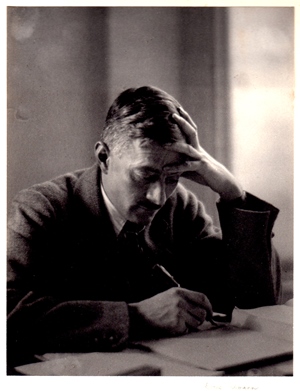
The frontispiece is a portrait of HW by Doris Ulmann:

Doris Ulmann (1882-1934) was an extremely well-known American photographer, who specialised in particular subjects: craft-makers such as Appalachian craftsmen; groups such as the Shakers and similar religious sects at work; and also writers. This photograph would have been taken while HW was in New York over the winter of 1930-31, but sadly there are no details whatsoever available. It is known that she invited writers to sit at her apartment on Park Avenue, when she would try to reveal their inner character. There are actually over a dozen poses of HW taken by her; they are of large size, mounted and signed. Here are four examples:
 |
 |
|
 |
 |
West’s monograph – about rather than by HW – arose directly out of The Gold Falcon, and would have added interesting detail about our author at that time – and indeed is still of interest to HW readers today.
HW met Professor Herbert Faulkner West (1898-1974) while on his first visit to America when he went to Dartmouth College in New Hampshire in January 1931 at the invitation of Professor W. K. Stewart (the dedicatee above, whom HW met on the boat out) to give a lecture. HW’s chosen title was ‘Hamlet and the Modern World’ (see entry for The Gold Falcon).
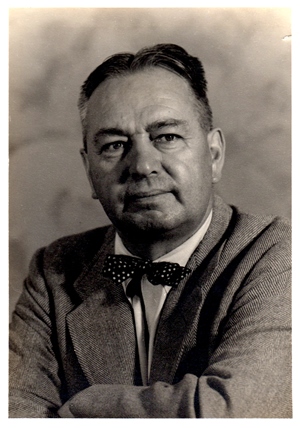 |
| Herb West in later life |
West, then Assistant Professor of Comparative Literature, was a bibliophile and, in due course, a writer of several books, of which this HW monograph was the first.
In 1932 West visited England as part of his research for a biography of Robert Cunninghame-Graham (1852-1936, a writer and adventure-traveller, politician and friend of W. H. Hudson), published as A Modern Conquistador in1932. While in England West visited HW at Shallowford and stayed for a week (7-14 March 1932), during which time he was given quite extraordinary access to HW’s manuscripts, past and current, and took notes preparatory to writing his essay. While there he also added his name to the Shallowford visitors' book:
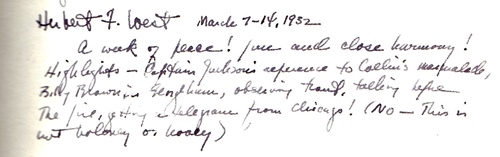
The Dreamer of Devon is a 28-page essay, written throughout in discursive style – a wander through the thoughts of its author – opens with a lyrical passage on Devon:
This situation was exactly the sort of place that I expected to find Henry Williamson living in.
We learn there is a German helmet from the war hanging next to the fireplace over which hangs HW’s Nevinson etching (‘A Group of Soldiers’) and a woodcut by Kermode (from The Patriot’s Progress).
The ghost which haunted Hamlet was a weak thin wraith compared to the ghosts which haunt Sassoon, Blunden, Tomlinson, Williamson, Graves, and others.
This is, of course, a reference to HW’s ‘Hamlet’ lecture but without explanation: so it appears as if this is an original thought by West, and not quoted from HW himself. We learn further that in HW’s study there are many books about the war, including two by HW himself (The Wet Flanders Plain and The Patriot’s Progress). West comments that post-war neuroticism is due not just to the war itself but also to the post-war situation (surely taken from HW’s own thoughts), and mentions Willie Maddison (hero of HW’s early series of Flax of Dream novels), who is Williamson.
His mind, turned too long upon itself, enjoying in its own solitude, the inner landscape of the soul, the prey to imagined fears, dreaming of some Utopia . . . soaring to a belief in an impossible and unearthly love, had woven for itself a set of ideals which clashed inevitably with the compromises the world of experience forces upon all men. So he was unhappy and indulged in a great deal of self-pity.
A better description of HW’s own inner character could not be made. West goes on to highlight two keynotes of HW’s character: ‘Imagination and Individualism’. (That would surely have to be true of all great writers!)
West describes the scene at Dartmouth College:
This delightful college town; on the banks of the Connecticut River and at the foothills of the White Mountains, was in February a world of white’ [that being the time when HW was there in 1931].
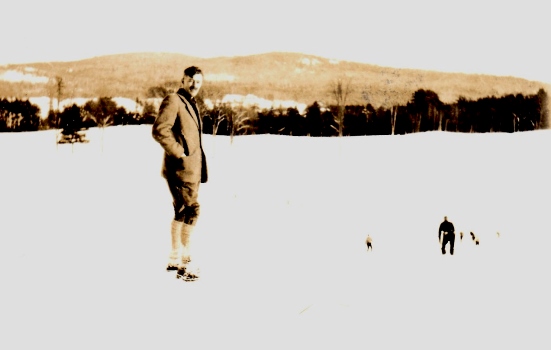 |
| Photograph captioned on the back: 'HW Dartmouth College New Hampshire USA 1931' |
He notes that HW was not much of a skier and eventually turned an ankle, as in The Gold Falcon.
During his stay he gave a lecture at the college on the war and its effects on his generation. . . . I have never heard one so well written, or as sincere and moving . . . [and he has heard many great writers]. He introduced to the audience some war literature [including] the war poems of Wilfred Owen. I hope that this address, which he also gave at Harvard and Yale University, will sometime be printed.
[See also The Gold Falcon review section where a letter is quoted from a student who attended this lecture – and was very impressed.]
At Shallowford they listen to Tristan and Isolde and Rudy Vallée records, ‘whose crooning voice Williamson liked and had heard in a New York night club the year before’. (He has quite a major role as Jack Starlight in The Gold Falcon.)
West mentions the presence of Ann Thomas, knitting by the fire and HW’s wife Gipsy also (interesting that he should put them in that order, even at this early stage in the relationship) and describes HW’s study and the books it contained.
They look at The Star-born (not yet published at that time) which HW reads ‘with all the feeling he is capable of’.
Through his descriptions of the walking and talking between the two men there emerges a lively picture of HW at this time. We also learn he is ‘planning a book to be called ‘The Water Dreamer’ about a trout’. (This became Salar the Salmon, published in 1935 – although there is a made-up blank book with that title on its cover, so it was quite a serious thought.)
A stag hunt goes by, and we hear HW’s thoughts as related in his book The Wild Red Deer of Exmoor.
Proofs of The Labouring Life arrive, and West describes HW standing correcting them, comparing galleys with page proofs, while listening and beating time to Tristan and Isolde. (What a pity there is no photograph of this event!)
He does whatever he does well, and is a master for detail and exactness, whether he is dealing with writing, correcting proofs, keeping the hearth clean, or seeing that his automobile runs perfectly.
(Exactly so!)
Otters are a thing of the past: they are now a pest that kill and eat his precious trout. (It must be understood that HW put an enormous amount of time and energy into re-establishing trout in the River Bray that ran through the meadows at Shallowford; not so much for the actual fishing, but so that he could get all the details for the proposed salmon book as exact as he had done for Tarka the Otter.)
At night: ‘The moon and the evening star appeared in solitary loveliness over Castle Hill’: which reminds HW of earlier times and he quotes from his first book The Beautiful Years.
HW shows West ‘Tarka’ country: this leads into the interest that T. E. Lawrence (Lawrence of Arabia) took in the book which led to the friendship between those two men. HW acknowledges his debt to TEL’s influence, although they see nothing of each other: ‘It is like the stars, each in its orbit.’
Then, quite extraordinarily, HW also shows West his early writing in the large folio volume which contains in great detail his intimate thoughts and ideas of the early 1920s (which I call his ‘Richard Jefferies Journal’ as it pays full tribute to Jefferies). After looking at it briefly (it was too intimate for the rather mundane West), he feels that HW as a young man was lacking in healthy sexual experience which caused the self-pity evident in Maddison/HW (a rather glib statement); but that ‘the diary revealed tremendous idealism’. (That Journal is a most poignant expression of everything HW felt and thought in those years so soon after the War, when his every nerve was raw. It also contains much early writing that shows HW’s development as a writer.)
West goes on to state that the revised Dream of Fair Women, written while in New York in 1930, showed HW’s increased maturity.
A visit to Georgeham reveals how well HW had ‘caught and preserved the true and real village’ in his two ‘Village’ books. Then they go on up the hill to HW’s Writing Hut in his field at Ox’s Cross.
In the afternoon we sought the heights above Georgeham, where Maddison wandered and indulged his love for Nature. . . .
What Edward Thomas wrote of Richard Jefferies may, I think, be applied with equal fitness and truth to Jefferies’ disciple, Henry Williamson. . . . “He drew Nature and human life as he saw it, and he saw it with an unusual eye for detail and with unusual wealth of personality behind. . . . he turns from theme to theme, and his seriousness, his utter frankness, the obvious importance of the matter to himself, give us confidence in following him; . . . it is for his way of seeing, for his composition, his glowing colours, his ideas, for the passionate music wrought out of his life, that we go to him. He is on the side of health, of beauty, of strength, of truth, of improvement in life to be wrought by increasing honesty, subtlety, tenderness, courage and foresight. . . .” Readers of Williamson’s finest work, much of which is still to come, will find for themselves this heritage of Jefferies, visible in Williamson, which is theirs as readers of the best in English literature.
(A Dreamer of Devon was reprinted in its entirety in HWSJ 31, September 1995, pp. 62-70.)
*************************
On his return to London from this Devon visit West met Edward Garnett (probably to do with his biography of Cunninghame-Graham: both Garnett and his father had helped him and Hudson – and many others including HW – as is shown by a letter to HW dated 1 April 1932, which reveals that HW is fuming because West has revealed that Jonathan Cape, the publisher, has shown Garnett a copy of the ‘anonymous manuscript’ (that is, The Gold Falcon), and HW thinks that West was involved in this ‘treachery’. West is denying treachery and explaining what he thinks happened. But we know HW was paranoid about the secrecy to be maintained about this book, which was not yet published at this point. He was afraid that Garnett would reveal all and ruin the incredible edifice he had built up.

This incident may have driven a wedge between HW and West. Certainly, when West published Modern Book Collecting for the Impecunious Amateur in 1936, HW took great exception to the remarks therein about himself.

The section on HW begins, after a sentence of praise for the nature books:
As a writer of fiction I feel he has been too introspective . . . [concludes that he is not a novelist]. It is surely true that the publication of The Gold Falcon hurt his reputation as a writer. . . .
West continues in this vein for most of the titles – damning with faint praise – but The Village Book and The Labouring Life get full praise. Mainly it is almost just a catalogue of titles. There is a further section on war books in which again HW features:
Henry Williamson’s contribution to war literature consists of two books written by himself [i.e. The Wet Flanders Plain and The Patriot’s Progress], and two books he helped others to write [i.e. Douglas Bell, A Soldier’s Diary of the Great War, and Victor Yeates, Winged Victory].
This time, extremely faint praise! HW was not amused. Little, Brown, the publisher, which by then had also published Salar the Salmon, had sent HW a blurb about Herb West, together with a letter that, innocuous enough in itself, only served to rile HW further:

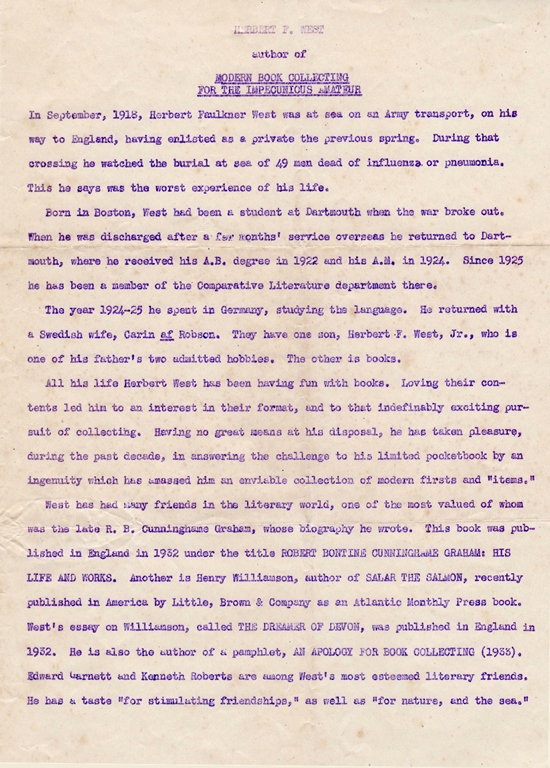
HW immediately typed a heated 2-page response to the poor Miss Bolton, shown below; which, on more considered reflection, he decided not to post (for the top copy is in the Archive); but one wonders what his actual reply was!


*************************
There is then a long gap in the letters file from this point to the 1950s, when West made a few (possibly biennial) visits to this country regarding the book trade (he had become a bookseller), and they met up again on at least one of them – although HW did not make any great effort for further contacts.
On a visit in 1961 West offered to buy HW’s manuscripts for the Dartmouth Library, for an amount that he claimed would make HW’s fortune.
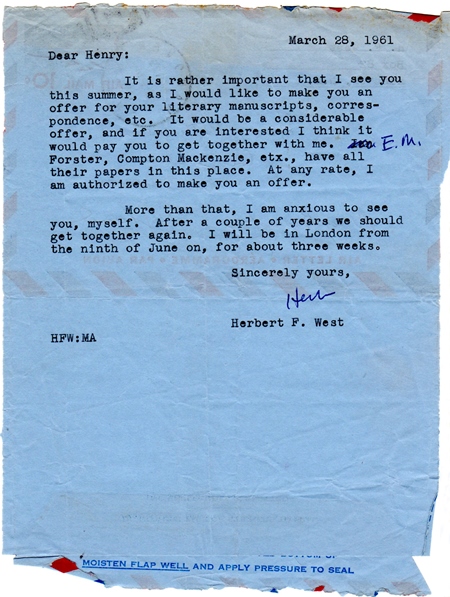
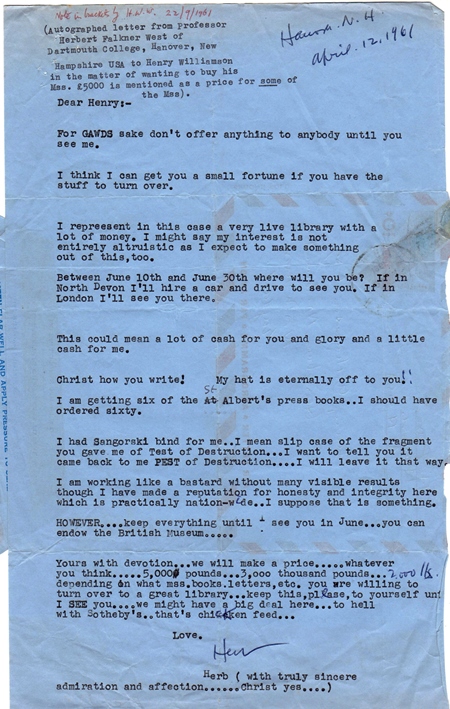
But this proposal did not get much further; indeed West seems to have retracted his first enthusiastic ideas. The end result was that HW gave West the manuscript of A Clear Water Stream (1958) to be handed over to Dartmouth. The following is HW’s version of events:
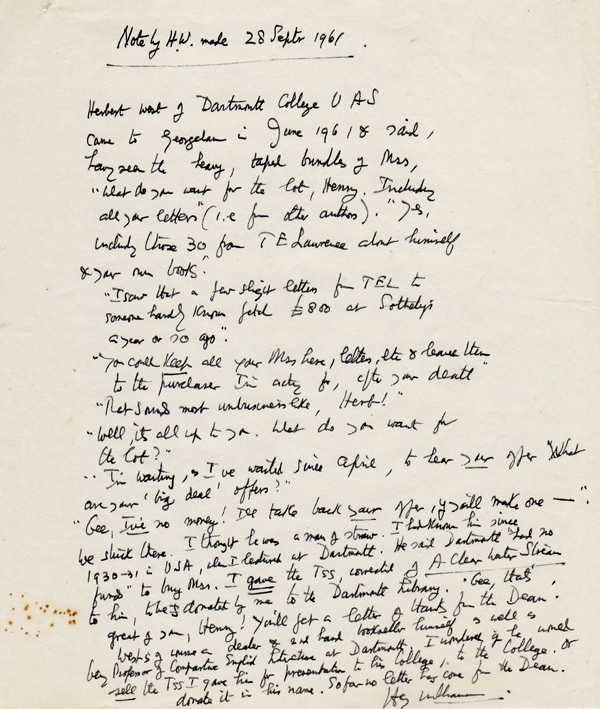
An official letter did arrive almost immediately after this outburst.
When Herbert Faulkner West died in November 1974 the Dartmouth Alumni Magazine wrote a glowing obituary: ‘a favourite teacher of thousands of Dartmouth students over his 40-year teaching career . . . a man of many talents. He was teacher, writer, critic, bookman, publisher and artist.’ HW is mentioned as among his many writer friends (as is Henry Beston, whom HW met at The Tomorrow Club in 1920 – West mentions Beston’s name in one or two letters to HW).
West’s letters to HW, written in an untidy hand, have no merit or style in themselves, but are of interest because he frequently mentions literary names.

*************************
Walker Burns relates further details about Herbert West, and points out that there is considerable material concerning these two men in the archive at Dartmouth College (see HWSJ 45, September 2009, pp. 51-4, part of Burns’s ‘Grove Street Blues: Places and People from Henry Williamson’s First Trip to North America 1930-1’).
Fergaunt the Fox
'FERGAUNT THE FOX'
(The book that never was)
An interesting and previously uncatalogued item.
At the end of January 1936 HW and Ann Thomas ‘Started for the North’ (diary entry for 29 January 1936, in AT’s handwriting), in the Alvis Silver Eagle. They first went to Swaffham (Norfolk), and then on to Norwich, where they stayed two nights. Although not mentioned, presumably they also visited the Norfolk Farm at Stiffkey and dealt with legal matters. Indeed, in Goodbye West Country the entry for 2 February notes:
Motored yesterday from Devon to Norfolk, to stay at Merton with Stephen Renshaw [who was the father of Margot, ‘Melissa’ in A Chronicle of Ancient Sunlight] and also to walk over the farm with a valuer.
HW certainly did sometimes stay with Sir Stephen Renshaw on his visits to Norfolk at this time, but here Ann actually has ‘B&B’ noted for each night! On 1 February they left for the Lake District, where they stayed until 10 February, returning down to Norwich, then on to Tenterden in Kent (Ann’s home with her sister). They drove back to Devon on 16 February.
Ann made a daily note of the expenses of the visit to the Lake District (including the Norfolk and Tenterden part). The total was £26 11s 10d. That includes the various B&Bs (of which one week’s board and lodging in Coniston, with fire and sitting room, was £5 10s), dinners, lunches, petrol (the total for whole trip comes to £3 18s 6d), stamps (two lots of 5 shillings for stamps seems odd!), cinema (4 shillings), socks (19s 6d), dance (7 shillings), shoes for AT (18 shillings), gloves (17s 9d), nurse and doctor, but not what for (10 shillings). Also noted is ‘Drinks to huntsman & whip 2s.’ Altogether this is an interesting sidelight on costs at that time.
More importantly, the purpose of the visit was to gather material for a book for which HW had signed a contract on 20 December 1935 with Faber. The contract states merely that the book is to be in the style of Tarka the Otter and Salar the Salmon; the title is not given, but this book was to be called Fergaunt the Fox. The contract also states that:
The sum of seven hundred and fifty pounds on account and in advance . . . of this one third shall be paid on January 1st 1936 [with one third on receipt of the manuscript and one third on publication].
Interestingly HW once again gave ‘into the Publisher’s keeping the manuscript of his Autobiography to be held by them as security for the first payment . . .’ This is the Sun in the Sands material that he had already left in the care of Faber as security for Salar the Salmon – which need was now redundant, for Salar had recently been published.
There is no mention of this first payment when The Sun in the Sands was eventually published in 1945. Then in 1948, when HW was negotiating the advance payment for his latest book, The Phasian Bird, Richard de la Mare reminds him that he had already received £250 for the non-existent 'Fergaunt', and so deducts that amount from the advance for The Phasian Bird.
There is, to the best of my recollection, no further mention of this book whatsoever. HW did talk about it to his son Richard, probably in the late 1950s or early 1960s, when he hoped that Richard would help with the writing of it; but that never materialised either. Apparently fox-hunting in the Lake District was different, in that it was undertaken on foot, in a similar fashion to otter hunting.
 |
|
The folded contract, with HW's identifying note written on the outside |
*************************
Miscellanea of the Early 1930s
MISCELLANEA OF THE EARLY 1930s
There are several interesting items – essays, stories and introductions – that HW produced in the early 1930s that I feel are important enough to mention separately here. Apart from anything else, they demonstrate the variety and the amount of work he was producing at this time over and above his published books.
 |
|
|
HW in New York, 1930 (photograph by Pirie Macdonald) |
The Book of Fleet Street (‘Confessions of a Fake Merchant’)
The Children’s Playhour Book (‘Timbo’s Dream’; ‘Educating the Cuckoo’)
Decent Fellows (Introduction)
Little Peter the Great (Foreword)
Daily Express (‘What I am Teaching My Children About God’)
The Compleat Angler (Introduction)
 |
|
‘Confessions of a Fake Merchant’ – HW’s essay in
The Book of Fleet Street, edited by T. Michael Pope
(Cassell & Co., November 1930, 10s 6d)
The book is dedicated to:
A. D. PETERS
In Gratitude and Affection
(A. D. Peters, the literary agent who had taken over Dakers’ Agency at this time, was of course well known to HW personally.)
There are 29 essays in this book (the cover names some of the contributors), of which HW’s is the last (pp. 280-302): the order being strictly alphabetical so as not to cause any jealousy in the ranks! The frontispiece is by C. R. W. Nevinson, depicting the scene of the busy-ness (and business) of Fleet Street, sadly reproduced only in black and white. Readers will recollect that it was about this time that HW met the artist and was presented by him with the etching of his famous First World War study ‘A Group of Soldiers’; in return HW dedicated his war volume The Wet Flanders Plain to Nevinson.

HW’s essay tells us of his early days in Fleet Street when he was first demobbed – and as such is a companion to the collection of HW’s early articles The Weekly Dispatch, edited by John Gregory, who painstakingly collected and published these in 1969; the edition was reprinted by the HWS in 1983, a new e-book edition being published as On the Road in 2013.
The first part of ‘Confessions of a Fake Merchant’ was reprinted in HWSJ 8, October 1983, pp. 5-9, the second in HWSJ 9, March 1984, pp. 7-15.
There is one single review cutting for the book in HW’s archive: a rather poignant tribute which provides for us today an interesting background.
John O’London’s Weekly (Edward Shanks), 29 November 1930:


*************************
The Children’s Playhour Book, edited by Stephen Southwold.
HW wrote at least two charming little stories for children in Southwold’s series:
No. 2 (1928) contains ‘Timbo’s Dream’ – reprinted in facsimile in HWSJ 32, September 1996, pp. 42-6
No. 4 (1930) contains ‘Educating the Cuckoo’ (not yet reprinted – but pending)
Stephen Southwold was also known as the novelist Neil Bell. Living in Cornwall, he moved to Georgeham at HW’s suggestion in 1929, just as HW moved to Shallowford (it is not clear whether that was actually into Vale House, vacated by HW) – but left precipitously on discovering that his well was contaminated by sewage seepage. He and HW were literary rather than real friends, though they kept in touch from time to time.
*************************
 |
|
| US edition, 1931 |
Decent Fellows, by John Heygate (Victor Gollancz under their ‘Mundanus Ltd.’ Imprint, November 1930; US edition published by Jonathan Cape and Harrison Smith,1931)
HW wrote an introduction for the American edition, pp. xi – xxii. This has been reprinted in Threnos for T. E. Lawrence and Other Writings, edited by John Gregory (HWS, 1994; e-book 2014).
HW’s Introduction (which appeared only in the USA edition – probably to explain the background to American readers) refers to the adverse reviews that appeared in the English press, and actually reprints that published in the Daily Express. John Gregory states that the introduction appears to have been withdrawn half-way through the edition. I suspect that HW’s comments were noted in England and their withdrawal was legally demanded!
John Heygate’s first novel caused quite a furore in England. It relates the story, fictionalised but based on reality, of his school days at Eton, the prestigious English public school, in great detail. The book is dedicated ‘TO HENRY WILLIAMSON’ and his copy is inscribed by Heygate:

John Heygate (1903-1976) had made himself known to HW soon after (and no doubt because of) the award of the Hawthornden Prize for Tarka the Otter in June 1928. The two men immediately became firm friends, which lasted throughout their lives; though not without one or two stormy periods! They both liked larking about and almost immediately got into severe trouble by pasting over the Georgeham village sign (see HWSJ 29, March 1994, pp. 44-47). Heygate’s father had been a ‘Master’ at Eton and John was heir to the baronetcy and Irish estate of his uncle, succeeding him in 1940. (For further background see Anne Williamson’s biography Henry Williamson: Tarka and the Last Romantic, and HWSJ 48, September 2012, Anne Williamson, 'Rise and Shine Again (As a Phoenix Regenerated)': Appendix B: ‘Sir John Heygate 4th Bart.’, pp.57-60.)
 |
|
HW, John Heygate and Bobby Roberts outside Vale House in Georgeham; Billy Goldsworthy's barn is on the right. HW has written on the reverse of this: 'HW; J. Heygate, & Bobby Roberts, 1928 after "pasting up" unpleasant new village sign'. |
John Heygate went on to write several novels though none were particularly successful. Of more historical interest perhaps is his book Motor Tramp (Jonathan Cape, 1935), which ostensibly tells the story of his travels and adventures in his new 4-seater touring MG sports car (the book is dedicated ‘To CG 1425’!), but develops into a paean to Hitler’s Germany. After taking delivery of the car and running it in, Heygate promptly took it to the Continent, first touring Germany – then on the brink of Nazism – Austria and Italy; and then later returning ‘To the New Germany’, Hitler now in power – and where indeed he would find work at the UFA film studios, which by then, whether Heygate knew it or not, was an instrument for Nazi propaganda. Heygate features as Piers Tofield in the Chronicle of Ancient Sunlight novels.
The dustwrapper to the 1931 US edition features Harrison Smith's design department's rather curious interpretation of Eton schoolboys; not entirely appropriate perhaps to the content of the novel!

*************************
 |
Little Peter the Great, by H. A. Manhood
(Joiner & Steele, as William Jackson (Books) Ltd, 1931; Furnival Books, No. 7, limited edition of 550 copies, 10s 6d)
Foreword by HW, written in New York City, dated 1st December 1930 (note – this was HW’s birthday)
Reprinted in Threnos for T. E. Lawrence and Other Writings, edited by John Gregory (HWS, 1994; e-book 2014)
Edward Garnett, the noted critic who had helped HW get established, informed HW in a letter dated 22 March 1928 that he had given his (HW’s) name and address to a young man whose first book Nightseed he thought was ‘a remarkable set of tales’ and, in effect, would HW give him a welcome. Manhood immediately contacted HW to say he would call on his way back from Cornwall two days later. That was the first of many self-invited visits that eventually got on HW’s nerves. However at this stage the two men became friends.
HW wrote a glowing review of Nightseed in Now and Then (Cape’s house magazine) No. 29, Autumn 1928, pp. 11-13. HW is noted as the ‘Author of Tarka the Otter (Hawthornden Prize, 1928), and The Pathway, A New Novel’. In this review HW notes that he had been shown the typescript of these stories by ‘an agent’ (his own of course) when they were first handed in, and had realised they were ‘quality’.
. . . Within the covers of Nightseed are sixteen short stories. . . . These stories are original: every page is full of achievement and signs of the highest promise. H. A. Manhood is a real writer: . . . when his wings are grown . . . he should soar around the peaks of the eagles.
This review is accompanied by a formal portrait:

The man in that photograph is almost unrecognisable as the Manhood who is shown in the only photo of him in HW’s archive – and indeed of HW’s own description as in his foreword to Little Peter the Great:
The author, a brown-faced youth with a wide smile and regular white teeth . . . always smiling or grinning . . .

On the reverse of the photograph above Manhood has written: '13½lb pike'. Below that HW has written: 'Manhood. Pheasant thief at Stiffkey 1939, "Cabton" of the story'.
Manhood wrote to HW (letter dated 17 November 1930), then on his visit to America, asking him if he would write an ‘Introduction’ – ‘not particularly about the story, but rather about me’ as he knew no-one else to ask: ‘payment can only be 5 guineas’.
HW must have sent off his piece by return, as a letter from Manhood thanking him is dated 15 December 1930. In it HW repeats the story about seeing the original typescript of Nightseed, but with greater detail; then rather drifts off on to his own early experiences (hearing the music of Delius and reading Jefferies’ The Story of My Heart); but returns to describe Manhood’s wandering and frugally frightful lifestyle first on Sedgemoor and then in Cornwall, and ends with mention of Manhood’s novel Gay Agony, which he has not yet had the chance to read. In the last paragraph he praises this young writer’s sensitivity and intuition.
In due course, on 3 March 1931, Manhood sent HW a complimentary copy of Little Peter the Great, accompanied by a letter (note his monogram) and his cheque for five guineas for the Introduction, as promised:

Little Peter the Great was a signed limited edition:

H. A. Manhood (1904-1991) appears to have had quite a forceful personality and a large sense of his own importance, and let no hindrance get in his way. He signed his letters with his initials and a great flourish. He often announced himself for a visit without forewarning, to HW’s great annoyance as time went on. He was a very keen fisherman and often sent HW fish through the post or by rail – frequently to their detriment! He is portrayed as the rather unpleasant character ‘Cabton’ in the later Chronicle of Ancient Sunlight novels.
*************************
 |
|
| HW in 1921 |
‘What I am Teaching My Children about God’
First printed as an article in the Daily Express on 30 May 1930 as part of a series; it was later incorporated into a book of the same theme and material, published by the Express. Curiously the Express chose to illustrate the newspaper article with a cropped photograph of HW taken nine years earlier outside Skirr Cottage 'in the brilliant sun of drought, 1921'. The uncropped photograph was used as the frontispiece to The Village Book, which was published in July 1930, shortly after the article appeared; so perhaps Jonathan Cape's publicity department had provided it to the newspaper, thinking it a recent photograph of the author!
Reprinted in Stumberleap, and other Devon Writings, edited by John Gregory (HWS, 2005 (out of print); e-book 2014).
The first and seventh pages of the corrected typescript:


The article prompted at least two responses from readers:

*************************
 |
|
| Trade edition, 1931 |
The Compleat Angler, by Izaak Walton (George Harrap, 1931)
Introduction by Henry Williamson; illustrated by Arthur Rackham (12 colour plates, many line illustrations)
Limited edition, 775 copies, 3 guineas
Trade edition, 15s
The essay was reprinted in The Linhay on the Downs and Other Adventures . . . (Cape, 1934).
It was further in reprinted in the e-book edition of Threnos for T. E. Lawrence and Other Writings, edited by John Gregory (HWS, 1994; e-book 2014).
Izaak Walton (1593-1683), probably the best-known piscatorial writer, was born in Stafford and went to London in 1618, apprenticed to a draper, and then to an ironmonger, eventually making himself prosperous through his own drapery business.
He lived in the Parish of St Dunstan’s and became friends with the vicar, who was none other than John Donne (later Dean of St Paul’s, who introduced to him to other influential people. Walton took over the writing of Donne’s biography, which was published in 1640, and proceeded to write other biographical books.
His unique place in English Letters is due to The Compleat Angler,a classic book on fish and fishing, first published in 1653 andwhich has since had numerous (some sources say hundreds) reprints, including this particular edition.
HW’s introduction is in his own inimical and idiosyncratic style: he is not particularly enthusiastic about the book, although he does state near the beginning that:
While there are fish in England, there will be men who dream of catching them . . . and so The Compleat Angler will continue to be a classic of fishing. [But he continues:] Much of the book is tedious and prolonged . . .
HW particularly notes the friendship between Walton and John Donne, whose poetry HW liked very much – indeed, Donne was one of his guiding lights. He also notes with dry humour the comments made by Mr Richard Franck, celebrated fly-fisher, who ‘recently’ rather slammed the book as a work of plagiary: ‘recently’ was 1656! And further, with tongue in cheek, he writes as if Walton were still alive and will learn how to write better in due course!
HW’s typescript for this essay has a well-corrected last page:

And indeed another version, which comes from the typescript of the Linhay on the Downs volume:

The cover for the trade edition, followed by the Rackham-designed endpapers:

 |
 |
Rackham's frontispiece, which is captioned: 'The quietest and fittest place for contemplation':

Critical reception:
The Financial News, 4 December 1931; possibly more interesting because of its source: it is saying, loud and large as it were, that this is a collector’s item which will be of great value in due course! (As indeed it was – books illustrated by Rackham are much sought after today.)
FOR ANGLERS
A gift volume that should appeal to lovers of classic prose and fine illustrations and to all anglers is a handsome edition of “The Compleat Angler” (Harrap, 15s. net). Arthur Rackham has supplied twelve full-page illustrations in colour and many line-drawings. There is a special introduction by Henry Williamson, author of “Tarka the Otter” who asks: “Why is the book still read?” and supplies the inevitable answer: “While there are fish in England there will be men who dream of catching them; and so ‘The Compleat angler’ will continue to be a classic of fishing. It is a jolly book, a book with which we can feel at home.” Everyone who appreciates Mr. Rackham’s art will also feel at home, for his delicate illustrations have caught the very atmosphere of Walton’s masterpiece. The original drawing of one of the plates is at present on view at Messrs. Denny’s shop in Queen Victoria-street.
Countryman, January – March 1932; under the sub-heading ‘Angling’ several books are mentioned, including:
The combination, as introduction writer, of Henry Williamson, and Arthur Rackham as illustrator, has produced a particularly pleasing edition of The Compleat Angler. . . . Mr. Williamson deals faithfully with the classic. Form and style are not ‘such as we could lose ourselves in it’. Further, ‘Mr. Walton will write a better book when he learns the art of selection, the art of compression, the art of construction’!
The reviewer obviously assumes that the reader will understand the joke.
The Fishing Gazette, 5 December 1931 (16-inch column):
There can be few books other than the Bible which have passed through so many editions as “The Comleat Angler”. .. including this edition with illustrations by Arthur Rackham. . . . This edition has an Introduction by Henry Williamson. . . . a great deal kinder, despite its fault finding, than the splenetic criticism of Walton’s contemporary, Captain Franck . . . .
Mr. Williamson finds “much of the book tedious and prolonged”. [The reviewer goes on to criticise HW’s attitude to Walton’s book – picking up on several technical points.]
If Mr. Williamson had endeavoured to discover why “The Compleat Angler” has lived for nearly three hundred years instead of devoting his energies to proving it is not all it is “cracked up” to be, he would have done better. . . .
Surely a modern reviewer need not feel superior when writing of the anglers of Walton’s day, who caught trout on a single hair and had not the advantage of a free-running reel which the modern angler considers an essential item in his angling outfit.
This edition is very nicely produced and the illustrations are extremely good. . . .
This brought forth a reply from HW thus:
The Fishing Gazette, 19 December 1931 (21-inch column); the first 6 inches are devoted to editorial comment vindicating their previous comment. Then HW’s letter:
Dear Sir, -- in your issue of December 5 you quote from my Introduction . . . in such a way that you are unfair to the Introduction as you say the Introduction is unfair to “The Compleat Angler”. . . .
He then goes on (and on) justifying what he had written in the Introduction with extensive quotation. Quite a little storm in a teacup!
Birmingham Post, 4 December 1931; a long article headed ‘The Art of the Modern Illustrator’, which includes this new edition:
Mr. Arthur Rackham has graced with his cool and lovely sense of colour “The Compleat Angler” (Harrap, 15s.). His pictures are indeed studies of “the contemplative man’s recreation”, as it was in the golden age . . . The text is from Richard le Gallienne’s edition of the author’s last revision, with a polite and piscatorial introduction by Henry Williamson, who says what we all think, even those who have never fished in their lives, that it is a “jolly book”, which is even jollier for Mr. Rackham’s bland and courteous art.
Connoisseur (Stanford Rayner), December 1931; again a composite article, headed ‘The Christmas Bookshelf’. It includes Dicken’s Pickwick Papers, Hudson’s Far Away and Long Ago, and Siegfried Sassoon’s Memoirs of an Infantry Man.
Another instance [of pleasant harmony between artist and author] of this is afforded by Harrap’s recently issued edition of The Compleat Angler whose whimsically serious vein accords admirably with the peculiar genre of Arthur Rackham . . . . It is an edition which will appeal to all lovers of that old angler Izaak Walton; and Mr. Henry Williamson’s preface, sweeping aside the veil of veneration and treating the text purely on its merits, renders it the more valuable.
Evening Transcript, Boston, Mass. (E.F.E.),5 December 1931:
Edition after edition of “The Compleat Angler” have followed its first publication in 1654 [sic] and it now comes from the press again with its distinguishing feature a group of exquisite illustrations in color by Arthur Rackham. The introduction is by Henry Williamson [and the reviewer quotes several phrases from this, continuing:] “the apologia of each of the three ambulating gentlemen – Fisherman, Falconer, and Hunter – is quaint and stuffed with all the ‘facts’ and information which the author could assemble from his various sources. Much of the book is what today would be called hackwork” [and there is a great deal of plagiarism in Walton’s text].
Perhaps the most eloquent tribute to Izaak Walton is the permanence given by the archaic spelling of his Christian name and of the adjective that forms a part of the title of his book.
*************************
It is perhaps also appropriate here to remind readers that it was at this time too that HW produced much revised editions of his early Flax of Dream series of novels:
The Beautiful Years: new edition, Faber, 1929, and a limited edition of 200 copies; Dutton, USA.
Dandelion Days: new edition, Faber, February 1930, and a limited edition of 200 copies; Dutton, USA
The Dream of Fair Women: new edition, Faber, June 1931, and a limited edition of 200 copies; Dutton USA (this was revised while HW was living in New York during autumn 1930, or rather: ‘H.W., Manhattan Island, Fall 1930.’)
The Pathway, which first appeared in 1928 was not given a major revision, although the Dutton 1929 edition had minor corrections. However, the limited edition, published uniform with the other three limited editions in 1931, included a new and illuminating 7-page Preface. The Preface has been reprinted in Threnos for T. E. Lawrence and Other Writings, edited by John Gregory (HWS, 1994; e-book 2014).
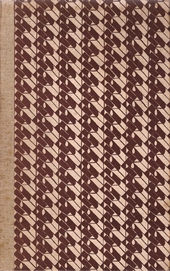
A Bibliography . . . of the works of Henry Williamson
A BIBLIOGRAPHY AND A CRITICAL SURVEY OF THE WORKS OF HENRY WILLIAMSON
By I. Waveney Girvan
Together with authentic bibliographical annotations
By ANOTHER HAND
 |
Waveney Girvan and The West Country Writers Association
The Alcuin Press, Chipping Campden, Gloucestershire, 1931
Limited edition, 420 copies, 10s 6d
(‘Another Hand’ was of course HW himself.)
The Henry Williamson Literary Estate's archive copy bears these two interesting inscriptions;

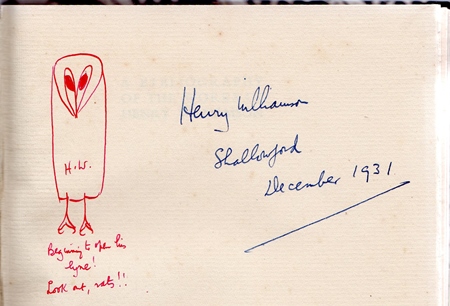
Another copy in the Literary Archive bears the inscription:
To Mother from Harry, Christmas 1931.
Perhaps you will be able, by the style & general benevolence, to decide what paragraphs are by "another hand", & who that "hand" is. HW.
*************************
The son of a military doctor, Ian Waveney Girvan was born in 1908, and spent some of his early life in the West Country where his father was stationed. He trained as an accountant but did not find this congenial and, apparently with some private means, wanted to be involved in the book world. His letters indicate that he was not a very happy man.
Waveney Girvan first wrote to HW in March 1930 on the headed notepaper of ‘The Liverpool First Edition Club’ (of which he was Honorary Treasurer), noting that he had a collection of all HW’s first editions and showing great appreciation for his work with interesting comments.
Girvan then wrote an article about HW’s books for the Bookman, and HW must have encouraged him to turn this into an actual book. On 16 June 1930 a letter records:
Thank you for your pc. I started on the bibliography on Saturday night and continued last night. It is not a job to take on lightly – every comma has its importance and there seem to be so many schools of thought in this science. . . . On Saturday I managed to finish The Beautiful Years to my satisfaction.
On HW’s return from America in spring of 1931 he wrote to say that the bibliography was finished.
The critical foreword gave me great trouble and naturally I am still not satisfied. However, it is in shape and I can do no better.
He also states that he is planning to call at the Alcuin Press at Chipping Campden as ‘Mr. Fairclough’ is a friend and seems anxious to print the book. He made a visit to HW at the end of April 1931, when HW’s additions to the book were no doubt made: and a photograph taken to mark the occasion.
 |
| HW, Windles, and Waveney Girvan, with a celebratory beer |
(In October 1964, after Waveney Girvan's death, HW wrote to the West Country Writers Association, of which Girvan was a founder and chairman, with a tribute, from which this is an extract:
I met Waveney Girvan in the valley of the Bray in the early thirties. He had proposed a visit to us at Shallowford, a thatched house beside that river, to ask me if he might publish a bibliography of my writings. I have a photograph of him sitting beside my son on a timber waggon in the shallows of another river, the Barle, by Dulverton. We had gone there to buy fish from the trout farm to put into my beat on the Bray. We are hatless, and sitting with my eldest son, then a small boy. The water ripples in the May sunshine, around the great wheels of the timber waggon. We are holding up pint pots of beer, toasting the photographer . . .)
A letter dated 1 July 1931 states that the work has been sent off to the press, but there is no further mention of it. It would have been published probably in November 1931; notice of its forthcoming appearance had already appeared in the Liverpool Post and Mercury's gossip column on 17 October 1931, their information, of course, courtesy of Waveney Girvan:

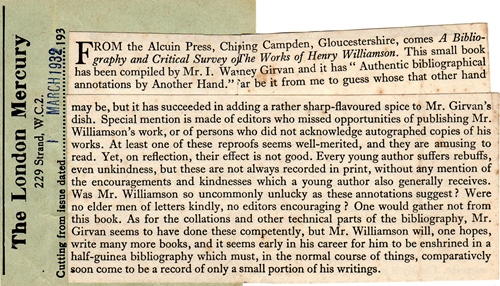
It is a charming if somewhat idiosyncratic work, appearing at what was still a very early stage of the author’s career; but very useful for checking the details of HW’s books written before this time, particularly noting the various revised new editions. Note that Girvan writes that HW was born in 1897 – which error HW had plenty of opportunity to correct; evidently he was not so minded! The critical introduction contains some interesting comments, and HW does not appear to have interfered with it. HW’s own comments seem to be limited to sharp remarks within the book descriptions, which are amusing to read now – but no doubt annoyed those on the receiving end at the time – including the reviewer from The London Mercury as the review below shows!
*************************
The London Mercury, 1 March 1932:
Liverpool Post and Mercury, 2 December 1931; from a long column headed ‘On the Table’, by ‘The Book Taster:

This is the paragraph about Mr Caradoc Evans referred to above:

Interestingly, in 2016 Clearwater Books, specialist dealer in the published works of Henry Williamson, came across the copy of The Lone Swallows that HW had inscribed for Evans, and has supplied us with a photograph of the inscription:

The last word appears to be 'Starving' – relating to the owl perhaps; or maybe as in 'starving' for a review!
We will meet Waveney Girvan again in due course, as after the Second World War he became the central figure of the West Country Writers Association.
************************
The book was bound in cloth-backed boards; the publishers thoughtfully provided a replacement label for the spine, tipped in on the last page:

*************************
Go to Waveney Girvan and the West Country Writers Association
Henry Williamson and the 'Gammons of Ham'
Henry Williamson and the ‘Gammons of Ham’
Alan Willey
This is an attempt to identify many of Williamson’s characters in The Village Book (1930) and The Labouring Life (1932).
It is common knowledge that Williamson attempted to conceal the real names of some of his Georgeham characters behind pseudonyms. The fact that that he was (either accidentally or ‘on purpose’!) not entirely successful in this aroused some hard feelings against him in the district after the publication of The Village Book.
I am mainly concerned with the ‘Gammons’, amongst whom are my forebears.
As was, no doubt, the situation in reality, Williamson’s ‘Ham’ is populated with a large number of ‘Gammons’. How many of his ‘Gammons’ were named Gammon in real life cannot easily be determined at this late stage.
One stroke of good fortune, however, makes it easy to identify accurately at least one strand of the Gammon family. Williamson had a close relationship with his next door neighbours, without whom his life in Georgeham would have been quite unrewarding, and possibly very brief.
(This is no place to undertake an examination of the psychological state of Williamson upon his discharge from the army at the end of the First World War. We know that he was, unsurprisingly, very disturbed by all that he had seen and experienced in the front line, and the recounting and transformation of these experiences form a large part of his opus. When he arrived in Georgeham after that war, his mind was in turmoil, as he – like thousands of others – tried to make some sense out of the ‘human condition’. Life in a sophisticated ‘big city’ milieu, where people with similar intellect to his own would endlessly discuss the problems of politics, war and the post-war reconstruction of society, would surely have exacerbated the anguish of his mental state. Georgeham life was far from this, and the (literally) ‘down to earth’ (and more often than not ‘hand to mouth’) existence of its inhabitants kept Williamson’s feet firmly planted on terra firma, as, like his neighbours, he had to earn a living in fairly basic surroundings.)
One may assume that since Williamson and his next door neighbours were almost in a ‘family’ relationship, he decided in their case at least to change the name Gammon to Carter in his books. Williamson must have made this change out of common courtesy, for no-one reading the books and knowing the village, could doubt for one second to which family he was referring.
Let us start by examining these ‘Carter’ Gammons, then, and return to other ‘Gammon’ characters later.
Abbreviations used – VB The Village Book; LL The Labouring Life.
‘Granfer Jimmy Carter’ is the patriarch of this strand of the family, James or Jim Gammon. He is first mentioned on VB p. 108 and appears from time to time in both books. Perhaps the most telling reference to him is LL p. 486, where, after being diagnosed with a serious rupture, he is told that he has no more than twelve hours to live. He ignores that advice and lives on for two more years.
‘Grannie Carter’ is Jim’s wife Emily Gammon (née Selway), who is frequently mentioned. On VB p. 218 she is mentioned as ‘laying out a corpse’.
‘Revvy Carter’ is, of course, Bill Gammon, the son of Jim Gammon. He is almost the leading character in the books – apart from the narrator. The descriptions of him are entirely sympathetic, and one almost detects a touch of envy in Williamson’s attitude towards his neighbour and (probably) best friend in Georgeham. ‘Revvy’ is courteous and can remember songs (VB p. 225) and obviously has a very soft spot for Williamson’s spaniel, Biell. In my opinion, ‘Revvy’ deserves posterity’s praise for giving his own brand of friendship to Williamson when the latter was at his lowest ebb and most in need of it.
‘Mrs Revvy Carter’ is Bill Gammon’s wife, Elsie Gammon. She remains rather in the background, keeping house and raising three children of her own plus a nephew.
Ernie, Madge and Megan ‘Carter’ are Bill and Elsie Gammon’s three children, who appear in the books in the order of their birth. Ernie is clearly a bit of a ‘tike’ and Williamson’s favourite. Williamson faithfully transcribes Ernie’s colourful language and descriptions with more than usual affection. Madge has whooping cough on VB p. 268. Ernie features on VB pp. 273-275. He has fun with a go-kart on LL p. 157. Some of his sayings are collected on LL p. 160. His need for special cow’s milk when he was a baby lends poignancy to the death of that cow on LL p. 417.
‘Babe Vivian Carter’ first appears on VB p. 280. In fact he is, of course, Vivian Gammon, cousin of Ernie, Madge and Megan, and the son of Freda Gammon, one of Bill Gammon’s sisters. Being a sole parent, she often left Vivian with her Georgeham relations, which must have been quite a responsibility for ‘Grannie’ and Elsie Gammon. He was often ‘difficult’ to manage. VB pp. 281, 282-286. LL p. 158.
‘Thunderbolt (William) Carter’ (with several other nicknames) is Bill Gammon’s (‘Revvy’s’) cousin (LL p. 24), who lived next door. He is a ‘9-acre farmer’ with distinguishing club feet (VB p. 67). His wife came from London, and sister Bessie lived with them and managed the dairy. He was very deaf, and reputed to be wealthy – hence ‘Vanderbilt’, hence ‘Thunderbolt’! On VB p. 299 he slaughters a pig.
To complete these ‘Carter’ households, mention must be made of the American visitor, ‘Clark’. He appears briefly from LL p. 166 onwards, in a Woolworth’s cowboy outfit, and fascinates the other children with his Americanisms. He is in fact Clarke Dawson, the son of Beenham and Gertrude Dawson (née Gammon) another of Bill Gammon’s sisters, who married that well-to-do tailor in Great Falls, Montana (not New York as ‘Clark’ says!).
(N.B. Late in her life Freda Gammon travelled to the USA on one of the ‘Queens’ to visit her sister. Upon her return I recall her saying that she found the pace of life there quite overpowering, especially constantly changing clothes, five or six times a day, and taking a whole wardrobe on a skiing weekend! On disembarking at Southampton, she fell and injured her leg, for which she was awarded hefty insurance damages. More recently Peggy Dawson, Clarke’s daughter, came to England for a course at Oxford, and stayed with Madge (I think) for a while.)
Other ‘Gammons’ in Williamson’s books – whether ‘real’ or ‘fictitious’:
Now we turn to other ‘Gammons’ mentioned in the books. It would be interesting to learn whether these are the real names of real persons or not.
Willy Gammon (VB p. 42) is the son of John Gammon. He is a mason (like his father?) and has many (14) children. The family nickname is ‘Brownie’, and they are described on VB pp. 71, 106, 269. On LL p. 427 he is said to have but one eye. (Technically, he is the third ‘William Gammon’ mentioned in the books, the other two being ‘Revvy’ and ‘Thunderbolt’.)
Harry Gammon is one of Willy Gammon’s sons. He served in the army in China (VB p. 81) and married a Maltese woman called Emma, who would call out ‘Hen-ry!’ to her son in a particular way (LL p. 172). Emma was not accepted in the village, had a complete mental breakdown and died unhappily in the infirmary (LL p. 485).
Others among Willy Gammon’s children are a girl Marty, who at 15 was ‘one for the men’ (VB p. 130), Tikey (aged 7), Daisy (5) and Boykins (3).
Tom Gammon is Willy’s brother and also a mason, although not a very industrious one! (VB pp. 49, 65, 66). He seems more famous for his rabbits and ferrets (VB p. 105) and for his lurcher dogs (LL p. 71).An Ernest Gammon, brother of Willy, is also mentioned (LL p. 425).
Albert Gammon is the landlord of the ‘Higher House’ (VB 99) and a key character in the life of Ham. His real name was Albert Jeffery.
A few other ‘names’ worthy of mention:
‘Arty Brooking’ matches the grocer and butcher Arty Thomas, of whom I have heard tell (VB p. 67). Williamson’s friendship with him goes back as far as May 1914 (LL p. 457). His sausages suffer from too much bread and pepper (LL p. 168). He is an expert on, and apologist for, cider (LL p. 318). Williamson’s motorcycle trip to Sedgemoor with Arty (who was brought up there) (LL pp. 479-81) is one of the most hilarious accounts in his writings.
(N.B. I can recall my father telling a story – possible apocryphal – which makes mention of Arty Thomas. It tells of Granny Gammon (Jim’s widow) stating that she would not be buying any lamb from Arty during a certain week, because she had noticed the sudden absence of an old sheep from his field across the way, and reckoned that he would therefore be selling tough old mutton.)
Two men of similar name – but different habits and occupations – are perhaps worthy of mention:
Farmer Counebere, aged 80, tells a story against himself (LL p. 51).
Coneybeare, on the other hand, (LL p. 192) is the Rector’s gardener-butler-chauffeur, whose bouts of drunkenness lead to his frequent dismissals. After a period of remorse, he is usually re-instated! His real name was Cecil Bacon.
A brief biographical note about Alan Willey:
My maternal grandmother was Alice Maude Vernon (née Gammon) of Georgeham, sister of Bill (‘Revvy’) Gammon, (‘Carter’ in HW's books). I was brought up in Exeter, however, and visited Georgeham and Mortehoe frequently in my youth.
My last visit there was 1995. I am now 82 and live in Melbourne, Australia. A few years back, for my own interest, I attempted to identify and reconcile the Gammons and Carters in The Village Book and The Labouring Life. I was always, and still am, a devotee of Henry Williamson, and have many of his books and the magnificent biography, of course.
I attended the Melbourne premiere of Harry's ‘Tarka Symphony’, bought the DVD and had the pleasure of meeting him briefly.