
The Henry Williamson Society
Uncategorised
The Vanishing Hedgerows
THE VANISHING HEDGEROWS
with Henry Williamson
 |
|
|
Videocassette cover HWS, 1997 |
Appendix: archive material concerning the film
Written and narrated by Henry Williamson
Produced by David Cobham
Shown on Sunday, 20 August 1972
Length: 50 minutes
VHS videocassette. HWS, 1997, under licence from the BBC
In May 1969 HW received following letter:

('The Green Desert' had been published during the month before this letter was written, in the Daily Telegraph Magazine for 18 April 1969; it was reprinted in HWS Journal No. 10, October 1984. The saga of the film treatment that Cobham remembered being mentioned in The Story of a Norfolk Farm is comprehensively detailed in the web page 'Immortal Corn'.)
A further letter arrived at the beginning of December: the project now has a title, 'THE VANISHING HEDGEROWS', and David Cobham reports that the BBC are enthusiastic and have authorised him to offer HW a Treatment fee of 250 guineas and suggesting they meet to discuss this further.
On 12 January 1970 HW noted in his diary that he has been contacted by the film producer David Cobham to write a treatment for film The Vanishing Hedgerows for 250 guineas commissioned by the BBC. David Cobham (1930–2018) was a UK film producer and director, mainly of programmes involving animals for children. He is best known perhaps for his film about Donald Campbell's land speed record attempt at Utah in 1960, and for the full-length Rank film of Tarka the Otter, 1979.
At this point in his personal life HW is in emotional turmoil over Anna Cash, as this friendship has now come to an end.
23 January 1970 (in London): Met film producer David Cobham . . . accepted £250 for treatment for The Vanishing Hedgerows, plus expenses to write it in London at the Nat. Lib. Club [National Liberal Club].
16 February (in London): Called at David Cobham's Studio in Oxford Street & took away large foolscap envelope with heavy data re Pollution, Conservation, etc, for the film treatment of “The Vanished Hedges”.
I was appalled; Haig and Hedgerow – frantic, fearful, morbid.
I simply can't work for such Officialese Data / Govt. Department Prose.
Start my 'Treatment' today.
Expenses to be paid by BBC: Bed & Breakfast £2/5/-
Lunch & dinner £2/-/-
(The reference to 'Haig' is to an 'Introduction' he had been asked to write for a commemorative volume on Field Marshal Haig: for which again he had been given masses of 'official' information: see 'Reflections on the Death of a Field Marshal'.)
HW ensconced himself at his club and got on with the work.
20 February: A letter from DC's secretary states that a cheque for £125 sent – the remainder to be paid when the BBC have accepted the Treatment.
25 February: Took Film Treatment (Pollution, Spraying etc) to David Cobham . . . Wrong, most of it. It is intended to cover Britain ONLY: & not the world. I said I'd recast it to his requirement if he sent old script to Devon.
27 February: Working on the 'Treatment' for The Vanishing Hedgerows. I find it difficult. I am Henry Williamson and used to writing in response to what H.W. sees / feels / knows. . . . Yet I promised to do it. I like David Cobham (who is 1st Class) so I'll do my best. [Notes that if he fails he won't accept any payment.]
On his return to Devon he found a letter from David Cobham enclosing his original typescript of 'Hedges' with comments.
6 March: Tried to do new version of Hedges. Felt awful. This isn't my style of writing. Hatched out something. David Cobham's letter most kind & constructive.
7 March: Wrote desperately, a revised Treatment.
11 March: Continuing revised expanded Hedgerows.
The following day he notes that he'll soon be finished and will then be free to begin the work on the Haig 'Introduction' (he used the word 'portrait'). However he received a letter from Dawyck Haig (son of the Field Marshal) to say they had now arranged for someone else to do the Introduction. HW then finished the work on the 'Hedgerows' treatment and took it down to Liz Cummings in Cornwall to be typed.
A whole year then passes before the next mention of the proposed film in his diary; but see the Appendix which gives further details about all the preparatory work on the film.
2 March 1971 (HW in London and dealing with his last book, The Scandaroon, and seeing his Agent): 4 pm called at Falconberg House, in a sort of slum by Charing X Road & saw David Cobham. He gave me a shooting script of the Vanishing Hedgerows and a cheque for £75. I am to film end of March at Old Hall. Told me the farmer was now a Mr. Pearson – son of that old crook (now dead) . . .
The following day his Agents (A. M. Heath) explained his fee for Vanishing Hedgerows: HW had had £250 and expenses for the script and further smaller sums for revision work (hence the £75 above), and would receive £800 for filming and a further sum for his '4th Revision'. On 20 March he travelled on to his son Robert's in Essex, who drove him up to Walsingham in Norfolk, where the camera crew had their base at the Black Lion hotel. HW was not looking forward to the filming – nor to returning to the Norfolk Farm.
22 March: The Vanishing Hedgerows started being filmed this morning. I don't appear until tomorrow. Very cold wind. Immense steel bulldozer pushing over 50 years of thorns and one large holly. This tree’s fall was tragic – leaves glistening, the sap going up, the tree straight and optimistic: & the steel mouth pushing it over, while it moved upright, again and again, the wounds on its trunk – big scrapings of bark – continued. It was sad to see it, while cameras focus'd, & the bulldozer tried again & again to rip up all roots - & then it was on its side, and a startled rabbit looking up from the clot of roots. . . . tomorrow we go to Old Hall Farm Stiffkey – much against my feelings.
23 March: We left . . . for Stiffkey. The road I made to the Corn Barn [in late 1930s] was still there, tho' covered with mud . . . I met my old 'cowman' youth of 15 or so, of 1945–6 – Douglas Jordan, now a mature man & such a good one. He 'made my day'.
But HW was cold and weary: '& couldn't repeat my lines while being filmed.'
The next day he was driven to Norwich and then train back to Colchester, and later continued his way home via London to Devon. David Cobham wrote on 5 April:
I have seen the rushes, some are very good, particularly the scene with Douglas [Jordan], others could be improved and I have an idea how we can do this.
He asks if HW could return to Norfolk for 12/13 June for further filming, and that he would like to film at Ox's Cross for one day on 19 June. He also wanted to know what car HW had had when he first went to farm – to see if he could find a similar one to use as a 'flashback'. HW has written alongside this:
Silver Eagle ALVIS DR 6084: appeared in mint condition Sheffield in a Motorsport article 4-5 years ago.
So on 11 June he repeated the journey via Robert in Essex, arriving at Walsingham for 'dinner with David Cobham & his myrmidons' [i.e. the camera crew].
12 June: To Old Hall Farm. Shot scene at river bridge, & the ruinous Sluice Gate I put in, new, with concrete etc in 1945. Swallows. Dull day. Much waiting to photograph an unseen (by me) partridge sitting tight on nearly-hatched eggs in a thistle clump (3 ft high) on Spong Common. I couldn't see it. I saw the cock bird on Spong Breck, watching . . . [In describing this for the film HW said 'nettles' instead of 'thistles' more than once, to his chagrin, but DC said it could be sorted later.]
Before this they were at the bridge, below Camping Hill, photographing swallows. . . . In 1946 I put in a new 'hatch' to lead in water from river to the grupps between meadows – dykes – & it is now smashed. Never used! Robert W. spoke some words as he peered by the hatch: & I approached on the river bank. It took 2–3 hours. David most patient: I cold & exhausted.
HW returned to London on 14 June, dealing with the current emotional complication, and then continuing on to Devon on 19 June where on arrival at the Field at lunch-time he found David Cobham and the film crew already there.
Filming was easy, tho' prolonged. Ended 5 pm & said goodbye to the 4 cars. Rather sad.
The next day he noted he was tired: 'My age has caught up on me.'
 |
|
HW and David Cobham in the Writing Hut (cameraman in the background) |
DC wrote again 19 October with notes for further filming:

So on 3 November HW went by train up to Norwich. Richard and I and our two young children were spending the school autumn half-term visiting the two grannies, who both lived in nearby Bungay. Richard was already in North Norfolk visiting a friend. It had been arranged therefore that I would meet HW, and so (with considerable trepidation!) in our 1948 vintage TA14 Alvis Coupe I collected him and drove him up to North Norfolk to rendezvous first with Richard and then on to meet David Cobham for dinner at Walsingham. We then returned to Bungay.
The next day HW filmed at Old Hall Farm:
. . . horses, the granary 'home' of 1937 winter, & also on the Hall Hills, then at edge Spong Breck which looked beautiful with autumn foliage afar & the faint beyond sea. I was distressed by fear of forgetting my lines. Many 'takes' were made.
'Lump' Jordan was his good self. Also I saw his poor uncle [Norman Jordan], my man 1937–45, who is ill. He was much affected, I held his hand, felt love for him.
That night HW and DC discussed the proposed Tarka film. Filming continued the next morning:
6 November: hedges being bulldozed up, using corners of the big 'shovel' or propelled 'scoop' – like one half of a razor shell – some 10 miles from Norwich. I was driven there in the car loaded with equipment, & round and about narrow lanes – to my dread, going far too fast.
(I am glad to note that there are no adverse comments about my own driving two days previously!)
Filming over, again with difficulties over HW remembering his lines, HW was taken to Norwich railway station to catch the London train. There is of course no hint of any of these problems in the finished film. As always, HW comes over as a highly sympathetic, powerful, and charismatic figure.
Stopping off at Robert's, he started to worry about the commitment of the proposed Tarka film. Indeed this did in due course become a big problem. HW's script for it became a hugely unwieldy affair, bringing in everything he had ever written. It could not be filmed and had to be abandoned. David Cobham wanted a straightforward film of the book.
In the new year there was further work on the film for the 'voice-over’. HW again travelled to London, in low spirits over problems with yet another young lady.
26 January 1972: Met DC at 12.30 with my revised Voice Over script which ends Hedgerows BBC TV film.
At lunch (very expensive but poor according to HW's diary: he had a virtually uneatable halibut steak, mostly bone and little fish, for which they 'had the nerve to price this rubbish at £1.25'), he 'declaimed the treatment' of the otter film – the opening scene was already well beyond the actual story of Tarka. He noticed Cobham seemed a little taken aback.
The next morning he took the Hedgerows script to Cobham's Studio in Falconberg Mews and proceeded to the Blind Talking Library to record the essay he had written for the Duke of Edinburgh's 70th Birthday (see the entry for The Twelfth Man): 'It took about 20 minutes, & was a success, I was told.'
On 9 March HW left home at '6.58 am' (HW always gives these very precise times) to catch a train from Taunton for London where he was to be at Cobham's Studio at 3 p.m. for recording for Hedgerows. Lunching at his Club he then fell asleep and was awakened at 5 p.m. with a telephone message:
the studio had waited since 3 pm for me. I hurried thither, made my apologies,& recorded the few words.
(It was actually more than 'a few words': the voice-over script is twelve pages long.)
On 13 June HW again went to London to meet Cobham for a showing of The Vanishing Hedgerows.
It was in colour and magnificent. I gave it full marks; despite HW on film – slowed-down voice, and white unruly hair – I didn't like to see these marks of Old Age . . .
I congratulated D.C. on a first class performance.
HW then went on to the offices of Macdonald, where he was shown a jacket for The Scandaroon: 'I liked it, & was very pleased.'
He returned to Devon on 16 June – giving a talk at the 'Lobster Pot' in Instow that evening! He noted:
I must return to London on Monday 19 June . . . to go to Norwich for the night with Robert Lacey who is to write 1000 words on H.W. for Radio Times, plus colour photographs . . . The Old Hall Farm at Stiffkey is up for sale.
And so three days later, on Monday, 19 June, HW travelled back up to London, again from Taunton railway station, and was met at the National Liberal club by a Radio Times photographer, who drove him on to Norwich. The next day they went on to Stiffkey, calling on 'Holly and Mossy' (the Hollingsworths, friends of HW from his Norfolk Farm days), then on to Old Hall Farm 'and many photographs'. He saw both 'Lump' Jordan and Pearson. Then at 4 p.m. on to Wells and Fakenham and the train back to London; and the next day back to Devon.
On 10 August, driven by Robert who had been staying at HW's Field doing some work there, it was back to London again to attend a 'Preview' showing of the film.
3 pm at DC's Falconberg Court Studio . . . to see Margie and Ben, & bearded Rikky with Anne & 'Brent' and his little sister. Also D. Cobham & Gipsy – and there we all were!
They liked Hedgerows: I'd seen it all before.
Afterwards we all went back to his daughter Margaret's house in Barnes for tea and the men went off to a pub for a drink. The family then dispersed and HW returned to Devon the following day.
The Vanishing Hedgerows was broadcast on BBC 2 the evening of 20 August 1972. HW invited a small group of friends to his Ilfracombe house (having previously bought a colour television for the occasion) – ten guests altogether:
The party was a success. They liked the film. I didn't like myself – too much white hair & moustache; weak voice – uncertain delivery. The scenes I liked best were natural history shots of partridges, herons, otters, finches, etc.
The film was something of a landmark, being an early pioneer in promoting nature conservation, and the issues it raised are still relevant today: so that one feels, 'When will they ever learn?' (As indeed one also does with the issues that HW raises regarding war.) Coupled with his work with the World Wildlife Fund, especially his three-part article series 'Save the Innocents', printed in the Daily Express to coincide with the 1970 World Wildlife Fund Congress, attended by many of the crowned heads of Europe, it gave HW a considerable name within the nature conservation movement.
(‘Save the Innocents’ is reprinted in Days of Wonder, ed. John Gregory, HWS, 1987; e-book 2013.)
*************************
The Vanishing Hedgerows was listed in the Radio Times dated 17 August 1972, both in its programme schedule for Sunday, 20 August, and as a feature on pages 8 and 9:


(The page-length photograph is by Gordon Moore.) The complete article, enlarged for legibility, is below:


Rather than attempt a synopsis of the film, which is at once elegiac and a passionate plea for change in current farming practices – chiefly the ripping out of hedgerows to create larger fields, spraying with toxic chemicals and the burning of stubble (not effectively banned until 1993) – all of which were detrimental to wildlife, the nature of its content can be gleaned from a reading of the documents given in the Appendix, which include extracts from the various draft film treatments written by HW.
*************************
No credit is given in the Radio Times to the composer of the music, which played an important role in the film. It was composed especially for The Vanishing Hedgerows by the young British composer Paul Lewis. Then aged 29, Lewis had been composing for television since he was 20; he has also written music for films and pieces for concert performance. When the HWS was preparing to issue its videocassette recording of The Vanishing Hedgerows, Lewis wrote in a letter dated 14 February 1997:
I am delighted that you are releasing the programme on video. . . . The film haunts me to this day, both for its visual images & for the opinions of HW with which I found myself in total sympathy. I decided to compose the music in a wistful English pastoral vein with the express purpose of evoking in the viewer a nostalgia for a vanishing rural scene, in order to underline the message of the commentary.
I know full well that the film is . . . still well remembered. A few years ago I composed my "Norfolk Concerto" for flute, harp & strings. . . . The first movement of the concerto – "Rhapsody" – is entirely based on the "Vanishing Hedgerows" score; the other movements contain music with Norfolk connections. At the 2 performances I have conducted myself, I have spoken to the audience of the film & of the way I used the music in it, and I have had members of the audience come up to me afterwards & say that they remember it well, & in one case the music also as soon as it began. Not bad after 20 years!
Paul Lewis subsequently contributed an article on the writing of the music to the HWS Journal: 'The Vanishing Hedgerows: Reflections on a Musical Theme' (HWSJ 33, September 1997).
*************************
Curiously, perhaps, there are very few press notices for the film in the Literary Archive. These are given below:
Warrington Guardian (reviewer unknown), 25 August 1972:

Source unknown:

Western Mail (Gwyn Thomas), date unknown:

Eastern Daily Press (reviewer unknown), 21 August 1972:
Norfolk farming days of old
For ten years, Henry Williamson, whose most famous book is "Tarka the Otter", farmed in Norfolk. Last night, on BBC-2, in "The Vanishing Hedgerows", he looked back on that time, with a writer's and a countryman's eye.
It was a delightful programme, written and spoken by Henry Williamson himself. A mixture of reminiscence about the run-down farm at Stiffkey – which he bought for £8 an acre and worked into good shape – lovely pictures of farming activity with horse and plough, and marvellous glimpses of Norfolk wildlife.
Sometimes Henry Williamson related an incident of 25 years ago, or read a passage from one of his books – and there was a film shot that illustrated it perfectly. It was beautifully done, and the credits showed that the work of a number of Norfolk wildlife photographers had helped to give the programme its many moments of charm and pleasure.
A real love of the countryside and intense feeling for it still was revealed in almost everything Mr. Williamson showed and talked about. Particularly was he concerned about the way that modern methods can put wild-life at risk. Only for rabbits and pigeons was he unable to find a kind word, and as an ex-farmer he could not tolerate their depradations.
A most enjoyable programme.
The Listener (John Carey), 31 August 1972:

*************************
*************************
No Man's Land
NO MAN'S LAND
With the war poems of Siegfried Sassoon
 |
Appendix: HW and Siegfried Sassoon
Written and narrated by Patrick Garland
Produced by Tristram Powell
Shown at 9.55 p.m. on BBC1, Armistice Sunday, 10 November 1968
Length: 40 minutes
11 November 1968 marked the fiftieth anniversary of the ending of the First World War. The Radio Times, in its 7 November issue, listed No Man's Land among its programmes for the evening of Sunday, 10 November, on BBC2:

More legibly, enlarged from the press cutting held in the Archive:

The Radio Times also made a feature of the programme on its central pages:


*************************
Unfortunately there is very little background information in the Archive about the making of the film.
HW spent the weekend of 1–2 June 1968 at Spode House, a Conference Centre under the auspices of the Aylesford Priory / Aylesford Review / Fr Brocard Sewell, where he met Penelope Shuttle and was briefly very attracted. (He does admit in one of his diary entries that he is desperate for 'love' – by which he probably means more 'attention' – and that almost any attractive young girl who showed interest in him would likely meet his requirements.) On his return, with no previous preamble, his diary states:
4 June 1968: See Pat Garland & T. Powell at Ilfracombe.
They came yesterday. Pleasant two, including Miss P.
I put up Patrick for night, the others to Lee Bay Hotel. Upshot of discussion I write to Dawyck Haig, may we film at Bemersyde in July.
Dawyck Haig (Earl Haig) was the son of Field Marshal Earl Haig; Bemersyde was the Haig family home on the Tweed in Scotland. HW and the current Earl were friends.
11 June: [re above] Write to Tristram Powell re BBC TV film in July NOT August.
HW noted in his diary at beginning August:

Monday, 5 August: Tristram Powell & BBC TV camera crew to arrive.
6 August: Dawyck Haig leaves Pickwell Manor.
(The Haig family had a holiday cottage at Pickwell at the bottom of the cliff below HW's Field. This entry may or may not be connected to the filming; but in any case there was no subsequent involvement.)
HW's diary entry for 8 August reads:

9 August: ? Last day of shooting (BBC TV)
On 19 August HW was supposed to meet Patrick Garland in London but cancelled.
11 September: Radio Times to telephone re 500 words by HW about Armistice 50th Anniversary BBC TV Programme for 9 Nov.
12 September: I wrote & posted 800 words for above Radio Times article.
13 September: Revised copy of yesterday's Radio Times article posted to Radio Times.
HW had earlier received an invitation to a preview of the film:

But, as his diary shows:
10 October: To view film Armistice with Tristram Powell & Co. POSTPONED.
22 October: [HW was also dealing with galley proofs for The Gale of the World – the fifteenth and final volume of the Chronicle.]
To London. To telephone Tristram Powell re film of HW.
23 October: Tristram Powell
31 October: 12 noon. BBC Film Studios Ealing.
Mary Hewitt: Richard W. via train to London.
Also Lyn Hally [unknown to AW; together with two other names, also unknown]
HW to get bottle of champagne.
(This is for a preview of the film: Mary Hewitt was HW's first wife's cousin and bridesmaid at her wedding – HW maintained a contact with her. Richard is one of his sons.)
For the day of the actual broadcast, HW noted:

A month later he notes:
10 December: ? Pat Garland to lunch.
(On 19/20 December HW was filming for Westward TV – the channel for the West Country channel – at Ox's Cross, and noted: 'They recorded much autobiographical data about me.' His comments show he was rather taken aback by that.
*************************
No Man’s Land follows the format of The Survivor, broadcast two years earlier, in that Patrick Garland again acts as the largely unseen gentle questioner and prompter of HW’s memories – this time of the First World War. These are interspersed with Garland’s fine readings of some of Siegfried Sassoon’s war poems.
The film, in colour (the BBC’s colour service began the previous year, in July 1967), makes an effective and most moving commemoration of the fiftieth anniversary of the signing of the Armistice.
It opens with HW reading from the opening paragraphs of A Test to Destruction, while the camera pans over the impressive interior of Ilfracombe’s cast-iron-framed glass-roofed pavilion, built in 1888 (now demolished):
In the winter of 1917–18 the Great War for Civilization – as it was generally accepted among the elderly and non-combatant of the Christian nations still engaged: Great Britain, France, Belgium, Italy, Germany, Austria, and the United States of America – was about to enter its penultimate phase on the Western Front.
This battlefield, upon which there had been continuous fighting for three and a half years, could be seen at night from aircraft as a great livid wound stretching from the North Sea to the Alps: a wound never ceasing to weep from wan dusk to gangrenous dawn, from sunrise to sunset of Europe in division.
As the great battles of the Spring of 1918 broke upon France and Flanders, so the flowers of the upland valleys arose with blooms as fugacious as human hopes for the outcome of the war, which, it was said everywhere, would decide the fate of the world.
When asked at the end of the reading how he felt at the war’s end, HW replies, ‘Sad, because all that had gone before, tremendous friendships and emotions, you see, had come to an end. . . .’
There follow shots of Ilfracombe as a brass band plays, panning round to 4 Capstone Place, as Garland comments: ‘Ilfracombe, a picturesque seaside resort in Devon, proves to be, rather unexpectedly, the winter home of Henry Williamson, novelist on animals and war. . . . Like so many fellow soldiers, Henry Williamson is unable, after fifty years, to shake off the burden of experiences suffered on the Western Front. His war-haunted mind is reflected in the poems of Siegfried Sassoon, almost as if the poet was speaking directly to him.’
Garland reads Sassoon’s sonnet ‘A Whispered Tale’, written in December 1916:
I’d heard fool-heroes brag of where they’d been,
With stories of the glories that they’d seen.
But you, good simple soldier, seasoned well
In woods and posts and crater-lines of hell
. . .
HW then talks of when he was in the trenches on Christmas Eve 1914, and how he’d heard ‘a beautiful baritone singing “Heilige Nacht”’; the subsequent meeting of English and German soldiers in No Man’s Land, and his realisation that both sides thought that God was on their side, and that each was fighting a righteous war.
Garland reads ‘Reconciliation’, written in November 1918, while the camera pans over various German pickelhauben and helmets on display in the Imperial War Museum in London:
When you are standing at your hero’s grave,
Or near some homeless village where he’d died,
Remember, through your heart’s rekindling pride,
The German soldiers who were loyal and brave.
. . .
HW recounts how, at Passchendaele, ‘it took four relays of stretcher bearers, four each to a stretcher, sixteen men with one stretcher, three hours to move a wounded man one hundred yards.’ Of the battle, he says: ’It wasn’t a question of gaining ground, but to knock your opponent out. . . . One [side] as brave and steadfast and clever as the other, and they were just battering each other to death.’
The scene switches to the great naval guns standing outside the Imperial War Museum, and then to the interior, with schoolboys examining guns and howitzers, while Garland reads ‘Song-Books of the War’, published in Sassoon’s Counter-Attack (Heinemann, June 1918):
In fifty years, when peace outshines
Remembrance of the battle lines,
Adventurous lads will sigh and cast
Proud looks upon the plundered past
. . .
Garland then asks HW what can it have been like to wait for an advance such as he described on the Somme [in his novel The Golden Virgin]; and HW replies with his impressions and memories drawn from his experiences on the Somme in early 1917.
Garland reads the sonnet ‘Dreamers’, written during Sassoon’s time at Craiglockhart in 1917:
Soldiers are citizens of death’s grey land,
Drawing no dividend from time’s to-morrows.
. . .
The film cuts to Ilfracombe Pavilion and a pianist playing to an open-air audience consisting chiefly of passers-by with their umbrellas up, as the rain patters down. She introduces herself as Nancy Mount (a regular summer entertainer in Ilfracombe, she was the sister of the formidable character actress Peggy Mount), and sings ‘Roses of Picardy’ as the camera focuses on HW, well wrapped up, listening in a deckchair; it then pulls back to reveal rows of empty, wet deckchairs. The singing fades as Garland reads ‘Blighters’, written in February 1917:
The House is crammed: tier beyond tier they grin
And cackle at the Show, while prancing ranks
Of harlots shrill the chorus, drunk with din;
“We’re sure the Kaiser loves our dear old Tanks!”
HW then recounts being sent on a short course ‘on what was known as “the accessory”’, actually chlorine gas; and describes how, when a transport officer in 1917, he witnessed the Battle of Arras, riding up in a snow storm just to watch it: ‘I went all over the place, and later – I should have been a war correspondent really – they wouldn’t have published my stuff for about thirty years afterwards, you see, because there was no propaganda in it, it was just fact. And I did publish it about thirty years afterwards.’
The film cuts to HW and Patrick Garland walking on Saunton Sands, while in voice-over Garland relates how HW was born not far from London, and that his affection for Devon stems from a summer holiday in 1914. HW then tells of this, his first visit to North Devon, in May 1914. Asked if he was on the Somme, HW replies simply, ‘Yes.’ (To clarify, while HW was indeed on the Somme, serving as the transport officer of 208 Machine Gun Company, and in France from 27 February to 8 June – see Henry Williamson and 208 Machine Gun Company – he did not take part in the Somme battles of 1916, unlike Phillip Maddison in The Golden Virgin.) HW then talks about The Golden Virgin, and the fact that Fourth Army staff had no idea that the German dugouts on the Somme were thirty feet deep in the chalk. In one of No Man’s Land’s memorable scenes, HW, reclining on the sand, uses a driftwood stick to draw in the sand the British and German lines, and, with the stick violently stirring up the sand, graphically illustrates the bombardment and subsequent events of 1 July 1916, the opening day of the Battle of the Somme. ‘That was the grave of Kitchener’s Army. After that things became pretty quiet. It was a pretty hard blow, you know, to – sixty thousand down, in half an hour, and the Big Push ending like that.’
Garland reads the sonnet ‘At the Cenotaph’:
I saw the Prince of Darkness, with his Staff,
Standing bare-headed by the Cenotaph:
Unostentatious and respectful, there
He stood, and offered up the following prayer.
. . .
Asked by Garland about the songs that used to be sung in 1913–14, HW reminisces about ‘the lovely summer of June 1914’, on the Hill, where his father used to fly big box kites in tandem on steel wires, and remembers ‘walking in flannels after tennis, with others on the Hill, and you’d sometimes hear groups of youths singing – I remember particularly, it was that song “We were sailing along on Moonlight Bay”.’ [He sings the first verse.] ‘Well, then we heard those songs again, you see, in Flanders, the troops would sing them when marching – so that linked up with my home – and I’ll always remember them, the golden years of my life, just before the war.’
HW then talks his experiences during the winter of 1914–15 in Flanders, where the water table was two feet below the surface; with trenches seven feet deep the troops had to cope with water ‘up to and above your navel, for three days and three nights, so cold, and raining . . . it was pretty bad.’
Garland reads the first verse of ‘Aftermath’ (March 1919), with the film showing poppies being assembled by hand, by old soldiers at a British Legion factory:
Have you forgotten yet? . . .
For the world’s events have rumbled on since those gagged days,
Like traffic checked while at the crossing of city-ways:
And the haunted gap in your mind has filled with thoughts that flow
Like clouds in the lit heaven of life, and you’re a man reprieved to go
. . .
HW is then shown leaves through a book of photographs from the war, including propaganda posters, and describes some of them; he talks about the massed attacks by the Germans in November 1914 at the First Battle of Ypres: ‘They were so dense that you couldn’t help but hit anybody, and your rifle got so hot the grease under part of the cover, the wooden cover, would run down – I was firing with my left eye, this way, my trigger finger – all the grease would run down, and I saw at the end of it, sweated out . . . a huge blister, where the boiling fat had gone down, firing cartridge after cartridge after cartridge . . .’ On looking at a picture of early tanks, he remarks, ‘God, they burned sometimes.’ And closing the book, he remarks, ‘The trouble is, the war achieved nothing.’
HW then takes up his first edition copy of Robert Graves’s Goodbye to All That and reads an unpublished poem by Sassoon that was deleted from subsequent editions (see the Appendix below).
Garland comments, ‘And so, every winter, surrounded by the stuffed fish, paintings, wall photographs and other personal mementoes of his life, Henry Williamson celebrates Christmas in Ilfracombe, solitary, without festivities, keeping a kind of vigil. It reminds him of a time when, out of the wilderness of no man’s land, there suddenly appeared a kind of reconciliation.’ HW responds, ‘I couldn’t bear Christmas, and I would walk about by myself and eat the simplest food, bread and cheese – wearing the hair shirt, my friends used to say. But I wasn’t, I was going back to that very wonderful time, on Christmas Eve . . .’
As the film shows HW climbing up the dunes into Braunton Burrows, Garland again reads Sassoon’s ‘Aftermath’, this time the first and last verses:
Have you forgotten yet?
. . .
Look up, and swear by the green of the spring that you’ll never forget.
And HW, in voice-over, concludes softly: ‘I mean, they were the great years of your life, just as before the war was the great summer of your boyhood . . .’
No Man’s Land closes with Garland reading again ‘Song-Books of the War’, as young boys play around the naval guns and the huge shells that stand outside the Imperial War Museum:
. . .
Some ancient man with silver locks
Will lift his weary face to say:
“War was a fiend who stopped our clocks
Although we met him grim and gay.”
. . .
But the boys, with grin and sidelong glance,
Will think, "Poor grandad's day is done."
And dream of lads who fought in France
And lived in time to share the fun.
*************************
There are only two short notices, both in advance of the programme, in the Archive; there must surely have been some reviews:


*************************
Appendix: HW and Siegfried Sassoon
In the film No Man's Land HW reads out a particular poem written in July 1918 by Siegfried Sassoon (1886‒1967, soldier, poet, writer) while in the American Red Cross hospital recovering from a severe head wound, and which he sent to his friend and comrade Robert Graves. The poem was really a private letter written in verse sent to a friend, and not intended for public consumption. It is a very powerful, moving piece of writing – almost incoherent in its intensity (perhaps arising from a delirious state). It subsequently had a somewhat turbulent history.
In 1929 Robert Graves published his war memoir Goodbye to All That. The book attracted a great deal of attention, although actually it needs to be taken with more than a pinch of salt: the half-Irish, half-German Graves did not let 'truth' get in the way of a good story (as he later admitted). The book contained two particular controversial points concerning Sassoon. The first was that he wrote a great deal about Sassoon, including his breakdown and the subsequent period he spent at Craiglockhart, thus pre-empting (indeed, in effect stealing the material of) Sassoon's own book Memoirs of an Infantry Officer, which, as Graves knew, was in the process of being written. It was published the following year, 1930. Graves had of course been officially involved in supporting Sassoon through that terrible period of personal crisis.
However, over and above that, Graves printed in his own book – without permission – that highly personal verse-letter written by Sassoon from his hospital bed. Goodbye to All That had been printed and a few copies distributed for review purposes (HW was sent one of these original copies) before Sassoon learned about it. He refused to allow it to go ahead, and the printing had to be withdrawn. The book was subsequently published with blank pages at that point. It was the end of the friendship between Graves and Sassoon, although Graves, of a somewhat cantankerous disposition, seems to have quarrelled with many of his friends at this time.
A later, 1957, edition of Graves’s book was adjusted thus:
He [Sassoon] sent me a verse-letter from a London hospital (which I cannot quote, though I should like to do so) beginning:
'I'd timed my death in action to the minute'
It is the most terrible of his war poems.
Siegfried Sassoon, CBE, MC had already published (some privately) ten small volumes of poems before the First World War broke out. He had enlisted in the Sussex Yeomanry before war was declared, but broke his arm badly in a hunting accident and was not 'active' until late spring 1915, when he was commissioned into the 3rd Battalion, Royal Welch Fusiliers (as was Robert Graves) and sent to France. His brother Hamo was killed at Gallipoli, and his great friend (possibly the love of his life) was also killed. Sassoon was an extremely brave and impetuous soldier (he was nicknamed 'Mad Jack'), and was awarded the Military Cross in the spring of 1916 for bringing in under heavy fire a wounded lance-corporal who was lying close to the German lines. The story of his war service with all its problems is well-known, but full details of his life can be found in Max Egremont’s superb biography Siegfried Sassoon (Picador, 2005).
HW and Siegfried Sassoon had contact with each other in the late 1920s. When Tarka the Otter was first published, Sassoon had written a most charming letter to say that Walter de la Mare had introduced HW's work to him, and he enclosed a cheque 'with great pleasure for a book I intend to enjoy'. This was for the vellum-bound edition of Tarka, limited to 100 copies: he was sent copy no. 22. In his letter he asked HW to send some prospectuses so he could do a little propaganda on HW's behalf: a generous gesture.
In due course Sassoon sent HW a copy of the limited edition of Memoirs of a Fox Hunting Man (Faber & Gwyer, 1928):


HW wrote to tell him the book was better than Tarka and deserved the Hawthornden Prize (which HW had just won for Tarka). Indeed, in 1929 Sassoon was the recipient. HW attended the prize-giving ceremony: Sassoon did not. HW's diary notes: 'Winner absent', and records the event in scrawled notes over several pages in his diary, written at the event, showing that Lord Lonsdale presented the prize, which was accepted by Edmund Blunden on behalf of Sassoon.

Further details can be found in Max Egremont's biography, where it is stated that Sassoon had suggested that T. E. Lawrence should present the prize, but he had refused to maintain anonymity and so it was arranged that Lord Lonsdale, 'a sporting philistine', should do the honours in his stead. This angered Sassoon, who felt it was a stunt, and he refused to attend.
There is little further contact between HW and Sassoon, but when Sassoon died on 1 September 1967 the Evening Standard telephoned HW for comment, prompting him to write in his diary:

Opposite this entry is pinned a piece of paper with his initial thoughts:

The Evening Standard quoted him thus in that evening's issue:

At the time of the filming No Man's Land in 1968, only a few months after Sassoon’s death, he would have been very much to the forefront of HW's mind, and he surely thought to make a commemoration of a man whom he greatly admired for his courage as a soldier in the First World War, and as a poet and novelist: a man whom he would have regarded as a 'fellow spirit' – a friend.
HW read Sassoon's 'Verse-Letter' poem in the film, but left out two verses in the middle which would not have made sense in that context. In the BBC's weekly journal The Listener, a week and a half after the broadcast, the entire poem was printed, with an introduction by HW:

*************************
The Survivor
THE SURVIVOR
 |
|
|
Videocassette cover HWS, 1998 |
Photographs by Anne James, taken during filming
One of a series of cultural programmes in the BBC1 series Sunday Night
Produced and directed by Patrick Garland; cameraman Tony Imi
Shown at 9.50 p.m., Sunday, 8 May 1966
Length: 50 minutes
VHS videocassette, HWS, 1998, under licence from the BBC
HW's long association with the BBC began on 16 December 1935 with his first radio broadcast, entitled ‘Recipe for Country Life’, being made from BBC Bristol. The surviving transcripts of this and his many subsequent radio broadcasts have been collected in two HWS publications:
Spring Days in Devon and other Broadcasts, ed. John Gregory, HWS, 1992; e-book 2013
Pen and Plough: Further Broadcasts, ed. John Gregory, HWS, 1993; e-book 2013
See also John Gregory’s ‘Henry Williamson and the BBC’ (HWSJ 29, March 1994), which, using BBC archival material, reveals the sometimes difficult relationship between the two parties.
HW took part too in a considerable number of television programmes, mainly interviews, including an important one with Kenneth Allsop which was broadcast on 7 January 1968. He was on the panel of an Any Questions programme in November 1965. Several programmes regarding his writing and some more personal programmes were made for the West Region service.
A cinema film of Tarka the Otter was made by Rank, directed by David Cobham (for details see the entry for Tarka the Otter). Although HW wrote the original film treatment (later discarded), he was not concerned personally in the film itself.
The Great War: HW was interviewed for the major 26-part series The Great War, made under the auspices of The Imperial War Museum for BBC television in 1964 to mark the fiftieth anniversary of the outbreak of the war. This groundbreaking series was later issued as a videocassette boxed set, and then on DVD. In March 2014 the BBC made available on iPlayer thirteen full-length interviews that had been originally recorded for the series; only brief excerpts were used at the time, and the complete interviews have never before been broadcast. Interviewees included Norman Macmillan (infantryman turned fighter pilot, and author of Into the Blue and Offensive Patrol); Charles Carrington (who, writing as Charles Edmonds, published A Subaltern’s War); and Cecil Lewis (author of the classic memoir of the air war, Sagittarius Rising). Click on the link for HW's interview, which lasts for almost half-an-hour.
*************************
HW made three major films for BBC television: The Survivor, broadcast in 1966; No Man’s Land, broadcast in 1968; and The Vanishing Hedgerows, broadcast in 1971.
The Radio Times advertised the BBC's new Sunday Night series in its issue for 7 April 1966; the first programme was Ustinov Ad Lib, with the actor and raconteur Peter Ustinov.


************************
Patrick Garland (1935‒2013) was a very well-known and respected producer and director of stage and television, and Artistic Director of the Chichester Festival Theatre from 1981‒85 and 1990‒94. HW first met him when Garland was making a film for BBC TV programme Monitor, a prestigious interview programme fronted by Huw Wheldon, in Ilfracombe.
HW diary entry, 25 January 1965: Patrick Garland BBC 'Monitor' comes to Devon this week.
There is no further information, but one has to presume that HW featured in this programme, as they evidently filmed him, as shown by the diary entry below:
11 February: 10.30.AM – Television people.
Card posted to Patrick Garland, MONITOR [at London address]
23 February: [HW in London] Ring Patrick Garland, Lime Grove Studio, W12. Monitor.
26 February: 1 pm. Patrick Garland. Floral Foyer. Ritz Hotel.
29 March: Lunch with Patrick Garland. BBC TV Centre.
18 May: BBC TV Monitor 9.25 pm
There is unfortunately no record of when the idea of The Survivor was first proposed and discussed with HW, and there is a gap of severeal months until the next mention of Garland, when there has evidently been a small misunderstanding:
8 November: Patrick Garland, for BBC TV, arrived for a week's work together: but he omitted to tell me this: I imagined one day only, he departs tomorrow when I must revise 170,000 words of No. 13 – The Man Who Went Outside [the working title for A Solitary War].
I would note here that HW's workload was quite tremendous at this time – one might say 'as always', but the intense and complicated work on the Chronicle novels, on top of his extreme emotional disturbances over his complicated female friendships, plus the various articles and letters he was almost continuously writing made it more extreme than usual. Also HW travelled a great deal: he was constantly on the move, no doubt finding life alone very difficult. Further, towards the end of November 1965 he took part in the well-known and popular series Any Questions.
26 November: BBC Exeter. 'Any Questions'.
Meet 5 pm. To join 3 MPs – Quinton Hogg, Shirley Williams, Jeremy Thorpe,
Freddie Grisewood Q-Master.
29 November: To meet Patrick Garland & camera team in Barnstaple. 50 miles in car for BBC.
4 December: Dec. 4-18th, for SUNDAY NIGHT BBC TV filming on HW
6 December: Patrick Garland and BBC TV camera crew at 4 Capstone Place [his Ilfracombe cottage].
HW rushed up to London for the weekend of 11/12 December (to meet up with his current female 'companion'; the relationship was not an easy one).
13 December: Filming with BBC TV.
Filming continued every day of that week until Friday, when again HW left for London, where he arrived too late to meet the current young lady as had been planned and so went on to Aylesford Priory to see Father Brocard Sewell, taking with him the young poet Frances Horowitz, to whom he was also attracted.
There is no further mention of the film until its actual showing on 8 May 1966, when he made a rather sad little entry in his diary:
My BBC T.V. programme 'The Survivor'.
Saw it with Christine at Ilfracombe. She came over on Sat. to garden in Field, and left in her little lorry for Stuckeridge at 11p.m. this night. [Christine was HW's second wife: they married in 1949 and were now separated.]
*************************
In 2000 Patrick Garland, who lived nearby, gave me (Anne Williamson) a selection of the photographs taken during the filming of the programme, with permission to use them. His note enclosing them stated: 'Good memories come flooding back.' One set of the photographs has ‘Anne James’ on the reverse and it is presumed that she was the photographer. Anne James was herself a respected producer and director who worked at the BBC between 1945 and 1983.
These photographs are reproduced on the separate page: Photographs by Anne James, taken during filming.
*************************


The Survivor, filmed in black and white (the BBC’s colour service was not launched until 1 July 1967), was the first major national TV programme devoted to HW, and has never been reshown. It takes the form of an informal portrait, with Patrick Garland acting as an unobtrusive, impartial but sympathetic questioner, companion and commentator. HW is here aged 70, a survivor of the trenches, with The Phoenix Generation just published, and talks about his life and books in a number of settings: the story of his tame otter and the writing of the Tarka the Otter, in his Writing Hut at the Field; at Beam Weir with the river in spate, and voice raised above the roar of the water (‘Am I talking like Fife Robertson?’); his first visit to Georgeham before the Great War; striding through the Burrows; talking about A Chronicle of Ancient Sunlight; listening to Wagner’s Tristan and Isolde outside the Studio, during which a jet aeroplane, probably a Hawker Hunter from RAF Chivenor, thunders overhead just as if on cue; his visit to Germany in 1935; driving through Landcross past the small church where he and Loetitia were married; looking through old photographs (commenting on two showing his very young – and bare – children, ‘My eldest boy, we couldn’t afford clothes!’, and on the next, ‘Another son, still couldn’t afford clothes!’); teasingly offering to read from T. E. Lawrence’s letters to him, reconsidering, and then relenting to read one; and finally reading from one of the war novels of the Chronicle. HW is shown in many moods: mischievous and humorous at times, emotional and pensive at others.
Garland perceptively comments during the film:
Never part of a literary fad or fashion, Henry has always stuck to what he calls his particular beam . . . In spite of appearances to the contrary Henry is not and never has been the most harmonious of men. He is a natural subject for controversy and people continue to argue about him and his work, varying from those who consider only his animal books to others who speak of him as one of the most undervalued writers of our time.
It needs to be pointed out that one or two of the comments made by HW and Patrick Garland in the film are just not true (though the latter is blameless): for example, in voiceover Garland, in innocence, repeats HW’s calumny – first publicly stated in his Genius of Friendship – that the content of his last letter to T. E. Lawrence contained the suggestion that TEL should meet Hitler. This is not so. That TEL would have been the only man able to stop Hitler going to war is a myth that HW thought up after Lawrence’s death; and, once imagined, he believed it to be true. Neither did HW actually meet Hitler briefly at the 1935 Nuremberg Rally as he claims, though he did see him at a distance. HW was, unfortunately, himself often the source of much that was later held against him.
The film generated considerable interest in the press, as is shown in the notices below.
*************************
Note that the cameraman's last name has been mispelled in three notices as Ami. Correctly, his name is Tony Imi (1937–2010), called by the Telegraph in its obituary notice 'one of the British film industry’s leading cinematographers, amassing more than 100 film and television credits during a career spanning 50 years'.
The notices in the Observer and the Scottish Daily Express state, inaccurately, that HW was interned for a fortnight in 1939. In actual fact he was detained for three nights over a weekend in a police cell in Wells-next-the-Sea in June 1940 under Defence Regulation 18b, as the Chief Constable was away and couldn't order his release until the Monday morning.
Southern Evening Echo, 3 May 1966:

Birmingham Evening Mail, 4 May 1966:

Lincolnshire Echo, 5 May 1966:

Western Times, 6 May 1966:

Western Morning News, 6 May 1966:
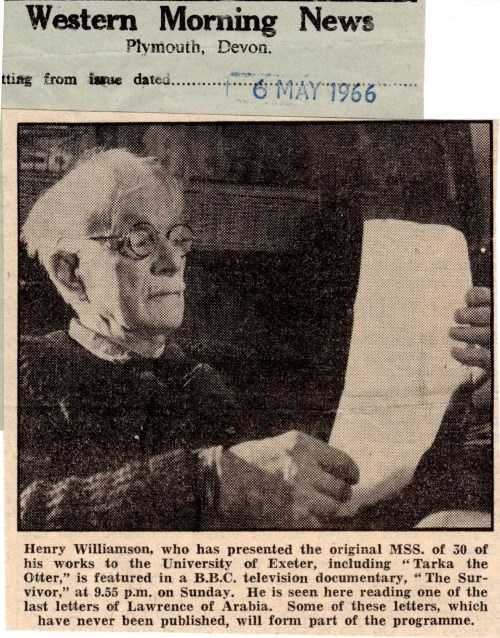
(Note that the complete correspondence between HW and TEL was published in T. E. Lawrence: Correspondence with Henry Williamson: Letters Vol. IX, limited edition, edited by J. Wilson, with Prologue, Epilogue and running Notes by Anne Williamson.)
Manchester Evening News, 7 May 1966:

Evening Herald, 7 May 1966:

Bookseller, 7 May 1966:

Observer, 8 May 1966:

Cumberland Evening Star, 7 May 1966:

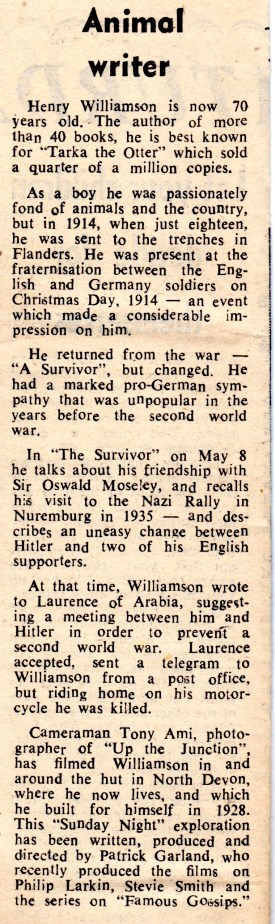
Sun, 9 May 1966:

Daily Express, 9 May 1966:

Guardian, 9 May 1966:

Daily Telegraph, 9 May 1966:

The Times, 9 May 1966:

Scottish Daily Express, 9 May 1966:

*************************
The Twelfth Man
THE TWELFTH MAN
A book of original contributions brought together by
The Lord's Taverners in honour of their patron
HRH Prince Philip, Duke of Edinburgh, KG, KT
 |
|
| Cassell, 1971 |
Cassell, 1971 (£3.25)
Edited by Martin Boddey
HRH Prince Philip, son of Prince Andrew of Greece and Princess Alice of Battenburg, was born in Corfu, 10 June 1921 and so reached his half century in 1971.
The dust wrapper blurb explains the title, and the function of the Lord’s Taverners:
The Twelfth Man, in cricketing parlance, is the player who acts as a fielding substitute when a member of his side is ill or injured; more important, perhaps, it is the Twelfth Man who brings out the trays of drinks to sustain players wilting in the hot sun of an Australian, West Indian, South African, New Zealand, or even English summer’s afternoon.
His Royal Highness the Prince Philip, Duke of Edinburgh, is the Twelfth Man of the Lord’s Taverners, that remarkable Commonwealth-wide organisation of “good fellows” from the worlds of sport and the arts, dedicated to the task of raising money for charity.
It continues:
The happy idea of the Twelfth Man’s fellow Taverners was to ask the writers, artists, sportsmen and show business personalities listed on this jacket to give an original piece of work of their own choice to Prince Philip. These were combined by the editor and founder-member of the Lord’s Taverners, Martin Boddey, in a book, the royalties from the sale of which go to a fund administered by Prince Philip.
There are fifty-eight contributors to this anthology, all well-known names of the era. HW's contribution is his essay ‘Genesis of Tarka’ (pp. 71‒8).

The book opens with a short Foreword by HRH the Prince of Wales, which ends:
The aim of all the contributors to this book is to wish the Twelfth Man the happiest of fiftieth birthdays – and so do I.
The Contents pages lists their contributions:


Nicolas Bentley, cartoonist and caricaturist (and son of E. C. Bentley, inventor of the clerihew) contributed a caricature of 'Sir Arthur Bliss—Master of the Queen's Musick':

Readers of this page may not be aware that he also drew a caricature of HW, which was published in the Sunday Telegraph on 6 September 1969 to accompany Francis King's review of The Gale of the World, the final volume in HW's Chronicle of Ancient Sunlight series:

*************************
There are only a few details concerning the background of this item in HW's personal archive. It coincided with the period of intensive work on the series of treatments for The Vanishing Hedgerows BBC film and the writing of his essay on Field Marshal Earl Haig, ‘Reflections on the Death of a Field Marshal’; and once again with various and continuous emotional turmoil. He was also having trouble with his left eye which was weeping continuously at this time, and on 14 April 1970, with considerable nervous apprehension, went into the Edward VII Hospital for Officers to have the tear duct cauterised, which he found was a fairly simple affair. HW spent much time travelling back and forth to London and elsewhere at this period, either for work purposes or personal reasons. It is evident from notes repeating information of telephone numbers and appointments etcetera in his diaries that he was in a state of great tension, and is worried about forgetting important details.
On 20 February 1970, while in London staying at the National Liberal Club and working on the (first) treatment for The Vanishing Hedgerows, HW recorded in his diary:
A letter from Martin Boddey, 137 Kings Court, London, W6, about a 3000-word article (on Nature) I am to write for Prince Philip's Birthday – 50th in July 1971.
Wrote several letters in the A.M. and tried to settle down to the Flypaper, sticky-fearful TREATMENT. (I am afraid of failure, in that job.)
That letter is not present in the archive, but a few days later there was another letter from Martin Boddey on notepaper headed 'The Lord's Taverners', dated 24 February 1970, showing that HW has agreed to write on a nature subject as his contribution for the forthcoming (and prestigious) book.
His appointment diary notes on 1 May 1970:

Then on 20 May (in his main diary, but there is also a short note in his appointment diary):
I started writing again this morning.
Subject – a rehash of Otter data taken from the pages of Goodbye West Country; the 'essay' developed into a 3000-word article for the Lord's Taverners birthday book for Prince Phillip's [sic] 50th birthday.
His appointment diary for the same date states:
Finished Lords Taverners article 3pm – 3000 words ex Goodbye West Country.
The reference to Goodbye West Country (Putnam, September 1937) can be found in Chapter XI of that book (each chapter represents a month in the year, so XI is November), pp. 330–40, where it is the entry for '2 November', relating his first sighting of an otter in 1912 as he was cycling to North Norfolk for a camping holiday; and the subsequent sighting of one on the River Ancre in early 1917, when he was Transport Officer with 208 Machine Gun Company on the Front Line – a very poignant contrast; followed by the tale of the rescued cub of 1921 and its development.
The opening entry for this Chapter XI, 1 November, relates what is obviously a joke against himself:

However 'The Otter' (as in that paragraph) was a real BBC radio broadcast, made on 28 October 1936 as the second in the series 'Lives of English Animals', which was printed in The Listener on 4 November 1936. The text of that broadcast can be found in Spring Days in Devon and other Broadcasts (ed. John Gregory, HWS, 1992, pp 58–64; e-book 2014). This text does not, however, include the opening paragraphs about the very early sightings which appear in both the Goodbye West Country version and the 'Prince Philip' text, and which of course add greatly to the interest from a research point of view!
The day following HW's diary entry above, on Thursday 21 May, he noted:
I revised the Otter essay, which isn't too bad.
He must have posted it to be typed up as clean copy by Liz Cummins there and then, for the next day he left to stay with the photographer Ossie Jones, with whom he was close friends, at his home, the Mill House at Rowlestone, in Herefordshire. He noted:
Ossie is a kind man: I've known him for some years, and like him more and more. I have returned a little of his kindness by recommending him for lecture jobs, etc, on photography, at various universities. Recently I recommended him for a BBC photography job.
(Ossie Jones took the superb photograph of HW that fronts this website. Typically, he very generously gave the right to use the photograph to the Society.)
The next day they went on to Spode House, near Rugeley, for an Aylesford Review literary weekend (for more details about this weekend, with photographs of HW and Ossie taken at the occasion, see HW’s involvement with Aylesford Review literary events). Then it was back to Rowlestone Mill, before he returned to Devon on 28 May.
Main diary, 2 June: . . . after going-over The Genesis of Tarka, which arrived cleanly typed by Liz Cummins . . . I posted it with a letter to Martin Boddey . . . My contribution to Prince Philip's 50th Birthday present, June 1971.
Liz Cummins’ note is pinned to his original corrected typescript, which is produced below.
A few months after the event there was a further development:

HW noted in his diary on 27 January 1972, after delivering 'my rewritten copy of the last section of the Hedgerows script' (to David Cobham at his London Studio – this was after the 'Fourth Treatment', and refers to the 'voice-over' script):
Thence to walk to 178–202 Gt. Pollard St. where I recorded the article I wrote for The Twelfth Man (Prince Philip) his 50th birthday, a collection of articles etc to celebrate that occasion. It took about 20 minutes, & was a success, I was told.
His appointment diary also recorded:
HW to record Taverners' Tarka article Blind's Talking Library.
The Royal National Institute for the Blind has no information about the resultant book, but somewhere, perhaps, the recording still exists?
*************************
This is HW's corrected typescript for the essay. The last page of the typescript is missing, so the short last paragraph is taken from the printed book.


*************************
Although there was only one edition of the book, there are two variants of dust wrapper. The reason for this is not known for certain, but probably the plainer, royal purple one was the first issued. Perhaps the second rather gaudier version, giving more prominence to the illustrious contributors, was produced later to encourage sales. Matthews' Henry Williamson: A Bibliography sheds no light on the matter.


*************************
'Some Nature Writers and Civilisation'
'SOME NATURE WRITERS AND CIVILISATION'
The Wedmore Memorial Lecture
given to the
Royal Society of Literature
9 October 1958

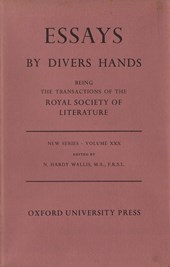 |
The background and the Lecture
First printed in Essays for Divers Hands, being the transactions of the Royal Society of Literature, vol. XXX, Ed. N. Hardy Willis (Oxford University Press, 1960)
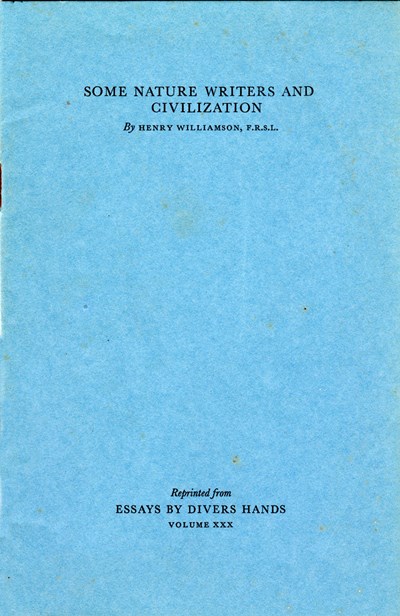
Off-print, OUP, thin card cover [1960]; about 100 copies were printed at HW's request
Reprinted in Threnos for T. E. Lawrence and other writings (ed. John Gregory, HWS, 1994; e-book 2014)
This essay is briefly recorded within the ‘Life’s Work’ entry for Richard Jefferies, but merits its own entry here to mark the official recognition of HW's work as a writer.
N. Hardy Willis, the editor of Essays by Divers Hands, notes in his Introduction:
The essay which opens the book by Mr. Williamson on 'Some Nature Writers and Civilization' is really a pleasant study of Jeffries [sic] and Hudson dealing almost entirely with these writers, but with a passing reference to Lawrence. The author is a real lover of his subjects and his quotations are admirably chosen, Perhaps as I am myself a great admirer of both Jeffries and Hudson I may be prejudiced in including this somewhat detailed consideration in a volume of Essays on wider topics; but it is always delightful when an enthusiast writes with enthusiasm, and Mr. Williamson certainly carries his readers with him. The only pity is that the large extent of quotation does not allow enough of his own writing to charm the reader.
*************************
The background and the Lecture:
HW, nominated by William Kean Seymour and seconded by Kenneth Hopkins, was made a Fellow of the Royal Society of Literature on 3 October 1957, recording in his diary:
Very happy day for me.
Fellowship was an honour reserved for 'persons of distinguished literary achievement' and nominations were restricted to authors whose published work was of such literary value as to deserve this high recognition, and had to be ratified by the vote of the council in session.
HW was now entitled to use FRSL after his name: but, although highly cognisant of the honour bestowed upon him, typically he never did so.
A month later he was further honoured by being made a Fellow of the International Institute of Arts and Letters (headquarters in Zurich) and so was also entitled to use FIAL.

(Note it is dated 1 December – HW's birthday: he was 62.)
Then in January 1958 there appeared the HW Special Issue of The Aylesford Review (Vol. II, Number 2, Winter 1957-8), edited by Father Brocard Sewell, containing a series of articles on various aspects of his work. For further information about Fr Brocard, The Aylesford Review and Henry Williamson, see the ‘Life’s Work’ entry for In the Woods (St Albert's Press, 1960).
So HW was being lauded by literary society, but as always his own thoughts were concentrated on the work in hand – the writing of his next book. Love and the Loveless was published on 22 October 1958; the next volume in the Chronicle of Ancient Sunlight series, A Test to Destruction, was under way. In his private life he was caught up in the complications of buying and renovating a house in Capstone Place (or Britannia Row, according to whether one used the front or back door!) in Ilfracombe, the popular seaside fishing town and resort on the coast of North Devon. The caravan in the Field at Ox's Cross was deemed not suitable for family life as young Harry grew older.
Further to his Fellowship of the RSL HW was invited to deliver the prestigious Wedmore Memorial Lecture for 1958. The Wedmore had been inaugurated by Miss Millicent Wedmore in honour of her father Sir Frederick Wedmore (author and art critic, famous for his work on etchings), and it was a considerable honour to be asked to give this. There are several charming letters from Miss Wedmore in HW's archive (now deposited at Exeter University), and to mark the occasion she presented HW with a small volume of her own poems, From a Cornish Moor (1956).
It is clear that the Secretary of the RSL and Miss Wedmore were expecting HW to talk on the subject of Tarka the Otter, but HW felt that would be rather subjective. There was considerable discussion over the choice of subject, but HW held firm. He chose a subject dear to his own heart, and delivered his talk, 'Some Nature Writers and Civilisation', on 9 October 1958. His appointment diary merely notes:
4.30 p.m. Royal Society of Lit. Lecture, I Hyde Park Gardens, W2
while his main diary for that date is a long tirade about domestic affairs (the problems with the new house and Christine's lack of efficient organisation). A few days later he noted:
Last Thursday (9th) I gave a talk on Jefferies & Hudson at the Royal Society of Literature. I did not feel at home there.
This is the first page of the printed lecture:

He took as much care over the writing of this lecture as any of his books, as these draft pages illustrate; the two typescript pages form the first and last pages of his talk, and include instructions to his typist:
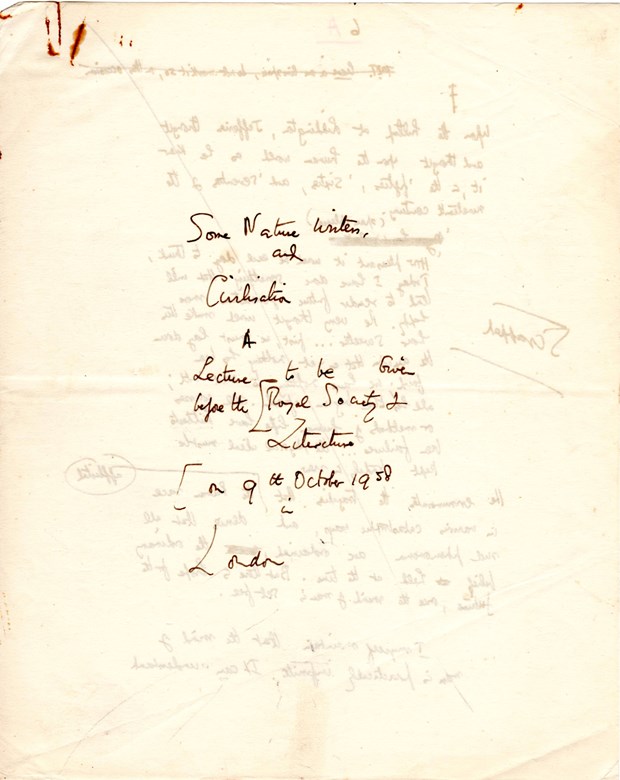
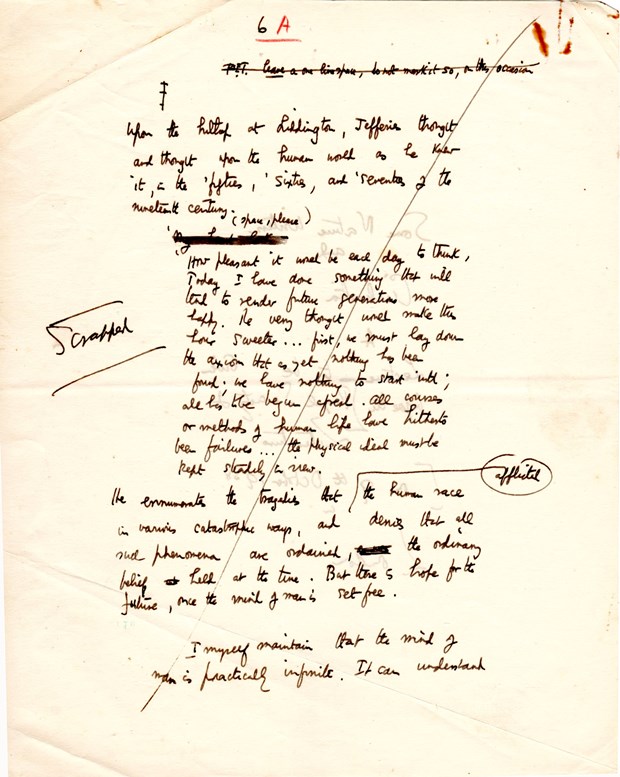
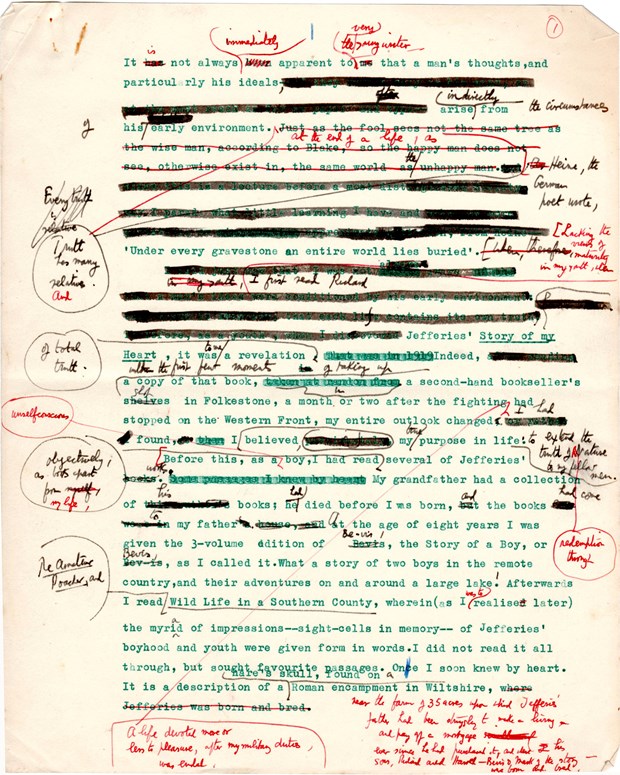
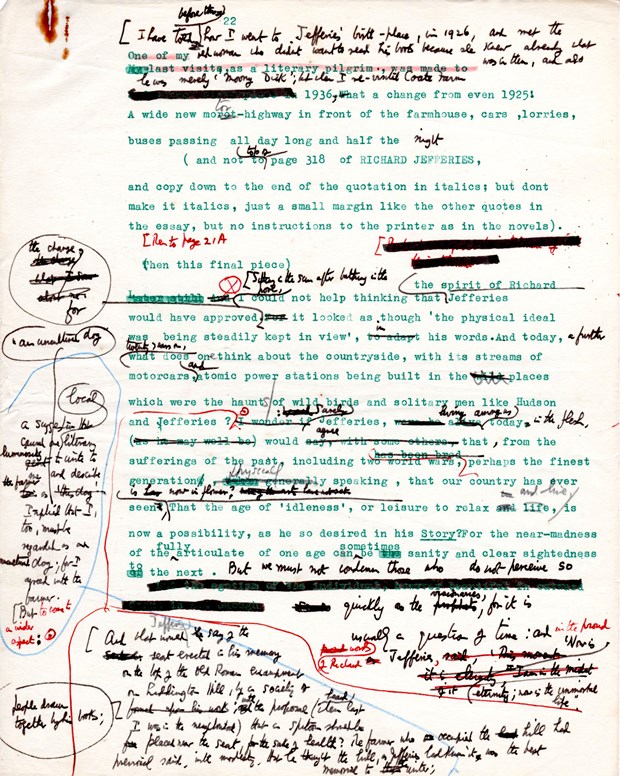
The 'Some Writers', as HW notes, were Richard Jefferies and W. H. Hudson, the two 'nature' writers about whom he had felt most strongly from his early years. His reading, at the age of ten, of Richard Jefferies' Bevis, from his own grandfather's three-volume edition, exploded into his reading of the visionary The Story of My Heart in 1919 at Folkestone, when he was in a vulnerable state of shock from the First World War. The influence of Hudson is not so obvious – there is no actual reference to pin it down, but it is certainly there. I have previously pointed out that the opening lines of Tarka the Otter, noting the trees on the river bank, have a distinct resonance to Hudson's description of the trees that lined the track to his house in Argentina (see Anne Williamson, ‘A Purple Thread (W. H. Hudson)’, HWSJ 41, September 2005).
HW's message here is basically that although the world of Jefferies and Hudson (and that of his own childhood) – the seemingly idyllic world of nature contrasted by the extreme poverty of working men – has disappeared, the turning point being the First World War (and, at the point of writing, a Second World War), there is hope for the present and the future: the slums have vanished and there is tenderness in a new young generation. The emphasis is, though, on an exposition of the lives of his two chosen men, rather than the 'civilisation' aspect.
The lives of Jefferies and Hudson are a metaphor for a natural life – subtly emphasised by mention of D. H. Lawrence's Lady Chatterley's Lover. If we are prepared to live a natural life, and so a life of truth, then we will be, using Jefferies' phrase, 'in eternity now'. And that is what 'civilisation' should be about. HW does however warn that, for some, reading Jefferies’ Story of My Heart can be dangerously influential. (I doubt that was ever really so – other than it upset those with set religious ideas – and it certainly does not apply in today's 'civilisation'.)
As with so much of HW's writing, it is an essay that needs to be read in order to fully understand HW's own philosophy of life.
(HWSJ 41, September 2005, gives full background to HW's connection with these two men. See also: Fred Shepherd, 'A Visit to the Royal Society of Literature', HWSJ 32, September 1996, pp 35-6, which describes the background to HW's Fellowship of the RSL.)
*************************
In the small archive file I have made of items relating to HW's Fellowship of the RSL and the subsequent invitation to give the Wedmore lecture, there are quite a number of cards for other RSL talks over several years. They show an interesting variety. HW did occasionally attend such functions if he was visiting London at the time.
Of particular interest is the occasion of a RSL poetry reading in the presence of the Queen Mother on 1 December 1964, which was of course also HW's 69th birthday.
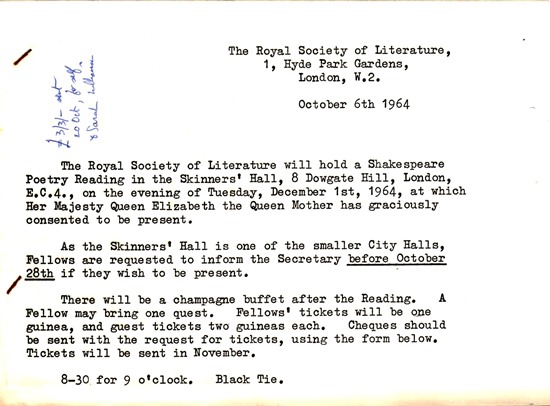
His diary records:
My birthday, 69 years old. Mentioned in Times, & D. Telegraph. Ugh!
At night Sarah W. [his youngest daughter Sarah by his first marriage] & I to Skinner's Hall, to hear poetry readings. Was presented to Queen Mother, who asked 'Did you like the readings'. I said 'Yes your Majesty' but that was a lie. I presented Sarah who curtsied. Rab Butler as President of the Royal Society of Literature stood by the Queen, looking exactly like Vikki's cartoon of him – exquisite anguish on face.
The following photograph recorded the occasion.
 |
|
L to R: Sarah Williamson, HW, HRH the Queen Mother, and the Conservative politician R. A. B. Butler, always known as Rab, later Baron Butler of Saffron Walden |
HW's own inimitable and somewhat irreverent inscription on the back of the photograph reads: 'Sarah Williamson, HW, Lady Birkenhead's arm & left bosom, H.M. Queen Mum, Some Court Gangster, Lord Butler of Trinity House, a Strange Interstellar Object Krawling up His Lordship's Koat-jacket.' Certainly, once the Interstellar Object has been pointed out one sees that and nothing else, particularly that little hand at its base!
(To present Sarah to the Queen Mother was against all the normal rules of state etiquette but, typically, HW did so anyway.)
*************************


Offprint, thin blue card:
************************