
The Henry Williamson Society
Uncategorised
Henry Williamson and the First World War
Henry Williamson and the London Rifle Brigade, 1914–1915: an illustrated timetime
Henry Williamson and 208 Machine Gun Company
Henry Williamson at Trefusis House, 1917
Henry Williamson at Felixstowe with the 3rd Battalion, The Bedfordshire Regiment, 1917–18
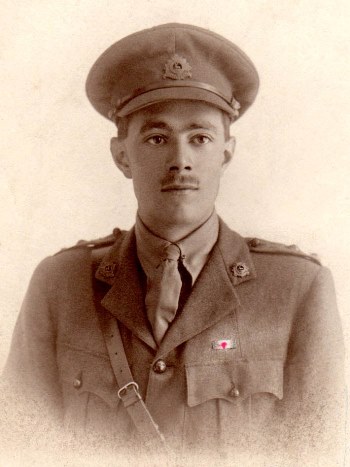
|
Lieutenant Henry W. Williamson in 1917 3rd Battalion The Bedfordshire Regiment |
Henry Williamson served throughout the First World War, an experience from which he never recovered. On various levels he was in a state of breakdown for the rest of his life. The war became the fulcrum of his life’s see-saw. It dominated everything. After the war's end he wrote after the last entry in the ‘Boy’s Nature Diary’ that he had kept until 1914:
HW was a soldier 2¼ months later; in France 5¼ months later
And Finish, Finish, Finish, the hope and illusion of youth,
For ever, and for ever, and for ever.
Thereafter, Henry Williamson could never enjoy Christmas – rather, Christmas was a torment for him because every year he relived the 1914 Christmas Truce, when he spoke to German soldiers and discovered that their hopes and fears were the same as those of himself and his English comrades, and that German soldiers dying in agony cried out for their mothers just as did the English Tommy. The slightest sight or sound would catapult him back into the battlefields. His formidable Aunt Maude had told him – in a war that tended to be called ‘The Cousin’s War’ (due to the Royal Family’s close German connections) – that he was literally fighting his own cousins, for he had a German grandmother. A troubling thought for a sensitive and immature lad; he had just turned nineteen at the time of the Truce. He came to realise that all men are brothers, and that war was futile and evil: basically engineered by political machination. His life’s credo was that it must never happen again, and to pursue that end through the medium of writing: to write the truth – the cause and effect.
This page serves as an introduction to both Henry Williamson's personal experiences and his writing about the war. It will include links to other relevant pages within this website, and to articles on the First World War that have appeared in the Society's journal. See also Biography: First World War.
Those interested in finding out more about HW's war should read Anne Williamson's definitive Henry Williamson and the First World War (Sutton Publishing, 1998; paperback 2004), regrettably now out of print, but which is highly recommended.
*************************
In 1928, ten years after the opening of the Battle of Arras, on 8 August 1918 – the battle that broke the stalemate of the trenches, Henry Williamson was asked by the Daily Express to write a series of articles on The Last 100 Days – there were nine published in all, but also three unpublished – about 'the principal events of the last hundred days of the war'. They make remarkable reading, and are given an effective immediacy, for Williamson, unusually, wrote them as reportage.
Henry Williamson first wrote of his own war experiences in The Wet Flanders Plain, published in the following year, 1929, being his reminiscences after a return to the battlefields. This was followed by The Patriot's Progress in 1930, which is the story of John Bullock, an ‘everyman’ soldier, and considered a classic in the genre of war novels. But mainly he used his war experiences in his later long series of novels – How Dear Is Life, A Fox Under My Cloak, The Golden Virgin, Love and the Loveless, and A Test to Destruction. (Vols 4, 5, 6, 7, and 8 of A Chronicle of Ancient Sunlight) – which record the horror, terror and thrill of that terrible experience.
One of Williamson's most moving and significant essays is his powerful 'I Believe in the Men Who Died', which first appeared in the Daily Express on 17 September 1928, and then published in The Wet Flanders Plain, re-titled 'Apologia pro vita mea'. Here he sets out what he feels is the reason for his surviving the war: to be a voice for those who had died. Anne Williamson has stated in her survey of The Wet Flanders Plain that '"Apologia" is, to my own mind, one of the most – possibly the most – important piece of writing in HW’s whole oeuvre – in his whole "life’s work": certainly it must be read by anyone who wants to understand what underpins HW’s psyche.'
Four years later, in July 1932, the BBC invited Henry Williamson to 'give an address, on some date near Armistice Day, to the Unknown Warrior'. He submitted the script for his talk on 15 September; but the BBC rejected it: 'It was not really what we had hoped for.' Neither did they want him to re-work it, and in the event there was no broadcast on the subject. Williamson included an amended version of the script in his book Goodbye West Country (Putnam, 1937), which purports to be a diary of the year 1936, as the entry for 11 November. It is entitled 'To the Unknown Soldier'; the web page also includes a copy of his much amended hand-written draft of the script refused by the BBC.
In 1964, to mark the fiftieth anniversary of the beginning of the First World War, the Evening Standard asked Henry Williamson to revisit and write about the battlefields of the Western Front. His five reports were published between 29 June and 3 July under the heading 'Return to Hell'. They were subsequently reprinted as a additional postscript in Gliddon Books' new edition of The Wet Flanders Plain (1987), which has long been out of print, and we are now pleased to reproduce them here.
HW was interviewed in 1963 for the major 26-part series The Great War, made under the auspices of The Imperial War Museum for BBC television and broadcast in 1964 to mark the fiftieth anniversary of the outbreak of the war. This groundbreaking series was later issued as a videocassette boxed set, and subsequently on DVD. In March 2014 the BBC made available on iPlayer The Great War Interviews: thirteen full-length interviews that were originally recorded for the series; only brief excerpts were used at the time, and the complete interviews have never before been broadcast. Interviewees included Norman Macmillan (infantryman turned fighter pilot, and author of Into the Blue and Offensive Patrol); Charles Carrington (who, writing as Charles Edmonds, published A Subaltern’s War); and Cecil Lewis (author of the classic memoir of the air war, Sagittarius Rising). Click on the link for HW's interview, which lasts almost half-an-hour.
*************************
John Gregory's 'The Great War in the Writings of Henry Williamson' is an exploration of the subject in both published and unpublished writings.
TIMELINE – Henry Williamson's diary of service
(Links to relevant web pages and journal articles for further reading are highlighted. The link will open in a new window.)
|
|
||
| 22 January | Joins the London Rifle Brigade (LRB), 5th Battalion City of London Regiment, as a Territorial soldier, enrolment No. 9689. Expected to attend three drills per month, involving activities such as rifle training, gymnastics and boxing to keep fit, and attending the summer camp. | |
|
16 May– 1 June |
Takes annual holiday, staying with his Aunt Mary Leopoldina Williamson in Georgeham, North Devon, a visit significant for his future life.
Journal article: Henry Williamson: 'The Last Summer' (HWSJ 11, April 1985) |
|
| August | The LRB's scheduled summer camp is cancelled. | |
| 5 August |
Troops mobilise. HW is a private in P Company, LRB, aged 18 years and 8 months. Training commences: at first in London at the Merchant Taylor's School, then at Charterhouse. By 24 August the LRB is camped at Bisley (familar to HW from schools rifle competitions).
Private Jack Widdicombe is in E Company. He is badly injured on the first day of the Battle of the Somme, with bullet wounds to his right thigh, left forearm, and another through his jaw, ending his war. He subsequently spent 190 days in hospital. His letters home are being published as a blog, Jack's War (external link), 100 years to the day from when he wrote them.
The three Daniel brothers, Herbert, Alfred and Harold, enrol in the LRB on 6 August, in G and H Companies. Alfred is shot by a sniper in January 1915 and dies the next day; Harold is found to be under age and sent back to England early in 1915. Herbert (MC and Bar) survives the war and makes a career in the regular Army.
Web page: Henry Williamson and the London Rifle Brigade, 1914–1915: an illustrated timeline |
|
| 16 September | The LRB marches to the main training camp in Ashdown Forest near Crowborough, Camp Hill Camp, where more serious training commences, with trench digging etc. | |
| 4 November | Orders are received to entrain to Southampton, where the LRB embark on the troopship Chyebassa for Le Havre in France. The Brigade is moved gradually up to the front. | |
| 19 November | Established in the village of Romarin, just outside Ploegsteert ('Plugstreet') Wood. The LRB is detailed as 'support troops' on rotational duties of three days in trenches, three days in support immediately behind the lines, and three days' rest in billets to wash, shave and pick lice out of uniforms (but still on fatigue duties). | |
| 19 December | The LRB is in support for an attack by 11th Infantry Brigade in front of Plugstreet Wood. The attack is aborted and the LRB not called upon to continue it. | |
|
24 December (Christmas Eve) |
HW is detailed as part of a wiring party in No Man's Land after dark: a dangerous task, with the need to be silent, and very vulnerable to snipers and other gunfire as out in the open.
He sees a light over the German trenches, and hears the singing of 'Stille Nacht, Heilige Nacht' (the British carol 'Silent Night, Holy Night'). German soldiers call out 'Come over, Tommy! Shake hands. It is Christmas.' Eventually nervous men climb out of trenches and both sides mingle. |
|
| 25 December |
Fraternisation continues: soldiers exchange gifts – tobacco and cigarettes sent by Princess Mary to British troops for cigarettes and tobacco sent by the Crown Prince to German troops. Some men kick a football around together. HW no doubt witnesses this, as it happens in his section of the line, but does not record it at the time, only talking about it later.
The fraternisation continues for two or three days more, then men are ordered to resume fighting. This is never allowed to happen again, and the following year British troops are told that they would be shot if any fraternisation occurs.
Web page: Henry Williamson and the Christmas Truce Web page: Henry Williamson: 'The Christmas Truce' (History of the First World War, vol. 2, no.4, 1970) Web page: Henry Williamson: 'Silent Night – when the guns held their peace' (Daily Express, 19 December 1970) Web page: Richard Williamson: 'Black earth and the silence of peace in No Man's Land' (Chichester Observer, 26 December 2013) |
|
| 26 December |
HW writes a letter home describing these events. His fathers sends the letter to the Daily Express, which prints an extract, together with extracts from the letters of other soldiers, in an article headed 'The Unofficial Truce', on 4 January 1915.
The effect of the Christmas Truce marks HW for life. |
|
| 1915 |
|
|
| 19 January | HW is hospitalised with severe trench feet and dysentery. | |
| 26 January | He returns to England and sent to Ancoats Hospital, Manchester, and later to Alderley Edge Convalescent Hospital. | |
| Early March | Returns home (his older sister describes him as 'a terrible sight . . . we could hardly recognise him . . . very pale and thin . . .'). He is given three weeks' leave. Applies for a commission. | |
| 10 April |
Commission is gazetted: Temporary 2nd Lieutenant, 10th Service Battalion, The Bedfordshire Regiment.
Commences officer training |
|
| May | Buys Norton motorcycle LP 1656. Attends initial Officers' Instruction Course at Sevenoaks, Kent. At the end of the course HW is instructed to report to Newmarket, where he is attached to the 2/1st Cambridgeshire Regiment for further training. It is a difficult time for him as he is something of a misfit. | |
| 9 October | He is transferred to 25th (Reserve) Battalion, Middlesex Regiment – 'The Diehards' – at Hornchurch, raised by the colourful Independent MP John Ward, an agitator for better conditions and pay for navvies, and now lieutenant colonel of his battalion. | |
| End of 1915 | Reorganisation, and a new battalion is formed; HW and other officers are transferred to Northampton, and sent on a Lewis Gun Course. On his return he is given four days' leave for Christmas. | |
| 1916 |
|
|
| January |
Transferred to the Machine Gun Training Centre at Grantham, and joins 208 Company, The Machine Gun Corps, 62nd Division, 187 Brigade.
HW spends the greater part of 1916 training as a Transport Officer, learning about the maintenance and firing of Vickers machine guns, and how to look after both horses and mules.
|
|
| 31 May | Admitted to Millbank Military Hospital. | |
| 26 June |
The report of the Medical Board states that 'he is now better but lost weight and is anaemic. He requires a complete change.' HW is given two month's leave, part of which he spends in Georgeham, North Devon, with his friend Terence Tetley.
This period of sickness greatly holds up his training, but it is completed by the end of 1916. |
|
|
1 July– 13 November |
The Battle of the Somme
Web page: Henry Williamson: 'When the sun arose that day on Picardy 60,000 were never to see it set' (Western Morning News, 7 August 1959) Web page: Henry Williamson: 'The Somme – just fifty years after' (Daily Express, 29/30 June, 1 July 1966) Web page: Henry Williamson: '7.30 a.m.: a time of hope that became an execution hour' (Evening Standard, 4 July 1966) Web page: Henry Williamson: [untitled, on the Battle of the Somme]; one of a number of articles commissioned to mark fifty years since the ending of the First World War (Daily Express, 9 November 1968) |
|
| 15 September |
Henry's schoolfriend, Rupert Bryers, a lance-corporal in the 9th Battalion, The Rifle Brigade, is wounded, missing and presumed killed near Guendecourt on the Somme, aged 20. His body is later recovered and he is buried in Guards Cemetery, Lesboeufs.
Web page: Anne Williamson: 'Rupert Bryers: An homage at his grave, Les Boeufs Cemetery, 20 April 2013' |
|
| 16 November |
Henry's cousin, Charlie Boon, is killed on the Somme. He is buried in Frankfurt Trench Cemetery.
Journal article: Anne Williamson (compiler): 'Cousin Charlie: a tribute' (HWSJ 43, September 2007) |
|
| 1917 |
|
|
| 6 January | HW diary entry: 'Go to 208 as T.O.' | |
| 24 February | 208 MGC leave Grantham for Southampton. They embark with all animals on the next evening, and arrive at Le Havre at 2 a.m., 26 February. | |
| 28 February |
208 MGC, attached to 187th Infantry Brigade, 62nd Division, moves up to the front line at Astreux. HW's role as Transport Officer is to oversee the welfare of horses and mules, and to organise the logistics of movements of guns and armaments, together with general support, such as arranging billets and provisions for both horses and men.
So begins a period of continuous movement from village to village, backwards and forwards, with attacks and counterattacks (see Anne Williamson's Henry Williamson and the First World War for full details) in preparation for the attack on the Hindenburg Line, commencing on 3 May.
Web page: Henry Williamson and 208 Machine Gun Company Web page: 208 Machine Gun Company: HW's photographs Journal article: Peter Cole: 'The 286th Machine Gun Company' (HWSJ 18, September 1988) |
|
| 9–12 April |
The Canadian Corps takes Vimy Ridge.
Web page: Henry Williamson: 'The Battle of Vimy Ridge' (Daily Express, 6/7 April 1967) |
|
| 8 June |
HW is gassed on a night journey taking limbers with supplies of ammunition up to the front line. One of the mule drivers, Private Frith, is killed by a shell within yards of him. He is admitted to a Field Ambulance Hospital.
Web page: Driver Frith |
|
| 10 June | Taken to 44 Casualty Clearing Station at Colincamps, and thence to Warloi Clearing Hospital. | |
| 15 June | Moves to No. 8 General Hospital at Rouen. Diary entry, 15 June: 'For England by first boat!' | |
| 18 June | Arrives back in Southampton, and leaves for London and Sussex Lodge Hospital. | |
| 22 June | Medical Board – HW is considered unfit for General Serice for three months, unfit for Home Service for two months, and unfit for Light Duties for one month. | |
| 29 June |
HW travels down to the Auxiliary Hospital for Officers at Trefusis House, near Falmouth, Cornwall. Among the friends he makes here is Major Colin Traill, MC.
Web page: Henry Williamson at Trefusis House Journal article: Anne Williamson (compiler): '"My Friend": Major Colin B. Traill, MC' (HWSJ 43, September 2007) |
|
| 3 July | HW diary entry: 'Began story.' There are no other details, but it seems probable (with hindsight), that writing has been recommended to him as a form of therapy for his extreme state of nervous exhaustion – then known as shell shock; in the Second World War as battle fatigue; and later as post-traumatic stress syndrome. | |
| 29 August | Moves from Trefusis to Devonport Military Hospital. | |
| 24 September | A Medical Board notes that he has improved and fit for light duty, but still 50 per cent unfit; he is given three weeks' leave. | |
| 15 October |
HW is posted to C Company, 3rd Battalion, the Bedfordshire Regiment, stationed at Landguard Camp just outside Felixstowe, Suffolk, as (assistant?) adjutant. The CO is Lieutenant Colonel Lord Ampthill.
Regular medical boards still mark him for general home duties only and unfit for front-line service.
Web page: Henry Williamson at Felixstowe |
|
| 30 November |
HW notes in his diary, 'Bosche counter attack. Transport lost.' This refers to the Battle of Cambrai. On this day Brigadier General Roland Boys Bradford, VC, MC, commanding 186th Infantry Brigade during the battle, is killed when a shell hits his headquarters. Aged just 25, and known as 'the Boy General', he is the youngest Brigadier General in the Army. He is one of the four remarkable Bradford brothers (external link) who between them win two VCs and two MCs during the First World War. He appears as a character in Love and the Loveless. |
|
| 1918 |
|
|
| 27 February | The latest Medical Board rules that HW is still 'debilitated and under 20 per cent fit', and unfit for active service. But he is getting very frustrated and wants to get back to the Front. | |
| 1 March | Diary entry: 'Switched name from H.S. [Home Service] to Overseas.' (As adjutant, it is possible to see that he is able to do this.) The incident appears in HW's novel A Test to Destruction. | |
| 22–26 March |
He is given four days' leave prior to embarking for France. It appears that he is detailed to escort a draft of soldiers to the Front. To do this, technically he has broken regulations, but it may have been with some tacit permission, as every man is needed at this time. There is no corroboration whatsoever of this event; records are in total chaos as the Germans make their last massive effort to attack and break through the lines, and so win the war: the German Spring Offensive.
Journal article: Paul Reed: 'Henry Williamson and the Kaiserschlacht, March 1918' (HWSJ 18, September 1988) Journal article: Dr Mike Maloney: 'A Test of Detection: the missing days, April 1918' HWSJ 43, September 2007) - Section 1; and Section 2 (This article is presented here in two sections because of the large file size.) |
|
| 18 April |
HW diary entry: 'Left Hall-Walkers Hospital in Regent's Park.' He is then given a few days' leave, and then attends a routine Medical Board on 26 April. He is still assessed as 20 per cent disabled.
Continues his duties at Landguard Camp. |
|
| 28 June | HW's friend from Trefusis House, Major Colin Traill, MC, is killed, aged 23. He is buried at Le Grand Hasard Cemetery, Morbecque.
Journal article: Anne Williamson (compiler): '"My Friend": Major Colin B. Traill, MC' (HWSJ 43, September 2007) |
|
| 4 September | HW seems to have applied to join the RAF: diary entry reads: 'Failed Air Force. Not fit. Hell.' | |
| 28 September | HW diary entry: 'Am going to India! My transfer to Indian Army came through! B1 category no bar!!' | |
| 2 October | Given leave prior to leaving for India. | |
| 28 October | A telegram recalls HW to Landguard Camp, where he learns that he is to embark on 4 November. | |
| 3 November | HW is told that orders are cancelled, and he returns home. | |
| 7 November | HW diary entry: 'War ending.' He is recalled Landguard Camp the next day. | |
| 11 November |
HW diary entry: 'Armistice signed at 5.30 this morning. Bands playing, guns, sirens, etc. etc. PEACE!'
Journal article: Henry Williamson: 'Ten Years' Remembrance – 11th November 1928' (HWSJ 18, September 1988) |
|
| 20 November | Witnesses around 20 German U-boats enter Harwich harbour in surrender: 'Saw scores, painted dragons on bows, saw-edge to cables over conning towers etc. Crews all to attention entering Orwell estuary.' The men had orders to be silent and at attention. | |
| 9–26 December | HW is on leave. | |
| 27 December | At the end of his leave HW is posted to No. 1 Dispersal Unit at Shorncliffe, and at some later point to No. 3 Rest Camp, Folkestone. His duties as adjutant are in dealing with soldiers returning from the Front. | |
| 1919 |
|
|
| September |
Posted to Brockton Camp at Cannock Chase in Staffordshire – where he more or less opts out of army life, neither dining nor attending parades, but spending his time reading and writing in 'my asbestos cubicle'. His CO realises that he is suffering from war stress and decides to release him from service forthwith. |
|
| 19 September |
HW is demobilised.
Web page: Henry Williamson: 'When I Was Demobilised' (Strand Magazine, September, 1945) |
How Dear is Life: Critical reception
Back to How Dear Is Life main page
Critical reception:
That HW was feeling very anxious and depressed about the lack of review coverage is obvious from the opening section above. This is the first of those books about the First World War that he had been planning to write since the end of that war. He was very keyed up, and fragile emotionally.
That there was a total lack of review from the mainstream newspapers seems most peculiar. However, there was quite a wide coverage elsewhere. But it becomes very clear that many did not want to be reminded of war, especially one that had taken place so long before – when they were still recovering from the wounds of the Second. But those that were in empathy were very enthusiastic.
First, a quotation from the long critical essay ‘The Novels of Henry Williamson’ by John Middleton Murry, printed in The Aylesford Review, Vol. II, No. 2 (Winter 1957-58): reprinted with additional material in Katherine Mansfield & Other Literary Studies (Constable, 1959), and issued as an e-book by the HWS (2013). It is from this essay that the quotation on the back cover of the Macdonald 1984 edition is taken. Murry was an esteemed writer and critic, had been a close friend of D. H. Lawrence, was the husband of Kathleen Mansfield, had run a Community Farm in Suffolk during the war, and was a long-term friend of HW, and the editor of The Adelphi (handing that literary magazine over to HW in 1946). Murry wrote:
. . . How Dear Is Life deals with Phillip’s experience in the First World War. Innocent and ignorant, as a young insurance clerk he has joined the London Highlanders, for the fun of the thing, with a schoolboy’s romantic idea of soldiering. Then he plunges into the appalling reality of war. No picture of the 1914 was that I know surpasses the second part of How Dear Is Life for the sheer power of enduring in the reader’s memory. In a queer way, it is not terrible; it does not so much haunt as satisfy the imagination. It is human, it is humorous, it is pathetic, it is horrible, it is noble – and, above all else, it is beautiful.
Liverpool Daily Post (Brother Savage), 7 June 1954. This is an advance notice by someone who knew HW and obviously wrote a regular column. That he had read the book is obvious – a TS version as proofs did not arrive with HW until 10 July. Headed ‘A Poet who Vanished’, the first part is about the poet Ralph Hodgson (with whom this reviewer had once been friends), now awarded the Queen’s Gold Medal for work done 40 years before and not heard of since the early 1920s – which he obviously finds rather odd. The second part is about HW, now moved back down to Devon and ‘with a talented son just preparing to embark on a career not unlike his father’s’ (that is Richard, author and naturalist, President of the HW Society).
Mr Williamson is happily at work writing more novels, all of them natural successors to that early best-seller “Tarka the Otter”. It is inevitable that the latest of them should be autobiographical. Mr Williamson’s own experience has been rich and vivid and in “How Dear Is Life” he looks back at the first World War in which he had a tragic part.
He brings home the poignancy of Laurence Binyon’s “They went with songs to the battle, they were young”, and the terrible irony of it. We learn now that the ammunition issued in the great Battle of Ypres was for rifles which had never been tested, so that it did not fit the magazine charges. The London Highlanders lost 400 men in the first twenty-four hours.
The Spectator (John Metcalf), 12 November 1954:
How Dear Is Life is the ninth volume in the chronicle of the Maddisons [interestingly including The Flax of Dream within the number!], the third to concentrate on Phillip. It takes him from his first job at the Moon Insurance sub-office in Wine Vaults Lane to a shell-hole near Ypres in the first year of the Great War. It is written with a timeless kind of cosiness, a sprawling, spacious, suburban mansion of a book, that includes somewhere in its overfilled rooms a souvenir of every day of its inhabitants’ lives; a comfortable cheery book which, by its good-hearted innocence, makes Phillip’s experience in France read like a Boys Own Paper for grown-ups. Yet Mr Williamson is patiently creating an authentic middle-class view of social history through the end of the nineteenth century towards today; and irritating as How Dear Is Life is at moments, the main impression retained is one of painstaking honesty.
Oxford Mail (S.P.B. Mais), 11 November 1954:
The Horror of Ypres
Epic of World War I
Henry Williamson deals faithfully and in vivid detail with the first four months of the First World War. Gifted with an extraordinarily retentive memory, and very unusual patience, he is able to reconstruct step by step every stage of his young hero’s transition from raw recruit in the Territorial London Highlanders to seasoned war veteran. . . .
Mr Williamson conveys very clearly the almost happy-go-lucky attitude of those first young volunteers who were sure it was all going to be over by Christmas; their gradual realisation of the overwhelming power of the Germans, the increasing misery and horror of those confused days. . . .
Mr Williamson is obviously building up a monumental epic . . .
The Scotsman, 11 November 1954:
. . . The new novel describes how young Phillip takes his first job in the City, joins the Territorials, and, almost before he has spent his first salary, finds himself in the Battle of Ypres.
Mr Williamson tells the story with a compelling depth of feeling. He makes deeply moving the youth’s introduction to work in the City, while his thoughts lie with the life of the country, and the hardening process of war, bringing lines to a young face which hardly knows the razor. The experiences of the British Expeditionary Force in the early months of the war are described with detail which, while engrossing, does not swamp the personal story. This is the most satisfying of the Maddison series of novels.
Eastern Daily Press (Adrian Bell), 2 November 1954 (8½” column):
A New Novel by Henry Williamson
. . . Partly it is a war book, but the war is that which we knew as the “Great War”. . . . But before that the scene is one of bourgeois tranquillity. . . . The jog-trot of the period is well suggested. Phillip suffers all the embarrassments of a young man not yet sure of himself . . . but there is a wild and independent streak in Phillip that takes him into the country . . . Nothing is more characteristic than this power which is infused into his writing when, through Phillip’s eyes, he looks at nature. It becomes also an implicit comment on humanity.
This dual nature of Phillip is the vital élan of the book. [Then records several instances of nature within the horror of the war scenes.] The battles of 1914 read like battles of a hundred years ago compared to the war of block-busters and guided missiles – confused struggles in midnight woods, while alternate terror and bravado possess Phillip. . . .
In the final pages . . . becoming inured to that nightmare world of mud and blood seems to be pushing the young idealist in Phillip into the background. But Mr Williamson has not done with Phillip yet.
The Birmingham Post (R.C. Churchill), 23 November 1954:
Henry Williamson’s chronicle . . . has now reached the time of the First World War. . . . [Phillip] soon becomes a unit in that mixed army of Regular veterans and Territorial youngsters which suffered so severely in Flanders in stemming the triumphant German advance.
How Dear Is Life is not a great novel, but it is a well-remembered one, reminding us notably of the poems of the author’s contemporaries – Edward Thomas, Isaac Rosenberg, Wilfred Owen – who were among the many young men who did not survive.
[Also reviewed here is J.R.R. Tolkien, The Two Towers:] ‘his epic romance . . . with further enormous instalment. Perhaps ‘epicurean’ would be a more fitting term . . . for [despite] every praise for his imagination and learning, one rather doubts whether his fable . . . has the inherent popularity which the epic theme demands.’ [Ah!]
Manchester Evening News (Julian Symons), 30 December 1954 (15” column):
OVER THE TOP – WITH A USELESS RIFLE
. . . Reading these books is rather like looking at a series of old photographs. It is with a kind of photographic faithfulness that Mr Williamson records the kind of tea Phillip eats as an insurance clerk . . . its cost . . . and reads one of the magazines of the day – Nash’s, The Royal, the London Magazine, or Pearson’s. . . . The effect of Mr Williamson’s writing is cumulative . . . the total effect is one of deep observation [gives various examples]. In this book Phillip Maddison for the first time emerges from the shadow of family life to become a real personality.
Sheffield Telegraph (E.P. Watling),26 November 1954. In a column headed ‘Language Has Its Explorers’, which states (waffles about) that good prose is verse, and vice versa and mentions some classic writers, giving William Sansom’s Lord Love Us as a current good example [not the best example surely?] and continuing:
Old hands Henry Williamson and Ernest Raymond can be relied on for good story-telling. “How Dear Is Life” is a further stage in the story of Phillip Maddison . . . London life of Edwardian days and First World War; nostalgic is the word. [I can imagine HW’s reaction to that!]
British Broadcasting Corporation (Bristol): Letter, 11 November 1954:
. . . Mr Waller [Talks Producer West Region] asked me to let you know the R. H. Ward will be reviewing [How Dear Is Life] on Tuesday 7 December, 6.45 – 7.00 pm in the West of England Home Service.
Church of England Newspaper (Bernard Causton), 3 December 1954 (7½” column):
An experienced novelist [basic resumé of the plot – 3 different parts]. The narrative, compelling attention throughout, evokes the tense atmosphere at the outbreak of war, as it affects ordinary people in homes and offices.
Yorkshire Evening Press (Evie Crosland), 2 December 1954 (10” column):
It’s Good But Conventional
By comparison with previous volumes, which raised Mr Williamson to the best rank of contemporary novelists . . . is a little on the conventional side. The first part of the book, it is true, reveals something of Mr Williamson’s individual style. . . . We glimpse the strain [of becoming adult] and we are infected by the animal exuberance which possesses the young man during his solitary holiday in the country. All this is unpretentious, real, solid, and beautifully handles. [But the reviewer does not like the war descriptions].
Nevertheless, the book is saved from being just another war novel by the author’s acute perception of character. Skilfully he reveals the gradual hardening of Phillip’s personality under the impact of army life. . . . I rather hope Mr Williamson will skip the rest of the war and concentrate on the pleasant landscape and sensitive portraits which are his true metier.
Western Mail, Cardiff (H.M. Dowling), 24 November 1954:
Continuing his saga of Phillip Maddison, a character in whom all men over 50 must recognise something of themselves and the vanished world of their youth, Mr Williamson takes him, raw, naïve, and untried, from an insurance office in London to the chaotic fury of Ypres. The 1914 era is reproduced with astonishing vividness. . . . rare fidelity to his recollections. He paints young Phillip and his world without romantic gloss, yet tenderly and with power.
Vanity Fair, February 1955, gave a mention:
. . .[How Dear Is Life] is an excursion into another branch of the Maddison family, the story of Phillip, cousin of Willie, . . . Set in the days of the First World War. . . . Wonderfully and movingly written in the best Henry Williamson manner, this book is a worthy addition to his list of previous bestsellers.
St Martin’s Review, 5 January 1955:
In fiction this month. Mr Henry Williamson leads the way with . . . I have sometimes thought that Phillip was doomed from the start in the petty and unhappy family life into which he was born, but Mr Williamson is a practical visionary and it is clear that he has plans for Phillip as he comes through his ordeal. Other writers – poets, historians, dramatists and novelists – have talked this mighty and painful theme, but none, I think, has excelled Mr Williamson in his dreadful but compassionate picture of a young generation lost or disillusioned in the inferno of war. He selects and marshals their experience with the vision and assurance of a great artist.
Fortnightly Review (John Eales), December 1954. Three novels are reviewed here: HW’s; John Cowper Powys, Atlantis; Sylvia Townsend Warner, The Flint Anchor. As these are authors of some standing in the literary world, one would expect such comparison to be useful and interesting. The reviewer opens with a nice analysis of the conventions of reviewing: ‘there are certain recognised civilities’ [one should not be rude!], and that the reviewer has to make choices and comparison [some of which is personal choice]. But after such a preamble his remarks tend to be somewhat trite.
Each of the novelists under review is an expert: ‘expert’ meaning no more or less than its face value. All have set their narratives in times already consigned to history. Mr Williamson . . . is the easiest to read; he put himself out to be agreeable company [one might query that statement!] . . . Mr Williamson’s account . . . will possibly never be more vividly described. . . .
Keeping company with Mr Powys is a different and altogether more disconcerting experience [and the reviewer cannot get on with his style or content].
[Miss Warner’s] novel is the one that gave this reviewer the greatest pleasure . . . [She] is an intractable realist.
The Bookseller, 1 January 1955. A long column: in the interval after Christmas the reviewer has ‘communed with the controversialists of a quarter of a century ago’, among which he looks briefly at war books at that time as reviewed then by Clennell Wilkinson, who had stated that:
Henry Williamson in The Wet Flanders Plain had revisited: “with every appearance of enjoyment the scene of all the blood and misery which he has so often denounced” (and what would the reviewer have said if he had known that twenty-five years later the same author would have just published So Dear Is Life [sic] the same theme in greater detail); Charles Douie’s The Weary Road was “refreshingly optimistic” and the Rev. P. B. Clayton’s Plain Tales from Flanders were “at any rate, sincere”, . . .. Only the key word Flanders marks the passage of years. [Thus for us tying up nicely those two HW titles.]
The Tablet (Robert Cardigan),8 January 1955. After a bland description of the plot the reviewer feels it all:
. . . seems quite distant in time. The book should hold an appeal for the curious, or for those who wish to rekindle old memories.
British Weekly, 27 January 1955:
. . . This story is memorable for two things, first the almost painful clarity of scene after scene of that old world, brilliant, care-free, hard-working, colourful; and second, the ineradicable effect of that first war on all those who knew the era before it. It says much for Mr Williamson’s powers that he rises triumphant over the horrors and bitterness. It would be unfair to ask him for a complete answer to the problems he raises.
The book got rather scant attention from west of England papers.
North Devon Journal, 21 October 1954 (with photo of HW):
New book on way.
A new book by . . . the celebrated author who now lives at Georgeham, is being published next week. I am told it includes an account of a holiday spent in North Devon just before the outbreak of the first world war. . . . Mr Williamson has kept his place among the foremost writers in England since he attained international fame with “Tarka the Otter”.
Western Morning News, 3 December 1954:
West Novelist Adds To Saga
Steadily Mr Williamson, the West Country writer, has matured into one of the really significant authors of this generation, each succeeding book seeming to show increased assurance and mastery. . . . Williamson has practically perfected his style of novel, which is distinctive in having no conventional plot at all. Like life, on which it is closely based, it consists of a series of incidents, a passage in the round of a typical family, having no specific beginning or end.
Ireland took more notice:
Dublin Evening Herald (Bookman), 1 November 1954:
It is now many years since I read with deep pleasure “The Flax of Dream” . . . Williamson’s latest novel returns again to those rural scenes he so well loves and to that first world war which provides such a startling contrast. This strangely nostalgic story shows the remarkable difference in outlook between the youth of that generation and those of the pre-1939 vintage. A story of great power and beauty.
The Cork Examiner, 4 November 1954 (7” column):
For his latest novel Henry Williamson goes back forty years to the time when there was something of romance left in the prospect of war and when youth ventured forth to fight as to a gay adventure. Those of us old enough to remember can recall that the opening gambits of World War I contained no threats of bleak years ahead or of such permanent changes in the structure of living that a new way of life had to be fashioned afterwards. Mr Williamson captures it all in this most realistic novel, which moves smoothly from youth to manhood and on to the final disillusionment in which all love, all romance and all the dramas of high adventure were swept away in the bloody holocaust that was the first Battle of Ypres. . . .
Dublin Sunday Independent, 30 January 1955 (6” column):
We do not consider this an exceptional novel . . . but it may bring back to readers deep in years, cherished and poignant memories of vanished youth. . . . Its opening pages are a literary recreation of the cushioned comfort and social serenity of the English middle classes in the months that preceded the bursting of the storm towards the end of Summer 1914. . . .
In Australia:
Sydney Morning Herald (E.H.S. Miller), 22 January 1955 (10½” column):
This novel of World War I is a good example of the impressiveness than can sometimes be gained by distant perspective. . . .
In these pages Mr Williamson is plainly reliving a personal experience, yet the passing of time has enabled him to place it with a historian’s accuracy in the broad pattern of events. This is the story of the British Expeditionary Force to France in 1914; of the Old Contemptibles – the regulars who met the first crushing weight of the German onslaught at Mons – and in particular, of the Territorial troops . . . the young men who found themselves pitchforked from a tranquil, prosperous, ordered and orderly life in the pre-1914 England into a holocaust beyond their wildest imaginings [a point made before] but seldom so effectively.
The change of setting to France is achieved with a suddenness that is stark and awesome. . . . painfully subjective but also uncompromisingly realistic. Though it is a notable departure from his other versatile writings, this novel will be counted by many as his best work.
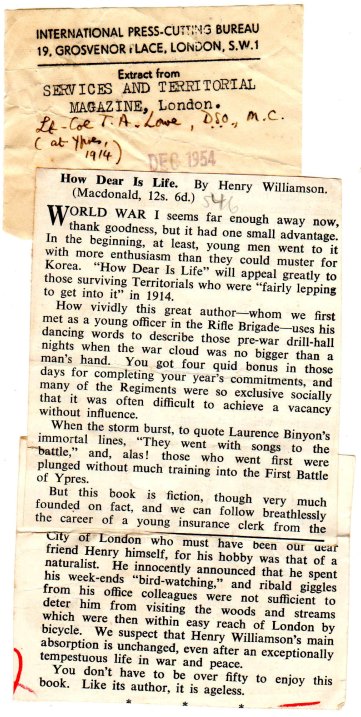
There are three reviews which deserve fuller coverage. The first because the writer, Lt. Col. T. A. Lowe, DSO, MC, had known HW at Ypres in 1914, and so must be unique:
The second is the discursive article by George Painter, a staunch supporter of HW, who himself was an eminent biographer, notably of Marcel Proust, which won him a prestigious literary prize. This is the review mentioned by HW’s first wife in her letter shown earlier in this exposition: a review which obviously restored some of HW’s belief in his self-set task.
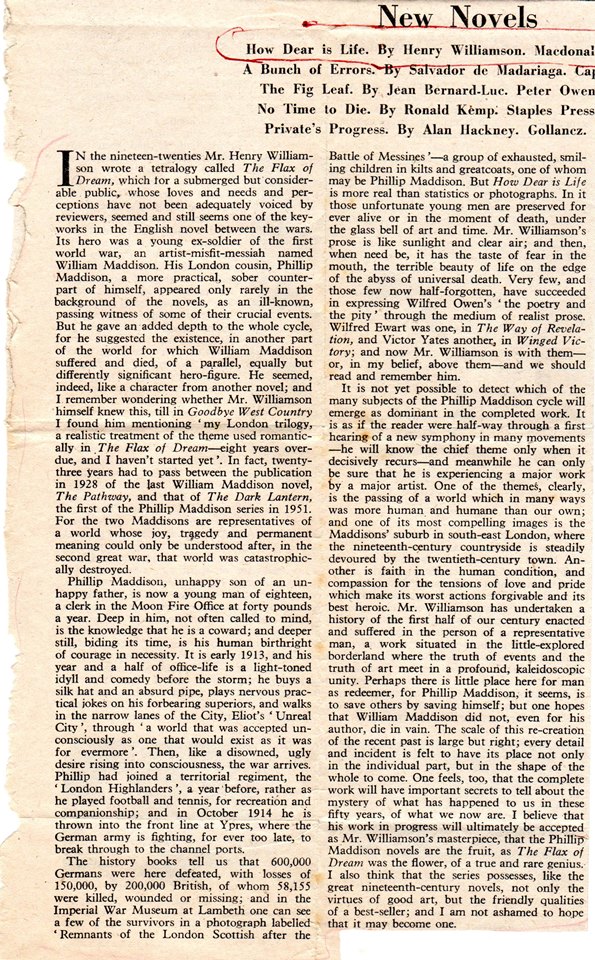
But let us end with the third, from John O’London’s Weekly, 20 August 1954, which has a photograph of HW on the front (one used quite a lot for publicity at this time).

The long article (over a whole page) is by Denys Val Baker (a friend of HW and himself a writer) and is headed:
BRILLIANT OR HALF-BAKED
Henry Williamson has written books of many types, but has now finished one that he has been wanting to write for nearly forty years, about the first battle of Ypres.
The content of all the first part of this article is general and belongs elsewhere but Val Baker finishes with comment on the forthcoming How Dear Is Life:
Of his latest book, he told me that it was one which he had been wanting to write for nearly forty years. It deals with the “red little, dead little army” which perished in the first battle of Ypres, in the 1914-18 Great War. For many months Williamson worked on this novel – to be published shortly by Messrs. Macdonald under the title How Dear Is Life – and he says he found it emotionally exhausting reliving a period that was so important in his life, both as man and writer.
After weeks and weeks of nearly night and day writing, often writing for eighty hours continuously with breaks for food and sleep in my clothes, I began to feel that my writing-hut was a bunker in the winter of 1914, in the Ypres salient. It was as if the battle were on outside in the Devon winter darkness, and I was almost afraid to cross the field at night to my home, in case machine guns opened up! But I enjoyed it all hugely.
After completing this book, Williamson described himself as looking like a ghost. When I saw him he was still voluble with
all the old feelings, anguishes, comradeship, and romance felt in those early days among the finest fellows in the world, the old soldiers of the pre-war Regular Army, the gutter boys who could not get work, so they joined the Army in the days when “soldier” was a taunt on the lips of those who had just avoided the gutter.
Written with such passion and feeling, Williamson’s book is certain to cause a stir. He is the sort of writer, and man, who can make his friends as well as enemies angry with him: but that is no reason for ignoring the fact that, in the stream of English literature, he is a figure of real stature and undoubted permanency.
Back to How Dear Is Life main page
Back to 'A Life's Work' Back to 'Young Phillip Maddison' Forward to 'A Fox Under My Cloak'
How Dear Is Life
HOW DEAR IS LIFE
(Vol. 4, A Chronicle of Ancient Sunlight)
 |
|
| First edition, Macdonald 1954 | |
First published Macdonald, 25 October 1954 (12s 6d net)
Panther, paperback (slightly revised), March 1963
Reprinted Macdonald, 1966, 1984
Zenith, paperback, 1985
Sutton Publishing, paperback, 1995
Currently available at Faber Finds
The title is taken from the words of Admiral Lord Nelson as he was dying:
How dear is life to all men.
(Quoted on the half-title page)
Dedicated to C.M.D.W. (HW’s second wife Christine, née Duffield).
At the end of the previous volume, Young Phillip Maddison, Phillip had just left school and had obtained a job on probation as clerk at the Moon Fire Insurance Office, to start on Lady Day (25 March).
As How Dear Is Life opens, Phillip is preparing for his first day at the Moon Office in ‘Wine Vaults Lane’ as Part One is titled, with the ominously prescient Shakespeare quotation:
And summer’s lease hath all too short a date.
In this volume we follow Phillip through his first months in this somewhat mundane job during the summer of 1914, leading up to the declaration of war on 4 August, his training as a soldier with ‘The London Highlanders’ (Part Two: ‘The Great Adventure’), and their embarkation for France and the terrifying scenes in the trenches of the Front Line as, instead of being support in the communications sector as they had thought, being Territorials, they are thrown into the Front Line (Part Three: ‘The Red Little, Dead Little Army’).
*************************
HW’s diary entry for 19 September 1953 reveals that he had just returned from a visit to Bungay in Suffolk, where his first wife Loetitia (Gipsy) was living, and where he had been to the annual Aston Martin meeting at Snetterton Motor Races in honour of Jock Horsfall – the eminent Aston Martin racing driver, who had lived at Botesdale when HW lived there after the sale of the Norfolk Farm, and the reason why HW bought his own (second-hand) Aston Martin. This thoroughbred car had continuous problems causing constant grumbling about poor quality garage work (it had broken down several times on this trip alone!). He expected to find the proofs of Young Phillip Maddison waiting for him on his return:
No proofs of Young PM. Damn! I want to read them to get back into the feeling, in order to get on with Book 4, now the old title of Goodbye My Bluebell.
This was a ‘Part’ sub-title from the material removed from Young Phillip Maddison as far too long. So, in effect, most of the material for this new volume was already written – but that title was (fortunately!) never mentioned again. The next diary mention on Monday 26 October states (obviously having dealt with the Young Phillip Maddison proofs meanwhile):
Finished new chapter 1 of How Dear Is Life.
It is obvious that he is re-writing all the material.
On 5 November he sent off the first 66 pages to his current typist, Mrs Tippett, in Cornwall. But he records that he and Christine are not getting on very well together (a year later she reveals she was already at this point having an affair with a local artist – more anon).
On 12 November he was in London ‘To open Greenacres Primary School, Eltham, SE9 at 2.30 p.m. Mr Harold Shearman, vice-chairman of Education Committee, County Hall, S.E.1.’ A successful event greatly appreciated by those concerned, but it cut through his work schedule and thought processes. And on his return he records further problems between himself and Christine. This is very unsettling for him with his need for total concentration on his work. On 20 November he wrote:
Have been working on Dear Life whenever a little energy came to me. I must finish these books: constant fear that I shall die before they are completed – my own fault for not working harder years ago.
He continues writing each day, recording:
On with the book. It moves me greatly – I am into the battle of Ypres again.
On 28 December he sent off Part III, chapters 19-23: ‘The fourth or fifth rewriting.’
And at the end of his 1953 diary, where it runs into the New Year he wrote:
Posted pp. 381-400 of H.D.I Life to Mrs Tippett. This is now the end of the book. I have wept, night after night alone in the hut, working all hours, sleeping on the couch, giving all to the work – the poorest ghost of an irritable companion for poor Chris.
The entry for 1 Jan. 1954 states: ‘Am on with A Fox Under My Cloak.’ (The next volume of the Chronicle.) There was no let-up on the writing treadmill. Two weeks later, on 16 January, he is considering recasting and shortening Dear Life:
Elwin [Malcolm Elwin, writer, HW’s friend and his reader at Macdonald Publishers] reports D.L. far too long. He wants me to cut the Westerham chapters – the county scenes. Says they hold up the narrative. He may be right. [But he then proceeds to criticise Elwin on various counts – particularly regarding his attitude to HW’s love for his step-daughter, Susan Connelly in 1946.]
Apart from that brief entry the diary is more or less blank. In March there is a short entry referring to Richard Aldington’s imminent controversial biography of T. E. Lawrence. There are no details recorded at this point but HW decided to pre-empt this book by writing his own ‘Threnos for T. E. Lawrence’, which appeared in two parts in the May and June 1954 issues of The European. This essay is reprinted in Threnos for T. E. Lawrence and other Writings, HWS, 1994 (e-book, 2014, and I will deal with it under the entry for HW’s book about his friendship with TEL,Genius of Friendship (1941; reprinted by HWS, e-book, 2014). I mention it here to show further evidence of the intensity of his workload at this time.
On 14 April the diary records: ‘I have not written in my diary for months . . . I have gone over my novel [Dear Life] so many times that it went off [i.e. to the publishers], after several typings, only a day or so ago. [But meanwhile he is working well on A Fox Under My Cloak.]
A week later, on 22 April, writing from Bungay (where he had gone once again for the Jock Horsfall Aston Martin Meet at Snetterton Motor Race Track) he notes that he plans –
with Eric Watkins of the News Chronicle editorial staff to go to Ypres next Friday week for 4 days: visit scenes of Dear Life, & also the Loos country. But it will be a lot of country for a weary old man [59 at this point!] to traverse in the time, on foot. . . .
Friday 7 May: Left Victoria station at 11 am with Watkins for a short tour, on foot, over battlefields of Loos, Arras & Ypres.
It was twenty-seven years and a Second World War since his 1927 visit, made when writing The Wet Flanders Plain. (The brief visit he had made as he passed through the area with Christine on their honeymoon in April 1949, on their way to the south of France, hardly counts.) This visit was mainly to clarify details for A Fox Under My Cloak and so will be dealt with under that volume. How Dear Is Life was already with the publishers, but he was also checking on details for that – thus:
& so up to Messines, crossing the little Donore stream. Had lunch by the Scottish Memorial. Visited L’Enfer wood. Yellow clay & rushy hillside, where springs fed the little Steenbeck. Got a bus into Ypres.
The import of that will be clear in the examination of the actual text of the book.
The proofs of How Dear Is Life arrived on 10 July.
Later that month HW was involved in The North Devon Festival – organised by his friend Ronald Duncan (poet and playwright). As part of this, HW gave a talk ‘Forty Years of Wild Life in Devon’ at the Bideford Cinema on 6 August. This talk was recorded for the BBC and broadcast on 11 August in the West of England Home Service, and again on 15 October on BBC radio. (It is reprinted in Spring Days in Devon and Other Broadcasts, ed. John Gregory, HWS, 1992; e-book 2014.)

On 28 September he received £500 advance royalties for How Dear Is Life. On 1 October he was in London where he met up with several members of his family for dinner, and he and Gipsy visited St Paul’s Cathedral:
A beautiful cool quiet living place – I thought of my final scene in Dear Life, where Hetty & Tom Turney attend Lord Robert’s funeral service there in November 1914. . . .
The book was published on 25 October 1954: ‘Will it bring my name back as a serious writer?’
Two days later Christine revealed that she was in love, and had been for at least a year, with a married artist living in Appledore – saying she had felt lonely and isolated by his irritable behaviour (caused by his extreme work load): thus throwing his psyche into chaos. It must certainly have cut across any feeling of celebration over publication of his book. There follows pages of angst, although he tried hard to rationalise and resolve the situation. After a while this all calmed down again. This makes his inscription to Christine in her copy of How Dear Is Life all the more poignant:

But there were also big problems with the new Studio built at the Field but never quite finished to his satisfaction, which constantly irritated him. But the most poignant diary entry was on Sunday 7 November:
I hoped for reviews of Dear Life in Sunday papers – none –
hoped the 40th anniversary of Ypres 1914 would be noticed. None.
Yes, the 40th anniversary of that battle occurred as How Dear Is Life was published. That no critic noticed that is rather appalling – although HW should of course have drawn attention to the fact to his publishers, so that they could have given it publicity. That he did not do so is typical of the man. He thought it was not necessary; that others would see it for themselves. Alas – such vision tends to be sadly lacking without it being pointed out. It was a crushing blow for our author. But a few days later he received a sweet letter from his first wife which he pasted into his diary:


The review is featured in full in the Critical reception section.
*************************
Part One, ‘Wine Vaults Lane’
This part is headed with the quotation ‘And summer’s lease hath all too short a date’ (Shakespeare, Sonnet 18) – setting a wistful and poignant tone before we start. It is 25 March 1913 – Lady Day (one of the official ‘quarter days’ marking legal transaction periods) – and after a two-month break Phillip is preparing to start work at the Moon Fire Insurance Office. Before leaving he has to endure a lecture (well meant) from his father on the ‘etiquette’ of life at this ‘eminent’ work-place.
HW himself started work as a clerk at the Sun Fire Insurance Office on Lammas Day (1 August, another quarter day) 1913, having left school two months before at the end of May. Both HW and his alter ego Phillip had two months’ holiday!
When Phillip gets off his train he dawdles, enjoying the sights, then finds he doesn’t know the way and panics about being late, but is rescued by his uncle, George Lemon, fortuitously to hand as he is about to enter his bank, who very kindly takes Phillip by taxi to Wine Vault’s Lane. All of course typical of our grasshopper character! (But we learn later that George Lemon has been embezzling money and has deteriorated with extraordinary speed to the point of madness – a very sorry tale for all concerned.)
Phillip meets his seniors: Mr Downham, Mr Hollis (Head Clerk) and Mr Howlett (Manager), and young Edgar, the messenger. As the tale progresses they are all shown as kindly, although at times exasperated with Phillip’s odd behaviour.
Phillip’s work as junior clerk was to enter details of each day’s post into either the Post Book or the Receipt Book; outgoing post into the Stamp Book. He was also responsible for taking any money received to the bank, and for writing out simple property policies. Once established he relieves the boredom of his tasks by larking about with Edgar in the basement, playing football with a ball made from screwed-up newspapers.
His first pay-day on half-quarter day (6 May) – six weeks or so after starting work – is a momentous occasion: £5 (so £40 per annum), paid over as ‘three sovereigns, three half-sovereigns, and ten shillings in silver’. He promptly goes out and buys himself a ‘cork-lined silk hat’ for 12s 6d (expensive!) and other manly items. But by the time he gets home he is wrought up, mainly through lack of food (he has had no money for lunch for quite a while) and, realising he will still not have any spare money once he has paid out commitments, quarrels with his mother. But his spirit is soothed first by food and then by a visit to Mrs Neville, his best friend’s mother, who lives nearby, and with whom he is always very close. Their easy and happy relationship is in sharp contrast with the awkwardness within his own home.
There follows a lyrical passage about a visit to Westerham, encompassing one of HW’s childhood haunts, Squerrye’s Court, for which he had obtained permits to visit from the owners. The shortness of this passage shows that he had indeed taken Elwin’s criticism to heart and cut out a large chunk of material here.
Much social history background is woven into the tale with broad brush strokes, so that we are quite subtly taken into the period. Much of this is through the activities of Phillip’s Aunt Dora (Theodora Maddison – HW’s Aunt Mary Leopoldina Williamson). Dora is in the suffrage movement and her exploits provide a running continuum to the tale. She marches with her fellow women, demonstrates, is imprisoned and force fed (to the total embarrassment and disapproval of her conventional relatives!). Her sincerity to her cause and to relieving the hardships of the poor is a potent thread. We learn of the death of Emily Davidson, who ran out in front of the king’s horse at the Epsom races – causing a great furore in the press. It is Dora the thinker who gives us the background arguments on all matters political and social, and through whom we discover the appalling hardships of the destitute women left at home.
But the main development within the first part of the book concerns Phillip’s enlistment into the Territorial Army. His older Cousin Bertie (Hubert Cakebread) is already a ‘Terrier’ in the London Highlanders, and after including Phillip in a game of tennis (a great honour) further invites him to go along to a meeting, telling him ‘it’s a top-hole club’. There was a grant of £4 to all who joined – with which Phillip buys a new suit. This fictional ‘London Highlanders Brigade’ as such did not exist: its actual equivalent was the London Scottish. Two of HW's contemporaries at Colfe's Grammar School, the Barnes brothers Roland and Leslie, joined the London Scottish.
HW himself actually joined the London Rifle Brigade (LRB) on 22 January 1914 and immediately bought a new suit with the £4 grant money! Interestingly he gives Phillip the same army number – Private 9689 – as his own enlisting number.
There is considerable detail about the Drill and School of Arms work. It is all authentic and a superb picture of what was entailed. HW is describing his own experiences, transferring them to his fictional London Highlanders. One of the people he meets there is Peter Wallace, the boy who had fought on his behalf six years before, in real life and in his fictional tale, which episode still fills him with shame, feeling himself to be thought a coward.

Phillip takes his annual holiday with his Aunt Dora at her cottage in Lynmouth in North Devon, where she is recovering from her latest spell in prison and force-feeding. He takes the train from Waterloo to Barnstaple where he changes to the small-gauge Lynton train, the famous little line that HW writes about in several books, with a commentary as it chugs its way up and over Exmoor: a wonderful description of a journey and of a time long gone, worth reading just for its own sake. They cross a bridge with several arches built of white bricks: this is the viaduct across the Park at Castle Hill (tucked in here as a little bon mot for those who know) where later HW lived for a few years (Shallowford) and was to write about in due course. Further, when the train stops at Chelfham (‘Chill’em’), he writes: ‘No one got out, no one got in.’ A clear nod to the poem ‘Addlestrop’, also about a train journey, by Edward Thomas, killed in the First World War, and to whom HW felt a great affinity. Such tiny details, and so easily missed: the reader doesn’t need to know – but it deepens the appreciation when they do.
At Lynton Phillip is met by his Aunt’s friend, Sylvia. It is gradually revealed that she is Sylvia Pankhurst, daughter of Emmeline Pankhurst, founder and leader of the Suffragette Movement, now estranged from her mother and sister, but the chief instigator of the relief of the poor and needy in London. Sylvia takes Phillip down the cliff to Lynmouth by way of the (famous) cliff railway – worked by water hydraulics, and still functioning today.
During this holiday Phillip witnesses an otter hunt, and to his great excitement he has a brief glimpse of an otter. And we all know what that means for the future of our still callow youth! (HW actually saw his first otter as he made his way by bicycle from London to north Norfolk for a holiday in 1912.) He spends his time roaming across Exmoor, walking 20 miles or so a day, 200 miles in total. He visits the well-known landmark Hoar Oak and gets caught in a storm. This very lyrical and happy episode has two purposes. First it is the lull before the storm of war which we know is inevitably coming, and secondly it is a prelude to the final volume of the series, The Gale of the World, which ends with the tremendous storm which devastated Lynmouth (which took place in August 1952, just before HW started writing this volume). I think we may assume that HW had already envisaged this event as providing the climax to his series and wrote this scene as a precursor – a minor theme here growing to a major one in due course.
Aunt Dora and Sylvia decide to go to Ireland to help sort out problems being caused by the Home Rule Bill. Dora establishes that Phillip has not heard about the shooting of Archduke Ferdinand and is completely naive about the consequences of this act.
'War, Aunt Dora? . . . The Terriers are home defence you know. We’re really more a sort of club than anything else.'
[Thus repeating the words of his Cousin Bertie when he suggested that Phillip join the London Highlanders]
In real life HW took this holiday at his Aunt Mary Leopoldina’s cottage in Georgeham in the last two weeks of May 1914. It was an idyllic time, and he wandered around that area much as the fictional Phillip does on Exmoor. At the end of his ‘Nature Diary’ notes he later wrote in pencil:
H.W. was a soldier 2¼ months later; in
France 5¼ months later.
And Finish, Finish, Finish the hope & illusion of youth,
for ever and for ever and for ever.

Returning to London, Phillip is excited about the future: his friend Desmond on holiday, and Cousin Willie living with them as he too is about to start work at the Moon Office (tying up Willie’s movements from the earlier Flax of Dream series), but most of all the Territorial Training Camp at Eastbourne.
But everywhere is full of the rumour of war. It is the Bank Holiday weekend. Richard reads out the ominous headlines from the special issue of the Sunday Trident to his assembled family, telling them:
‘Bismark killed your great-grandfather and his sons, and your grandmother fled to England, and married your grandfather.’
– which is more or less what had indeed happened in real life (see references in AW’s biography Henry Williamson: Tarka and the Last Romantic).
The two youths invite Richard to join them for tennis on the Bank holiday Monday, 3 August 1914:
Bank holiday on the Hill. A day of sun and wind, white cumulous clouds passing swiftly across the blue, dry elm leaves rustling above a sun-baked gravelly soil, kites flying, distant Crystal Palace glinting along its grey scales. The thud of tennis balls on strung catgut (one or two strings broken), how proud he was of Father’s swift service, coming from the racquet held at the top of his extended right arm, whipping low over the net, flicking in low swift bounce upon him. . . . Father looked almost distinguished. He was glad he had asked him to play. He had been nervous about it at first, in case Father became cross. His relief therefore was the greater. Father wore old-fashioned brown-striped white flannel trousers, but they looked quite nice. . . . It really was a wonderful Bank Holiday. A pity Mother had to miss it all, having to do the housework. The wind blew, warm and sunny, the atmosphere was very clear. When the play was over, the question became uppermost again, Would Great Britain stand by France?
The next day, Tuesday 4 August 1914, work was resumed. Phillip hears immediately that the long awaited training camp has been cancelled, and later in the day that the King had signed the Order for General Mobilisation. Work finishes for the day.
Phillip and Willie join the crowds excitedly milling around. They see Keir Hardie (the Scottish Socialist MP and pacifist) being booed as he calls on ‘wor-r-rkers’ to unite (in order to defeat the call to arms). They end up at Buckingham Palace and see the King and Queen on the balcony acknowledging the cheers of the crowd.
When they return home Richard Maddison is playing records on his precious gramophone: ‘Liebestod’ from Tristan und Isolde:
Most beautiful music, that he had not heard before, filled the room. It made him think of the sun, which was dying and saying goodbye to the earth, a golden god slain in the darkness. . . . Voices came from the dark grass [of the Hill], laughter and far-off yodelling cries of happy boys. A star shone very small.
All very understated, but a very effective setting of atmosphere and mood.
That night, when the others were in bed, Richard went quietly to the front gate, and with a screw-driver removed the ten brass letters of Lindenheim from the top bar.
Richard realises that anything connected with Germany would have repercussions: Germany is now the enemy with which the country was at war. He sorts out his Special Constable items, including pistol, and prepares himself to do his duty.
The name of the Williamson’s actual house was ‘Hildersheim’, as had been the original family home in Sutton – deriving from HW’s grandmother’s German nationality. The name on the gate was indeed removed at the outbreak of war.
The next day Mr Howlett tells Phillip to report to his Brigade HQ: Downham is already in uniform. Phillip goes home to get into his: kilt, woollen hose, special garters, spats, shirt, jacket, sporran and finally glengarry bonnet and regimental badge. His mother is fearfully proud. The nervous Phillip eventually meets up with the other local young men: his cousin Bertie (corporal), Bolton (sergeant), Peter and David Wallace, while the youngest Wallace boy, Nimmo, plans to join the next day. His cousin Gerry Cakebread also enlists into this battalion. Willie also wants to enlist. So many young men, so eager for adventure.
Phillip’s main concern – the focus for his wider total anxiety – is that his boots should be thickly resoled for marching. But despite having taken them to the shoe-shop immediately, they are not returned and become an issue.
So we turn to Part Two: ‘The Great Adventure’.
‘It was then that the country in her need turned to the despised Territorials’ (quoted from Field Marshal French, 1914 (p. 293). The Territorials, as part-time amateurs, tended to be considered inferior soldiers who would be useless for actual battle.
Phillip duly reports to his HQ and is issued with rifle and bayonet, and then they march off. He makes friends with the man marching next to him, Norman Baldwin, and they team up and become close friends. Willie is unable to get into the London Scottish and so joins the London Rifle Brigade (LRB) – which was of course HW’s real placement: Willie and Phillip are both versions of HW himself, so we are in rather surreal country here!). The fictional LRB have their HQ in ‘Sconhill Row’: the real LRB had theirs in Bunhill Row. One of HW’s little bon mots!
He sees soldiers marching in the distance and recognises his friend (the former destitute) Horace Cranmer among them, so realising with some surprise that Cranmer is now a soldier with the Guards.
Phillip’s immediate training roughly follows that of HW’s (apart from the uniform kilt). (See AW, Henry Williamson and the First World War). A means by which HW shows the development of Phillip’s character is through his initial extreme embarrassment about the primitive lavatories, which he cannot and will not bring himself to use, which gets him into trouble several times – until eventually when in the trenches he has lost all inhibition about performing this natural bodily function. This small thread also cleverly illustrates how an individual is moulded to conform into a unit.
The men are given to understand that any role they will be asked to take will be in the communication lines or as support defence of the coast of Britain. But quite soon everyone over 18 is asked to volunteer for foreign service as there is a great need to reinforce the already overwhelmed regular troops at the Front (hence the quotation from Field Marshal French heading this section). Phillip and Baldwin and various others do so. Phillip is surprised by some who do not – Downham (from the Moon office) among them. But the men still think they will be used only in the communication lines.
His mother and Aunt Dora (back from Ireland and further disillusioned about the state of the world) arrive to see him briefly. Then Dora’s thoughts take us into the work of Sylvia Pankhurst in relieving the poverty-stricken out-of-work families. The first edition of How Dear Is Life carries acknowledgement to Sylvia Pankhurst’s book The Home Front as the source of background for her character and actions.
Phillip’s heavy soled and nailed ‘campaign boots’ arrive just in time for the long march to the training camp. They immediately prove far too heavy, and his feet are very quickly badly blistered. He abandons the boots for a pair of thin ‘elastic-sided’ ones – all he could get. Their destination is Crowborough Camp in Ashdown Forest. HW's letters home at this time included a cartoon of himself:

The letter on the reverse of the sketch reads:

Phillip’s letters from Crowborough follow those of HW’s own letters. (All his letters are reprinted in AW, Henry Williamson and the First World War.) From these we gain a very clear picture of life at Crowborough – ‘Bleak Hill’, that lull before the storm.


Orders arrive to proceed overseas and Phillip’s parents arrive on a visit; but the meeting is awkward as always. We have the first mention of Corporal ‘Douglas’ as in Phillip’s tent: ‘a dark, handsome, rugger-playing Old Blue’. Hetty thought him nice as he helped them to find Phillip. This is Douglas Bell, who was also at Colfe’s but older than HW, and who was in due course to publish (anonymously, and with HW’s help) his own A Soldier’s Diary of the Great War.
The men get 24 hours embarkation leave.
The Hill was just the same, though somehow looking more bare.
The time vanishes, and as Phillip prepares to leave, his father once again plays ‘Liebestod’. Father and son have a rare moment of accord, as they share a memory of a spider that Richard had saved in the past, and Richard assures Phillip that of course he will keep an eye on Timmy Rat for him. Phillip agonises whether to say goodbye to the Rolls family (and so the love of his young life, Helena, who plays rather a sotto voce role in this volume) but eventually walks back over the Hill to catch the train back to camp.

| HW/Phillip's pet, held by – perhaps – Doris Nicholson/Helena Rolls |
It was a fine day in the third week of September when the London Highlanders . . . marched away from Ashdown Forest . . . the piper played The Road to the Isles, the regimental march, and at once an air of braced alertness moved down the swinging length of a thousand-odd men.
So the battalion crossed the channel to France en route, not for the communication lines as they assumed, but: ‘The London Highlanders were about to be flung into battle.’
There are two obvious reasons why HW put Phillip into the London Highlanders. The first was to disguise which regiment he had actually been in, in order to remove any immediate autobiographical element, and so give the work its fictional integrity. The second concerns HW’s overall purpose within the ‘war’ volumes of the Chronicle, which was to encompass a far wider view of the war than just his own experience. Thus the London Highlanders (i.e. the London Scottish) went to the Front Line well in advance of HW’s actual battalion, the LRB, and took part in the First Battle of Ypres. Without this strategy, HW could not have brought this important phase of the war into his fictional edifice. It was a very clever structural ploy.
And so as Part Three, ‘The Red Little, Dead Little Army’, progresses, that is where we find ourselves: at the First Battle of Ypres. The section is headed by further quotations from Field Marshal French’s 1914 (pp.293, 294) and General Oberst von Kluck (Commander German Army, 1914): ‘The British Expeditionary Force was the finest of its kind that ever took to the field in Europe.’Both praised the B.E.F. (British Expeditionary Force), that is the army of Territorial (non-professional) soldiers who made up the bulk of the fighting force, which not only sets the tone for what is to come but is also a tribute to the huge task and the price paid by these men. It is known that von Kluck held the British soldier in high esteem, and marvelled at his endurance and performance against such incredible odds (Von Kluck, Memoirs, ‘The March on Paris & The Battle of the Marne, 1920).
The men are taken by slow jolting train via Paris and on to Amiens, arriving at St Omer, and from there on to a convent. This is the route actually taken by the LRB, so HW is here recounting his actual experience within the fictional London Highlanders scenario. All is authentic.
Interestingly HW quotes here the supposed words of the Kaiser’s ‘Order of the Day’ to his troops at Aix-en-Chapelle (according to the Daily Trident): ‘Walk all over the contemptible little British Army.’ Then nearer the end of the book (see p. 320) he tells us what he had known for many years: that the Kaiser had never said any such thing, and it had been made up by an English Staff officer to stiffen morale after the Retreat from Mons. HW repeats it here in the 1914 context as that was indeed what everyone believed at that time – but with the caveat ‘as printed in the Daily Trident’ – Richard Maddison’s newspaper (with the inference that it could not be relied upon to be telling the actual truth!).
On at least two occasions HW wrote letters about the repetition of this untrue ‘fact’ in the national press, causing a little flurry among those who wanted to believe the story. There is a letter in HW’s archive from the Kaiser’s grandson thanking him for correcting this calumny which ‘grieved [my grandfather] deeply that such an order had been attributed to him’, and pointing out that the Kaiser had been a Field Marshal in the British Army.

While the battalion is still at the convent Phillip and Baldwin wander out at night to have a look round.
The clouds had lifted. A star shone in the clear sky. There was a slight hillock among the trees, and seeing several men standing there, they wandered that way. . . . No one was talking as they stared towards the open space through the trees . . . Under distant clouds ran a faint flicker of light. A moment later he saw it appear again . . . A dull blow came on the light breeze, then another. The horizon was faintly reverberating, glowing fitfully, trembling with light. . . . The guns of Ypres.
HW noted in the margin of the official LRB book that recorded their progress at this early stage of the war, next to a statement about being billeted in a convent: ‘Wisques. First heard the guns here at night.’
London buses (commandeered for the purpose, and an emblem of British pride – a huge feature at this stage of the war) take the men on to Ypres – as Phillip begins to realise that they are in fact actually going into battle. Captain Forbes tells them they ‘have been given the honour’ of supporting the regular troops who have been in action continuously since Mons and are exhausted. The men march out through ‘a gap in the massive red-brick walls’: the ramparts with a moat beyond that guarded the town, and the place from where all soldiers marched off into the Ypres Salient battles; and where now stands the Menin Gate Memorial recording the 55,000 names of those who died with no known grave in the Ypres Salient (another 35,000 who died from August 1917 onwards are on the Tyne Cot Cemetery Memorial).
They pass Hooge Château on the Menin Road (about 3 miles east of Ypres) and march on into the Front Line, into an ever increasing barrage of shells and gunfire, described with chilling detail. But they are halted and return to Hooge, and then back to Ypres. However this respite is a false hope. The Germans are planning an attack for the next day: Hallowe’en. The London Highlanders are the only reserve there is. (The London Scottish were indeed the first battalion of Territorials to enter the line of battle.) They are to be support to the cavalry holding the Messines ridge.
They arrive at St Eloi, then on to Wytschaete (Whitesheet), where they come under a shell attack as they cross the square and are halted there in frightening exposure. Then they are given attack orders, and Phillip finds to his horror that his rifle is defective and cannot be fired – as are others – but he sorts it out just in time. (These defective rifles were a well-known and scandalous occurrence, as was lack of ammunition.)
As they move forward into the attack so Baldwin falls with blood spurting from his mouth. Phillip continues forward within the hell of shells and rifle fire and maimed and dead bodies:
It was like running for a train in a dream. All the steam-screeching engines in London Bridge station under the sooty glass roof were now out of control.
(So HW records the death of his friend Private E. W. Baldwin. Baldwin was actually killed in May 1915 and his name is on the Menin Gate, but as HW himself had been returned by then to England because of dysentry and trench foot, he has moved his death forward within the fictional story to make his tribute.)
Phillip reaches a ditch next to a stack, where he is told to remain to give covering fire. Next to him is ‘The Iron Colonel’ (Colonel Hatton – second in command ), dying from his wounds. With darkness the attack fades out. Phillip thinks of his father who at that moment will be walking over London Bridge. Richard, indeed walking over London Bridge, hears a noise.
Was it the rumble of traffic, or had the air shivered? He waited – it came again. Gunfire!
Another attack by the Germans is repulsed. Then Phillip and one of the ‘Leytonstone Louts’ are detailed to fetch more ammunition, but all is chaos as the Germans attack again and break through killing all those in the trench Phillip had just left. If he hadn’t been detailed to fetch ammunition, he would have been among them. The London Highlanders are driven out of L’Enfer Wood (interestingly, L’Enfer translates as ‘Hell’ – one wonders at the origin) and make their way back to Wulverghem.
When the roll was called one hundred and fifty men of all ranks answered their names. Of ‘B’ company twenty-seven remained.
‘Only’ 400 of their men had been lost. Phillip learns Peter Wallace had been killed in the attack going to the aid of a wounded man. ‘Peter had always been brave.’ (Peter had fought on Phillip’s behalf in their now distant school-days, a fact which always made him feel ashamed.) Field Marshal Sir John French arrives, ‘a sturdy, white-moustached figure’, to give praise and gratitude to the London Highlanders. They had ‘saved’ the situation. Phillip can’t see how.


|
Roland Barnes, Old Colfeian, signed by him 'Yrs aye', with HW's note |
Back in England headlines in the paper announce: ‘London Highlanders in Action’ (which Mrs Neville tries to hide from Phillip’s mother). Mr Bolton receives a dreaded telegram – and we also learn all three of the Wallace brothers have been killed, the most dreadfully cruel blow for their mother. (This actually happened.)
The London Highlanders go out of the line to Bailleul, but inevitably are sent back again. Phillip asks for a transfer to transport, but is scorned. He gradually realises he is alone, and desperately misses his friend: ‘Norman Baldwin dead, and gone for ever.’
The new attack is again beyond Hooge Château, where they had been only a week before. The battalion is in reserve at their HQ, Bellewaarde Farm (just north-west of Hooge). While Phillip is on guard he feels something tug at his coat: a bullet has glanced across his greatcoat. He realises that if he had not turned at that moment he would have been killed.
They move again. Phillip’s thoughts turn to the happy visit he had made to Belgium at Easter 1912 when his sister Mavis was at school at the Thildonck convent – and now ‘Baldwin dead and nearly four hundred others in the battalion’. He faints momentarily, and is helped by the kindness of Corporal Douglas (the ex-Colfeian previously briefly mentioned).
Phillip learns they have been attached to the 1st Guards brigade – the Grenadiers (known as the ‘Bill Browns’ – hence the chapter heading ‘The Brown Wood Line’), under General Fitzclarence (a hero for his counter-attack at Polygon Wood at Hallowe’en) and remembers that’s where Horace Cranmer, pal of his boyhood Bloodhound Patrol, was. He learns Cranmer is in the trench, and as he is sent in they meet up. They go out on patrol into No Man’s Land, Cranmer cheerful, and being a proper Cockney lad finally gets Phillip a rifle, also a Mauser and Zeiss field-glasses. We learn Cranmer’s brother had been killed in the Battle of the Marne in September.
They are in a German attack on the Brown Wood Line: the Germans advance and find their way blocked by barbed wire which they have to cut. The Grenadiers hold fire until the very last moment and then let rip, killing all the Germans. (This incident was reported and remarked upon officially. Also at this time a Corporal Adolf Hitler won the Iron Cross for rescuing a wounded officer under fire at Messines.)
After this attack the Grenadiers move on, Cranmer with them. Phillip’s unit moves to Klein Zillebeke Wood (about 3 miles directly south of Hooge) and occupy an abandoned trench while the Guards counter-attack again – successfully. Cranmer appears again. The pair cook up tea and fry their rasher of bacon on a camp fire, just like the old scout days. In a poignant scene Cranmer gives Phillip his most treasured possession – a coke-bucket he has ‘obtained’. The fighting continues. Cranmer goes ‘on ahead’: we do not see him again.
Meanwhile back in London there is complete contrast. Thomas Turney attends the Lord Mayor’s Banquet, with a superb menu and an address by the Prime Minister, the Right Honourable H. H. Asquith, whose rousing speech gave rise to cheers.
Another attack: this time by the dreaded Prussians. The battalion is relieved by the French, but when they return to the Menin Road they turn away from Ypres back towards the line.
Men moving from a moment of chaos into a moment of chaos.
In ‘Pause’ (Chapter 29) the tone moves away from first-hand account to a reporting mode, breaking the tension and giving an overview of the battle so far. And it is here that we learn that the Kaiser had never made the remark about ‘walking over the contemptible little British Army’ and its real source. And that the Marquess of Husborne, heir to the Dukedom of Gaultshire protested about this calumny: to Richard Maddison’s rage as he read his Daily Trident – calling him a traitor. This is a reference to the son of the then current Duke of Bedford, who was a pacifist and with whom HW had some contact. This relates back to HW’s childhood visits to his Bedfordshire cousins – and, indeed, forward to his attachment to the Bedfordshire Regiment as will be shown in due course. But it is from this greatly publicised phrase that the army was nicknamed ‘The Old Contemptibles’.
The scene returns to the reality of the battle: the London Highlanders face a scene of disaster. Another attack, the men go forward, swearing and coarse: the Germans overcome them. Phillip’s gun bursts and he is knocked unconscious. As he recovers he sees the body of General Fitzclarence, hero of Gheluvelt and thrice VC of the Boer War, being stretchered away. We also learn that Field Marshal Lord Roberts had died of a chill at St Omer, aged 82. Field Marshal Lord Roberts, KG & string of other letters, who had won the VC in 1857 in the Indian Rebellion, fought in Abyssinia, Afghanistan, and the Second Boer War, had been visiting Indian troops at the Front and caught pneumonia, dying on 14 November 1914. He was given a lying-in-state at Westminster (the only other non-Royal to be so honoured was Sir Winston Churchill) and buried in St Paul’s Cathedral. Richard Maddison mentions him as prophesying the war in one of his typical tirades earlier in the book (p. 115 – for once he was right!).
The battalion remains in support on fatigue duties:
Life had the actuality of nightmare, thick with tiredness in a slow, dragging world; a deadness of living only just endurable from moment to moment by the thought of relief.
They are relieved in the third week of November and march back to St Omer through mud for eight hours, exhausted, many losing their boots and becoming barefooted, including Phillip. At St Omer Phillip learns that he has just missed the LRB – and so his cousin Willie – on their way up the line. (This was HW’s own real-life movement forward to the Front Line.)
Rumour abounds that they are to be an Officers Training Corps. But all goes on the same:
This was the life! — And this the death!
In London Hetty and Thomas Turney watch the funeral procession of Lord Roberts at St Paul’s Cathedral. They go into St Paul’s and Hetty prays for her son.
She sat up, her eyes gleaming in the candles that burned for the dead in that cavernous stillness of marble and stone, murmurous with the remote traffic of the city, the dull thudding of a drum, its aisles whispering with the feet of the bereaved coming to their seats, and the flutters of a solitary rock-dove high up in the dome, lost within vast space, seeking a way to freedom.
And on that symbolic note this volume ends.
*************************
The intensity of the writing within these scenes of the opening phase of the war has an immediacy and at the same time an ageless, almost dream-like, quality that give it immortality. HW’s writing gives us reality: we experience what Phillip experiences, and we know that what Phillip experiences has its own truth.
The contrast between the happy-go-lucky days of that pre-war summer and of Phillip’s naive and innocent pursuits, all understated and not blown up with the rhetoric of hindsight, with the gradual realisation that the war is not actually a jolly lark, coming suddenly and forcefully into the horror of war in the trenches, shows the skill of a great writer.
We begin to see what HW is trying to do in this series of Chronicle novels: not just to recreate the past but to give us the inner essence of that past. This gives HW’s work a universal appeal: we can all relate to that essence, and it is that factor which lifts HW’s writing out of the ordinary into the echelon of the great.
*************************
Index and Chronology to How Dear is Life
Between 2000 and 2002 Peter Lewis, a longstanding and dedicated member of The Henry Williamson Society, researched and prepared indices of the individual books in the Chronicle of Ancient Sunlight series (the first three volumes being indexed together as 'The London Trilogy'). Originally typed by hand, copies were given only to a select few. His index to How Dear is Life is reproduced here in a non-searchable PDF format, with his kind permission. It forms a valuable and, indeed, unique resource.
*************************
Go to Critical reception.
*************************
The dust wrapper of the first edition, Macdonald, 1954, designed by James Broom Lynne

Other editions:
 |
 |
|
|
Panther, paperback, 1963; and back cover. The cover is inaccurate, showing soldiers in the steel helmets introduced later in the war. |
||
 |
 |
 |
||
| Macdonald, hardback, 1884 | Zenith, paperback, 1985 | Sutton, paperback, 1995 |
Go to Critical reception
Back to 'A Life's Work' Back to 'Young Phillip Maddison' Forward to 'A Fox Under My Cloak'
The Wet Flanders Plain: Photographs, postcards and maps
Back to The Wet Flanders Plain main page
Publishing history and Critical reception
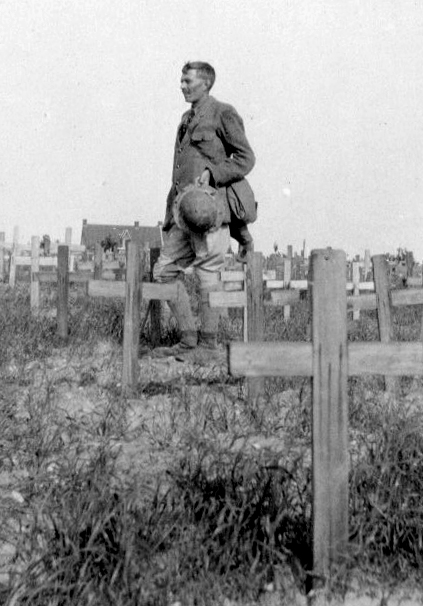
The photographs that follow are a selection from HW's own album of those that he and Gipsy took on their honeymoon visit to the Western Front in 1925. Most have HW's captions.

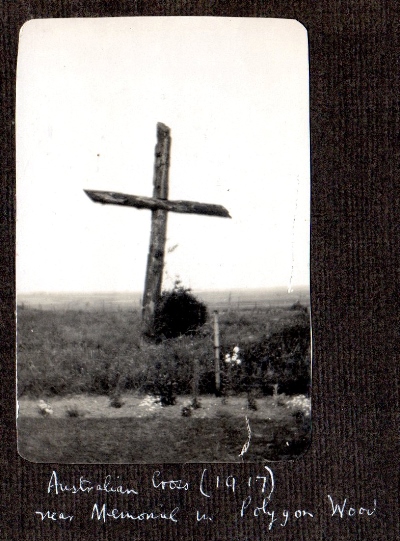

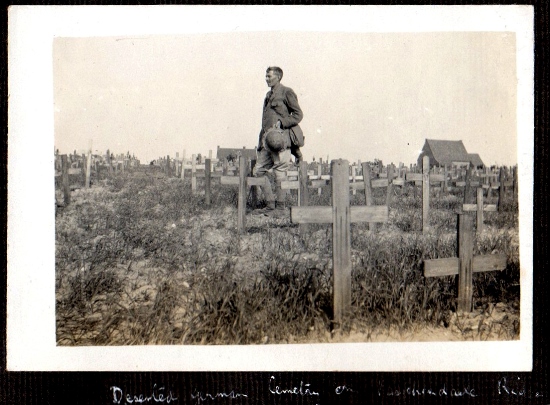

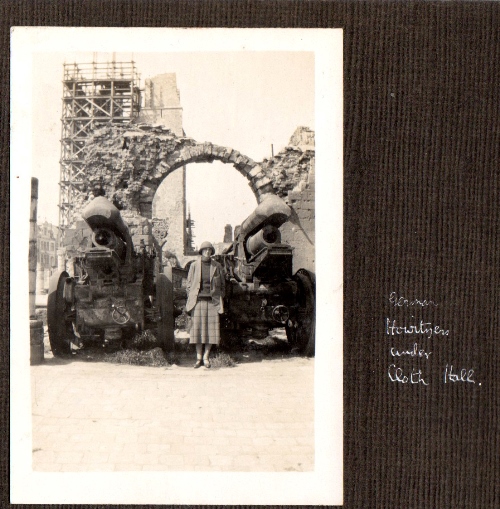
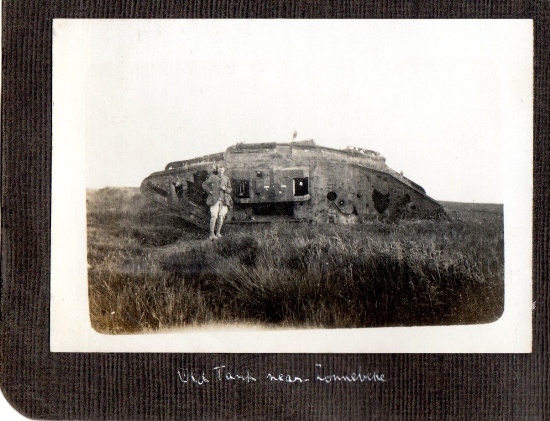
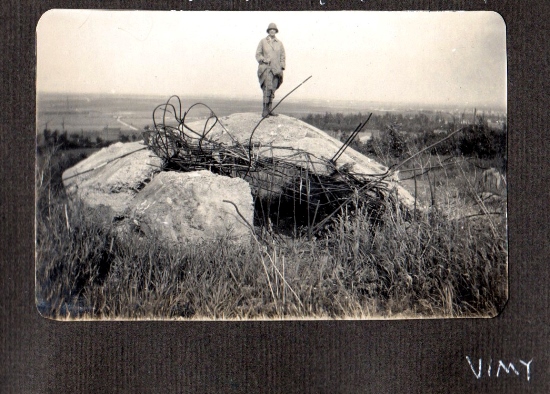


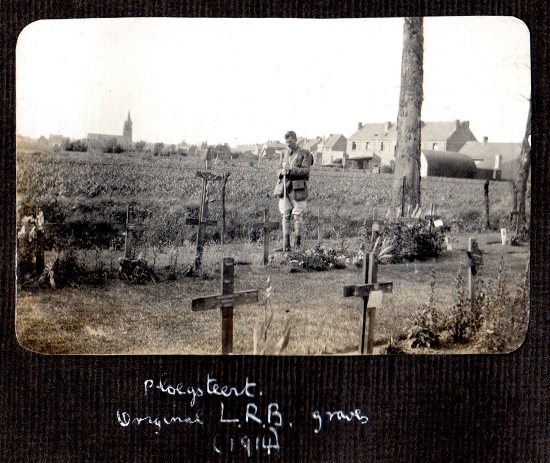
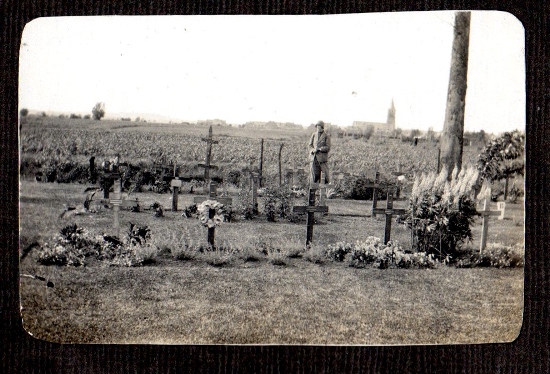


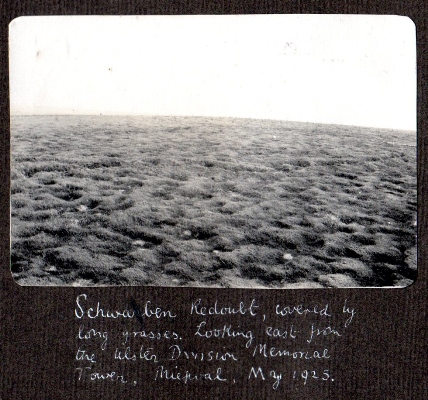
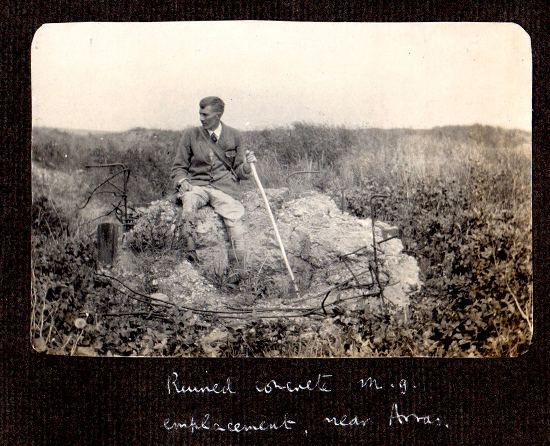
An unidentified mine crater – almost certainly Lochnagar crater, on the Somme, detonated on 1 July 1916:
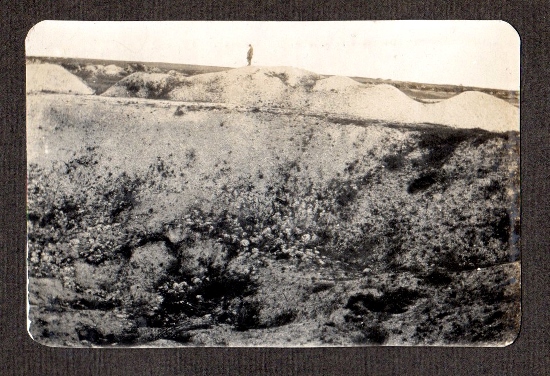

*************************
Postcards – three postcards sent by Henry and Gipsy while on their honeymoon tour of the battlefields.
From Gipsy to her brother Frank, posted 31 May 1925:
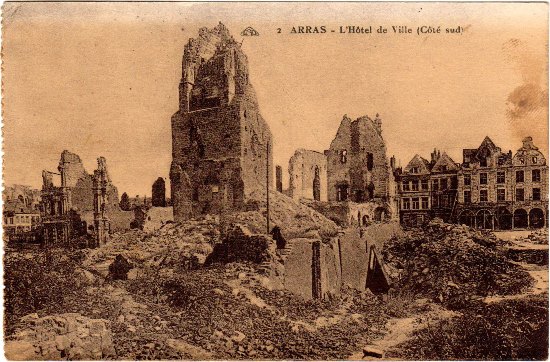
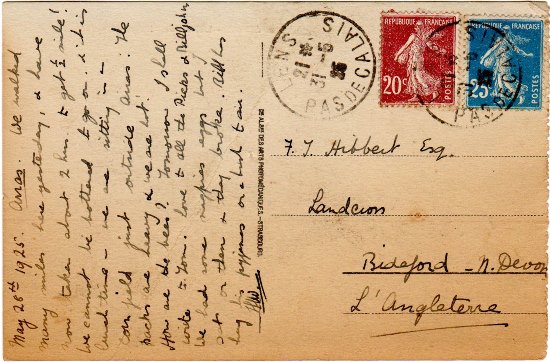
From HW to his father – for some reason sent to his place of work and forwarded on – posted on 1 June 1925:
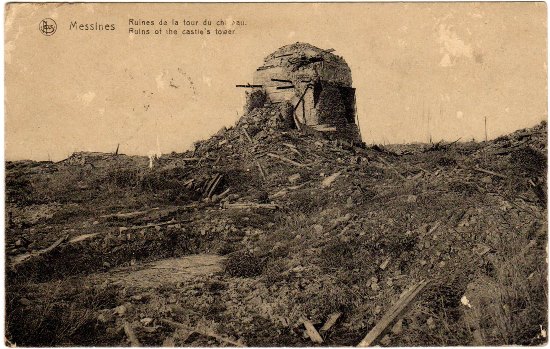
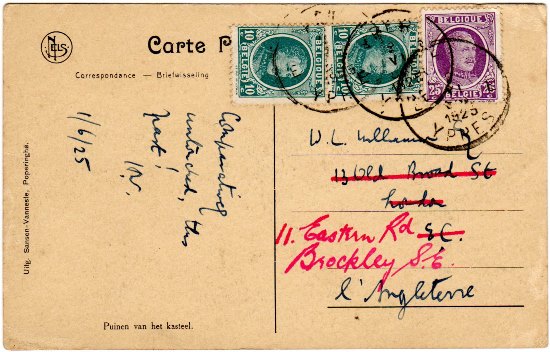
From HW to his mother, posted 1 June 1925:
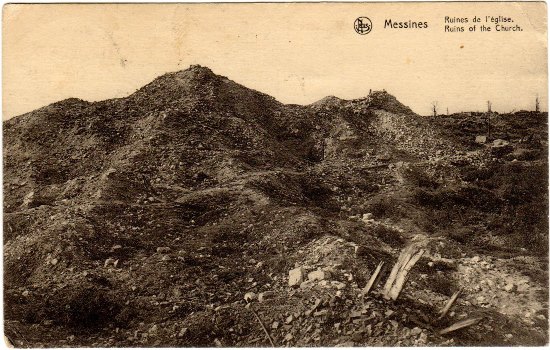
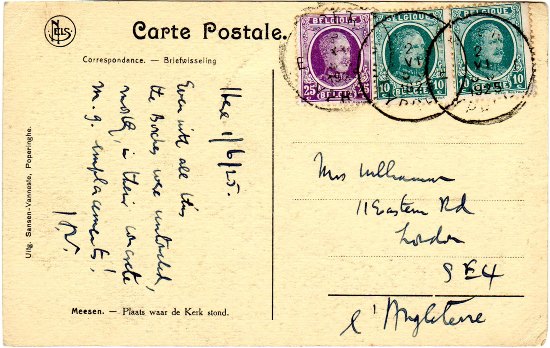
***************************
The area around Ypres (from Ypres in War and Peace – with modern spellings of place names):
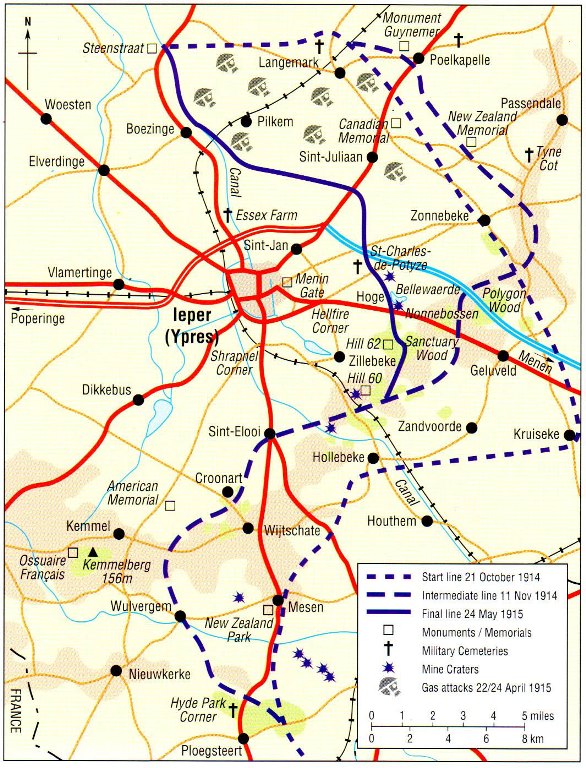
********************
The Ypres Salient: maps of the area north-east of Ypres and the area around Ploegsteert and Messines, dated 1924 (scale 1:40,000, but resized for this web page), that HW used on his 1925 visit:
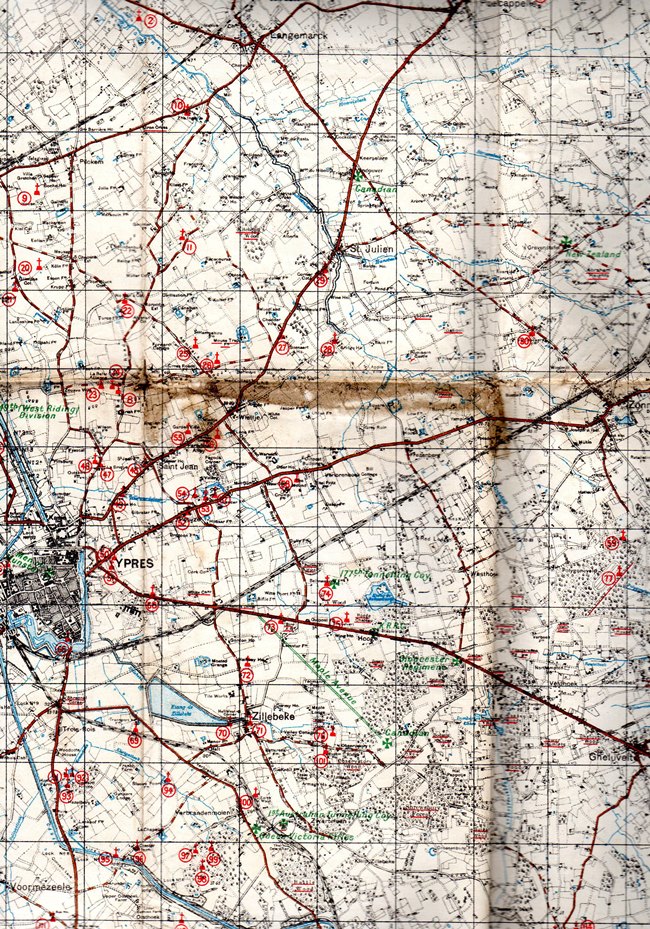
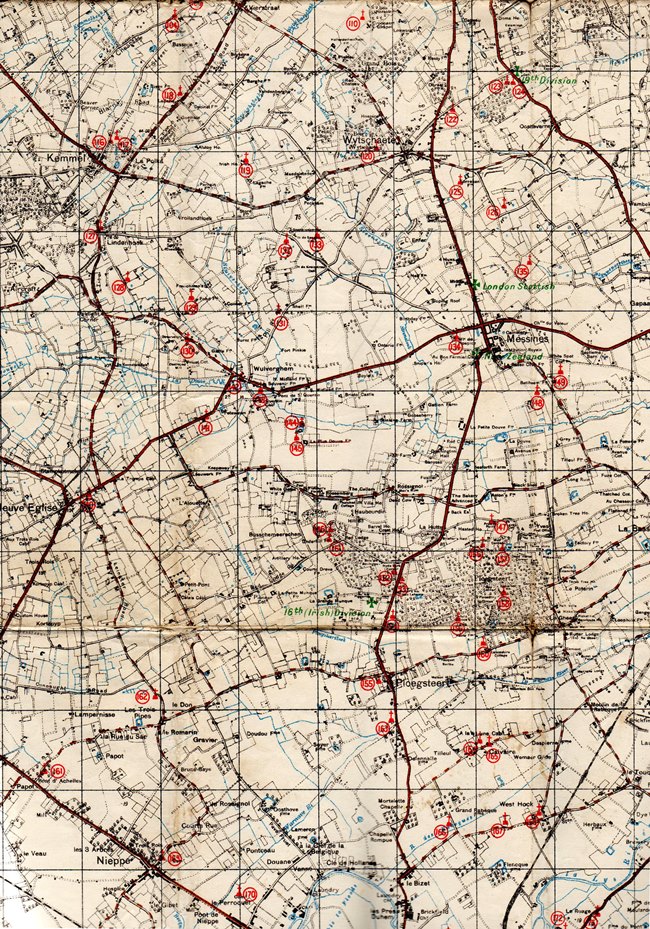
********************
A sketch of Ploegsteert Wood from HW's notebook, with his explanatory note:
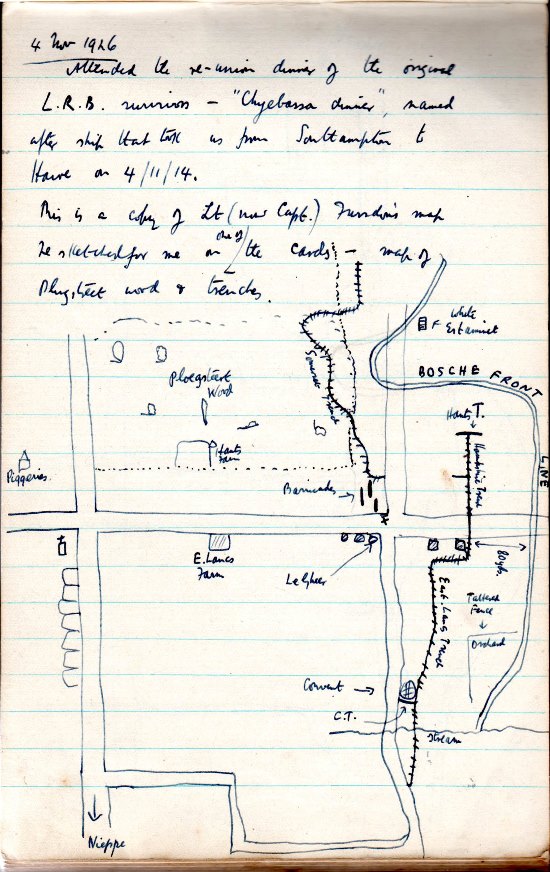
********************
A map of Ploegsteert Wood taken from a brochure produced by the London Rifle Brigade: 'Ploegsteert 1927 - The unveiling of the Commemorative Tablet in the London Rifle Brigade Cemetery at Ploegsteert on Sunday June 19, 1927':

********************
This map was used by HW on his 1927 visit, marked up with the places and dates where he was in 1917 and visited ten years later:
Back to The Wet Flanders Plain main page
Publishing history and Critical reception
The Wet Flanders Plain: Publishing history & Critical reception
Back to The Wet Flanders Plain main page
Photographs, postcards and maps

There is no background detail to explain the circumstances of any contact with Cyril Beaumont, but one has to wonder – by association – whether he had been recommended to HW by Kit Williams. HW returned from the Pyrenees on 16 January and must have immediately sent his manuscript off to Beaumont, as a letter from Beaumont dated 23 January acknowledges receipt of the ‘M.S. of the small travel diary’, followed on 26 January with:
I have read the M.S. of your travel diary “They Only Fade Away”, and I have been much impressed by its beauty and sincerity. I should be very pleased to publish it in my Beaumont Press Series, subject to my usual terms being agreeable to you. My editions consist of 300 on h.m. [hand-made] paper and 80 on parchment vellum, the latter signed by the author.
All his letters (there are about 13 of them in the archive) are handwritten in very fine and small script, with an attractive sage green heading at the top of the page.
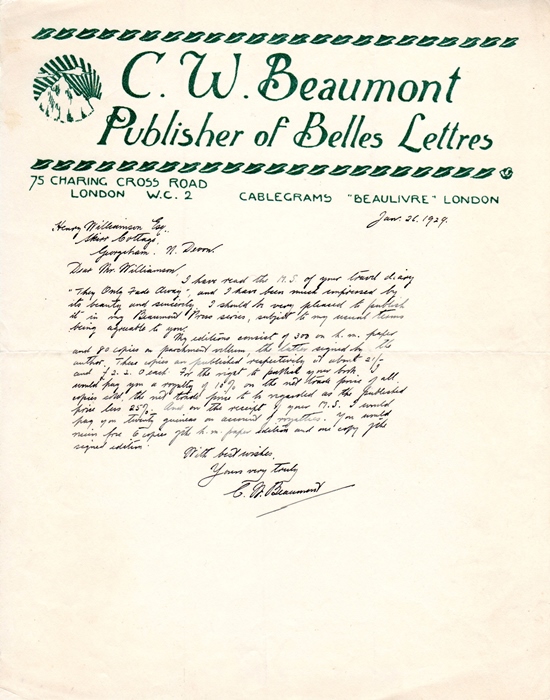
Beaumont’s terms were basically 10% royalty of the trade price ( which was 25% off published price). HW nearly blew this opportunity by querying these terms: 30 January brought a tart reply:
... up to the present I have published 22 books in my press series, by writers such as Conrad, Blunden, De La Mare, Drinkwater, Lawrence etc and this is the first time I have had my terms questioned... . These books are hand-set and printed on a hand-made paper specially made for me, decorated with one or more wood-blocks. The special copies are printed on Japanese vellum or parchment vellum ...
But he did increase the terms to 12½% of the trade price. HW caved in, and Beaumont’s next letter enclosed an agreement for signing, returning the MS and suggesting several ideas for a title (which HW had obviously asked him to do). One of these was ‘After Ten Years’, and HW has written in green ink at end ‘Ten Years After’. His diary entry for 12 February states:
Sent Ten Years After, mss, registered, to C.W. Beaumont for publication.
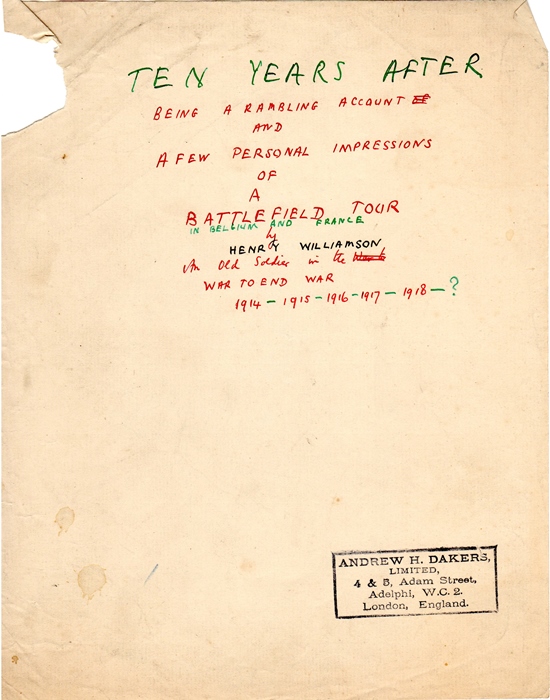
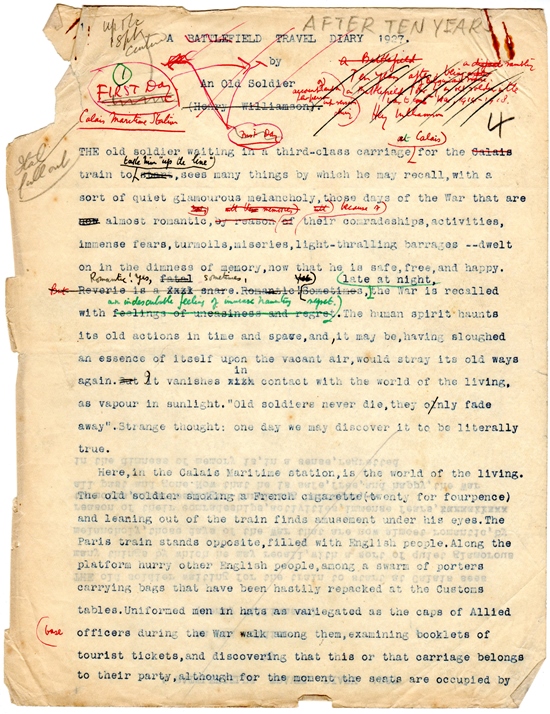
Beaumont duly acknowledged its receipt the following day, and forged ahead with all the work involved in setting the book up ready for publication. On 27 March, with this process well under way, a rather plaintive letter from Beaumont shows that HW wanted to change the title. The book was already set with ‘Ten Years After’ as the running page header, so this presented a big problem, adding considerably to the production cost, but Beaumont agreed to do this. His letter also reveals that HW had informed him that he had arranged for a cheap edition of the book (this was the Faber ‘trade’ edition) and Beaumont asks him to keep this quiet as it will possibly affect sales of the limited edition.
Meanwhile Schwabe had produced his design for the title page – to be the Menin Gate Memorial at Ypres (inaugurated in July 1927 but already in situ on HW’s June visit, of course). HW had not liked the first drawing (see Jeremy Archer, ‘A Literary Collaboration: The Wet Flanders Plain’, HWSJ 44, September 2008, p. 88), finding it too frivolous, so Schwabe modified it to HW’s own ideas – and subsequent approval.
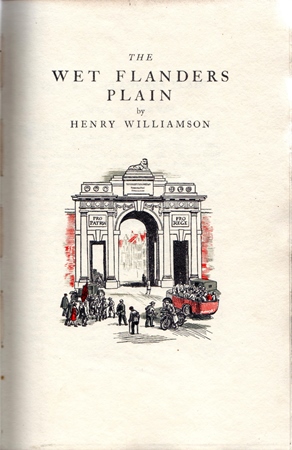
A further letter, on 16 May, reveals Beaumont’s anxiety about the timing of HW’s proposed trade edition. HW had said it would appear in October – Beaumont rather agitatedly asks for that date to be later, adding that the book is printed and being bound. Then a letter of 3 June states:
Enclosed I send you two copies of “The Wet Flanders Plain” Special Edition... . The book will be published on June 6th ...
He asks that the trade edition waits six months, the usual time lapse, thus 6 December, but ‘if necessary’ as late in November as possible. A letter of 17 June reveals that this limited edition of WFP was actually published on 12 June, and that some royalties are due; but ‘in view of the heavy corrections 2½% be deducted’ [as you agreed]. (Thus back to the original 10% net.) HW was incensed by this, felt he was being cheated, and sent the letter with his own typed acid comments (obviously having forgotten about the increase to 12½%) to Richard de la Mare at Faber. (Dick de la Mare – son of Walter de la Mare – was his friend and had been best man at his wedding, as well as being his publisher at Faber.) Faber of course would have wanted to catch the Christmas market.
In the accounts section of HW’s 1929 diary he notes:
1 August: Beaumont for W.F. Plain £40-8-9d
2 Oct.: Fabers for W.F. Plain £45 - -
The Wet Flanders Plain was published by the Beaumont Press in a limited edition of 400 copies. The first 80 copies (of which five were not for sale) were bound in quarter vellum with a decorative board design of rifles and ploughshares; the cover and title page were designed by Randolph Schwabe; it was signed by the author, artist and publisher, and published on 12 June 1929, priced at £2/10/- (£2.50).
The remaining 320 copies (numbered 81-400), were bound in quarter buckram, with same decorative board design, published in June 1929 and priced at £1/5/- (£1.25).
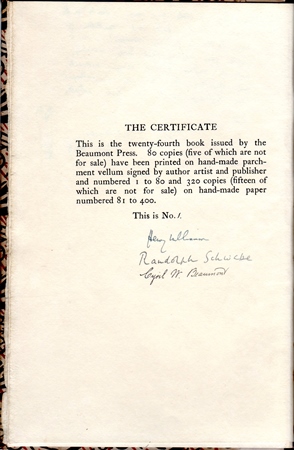
There is a Beaumont Press ‘colophon’ at the end of the book:
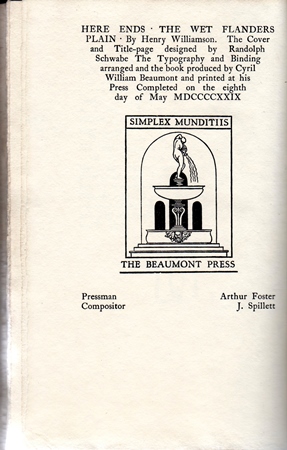
Out of 122 pages there are only 90 pages of actual text (there are a lot of ‘extravagant’ blank pages between sections). Most text pages probably contain about 300 words, making 27,000 words in total: a relatively short book – especially for HW!
Cyril Beaumont (1871-1976) was a quite extraordinary man who, although he became the owner of a bookshop in 1910 and set up the Beaumont Press in 1917, is chiefly known for his work in the world of ballet (where he is very famous), writing many books and articles on the subject (including a manual of the Cecchetti system of classical ballet). His prestigious Beaumont Press series of books included such names as D. H. Lawrence and Joseph Conrad.
Randolph Schwabe (1885-1948) was a well-known artist mainly of architectural subjects who was an official war artist. He succeeded the famous Tonks as Professor of Drawing at the Slade School of Art and was one of a small group of artists regularly used by Cyril Beaumont.
(For background information about the Beaumont Press, see Jeremy Archer, ‘A Literary Collaboration: The Wet Flanders Plain’, HWSJ 44, September 2008, pp. 83-90, reprinted with some changes in Stand To! (the journal of the Western Front Association), 93, Dec. 2011/Jan. 2012.)
**********
Faber & Faber: trade edition, slightly revised, autumn (probably early November) 1929; 5/-; 2990 copies (according to Waveney Girvan’s A Bibliography and a Critical Survey of the Works of Henry Williamson (1931) – but as HW supplied much of the information this is not necessarily accurate – more probably the actual round figure of 3000!). This edition has a small deletion and rephrasing within the ‘Apologia’ which improved it a great deal. The dustwrapper is a classic Faber design of the period:
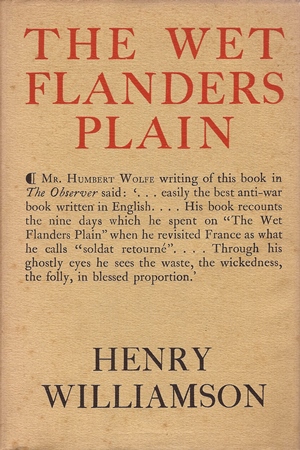
This edition also carries a quotation on its title page:
‘... lost forever in ancient sunlight, which rises again as Truth’
(unattributed but from Richard Jefferies, The Story of My Heart).
It is dedicated ‘To C. R. W. Nevinson’.
Christopher Richard Wynne Nevinson (1889-1946) was a well-known artist with a flamboyant and fiery character, who had been a founder of the Futurist Movement. He was an official war artist and his work was very powerful. HW was taken to a party given by Nevinson by another friend, John Heygate, soon after HW had won the Hawthornden Prize. An account of that party can be found in The Power of the Dead (Vol. 11 of A Chronicle of Ancient Sunlight) chapter 9, ‘Bottle Party’, where Nevinson is called ‘Channerson’. But HW also records in his 1929 diary on 2 May: ‘Nevinson, Cocktail Party 5 p.m.’. A cutting from the Daily Mirror dated 4.5.29 tells us more:
PEAR-TREE PARTY
Mr. C.R.W. Nevinson hit upon a novel idea for a party when he invited his friends to his studio on Thursday to inspect a pear tree which had just burst into bloom in his garden. Among those who came to admire Mr. Nevinson’s tree and drink his cocktails were Mr. Williamson (the winner of last year’s Hawthornden Prize), Mr. A. Neil Lyons, Mr. Ernest Milton, Mr. Morris Harvey and Miss Kathleen Hilyard.
This would seem to be the occasion when Nevinson gave HW a drawn (or etched) version of his famous painting ‘A Group of Soldiers’; it may well be that HW’s subsequent dedication in The Wet Flanders Plain later the same year was in return for this most generous gesture. The soldier facing the front bears a distinct resemblance to HW, which may have been remarked upon at that party. (Further discussion of this can be found in AW, ‘A Group of Soldiers’, HWSJ 44, September 2008, pp. 94-6.)
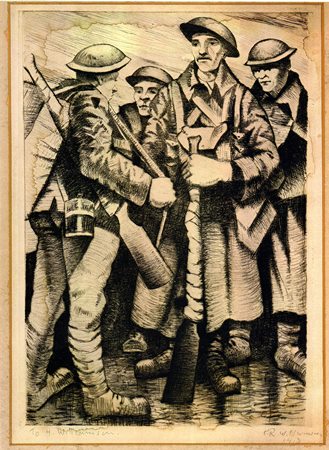
**********
American edition: Dutton (USA), as Faber text, (seemingly end of December) 1929.
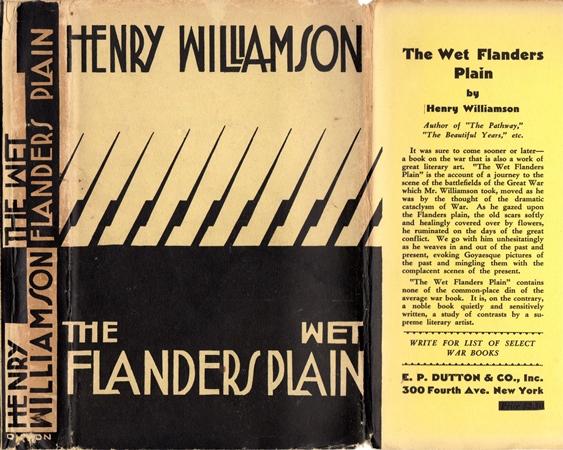
**********
Reprinted by Gliddon Books, hardback & paperback, 1987, in their ‘Great War Classics’ series, with an Introduction containing interesting background by Richard Williamson, and also including HW’s 1964 articles for the Evening Standard, ‘Return to Hell’, commissioned to commemorate the 50th anniversary of the First World War for which he made a further visit to the battlefields, and a selection of photographs from HW’s own archive. The front cover of the hardback featured a photograph of the young Henry in early 1915, back from the Front, and with torn greatcoat; while on the back cover was a photograph of Henry on the battlefields in 1964. The paperback edition, on the right below, reversed these two photographs.
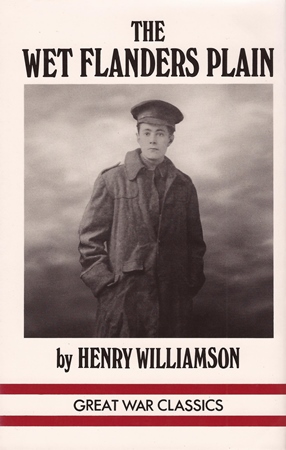
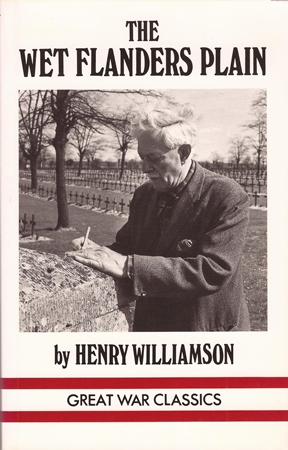
**********
Currently available at Faber Finds, 2009; also available as an e-book. This is a reprint of the Gliddon edition.
Referee (W.E. Hayter Preston), October 1929. In a column which covers several war volumes the reviewer opens:
Mr Henry Williamson’s passionate hatred of war finds expression in all his books; but in The Wet Flanders Plain his hatred is orchestrated to sublime power. It is a record of nine days which he spent in Flanders as a “soldat retourné” – a record of remembered horrors and ghostly glory – set down in a beautiful and sensitive prose. So many War books are merely skilful reporting; but here the creative element is always at work like yeast beneath the details and debris of battle; and the tragic evil of it all is presented with glowing menace ... As the record of the spiritual effect of war on a sensitive personality the book is unrivalled. It should be read by all who, for the betterment of the world, would sound the full depths of human folly.
The reviewer continues here most fortuitously with Plain Tales from Flanders (Longman, 3/6d) by the Rev. P. B. Clayton, MC – ‘Tubby’ Clayton of the Toc H Chapel at Poperinghe:
They are tales filled with that inner light which shines like a torch above all the filth and beastliness of war.
Glasgow News, 10 October 1929. Ten column inches of excellent summing up of the content ends with:
Through this little book of many fine passages and of deep understanding and feeling runs the note of tears unshed that so much should have been lost and so little should have been learned.
Aberdeen Press and Journal, 21 October 1929:
BOOK OF THE WEEK
A Soldier Returns to Flanders
(The text is very similar to the Glasgow News review above but ends:)
... We do not know of a stronger anti-war book written in English than this of Mr. Williamson’s. Through his eyes we see the waste, the wickedness and the folly of war; that so much should have been done and so little learned.
“Once these were men who, having marched where they were ordered, and having done what they were commanded, after endurance and suffering, fell, and were lost.”
No fitter words could be written as a memorial to them.
The Observer (Hubert Wolfe), 28 July 1929. Four war books were reviewed:
Ludwig Renn, War (Secker 7/6d)
Ernst Jünger, The Storm of Steel (Chatto & Windus, 7/6d)
Charles Edmonds, A Subaltern’s War (Peter Davies, 7/6d)
Henry Williamson, The Wet Flanders Plain (C.W. Beaumont, 25/-)
A very interesting review, quoted here at length because the analysis broadens the concept of ‘war-book’ and further, lays down a perceptive marker for HW’s ‘moral’ character:
Books about the war have again, after a period of extreme disfavour, become the fashion. But they are different books. The earlier ones were written by the leaders – exalting and defending their failures. The new are being written by the led, and they do not exalt, and rarely defend their leaders... . I believe it is the duty of every man, who can get an instant of public attention, to do his utmost to discredit everything that makes war possible.
[But such a book must not be flabby or insincere or sham. Note Wolfe is somewhat dubious about Remarque’s All Quiet on the Western Front, as HW was also.]
War-books, unlike other forms of literature, may be judged by two standards – one of morals and one of art.
[Wolfe judges Renn’s book to be the best, but he questions its absolute validity:] I cannot help asking myself if Renn is not at bottom criticising failure rather than the principal of war itself.
[He does not rate either Jünger’s The Storm of Steel or Edmonds’ A Subaltern’s War:]
Both from different angles sentimentalise war. Mr Mottram argues in his preface to Jünger’s book that it is the very blindness of his author to the facts he recounts which makes him a testimony against war. I do not believe it. I think on the contrary that the effect of both these books – neither of them of any literary value and both therefore to be judged by the first standard [the moral standard] ... [but both these authors] encourage [the idea] that ‘bad as war is, there is a worse thing – to lose one’s own soul. That is a fallacy. It will profit a man nothing to win the world and lose his soul and as little to save his soul and lose the world. If the cost of rejecting war is to reject one’s own salvation, that price must be paid.
And Mr. Henry Williamson, in easily the best anti-war book written in English, would be willing to pay even that price. [I have underlined that as I consider it to be of importance as a (very percipient) marker for HW’s personal moral code – integrity – particularly with regard to the future.] But as he himself knows, he is not a soldier, but a ghost returning – a gentle, wise, unembittered ghost, with a little of the sanity and some of the knowledge that we must suppose waits for us beyond the grave. Through his ghostly eyes he sees the waste, the wickedness, the folly in blessed proportion. He has suffered too much to judge; he records, leaving sentence to the conscience of all good men.
The Nation and Athenæum (Robert Graves), 10 August 1929:
[Two] More War Books: A Subaltern’s War, Charles Edmonds
The Wet Flander’s Plain, Henry Williamson
I cannot like either of these war books though they are written from exactly opposite points of view. [Graves sees many faults in Edmonds’ book and ends:] Mr. Edmonds is still war-minded and writes about “Russia deserting her allies” in 1917 and about the “yellow streak” of pacifism.
Mr. Williamson’s book is an all-yellow anti-war tract, the nine-days’ diary of a recent visit to the battlefields. It is beautifully printed, so beautifully printed in fact that it is a little difficult to read. He has made the not very remarkable discovery that Belgian peasants feel no sentimental friendliness to ‘soldats anglais retournes’ ...
Graves continues in this scathing tone though he does allow that the author ‘seems to have been a stout trench-fighter in his day’. [Graves was of an extremely irascible temper and nature, and this animosity around HW was to surface again over the publication of HW’s The Gold Falcon in 1935.]
G.K.’s Weekly (A. M. Currie), 9 November 1929. Headed ‘Evolution of Pacifism’, this review opens with an analysis which Currie then uses as a criterion for his conclusions:
It provides a key to much of the pacifism which has sprung up since the war – I mean the honest pacifism of men who fought bravely and were sickened of the whole business – that the issues in which it originated were so tremendous, so involved, and in some part so obscure that it is not always easy to select the salient facts and to keep them constantly in mind.
[Currie decides that England was right to go to war and that] her rulers at that time were for the most part, impelled by honest motives in deciding for war. But I recognise that a case can be made on the other side [and he gives some argument for this].
[Currie then proceeds to compare Commando by Deneys Reitz, the memoirs of a Boer about the Boer war, with HW’s book, ‘a medley of memories of France and Flanders’. He finds HW ‘writing in a spirit of railing against his people for their folly and their iniquity in having fought’ – it being inconceivable that a Boer would do such a thing. It is obvious that Currie finds the Boer volume full of deeds of ‘derring-do’ written in ‘clean, straight English’.]
To come to Mr. Williamson’s book ... I just don’t like it. Mr. Humbert Wolfe is said to have described it as “easily the best anti-war book written in English” ... I ... will say “Tiggers don’t like anti-war books.”
There is a gelatinous quality about Mr. Williamson’s style which, admirably as it suits the more tricksey of his work, makes for heavy going in an essay of this sort... . I disagree with Mr. Williamson [but] I am sure the book will be read with pleasure in that market for which it was written.
The Times Literary Supplement, 11 July 1929 (unsigned):
Mr. Williamson ... is no ordinary tourist, but a ghostly revisitor, a revenant, a spirit come back to haunt the place where it received its deepest impress... . This is only a book of scraps, of disjointed observations and reflections, but there is throughout this accent of intermittent deep seriousness, making for eloquence. This eloquence is most sustained in the introduction, an ‘Apologia pro vita mea’, which defines an emotional attitude almost too unrestrained to be effective. [The reviewer quotes the sentence about HW’s father calling him a traitor – which was indeed removed from the later trade edition.]
Good writing ... must be impersonal: it must attempt to be universal... . [Mr. Williamson] tells us in this diary that he is writing a War novel, or series of novels... . It is difficult to disguise one’s spleen in a diary; but a novel should be a stricter discipline and the very defects of the present slight work are an earnest of strength for the greater task in hand.
*************************
Reviews of the US Dutton edition follow. It might seem rather a strange book to be published in the USA. The text seems rather particularly British, and the many place names possibly obscure even to British readers other than WWI enthusiasts then, let alone now (hence my rather detailed commentary), and I have wondered what Americans would have made of it: but to use today’s jargon – obviously ‘no problem!’
Washington News (L.A.M.), 9 January 1930 (also reprinted in other newspapers):
Probably most of us are getting a bit case-hardened about war books ... Nevertheless we recommend Williamson’s work to you, and recommend it very emphatically. It is unlike the rest of the war books. It is very short and very beautifully written – two qualities which few other books have ...
Williamson fought with the British, in the Ypres sector and to the South. He simply tells what he saw, what he felt, when he revisited the scenes of his war-time experiences. He writes like one of those favoured few who are born into this world for no other purpose than to put words together on paper; his book ... is one of the very best war books yet written.
TOPEKA, Kansas, 29 December 1929 (quoting from a review by Herschel Brickell):
WAR BOOK BY PACIFIST
Just as we had finished reading “Wet Flanders Plain” we came upon this review of the book by Herschell Brickell, the distinguished literary editor of the North American Review [Unfortunately that review is not in the archive collection, but a large section of it would appear to be quoted here.]
... Henry Williamson has added a poignant protest to the flood of argument against the cruelty, brutality, and futility of warfare. [Suggests The Pathway and the nature books have shown this, then describes the book’s content – the attitude of the Belgians to a “soldat anglais retourné”.]
And what a contrast between Mr. Williamson’s kindly attitude toward the greyclad men in their scuttle helmets, once known as Huns, and now sleeping in uncared for cemeteries! Or between the popular conception of the character of the enemy, and Mr. Williamson’s touching description of [the careful burial by the Germans of an airman ‘who fell in Battle July 14, 1916’.]
[The father of a small boy] asking: “Shall the world return again to its supreme folly as a dog to its vomit? [The answer will be no] if enough people read and understand such books as “The Wet Flanders Plain”. It is a war-book of a different sort from most, and it deserves to be read for its intelligence and fine spirit.
Star Telegraph, Fort Worth, Texas (Mary Sears), 5 January 1930:
[WFP] is a study of contrasts, quietly and sensitively written by a supreme literary artist... . The book is so skilfully written and so delicately etched that the past and present mingle with each other; that the hideous scenes of the past mingle with the complacent scenes of the present, quietly and naturally, giving the reader the feeling of double vision.
It has been said that a book of the war that would also be a work of literary art must surely come and those who have read “The Wet Flanders Plain” whether they were a part of the vast horde of German or Allied armies, seem of the opinion that this is the book.
-------- (unreadable). Portland, 28 December 1929
Henry Williamson, whose reputation as a beautiful writer ... whose love of nature is ever apparent in his writings has ample opportunity in this book to express himself nobly and sensitively. It is not a blaring attack upon war. Mr Williamson does not rave ... in quiet fashion he presents his observations, his impressions, and blending these with his memories, forces one to deeper conclusions [than others of lesser artistry]... . There are beautiful pictures of the countryside which a decade ago was laid waste by war. Mr. Williamson looks ... and thinks: ‘I will renew the truths which have quickened out of their deaths ... We must free the child from all things which maintain the ideals of a commercial nationalism’ ... [but] He sees that old race hatred still exists in the hearts of many and he sorrows.
Raleigh Times, N.C. (North Carolina), 1 January 1930 (34-inch column, signed ‘D’). This enthusiastic reviewer relives his own experiences: I only wish we could print it all. Note that he uses HW’s headings with his own additions.
WET FLANDERS PLAIN BRINGS BACK MEMORIES OF OLD 30TH DIVISION
Henry Williamson Visits Spots on Return Pilgrimage to Belgium and France
Where North Carolinians Fought in Summer and Fall of 1918
... Henry Williamson has written a little volume that is a thing of beauty... .
[WFP] will go at once to the heart of many North Carolinians ... who were members of the 30th Division. Few of them have returned to view the scenes of their conquests but in Henry Williamson’s little book they will find the next best thing to a return pilgrimage ... The author follows the same trail as the Old Hickory took in its war journeying through the summer and fall of 1918.
Calais, Bombs and Waacs
Who in the 30th could forget Calais ... the old Sand Camp ... a British diet, mostly jam and tea ... bombs dropped like rain ... Waacs – and romance, if you can call it that ... for many a Tar Heel Doughboy ...
St. Omer Recalls a Hike
Mr. Williamson stops overnight at St. Omer just as the men of the 30th did on that late June and July hike in 1918 [where they met] ‘A Scotch Captain attached to the 60th Brigade [who had been out since 1914 and was going around with a cart full of Scotch whiskey] This dapper little man in kilts found his war easier to digest with a wee dram or two along the bumpy roads that ran serpentine courses to and from the lines.
...
Mr. Williamson goes to Poperinghe and recalls the old “Pop” as he knew in the war days and as the men of the 30th Division remember it ... Mr Williamson tells us about a town restored and going about its daily business of living a normal life.
About a Famous Road
Not far away is Ypres, the “Wipers”of 1918 where the first German gas killed thousands. Members of the 30th Division remember that duck-board road that leads from “Pop” up to Ypres, a road through the wilderness of mud and destruction. There is Vlamertinghe, wiped off the face of the earth by artillery, Dickebush, Rifle Farm. Hill 60 in the distance. Death Corner and a long list of other spots that will forever be sacred to men who knew them in the days of their greatest tragedy... .
The author trekked down the old line of the Western Front ... We wonder what has ever become of the British Captain we saw one afternoon in an estaminet in St. Pol, dressed in the panties of a French bar maid, a Sam Browne belt and nothing else... .
The Wet Flanders Plain is choice meat for those who served in Belgium and with the British in France. The book is done seriously and writing that is not seen every day shines from its every page. We hope Mr. Williamson will pardon us for the personal reminiscences, but we hasten to thank him for the fond recollections recalled by The Wet Flanders Plain after staying dormant in our thinking machine for so many years.
There are in particular two letters in the archive which are practically reviews of the book. One is from Coley Taylor, who worked for Dutton Publishing, but who also sent HW personal letters as a friend. Dated 5 June 1929, the letter is therefore before publication of the book, but he has obviously had a proof copy (sent out for Dutton’s to work from) and sends a measured response.
... I think you have written a splendid book, a fine, ironic record that is revealing in its contrasts, and we need that record just as it is. I’m afraid it will not be very popular. [gives some reasons for that – present attitudes to war books] ... Flanders Plain is as beautiful as it is unique. I delight in you for writing it... .
[He continues with a paragraph about the American elections and Hoover] ...
If only the U.S. would cancel all war debts of every kind, and insist on the relinquishment of reparations, I think there might be very good chances for real international friendship. There are a great many Americans that believe that and want it badly, but it won’t come, if ever, for some years yet... .
In reading Flanders Plain I winced at your portrait of the Americans you met – winced knowing that it, and they, were only too true, and too often true. I apologize for them. There are a lot of them, God knows. I hope some day you will know a different sort of American ... if ever you come to see us ...
Yours most sincerely, Coley Taylor.
It is surprising that no USA reviewers mentioned HW’s rather pointed references to the behaviour of Americans he met on his visits!
The second letter is reproduced below as it deserves full coverage.
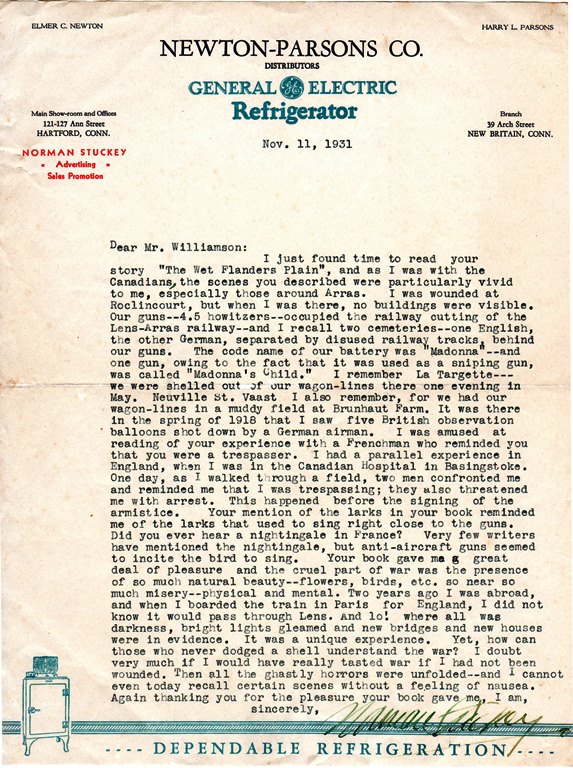
But there was one review which HW obviously really treasured above the others as he pasted it into the back of his file copy of the US edition. It had appeared in the New York Times on 8 December 1929. The writer (not named) truly understood the book’s content and what HW was trying to achieve.
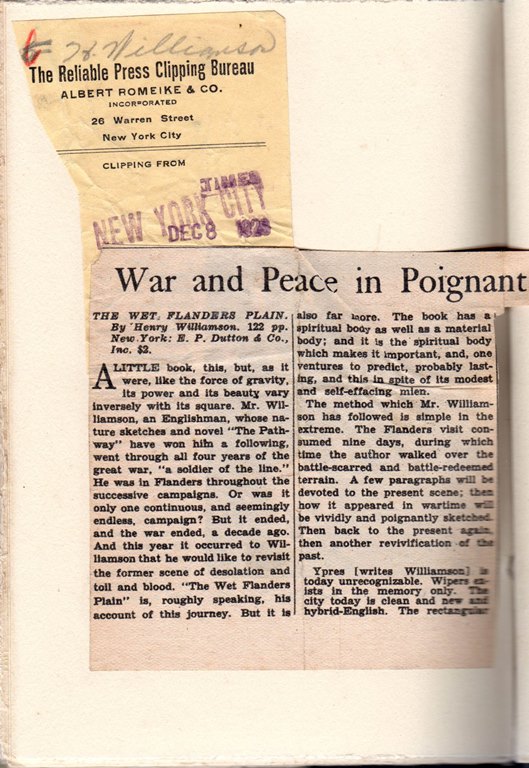
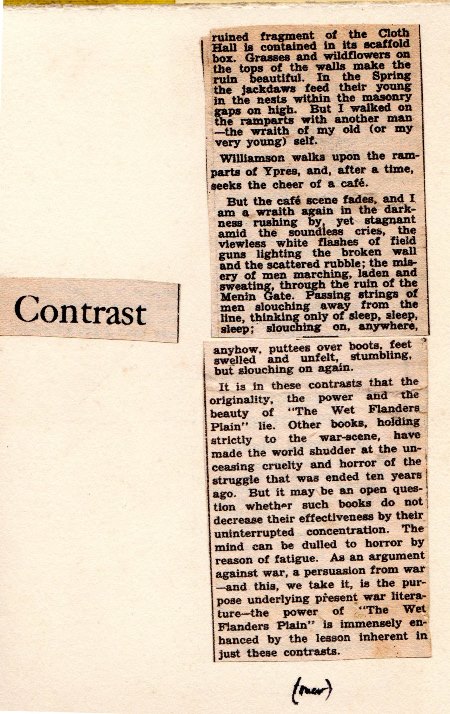
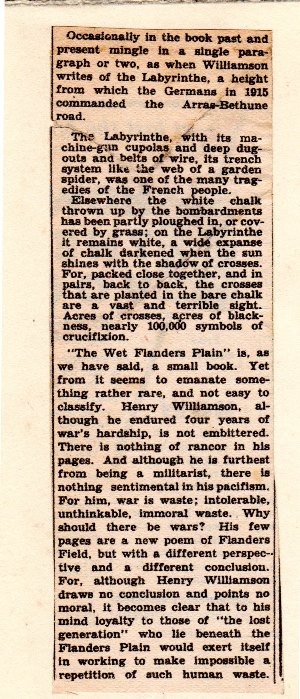
It is noticeable that many of these reviews refer to HW as ‘pacifist’: a concept that needs to be taken into account in one’s over-view of HW.
*************************
Back to The Wet Flanders Plain main page
Photographs, postcards and maps