
The Henry Williamson Society
Uncategorised
Love and the Loveless - Critical reception
Back to Love and the Loveless main page
HW's photographs from 1917 (208 MGC)
Critical reception:
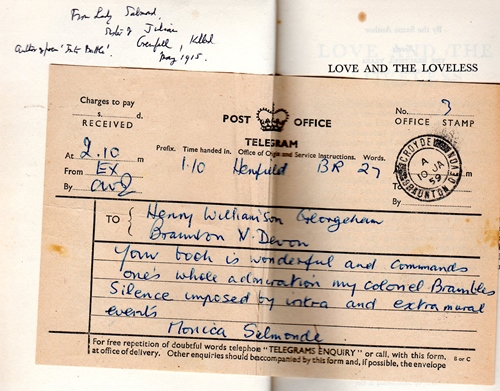
Pasted into the front of his own copy of Love and the Loveless (together with the commemoration cuttings for the 'Boy General', Roland Bradford) is a telegram from Lady Monica Salmond, sister of Julian Grenfell whose poem 'Into Battle' meant so much to HW, and whom he incorporated to a large extent into his portrait of 'Spectre' West (see A Fox Under My Cloak):
It is clear that at this time there were a large number of books being published on the Second World War: the tone of some reviewers reveals a slightly weary attitude towards war books in general.
Pre-publication notices appeared in:
Publisher’s Circular, 18 and 25 October 1958:
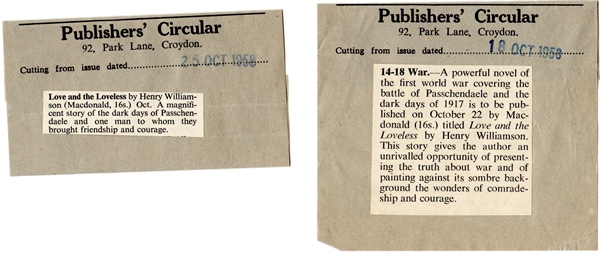
Similar notices appeared in The Bookseller, 5 July 1958 and 18 October 1958.
Yorkshire Post (Phyllis Young), 6 November 1958:
“Love and the Loveless” . . . describes the most sombre years of the First World War . . . It is written with utter devotion to the nightmare as Mr. Williamson himself knew it. . . . For in the world of death . . . there remains loyalty; there is mutiny, and poetry . . .
This, remember, is “chronicle”, its effect is achieved by narration supported by fact, without attempt to concoct dramatic moments, and it is all the more powerful for that. [This book] puts Mr. Williamson, as a writer on the First World War, where his “Tarka the Otter” put him as a nature-writer – in the first rank.
News Chronicle (David Holloway):
In Love and the Loveless Henry Williamson continues with the seemingly endless saga of Phillip Maddison, the socially unsure subaltern who fights the Germans he does not hate on behalf of the neighbours he does not love . . . the best thing in the book is the quite brilliant description of a mutiny in a base camp . . .
Sunday Graphic (Maurice Wiggin), 2 November 1958:
The great writer Henry Williamson, whom I am proud to call my friend . . . many people think of him as “just a nature writer”. He is “a nature writer” . . . but to Henry Williamson his nature books, though they are luminous with insight and love, are only a sideline.
He is engaged on a tremendous series of novels . . . they are adding up to one of the few truly great achievements in twentieth century fiction. The latest, Love and the Loveless, is a terribly vivid and moving story of Phillip Maddison’s experiences in the darkest year of the war, 1917. Williamson’s gift of recreation has never been displayed more magnificently. Nor has his compassionate vision shone more clearly. . . . Together these books add up to a historical novel on the heroic scale, as big as “War and Peace”.
The Daily Mail (Kenneth Allsop),1 November 1958; Allsop’s main article covers an amazing interview with James Jones, author of From Here to Eternity (bestseller and subsequently a cult film): a side column ‘Book-Ends’ covers HW’s novel – perhaps revealing that coolness that had sprung up between them since Allsop’s review of the previous book in the series, The Golden Virgin, where he mistakenly stated that HW had been awarded the MC, to HW’s embarrassment.
Henry Williamson’s spiritually maiming experiences as a front line soldier in the mud and murder of the Western Front have never far left his mind. . . . Standing by itself the novel is true, compassionate and an almost unbearably vivid revelation of those forgotten men in that distant nightmare. Also, it is an additional stone in the important historical monument that Williamson is building in intensely felt words.
Eastern Daily Press (Doreen Wallace), 18 November 1958; having led off with two ‘country books’, Lindy by Basil Davidson and The Long Meadow by Katherine Morris (both appear to be love stories!):
Henry Williamson is not country in Love and the Loveless: he is World War One . . . Mr. Williamson is a very good writer [but] on the whole I am against the modern fashion of saga-writing.
Manchester Guardian (Norman Shrapnel), 11 November 1958, repeated 27 November:
With Henry Williamson we seem to peer through a reversed telescope. The 1917 scene looks sharp and small and impossibly distant – the cavalry drill, the mules, the dashing-emancipated girls in bars, and then the horror of the trenches. It is a feeling book . . . without anaesthetic . . .
Glasgow Herald (Frederick Porter), 13 November 1958:
Love and the Loveless is a fine remembrance of the First World War . . . narrates a plain “soldier’s tale” of the disastrous year 1917. Maddison is a transport officer at Vimy Ridge, Passchendaele and the Ypres Salient. He remains unembittered and compassionate towards his comrades and the enemy throughout frequent injustice and every beastly horror. The battles are pulverising and the documentation . . . faultless and complete. A book of great human sympathy and professional skill.
Yorkshire Evening Post (C.R.B.), 14 November 1958:
. . . Some events in our history, in terms of human misery, are beyond adequate description: the 1914-18 war is one of them. Henry Williamson, however, has got nearer than most writers . . . The highly individual Phillip is something of a rebel. He finds discipline a hard pill to swallow, which often lands him in trouble. He puts his own opinions first and acts accordingly; he is forever questioning the decisions of his superiors. . . . We sympathise with this square peg in a round hole . . . but we have to agree with the commanding officer who once told him: “You’re such an ass” . . .
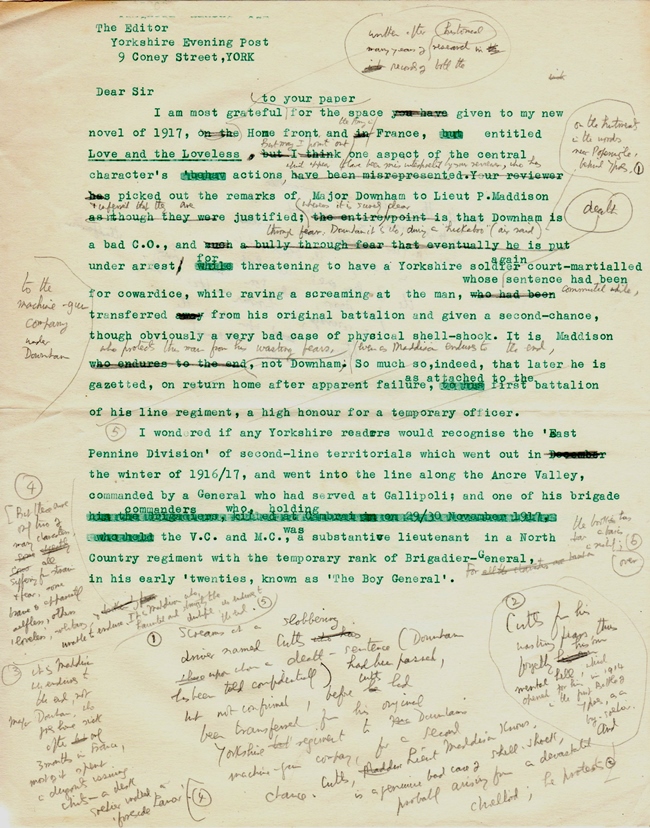
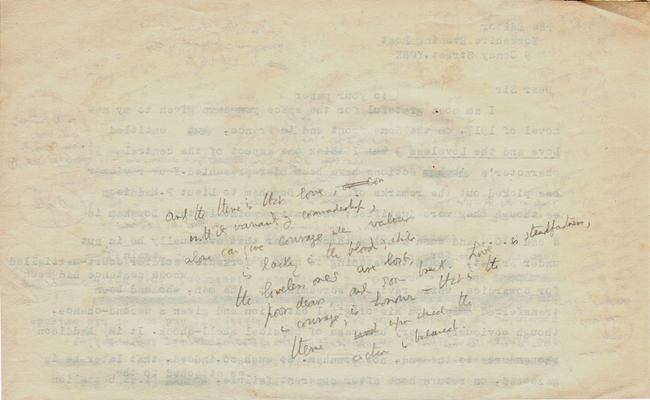
HW rather took exception to the above review and wrote a heated reply, of which there is a draft copy in this file:
The Scotsman,15 November 1958:
“Love and the Loveless” is the seventh volume of Henry Williamson’s remarkable chronicle . . . Mr. Williamson’s capacity for recreating, after some 40 years, the living detail of an epoch is continually astonishing. There are chapters in the novel whose evocation of sights and sounds is so full and true that they might have been written yesterday. . . . This is essentially a personal story, a sympathetic and reflective view of life in the trenches during the First World War, poles apart in spirit and treatment from “All Quiet on the Western Front”.
Sunday Times (J.M.), 16 November 1958; contrasts Love and the Loveless to Of Lesser Renown by Laurie Andrews, set in Burma during the Second World War:
Mr. Williamson on the other hand, in a tradition that dates back to Edmund Blunden and Siegfried Sassoon, is concerned with the sensitive individual. His picture of France and England during the bleak horrors of 1917 is enormous in scope and intensely detailed. The series is an impressive undertaking. . . .
Scarborough Evening News, 20 November 1958:
How vividly Mr. Williamson shows the differences in feeling of the fighting forces in the two world wars. It was never difficult to inspire hatred of the Nazis, an enemy whose creed involved persecution of an innocent minority. But . . . in World War I the British soldier had a respectful sympathy for his enemies. Into his novels Mr. Williamson cleverly conveys this spirit – the spirit of hapless human beings pitchforked into a common holocaust for a cause that was bewildering vague. . . .
Evening News (John Connell), 20 November 1958:
A strong sad courageous novel which recreates with great fidelity the sense of the ordeal which was life for an infantry officer on the Western Front in 1917.
The Observer (W. John Morgan), 23 November 1958:
Time and Tide (Fred Urquhart), 22 November 1958:
[Love and the Loveless] can be recommended wholeheartedly whether readers are familiar with the previous volumes or not. . . . Phillip now an officer in a Transport company . . . at last gets first hand contact with “the donks” or mules. This contact leads to his persecution by an irascible director of Veterinary Services and by his commanding officer, Major Downham. . . . Phillip’s experiences at riding school, an exhilarating account of a wartime foxhunt, and his attachment to his charger, the Black Prince, . . . are a prelude to powerful descriptions of fighting at Messines and Cambrai and the mutiny of the British troops at Etaples, following widespread mutinies in the French army. . . .
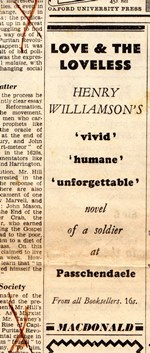
Identical adverts were placed by the publishers in The Sunday Times and the Observer, 30 November 1958:
Birmingham Post (R. C.Churchill), 2 December 1958:
Henry Williamson continues . . . Maddison is, very largely, the young Mr. Williamson, and this vein of autobiography gives the reader confidence, for who can properly re-create the Western Front of 1917 save one who saw service in it. The sequence of novels . . . is going to be a massive affair when completed, but on the whole the method is justified. The detail is what counts in this re-creation of war . . .
Evening Chronicle (Manchester), 4 December 1958:
Best known for his wonderful nature books “Tarka the Otter” and “Salar the Salmon” Williamson is also a novelist of great power. “Love and the Loveless” is a grim but enthralling book. The time is 1917, and the main scene, that muddy blood-soaked hell, the Ypres Salient.
After the rush of novels dealing with the last war, younger readers may believe that their generation discovered the terror, the courage and the horrors of warfare. Williamson shows that not only did the first war have its heroes and cowards, it also had writers of more than sufficient talent to bring them to life again 40 years later.
The Times Literary Supplement (Philip Rawson), 12 December 1958:
In "Love and the Loveless" Mr. Williamson succeeds admirably in recording a young man's experience of the First World War. The young man in question is no one special. He is interested vaguely in poetry and ideals, he is a moderately competent transport officer in charge of the mule-trains of a line battalion. And he is something of a dreamer. All the appertunances of the setting – the clothes and uniforms, the primitive buses, the stock attitudes of the characters – are recorded with accuracy and a nostalgic affection for period detail. In keeping no doubt with the character of his hero, whose single viewpoint is maintained throughout the book, the horrors and emotional cataclysms of that "Other War" are painted in very restrained colours. They are there, felt, but not dwelt on. The heart of the book is the hero's acute awareness of the changing shapes of the battlefields, with all their associations and regrets. Whenever he can he explores old trench systems, surveys old strongpoints, remembers ill-prepared advances and desperate retreats, and is haunted by the ghosts of the tens of thousands who perished in them. Those ghosts of Mons, of Passchendaele and the Somme are, for Mr. Williamson, as for many artists who became conscious of themselves under the shadow of those tragedies, the ghosts of people, not mere units in a force. People who suffered and perished pointlessly, uncomprehendingly, for no ultimate reward. "Love and the Loveless", with its undertone of compassion, its sense of time come-and-gone, the emptiness of hope, yet lacking bitterness, is a good book.
The Bulletin & Scots Pictorial (Glasgow), 11 December 1958; after a brief, snappy précis of the plot:
So vivid, plain, and realistic that it is practically a documentary of war.
Newcastle Journal, 13 December 1958:
. . . told in a dispassionate, restrained and thoroughly effective manner, it vividly evokes all the discomfort, squalor and fear of the trenches, as well as the contrast between the front line and life at home during the brief periods of leave. Nor, in giving the picture of the bitter, futile struggle of attrition does Mr. Williamson neglect his story. His hero – whose private grief . . . is a complex but entirely flesh-and-blood character.
The Listener (Goronwy Rees), 18 December 1958; There are three copies of this review in the archive file: on one of them the sender (it looks like George Painter’s handwriting – biographer of Proust etc. – whose own review appears below) has written above it ‘Be uplifted in spirit about Love and the Loveless’, and marked with a margin line one or two of the best sentences:
I have not read the earlier volumes . . . [but] if they are all as good as this I must make haste to remedy my omission. In this volume Phillip Maddison is a young transport officer in the Machine Gun corps during that appalling blood-letting . . . the Battle of Passchendaele. The description of the fighting itself is so vivid as to make one wonder once again how the human body and the human spirit ever endured such intolerable hardships, yet in glimpses of Haig and his staff Mr. Williamson makes us understand how Passchendaele might be justified on military and political grounds, if on no other. It is no ordinary achievement to write in a way that does even approximate justice to an immense human tragedy, for Passchendaele was certainly tragedy, even if, in the eyes of Haig and others, it was also victory, or the unavoidable preliminary to victory.
But what is equally extraordinary is Mr. Williamson’s eye and ear for the details of a period . . . his soldiers, officers, and civilians speak with the voice of a doomed generation yet with a vivacity and a historical truth that make the living seem, in Yeats’s words, more shadowy than they. It is a feat of recollection that has something in it which is akin to genius. . . . it seems certain that when the story of Phillip Maddison is finally completed it will compose a chronicle which will be of permanent literary and historical value. There are not many works of fiction of which one can say that.
The Daily Telegraph (Robert Greacen), 19 December 1958; first a précis of the plot – then ends:
This is a sincere and moving piece of work.
Books of the Month (Denys Val Baker), December 1958: This review is by someone who knew HW and his writing well, and contains good insights. HW had noted in his diary (see main section) that he had sent Val Baker a copy of the book for ‘his excellent article in W. H. Smith’s Trade News’. That article is not in the archive file but I would presume this is identical:
 |
 |
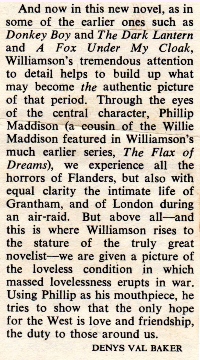 |
There are three letters in this file that are worth noting. One is from Stephen Southwold (who wrote under several pseudonyms, including Neil Bell), writer and editor and a long-term friend of HW:
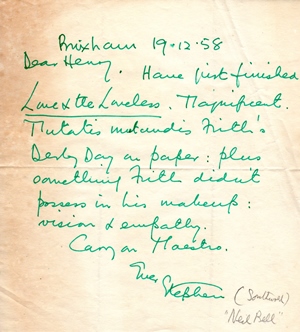
Another is from Eric Watkins (who helped with reading and making corrections on several volumes): long and detailed – dated 30 December 1958:
What impresses me most about the book is, first, its total impact, formidable with a sense of agony of creation behind it. . . . Second, what strikes me is the maturity of Phillip, his integration, which is all the more effective because it is against a background of disintegration.
Watkins gets through many points in great detail: he would have known how much HW wanted someone to understand and appreciate the finer detail.
The third letter is from a captain of the RAMC (T) in the West Riding Field Ambulance. He wrote with appreciation for HW’s writing, telling his own tale of war service.
Books & Bookmen (A.B.), January 1959:
Now some real war writing, Love and the Loveless is another of Henry Williamson’s marvellous meticulous and comprehensive reconstructions of the days of the first world war. Phillip Maddison is at Ypres in 1917.
It is of course much more than just a war novel. . . . this latest in the series is a novel of sincerity, sensitivity, grandeur and that transcendent quality of creative imagination which is hard to define but unmistakeable when one meets it.
St Martin’s Review (William Kean Seymour), January 1959:
. . . again I salute the author’s genius for recapturing in detail – interpreted with sweeping imagination – the titan struggle in France . . . Mr. Williamson draws a sombre and terrible picture of the attack . . . Mr. Williamson’s remarkable feats of memory and collocation make that struggle an epicof human endurance, and the complete work will rank with Rolland’s masterpiece, though from an utterly different viewpoint. . . .
['Rolland' (sic) has to be a reference to the medieval French romaunce heroic poem Song of Roland, which expresses the code of chivalry, Roland being a brave warrior at the court of Charlemagne. Roland is betrayed in battle, his men are all killed and he also dies – and his soul is taken straight to Paradise. This enhances my earlier comments in connection with the Pervigilium Veneris. It is quite possible that HW had discussed this aspect with his friend Seymour.]
Manchester Evening News (R.C.H.), 20 January 1959:
A Soldier of Ill Fortune – but a brave one
. . . A bewildered, beaten youth who drifted into trouble with his superiors yet earned their grudging friendship at times. Was he like the nation – a little baffled by the origins of a silly war?
Williamson has relived this war. The treatment is almost documentary . . . This book is a wonderfully sensitive reminder of Britain – desolate and nearly overthrown.
There is little for the 1964 paperback edition available, but one is worth noting – because it contains a priceless error!
Evening Argus Brighton (Gordon Thomas), 2 January 1964:
As this is the fiftieth year anniversary [expect a flood of WWI reprints]. Few, I believe, will come better than LOVE AND THE LAWLESS by Henry Williamson.
“Love and the Lawless” is a novel that picks abrasively away at the events . . .
But perhaps the most important review was one by George Painter (Assistant Keeper of Printed Books in the British Museum, literary critic and author of works on André Gide and other French writers, and at this time working on his 2-volume biography of Marcel Proust (author of the great work À la recherche du temps perdu, which won great acclaim when published) that appeared in The Aylesford Review,Vol. II, No. 6, Spring 1959, pp. 214-18. Ostensibly a review of Love and the Loveless, it actually places HW’s writing into the literary context, being entitled ‘The Two Maddisons’.
Painter opens with an explanation of how he first came to read Dandelion Days when on a visit to Croyde (North Devon, village adjoining Georgeham) in 1936:
And the presence of Henry Williamson has stayed living within me as one of the permanent experiences of my life. . . .
All great writers have something in common – a sense of power and vision, a moment of grace and revelation made permanent – which is communicated from them to the reader and is lacking in other authors . . . it will be among the accepted facts of English literary history that our only two great novelists writing in the second quarter of the second century, after the deaths of Lawrence and Joyce, were John Cowper Powys and Henry Williamson; . . .
Great writers are all the same, because the truth to which they have direct access is single; but they are also all unique, because it is infinite. The peculiar quality of Henry Williamson is the piercing directness of his vision, the absolute identity of his own feeling, and its communication to the reader, the clothing of a naked and terrible pain or joy in a noble and innocent prose, as keen as sunlight and as transparent as spring-water. He stands at the end of the line of Blake, Shelley and Jefferies: he is the last classic and the last romantic. . . . the theme of all his work has been the search for redemption from the miseries of the human condition.
[There follows analysis and comparisons of previous writings The Flax of Dream and Willie Maddison, The Gold Falcon, etc.]
In Love and the Loveless. . . three hideous battles – Messines, when the great mine was exploded, Cambrai, when the new tanks failed to exploit their break-through, Passchendaele with its blood and mud – are fought and described with a terror and beauty which no prose-writer of that war and only one poet, Wilfred Owen, has hitherto achieved. . . . there are scenes in which the poetry goes deeper than the sum of all the symbols into which it can be analysed. . . . The detail and unity of the novel, both in itself and as a part in a series, are organised with the same astonishing fusion of instinct and intelligence. . . .
. . . The two writers [Marcel Proust and HW] have a real affinity in their vision of the past as the place in time where the truth of things and people . . . can be seen as pure and undying. The two ideas of Time Lost and Ancient Sunlight . . . are intimately related; . . .
This vast novel-cycle . . . is an unrolling map of the labyrinth of three generations, our fathers, ourselves, and our children and the thread leading to the mystery – monster or divinity – at the centre.
[I believe] Love and the Loveless [and the other volumes] constitute the only true English war novel, comparable in vastness and compassion to War and Peace . . . and the whole cycle will ultimately be recognised as the great historical novel of our time, its subject as the total experience of twentieth-century man.
Immediately following this article in The Aylesford Review is a review of John Middleton Murry’s book Katherine Mansfield & Other Literary Studies (Constable, 1958) by Fr Brocard Sewell. Murry’s book contains an important essay on HW’s writings ('The Novels of Henry Williamson' – reprinted as an e-book by the HWS in 2013). Here it is noted that Mrs Murry, in her Compiler’s Note in the book, states that her husband
considered it of real importance that Henry Williamson should be recognised as one of the great novelists of the generation. [Before Murry died he had read] A Fox Under My Cloak (Vol. 5), which he judges ‘altogether worthy of its predecessors’ . . . Henry Williamson is among the greatest of English novelists.
The same issue of The Aylesford Review also contains a revue by HW of In Flanders Fields, by Leon Wolff – ‘an American of a generation hardly born when Third Ypres was being fought.’ HW did not entirely approve the content of this book – but he says so quite politely!
Back to Love and the Loveless main page
HW's photographs from 1917 (208 MGC)
Back to 'A Life's Work' Back to 'The Golden Virgin' Forward to 'A Test to Destruction'
Love and the Loveless
LOVE AND THE LOVELESS
A Soldier’s Tale
(Vol. 7, A Chronicle of Ancient Sunlight)
Whider thou gost, i chil with the
And whider y go, thou schalt with me –
from the Breton lay in English called Sir Orfeo
 |
|
| First edition, Macdonald, 1958 | |
HW's photographs from 1917 (208 MGC)
First published Macdonald, 22 October 1958 (16/- net)
Panther, paperback, with small revisions, December 1963
Chivers reprint, by request of the Library Association, 1974
Macdonald, reprint, 1984
Sutton Publishing, paperback, 1997
Currently available at Faber Finds
Dedication:

In September 1916 Phillip is passed fit for Home Service and resumes his training at the Machine Gun Corps Training Centre at Grantham. When completed his unit is sent to France, and find themselves taking part in various attacks while preparations are made for the ‘Spring Offensive’ on the Hindenburg Line, May 1917. Phillip’s job involves the difficult and dangerous task of taking the limbers (wagons) with ammunition and rations up to the Front Line every night. He takes part in the attack on Messines Ridge, but various problems result in him getting adverse reports. He meets up again with Spectre West, who encourages him. On 1 July they move through Ypres for the Third Battle of Ypres (Passchendaele). The battle goes badly resulting in chaos. In November there is fierce fighting at the Battle of Cambrai. Phillip ends up exhausted suffering from fever and is sent back to hospital in England. When he recovers he is sent to join the Gaultshires at Landguard Camp at Felixstowe where the commanding officer is Lord Satchville (cousin of the Duke on whose moors he had roamed as a boy), whom he likes. The book ends with a New Year’s Eve party in London with Westy, which ends rather unhappily.
*************************
The dedication to Jack Squire (Sir John – he was knighted in 1933) was possibly long overdue. Squire had supported HW from a very early stage of his writing – they almost certainly met at The Tomorrow Club during 1920-21.

Squire was instrumental in putting forward Tarka the Otter for the Hawthornden Prize in 1928 and had introduced HW to the artist William Kermode, which resulted in their collaboration in The Patriot’s Progress. But the two men had lost touch over the years until, it appears, early 1958. Squire was born in Plymouth and educated at Blundell’s School at Tiverton (Devon). He considered himself a ‘Devonian’ and refers (in what is sadly a torn fragment of a letter written at this time) to ‘my Devon’. There is a long letter (14 quarto pages) written by HW to Squire dated 20 February 1958, which contains a large amount of information about his life and writing (with his usual complaints), but it was never sent – although a letter obviously was. The unsent letter ends:
But before the schnorrer, this totter [rag and bone man], this ragman pushes his barrow round the corner, let him say the principle thing that is on his mind: Deep and abiding affection for Jack Squire, with crystal-clear memories of the London Mercury office, the visits there, the encouragement, the help given, the spreading of the fame which came to a head with the Hawthornden Prize for Tarka - . . . That is why I have an abiding affection for Jack Squire.
Yours, Henry Williamson.
There is no indication whatsoever as to why HW rekindled this contact. My surmise is that he sent Squire a copy of the special HW issue of the Aylesford Review that had appeared that January. The torn fragment from Squire refers to the ‘brochure on your life and works’. HW probably had heard how ill Squire was (by then he was bedridden) via his various London contacts, and had thought a letter would be cheering. The letter that HW obviously did send Squire must have offered to dedicate this current book to him. Squire’s reply is dated 28 March 1958.

HW never knew whether his early mentor was able to appreciate the dedication. By October Sir John Squire was no doubt very weak. He died on 20 December. HW seems to have learnt of his death via the obituary in the Western Morning News, which he cut out and kept. He does not mention the death in his diary but added a brief note under the dedication in one of his file copies of the book which states that he had heard nothing from Squire about this – and then adding his date of death.
*************************
Whider thou gost, i chil with the
And whider y go, thou schalt with me –
from the Breton lay in English called Sir Orfeo
Somewhat obscure and chillingly mysterious, this intriguing quotation has a significance that needs some attention and explanation. HW must have known this poem very well to have quoted from it: it is not from a ‘run-of-the-mill’ source.
Superficially, taking the quotation as of being to do with Orpheus and Eurydice, one could (and indeed to some extent can) transfer that to Phillip and Lily Cornford, so tragically killed at the end of the last volume and who is often in Phillip’s thoughts, but the concept of the Sir Orfeo lay is very different from the classical story. I am quite sure that if HW had meant to refer to the Orpheus and Eurydice concept he would have used an appropriate quotation from that source. This is far more subtle an inference and has a deeper and wider significance.
Sir Orfeo is a verse romaunce of the early fourteenth century – to put that into context, around the time of Chaucer (1343-1400). A ‘lay’ was a narrative poem usually in rhyming couplets meant to be sung accompanied by a lyre. The form originated in France, thus ‘Breton’ – Brittany. It is a tale of chivalric deed. ‘Chivalry’ comes from the original ‘cheval’, meaning 'horse' (as does ‘cavalry’): and note that Phillip in this volume has a horse, Black Prince. The concept of Chivalry embodies the ideal knight, gallant, honourable, courteous, quixotic. The medieval knightly system had a religious, moral and social code.
The ‘romaunce’ tales of the medieval period have their own history and interpretation, much of which centres around what is known as ‘dream narrative’. (‘Dream narrative’ is too complicated to go into here but I have investigated this in relation to HW’s earlier work The Dream of Fair Women – see HWSJ 39, September 2003, AW, ‘Save his own soul he hath no star’, pp. 30-59.) Suffice to say here that the heroine Heurodis is abducted by the King of Faerie when she falls asleep, having previously dreamt that this is going to happen, which fits that theme.
The poem is based loosely on the classical story of Orpheus and Eurydice, but has a very different connotation. There is no tragic ending as in the standard Orpheus tale: Orfeo and his queen regain their kingdom. Sir Orfeo is an English king, so renowned for his harp playing as the best ever heard, who rules from Winchester (the ancient capital of Wessex). His beloved and beautiful wife Heurodis is abducted from beneath an ‘impe-tree’ as she sleeps by the King of Faerie.
(Scholars consider this to be a tree that has been grafted: ‘impa’ is Old English for young shoot – but also has the sense of scion (son of) and to me this would mean the ‘tree of the little devil (imp)’, i.e. a magic tree. The tree of the devil would surely be a yew tree which has connotations of evil – superstition states that if one falls asleep under a yew tree one will die (parts of the yew tree are highly poisonous). Indeed it is possible that the word ‘impe’ may actually be a mis-reading of an ancient name for the yew tree, most of which begin with an ‘I’, many ‘iw’ or ‘iu’, Old Dutch is ‘iep’, Old English includes ‘iuu’, iewe’, the Breton word was ‘iuin’.)
Leaving his kingdom in the care of a trusted steward the distraught Orfeo sets off on a quest or pilgrimage to find her. He wanders in the forest (wilderness) for ten years virtually as a hermit, living off berries, roots and bark, as would an animal. Eventually he catches a glimpse of his wife out hawking with sixty other ladies. He manages to follow her into the faerie kingdom, and bluffs his way past the door-keeper of a castle made of gold and crystal and glass by saying he has been sent to play his harp to the king.
Here he finds many people thought to have been dead but who are not – some drowned, some burned, some headless. (The allegory of this with regard to the First World War and HW’s writing is startlingly obvious.) Heurodis is once again asleep. Orfeo plays his harp, so charming the King of Faerie that he offers him a wish. Orfeo asks for the lady who had been taken from under the ‘impe-tree’.
The King of Faerie at first demurs but has to keep his royal word, and so Sir Orfeo returns with his wife to Winchester, at first keeping his identity secret but eventually revealing himself amid great rejoicing.
There is, I think, a further more subtle inference embodied by HW’s use here. The original concept of ‘Orphism’ embodies a sense of sin, a need for atonement, theory of suffering and death of a good (god-) man and a belief in immortality, and a final escape from evil – all very Christian virtues – which are all quite overtly present in Sir Orfeo. This means that we are actually looking at a quite deep religious concept underlying Love and the Loveless. It is interesting that several reviewers remarked on a religious aspect in the previous volume, The Golden Virgin. Here it is more hidden. This aspect is reinforced by the other source of almost exactly the same words as that quotation: they are to be found also in the Bible.
For whither thou goest, I will go; and where thou lodgest, I will lodge: thy people shall be my people, and thy God my God.
(or: For withersoever thou shalt go, I will go: and where thou shalt dwell, I also will dwell.)
The words are spoken by Ruth to her mother-in-law Naomi, whom she insists on accompanying from her own native land of Moab to Naomi’s home in Bethlehem. This is about loyalty, devotion, duty: of doing something that involves hardship because it is the right thing to do.
This covert religious theme is actually present in HW’s title, for those words ‘Love and the Loveless’ are found in a poem by Samuel Crossman:
My song is love unknown
My Saviour’s love for me
Love to the loveless shown
That they might lovely be.
O, who am I
That for my sake
My lord should take
Frail flesh and die?
These words were set to music by John Ireland in 1919, and is now a much-loved hymn. For HW, they would surely have had an association with the First World War.
However, there is an even more obvious source: I have found tucked away among the numerous items in HW’s archive material a copy of Pervigilium Veneris (Vigil for Venus), a Latin poem of about the fourth century which has a refrain:
Tomorrow shall be love for the loveless: tomorrow for the lover shall be love!
HW was given a copy of a privately printed limited edition translation of this work by its author, Geoffrey Higgens, in 1933 (unfortunately there is nothing to explain the background or connection between these two men), although HW may well have already been aware of the poem from earlier days as it is part of the classical heritage.
 |
 |
|
 |
||
Pervigilium Veneris is quite complicated but is basically a song of spring (the festival itself was the first three days of April). Celebrating all the joy of spring and love, it calls on a large number of the gods to attend the festival but it particularly calls for a cessation of killing – that spring shall not be defiled by the blood of the slaughtered. ‘Love’ (Cupid) was to lay down all weapons in case he accidentally killed or harmed anyone – and Diana (goddess of hunting) was begged not to hunt; she was not invited in case her urge to kill creatures overcame her.
The work ends with reference to the nightingale’s song (‘fair Philomena’) and has a clear division between that joy and a plaintive sorrow:
Illa cantat, nos tacemos: quando ver venit meum?
(She sings, we are silent: when will spring come to me?)
And the poem, or plaint, continues (and ends, apart from another repeat of the chorus):
When shall I become as the swallow and renounce my silence? I am forgotten by my muse, nor does Apollo regard me: so Amyclae, being voiceless, was overwhelmed by silence.
Amyclae was an ancient (mythical?) city which was destroyed in war, its people killed or fled: Virgil speaks of ‘tacitae Amyclae’ (silent Amyclae). The commentator R. W. Postgate, writing in 1924, stated:
[This] is a lament, not for the death of a loved woman or friend, but for the death of a whole nation and a whole civilisation . . . [a point missed by most translators].
The connection to HW’s story here is painfully obvious. Its title and the accompanying quotation have a hidden depth of meaning that, once revealed, give a clear pointer to what HW wanted to achieve in this book: a lamentation for a spring and nations and civilisation killed by war – the British 1917 spring offensive.
*************************
By the time The Golden Virgin was published in September 1957 HW was already working on a very different book, A Clear Water Stream (Faber, June 1958). When he returned from his long holiday in Ireland in the summer of 1957 he also began work on volume 7 of the Chronicle, at this point provisionally entitled ‘A Test to Destruction’, the first mention in his diary being early December:
I posted 3 chapters – pp. 1-79 (inclusive) of A Test to Elizabeth Tippet.
On 5 December he was in London where he finalised the contract for A Clear Water Stream and had lunch with Eric Harvey of Macdonald’s, learning that The Golden Virgin had sold 6000 copies since publication.
Told him of No. 7, A Test to Destruction. He said I like the theme & title.
HW’s agent is now Cyrus Brooks at A. M. Heath.
On 31 January 1958 he recorded that he sent off his ‘first article for the Home (Co-op Manchester) Magazine. 500 words. £15-15-.’ This was the first of a monthly article from then until 1964. These articles have been published in From a Country Hilltop, ed. and introduction by John Gregory (HWS, 1988; e-book 2013).
There are some quite detailed diary entries concerning the writing of Love and the Loveless which gives an insight into his overall modus operandi – and his huge workload.
On 4 February he received the contract for No. 7 novel (but does not give details).
5 February: Finished Chapter 11 – ‘Spectre Speaks’ [becomes Ch. 12, ‘Phillip Meets an Old Friend’] this evening. Very hard chapter, result of much reading and searching & over-reading. I am very tired, have been on this single thread, like a caterpillar eating upwards on a silken line, for many many thousands of days & nights now. I have headaches at times.
6 February: Working on Chapter 10. The work has to be pulled apart, cancelled in places, re-adjusted many times. Usually when a chapter is done I see how it should have been done. . . . Began Chapter 11 at night – two sentences.
9 February: Worked all day on Chapter 11. Didn’t get far. Rearranged 9 pages done so far, after much research.
He had also been back and forth to the cottage he had bought in Ilfracombe, arranging for repairs and buying furniture at various sales. All this was a great source of irritation, with the spending of much nervous energy.
11 February: Finished Chapter 12 – It would not fit into my plan but wrote and adjusted itself en route pp. 294-313 ‘The Fox Out-foxed’. [became ch. 13 when published].
18 February: I decided at 6.30 pm, after reading the reconstructed first part of chapter 16 of No. 7 to not pursue the theme of destruction to Oct. 1919, but to end it in 1917.
Chapter 16 as planned – Westy wounded up by Passchendaele, Ph. struggle to get to G.H.Q. as ordered by Westy. Seeing Haig & return. Then to Cambrai, the advance & the chop, himself in pyjamas & trench coat fleeing with German flare pistol & cartridges in his haversack. Arrest & goes sick. P.U.O. [louse fever] like Downham. So to England, convalescent home at Falmouth . . . On leave, Ph, meets Desmond & Gene. Party in Picadilly – not Flowers - & all back to the flat for Christmas & sending up hot-air balloons on Christmas Eve with Very lights. Ends with orders to report to 3rd Gaultshires. “Thank God I’ll at least be with a decent crowd.” (end of book).
At the end of February proofs of A Clear Water Stream arrived, were dealt with over two days and sent back – as also the ‘May’ article for the Co-op Magazine. On Sunday 2 March HW recorded he had got to near the end of Chapter 15 of 'Test'. The next day, stating that he is upsetting himself by diverting from his original plan, he decided to scrap chapter 15 – ‘When Phillip returns to the Gaultshires & revert to the plan’. There was a short interlude in London where he checked the corrected proofs of A Clear Water Stream and recorded an unscripted 40-minute talk for the BBC about John Murry and the Adelphi.
Tuesday 11 March: Began, after agonising (head aching) interval to recast Chapter 15 of No. 7 novel. I strayed off the planned path.
12 March: Working all morning on Chapter 15. Wrote 800 words review of Leslie Reid’s Earth’s Company in afternoon, for the final issue of ‘Time and Tide’ on 22 March.
13 March: Almost finished the recast Chapter 15. [But he is thrown by problem with Christine and also has a cold; and has received a very critical letter from the north country writer Crichton Porteous telling him his] novels are so dull, almost unreadable . . . Rather hit me . . .
15 March: Slogging on with novel. Find it very hard to maintain confidence. Still altering & trying to arrange Chapter 15. [In the printed book this is the ‘Mutiny’ chapter.]
On 18 March he sent off chapter 15 for typing and started chapter 16.
20 March: Changed plan of novel. Am on Chapter 16 – Spectre’s walk with Phillip to Passchendaele; his wound: & instructions to Phillip to carry his message – report to G.H.Q. at Westcapelle.
21 March: Working, working, working. The new plan shortens book & makes the old title obsolete. Novel to end in 1917, after Cambrai (Chapter 17) & P’s escape from near-prisoner & with PUO gets home to England, & returned to Gaultshires. [PUO = Pyrexia of Unknown Origin: and was louse or trench fever. In Love and the Loveless, p. 355, this is misprinted as 'Perdoxia'. HW has a correction note to change it to 'Pyraxia', but my dictionary spells it with an 'e'.]
On 28 March he posted off Chapter 16 for typing and revises earlier typed pages.
30 March: Writing Chapter 17 “Mouse to Lion” [is ch. 18 in printed version]
31 March: Writing chapter 17, first rough draft. [+ 800 words for the Co-op Magazine].
2 April: Revised Chapter 17 and in afternoon posted it to typist. [Plans to have a break – go to Bungay – collect Richard and books] before beginning the Cambrai (Nov. 1917) Chapter, to be followed by two chapters (19 & 20) to end the book.
The title A Test To Destruction is now unapplicable to the present novel.
So he needs a new title; and holds a little family competition:


It will be noticed that the actual title used is not among these! ‘Love and the Loveless’ had originally been meant as a sub-title for the previous volume – and for some reason it got left out. HW’s diary entry of 20 November 1957 notes corrections for The Golden Virgin to be made and sent to Macdonald with a request to restore the sub-title ‘Love and the Loveless’, but that did not happen. So of course he already had a ready-made title for the present volume, and had already decided upon it: the little family competition was no doubt a charade to have some fun. ‘Love and the Loveless’ was anyway far too important a concept to be merely a sub-title, as has been explained. The discarded ‘Test’ title then gets transferred to the next volume.
There is also an extraordinary file of HW’s own sketches for the cover design of this book (and some by his wife): thirteen pages of them over the best part of two weeks (24 June–4 July). This task obviously had great significance for him and caused some anguish of spirit! There is unfortunately nothing in the files to explain the background of this quite amazing attention to detail. One wonders what Broome Lynne, the artist who designed the Chronicle of Ancient Sunlight covers, made of it all, but he certainly took on board the main concept. That handclasp is of two males – two soldiers. It gives emphasis to the concept of 'love and the loveless' as being about the comradeship of soldiers (perhaps also representing the opposing armies); and NOT Phillip's grieving for the dead Lily.
A selection of these sketches is given on a separate page.
HW was at Bungay for a week, returning to Devon with his son Richard on Saturday, 12 April. The following day he sent off a 700-word article ‘Road to the West’ to Macdonald Hastings for the Farmers’ Weekly Show Number (for which he received 35 guineas). He worked on the revisions for ‘No 7, reading it to Richard & Christine each evening’. (There is no indication of how long Richard stayed!) HW now records continuous rows with Christine because she won’t deal with the Ilfracombe cottage (which he never wanted), the architect’s plans to rebuild the kitchen and buying of furniture, etc. This is still going on in June. In August the plans are finally sent to Ilfracombe Council.
On 30 May he recorded in his ‘Tablet’ appointment diary:
Finished No. 7 Novel (Love & Loveless) today thank God. Now for a spell of outdoor work.
On 17 June he attended Lord Fortescue’s Memorial Service at Exeter at 3 p.m. (Fortescue had been his landlord at Shallowford, Devon, in the 1930s, and was the older brother of Sir John Fortescue who had written the Introduction for Tarka the Otter.) On 4 August HW sent a copy of ‘John Bull’s Schooldays’ to the Spectator [published as ‘Out of the Prisoning Tower’, 22 August; collected in Indian Summer Notebook, HWS 2001; e-book 2013.]
15 August: I have the proofs of No. 7.
In September Ernie Brown, whom he had known as a child in 1916-21 when living at Skirr Cottage in Georgeham, and who features in the early village stories, is engaged to do the work on the Ilfracombe cottage because his tender was the cheapest: there are, inevitably, constant problems over this work! The unsent letter to Ernie shown below has on its reverse side a suggested 'puff' for the novel, not taken up by Macdonald:


On 9 October he gave the prestigious Wedmore Memorial Lecture to the Fellows of the Royal Society of Literature, 'Some Nature Writers and Civilisation', his subject being Richard Jefferies and W. H. Hudson (collected in Threnos for T. E. Lawrence & Other Essays, HWS 1994; e-book 2014).
Wednesday, 22 October: Love and the Loveless published today. Copies have been, or will be, sent to Sir John Squire, Denys Val Baker (his excellent article in W.H. Smith’s Trade News), Lords Hankey & Moyne (Bryan Guinness), Fr. Brocard Sewell, O. Carm., Lt. Gen Sir Brian Horrocks, F.M. Lord Montgomery.
In his ‘Tablet’ appointment diary, 3 November: ‘To begin re-start No. 8 today.’
14 November: Deep depression over Love & Loveless – unreviewed. [Not totally correct but reviews were quite slow in appearing and HW obviously felt great disappointment at this point.]
*************************
Love and the Loveless is divided into four parts: Part One: ‘The Black Prince’; Part Two: ‘‘All Weather Jack’ Hobart’; Part Three: ‘‘Sharpshooter’ Downham’; and Part Four: ‘’Spectre’ West’.
Part One opens in September 1916 as Phillip travels to rejoin the Machine Gun Corps Training Centre at Grantham. (A Medical Board passed HW fit for Home Service only, and he returned from convalescent leave on 23 October 1916.) Phillip applies for the Transport Course, i.e. to train as a Transport Officer. Among other training he is sent to Riding School where he learns how to deal with all aspects of horses and mules as will be necessary at the Front. (See also AW, Henry Williamson and the First World War, Chapter 5, ‘Transport Officer at the Front’, pp. 69-132, where full details of HW’s own training etc. are described; this training in animal husbandry stood HW in good stead in later years when he bought the Norfolk Farm.) He meets Yeomanry Captain ‘All-Weather Jack’ Hobart, a capable officer and splendid man (based on Captain Roy Colgate, see AW, Henry Williamson and the First World War, p. 186), with whom he strikes up a friendship and with whom he goes hunting. We also meet Teddy Pinnegar (also based on a real person, but whom HW did not actually meet until many years later on the Norfolk Farm – but whom he added in here for structural purposes). There are various authentic scenes of the off-duty high-jinks that the various characters get up to.
Phillip obtains ‘Black Prince’, a lively black gelding of sixteen hands with some Arab blood. There is a superb description of the moment that he felt at one with his horse:
He experienced a new power upon himself, accompanied by a singing joy. It was not just confined to the feeling that he could ride, but to other things in life. . . . As he fled across the park he felt that he had come through the shadow that had always lain upon his life. . . . he felt he and the gelding were great friends already. . . . Black Prince is intelligent, Phillip thought; he knows, as Lily had known.
This new achievement gives Phillip confidence within life itself (today an obvious aspect of modern psychology). This (and the ensuing scenes at the Front) is also one of the first genuine descriptions of the tremendously important part played by horses and mules in the First World War.
When training is completed the men are given embarkation leave. Hobart takes Phillip to London in his ‘Racing Merc’ (Mercedes sports car) to the Flossie Flowers Hotel, to meet up with Hobart’s rather dashing girlfriend, Sasha. (For background on the Flossie Flowers Hotel, see John Homan, ‘Flossie Flowers Revealed’, HWSJ 22, September 1990, pp. 42-3.)
Part Two opens in mid-December 1916 as the men entrain with mules and horses to France and the Front Line. (HW embarked in similar fashion in February 1917. He took the time back in the novel so he could include wider aspects of the war.) On Christmas Day Phillip rides, on Black Prince, into Albert, seeing the Leaning Virgin, and then on to Mash Valley (where he had been wounded on 1 July), where nothing is recognisable: a wasteland. He grieves for the dead, as HW grieved every Christmas throughout his life.
The spirit of a million unhappy homes had found its final devastation in this land of the loveless.
Phillip’s work involves taking limbers (wagons) with ammunition and rations up to the Front Line every night, difficult and frequently dangerous work, for the teams of men and horses have to progress in the dark through the mud swamps under constant shelling. There is a succession of problems with men and horses (the veterinary rules were very strict indeed – and the army veterinary officer did not like Phillip). The men are involved in a series of smaller attacks moving forward as the Germans retreat, while preparations for the spring offensive continue.
Phillip is ever conscious of the presence of nature even within this desolate landscape. He notices flowers, and birds, nightingales and skylarks, and even mallard flighting over at night.
They would be nesting soon, he thought. For birds, the spring meant love – for men, the spring offensive, and the kiss of bullets.
There we have a direct reference to that Pervigilium Veneris poem:
Spring! Spring is of youth! Spring is now singing!
Spring is the birth, the birth of the world!
In Spring Loves unite,
In Spring the birds mate and the woodland
Unbinds her green tresses in the rain.
Spring in the trenches of the Front Line of France and Flanders, however, meant only death and destruction.
There is a major attack on the Hindenburg Line planned for the beginning of May, which results in another sprawl of dead and maimed. HW’s various detailed field notes made in 1917 at the time of this attack can be found in AW, Henry Williamson and the First World War. His actual orders for the attack are reprinted facsimile in HWSJ 34, September 1998; the first page of these is shown below, together with the Order of the Day:


Then at the end of May Phillip is involved in a further attack on the Messines Ridge held by the Germans. In a second attack which goes wrong, Phillip loses two mules and a driver on his nightly run, and later learns that Captain Hobart has been killed. Pinnegar takes temporary command but the new CO is Major Downham, who had been in the Moon Insurance Office where Phillip worked before the war, and does not like Phillip. To Phillip’s dismay, Downham immediately commandeers Black Prince for his own use.
When the company goes out of line, Phillip is sent off on a signalling course which he fails and from which he is returned fairly quickly, and so is reprimanded over adverse reports. He goes back to England for ten days’ leave with the unhappy Bright, whose plight is based on true story, where he asks to be transferred back to the Gaultshires.
Phillip, during this period, served with the fictional 286 Machine Gun Company. HW actually served with 208 Machine Gun Company, and his photographs of 208 MGC, in an album in the Literary Archive, are shown on a separate page.
On return to France the situation is the same, but going into Poperinghe he sees Spectre West, who is giving a staff lecture on Ypres and battle tactics. Afterwards the two men meet for a meal. Westy states that he had once had ambitions to write a War and Peace for this age:
‘But it will take thirty years before anyone taking part in this war or age will be able to write about the war [or its wider aspects] . . . ’
As Westy is Phillip’s (HW’s) alter ego, this is a pointer laid down by HW for his own work not begun until thirty years after the events: the War and Peace analogy being an ongoing theme which had pre-occupied HW from the earliest days of his writing career. Their conversation allows HW to include philosophical discussion of war. Westy ends:
‘Remember this, “He who loses his life shall save it” [quotation from Matthew 10, v. 39]. Put duty before self! That alone will carry you through to the end.’
This reinforces the covert religious aspect of the novel.
On 1 July the men move through Ypres for the Third Battle of Ypres – Passchendaele. Phillip, not trusting his sergeant to be able to cope, now takes the limbers with rations and ammunition up to the Front Line every night himself. The battle goes very badly with the tanks bogged down in the mud. Chaos. Phillip’s horse (not Black Prince but a mare) is hit and he has to shoot it. As he goes forward:
To the right, a few miles away, tremulous piano-playing fingers had changed to a flight of butterflies with wings overlapping one another, trembling and blazing in radiance above the row of lily flares . . . Soon they were in full view of the Steenbeek valley . . . the luminous butterfly wings still rose to the zenith above the Menin Road where ruddy splashes and sparks revealed the fall of British shells among the German batteries on the Gheluvelt plateau. The tempest of Hell!
However, Downham, regardless of the problems they had encountered, is furious because they are late arriving. (Later, Pinnegar says that Downham is useless.) One of Phillip’s drivers is killed by a shell. The men manage to bring his body back:
The truth was that it did not seem right to leave Daddy M’Kinnell in that lonely waste of mud and water.
Spectre takes Phillip to Tubby Clayton’s chapel in the upstairs hayloft in Poperinghe, in a very beautiful passage in the midst of carnage and chaos of war:
They stopped outside a tall grey house, on the door of which was a notice, All rank abandon ye who enter here. Inside on the wall was a painted hand pointing to the door . . . They went up a wooden stairway, and then up another flight, and so along a bare wooden corridor . . . up some steep open treads, and so into a large loft with beams and posts holding up the roof.
Phillip saw it was a chapel. From the king-post was suspended a chandelier with a ring of candles. Beyond, against one wall, was a red altar cloth, with green borders. Another red cloth, with gilt tassels, hung from a beam above the altar. The space before the altar was flanked by two massive candles on wooden stands. Beside each was a bowl of flowers. A carpet covered the centre of the floor. There were a few plain wooden chairs and benches, and two shrines, one on either side of the altar, below semi-circular windows. There was a lectern painted white. . . .
The air shivered with deeper undertones of heavy howitzers, pounding away in the Salient. Then the sun came out behind a cloud and light shone whiter through the semi-circular windows, Here men had clumped up the steep and narrow stair, borne up by Hope, seeking solace at the verge of unutterable Darkness. . . .

Phillip thinks of Father Aloysius, and Mère Ambroisine and of Francis Thompson, and recites one of his poems to himself. [HW’s Aunt Mary Leopoldina – Theodora Maddison in the Chronicle – had given him a book of Francis Thompson’s poems just before or at the beginning of the war. This poem echoes the quotation from Matthew that Spectre West had used earlier.] Spectre explains the background of the chapel to him.
(HW has a diary note made – in a separate diary otherwise blank – on Monday, 10 February 1958 in the Athenaeum, Barnstaple (very precise!):
Gilbert Talbot fell in flame attack at Hooge in July 1915 [see The Wet Flanders Plain entry, where HW visits this chapel in 1927]. Son of Bishop of Winchester. Lt. R.B., [Rifle Brigade]. ‘Talbot House’ a club in Pop. opened in Dec. 15 in his memory. Tubby Clayton, padre C.E. It was not Toc H in 1917. This name arose in 1920 as there was already a Talbot House in the Black Dog.
A small detail but checked thoroughly!)
To get rid of him, Downham sends Phillip on a course at No. 3 Infantry Base Depot, Etaples. A respite is given (as it was throughout the Front), with amusing extracts from the B.E.F. Times which Phillip, on the train now, sees for the first time.The archive contains HW's copy of the 1928 reprint of this publication which had been so important for the morale of the troops.


(HW later wrote the Foreword for The Wipers Times (Peter Davies, 1973), in which he includes a description of the 1914 Christmas Truce, and states that these front line publications were:
gentle and kindly in attitude to what was hellish – and this attitude, its virtue, was extended towards the enemy. It is a charity which links those who have passed through the estranging strangeness of battle . . .
The full Foreword is collected in the revised e-book edition of Threnos for T. E. Lawrence & Other Essays, HWS, 2014.)
Etaples is described as being like a POW camp, surrounded by barbed wire fences. The main feature is the Bull Ring where: ‘thousands of men daily received intensive training with bombs, rifle-grenades, Lewis gun and rifle fire and bayonet practice. . . .’ There is also the appalling and degrading ‘Punishment Compound’.
The whole place was rancid with subdued anger . . .
This is the all-important Etaples ‘Mutiny’ chapter, over which, as we have seen, HW took so much trouble – and as I have pointed out, he appears to have been the first to put this episode into print.
Phillip meets Major Colin Traill, a gentle man who likes poetry. (HW actually met Traill when both were convalescent at Trefusis in Cornwall where they become friends. Traill had been wounded at Oppy Wood on 3 May 1917 and awarded the MC. He was later killed in action – see HWSJ 43, September 2007, Anne Williamson, ‘"My Friend": Major Colin B. Traill, MC’, pp. 92-3.)
 |
 |
|
|
Major Colin Traill, MC (photograph taken at Trefusis in July/August 1917) |
Colin Balfour Traill was killed on 28 June 1918, aged 23. He is buried at Le Grand Hasard Cemetery, Morbecque. |
Trouble escalates, coming to a climax when a sergeant in the Military Police accidentally shoots a Gordon Highlander when a bullet ricochets. A semi-riot occurs. Troops move in to guard prisoners. At the resulting courts-martial the ringleaders are sentenced to death and imprisonment. This episode was completely hushed up at the time for the purposes of morale, and little had ever been known publicly. HW first mentions this in The Patriot’s Progress, published in 1930, but here the description is much more detailed. (In a letter to T. E. Lawrence dated 24 March 1930, after the publication of The Patriot’s Progress, HW wrote: 'Damn! I wanted 60,000 words recreating the Etaples mutiny: now I've pooped it off in 600 words.')

(The later BBC programme The Monocled Mutineer, broadcast in 1986, claimed wrongly to be the first revelation of this episode: see HWSJ 15, p. 54 and HWSJ 16, pp. 37-8.)
His course over, to his relief Phillip is told to return to his unit where he finds Pinnegar in charge. Downham has gone back to England with PUO (louse or trench fever), having totally blotted his copybook anyway. Phillip gets Black Prince, his horse, back and goes off for a ride.
Phillip returns to Poperinghe, where he goes to the rue de l’Hôpital, and again climbs the steep flights of stairs to the hop-loft chapel. A service was being held:
Now with feelings of optimism and even joy, he knelt down, and became clear and simple.
Afterwards he talks to the padre (Tubby Clayton): ‘Thank you for making this oasis for all of us.’
The story continues with another attack with detailed descriptions, much of which can be found within HW’s Field Note Books of 1917 (see AW, Henry Williamson and the First World War), although taking place earlier than in the novel. Phillip meets up again with Douglas, originally in the London Highlanders with him in 1914, now wounded with a bullet through his shoulder (Douglas Bell; see A Soldier’s Diary of the Great War.)
Westy then takes Phillip with him on an intelligence-gathering mission during which he is badly wounded and sends Phillip back to HQ with the urgent information, insisting he leave him lying there. This does not prove an easy task in the chaotic conditions, and Phillip ends up ‘stealing’ someone else’s horse to achieve Westy’s orders. Once he has handed over the information he is interviewed by Field Marshal General Sir Douglas Haig who is courteous and kind. When this is all over and he gets back to his unit he goes for a ride on Black Prince to calm himself.
The action moves inexorably on to the Battle of Cambrai in November 1917, involving huge numbers of tanks. The new Brigadier is the ‘Boy General’, the legendary Brigadier General Roland Boys Bradford, VC, MC, who was killed in action on 30 November 1917, aged 25.
 |
|
Bradford's grave at Hermies British Cemetery, situated between Cambrai and Bapaume |
Pasted into HW’s own copy of Love and the Loveless are two Remembrance Notices for Roland Bradford – one from The Times, 1 December 1958 (HW’s birthday, which would have made it very poignant for him); the other unmarked, but noting the death of the three brothers: a family tragedy.


The fighting is desperate and Phillip’s work is intense. Bourlon Wood is taken at great cost, but the attack on Bourlon village fails. There is a gas attack and the men have to fit masks on to the animals before donning their own. Phillip manages to lose the way to Graincourt and ends up way beyond it at Le Quennet Farm, almost in the German line (these are all famous landmarks within that battle scenario). That night the Germans break through, so there is yet more chaotic fighting and movement.

(The map is reproduced from the useful and interesting article by Peter Cole, 'The 286th Machine Gun Company' in HWSJ 18, September 1988, pp. 30-37.)
Phillip finally collapses with exhaustion and fever (PUO – see HW’s diary notes). The doctor won’t let him move so he cannot say goodbye, a great sadness because:
he could write to Teddy [Pinnegar], to Nolan and to Morris; but nothing could be done about Black Prince.
He is sent back to England to hospital where he learns with great relief that Westy was found and is safe. On being discharged he is given three months’ Garrison ‘B’ duty (i.e. not fit enough for Front Line service).
(HW was actually gassed at Bullecourt on the night of 7/8 June 1917 taking a limber up to the Front Line, when one of the mule drivers, Private Frith, was killed by a shell within feet of him: he was hospitalised, returned to England and eventually sent to Trefusis at Falmouth, Cornwall, to convalesce, where he began to write – almost certainly as therapy. Eventually he rejoined the Bedfordshire Regiment at Landguard, as did Phillip.)
Phillip is sent to join the Gaultshires at Landguard Camp, Felixstowe (Suffolk), where he learns Westy is also currently stationed but has gone to London to receive yet another decoration. The commanding officer is Lord Satchville (Lord Ampthill in real life), cousin of the Duke of Gaultshire (Duke of Bedford) on whose moors Phillip/HW roamed as a boy. (All this echoes the real life situation – other than the fictitious ‘Westy’.)
The final scene involves a New Year’s Eve party in London attended by Westy and Phillip at the Flossie Flowers Hotel, where Sasha attaches herself to both men and so divides them. Phillip thinks it is the ‘Lily’ situation all over again. Westy leaves: shortly after so does Phillip. The reader is left on a ‘cliff-hanger’ wondering what the outcome is to be!
*************************
Index and Chronology to Love and the Loveless: Maps and Chronology and Index
Between 2000 and 2002 Peter Lewis, a longstanding and dedicated member of The Henry Williamson Society, researched and prepared indices of the individual books in the Chronicle of Ancient Sunlight series (the first three volumes being indexed together as 'The London Trilogy'). Originally typed by hand, copies were given only to a select few. His index to Love and the Loveless is reproduced here in a non-searchable PDF format, in two parts, with his kind permission. It forms a valuable and, indeed, unique resource.
*************************
Click on link to go to Critical Reception.
***************************
The dust wrapper of the first edition, Macdonald, 1958, designed by James Broom Lynne:


HW's comments written on the blurb:

Other editions:
 |
 |
 |
|
Panther, paperback, 1963. The edition featured this striking wrap-round contemporary drawing by Chevalier Fortunino Matania R.I., entitled 'How the Gunners of 'L' Battery RHA won their VC'. |
||
 |
|
Cedric Chivers, for The Library Association, hardback, 1974 |
 |
 |
|
| Macdonald, hardback, 1984 | Sutton, paperback, 1997 |
The Macdonald cover features a detail from 'Epehy 1918', by Haydn R. Mackey (1883-1979) (Imperial War Museum). The Sutton cover is a detail from 'The Triumph of Death' by Pieter Brueghel the Elder (c.1815-1569).
Back to 'A Life's Work' Back to 'The Golden Virgin' Forward to 'A Test to Destruction'
The Golden Virgin - Critical reception
Back to The Golden Virgin main page
Critical reception:
In particular let me start with the cuttings HW himself placed in the front of his own file copy.
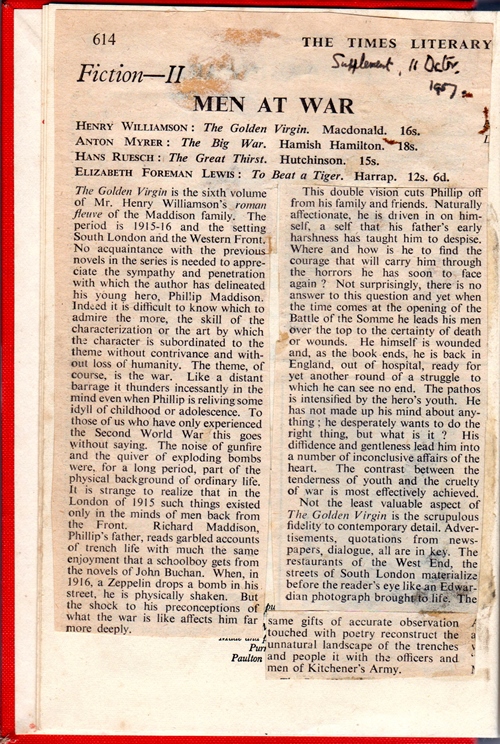
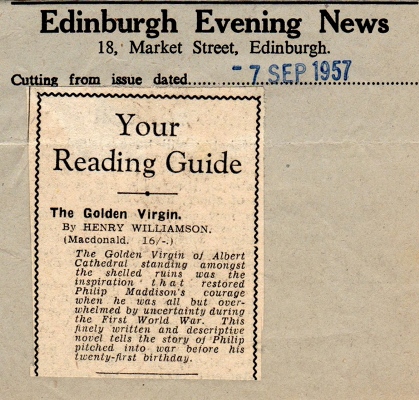
But immediately came the awful faux pas committed by Kenneth Allsop, which completely ruined the publication day for HW, embarrassing him publicly. It had all started so well, as can be seen first by a major article by HW printed in the Daily Mail in June; then by a telegram from Allsop addressed to HW, who was on holiday with John Heygate in Ireland.
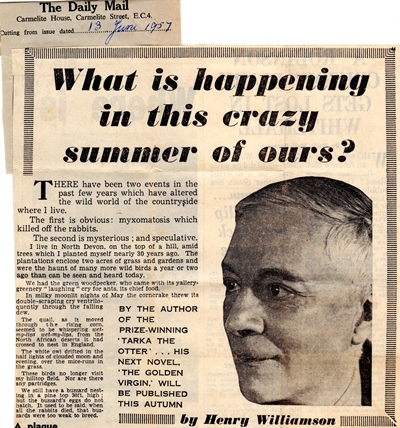
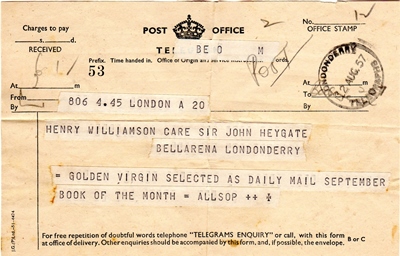
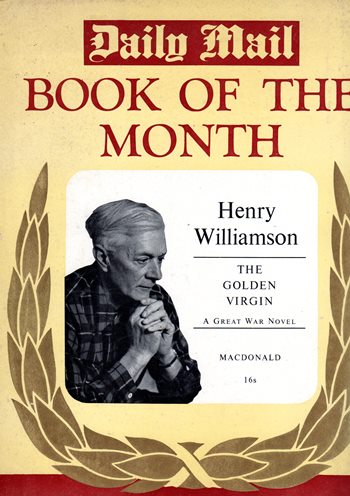
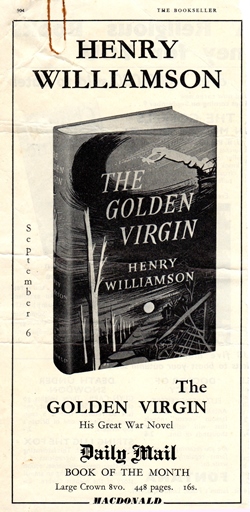
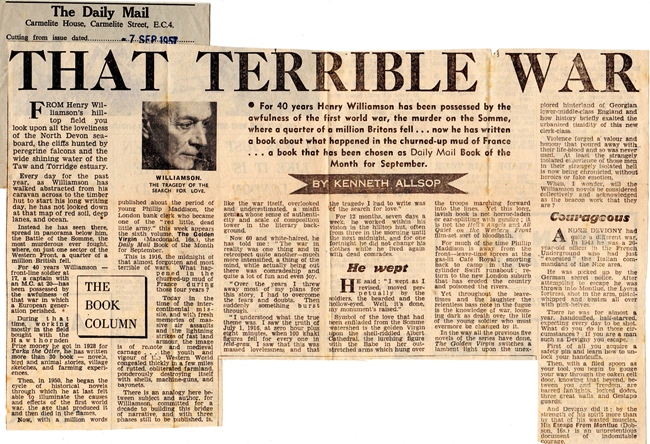
Kenneth Allsop's Daily Mail article, 7 September 1957; apart from the faux pas about the Military Cross the article is very good:
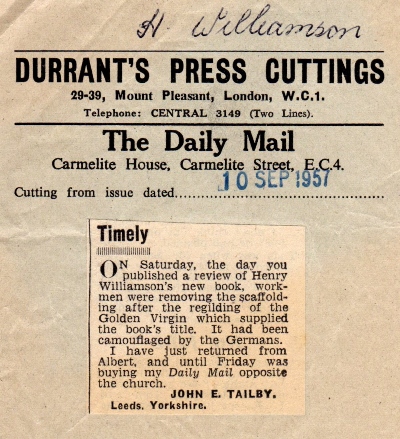
The final Daily Mail item adds a most extraordinary poignancy:
The build-up to the book’s publication had begun earlier in the year.
Liverpool Daily Post, 26 June 1957 (‘Brother Savage’, Books and Bookmen – I do not know who ‘Brother Savage’ is, but obviously a member of the Savage club, and knows HW well.) This evidently regular column is written in an easy ‘chatty’ style:
Admirers in London of Henry Williamson’s books have long since resigned themselves to losing touch with him personally from time to time. He lives as far as possible from cities and the roar of the crowd . . . but they are quite happy about it, as long as in his retreat he continues to write such splendid books as “Fox Under My Cloak”. . . . Its successor is announced for the late summer. “The Golden Virgin” is a continuation of Phillip Maddison’s story. . . .
The setting of the story is war and especially the Golden Virgin of Albert Cathedral, all but shattered by German shells yet offering to Phillip and many like him the symbol of life that would be upright, noble and fundamentally simple in its beliefs.
Books and Bookmen, August 1957, ‘On the Way’ (unsigned – but is ‘Brother Savage’ as is shown):
Henry Williamson is a writer who in his own lifetime seems already to have secured a place in posterity. In The Golden Virgin he writes once again of Phillip Maddison . . . and is concerned with new aspects of the first “war to end wars” . . . [The wording here is exactly the same as that of Brother Savage as above – but includes a further sentence at the end:] A symbol like itself, now poised perilously between standing and falling.
Smith’s Trade News (compiled by William Lloyd), 7 September 1957:
Henry Williamson’s magnificent large-scale saga of the life and times of Phillip Maddison is carried a stage further in this latest volume which has been selected as the Daily Mail Book of the Month. . . .
How he finds inspiration in the Golden Virgin of Albert Cathedral which has almost been destroyed by German shells, and makes it a symbol of a future which will develop the best side of him, is narrated with great power and compassion. Character drawing, as is customary with this writer, is firmly executed.
News Chronicle (David Holloway),11 September 1957:
. . . a further long instalment of the gigantic Maddison saga . . . The period covered is a few months either side of the opening of the Battle of the Somme . . . There is far less about the actual fighting . . . [Phillip] is still having trouble with socially superior officers and will not believe that he can be any sort of success with women. . . . The occasional battles are vivid. So are many of the scenes of London in 1916. But through most of the 446 pages the pace is deathly slow.
Coventry Evening Telegraph (the name is cut off but appears to be ‘Bookman’),12 September 1957, 11” column, plus irrelevant photo of a ship which presumably illustrates another book reviewed:
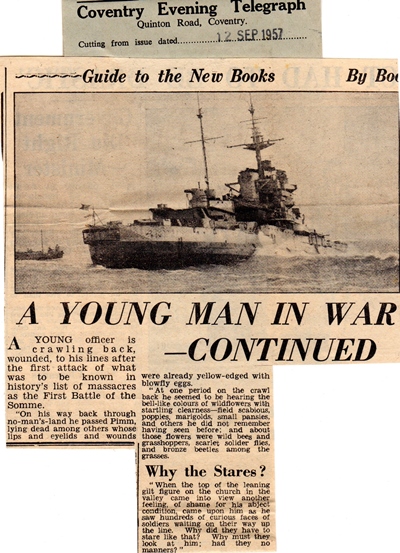
[It continues:] I am quoting from [The Golden Virgin] . . . in an all too inadequate attempt to give you some idea of the honesty and understanding you will find in a fine novel. . . . This book, like its predecessor “A Fox Under My Cloak”, is filled with compassion, . . . war is only part of the pattern so vividly created.
Phillip Maddison’s idealism; his uneasiness; his groping after some meaning to his life; his fears; . . . I have read nothing that has brought the period and its people . . . so alive.
When he finishes his grand design we shall, I believe, have a work of fiction that will not be forgotten.
Yorkshire Evening Press (S.S.), 12 September 1957, 10” column (those initials are suggestive, especially combined with the final quotation – could it be Siegfried Sassoon?)
The holocaust that was the Somme . . .
Henry Williamson is a man with an obsession . . . And Williamson’s obsession – magnificent enough for any man – is to find the ultimate meaning of the mass slaughter that used to be called the Great War, to penetrate to the truth lying beneath and behind all the destruction and sorrow. The author sees it all as a tragedy of massed lovelessness, of an unavailing – and often unrecognised – search for love . . .
There is also a memorable picture of Maddison’s repressed, embittered father: and all the time we can feel at work the pen of the historian, tracing the gradual change from an old England to a new . . .
On laying down the book one can only exclaim: “The pity of it”.
Truth (Eric Gillett), 13 September 1957:
The Golden Virgin is the famous statue on Albert Cathedral [continues with the legend] . . . [the scenes of trench warfare] are authentic and one can be enthusiastic about [their] accuracy. The rest of the book is curiously old-fashioned and outmoded.
The reviewer makes the very unfortunate error of calling Phillip ‘Paul’, which may have been the root cause for HW’s long and somewhat irate letter in the issue dated 27 September 1957 – but he was also no doubt still upset about Allsop’s perfidy, as his response seems a little out of proportion: ‘May I ask for space to implement what your reviewer says about my novel?’[‘implement’ seems an odd word to use here?] HW proceeds to give reasons for Phillip’s ‘(not Paul)’behaviour – which is obvious to anyone reading these books with empathy – but he also states most interestingly:
Phillip is hypersensitive . . . He is also, unknown to himself and others, shellshocked – a condition not at that time recognised. He is basically loveless . . . The theme of the book, as exemplified by certain good soldiers who befriend Phillip, is that men who are calm, with inner harmony, are those who have love in their lives. With this love, faith in god, surety of honour, sense of duty, and courage. By contrast, lack of love creates fear and hate . . . All the characters in the book reveal, in their kind or unkind behaviour towards each one another . . . the underlying theme of love and the loveless. . . . [Phillip knew] that the real enemy of the war was not the German soldier. It was hate.
[HW was by this time working on his next volume of the Chronicle, the title of which was Love and the Loveless.] His final paragraph looks forward from the point of this novel, but specifying that Phillip’s father had been denied love, and his whole life ‘had been spent at a desk in the City of London, under artificial light'.
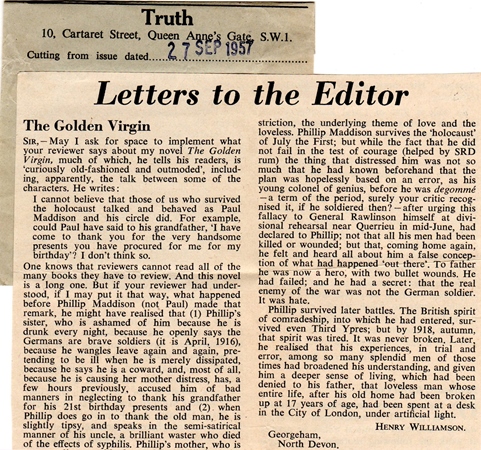
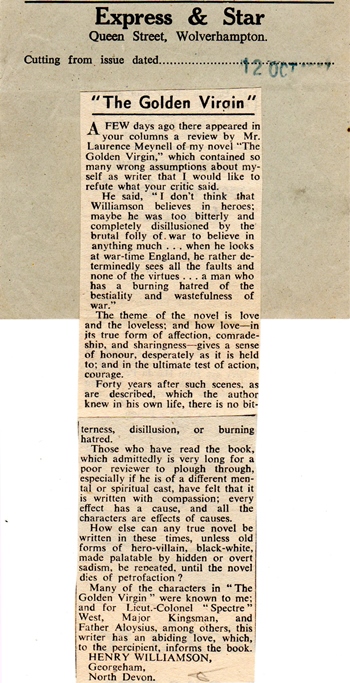
HW also wrote to Wolverhampton's Express and Star. Unfortunately there is no copy of the original review, although again his response seems out of proportion; but perhaps this cleared the angst out of his system!
The Bookseller (Whitefriar),14 September 1957:
The Mail did a fine piece on a fine book. . . . Until I read The Golden Virgin [after Allsop’s review] I had judged his The Gold Falcon [1933] to be his best effort. Now I know better. For forty years Williamson has been obsessed by World War I . . . I won’t be surprised to see him hailed as that war’s greatest novelist.
The Times, 19 September 1957, also printed in The Times Weekly Review, 26 September 1957:
Mr. Henry Williamson can write about animals . . . but when it comes to human beings he is tied by his memories and his limitations as a novelist to one type existing at one moment in history. . . . For Mr. Williamson it is always July 1 1916, that day of doom and destiny . . . Wherever Mr. Williamson is, there is the chalk country of the Somme, and this identification of himself and his writing with the past is as passionate as it is natural and unrestrained. But “past” is the wrong word. With Mr. Williamson it is the present and this sleight-of-mind, combined with his keen bird-vision for detail, make his battle scenes unique. His writing . . . [is] a corrective to, and a complement of, the war poems of [Grenfell and Brooke – who appear in his story] . . . the slant of his emotion inclines more towards Mr. Sassoon.
[However, this reviewer does not like Phillip in the home scenes:] falling in love and interminably brooding about himself.
The Observer (Tom Hopkins – HW noted: ‘Original editor of Picture Post & left-wing intellectual'), 22 September 1957; that he had no empathy with the First World War is very apparent by his opening sentence:
The Golden Virgin – she is a statue on a ruined church and scarcely enters the story . . . The book is a long-winded, slow-moving compilation . . . The author is not really at home with people . . . He turns with relief to nature, to his knowledge and insight into wild creatures and their lives; to the quotation of poetry that he loves.
The Sunday Times (Hilary Seton), 22 September 1957:
The first world war, as it was fought, as it appeared to those at home, and as it was endured by Phillip Maddison . . . Henry Williamson has once again re-created it with harrowing, frequently sickening detail, permeating the scenes of action with a living minute-by-minute intensity and transmitting to the narrative his own, very deep feeling. The suffering of a nation is compellingly illustrated.
Oxford Times, 27 September 1957:
Mr. Williamson is concerned in this long, too long, novel with another stage in the life of his Phillip Maddison, at home and in France during the 1914-18 war. . . . This one feels must have been very much what it was like for the young man of 40 years ago to be faced with the hell of no-man’s land. Here are the setting, the men, the action, the horror, all set down dispassionately and graphically. The story of Phillip at home, before and after the battle, is far less gripping.
Oxford Mail (B. Evan Owen), 19 September 1957:
The World of Henry Williamson
There is no better chronicler of the 1914-18 world war then Mr. Henry Williamson, one of the few living novelists capable of writing in the grand manner [then basically goes through the plot].
Eastern Daily Press (M.P.), 13 September 1957; the reviewer takes the reader through a résumé of the plot – of which he considers the pivotal point is Phillip’s meeting with Father Aloysius and the religious connotations:
Not yet for him the fold of Catholicism, but the gates have been opened. [War does Phillip good] helps to stay the moral rot; and it does the same for Lily, his pick-up girl at home . . . [they] arrange to go to Mass together: and it is then that the Golden Virgin in the battered cathedral of Albert must have smiled.
In its wide compass of human nature and of war and in the subtle beauty of its prose, this is a novel of entertaining distinction.
Western Morning News, 27 September 1957:
. . . another grand volume in the saga of Phillip Maddison, now grown to one of the longest life stories ever written. That it becomes more enthralling as each volume is added derives from the intense feeling with which the author develops each episode. . . . no formal plot other than life itself.
The author’s dramatic contrast between life at home and at the front at that time is in no way exaggerated. But above all Williamson is concerned with the spiritual evolution of his young hero, displayed objectively without comment. . . .
Such a realistic novel should live in literature a long time.
North Devon Journal & Herald (Elizabeth Mitchell), 3 October 1957:
Over the years in the Maddison saga Mr. Henry Williamson has been building up with infinite care the character of a sensitive boy in a loveless world.
Phillip Maddison has the mind of a poet, but lacking the understanding, guidance, and affection his complicated nature needs he has become guilt-ridden and unsure of his abilities. Now at the age of 21, in the middle of the great holocaust of 1914-18 war, he begins to find his way.
Greater tolerance for himself and for others, and love for mankind make the answer he finds: “Love was before the stars were flames, and Love would remain when they were burned out. Love was the spirit of the universe, shining in the Abyss.”
Glasgow Herald, 19 September 1957:
Forty years after, and with too many uncounted wars in between, one is inclined to approach a novel about the First World War with reluctance. To come to Henry Williamson's The Golden Virgin, fearing yet another version of “All Quiet” is to be hopelessly, wonderfully wrong. For Mr Williamson begins by painting in loving detail a London scene more evocative even than the early Wells. Phillip Maddison, his unheroic hero, of whom he has written before, goes to the mud of the Somme from a real world of suburbs and tea, muddled morality, and Nash’s Magazine. Phillip's wayward career as a junior officer leads him, despite himself, to participation in the catastrophic "Big Push" of July1, 1916, and, again despite himself, to honourable "Blighty" wounds.
The battle scenes and the dreadful details of trench life are written with remorseless realism; but Phillip himself, his friends and his girls, bring alive a whole era in which both Julian Grenfell and Siegfried Sassoon fall into place, and the speeches of Lloyd George are given a bitter perspective.
Manchester Evening News (David Brett), 21 September 1957, 9½” column; opening with a précis of HW’s description of the scene pre-1 July 1916, the reviewer continues:
. . . Flesh and blood can stand just so much, and the long-drawn agony of Mr. Williamson’s war, meticulously remembered, dispassionately described, goes on and on until it bites deep into the marrow . . . [It] is like watching a very old news reel . . . uncut and uncensored, stark and horrible. . . . Terrifying in its actuality, damning in its implication. A record for all time. . . . Yet the author makes no attempt to shock. Why should he? . . . The flower of a nation thrown into a glory-hole; withering, dying in mud and terror and on the uncut barbed wire.
This reviewer (one of only two I found) also covers Portrait of a Rebel by Richard Aldington [to whom The Golden Virgin is dedicated], his biography of Robert Louis Stevenson. As with several of Aldington’s biographies, this exposes Stevenson’s weaknesses – that he claimed a grandiosity that had no basis. The reviewer ends: ‘And in Richard Aldington’s harshly-fair appreciation all the brave, unquenchable, uncompromising spirit of the man bursts into flame.’
The Spectator (Francis Wyndham), 27 September 1957:
While we are waiting for the great English novel of the Second World War, Henry Williamson continues, with unhurried dignity, to write about the first. . . . This is an old-fashioned novel, slow-moving, full of documentary detail and centred on the sensitive youth . . . The battle scenes are very fine, the fruit of vivid experience that has been digested for forty years.
Queen (Michael Harrison), 1 October 1957:
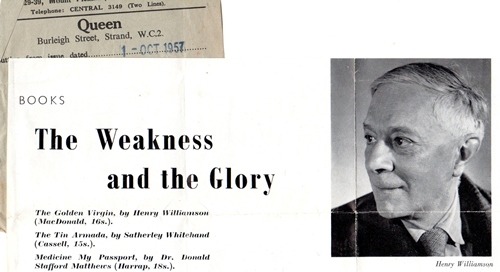
The Golden Virgin . . . is a masterly novel in every way: the mature work of a mature writer, who can survey the past without sentimentality, yet whose bitterness has a vintage quality, where an all-embracing charity has purged out the rawness of blind instinctive protest against the unfairness – the waste – of life. . . . This latest novel . . . centres the spiritual development of young Phillip Maddison. . . . Bewildered because he seems to be unable to conform, in his own mind, to the classic, copy-book conception of a hero . . . [but] boasting, evading, hoping, dreaming, getting tight, and reaching out to the stars, Phillip Maddison, at twenty-one, grows up. He is at once both the epitome and the symbol of Man. The Golden Virgin has tenderness uncorroded by self-pity; it has nobility based on, and never divorced from, the simple, the common, way of living. It is a memorable – a wonderful – book.
Time and Tide (Fred Urquhart), 28 September 1957:
Has any study of the work of Henry Williamson been published? If not, such a critical appreciation is overdue. . . . [And how does the Flax of Dream series compare with the new series? – then proceeds to précis the plot of The Golden Virgin] . . .
Mr. Williamson gives the best picture I’ve ever read not only of the ‘nightlife’ of London but of the lives and feelings of its ordinary suburban citizens of that era, with a more authentic atmosphere [than most other books]. I read it with fascination . . . [greatly] due to the unsentimental yet sensitive unfolding of the character of Phillip. At times one feels like kicking him for his pomposity and priggishness . . . yet here is a portrait of a fundamentally nice youth – a young man whose emotions are understandable.
[The Golden Virgin] demands closer inspection . . . I should not be surprised if eventually Mr. Williamson’s sagas about Willie and Phillip Maddison come to be regarded as two of the major achievements of twentieth century literature.
The Bookseller, 5 October 1957 (‘Under Review’, Henry Puffmore); this is the second review in this journal). It is in direct response to Fred Urquhart’s review above, and is actually an oblique warning to reviewers to stop being slick and clever. It refers to John Moore’s September Moon, given similar treatment to The Golden Virgin:
Mr. Fred Urquhart’s review of . . . offered a reasoned opinion. A number of early reviewers had seemed . . . [to regard] the author’s hero as something of a bore, [and the story] pedestrian. But Mr. Urquhart thought a critical appreciation of this work was overdue. . . . I contemplate with interest the possibilities of even later reviews.
[The Bookseller was the bible of the literary world – everyone read it:so who rose to this challenge?]
Books and Bookmen, October 1957 (unsigned but I think one can assume ‘Brother Savage’, as in the earlier ‘B&B’ reviews – but this cannot have been in response to Puffmore’s challenge – it would have been written well before. However it makes a nice juxtaposition!) A superb write-up as ‘PERSONALITY OF THE MONTH’ – even if one or two ‘facts’ are incorrect.
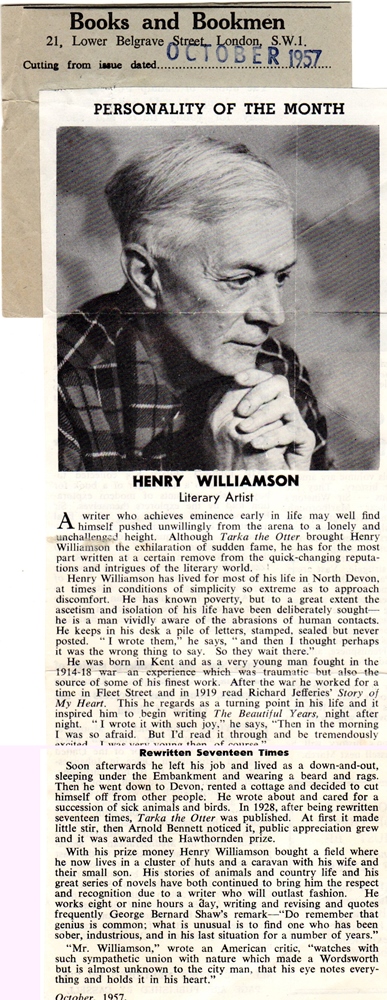
The Times Literary Supplement, 11 October 1957,10” column (This was in response?) This is the review pasted into the front of HW’s own copy.
The Golden Virgin is the sixth volume of Henry Williamson’s roman-fleuve of the Maddison family. The period is 1915-16 and the setting South London and the Western Front. . . . It is difficult to know what to admire more, the skill of the characterisation or the art by which the character is subordinated to the theme without contrivance and without loss of humanity. The theme is the war. Like a distant barrage it thunders incessantly in the mind even when Phillip is reliving some idyll of childhood or adolescence. . . . Richard Maddison reads garbled accounts of trench life with the enjoyment [of a schoolboy]. . . .
This double vision cuts Phillip off from his family and friends. He is driven in on himself, a self that his father’s early harshness has taught him to despise. [where will he find the courage to face the Front Line – no answer to that – but when time comes, he leads his men over the top] . . .
The pathos is intensified by the hero’s youth . . . he desperately wants to do the right thing but what is it?
Not the least valuable aspect is the scrupulous fidelity to contemporary detail. Advertisements, quotations from newspapers, dialogue, all are in key. The restaurants of the West End, the streets of South London materialize before the reader’s eye like an Edwardian photograph brought to life. The same gifts of accurate observation touched with poetry reconstruct the unnatural landscape of the trenches and people it with the officers and men of Kitchener’s Army.
The Daily Telegraph (John Betjeman), 11 October 1957:
For some years now that excellent nature writer Henry Williamson has been turning his attention to pre-1914 South London suburban life. In “The Golden Virgin” he traces the career of Phillip Maddison (why does he spell Phillip with two “l’s”) on leave in south London in 1915 and in the second and finer half of the book, in the Battle of the Somme.
The description recalls the thunder of guns, the squelching horror of that First World War . . . without a trace of self-pity and a deep understanding of fear.
The Cork Examiner, 10 October 1957; a whole broadsheet page of ‘Book Reviews’ from a good old-fashioned daily newspaper – sent no doubt by John Heygate (it does not have the usual ‘Durrant’s’ news-cutting service tag). An interesting factor with all these reviews within HW’s own archive is the number of other book titles they contain – all look interesting but few have stood the test of time. On this page alone there are 22 titles, most of which get several column inches coverage: one on the R101 airship, The Millionth Chance, James Leason; Up and Out, John Cowper Powys; two books on Mary Kingsley; in the ‘shorter Notices’ appear The Railway Children and new translation of Pinocchio. Of great interest is a long analysis of Portrait of a Rebel, Richard Aldington’s assessment of Robert Louis Stevenson (27” column) – only the second one I found in this whole file:
While exploring, and perhaps exploiting, elemental causes, biographer Richard Aldington specialises in exploding current mythologies. Typical of his dynamiting method are two recent works on D. H. Lawrence and Lawrence of Arabia. . . . [Concerning RLS] Aldington characteristically concerns himself with the essential man dimmed under his own deliberate poses . . . in demolishing the “plastered saint” conveys a ruthlessly human portrait . . . [wherein] RLS is returned to us more of a hero than ever.
HW and The Golden Virgin gets an 11” column under the heading ‘To End All Wars’:
When fears of a third world war [and when others are writing about the Second] . . . it is a trifle surprising . . . a novel relating to the first war, the Kaiser’s, as it is sometimes called [and states that the overall effect is of a saga].
Against the canvas of England fighting the war “to end all wars” . . . the portrait presented is of a young man puzzled by something but not sure what. [Catholics are presented as an answer.]
The theme of the novel (taken from the Albert statue and not the ‘blonde maiden’) is the existence within every man of an impersonal love for his fellow man, a love which is a motive force for living. When the novel comes to an end, Maddison is on the threshold of discovery of that love. . . .
Sphere (Vernon Fane, ‘The World of Books’), 19 October 1957:
[The Golden Virgin] is new novel about a young man and his sometimes rapturous, sometimes agonising development of mind and spirit during the First World War. It always seems too long between Williamson’s books, which is as complimentary [as one could be] . . . the present one, with its deeply serious tone but its grace of touch, is as satisfying as its predecessors.
Universe, 25 October 1957, 5½” column:
The title derives from . . . [the golden virgin of Albert] . . . the young subaltern whose wartime experiences are told in prose that reaches an almost epic level when it comes to the mud, misery and meaningless massacre of the Somme battles of 1916.
East Essex Gazette (The Looker On), 1 November 1957, 36” column, including photo
THE FLOWERS OF THE FOREST
Forty Years after: Henry Williamson’s great book of the first world war
BATTLE OF THE SOMME
. . . there appears what must surely be one of the great war books of our time. [The reviewer refers to John Osborne ‘who looks back in anger’ and ‘tells us his object is to make us feel’, but this demands a sympathetic skill]. Mr. Osborne may one day find that skill. Mr. Williamson is alive with it.
The book recounts the experiences and bewilderments of a sensitive young man, Phillip Maddison, in south London and on the Western Front – all unquiet on the Western Front – between the first blooding of Kitchener’s Army at Loos and the Battle of the Somme. [The reviewer then details that battle.]
The re-creative power of the book is uncanny. Everything at home and overseas will be found “as you were” by those who lived in those times and shared in them. The colours, drab or bright, are in perfect register. The lonely desperations of this boy are revealed with uncommon insight in a cool, clear prose style. . . .
Now, as November 11 comes round once again with Flanders poppies and old memories, this truthful and beautiful book, magical in its heart-searching and compelling to read, lays its garland of flowers at the base of the cenotaph in Whitehall, erected long ago to commemorate the great company who died in “the war to end wars”.
Few in those days could have been brought to believe that the next generation would go armed once more along the road to Bapaume.
At the bottom of this long piece is appended the following quotation: it does not say so, but it is part of the quotation HW places at the beginning of Part One of The Golden Virgin.
The Illustrated London News (K. John – against whose name HW has written: ‘The daughter of ‘Tenby Jones’, the painter in G.V.’ i.e. Augustus John), 9 November 1957:
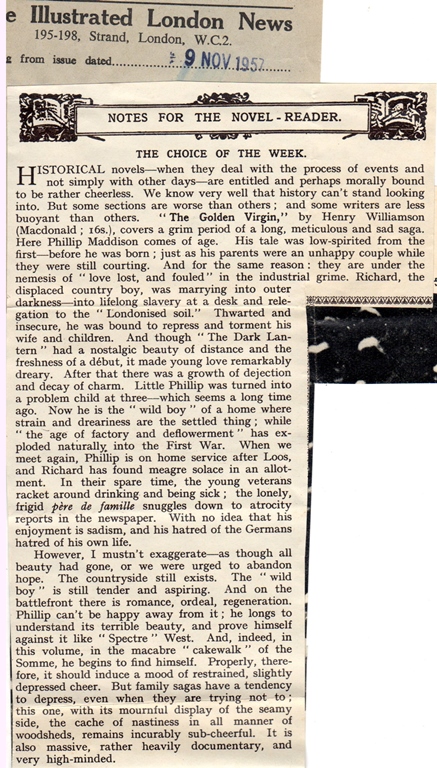
St Martin’s Review (William Kean Seymour), November 1957:
MY CHOICE THIS MONTH
. . . [re Tarka and Salar] but for some years past Mr. Williamson has been producing instalments of a great work of fiction [WKS includes The Flax of Dream in his overall view] . . . the million or so words already written demonstrate the genius in conception and the steady fulfilment. . . . Mr. Williamson analyses [Phillip] and his family and associates as tenderly and as remorselessly . . . each paragraph is flooded with illumination and conviction. . . .
So powerful is the writing and so lucent with light and pulsing rhythm that The Golden Virgin must be acclaimed independently as one of the great war novels of the century. . . . Mr. Williamson makes no concession to the popular taste for larger-than-life heroes and happy endings: he is an artist first and last and his work will endure as an unforgettable picture of a lost generation.
Books and Bookmen (Reginald Moore), December 1957 (their third bite at the cherry!):
ASKING FOR OBJECTIVITY
A controversial Russian novel ‘promises more than it provides [Vladimir Dudintsev, Not By Bread Alone: widely reviewed alongside HW’s The Golden Virgin in many columns]; a Finnish historical novel written with fidelity. . . [Mika Waltair, The Etruscan]; a finely balanced story of the Great War I enhances a novelist’s reputation [HW, The Golden Virgin]; a novel about entertainers contains splendid, vibrant and living characters [Norah Hoult, Father and Daughter].
. . . Henry Williamson’s The Golden Virgin is as good a novel of the Great War as I have ever read. The picture is so complete. [The reviewer takes the main features of the plot and succinctly places their value in Phillip’s development – especially Fr Aloysius] whose faith and philosophy are helping to bring something good and enduring out of the muck and muddle of war. . . . [But whatever Phillip does] we know that it is only an interlude between acts of tragedy that involves them all. A fine sensitively balanced story that enhances Henry Williamson’s already considerable reputation as a novelist.
BBC Network Three: ‘The World of Books’, 23 November 1957; This had been scheduled for 7 December but last minute change:]
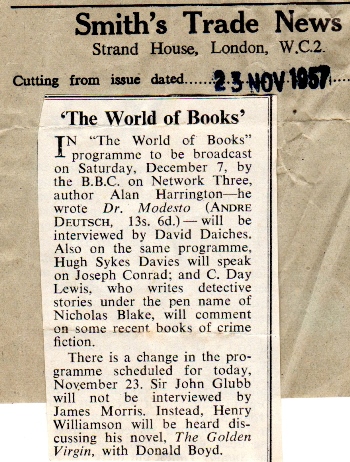
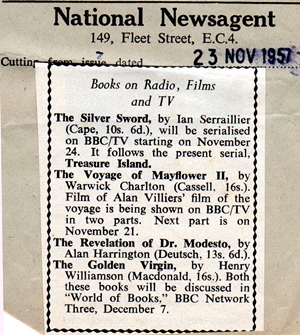
*************************
Reviews also appeared of the 1963 paperback edition (mainly just mentions of the book):
Smith’s Trade News (‘Whitefriar talking’), 28 September 1963, very short column. Panther’s top title is Xavier Herbert’s Soldier’s Women (Australian war & sex setting). The list includes The Golden Virgin.
Retail Newsagent (Stephen Mogridges), 12 October 1963, short column; again the star title is Soldier’s Women (413 pages) – then:
Continuing the series of novels by Henry Williamson dealing with World War I Panther now reissue his massive volume The Golden Virgin. This follows the fortunes of his hero Phillip Maddison after Ypres. 383 pp. 5/-
National Newsagent, 19 October 1963; Top title here is Philip McCutcheon’s Bluebolt One (spy thriller) and again Soldier’s Women.
War is also the subject of The Golden Virgin . . .
Irish Times (B.P.F.), 16 November 1963; the main review here is for Penguin reissues of Colette’s works (11” column) – lesbianism being the ‘tag’. The Golden Virgin gets 2 inches:
. . . [not as good as A Fox Under My Cloak] . . . Williamson labours deep in the mines of the past, throwing up great heaps of rubble with gleams of his own vein of ore. [Interestingly mentions Thomas Mann, with whom I have compared HW.]
“There is poetry in the book”, said Carlyle while toiling over his translation of “Wilhelm Meister”, “and prose, prose for ever.” Williamson’s plodding lower-middle-class prosiness is a barrier to those who dislike, or ignore, the real power and vision behind.
Evening Argus (Brighton) (Gordon Thomas, ‘Paperback Parade’), 10 October 1963:
‘Great’ War? – great book
More than 500,000 of Kitchener’s men fell in the unspeakable agony of the Somme . . . A generation of children without fathers; a generation of women without husbands. [The reviewer first mentions Covenant with Death, John Harris’s terrific novel about Kitchener’s men and the battle of the Somme.]
Today that bitterness is kindled again in a novel that must rank as one of the greatest about the Great War – indeed any war. It is THE GOLDEN VIRGIN . . . sixth in “A Chronicle of Ancient Sunlight” – a series which has rightly won unstinted praise. Panther have done justice with a superb jacket that, like a Giles drawing [cartoonist of note] you can look at and find something new each time you look.
A great part of this book is concerned with the Somme - a battle that destroyed thousands of lives in a mere matter of moments. . . . Twenty-four years later it had started all over again – against Hitler.
Nobody seemed to learn.
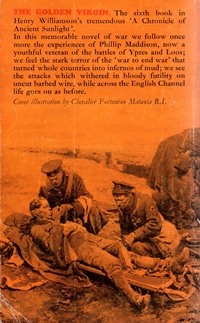 |
 |
 |
Back to The Golden Virgin main page
Back to 'A Life's Work' Back to 'A Fox Under My Cloak' Forward to 'Love and the Loveless'
The Golden Virgin
THE GOLDEN VIRGIN
(Vol. 6, A Chronicle of Ancient Sunlight)
“Objects of hate are but our own chimaerae
They arise from wounds within us”
Father Aloysius
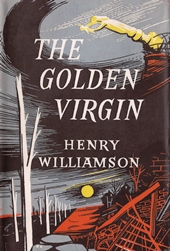 |
|
| First edition, Macdonald, 1957 | |
First published Macdonald, 6 September 1957 (16/- net)
Second impression, with some revisions, May 1961
Third impression, January 1966
Re-issued Macdonald, using sheets from the 1966 third impression, re-cased and with a new dust wrapper bearing an ISBN. Date not known, but probably 1970 or soon after, as that is when ISBNs were introduced in the UK.
Panther, paperback, October 1963, 5/-
Macdonald, reprint, 1984
Sutton Publishing, paperback, 1996
Currently available at Faber Finds
Dedicated:
‘To RICHARD ALDINGTON’
Richard Aldington (1892-1962) was a writer of note, although somewhat controversial. The two men were close friends. The first contact between them was in 1929 when RA wrote a complimentary letter on publication of The Wet Flanders Plain. His own very well received book Death of a Hero was published soon after. But there was no further contact until HW invited RA to contribute an article in The Adelphi when in 1948 he became owner and editor. But the two men were really brought together by Alister Kershaw, who admired both writers and went to work for Aldington. In 1949 Kershaw arranged for HW to spend his honeymoon with his new bride Christine at RA’s home at Le Lavandou on the south coast of France; and so began a steady friendship between these two eminent writers. Correspondence between them was extensive. The friendship was somewhat bruised however by Aldington’s revelations in his controversial book on HW’s rather god-like hero, T. E. Lawrence: Lawrence of Arabia: A Biographical enquiry (Collins, 1955). However, they made up their differences and the dedication here is HW’s public affirmation of their enduring friendship.
[For the full background see HWSJ 28, Sept ‘93, AW, ‘The Genius of Friendship, Part II: Richard Aldington’, pp. 7-23, and a further article by Kershaw, 'Henry Williamson', in same issue, pp. 24-33. This area will be more fully explored in the forthcoming page on Genius of Friendship.]
Placed in the front of HW’s own copy of this first edition are several items. One is this postcard of the Golden Virgin of Albert:
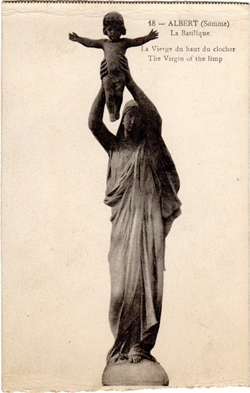
Another is the later Book of the Month wrap-around addition:

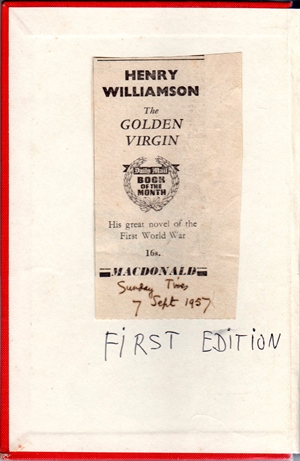
There are also two or three review cuttings which will be found in the Critical reception section, and these two watercolours, the first showing the basilica of Albert, with its leaning Virgin and Child; the other is dated 6/16 and initialled 'DNM' (?):

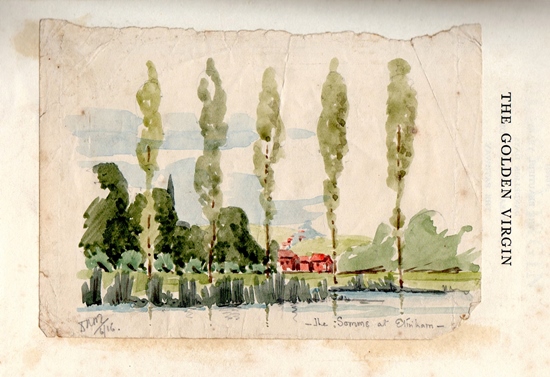
************************
Phillip has returned to England in the late summer of 1915, and as this volume opens is on leave, letting his hair down, to his sister Mavis’s jealous annoyance. He then joins the ‘Diehards’ Regiment where he proceeds with training, first at Hornchurch, then at Northampton and on to the Machine-Gun Training Centre at Grantham. This training is interrupted by further convalescent leave (during which he meets the tragic Lily Cornford) but orders arrive recalling him to report for immediate duty in France.
At Étaples there is further training for the forthcoming attack, with a great deal of detail included. Phillip is moved forward to Albert where he sees the symbolic ‘Golden Virgin’ – the legendary statue damaged by German shelling but still hanging from the church tower. His new C.O. is ‘Spectre’ West, who understands that the German defences are impregnable and that the forthcoming attack is doomed (on trying to point this out he is relieved of his command – but in the ensuing battle wins a decoration, adding a bar to his MC).
The attack – the Battle of the Somme – commences at dawn on the 1st July: a fine summer’s day. During the chaotic carnage, Phillip is wounded on the first day, lying out in No Man’s Land and later found by the saintly Father Aloysius. He is returned to England where he gradually recovers and goes down to Lynton in Devon to recuperate. Back in London the domestic scene continues with its own involved scenes of mayhem: the climax being the death of Lily Cornford (Phillip’s own ‘Golden Virgin’) from a Zeppelin bomb.
As this volume ends Phillip is due to return to Grantham to continue his interrupted training.
************************
This correction sheet, itself heavily revised, shows the extreme care that HW took over his writing – in a letter to HW, Victor Yeates, his schoolfriend and author of the classic Winged Victory, wrote, 'Writing is instinct: revision is skill'; and HW constantly – obsessively even – revised and re-revised all his work:

Piecing together the various sparse bits of information – clues – it is obvious that HW found The Golden Virgin a difficult book to write. There is little in his diary, but enough so that, with other sources to illuminate the struggle, one can piece the background together. The book needed a great deal of research (as had A Fox Under My Cloak) but mainly HW had to decide his story-line – how he was going to manipulate his characters and encompass as wide a view of the whole war as possible, both at the Front and back in England.
He also had to think ahead about the structure of the series as a whole. We know that from the earliest point he actually started to write these books (1948/9) he planned to encompass his time on the Norfolk Farm during the Second World War, because his first idea was to start at that point and make everything else retrospective; but his publishers (mainly through Malcolm Elwin) advised him to actually start at the beginning and work through to the end.
It is apparent that in early 1956 this flared up again. The main reason was possibly the product of an overworked mind, compounded by the fact that he was always convinced that he would die before the work was completed, and whenever his mind was in turmoil he would (albeit subconsciously) invent further complications. At this time, too, he had a huge falling out with Malcolm Elwin (who apparently now no longer worked for Macdonald). A diary entry at the beginning of 1956 reveals that Elwin was passing on to others information about HW’s personal life and, more importantly, his writing plans, which had been made in confidence. This brought to the fore a number of old grudges – including those about Susan Connelly, but more importantly here, that about the Norfolk Farm volume (variously called ‘Lucifer and Darkness’, ‘The Man who Went Outside’, ‘Wit’s Misery’ etc.).
So (one feels perhaps to spite Elwin!) HW now resurrected this MS/TS and was obviously working on on it at the same time as The Golden Virgin: a recipe for disaster. All this is apparent from a diary entry at the beginning of March 1956: one book is being typed by a lady at nearby Combe Martin, the other by Mrs. Tippett in Truro, Cornwall (his ‘official’ typist). On 7 March, finished work arrived from both sources. HW recorded: ‘Returned this afternoon from London, tired and confused.’
He had been to London to sort out the future structure of the Chronicle series with his publishers. Although they were willing and had accepted the farm volume, he had actually been advised by John Middleton Murry, prominent critic and writer, a pacifist who had run a ‘Community Farm’ in the Second World War and editor of The Adelphi magazine, which HW took over briefly in 1948/9, and who was hugely supportive of HW, and preparing at this time a major critical essay on HW’s work (see HWSJ 35, September 1999, for full background) and also by his long-standing friend John Heygate, NOT to publish the farm volume out of sequence as it would confuse readers. He was in a fraught frame of mind and could not make a decision.
Interestingly, it was his typist Elizabeth Tippett who ‘tipped’ the scales. She wrote to say that having typed up various versions of the farm book and the previous Chronicle volumes, she felt that HW should continue in sequence, as readers would not be able to comprehend the later Phillip without continuous build-up. HW commented:
Admirable criticism! . . . I’ve been yea-naying. Now I say, NAY. Let it be put away, & on with No. 6.
The next day he notes ‘Posted Chapters 36-41 (end) of Man Outside [i.e. the farm volume] to Mrs. Tippett.’!! But this book does indeed now get left to appear in its sequence in due course.
Apart from a later addition (see end of the year entry) the diary is totally blank until 11 October:
I finished the 1st draft of The Golden Virgin today. Felt a little relief. No: I finished some weeks ago, & rewrote the last bits today, & posted in afternoon to Middleton Murry.
Monday 22 October: Murry’s opinion of Parts I & II sent to him recently came this morning. I read it, dolefully, in the churchyard [Georgeham]. It is unfavourable. . . . Part I should be cut . . . he was severe . . . I recovered later, and planted some oak trees in the west spinney. . . . I think I’ll be grateful to Murry, because I shall condense & cut & that hurts nothing, considering that I wrote the book rather vaguely & only found out things as I went.
The next day he affirms: ‘. . . Jack is right. . . . See MEMORANDUM at the end of this diary for results of . . . ‘
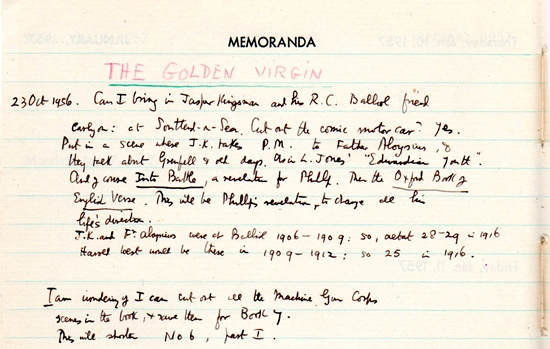
He chews the problem over again in an entry added into April but actually written in retrospect from the end of the year:
. . . So I withdrew it [the farm volume] and went on with The Golden Virgin though I was tired and had planned to REST this year, & write the Bray Stream Book for Faber – most of which is already done. [This is A Clear Water Stream, published by Faber, 1958.] I wrote Virgin steadily, with seldom a break until October of this year. It totalled about 180,000 words & I was pretty stale all through & as I have recorded in passage of 22 October Murry read 2/3rds of it & reported that it was bad.
So it looks as though I have had 3 miscarriages this year, with Doctors Heygate and Murry in attendance, . . . & again when the Golden Virgin was apparently sterile and boring.
But it is actually obvious that HW himself had doubts anyway about the book. The fact that he sent it to Murry – and then accepted his criticisms very calmly – shows this. If he hadn’t felt that himself, he would never have accepted such criticism, and would have turned against Murry just as he did Elwin.
Serious researchers consulting the manuscripts held at Exeter University Special Collections Department will find the various versions of this volume (and of all the Chronicle – and indeed HW’s entire oeuvre) reveal all the various revisions. HW was a perfectionist and reworked his material, almost obsessively and often unnecessarily, until he felt it was right.
Letters between HW and Murry reveal further detailed discussion about the book (see HWSJ 35, September 1999, AW, ‘Millenium Revelations: John Middleton Murry’, pp. 38-66, see p. 60-61). But Murry was now a very sick man, and he died on 13 March 1957. HW attended his funeral at his home in Thelnetham (near Diss, Suffolk).
His last letter to HW, written on 11 December 1956, had been finally encouraging about the new version of The Golden Virgin:
What you tell me of the new beginning – Tollemere Park, Father Aloysius, and the words on Ching – seem good to me: gives me the feeling it belongs . . .
HW later wrote at the bottom of this:
My dear Jack, you were to die three months after sending me this letter. I wish you could have seen the story as it is now, due (the vast improvement) to both you and Elwin. You, and he, both went far out of your different ways to be kind to me, Henry, 27 March, 1957
With the problems all satisfactorily solved, HW had reverted to an equanimity of mind. One deduces here that the final version was ready to be sent off to the publishers.
(John Murry’s important critical essay on HW’s work (up to A Fox Under My Cloak) was published first in shortened version in The Aylesford Review, Vol. 11, No. 2, Winter 1957-8, a special edition devoted to HW’s work – see below; and in full version in the posthumously published Katherine Mansfield & Other Literary Essays, Constable, 1959. The essay, The Novels of Henry Williamson, has been also been published separately as an e-book by the Henry Williamson Society, and is available from Amazon, iTunes, or directly from the Society.)
Diary entry 6 September 1957: ‘The Golden Virgin published today.’
But the occasion was marred. HW had been in Ireland since 28 July, camping in the Countryman but at this point staying as guests of John Heygate at his home on the Bellarena Estate. The day after publication HW went into the nearby village, Limavady, to collect copies of the Daily Mail, which he knew was publishing an article on him by Kenneth Allsop (well-known writer and broadcaster, and close friend). To his horror, he found that Allsop had written that HW had been awarded the Military Cross aged 20 – apparently having mistaken the ribbon of the Mons Star on a photograph of HW pinned up in his Writing Hut for that of the MC. HW was extremely upset that such a false statement should be published in case it would brand him a liar. Allsop was of course basically a journalist and such a good story line prevailed over verified facts (note Allsop’s own tale that his right leg was amputated due to a flying accident in the war, when in reality it was due to a tubercular bone going back to childhood). On HW’s return to England a few days later he received a letter of apology from Allsop, saying he should have checked his facts (but I don’t think it was ever publicly retracted). This caused a coolness in their friendship for a long time (in fact it never really stopped rankling, and surfaced in HW’s thoughts from time to time).Allsop's review is included in the Critical reception section.
(See Mark Andresen, Field of Vision, 2004 (but where several facts about HW are incorrect) and AW’s review of this in HWSJ 40, September 2004, pp. 95-6. Also HWSJ 28, Peter Robins, ‘Adventure Lit His Star’, pp. 34-9; and HWSJ 29, ‘Steepholm, the K.A. Memorial Trust’, letter, pp. 62-3.)
************************
Soon after this HW moved into a proper house again. Life in a caravan at the Field with wife and child had become a problem. On 23 November 1957 HW noted: ‘Posted cheque to [solicitors] for purchase of No. 8 Brittania Row £86.’ This was one of a row of houses (narrow but tall!) in the nearby town of Ilfracombe, where HW lived for the rest of his life. The Field and his Writing Hut reverted to his refuge for peace and quiet.
On 3 October 1957 HW was made a FRSL (Fellow of the Royal Society Literature), and his diary notes: ‘Very happy day for me’. This was a high literary honour reserved for ‘persons of distinguished literary achievement’, and was not given lightly. On 1 December 1957 (his sixty-second birthday) he was also made an FIAL (Fellow of the International Institute of Arts and Letters, which is based in Zurich).
HW’s diary entry for 12 December 1957 shows that he met:
Father Brocard Sewell with whom I’ve exchanged letters about the G.V. & other books. [At dinner at his daughter Margaret’s in London.] He is producing a Winter number of Aylesford Review, dealing mainly with H.W.
This work duly appeared in late January 1958 when HW noted:
The copies of the H.W. number of Aylesford Review arrived. Splendid, kind, warm number.

However, HW took great exception to the essay by Malcolm Elwin, because Elwin used material which HW had given him in confidence (mainly the Norfolk Farm typescript), which HW did not want publicised then as he had decided to hold that for later (as previously explained). Several file copies at that time had very irritable comments about Elwin and his methods!
Fr Brocard’s editorial ‘Henry Williamson’ opened:
We direct our readers’ attention to the works of a great living writer, the maker of many beautiful books, Henry Williamson.
Father Brocard Sewell (an assumed name taken when he entered the priesthood post Second World War) was a Carmelite friar based at Aylesford in Kent, and editor of the erudite literary journal The Aylesford Review. This was the start of a firm friendship between the two men, and Fr Brocard always did all he could to promote HW’s writing. There is a large file of the correspondence between them held at Exeter University, which contains many literary details of interest to researchers.
HW attended various literary meetings organised by the Review (held at Spode House, near Rugeley, Staffordshire, run by the Carmelites) which he always greatly enjoyed. After HW’s death, Fr Brocard organised a Symposium of writing in his honour, with contributions covering the various aspects of his writing (Henry Williamson, The Man, The Writings: A Symposium, ed. Fr. B. Sewell, Tabb House 1980; copies available directly from the Henry Williamson Society).
************************
The Golden Virgin is divided into three parts: Part One, ‘The Wild Boy’; Part Two, ‘The Somme’; Part Three, ‘The Quiet Boy’. These immediately reflect the structure and content for the reader. However, things are not quite as simple as that. The outline overall story line is straightforward, as the above shows, but HW weaves a complicated tapestry in the making of his magic carpet, as will become clear.
Part One, ‘The Wild Boy’
As the book opens it is late autumn 1915 and Phillip is on leave at home, having returned from the Front (and the aftermath of the Battle of Loos) to join the ‘Diehards’. This was the actual familiar name given to the Middlesex Regiment: HW made a correction note to change that to a fictional ‘Standfast’, but that never happened.
Phillip is shown ‘letting his hair down’ at the Gild Hall with his friends Desmond and Eugene, to his sister Mavis’s jealous annoyance, who tells tales embellished to actual lies to their mother. Mavis is now working in the Head Office of the Moon Insurance Company (Phillip's firm). (In real life HW’s sister Kathy actually worked in the same bank as their father.)

Other local worthies are also looking out for trouble: Detective Sergeant Keechey and his mate, unpleasant plain clothes detectives who are officially on the look-out for deserters and spies.
We learn that Tom Ching, a singularly unpleasant character (the wretch was based on a real person), is running after Mavis. He is the unsavoury type whose main purpose in life is to dodge service in the Army (but with no real pacifist conviction).
Phillip’s only relief from the reputation of cowardice and wastrel that circulates among his family and the locality of Wakenham is a letter that arrives from ‘Spectre’ West, praising Phillip’s actions at the Battle of Loos (where Spectre wounded, and was awarded a bar to his MC).
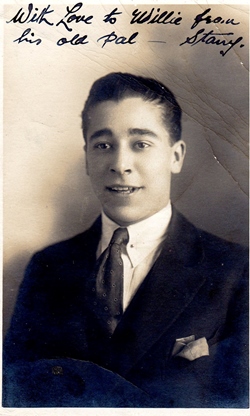 |
| Eugene Maristany |
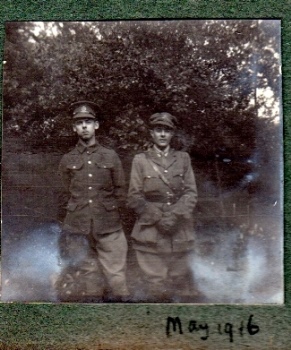 |
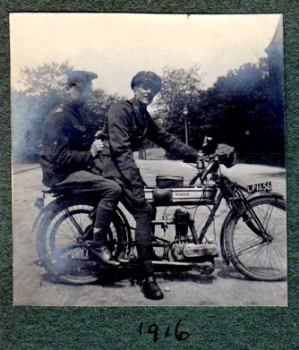 |
| HW and his friend Terence Tetley | |

Due to report to his new posting at Hornchurch, Phillip, finding his beloved motorbike had a flat tyre, recklessly buys a Swift ‘runabout’ and he and Desmond set off for Hornchurch – ‘Grey Towers’, east of London and north of the river; they drive through the Blackwall Tunnel. (There is no indication that HW actually had a Swift at this time: but this cameo shows his great interest in sports cars, which remains a potent thread running through his life and his books as time goes on.)
Phillip’s mood is optimistic as he settles in, but of course it evaporates. He reads a letter from Granpa Turney warning him against drink – the fate of the syphilitic Uncle Hugh looms over Phillip and any hint of dissipated behaviour at regular intervals. (This letter actually exists, though it was in real life written later, after the war had ended.)
Phillip is in Captain Kingsman’s company. Soon after his arrival, Kingsman asks Phillip to drive him to Southend to inspect a detachment of the company. These turn out to be blind men – who strange though this may seem, were indeed used as lookouts, their other senses being enhanced – and then to spend the night at his home.
This is a large country house, very formal, and Phillip feels there is a strained atmosphere. Father Aloysius arrives, and his conversation reveals that the Kingsmans are very well connected, and know the Asquiths (Herbert Asquith being the Prime Minister), and gradually we learn that their son in the RFC uniform, whose portrait on the wall intrigues Phillip, has recently been killed. Phillip is asked to read the poem Into Battle by Julian Grenfell (killed in action May 1915). And we learn later in the novel that Fr Aloysius’s actual name is Llewellyn Vaughan-Herbert.
This cameo piece is rather obscure and, although the reader does not need to know the background, it does enhance understanding to have it explained. HW is presenting something that otherwise would not have impinged on Phillip’s world at that time. Through the medium of the Grenfell poem to record the deaths and pay homage to a set of quite brilliant young men, friends and fresh from university, many being titled sons of the aristocracy, whose lives were cut so tragically short and about whom little is now heard (they were but a few among so many who gave their lives); they include Raymond Asquith, the son of the Prime Minister, Rupert Brooke, and in particular here the promising poet Julian Grenfell, the brother of Lady Monica Salmond (their parents were Lord and Lady Desborough). Grenfell’s poem is printed in Soldier Poets published during the war, of which HW had a copy), and he may also have seen it when it was printed in The Times in its report of Grenfell’s death in May 1915. The poem certainly meant a great deal to him. At the time HW was writing The Golden Virgin he was in close touch with Monica Salmond (and was indeed godfather to her grandson).
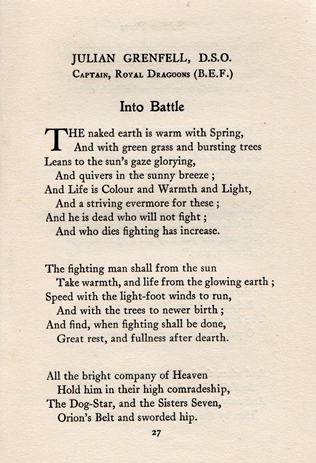
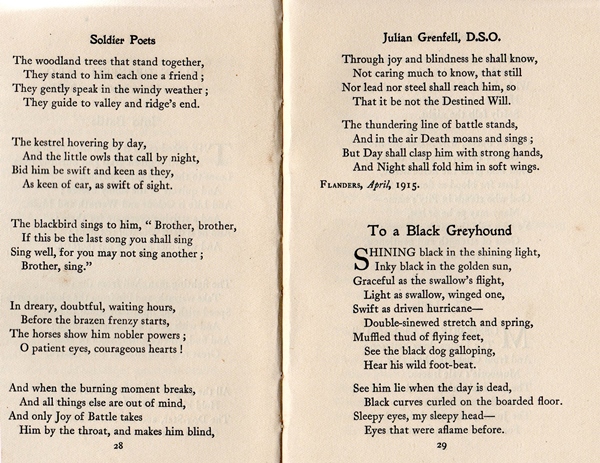
Grenfell, who treated the war as a glorified picnic, going out into no-man's-land stalking and shooting German snipers (he died before the Battle of Loos, the debacle of the Somme and the dreadful attrition of Passchendaele, after any of which he may have modified his views), was hit in the head near Ypres and died at a hospital at Boulogne on 26 May 1915, nursed by his sister Monica.
(Fuller research into the background here can be found in HWSJ 34, Sept. 1998, as part of Anne Williamson, ‘Some Thoughts on Spectre West and other elusive characters’, pp. 86-94, particularly 88-92. The background to the portrait of the RFC pilot is also examined in this article. It is clear from letters between Monica Salmond and HW that Grenfell forms a large part of Spectre’s persona.)
There is now an obvious connection from this passage to the quotation from Margot Asquith (the Prime Minister’s wife) at the beginning of this Part One, which is otherwise possibly puzzling. Her son had been killed by the Germans, but her message is of reconciliation. The Hamlet quote which follows furthers this theme, although not so obviously. (HW’s personal empathy with Hamlet is discussed in the page on The Gold Falcon, published in 1933.) Reconciliation is a huge underlying theme within the Chronicle, and one that should not be underestimated, which becomes obvious in the final volume, The Gale of the World.
Mainly, this scene brings into prominence the shadowy Father Aloysius, who is an important thread in the Chronicle. Like Spectre West, this character does not seem to exist in real life as a separate entity, and is a complicated composite. He is used by HW to show tolerance and compassion and reconciliation – as the quotation on the title page of this volume reveals:
'Objects of hate are but our own chimaeræ. They arise from wounds within us.'
These words can be found on page 75 of The Golden Virgin in a paragraph well worth reading for its overt and covert message. As Father Aloysius does not exist, his words are directly attributable to his creator, HW. However the last words of the great Indian leader Mahatma Gandhi (who died in 1948) were very similar:
The devil is in our own hearts and that is where we must fight him.
Gandhi was a proponent of love and peace (in effect a pacifist). It would be typical of HW to transmute those words to illuminate his own purpose. By its prominent placing on the title page, it is certainly a thought HW that wanted his readers to ponder: they echo words spoken in an earlier age: ‘Love thy neighbour.’
After Phillip reads Grenfell’s powerful poem Into Battle and Fr Aloysius says a prayer, he ‘felt himself to be small and simple and blessed’. Phillip had had that exact feeling in the presence of Mother Ambroisine when he visited the Thildonck Convent in Belgium as a young boy. His sister had attended that convent and of course the current fighting is on Belgian soil – so there is a multiple association, a linking of thought. Father Aloysius tells him that his sister loves him (contrary to all the evidence against that!).
After this scene Phillip is seen to have become more mature and to have a better understanding and tolerance of life’s problems: although the reader may not necessarily realise the source of this.
Life at Hornchurch is shown as somewhat squalid, but immediately Phillip is seen to have matured as an officer (and thus as a man) as he deals with the navvies who are the raison d’être of the unit. ‘Navvies’ were manual workers, so named originally for digging out ‘navigation’ canals, now on trench defence work, who tended to be rough, and the scene involving them is in marked contrast to the weekly over-genteel ‘social’ soirée of the officers.
Phillip goes up to ‘Town’ (London) where he meets two girls, Frances and Alice. Frances is (rather too fortuitously) the cousin of Spectre West. These young women typify the era, revelling in the sudden freedom of behaviour allowed women due to the war. Phillip rather falls for Alice. But just before Christmas a new battalion is formed at Northampton, and the chosen men move on: Phillip shares lodgings with his new friend Captain Bason, and they invite the two girls to visit.
 |
|
On the reverse of this photograph HW has marked: top left: 'Phillip M.' [HW, of course]; front row left: 'Flagg the Grimsby fishmonger'; middle front: 'Captain Bason'; the other two: 'not used' |
The battalion is moved out to a camp for a Lewis Gun Training course (following HW’s own experience). Going to Town on Christmas Eve to see Alice, Phillip finds her with another man. He returns to camp despondent, and his thoughts turn (as HW’s always did) to the Christmas at the Front the previous year:
Now the lighted fir-trees would be on the parapets, voices singing Heilige Nacht. Why was he not there . . . While he lived in memory upon the frozen battlefield, where the morning star shone white and lustrous in the east. . . .
This is sharp irony. Fraternisation that year had been forbidden: the authorities dare not let such events happen again, for it undermined the act of war. As Phillip later learns from a letter from his cousin Willie, British guns were ordered to fire at 7 p.m. on Christmas Eve and blasted the German ‘Holy Night’ festivities.
Phillip is now posted to the Machine Gun Training Centre at Grantham: two months learning Vickers Mark Ten gun use – then Riding School (all following HW’s own routine). When fully trained he expected to be a Transport Officer within a company.
On weekend leave Phillip goes down to London and buys suitable new kit, the ‘permitted’ field-boots, breeches, and spurs. He collects his beloved motorbike, leaving the Swift behind, and makes a brief visit to his parents, making more sympathetic contact with his father. His mother feels he has matured.
Phillip returns via Beau Brickhill to visit his cousin Polly (with but one purpose in mind) and finds Percy on leave, also wearing breeches (which Phillip realises are unsuitable), as his father wants him to go into the transport division. That night Polly does indeed come to Phillip’s bed.
Arriving late back at Camp, Phillip reports sick and is given leave – ‘to rest’. Back home again (to surprise and suspicion) he finds Desmond and Eugene in Freddy’s Bar, with a girl with
large blue glistening eyes and loose smiling mouth, tall white neck and golden hair coiled under straw hat with a spray of forget-me-knots circling its dark blue crown
– the delectable Lily Cornford.
Also in the bar is the malevolent Detective Sergeant Keechey, watching Lily and his other suspects, including Philip, whom he has decided is a deserter.
Freddie's Bar was The Castle, run by William Frederick (Freddie) Coates:

Phillip’s 21st birthday approaches (April 1916 – HW’s real 21st was on 1 December 1916). His father wants to give him a signet ring, but when Phillip wants to have it engraved with the Maddison crest, Richard is totally against it and refuses to have anything to do with it. Thus empathy between father and son again destroyed. Granpa Turney takes charge instead, giving both signet ring and a cigarette case (with the Turney crest) – poor Richard! All these difficult family interactions are very well handled: all are given faults and virtues, and there is throughout a solid portrayal of real family life.
Tom Ching is called before the ‘Tribunal’ to hear his appeal against being called up on grounds of conscientious objection (to war) – another social factor brought into the story. His claim is refused as false (as are several others).
Phillip meets up with Lily (shaking off the clinging Ching). He recites Grenfell’s poem to her which moves her to tears, and she confesses that Keechey had raped her when she was fourteen years old, resulting in an abortion. Lily is portrayed with great sympathy as one who copes with life’s circumstances as best she can, while with a sensitive nature. But Desmond gets to hear of their meeting and takes great offence, while Mavis’s unpleasant persona is furthered by her truculent demand for money from their mother.
Phillip, having over indulged drink on his birthday (and cut the family celebration to do so), goes to see Dr Dashwood, who finds a dull patch on his lung, and he is sent to Milbank Military Hospital. Again HW makes out that Phillip is a malingerer, which is very unfair to Phillip – and to himself. HW was still very far from fit and was admitted to Milbank Military Hospital at the end of May 1916 for a month, and then given two months’ convalescent leave (see AW, Henry Williamson and the First World War, p. 59). No malingerer would have been tolerated or indulged with such treatment: more likely a court martial would have resulted.
Phillip is also given two months’ convalescent leave (note that the timing is ahead of HW’s actual experience), which he plans on spending at Lynton in North Devon, at his Aunt Dora’s cottage. He prepares his ‘three-piece hickory’ fishing rod: ‘It was a fine morning in the second week of May.’ The garden is coming towards its perfect state, blossom out, the apples beginning to form, BUT as he remembers childhood delight in stealing those apples with his pals,
Never, never again! Gerry and Bertie, Tommy and Peter, Alfred and Horace, and the boy he was, never the same again, for tree or man or bird.
[i.e. his Cakebread cousins, Tommy Atkins, Peter Wallace, Alfred Hawkins, and Horace Cranmer]
A cry for that lost boyhood, cut off so abruptly – so totally for many of his friends – as his poignant words at the end of his ‘Boy’s Nature Diary’: ‘For ever, and for ever, and for ever.’
The convalescent holiday in North Devon does not happen. A telegram recalls Phillip to report for duty, finally triumphing over Keechey (who meanwhile is known to have attacked the naive Dr Dashwood because he thought he was involved with Lily), who thought it was a summons to appear before authority. (In real life the person on whom Keechey is based was in due course sent to jail, as a cutting in the archive reveals.) Phillip knows that this means ‘The Big Push’ is imminent, and says his goodbyes to family and friends. Desmond, knowing Phillip has been with Lily, whom he considers his girl, is bitterly vicious, saying he hopes Phillip is killed in France and doesn’t come back.
HW sends Phillip back to France to prepare for the Battle of the Somme. In real life HW came out of the Milbank Military Hospital after a month on 26 June, and was given two months’ convalescent leave. He was extremely lucky not to have been involved in that hellish battle, with its huge loss of life and little chance of living through it. But to achieve his purpose of showing as wide a panorama as possible of the war, this major event had to be included. His structural device and faultless ingenuity, together with his writing skill, manipulates the material with meticulous technique. The reader lives within the scene with vivid clarity.
Part Two, ‘The Somme’
As they cross the channel they hear the noise of what Phillip thinks must be a naval battle: this is the massive Battle of Jutland on 31 May/1 June, which resulted in huge loss of British life and ships. The result was inconclusive (though both sides claimed ‘victory’), but the Germans had to rethink their naval strategy (which resulted in unrestricted submarine warfare). But this was a very clever way to bring that event into the story.
Phillip is told to report to Étaples, where the training for the forthcoming attack is described in some detail. After three days the men are moved on to various regiments (quite stupidly arbitrarily, as in real life, causing considerable disquiet in the ranks). Phillip is sent (very fortuitously) to Querrieu to join the regiment he had been with at Northampton, currently out of the line, where he finds Kingsman is acting CO, with Milman as Adjutant, and Captain Bason and others.
He reads the current orders, catching up (and allowing the reader to become acquainted) with information about the forthcoming attack – ‘The Big Push’. Grenfell’s poem is constantly flashing through his mind.
The men practice over an area representing the section they will be attacking. They also play cricket, football, run, and box: all keeping the men occupied and fit. Phillip goes to a concert got up by the men where, unbeknown to him, Father Aloysius is present, who is padre with an Irish battalion. The men are marched off towards Albert. Another little nugget of history is included when they hear that Lord Kitchener has been drowned on his way to Russia: his ship has hit a mine.
Phillip is shown developing a good rapport with his men as we come to the central theme of this volume:
Phillip lay near his men, listening to the singing of larks through the thud of howitzers, the remote corkscrewing of shells travelling east into the height of the sky. Poppies shook in the evening breeze, with marigolds and scabious. Below the hill, to the north-east, lay the ruinous town of Albert. . . . a large building with a campanile with something upon its summit glinting in the western sun. Focusing his field-glasses upon it, Phillip saw a figure, which once had been upright, but now was, upon its iron frame, inclining downwards at an angle, so that the object held in the figure’s arms seemed about to drop into the void below. . . . seen by all going into the line [and inspiring] the legend that the war would end only when the Golden Virgin fell into the ruins below.
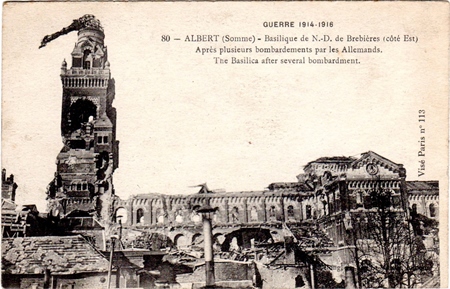
Immediately following this ‘set-piece’ on this great symbol of hope, there is an exposition on water engineering: a vital component for the men and their horses and mules.
‘A’ company (8th Division) goes into the trenches nearly two miles north-east of Albert. They are just north of the long straight (Roman) Albert–Bapaume road, with the German front line on a rising slope just in front of the villages of Ovillers (in Mash Valley) and La Boiselle (in Sausage Valley) as these deadly areas were familiarly named.

Phillip is sent out on a raiding party to get prisoners from the German trenches, which to their surprise they find empty, one man only taken as prisoner (and he commits suicide before he can be questioned). On reporting back Phillip is taken to the colonel:
A figure with a black patch over one eye . . . a black hand . . . and a silver rosette upon the riband of the Military Cross.
It is ‘Spectre’ West, who astutely questions Phillip closely about the raid, realising that the Germans must have had pre-knowledge of it (and the implications of that); also on the crucial point of the depth of the German dugouts – and angry because the significance of such knowledge has not been grasped by the Staff: if deep, then the battle plan will prove useless.
Phillip decides it might help if he investigates the sappers’ underground galleries made for mine-laying: the complicated, dangerous and vitally important preparations for the mines under Y-Sap and the massive (famous) ‘Lochnagar’ under the Schwaben Redoubt (ten such mines were laid along the length of the whole Front). Silence is imperative. So difficult is this tunnelling work that the Official Record states: ‘An advance of 18 inches in 24 hours was considered satisfactory.’
HW’s research into this whole set-up prior to the opening offensive of the Battle of the Somme was meticulous. Every detail is correct. His basic material is taken from the 1916 volume of The Official History of the Great War (those volumes he had bought in October 1954 while writing A Fox Under My Cloak) but he used various other sources as well, and certainly first-hand accounts from men he knew. He weaves all this information seamlessly into Phillip’s life, with total reality. The reader is there in the harsh chaotic nerve-wracking tension and cheery comradeship that preceded the ‘Z-Day’ attack on 1 July. Much of this information is common knowledge today, but not really widely known at the time of HW’s writing.
Phillip decides that the German dugouts must indeed be deep, but this is not good enough for Westy, and he plans a further raid into the German trenches to find out exactly. They discover that the German front line is held in strength. They are unable to investigate the depth of dugouts but Phillip now deduces that they are pretty deep. These facts are crucial to the coming battle: Westy knows that what they have found means the attack is certain to fail.
Chapter 16, ‘The Yellowhammer’, covers a final rehearsal for the forthcoming assault. This takes place over French farmland: the French cultivateurs are furious that their crops are destroyed: one calls the English ‘les autres Boches’, again based on fact. This man then shoots a yellowhammer. (There is a distinct resonance here to a similar incident in HW’s short story ‘The Ackymals’,when John Kift shoots two marsh-tits. However one needs to realise that a yellowhammer would actually mean food to a Frenchmen in the middle of this war.)
The rehearsal goes well:
Unimpeded, irresistible, the division went forward in six waves, up slowly rising ground to the final objective, a large white notice board on which was painted in black letters
SITE OF POZIERES
The irony here is of course unmistakeable. HW’s writing skill placing the barb very cleverly and subtly. There was nothing to impede, to overcome – the notice-board was just an inanimate object. It could not blast the men with horrific barrage. The men were lulled into a false sense of security (though possibly this was just as well). Immediately after this, we learn that Colonel West has been removed from his command. Spectre had reported his unpalatable truth about all the envisaged problems to his immediate Commander, General Rawlinson. Rawlinson did not want to know, so West was removed. This is a prime example of Spectre West’s character being used to show the problems of lack of reconnaissance and communication.
Proceedings had been watched by Field Marshal Sir Douglas Haig. We read his views in an aside within the flow of the story line, and we learn further what has happened. It is all cleverly done, and we are hardly aware how that important information has been imparted.
So the waiting continues, with British bombardment intended to confuse the Germans about the timing of the forthcoming attack. Phillip is appointed ‘Pigeon Officer’, so encapsulating an important aspect of communication at the Front (although this is not really carried through and examination of typescript versions might reveal that text cuts in the text were made). In another ‘aside’ we learn that the Germans know all the details of the forthcoming attack. The final preparations are made, as the men go into the front line carrying picks, shovels, bombs etc. All was ready,
as in the last night of June the company paraded silently, while the croaking of frogs in the wide marshes of the Ancre became insistent.
[See also The Wet Flanders Plain, where in 1925 HW hears those frogs again and remembers how sinister they were.]
The men march off through Albert, passing under the ‘Golden Virgin’. Phillip’s thoughts are chaotic, but he calms himself by reciting Julian Grenfell’s poem Into Battle and thinking of all those already dead (i.e. brave enough to die).
General Rawlinson added the final nail into the Somme coffin by telephoning a message of good luck – overheard by the German listening post, thus confirming the exact moment of the attack they were already thoroughly prepared for.
As the fearful bombardment begins, back in England Richard Maddison, out on the Hill on a beautiful summer’s day in England, hears the rumbling, and thinks how splendid it all is.
The Battle of the Somme continued for 140 days; 140 days of relentless fighting; 140 days of death and horror. With gritted, relentless determination the Germans were driven back about six miles. The battle was finally halted on 18 November. Total British casualties, dead and wounded, were 420,000 (nearly 60,000 on that first day), French casualties 203,000; German, 437,500: over one million in total.
Having set the scene with such harrowing accuracy, HW did not labour his writing on the battle itself. Phillip is one of those wounded on the first day. Collapsing unconscious, as he comes round he finds Father Aloysius there calming him. Phillip is seen now thinking of others rather than himself. Much later he manages to crawl back towards the British line.
At one period on the crawl back he seemed to be hearing the bell-like colour of wildflowers with startling clearness – field scabious, poppies, marigolds, small pansies . . . about the flowers were wild bees and grasshoppers, scarlet soldier flies and bronze beetles among the grasses. They glowed and shimmered with varying sounds and colours . . . it did not last long . . . pain returned.
A bitingly poignant and surreal description of what was in actuality a nightmare of ruin and disaster: a mini master stroke which should not be overlooked. We should not underestimate how many hours went into getting that small scene to such a pitch of perfect imagery.
This scene is reprised as it really was towards the end of the volume in another master stroke of structure, when Phillip is talking to Mrs Neville:
To her surprise he broke into tears; but almost immediately recovered. He did not tell her what had caused him suddenly to break – a vision of thousands of still figures lying in Mash Valley as he crawled away from his dead platoon on that afternoon of intolerable sunshine.
Phillip is found by a stretcher party and sent first to the CCS (Casualty Clearing Station) at Heilly and then to the Field Hospital at Rouen, where he learns that Captain Kingsman and all the brigade have been killed. After basic treatment he is sent back to hospital in England. He has survived. And it is that element that was to drive HW for the rest of his life: he had survived – and must speak for those millions who had not: to try and prevent such horror ever happening again.
The mood is lightened on the hospital ship across the Channel, when Phillip picks up some old copies of magazines, and scrawls scathing comments across the advertisments. It is partly through the inclusion of such small, authentic details as these that HW recreates the past so vividly for his readers. One such was for the 'AutoStrop' razor, in Nash's and Pall Mall Magazine:

So the intense theme and mood passes into:
Part Three, ‘The Quiet Boy’
Richard, working at his allotment, has a visit from a concerned Lily Cornford – the Vision, as he thinks of her. Lily continues, and nervously calls on Mrs Neville as Desmond has also been at the Front and is wounded. Mrs Neville understands her and the two women become friends. Lily is trying to put the past behind her and make a fresh start. She is sorry that she has come between the two friends, and does not want to see either of them.
We also catch up with Captain Hilary Maddison, Richard’s older brother: he has been torpedoed, but has accumulated money through war investment, and now plans to buy back the family land sold by their father. We learn that Willie has also been wounded (in the attack on 14 July) and is also in a London hospital. This is laying down pointers that will have significance as the plot later develops: HW knew how he was going to develop his story in future volumes. The two brothers also discuss their German heritage and condemn the Germans for their cruelty and sentimentality – an interesting little exchange that is easily missed.
Phillip has a letter from Spectre (also badly wounded and in hospital), which conveniently explains the battle strategy and why it has failed: a neat – though obvious – device.
When Phillip recovers he is sent off by the redoubtable Georgiana, Lady Dudley – thus bringing into the picture the work done by those titled women who worked tirelessly for the wounded, and of whom we learn more later – to convalesce at Sir George Newnes’ home, Hollerday House, on the cliffs at Lynton. (This was a real place, but had actually been burnt down just before the war – so this scene is entirely fictional.)
After a short period at home Phillip travels to Devon, along with his sister Doris and Cousin Polly (in a separate carriage!) who are to stay with Aunt Theodora at her cottage in Lynmouth. They are to be joined by Willie, also convalescent, and Percy, on leave before he is sent to France. On the train Phillip reads with great excitement that ‘Lieutenant (temporary Major) H. J. West, MC and bar’ has been awarded a DSO for his bravery in the attack on 1 July. The demoted Westy has been vindicated.
Once again Phillip and his small party take that narrow gauge train from Barnstaple to Lynton, to be met by Aunt Dora, pleased to have the young people with her. Phillip is taken off (with humorous detail) to Hollerday House, from which he escapes as soon as possible. Down at the cottage, Dora notices immediately that Doris is in love with her cousin Percy:
An honest, rosy-faced country boy, a little slow perhaps, and an ordinary mind, but that was all to the good; there was enough nervous tautness already in the family.
Dora muses (to herself) on the causes of war, ancient and modern. She talks to Phillip, finding him receptive. And we have here a little ‘motif’ of the River Lyn – that symbolic thread running through the Chronicle series:
Was her mood taken from the running noises of the stream below, the water everlastingly hurrying, blindly, despite its clearness . . . to the sea, its blind parent . . . ever set upon its task of reducing rock to sand, and sand to dust. Water in the end wore away the hardest stone.
Deeply within her, Dora was afraid of her cottage . . . an indefinable remote dread haunted her, as though the Erinyes, avenging spirits of twilight, dwelt in the dark glen above the village.
That, in retrospect, chilling passage reveals that HW knows by then (1956/7) exactly how he is going to end his magnum opus – and I am sure he had indeed made that decision at the time of the disastrous natural event (the Lynmouth flood of August 1952) that encompasses the climax, still many years ahead of this point in the Chronicle.
Now re-introduced into the tale is the most extraordinary character, who appeared briefly at the Front: Lieutenant Piston, supposedly shell-shocked and wild to the point of (feigned) madness. Piston (and another equally strange character, Bill Kidd) was based on a friend of HW’s, Bill Child – who was possibly even more wild in real life than HW’s created fictional persona! Piston’s main histrionic act, having learnt that he is to be sent off to Scotland (though not named, this would have been the famous Craiglockhart Hospital where Siegfried Sassoon and Wilfred Owen were for a while, and which led of course to Owen’s outpouring of poetry), was to set fire to Hollerday House. His ploy worked. He was in due course invalided out of the Army – and out of the tale until the very last volume.
On Phillip’s return home he plays tennis with Helena Rolls. Milton arrives (an ex-Colfeian headboy – a nice touch!) and later at a St Simon’s Parish Hall dance, just as he thinks he is getting somewhere at last, Phillip learns that Helena and Milton are engaged.
Meanwhile Cousin Polly has come to stay – and announces, to Phillip’s total consternation, that she is pregnant; but Mrs Neville soon sorts out that tarradiddle! But as he goes back in great relief to his own house, the news has arrived that Percy has been killed in action at the Battle of Flers on 15 September 1916. Polly returns home. Doris is heartbroken. And later that night Phillip thinks of
the grief that must now be felt even by the walls of Brickhill House.
HW’s cousin Charlie Boon was killed in action at the battle at Beaumont Hamel on 16 November 1916, aged 21. [Details can be found in HWSJ 43, 2007, AW, ‘Cousin Charlie: A Tribute’, pp. 94-104] The HWS has visited his grave and made due tribute to this young lad, so typical of ‘every soldier’.
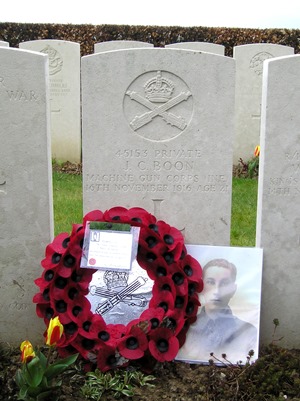
Phillip meets up with Tom Cundall, now a pilot in the RFC (HW’s friend, Victor Yeates) and hears all about the problem of Zeppelin raids now prevalent on London: again a useful device to bring this into the story, another social detail woven into the tapestry. He then goes round to Lily Cornford’s home and talks to her mother, who tells him that Lily will be home the following Saturday, 23 September.
On that day he goes up to stand outside Buckingham Palace when Spectre West is to be awarded his DSO, and afterwards is asked to join him for lunch at the Café Royal, where the rich food and drink are too much, as always, for his stomach to deal with. Later he meets Lily, firm in her intention not to become the bone of contention between the two men, now determined to become a nurse and to put the past behind her. He then goes off to meet Desmond and Eugene.
Later that night there is a Zeppelin raid warning. We learn that the pilot is the famous Kapitanleutnant Mathy. Going out on the Hill to watch out with Desmond, the latter argues about Lily, dragging up every fault against Phillip that he can think of. He is possessed by jealousy. Later they make it up, but at that moment the Zeppelin appears. HW’s dramatic description takes us to the climax: a bomb is dropped but then the airship is shot down. The two men go to find the damage. The bomb has fallen on Nightingale Grove – on Lily’s home: she and her mother (and others) have been killed. They help with the wounded. Richard Maddison was on duty and gets slightly injured, and later Phillip collects his father from hospital (another mark of increased maturity).
[This is based on a true incident – except that HW was not present. The background to this Zeppelin raid can be found in AW, Henry Williamson and the First World War, pp. 62-4. There is no evidence that HW actually knew the girl on whom Lily Cornford is based, Lily Milgate (although Terence Tetley may have done), but HW wanted to include this tragic happening in his tale.]
The next day Phillip and Desmond drive out to see the wreckage of the stricken Zeppelin at Snail’s Hall Farm (a real place): the pilot was not Mathy, although he was shot down soon after (in real life by Second Lieutenant Tempest, though HW attributes the feat to the amazing Tom Cundall). Phillip attends the funeral service of this pilot, rather than (although thinking about) that of Lily, also being buried that day. His own ‘Golden Virgin’ (that she isn’t is no fault of her own) has gone. He continues to Tollemere Park, home of the Kingsman family, to pay his respects and condolences to Mrs Kingsman, but she is not there. On his way home he is filled with a piercing anguish. But the volume ends on a note of affirmation:
The next day he would be going back to Grantham, to rejoin the training centre. . . . When the time came to take over a section, he would live for the horses and mules and grooms and drivers which would be in his care. He would be part of one of the many new Companies which were going out every week, to the Battle of the Somme.
*************************
Index and Chronology to The Golden Virgin: Maps and Chronology and Index
Between 2000 and 2002 Peter Lewis, a longstanding and dedicated member of The Henry Williamson Society, researched and prepared indices of the individual books in the Chronicle of Ancient Sunlight series (the first three volumes being indexed together as 'The London Trilogy'). Originally typed by hand, copies were given only to a select few. His index to The Golden Virgin is reproduced here in a non-searchable PDF format, in two parts, with his kind permission. It forms a valuable and, indeed, unique resource.
*************************
Click on link to go to Critical reception.
*************************
The dust wrapper of the first edition, Macdonald, 1957, designed by James Broom Lynne:
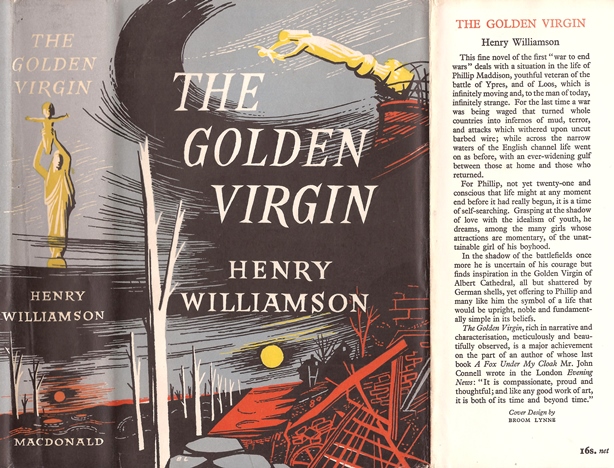
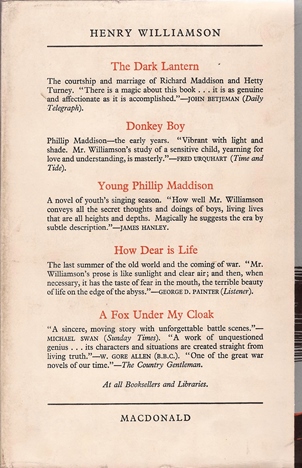
Macdonald re-issued the book at a later unknown date, using spare sheets from that edition: the year of publication on the reverse of the title page still being given as January 1966. This is clearly not the case, however, as it was published with a new, not particularly attractive, dust wrapper which bears an ISBN (International Standard Book Number). These were only introduced in the UK in 1970, so this, or soon after, is the probable date of publication. Donkey Boy was also re-issued at the same time, and given a similar jacket.

Other editions:
|
|
|
|
Panther, paperback, 1963. The edition featured this striking wrap-round contemporary drawing by Chevalier Fortunino Matania R.I. |
||
 |
 |
|
| Macdonald, hardback, 1984 | Sutton, paperback, 1996 |
The Macdonald cover features 'The Household Brigade Passing to the Ypres Salient', by Sir William Orpen (1878-1931); the Sutton cover is a detail from 'The Battle of the Somme', painted by Richard Caton Woodville (1856-1927).
Back to 'A Life's Work' 'Back to 'A Fox Under My Cloak' Forward to 'Love and the Loveless'
A Fox Under My Cloak - Critical reception
Back to A Fox Under My Cloak main page
Critical reception:
The book got a great deal of attention, being hailed as a masterpiece in the genre of war writing.
Smith’s Trade News, 5 November 1955, ‘Book Gossip’:
One of the most considerable of the English novelists in the field of the large-scale saga is unquestionably Henry Williamson. . . . In his latest book he goes back in time to the outbreak of the First World War, with 19-year-old Phillip Maddison, a city clerk, going to Flanders with a Scottish Regiment as a private soldier.
A Fox Under My Cloak is being published, very appropriately, on November 11, the 37th anniversary of Armistice Day.
Viewing the first great upheaval from a distance of time, Williamson has, perhaps an advantage over those of his contemporaries who wrote of it too soon after the events. He himself says: “It was written with love for all remembered faces of nearly 40 years ago. There are no villains in the story – only human beings.”
Smith’s Trade News (William Lloyd), 5 November 1955:
As I read this vividly-written novel with a first world war setting, it seemed that it was only yesterday that I shared in the perils and discomforts of trench warfare. I could hear, once again, the crump of shells and the vicious ping-ping of bullets, so realistic and the passages descriptive of the battle of Loos. This is Williamson’s finest work for many years, if not his best work ever. It is my Book of the Month. . . .
Smith’s Trade News (William Lloyd), 10 December 1955 (recalls Outstanding Selections of 1955):
That mature novelist, Henry Williamson, in my estimation, easily topped the list of writers of novels dealing with wartime exploits of the Army. He went back to 1914-18 war, but he recreated that atmosphere of dreary trench warfare with such skill that A Fox Under My Cloak will be remembered by its readers for a long time to come.
Illustrated Newspapers, 23 November 1955 (Tatler, Sketch etc.):

The text accompanying this item was:
There is a twofold purpose here; to go on with the Maddison story (now a many-volumed thing), and to give a faithful record of the year 1915 in World War 1 – but so good a war book is it that any reader can get its full impact, and will, in any case, quickly establish familiarity with the drably suburban, but strangely appealing Maddisons and the boy Phillip, the character through whose eyes we see the war. The book opens just after Ypres, with Phillip doing an appalling frost-bitten spell in the trenches as a private soldier. He goes back sick to England, gets a commission and an almost equally appalling training period with some very class-conscious officers, and returns to France to fight at Loos and become a seasoned, and to some extent esteemed, warrior.
Never heavy, indeed often very funny in his treatment of Phillip – the “temporary gentleman” who is always putting his foot in it, but in his own endearing way does well enough – Mr. Williamson is extremely effective in presenting a war history that is both subjective and objective.
New Statesman and Nation (Maurice Richardson), 3 December 1955 (6½” x 3” column):
One of the many socially revolutionary effects of the First World War was the creation of thousands of T.G.s – Temporary Gentlemen, as they were called – to officer the new mass armies. . . . One of the strong points of Mr. Williamson’s novel is his concentration on this important phenomenon. [Then a neat précis of the plot, commenting – presumably Mr. Williamson is saving Phillip for further war coverage. Many features in this book not covered in previous war books: the Christmas Truce and Battle of Loos] . . . All the background, with details of the impending struggle between the Frocks [politicians] and the soldiers has a nice authentic period flavour. . . . As a character Phillip is not altogether satisfactory, too much of a bundle of impulses and moods [as was HW himself!] perhaps; but he serves well enough as the hero of a pre-eminent sociological novel which – so it seems to me – has been written principally to recapture a period. The writing, plain and straightforward, is subordinated to this end.
The Listener (Maurice Cranston), 22 December 1955, reviewed A Fox Under My Cloak in tandem with (but not in comparison) The Quiet American by Graham Greene (an interesting and quite critical analysis of this work – ‘despite denial it is intensely religious’). That HW was pleased by this piece is shown by his note written at the top of the page:

The reviewer makes a useful comparison with John Galsworthy (to whom, as I have stated previously, HW was related, unbeknown to either):
Mr. Henry Williamson is a novelist who deserves more recognition than he has as yet received. Like Galsworthy, he goes in for family sagas, and he leans heavily on social history; but he seems to me a better social historian than Galsworthy, by whom I suppose, his market has been spoiled. [The Forsyte Saga, volumes published 1906 to 1921, as one volume 1927; with second series 1924-29.] Mr. Williamson knows and understands people of diverse social classes, whereas Galsworthy was quite incapable of anything . . . other than haute bourgeois; and Mr. Williamson has none of Galsworthy’s infuriating neutralism (which pretended to be liberalism). A Fox Under My Cloak is about the adventures of Phillip Maddison . . . during the 1914 war. Mr. Williamson takes the Owen-Sassoon-Sitwell view of that war, which is, I believe, the right one: the soldiers on both sides are seen as decent fellows from whose mutual slaughter no good will come. . . . He [Phillip] cannot connect the business-as-usual life in England with what is happening in France. His main problem is that of being a lower-middle-class subaltern in a fairly smart regiment. He dreads the trenches, but the embarrassments of the class barrier prove to be, if anything, more painful still. Mr. Williamson’s book is not anti-class in the sense it could be said to be anti-war. [neither class are blamed] . . .
Mr. Williamson manages to be detached without being non-committed. He has set himself to record the inside as well as the outside of events, to give a narrative at once of private and public things. The result is not a well-constructed novel, and the style is sometimes makeshift; but it is a genuine, wise, and continuously interesting book.
News Chronicle (David Holloway), 15 December 1955:
(Also reviewing The Quiet American: ‘Greene remains the finest story-teller of our time and those who would shrug him aside will find him uncommonly hard to shift from that pinnacle.’)
Those who know Mr. Henry Williamson as an exact and understanding observer of Nature might be surprised that he can see a battle long ago with as clear an eye.
. . . Here is the feel and smell of the trenches during one of the worst periods of the First World War, as seen by a rather cowardly young man whose only real desire is to save his own skin. . . .
The writing is not elegant, but it remains immensely forceful. It is strange that Mr. Williamson should have taken so long to get round to writing this book, forty years after, but it has been well worth waiting for.
Guardian, 24 November 1955:
No-one who already knows young Phillip Maddison will expect heroics from him as a soldier of the First World War. . . . Through it all he displays a touching humanity, youthfulness and love of a spree, and at the same time an illuminating candour through which we see the muddy, bloody, blundering warfare of the Western Front and the wretched human beings submerged in it. These battle scenes in this latest section of the Maddison saga are as realistic and memorable as the lighter passages are amusing.
Birmingham Post (R. C. Churchill), 29 November 1955:
Henry Williamson is that rather paradoxical figure in modern life, a pacifist who knows something of war at first hand. . . . It is not too much to say that the whole of Mr. Williamson’s attitude to life was changed by the 1914 war, and particularly perhaps by one strange incident in it, that unofficial truce one Christmas in the trenches when Tommy and Fritz exchanged greetings for a while before getting on with the business of exchanging bullets.
Mr. Williamson is one of the few surviving eye-witnesses of this “strange meeting” and it was inevitable that it should come into this “Maddison” series of novels . . . In A Fox Under My Cloak Phillip is, comparatively, the tried soldier – and seldom can any writer have described more honestly than Mr. Williamson the manifold things that tried, almost to breaking point, the soldier of 1915. The battle scenes in this novel have the mark of truth upon them. . . .
Queen, 28 December 1955 (a most wonderful example of bathos – and indeed, snobbery!):

The Daily Telegraph (Peter Green), 16 December 1955:
Just how does one define a historical novel? . . . [as stated by his publishers] . . . They are quite right; it is a matter of viewpoint, not dates. For all his detailed battle-scenes . . . Mr. Williamson’s real aim is to recapture the social and moral flavour of the era.
In this he has succeeded only too well. His dialogue . . . reads far too like the real thing: stilted, crudely prolix, facetious when not expository. . . . It may be good history, but it doesn’t make a good novel. . . .
Mr. Williamson, plodding gamely along in the mud behind Messrs. Graves and Sassoon, flogs all their dead horses with a flourish. But his world – less familiar to a young reader today than Imperial Rome – may still have its grisly fascination.
Sunday Times (Michael Swan), 27 November 1955:
. . . It is a sincere, moving story, but it is a pity Mr. Williamson has deliberately chosen to remove stylistic distinction from his narrative.
The Times, 8 December 1955, gives a short overview – emphasising the ‘temporary gentlemen’ aspect and:
the rough strength of the author’s compassion, underlined rather than diminished by the sometimes rather clumsy and homespun quality of the writing.
This was repeated the following week in:
The Times Weekly Review, 15 December 1955 (reviewing Greene, The Quiet American, Sylvia Townsend Warner, Winter In The Air, HW, A Fox Under My Cloak):
Greene’s ‘a tragedy of good intentions gone wrong’ – ‘a disappointment when finished’; Winter In The Air – ‘a masterpiece’. . . .
A Fox Under My Cloak . . . [briefest précis of plot] . . . Maddison, in his diffidence and fears, is a likable character, but what makes the story memorable is the rough strength of the author’s compassion, a compassion that is underlined rather than diminished by the sometimes rather clumsy and homespun quality of the writing.
[As several reviewers mention this, it is perhaps pertinent to point out that HW was writing as it was – the style is deliberate: of its era and of Phillip’s temperament and background (although it is possibly not a feature that stands out for the modern reader).]
The Times,16 December 1955, unsigned (8” column) – note: this is a second review:
. . . [This book, fifth etc. . . .] is also a history of England during part of the First World War. The young man, partly owing to an unhappy childhood and partly because of his own temperament, is stricken by his war experiences . . . [at the end] he rises gallantly, though still in his own haphazard fashion, to the occasion. He is throughout a strange mixture of rather endearing boyishness, a little boastful, an occasional liar, always uncertain of himself, yet with an impish daring. The battle scenes are magnificently done . . . The portraits of various soldiers and officers – notably . . . Twinkle – are very good indeed.
Mr. Williamson’s strength lies largely in his ability to build up a sense of breadth and depth by an expert use of detail, coupled with a splendid imaginative insight into character. Amid a deluge of war books, A Fox Under My Cloak will hold its own.
Time and Tide (Henry Drown), 19 December 1955:
The sad thing about [Fox - and the series as a whole] is that the book might just as well have been written and published a quarter of a century ago. . . . no worse and no better [than Goodbye to all That] . . . but no different. Yet this is not to say that it isn’t well done. The descriptions of the Battle of Loos is probably as good an account of one of those bloody, confused and blundering trench battles of the Western Front as you will find anywhere. A good, solid wodge of reading-matter.
The Observer (John Davenport), 11 December 1955 (unfortunately the review opens, and is threaded, with 'clever-clever' stuff – the reviewer showing off in a nervous self-conscious manner, which rather mars the interesting points he makes):
. . . such jumbled automata as most of us become are fit slaves for Houyhnhnms; yet Mr. Williamson is a novelist, not a satirist, and although one may sympathise with the man, one is puzzled by the writer. Can it be that he is working out some obscure grudge not against mankind, but against himself? It is not easy to see what ghost he is laying [in this novel]. Mr. Williamson writes of the 1914 war as part of the tragedy of European man, divided against himself. This desire to re-create a period is Tolstoyan, and with all his virtues, Mr. Williamson is no Tolstoy. A Fox Under My Cloak is the fox of physical cowardice and of social insecurity, united in the vitals of a suburban bank clerk, an imaginative but semi-literate twin of Mr. Aldington’s ‘Hero’, who died.
[Points out that it is (unfortunately) obviously going to be a long series.] There are some good things in this seemingly purposeless chronicle. . . . As I was only six years old at the time . . . I cannot vouch personally for its accuracy . . . [but in 1939 it wasn’t like that (but who said it was!)] Phillip’s agonies in his county Territorial regimental mess could scarcely be matched today except by those of an ill-trained chimpanzee unexpectedly posted to the Rifle Brigade.
The Spectator (H.M. Champness), 25 November 1955:
. . . no reader should ignore Mr. Williamson’s latest novel . . . [plot précis] . . . This is the early war, preceding the tanks and Sopwith Camels, the scene which still offers a diminishing vista back into the age of peace. . . . It is a scene of unique and appalling fascination. . . . Mr. Williamson has it all at his fingertips: Zola, in La Débâcle, can hardly have taken more trouble. Throughout the book, self-respect and self-preservation contend for Phillip. Each has its victories and the final result is far from certain, but . . . it does not seem to matter. He is altogether dwarfed in his monstrous setting. . . . [notes Phillip’s various key experiences] It is a splendid, frightful torrent of experience which tends to flow past Phillip and pour direct upon the reader. Unsubtle (though highly observant) as a novel, as a record it is often overwhelming.
Eastern Daily Press (Adrian Bell), 9 December 1955: reviews 7 books under heading ‘American Novels’ – rather misleading as only two of them are. This review from a close friend of HW (and notable writer himself) seems a little grudging. Obviously Bell was not interested in the First World War:
[Fox] . . . continues the story of Phillip Maddison . . . The book is episodic: the episodes seemingly accidental, do not follow a line of development so much as build up a picture – a chaotic picture of trench warfare and “Blighty”. . . . Phillip’s pranks . . . are so tactless that we feel he rather asked for what he got. Actually, Phillip is only his true self when alone with nature. The Battle of Loos is graphically told, with the eye of a combatant and the wider knowledge of later research.
St Martin’s Review (William Kean Seymour), January 1956 (also friend of HW – different viewpoint):
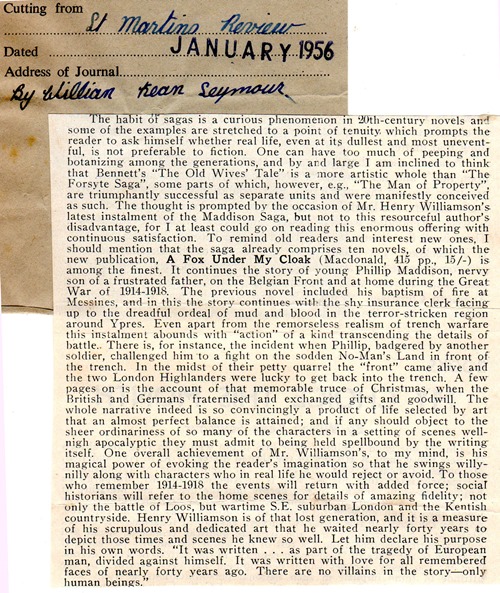
Manchester Evening News (Julian Symons), 3 December 1955:
Top of the list this week are two good factually-based novels one English [Fox] and the other American [A Stone for Danny Fisher, Harold Robbins].
Fox . . . [précis and background] . . . Each little incident taken by itself may seem flat and pedestrian . . . [but] through hundreds of such incidents Mr. Williamson has rebuilt convincingly a vanished world. . . .
The tautly-written military narrative is interspersed with scenes of civilian life which reintroduce many characters from earlier books.
. . . the heart of the book is in those memorable evocations of battle scenes, of the fatigue, discomfort, absurdity – and the occasional exhilaration and comradeship – of war.
Manchester Guardian (Anna Bostock), 5 January 1956 (the reviewer does not appear to have read the previous volumes & so found herself confused):
The time is Christmas 1914, and the none-too-endearing youth is in the trenches, taking part in the fighting as in the famous fraternisation. [Then he goes home and new reader cannot possibly comprehend the details. . . . then the Battle of Loos, which he survives:] and the sense of surprise that any man should have done so, conveyed by sheer hard reporting, seems to me the only thing to raise this long, confusing book above the level of private reminiscence.
National and English Review (Ruby Millar), January 1956:
The atmosphere of the First World War is brought back . . . the charm of the book lies in the magnificent battle scenes, word painting comparable with those contorted landscapes, those hell-hound unities of men and guns, painted by Wyndham Lewis, C. R. W. Nevinson and Paul Nash . . . It is a long while ago and much has since happened, but no generation of men has ever been called upon to endure more than was asked of Phillip Maddison.
Western Morning News, 9 December 1955:
With A Fox . . . Henry Williamson, the West Country author, has achieved a further stage in mastery that ranks him among the great authors of the time. This novel has moments as fine as any in All Quiet and the subject provides magnificent opportunities, which he handles with a blend of intuitive psychological insight and keen objective description. The result is truly fine.
[résumée of plot – placing re previous vols.] . . . This volume recreates the spirit of the time; the mixture of fear, courage, misery, and incompetence at the Front, and the dwindling and modulating of long-established values at home. There need be no end to the series, which is so close to reality as to constitute a social history of this century.
North Devon Journal and Herald (L.M.J.), 8 December 1955:
MUDDLE AND BLOOD
Henry Williamson describes War
To many of the people who took part in it, the 1914-18 war will always be the Great War. Their experiences touched heights and depths in them which no other event can equal. Possibly the ability to endure Hell is memorable.
Mr. Henry Williamson must, one feels, be of this number for . . . [in Fox] this atmosphere of frustration and exultation overwhelms and almost swamps his continued story of the life of Phillip Maddison. . . . [the wealth of detail present in his nature books now seen here in war scenes] . . . No bitterness pervades the story . . . the enemy appear not as Huns, but as soldiers, believing that “God and Right” was with them in their struggle for their Fatherland.
Mr. Williamson set out to write this book as “part of the tragedy of European man divided against himself”. He has succeeded, perhaps because he has no use for bitterness, only the memory of human beings of nearly forty years ago.
Homes and Gardens (Brenda E. Spender), June 1956; gives a résumé of the plot and ends:
[Phillip] is in the main the sad product of an unhappy childhood and dreadful wartime experiences. This is a painful book, but worth very serious consideration.
Rochdale Observer,10 December 1955 (7” column):
Novels of the Month [headed by Fox]
A Fox Under My Cloak is a notable piece of work which adds another long chapter of 400 pages to the Phillip Maddison saga. [Gives good analysis of plot with comments] . . .
. . . this book leaves the reader with some disquieting thoughts. How many lives were thrown away between 1914 and 1917 by bad staff work [etc] . . .
The advance of the Guards as Phillip Maddison saw it from one of the pylons of “Tower Bridge” – in which swallows were nesting amidst the crash of the enemy bombardment – will take its place among the great passages of literature which were forged in the fiery furnace of the First World War.
Yorkshire Evening Press (S. P. B. Mais), 12 December 1955:
This is, in my view, Henry Williamson’s best novel up to date. He went to the front in the First World War at a very impressionable age and as he grows older he is getting it into ever clearer perspective. . . .
From an inevitable contrast with Evelyn Waugh’s “Officers and Gentlemen”, Williamson’s portrait comes out with flying colours. Both authors describe with fidelity the fright and futility of modern war, but the mud of Flanders provides a large canvas for the greater artist.
The canvas is not so large as that taken by Tolstoi in “War and Peace” but Williamson certainly recaptures the emotional feelings of a young and untried fighting man with amazing accuracy. . .
I look forward to the volumes dealing with the later phases of the war with impatience and great interest.
There is a further selection of cuttings from numerous provincial newspapers – Coventry, Glasgow, Manchester, etc. – but all are of a similar nature. One stands out, as HW underlined the following sentence:
The Northern Echo, 9 December 1955:
. . . one has read nothing more evocative of the Great War and the accents of the time on home and Flanders fronts; the latter sequences are magnificent. The people are as alive as the events.
There was also good selection of reviews in Ireland: Belfast Telegraph, 1 December 1955; The Belfast Newsletter, 17 December 1955; Irish Independent, 31 December 1955; Irish Times, 7 January 1956 (a very good review).
Belfast Newsletter, 17 December 1955 (a long Saturday review column by ‘E.M.L.’ – 8 books, devoting 6” to each):
Is it possible to publish in 1955 a first-class work of fiction about the 1914/1918 war? The answer is that Mr. Williamson has done it, and done it brilliantly. . . . [brief note on HW’s writing career, & précis of the plot.]
. . . The battle scenes have been magnificently done. For all who served in that war and knew its misery this book will stir the memory and the heart. Mr. Williamson’s prose rises on occasion to the heights, and its lyrical quality, its evocation of the past, its occasional satire, its sincerity and accuracy of description, mark this as an outstanding work. . . .
Irish Times (R.G.), 7 January 1956 (8” column):
Mr. Henry Williamson’s output . . . comprises in great measure the ploughing and reploughing of the same lonely furrow . . . His nature books are superbly observed . . . and the same quality of detail is to be found in his novels.
The chief disadvantage . . . is his dynastic outlook. The Maddison family, an undistinguished collection of human beings, has occupied all his attention . . .
A Fox Under My cloak covers a short period in Phillip Maddison’s life as a soldier . . . [précis of plot] . . . Mr. Williamson has been commandingly objective . . . The battles which he describes are almost forgotten history; but they take on, under his inspiration, an immediate vividness. He has in fact surpassed himself and [Fox] should remain in the memory for some time to come.
These are made amusingly memorable by a further article in:
Irish Times, 21 January 1956 (double 7” column), headed:
“DAILY SKETCH” BANNED WITH 77 BOOKS
The British newspaper Daily Sketch has been banned because recent issues “have usually or frequently been indecent or obscene . . . [plus] a large amount of crime”.
The Board has also banned 77 books [this list is given in full: it includes The Quiet American by Graham Greene; Aspects of Love by David Garnett; The Photography Book of the Year; and Marriage for Moderns, Barbara Cartland (birth control content!). The list is headed by Lolita (the only title that is perhaps understandable!). It is not clear if the list is in order of iniquity, but Maigret and the Burglar’s Wife is very near the top. Squadron Airborne, by Elleston Trevo appears, The Daffodil Sky by H.E. Bates, and well towards the bottom, A Fox Under My Cloak. Well!]
It does also state that the ban is only for three months, when content will be reviewed – but possibly renewed.
************************
The book was discussed in a BBC Radio programme on 6 January 1956:
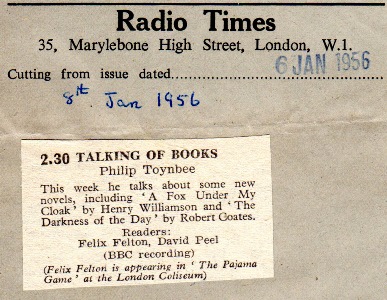
************************
1963 paperback reprint:
A Fox Under My Cloak got wide coverage as one of the top ten paperbacks. One or two gave more detailed coverage: remember that by 1963 HW was actually up to volume 11 of the Chronicle.
North Western Evening Mail, 10 October 1963:
Henry Williamson has surely set himself one of the most monumental tasks of his time . . . under the collective title A Chronicle of Ancient Sunlight. This is the fifth, a separate story in itself but still only a part of the epic. . . . Obviously, many hours of research have gone into this project – and it is equally obvious that the effort has been well worth while. It is a highly impressive book.
Oldham Evening Chronicle (D.R.T.), 19 August 1963 (having reviewed a book about Sir Bernard Spilsbury, the famous criminologist, and found it disappointing, it continues):
Murder of a different kind, and murder more horrifying because of its senseless perpetration is the subject of (Fox) . . . This chronicle of the First World War, with the retelling of the mass slaughter that took place on the battlefields of France, is horrific as it is brilliantly unfolded. It is a book which, almost 50 years on [and now a 100 years on] can still frighten the reader, living in a world where the formidable tank and flimsy aircraft of the 1914-18 debacle are [now well in the past].
Irish Times (B.F.P.), 30 September 1963 (12” column) – the ban has obviously been lifted! This is so percipient that it is reprinted nearly in full (note it is again from Ireland, but 8 years later; the reviewer does not mention Tolstoi, but from the heading he obviously had this somewhere in mind):
WAR AND PEACE
Henry Williamson seems doomed to live with the label “nature-writer” hung about his neck. . . . That was the early Georgian¹ Williamson, who came home from the trenches to hide his scarified² soul among the lanes of the English countryside. The early Williamson wrote good novels as well as nature books, but it was decades later that he began “A Chronicle of Ancient Sunlight”, a great sprawling cycle . . . . Many critics have lashed these books with rods. They have been called old-fashioned, rambling, diffuse, over-personal, trite. Certainly they straggled at times like uncut hedgerows. . . . But if these books lack tailormade neatness and linger minutely over details and description, that is because he has chosen deliberately to make them so. He is painting an age, the one leading up to the First World War, and great realist that he is, has been at pains to fill in his background fully. Also, he has a passion for the English landscape and lavished pages of golden prose upon it. . . . [Critics are ‘bright little urbanities . . . they want their novels in the same bloodless and stylised mould.’]
Williamson, with his Victorian-Edwardian sprawl, his nostalgia and his real bigness, is not for them. Realism – true realism – that rarest of things – has never been popular unless it keeps in step. . . . [Gives a brief but succinct résumé of the previous volumes.] Panther Books, who are publishing the series, have brought out the fifth [Fox]. This is in many ways the finest, a truly great war novel. The description of Loos is a classic masterpiece. . . .
Williamson is a cumulative writer, not one who composes in swift scenes. A rich and uneven book, with a gallery of characters who have the stamp of reality, a magical feeling for period, and a vein of pure poetry which gleams through the frequent prosiness. Williamson’s visionary moments fall like brief rays upon the sunless plain of his realism. For all their seeming backward look, these books are “modern” in the deepest sense.
Compare them with the war novels of Ford Madox Ford, so much lauded just now. Ford is an old pro with all the tricks of his trade, but a suspicion of contrivance remains. Nor do his people become more than types, closely but externally observed. Williamson is the natural writer of the two, with all his faults.
[¹ ‘Georgian’: the early ‘Georgians’ (this is George V – movement c. 1910-22) were considered ‘nature writers’ – later Georgians considered more ‘innovative’.
² ‘scarified’: does not mean ‘frightened’ but ‘scratched’: one ‘scarifies’ (rakes) soil to allow seed to grow. Thus HW’s soul was raked raw – allowing the seed of writing to grow.]
Back to A Fox Under My Cloak main page
Back to 'A Life's Work' Back to 'How Dear Is Life' Forward to 'The Golden Virgin'