
The Henry Williamson Society
Uncategorised
The Village Book
THE VILLAGE BOOK
 |
|
|
First edition, Jonathan Cape, 1930 |
|
1920s Georgeham, its characters and other photographs
First published by Jonathan Cape, July 1930:
Limited edition, 504 copies, 2 guineas (£2 2s)
Trade edition, 7s 6d
Reprinted 1930 with some corrections, 7s 6d
E. P. Dutton, USA, 21 October 1930, $2.50
Cape, 1933, reprint in their ‘Life and Letters’ series, no. 53, 4s 6d
Cape, 1937, reprint in their ‘The Travellers’ Library’ series, no. 217, 3s 6d
These stories, together with those in the companion volume The Labouring Life (and some other fresh material), were to be republished by Faber under new titles in 1945..
*************************
‘If you want good neighbours, you must first
be a good neighbour yourself’ –
Old Ploughman of Ham at
the Rabbit Supper
Illustrated, twice only, by sketches from the original MS.
The Village Book is a collection of 55 stories illustrating ‘The Spirit of the Village in Winter and Spring’ and ‘Air and Light of the Fields and the Sea in Winter and Spring’; they cover the period 1921–1929 (the period that HW had actually lived in Georgeham). Note, however, that this does not mean the book took nine years to actually write, as many reviewers seemed to think.
Although HW states in his dedicatory preface that this is an imaginative work which should not be read as the history of any particular village or its inhabitants, it would have been very obvious right from the start to anyone familiar with HW’s life and work that these stories present a picture of the village of Georgeham, with its two village inns – ‘The Lower House’ and ‘The Upper House’ – and the inhabitants thereof. The interwoven second theme takes the reader out into the surrounding countryside, mainly the nearby cliffs and sand-dunes within easy walking distance from the village, and notably the steep and dangerous precipices of Baggy Point and Morte Point.
The book has a double dedication:

Mrs Hibbert, known as ‘Grannie’ in the family, was unfailingly kind, courteous and encouraging to the young writer. She died fairly soon after publication of this book. Sarah Catherine Augusta Hibbert was born in 1840, the daughter of the eminent artist Frederick Lee, RA (1798-1879), of Broadgate House, Pilton, a substantial estate on the outskirts of Barnstaple, North Devon. In 1861 she married Col. Hugh Robert Hibbert (1828-1895), 7th Royal Fusiliers, of Birtles Hall, Cheshire (one of several Hibbert estates at that time), and at first they lived at Birtles where all their children were born. They moved to Broadgate House probably after the death of her father (abroad in Africa), but after the death of Col. Hibbert in 1895 and later having to settle the debts of a wayward son, she was eventually forced to move to a cottage within her own grounds. Their fourth child, Margaret Dora (b.1871 at Birtles) married, against the family’s wishes on both sides, her cousin Charles Robert Hibbert, ‘Pa’, son of Leicester Hibbert, the ‘Guv’nor’, of Chalfont, Bucks (another Hibbert estate): this side of the family was already in some financial difficulty.
Virtually disowned financially by both sides of the family, except for income from a Trust, Charles and Dora lived a very impecunious life at the White House, Abbotsham, a tiny hamlet on the coast near Bideford, North Devon, growing their own food, making own furniture (though that was a Hibbert family hobby) and shooting rabbits and pigeons for meat. They had four children, Francis, b.1890, known as Frank; Charles Thomas, b.1899, known as Tom; Ida Loetitia, b.1901 (HW’s wife, ‘Gipsy’); and Robert Edward, b.1902, known as Robin, or Bin. Loetitia is of course ‘Lucy’ in the Chronicle of Ancient Sunlight novels, while Bin is portrayed (rather unkindly) as the hapless brother who helped on the farm – as ‘Sam’ in The Story of a Norfolk Farm, and ‘Tim’ in the Chronicle. Dora, to whom Pa was devoted, died in March 1918 from tuberculosis after some time as an invalid. Grannie Hibbert died on 15 January 1931. HW would have known that she was failing, and no doubt made this dedication for that reason, to express his gratitude for her kindness to him.
 |
|
Broadgate House, Pilton, nr Barnstaple Currently a Grade II listed building, it was partially derelict at the time of listing, and is now divided into flats. |
The second dedicatee is Petre Mais (Stuart Petre Brodie Mais, generally known as ‘SPB’, 1885-1975), a prolific writer of about 200 books and a huge number of articles and book reviews, who was to be a life-long friend. His family roots were in Devon (both grandparents and parents) and although he was actually born and bred in Derbyshire he spent considerable time in Devon and considered himself to be ‘Devonian’. SPB was of rumbustuous character, a passionate cricketer and a great walker. He was always hard-up due to his personal extravagant life-style and having to support a first disastrous marriage. He constantly borrowed sums of money off HW (without necessarily ever repaying it), who was possibly even more hard up! Mais wrote an enthusiastic review of HW’s first book published in 1921 and they actually first met in London at the newspaper office in 1922. Mais was often in Devon and they frequently walked together there. HW visited Mais at his Brighton home on many occasions, where they walked on the nearby Downs. (See Robert Walker, ‘S. P. B. Mais – Henry’s longest literary relationship’, HWSJ 49, September 2013, pp. 35-53 for further details.)
*************************
HW had moved from Georgeham in the autumn of 1929 to Shallowford, a house on the estate of Lord Fortescue (elder brother of Sir John Fortescue, who had written the ‘Introduction’ to Tarka the Otter) at Castle Hill, Filleigh, near South Molton, North Devon – a few miles east of Barnstaple. By the time The Village Book was published the family were firmly in residence, with their third child, a girl named Margaret, born in mid-April 1930.
The original contract for the book is dated 1 June 1928, with a provisional title of ‘LIFE IN A WEST COUNTRY VILLAGE’. The manuscript was to be delivered by 30 June 1928. This date was not of course fulfilled, possibly as the award of the Hawthornden Prize for Tarka the Otter gave HW a rather busy schedule.
The first mention of this book appears in a small pocket-book diary entry (the main diaries covering this period are missing) at the beginning of March 1929, where HW noted ‘Work in hand during March’, which included ‘Village Book’. But there is practically no archive information whatsoever about this work. There is no further mention of it in 1929 (or indeed of anything!). HW was very involved at that time in an affaire with a German girl, Barbara Krebs, who was staying in Georgeham with the redoubtable vegetarian and nudist Miss Johnson (who kept a boarding house just along the road from HW, around the corner towards Putsborough), but who was actually attending lectures on literature at King’s College, London. But Fraulein Krebs, although obviously in love with HW, kept her head and her distance, and finally in mid-January 1930, HW noted in his diary: ‘Barbara writes and washes out everything.’ She returned to Germany soon after that, leaving HW, as always at such times, somewhat distraught. (See AW’s biography, Henry Williamson: Tarka and the Last Romantic (1995) pp.126, 160, 175.)
On 24 January 1930 he noted: ‘Village Book revised’, and on the following day: ‘V.B. sent to Cape’.
There is a note on 27 March which would seem to indicate he was checking proofs:
Village Book: 2 fat pigs killed 1 week after death. [i.e. to be corrected]
And the next day, 28 March:
V.B. Eating fruit in a haphazard way; this is a sign for women pregnant. Woman who took Arty’s tomatoes.
Other small diary entries reveal that he dined with Arnold Bennett at the Royal Thames Yacht Club on 18 March, and with Mrs Munnings, wife of the great artist Alfred Munnings with whom HW became quite friendly in due course, at their nearby Exford home on 12 April. (She admired his writing.)
His daughter’s birth on 15 April is not recorded – though there is a joke a few days later that she is now called ‘Rhubarb’, since Gipsy merely thought she was suffering from indigestion following eating rhubarb when she gave birth! However the following day, 16 April, the diary reads: ‘Fortescue to lunch . . . The Wild Red of England’ (sic). This has significance for his next book, The Wild Red Deer of Exmoor – so it is possible that the ‘Fortescue’ here is Sir John who himself, had written a book about the wild red deer of Exmoor, rather than his new landlord Lord Fortescue. Note that HW evidently entertained his guest on his own.
The actual publication of The Village Book is not mentioned by HW, perhaps surprising in view of the handsome vellum-backed signed limited edition; Cape produced a 4-page folded prospectus for the trade and limited editions, with a generous review by Sir William Beach-Thomas forming the centre pages:
 |
 |
 |
|
Sir William Beach-Thomas (1868-1957) had been a highly respected war correspondent during the First World War (for which he was awarded the KBE in 1920 and knighted by both England and France), and he was a well-known writer and journalist on country matters. He is known to have regretted that the tone of his war reports did not reflect the actuality of the Western Front. Although there is very little evidence within the archive that these two men were friends, Beach-Thomas certainly stayed at Shallowford for a fishing visit, and HW had copies of several of his books.
*************************
The Contents page divides the book into two separate lists under their main headings but the stories are intermingled in the text itself without any further reference to that division. It is not difficult to see the actual order in which the stories are printed from the pagination.
The book takes us on a meandering journey through the village and the surrounding countryside – and indeed through HW’s life at that time: a journey objectively observed and recorded. So immediate in effect is it that it is as if we were taking part in it ourselves. We know these people and their lives. It is The Archers of the 1920s! Particularly vivid are the cameos of the two village inns, the Lower House and the Upper House, with their respective and contrasting landlords, captured as vividly as if their painted portraits were before us.
The book consists of observations on the lives of the people who live in the village and nearby, blended with a study of the natural life in the area. HW tells us in an effortless way of everyday happenings, of the old rabbit buyer, William Gammon, the village masons, the farmers, the inns, their landlords and customers: and the book includes the essay ‘The Ackymals’, now slightly revised from the private limited edition of the previous year, about John Kift who could not be convinced that the great tits did not eat his peas.
We learn about Billy Goldsworthy’s barn with its hoarded implements of bygone farming days, and how Sparker sets his grandfather clocks to strike in succession so that he can have the pleasure of hearing them one after the other. The book closes with ‘The Firing Gatherer’, the text of which is as printed in the limited edition of The Linhay on the Downs.
Today, not only do we recognise these essays for their literary worth – and many of them are gems, superb examples of their genre – but, further, as a document of social history of an age now lost, an aspect which becomes increasingly of value as time passes.
The twin aspect of the book is a far cleverer device than is immediately apparent for it gives us a dual nature on more than one level. The most obvious are the village characters versus nature aspect, and the good and bad in both people and natural phenomena. But there is a deeper duality running through the book which we recognise probably on a sub-conscious level: an eternal yin-yang theme, giving the book a lasting worth beyond the immediate enjoyment of the stories for their own sake.
As the stories progress the reader will find ‘friends’ (human and animal) who have already appeared in previous volumes; but also several new characters appear. HW changed real names around in these stories, swapping those of one family for those of another. It is known that some of the people concerned were upset at his portrayal at the time: I rather suspect it was this changing of names that was the problem rather than the actual stories themselves. People would not have liked their name being portrayed with other people’s ‘sins’ (the old country word would have been ‘doings’), while they would probably have been quite proud of their own!
It is not possible to mention every one of the stories here, so below are highlights; the omission of an item does not mean that it is any less readable than those included. They are all delightful. Apart from perhaps ‘The Badger Dig’, the harrowing aspect of some of HW’s earlier short stories is not so noticeable.
‘The Donkey’ (pp. 11-13): first published in the Daily Express, 5 December 1927 as ‘A Devonshire donkey’. An interesting opening: a skittish donkey is exercised down the village street – or rather it exercises its owner; the author humorously ponders what ‘truths’ it would tell about its master’s dubious activities if it could speak – the repetitive refrain ‘Not master’s’ translating the ‘hee-haw’ continuum of donkey-talk!
‘The Badger Dig’ (pp. 14-34): first published in T.P.s and Cassell’s Magazine, 1 May 1926, but HW tells the reader in a short epigraph that the story was written in 1923. The story opens ‘On Valentine’s Day . . .’ which is an addition to his typescript (see scan below) and is obviously intended to reinforce the idea of love for one’s fellow creatures. First his much loved spaniel gets its paw caught in a gin trap, panics, is released and shows his gratitude for master. But later our wanderer gets involved with the Badger Digging Club, where we find the rather vicious terrier ‘Mad Mullah’ in attendance. It is quite a bloody story, but with a good underlying moral, reinforced in the ‘Epigraph’ when we find the bloodthirsty farmer of the badger dig in trembling fear of having a tooth pulled: ‘Like many other farmers I knew, this man was timid, afraid of pain for himself, and brutal to weaker things.’

‘Night in the Estuary’ (pp. 35-37): first published in the Daily Express, 19 March 1927 as ‘A night symphony’. A lyrical essay on the sounds of the various birds heard at night on the estuary, likening them to music, especially that of Delius, whom HW compares to Richard Jefferies.
‘Scandal and Gossip’ (pp. 38-42): In which the village men (‘drunkards’), relieving themselves in the ditch after closing time at the inn, shock a lady from the town; and involves the parson in giving a sermon which upsets his parishioners!
‘The Poor Fowl’ (pp. 43-44): Stormy seas throw up an oiled guillemot on the shore, doomed to die as it cannot fly, and once washed up cannot get food to eat. The author is in a dilemma – but an old shore-man’s solution is that ‘’Er would taste proper, baked wi’ tetties, midear.’ So the guillemot is knocked on the head and killed: ‘The best ending for the poor fowl . . .’ (No RSPB Rescue Centre then!)
‘A Mason’s Week’ (pp. 45-49): A tale of Willy Gammon, a mason, who, although ‘his wife had a hard life, bringing up so many children, in a cottage with one dark living room, and one bedroom divided into two by a thin wall of lathe-and plaster’, spent most of his spare time and his money in the inn: ‘bottled stout, sixpenny ale, and a drop or two of whiskey to finish up on’. But nevertheless, ‘a good man, kind and gentle and very fond of the childer’. The family muddled through in its own way.
‘A Winter Fresh’ (pp. 50-52): HW paints a scene of the seashore as the tide ebbs with sharp clear brush-strokes of his pen: a veritable water-colour of delight.
‘Washing Day’ (pp. 53-58): The author looks down on the village from the lofty top of the church tower, from where one can not only see but smell and hear the activities of all its occupants. The church tower was of great symbolic importance to HW, featuring in two important essays (the ‘Apologia’ at the beginning of The Wet Flanders Plain and ‘Surview and Farewell’ in The Village Book’s companion volume, The Labouring Life). Here it is a straightforward description, yet ends with the enigmatic ‘the sky which sees all, and yet hears nothing’.
‘The Linnets’ (pp. 59-61): The beauty of the linnet’s song makes HW think that the bird is in a ‘state of spiritual joy’ but he remembers with sadness a past sin when he set fire to a gorse bush and his thoughtlessness killed off the nestlings it contained.
‘The Village Inns’: (1), ‘The Lower House’ (pp. 62-85); (2), ‘The Higher House’ (pp. 98-112): The fictional village of ‘Ham’ has two inns: so does the real village of Georgeham. The fictional Lower House was kept by Charlie Taylor (actually The King’s Arms, kept by Charlie Ovey), owner of the terrier Mad Mullah (one always feels as if this dog was actually a bloodhound or bull mastiff!) and who was the instigator of the (free) ‘Rabbit Supper’, to which very few of the villagers turned up. But of those that do we are given a detailed description. It is a most wonderful tale of village life, as gossipy as if one was sitting in the fug and listening to the men oneself. There is a slight problem with the landlord of the Higher House (actually The Rock Inn, landlord Albert Jeffery) – in the first part he is called Albert Hancock, but when we actually come to the second part he is Albert Gammon: ‘noo-mye,’ as they said in those days; the two parts are well separated and I doubt if many notice the discrepancy – and if they do – well, ‘noo-mye’! It is the tale that matters.
This essay was first printed in The Monthly Criterion (February 1928), a leading prestigious literary journal (its equal rival was The Adelphi with which HW was to be associated in due course), edited by T. S. Eliot from late 1922 to January 1939. Originally a quarterly entitled The Criterion, it was financed by Lady Rothermere, wife of the newspaper magnate Lord Rothermere, but in 1926 was taken over by Faber and Gwyer Publishing (later Faber and Faber), and for a time it was published monthly. There does not seem to have been direct contact between HW and T. S. Eliot at that time. HW would have sent the story off to his agent, or perhaps Richard de la Mare (of Faber & Gwyer, and HW’s friend and best man at his wedding) had a hand in it. It is interesting however that such an intellectual journal and editor printed what is essentially a ‘domestic’ tale. It was obviously considered to be of sufficient quality by one of the leading intellectuals of the era.
 |
|
|
| HW's rather battered copy of The Criterion |
The first page of 'The Village Inns' – this earlier version differs slightly from that in The Village Book |

‘‘Muggy’, The Rabbit Agent’ (pp. 86-92): first printed in The Atlantic Monthly (February 1928), and then in the Manchester Guardian (1929), this is a very true portrait of ‘Muggy Smith of Cryde’ (Croyde):
‘Muggy Smith of Cryde’ is plain as a field is plain, plough, arrish, or pasture; a rare and simple being, warped to no property, true to himself, and therefore to all men. Shakespeare would have loved him.
Muggy died in August 1929. HW tells us in an ‘epigraph’:
Four years after the above was written, my old friend Muggy Smith of Cryde fell down and died as he was going into his hut, at the age of 75 years. During his life he asked me frequently not to omit, when I ‘put him in the book’, the facts that he was ‘proper wild’ as a young man, . . . I am sure Muggy was the first to laugh at the joke of his own funeral in August, 1929, when his coffin could not be lowered into its grave because it was too long.
You will have to read the story to find the significance of that cryptic remark!
 |
| Muggy Smith of Cryde |
‘Old Woolacott’ (pp. 116-125) tells the rather sad tale of the stricken old man who has to leave his home in the village due to the greed of the owner-builders: the young son not caring about the ‘bliddy ould vule’ he was turning out – he has his own, happy, life before him.
Two loose printed pages reveal that this story had already been printed elsewhere as ‘The Spirit of the Village’ in a magazine called The Quiver. This magazine was established in 1861 by John Cassell and continued until 1926: so HW’s story has to be no later than that date. In that version the old man is called ‘Old Watts’ while the anonymous ‘mason-builder’ of The Village Book is named as William Ley and his father as John Ley. (HW’s ‘Village Families’ included below shows that a Ley family did indeed live in the village – but HW is playing around with the names.) One can see also that a sentence from this original story has been removed from the book version. After the sentence ‘William Ley [‘the master-builder’] was always on the look-out for more property’ the original story continues:
The monthly parish sheet, regularly delivered by his wife and daughter to the cottages, advertised his name as rector’s warden; he was most conscientious in church matters and had nothing to do with the chapel.
On the front of the parish's Monthly Bulletin for April 1927 (an illustration of it appears later), the Rector’s Warden is named as Mr Walter R. Brown. How HW kept track of his convoluted renaming of characters is almost incredible!
‘The Sawyers’ (pp. 126-139), although dated 1922 first appeared in the London Mercury in October 1928. The tale tells the felling of the churchyard elms: HW again painting a picture, gradually adding the details. The story features a branch breaking a grave headstone, and interestingly the author can remember the man, who had been in the Labour Corps salvaging on the Somme battlefields. Here there is a superb portrait of Robert Chugg, the top sawyer, whose nimbleness in moving around the tree-trunks like a monkey avoids what would have been a bad accident – if not death. (No safety harness in those days!)
‘The First Day of Spring’ (pp. 140-207) covers numerous sections, twenty-one in all, from both the ‘Village’ and ‘Field’ main headings.
 |
| The manuscript draft |
 |
| The later typescript, with further revisions |
This is the heart of the book. (The writer mentions his two-year-old son, so we assume the time is 1928, but I think most of these pieces were actually written much earlier.) The author sets out for a walk drawn by the ‘Hot sunlight flooding the red lane below my garden wall’. As he sets out he sees a slow-worm enticed out of hibernation by the warmth of the sun, but still very torpid and vulnerable, and he moves it to a place of safety. Mrs ‘Thunderbolt’ (the name given to the club-footed and very deaf ‘Farmer’ William 'Vanderbilt' Carter who lived in the third cottage of the row that contained Skirr Cottage, at right angles to where the author was then living at Vale Cottage. The nickname, bestowed because he was thought to be very rich, was corrupted to 'Thunderbolt') ‘knows’ it is a dangerous snake, despite explanation. He promises his two-year-old son that he will be back for tea.
So the author sets off down ‘The Lane to the Sea’ (147-149), and we meander with him on a most lyrical walk which takes him on a circuit out to the headland of Baggy Point and round back to his own village. As he wanders he sees:
Gulls drifted overhead, rocking and crooking their wings. The fields of plough and pasture, the trees and thatched roofs of the farm buildings below, the flock of yellow-hammers alighting and flitting along the ruddy twigs of dogwood and the young leaves of honeysuckle, the plants of foxglove, the lichens on the stone – all took light from the sky, and freed the thought-cumbered spirit. Air and sun and wind, these are the inspiration of life, the ancient source of renewal, whose inherited essence is the beauty in Man’s mind. A lark was singing, and another lark, many larks . . .
The wind and sun vibrate the tissues charged and impressed in ancient days: I am one with the sunlight, and the lark is my brother. . . .
. . . but I will forget sadness, for this is the first day of Spring.
BUT a few pages further on:
Ten years ago, this very month, I saw it [water-cress] in the waters of the Ancre, flowing cold and swift on its chalk bed under Beaumont Hamel; and a ghost, not long of the thin air, rose up beside me among the charred poplar stumps of the dreadful swamp.
In ‘The Engboo’ (the post on which a gate hangs) (pp. 157-159) he recalls a war-time visit:
Those sands, where in 1916 my friend [Terence Tetley – ‘Desmond Neville’ of the Chronicle of Ancient Sunlight series] and I ran naked and shouting into the sea: the days before the Somme, when the illusion of youth still wandered over the sea and the sky.
In one of HW's early photograph albums there are three much faded photographs of that 1916 visit to the sands:

And then a few lines further, he remembers another holiday – his first visit to this tiny hamlet of Georgeham:
That last day of May, 1914, when a boy walked over thirty miles in the hot sun, taking a last look at trees and lanes and cliffs and streams, taking farewell of enchantment, and saying on the lonely headland while the heart ached with all longing, ‘Goodbye, I shall return but it will never be the same.’
And yet again, two pages on:
[German and British soldier had] smiled at each other in no-Man’s land on Christmas Day, in the year of the prophetic farewell to these very trees and lanes and streams and cliffs.
The lark is our brother; the sun shines in beauty again.
In ‘The Origin of Ghosts’ (pp. 163-164), which one might call one of HW’s ‘scriddicks’, HW uses the word ‘magniloquently’: I looked this odd word up: it means ‘lofty in expression’!
‘The Blackbird of the Blasted Tree’ (pp. 167-168 but actually under a page in length)
As I walked on the wet sand under the Naps, I heard the notes of a blackbird, and looking up at the cliffs, I saw my old friend on his usual perch . . . I had known that blackbird six years before; I recognised him every spring by the quality of his notes . . . and at intervals he repeated a refrain which was a perfect cadence. One year I asked a friend to write it down, and he was amazed by its perfection of time and tune.

Here it is in the original manuscript:

But there is more to this example of so much apparent care taken over such a tiny detail. In the archive there is a letter addressed to HW’s wife, dated 9 May 1926. It is from an old Hibbert family friend from before her marriage, ‘A. H. Hall’, who lived at Westward Ho!, and who appears in the Chronicle novels as ‘Mister’ (as indeed he was known).
My dear Ida,
As I know you are interested in birds & their ways I want to tell you of a blackbird who for some time now has taken up his position in a tree by our front gate, & being comfortably installed in said tree, he sings.
Now this in itself is not very remarkable, but the point is he sings a real tune . . . I was struck by our black friend singing not once, but more than a dozen times at intervals a perfect cadence, not only perfectly in tune, but in time too, so much so that I got a bit of paper & wrote it down & here it is.

With the exception of the first note in brackets, I’ve written the tune exactly as the black-bird sang it time and all! . . . Can’t Bill make this into copy of sorts? The tune was so striking & so perfect I’ve never heard anything like it before & it beat any nightingale from a musical point of view.
Well, Bill (HW – always called Bill by his intimates at this time) did indeed in due course make something of it! And so we can all enjoy this charming little story, embellished by the imagination of our author, even if we might be a little disappointed that it did not originate with HW himself.
‘The Ravens of Bloodhill’ (pp. 174-178), whose eggs get taken every year: here we have a short reprise of the story of the Kift brothers, John and ‘Tiger’, and their amazing feats as egg-collectors hanging off the cliffs, as in the earlier tale ‘Tiger’s Teeth’, which had appeared in The Lone Swallows.
‘Interlude’ (pp. 184-185) shows us our walker, invoking Hardy’s ‘strangers’ and William Blake’s ‘visitants’ as witnesses, throwing a man-forged manacle (that is, an animal trap) over the cliff while screaming curses – so releasing his fury and enabling him to continue to once again enjoy his walk. That is so typically HW in behaviour! (This was perhaps the trap that Billjohn’s leg got caught in?)
On the cliffs (his beloved Baggy Point) he sees peregrine falcons who try to hunt down a tiny exhausted pipit, but it manages to elude them and find safe refuge. We learn of his dog, which all the while has been following him faithfully wherever he walks, and for whom he pays a 7/6d licence every year so it can continue to sleep, eat, act as a pony for his son, and a mattress for the cat (and it’s obviously very much loved): when he bought it for 30/- aged eight weeks it was ‘lousy as a cuckoo’ – now eight years old – and despite delousing at intervals, it is ‘still lousy as a cuckoo’.
So the walker continues, taking the inner path over the Baggy Point headland as dogs are not allowed on the cliff-edge path (much rougher and more dangerous than the modern wide cindered track; it was probably no more than a sheep-track at that time), and going round by Cryde (Croyde) turns back to go up the hill on ‘The Way Home’ (pp. 198-200), past Fig-Tree Farm (still there!), to where the dear sweet old lady, Grannie Parsons, peeps
out of the door of her cottage like a jenny-wren out of its nest . . .
[She calls him ‘midear’:] A usual term of greeting, but truly a thing of sweetness and light when spoken, scarcely more than whispered, from the small brown face, with the bright eyes, and smiling withered lips. All the beauty I had known that day: of wandering air and bright water, the white innocence of thorns, the scent of wild thyme on the headland, the happy burr of the honey bee, the sunward lark-song, the glistening, flowery constellations and red plastic mud of windy spring: all the beauty of the day was fused and made one for me. It seemed that I came home to my village very swiftly.
So he returns to ‘Ham Saint George’ (pp. 200-207) (and this village is meant to be anonymous!) to find a tramp singing (for his supper) on stony ground and a surly prayer-book-thumper getting signatures for a petition to install the ‘New Prayer Book’ to the Rector’s annoyance. He also looks for the totally harmless slow-worm he had so carefully moved to safety at the beginning of his walk: ‘Among the old nettle stalks I found it, battered and broken by stones.’
To the superstitious village people a snake is a snake, and not to be tolerated. All in all, there are several little morals in this section!
Our author goes on to tell the tale of ‘The Old Cob Cottage’ (pp. 208-227) dated 1924, but first published in the Sunday Dispatch, 9 September 1928. The description of the old cob cottage (cob is basically mud mixed with straw and cow-dung and fronted with mortar, and usually lime-washed every year. It was a very common building material in ‘the old days’) is very exact. Such cottages do look very picturesque but tend to be rather damp and cold to live in. We are given very precise details of the location of this cottage, basically uphill from ‘The Higher House’ and opposite the Glebe Field (property of the Church). The occupant of this cottage was old Jacob Ley, called ‘Sparker’, once champion wrestler of renown of the ‘Ham Revel’ (with six silver spoons to prove it). This wrestling was a bloodthirsty affair involving steel-capped boots with kicks from these frequently resulting in quite serious injury! ‘Sparker’s’ name came from the sparks his boots made from the double kick for which he was famous. Sparker’s other fame was for his many clocks which he set to chime one after the other for the pleasure of hearing each one separately. But the old man dies and his effects are auctioned off. The villagers tell each other tales about each item. Our author bids for one of the clocks for which bidding was quite fierce, but gradually others drop out and: ‘at fifty-two and six the clock belonged to Mr. Henry Williamson, who could hardly refrain from giving a shout . . .’ (Fifty-two and six was £2.12s. 6d., or about £2.65p in today’s coinage, and a large amount to pay for an old clock then.)
This is a superb tale of a life that is past: its innocent occupations, its songs; its characters: the charm and essence of village life. At the end we are told that the old cob cottage has gone (even then), although:
Larks and pipits still make their nests in the glebe field, and the summer wind shines in the grass.
Sadly today that exists only in HW’s story: for the Glebe Field is now a car park.
‘A Boy on the Headland’ (228-231) (first printed in the Daily Telegraph, 13 June 1928) tells us of an outing of the author accompanied by a young boy, full of questions about what they see, but hardly listening to the answers before asking another. It is obvious that HW is a little anxious about the safety of his young exuberant charge! We are not told who this boy is – it cannot be HW’s own son, he was still too young: this lad is a schoolboy and old enough to have read Tom Brown’s Schooldays. He may be the young lad whom HW briefly tutored, or the brother of young Mary Stokes, with whom he fell in love in 1922.
‘Billy Goldsworthy’s Barn’ (pp. 232-250) tells us the story of this little lean-to ‘barn’ which is a veritable museum of country farm items. This ‘barn’ actually adjoined HW’s home, Vale House (now called Crowberry Cottage). Today this is a proper cottage, and has a house sign on it ‘Billy Goldsworthy’s Barn’. Billy Goldsworthy was actually Billy Geen (HW spells it 'Gean'). A tiny plant was growing out of its roof, which to the author’s amazement had survived the severe drought that occurred during his first summer living in Georgeham (1921), when all weeds had dried up and died. After various diversions, as the tale is told in the way of country folk, we learn at the end that this plant is actually quite a large shrub that has its roots in ‘Thunderbolt’ Carter’s cottage garden behind the barn and in a sudden and unusual burst of action Billy Goldsworthy hacks it down:
‘Tidden right that another man’s tree should grow otherwise than on his own property.’
 |
|
The first MS draft of what would become 'Billy Goldsworthy's Barn', giving Billy's real name. After a false start, HW begins again towards the end of the page, this time under the title of 'An Old Barn'. |
‘Scriddicks’ (lovely local word for things of little consequence) (pp. 254-269) tells of several superstitions of the village folk concerning religion and witches and cures for ills.
‘The Ackymals’ (pp. 273-288): the story of John Kift and the wilful shooting of great tits because he would not believe that they were not responsible for eating his precious ‘pays’ (peas), wrapped up in a sad tale about the funeral of a baby: the tale was previously only available as a limited edition book printed in 1928 (see entry for The Ackymals for story detail) but now available for all to read.
‘The Water Ousels’ (pp. 289-292) tells of seeing dippers:
Dripple and splash and murmur of water running so clear among the rocks lured me to rest on the green sward by a little fall. A child could step over the stream, which was scarcely half a mile from its source on the northern slope of Dunkery. Beautiful it was in the sunlit solitude of the valley . . . as I listened to the water-song, it seemed to arise from the rocks and the mosses of the moor and to run faint in the sky; and to come to earth again, suddenly sharpened and sweetened . . . my mind was now alert . . . The song ceased, and I heard, above the water-sounds, a noise like a pebble striking a shillet. . . . a bird alighted on a rock eighteen inches away from my eyes .. it was a water ousel, or dipper.
So the charming little story continues. But what HW does not tell his reader is that this incident occurred when he was on his honeymoon in May 1925, staying at a farm (Higher House, Wheddon Cross, near Dunkery Beacon, a famous landmark towards the south-east side of Exmoor). It was recorded by his bride in the nature notebook that she kept:
 |
 |
Loetitia also took a photograph of her new husband fording an Exmoor stream . . . looking for dippers, perhaps!

(For other photographs of their honeymoon, see the photographs page.)
HW quickly continued with his own notes concerning the Dunkery farm; their honeymoon continued with a visit to the battlefields of the Western Front, as I have described in the page for The Wet Flanders Plain.
The next story in The Village Book is ‘A Farmer’s Life’ (pp. 293-304). This is headed by the second little sketch by HW – and unlike the blackbird’s song, this one seems to be totally genuine.

(As with the ‘Blackbird’s Song’ there is also a separate sheet of this sketch marked up by the printer.)
And within this story HW quotes from the Monthly Bulletin of the Parish Church of Ham Saint George – as can be seen, the children from this school were obviously learning farming from the Bible!
 |
 |
‘Swallows in Cliffs’ (pp. 305-307), first printed in The Daily News, 10 August 1925, tells of how the author discovered the most extraordinary fact that hundreds of swallows were actually nesting ‘on a series of ledges about thirty feet above the sea’. Swallows were especially important to HW (remember his earlier book The Lone Swallows), particularly because of their association with Richard Jefferies as he reminds us by quoting Jefferies at the end of the essay:
‘The beautiful swallows, be tender to them, for they symbol all that is best in nature, and all that is best in our hearts – and desert the old sheds and barns of the mind, and return to the simple rock of my being.’
‘My Owls’ (pp. 313-317) relates the tale of the barn owls that lived in the roof of Skirr Cottage – which he named after the quite unearthly noise they made on returning to the nest with food for their youngsters:
You should have been with me in my dark room under the glimmering uneven ceiling, to hear the screeching, the screaking, the screaming, the angry squealing . . . they seemed to be wearing clogs.
(Having slept on more than one occasion with our own young family in HW’s Studio in his Field at Ox’s Cross, where a special barn owl nesting box was installed, I can assure you this description is very exact: sleep was constantly disturbed at regular intervals throughout the night! But it was a very thrilling experience for us all.)
‘The Zeale Brothers’ (pp. 318-342) first appeared in the London Mercury, July 1929. It is a rather sad but insightful tale of two brothers quarrelling. ‘Sailor’ is the younger, an ex-RN stoker, much travelled, but rather too fond of his drink. When he left the Navy his older brother, Stanley and wife Liza, gave him a home in return for board and lodging money and his help with quarrying (stone-mason) work. There are many rather slanting references to goldfinches, which seem to be at the root of the quarrelling. This all flares up and in a mighty quarrel, witnesses by our author, Stanley tells Sailor to leave his house for ever. Two years later Sailor returns to the Higher House: when his brother comes in Sailor offers drinks all round but Stanley will not respond, and when Sailor offers him his hand to shake: ‘It remained unclasped.’
Our author later learns that Sailor and Liza had once courted, but after Sailor left for the Navy, Stanley who was ‘turrible jealous’ had married her. But once Sailor had given Liza a goldfinch; it had been found inexplicably dead at the bottom of its cage. (Goldfinches in cages were common in villages at this time.) The ambiguous references to this bird make the thread as the story develops.
Again, HW is playing complicated games with names and the real-life situation was somewhat different. ‘Sailor’ Zeale and Stanley were not actually brothers. It is believed that they were based on Percy Ireland, who served in the Royal Navy in both the First and Second World Wars, and Stanley Baggett. Percy and Stanley were drinking partners, but always argued when they had downed a few pints in the Lower or Higher House. Percy/Sailor lived at the Lower House until he and Charlie the landlord fell out, so he then stayed with William Gammon (called 'Revvy' Carter in HW's books). They were both well-known characters to HW.
The final story in The Village Book is ‘The Firing Gatherer’, the short but very powerful essay of the old lady who gathered her firing wood along the seashore until one day in her very old age she dies at her task; the story had appeared first in the limited edition of The Linhay on the Downs in 1929.
************************
Readers interested in the background and real-life names of these various characters can find information in: Peter Lewis, ‘Ham: Henry Williamson’s Village in the 1920s’, HWSJ 31, September 1995, pp. 47-58; and David Stokes, ‘Living in Georgeham’, HWSJ 12, September 1985, pp. 41-9.
There is also an interesting short article by HW on 'Village Families' in The News-Letter: The National Labour Fortnightly (October 1932) which is worth reprinting here for background information.
The great nephew of 'Revvy' Gammon (HW's neighbour 'Revvy Carter'), Alan Willey, has researched the Gammon family in Georgeham, and his 'Henry Williamson and the "Gammons of Ham"' has recently been sent to us, together with some photographs, which can be found on the 1920s Georgeham, its characters and other photographs page.
(Links will open in a new window).
Click on link to go to Critical Reception.
************************
The first trade edition has one of Jonathan Cape's classic typographical designs of the late 1920s and 1930s:


The US edition (E. P. Dutton, 1930) had the same design front cover.
**********
Jonathan Cape's limited signed edition was published simultaneously with the trade edition, at two guineas. This handsome edition, limited to 504 copies (a curious number!), was quarter bound in white vellum with green cloth, with the top edge gilt and the other edges uncut. It was accompanied by a glassine wrapper which became brittle and fragile with age, and few have survived the years.


**********
Jonathan Cape's reprint in their Life and Letters Series (1933), using their standard cover design for the series:

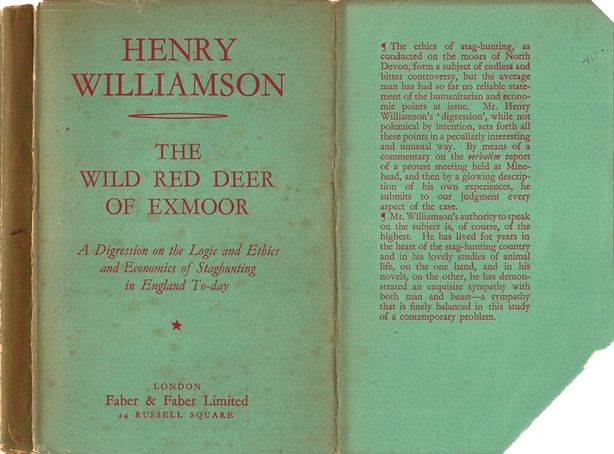
The Wild Red Deer of Exmoor
THE WILD RED DEER OF EXMOOR
A Digression on the Logic and Ethics and Economics
of Stag-Hunting in England To-day
 |
|
| First trade edition, Faber, 1931 |
Privately printed limited edition, 75 copies, issued in a pale green card slipcase, July 1931 (none of which were for sale)
Ordinary (trade) edition: Faber & Faber, August 1931, 2/6d
Dedication:
TO
THE GENTLE READER
Title page:

The book is short: 58 pages (pp. 7-64) only of actual text, in a size just slightly smaller than our current A5, roughly about 13,000 words.
The somewhat ponderous sub-title is misleading, detracting, and distracting, since this work is an interesting, well-argued exposition giving a balanced, and at times amusing, account of two opposing points of view: those for and those against the hunting of deer. Particularly it shows us that the theme is not just a black and white opposition but has many nuances of opinion, and that those who argue most vociferously against are often hiding their own sins, whether consciously or subconsciously or even without conscience (so true in many walks of life).
***********************
There is very little in HW’s archive to throw any light on the background of this book. An enigmatic and teasingly intriguing appointment pocket diary entry for 16 April 1930 states:
Fortescue to lunch. . . . The Wild Red of England. [sic]
Lord Hugh Fortescue (4th Earl) (1854-1932) was HW’s new landlord, on whose estate at Castle Hill, Filleigh, he was renting the Shallowford cottage. Lord Fortescue was the older brother of Sir John Fortescue (1859-1933), who had written the ‘Introduction’ for Tarka the Otter. HW would have had to entertain the Earl on his own, as his wife had given birth the previous day to their third child (and first daughter) in a local nursing home, although this event is not mentioned in this diary. (Note: there is no diary proper extant for 1930.)
One deduces from that brief note that the two men discussed (as would be a natural topic of conversation between them) Sir John’s famous book The Story of a Red Deer,published in 1897 by Macmillan. This charming story has an ‘Epistle Dedicatory’ to ‘Mr. Hugh Fortescue’, beginning ‘Honoured Sir’. Nine years old at that time, Hugh (1888-1958) was the son of this present 4th Earl and became the 5th Earl on the death of his father in the autumn of 1932. Sir John’s book tells the life-story:
of one of our own red deer, which, as they be the most beautiful of all creatures to the eye, so be also the most worthy of study by the mind for their subtlety, their nobility and their wisdom.
The letter ends: ‘Your very loving kinsman and faithful friend to serve you, J.W.F., Castle Hill, this 26th of September, 1897’. The affection of the uncle for his nephew is heart-warmingly obvious.
The story tells the life-story of a red deer stag, its growing up and adventures on the moors, its courting of a hind, the various other creatures with which it comes into contact, ending with a hunt and the inevitable death of the stag – all very much as Tarka tells the life-story of an otter, but in a very different style. It is indeed a story written for young people and, charming and absorbing though it is, contains a great deal of Victorian whimsy.
This conversation over lunch (as I am presuming occurred) would have brought thoughts about deer to the forefront of HW’s mind, and may perhaps have given him the germ of an idea for a new book. But he had already written his own short story ‘Stumberleap’, printed in The Old Stag (1926), and a short essay ‘Hunting to Kill’, which had appeared previously in a magazine, of which more anon. However, he certainly did nothing about this until after his return from the USA in the spring of 1931.
The only indication of this book is in three letters from his friend and publisher, Richard de la Mare, on Faber & Faber headed notepaper, dated 30 April 1931.
My dear Henry,
We are delighted at your suggestion that you should do an essay on the Wild Red Deer of Exmoor. Our own opinion is that if you want a fairly expensive limited edition as well (say at 15/-) it would be very much better not to publish it in the Criterion Miscellany [The Criterion was Faber’s house journal, edited by T. S. Eliot and already mentioned in the entry for The Village Book] but to do it on its own in a more permanent format, and say at 2/6d. That would mean that the essay would have to be rather longer than a Miscellany essay, and I should suggest from 20 to 25 thousand words. We should like, if you agree, to keep the limited edition down to 400 copies at 15/-.
De la Mare goes on to offer an advance payment of £75, with 10% royalties on the 2/6d edition, rising to 15% after sales of 5000, plus a royalty of 20% on the limited edition. That was quite a generous offer!
He also mentions in this letter details about the revised edition of The Dream of Fair Women (which HW had written while in New York the previous autumn), which they hope to bring out in June 1931 – so could HW make a decision quickly on the colour of the binding.
A further letter from de la Mare, dated 5 May 1931, shows that HW has stated that he only intends to write a short essay (as his original plan):
I can see that it is to be only a fraction of the length that I suggested.
This means Faber cannot offer such good terms as previously suggested – (these new terms are set out in such a convoluted manner that I cannot quite rationalise them). It is also obvious that HW still wants this to appear in the Criterion Miscellany, which seems a little perverse as he has been offered an actual book edition, which must surely have been more lucrative. That HW is further querying publication details for The Dream of Fair Women is also apparent.
These continual complications about contractual details over, it seems, just about every book must have been a great irritation to the various publishers concerned.
A third letter dated 9 June 1931 states that the proofs ‘of your essay’ are ready and would HW please correct them as quickly as possible. The letter gives details of the final contractual arrangements: the cost of printing a special edition of 75 copies on hand-made paper will be £8 (2/- a copy). So HW’s ideas have changed yet again. Apparently, according to Waveney Girvan’s Bibliography (1931), this limited edition was for HW’s personal use and copies were never for sale. This typed business letter ends in holograph:
We were so happy that you were able to come on Friday, & we enjoyed having you both with us more than I can say, Yours, Dick.
It is very tantalising not to have more details although some may still come to light in the future. As with all HW’s books, the manuscripts and typescripts and any ancillary papers reside in the care of Exeter University.
Girvan's entry:

***********************
The opening paragraph of The Wild Red Deer of Exmoor tells us:

Britannia magazine was set up in 1928 by the proprietor of what was known as ‘The Great Eight’ – those glossy magazines which included The Tatler, Illustrated London News, Queen, Graphic etc. – who asked Gilbert Frankau to be editor. Frankau (1884-1952) had fought throughout the First World War, and was at Loos, Ypres, and on the Somme. He was known as a First World War poet but also wrote a large number of novels. There is one poem in particular that would have resonated with HW: ‘Gun-Teams’, which begins:
Their rugs are sodden, their heads are down, their
tails are turned to the storm.
[. . .]
The blown rain stings, there is never a star, the
tracks are rivers of slime:
(You must harness-up by guesswork with a
failing torch for light,
Instep-deep in unmade standings; for it’s active service time,
And our resting weeks are over, and we move
the guns tonight.
The Britannia venture was not a success, and was apparently very short lived. There is no evidence of direct contact between Frankau and HW: no doubt his agent dealt with this item.
‘Hunting to Kill’ reveals the opposition of the sportsman, who wants to continue his sport, and the humanitarian, who wants to stop it: the author understands both points of view – the dichotomy of opposites – and he states that ‘their intolerant attitudes [towards each other] are identical.’
HW sets out, quite briefly, what these attitudes are based on and why. He too had once enjoyed the idea of ‘sport’. But he moves on to state: ‘a newer post-War point of view’. He explains his (and most soldiers) unthinking attitudes ‘hating those I had never seen because everyone else did so; doing towards those I did not hate acts which were considered glorious and noble.’
Then, relating that in terms of a hunt, he wonders: ‘has not enough blood flowed on the face of the earth already?’ And so we have a further instance of HW’s constant juxtaposing the war with life in the natural world.
However we are shown that life is not that simple. The author does not like the idea of otters being killed, but now that he is interested in trout (living at Shallowford on the bank of the River Bray) he thinks it is justified as the otter kills fish just for ‘play’ and will leave none alive.
Chapter, or Section, II describes a meeting of ‘Protest’ held in the Town Hall at Lynton under the auspices of the League for the Prohibition of Cruel Sports. The various comments and opinions of those present are recorded with all their amusing digressions and bigoted ideas, which gradually moves to the idea of shooting to control rather than hunting on horseback with hounds. The question of foxes killing chickens, and thus the livelihood of their owners, is raised by one; then the damage done by deer to crops – but shooting deer would only result in wounded deer, although the Chairman now argues that this is minimal. A further point is made about the drastic effect on the livelihood of all those who are dependent on stag-hunting, to which the reply is that organised drag-hunts would provide such people with an equal income.
The chairman points out that the activity of these hunts in August and September keeps many (most!) tourists away as they so dislike the disturbance or the sport: refuted from the audience that the sport provides a huge amount of tourism in itself (rich hunting Americans are cited).
The author ends this section:

It is interesting to note that this was 1931: the arguments and comments set out here are identical to the furore that occurred in the media in recent years in the run-up to the law on the banning of hunting with dogs, which came into being in February 2005.
Part III is a short (2 pages, about 350 words), rather clever little homily, combining thoughts of war, religion and the pursuits and ideas of Lenin:
. . . The World War caused and intensified many emotions; a few of these emotions were transmuted into what is loosely called religious feeling. Many emotions, many religions. Most of the opposition to field sports, called blood sports, comes from religious feeling, which one of the great spirits of this or any other century (Lenin) said arose from contemplation of the idler, gentler part of oneself.
Such religious feeling is compared then with the behaviour of a holiday crowd turning on a one-armed huntsman standing on the beach waiting for a stag to be retrieved from the sea by the boat hired for the purpose. The unstated inference is that the huntsman had lost his arm in the World War in the service of his country and for the freedom of those that were now berating him (rather reminiscent of HW’s recent The Patriot’s Progress) – thus turning the thought back to the opening comment.
The fourth section gives some general background about deer and information about the complications of compensation for deer damage (not necessarily always honestly claimed), paid by the Hunt. Again hunting and its opponents are given an equal voice.
Part V opens by stating that Sir John Fortescue’s book should be read, and his own ‘Stumberleap’ story also. He then proceeds to give a list of critical comments made about his story by ‘an authority who has lived among deer more than seventy years’. But HW counteracts these moot points by guoting Richard Jefferies’ Red Deer as corroborative evidence, and further quotes a letter from the Earl of Dunraven printed in the Daily Mail in 1926 proving that a stag was known to have swum across the Bristol channel in the past (as does Stumberleap in HW’s tale).
The sixth and final part relates the recent experience of our author as guest at a meet of stag-hounds. First a list of memory thoughts about various unhappy occurrences is given. This list encapsulates many of those short stories that made up the earlier nature books – those stories which I have pointed out nearly all end in the sudden death of the creature concerned: those stories which I feel are allied to HW’s experiences in the war. That the war is mentioned several times in this present book reinforces this thesis: at the end of this list of wrongs HW writes:
The snail is a delicate little wanderer in the starry dewfall, a slow small vegetarian; I blinded and burned them with quicklime on my garden seedbeds, causing them to froth with green slime like the green froth in the lungs of men writhing in chlorine gas.
His love for his flowers and vegetable garden outweighs his feeling for the ‘tender night-wanderer with his house on his back’. There is a great moral thought in there: cast out the mote in your own eye before you criticise other people’s sins.
So HW goes on to describe his participation in this hunt which basically consisted of cantering about over the moor and gives him the opportunity for a lyrical passage:
Heather, whortleberry, furze, bog-plants, bog-grass, the clouds trailing the grey sky among the steady-cantering horsemen.
Eventually they return to the hotel in Exford for poached eggs (‘the exploited brood dream of some man-ruined bird’) – reinforcing the idea that we cannot afford to be critical or take sides on moral questions, for our own every action is suspect.
That evening our author goes to a dinner party (this was possibly at the home of the artist Alfred Munnings who lived nearby), where he meets a friend who is a vegetarian and had been a conscientious objector during the war: ‘a genuine benevolent and gentle soul’, who questions HW’s actions in taking part in that day’s Hunt.
HW’s answer is that the act of riding is good for the constitution, thus: ‘decreasing intolerance, which would tend to decrease the possibilities of another European war’. This is the credo that was so central to HW’s life and thinking.
The author notes to himself that his vegetarian friend is eating turkey with gusto (which he justifies by saying that he does it to prove that his principles are not the master of him!). HW notes that he also remembers this man has rat-traps set in his garden. Both men smile to themselves over the foibles of the other: a further hidden subtlety of the moral undertone.
HW’s final paragraph is worth quoting verbatim. It leaves us with a tolerant view of the activities which have occasioned this pamphlet – or ‘digression’.

**************************
The file is very sparse, only five items, but they are amazingly detailed.
Somerset County Gazette,19 September 1931; not signed, 26½ column inches:
THE WILD RED DEER OF EXMOOR
STAGHUNTING AND ITS ETHICS
FAMOUS AUTHOR’S VIEWS
MR. HENRY WILLIAMSON ON A
CURRENT PROBLEM
The ethics of staghunting, as conducted on the moors of West Somerset and North Devon, form a subject of endless and bitter controversy, but the average man or woman has had so far few reliable statements of the humanitarian and economic points at issue. . . . Mr. Henry Williamson . . . sets forth all these points in a peculiarly interesting and unusual way. . . .
Mr. Williamson’s authority to speak on the subject is, of course, of the highest . . . [empowers him with] . . . a sympathy that is finely balanced in this study of a contemporary problem.
[The reviewer then takes the reader through more or less every aspect of the book.]
Bridgewater Mercury, 23 September 1931: repeats the review above.
Horse and Hound (‘I.C.’), 16 October 1931:
THE STAGHUNTING CONTROVERSY
[The review opens with the usual details of this book and HW in general. It then sets a moral tone about there being two sides to every question, an attitude unfortunately held by very few but inferring that Mr. Williamson’s book does:]
It is brief, but it is powerful; strong in its fairness to both sides – although, human nature being what it is, that will be accounted by some to be a weakness.
[The reviewer again takes the reader through the main points of the book with the occasional personal comment. Ending again on a moral note:]
It still remains among our chief necessities that we should know ourselves and examine into the composition of our thoughts and actions. I should add that the price is half a crown.
The Western Mail (J.C. Griffith-Jones), 8 September 1931 (15 column inches):
HUNTING TO KILL
ARE BLOOD SPORTS ESSENTIAL?
MEN, GUNS AND THE RED DEER OF EXMOOR
Recently a prominent follower of the Devon and Somerset Stag Hunt was drowned during a hunt.
The tragedy was hailed with almost fiendish delight by a number of opponents of the sport all over the country. Remarkable letters were sent to the dead man’s relatives, rejoicing in the manifestation of God’s wrath against murderers of innocent animals, and expressing the hope that a similar fate would befall many more of the hunters!
Thus once again fierce controversy rages around the wild red deer of Exmoor. Is stag-hunting cruel? Is the sport compatible with ethics? The sportsman and the humanitarian, as ever, are at variance.
Mr. Henry Williamson, the distinguished novelist and nature writer, in . . . , dispassionately states the case for and against stag-hunting. He is peculiarly gifted for the task. [States the various raisons d’être and follows with a resumé of the book.]
Mr. Williamson reflects on all this, as you and I, average thinking people, reflect. [But it is marred for him] by an overwhelming feeling of anguish at the lost harmony of the world.
[The reviewer asks the question:] What is humanitarian? What is the dividing line between the humanitarian and the sportsman? [It is not really answerable. And – showing that he has grasped the inner message of the book – he ends:]
Nearly 300 red deer were killed last year. Yes, and a million men were killed in the war – shot down, blown to bits, suffocated by gas, hunted to a terrible oblivion.
There is, you may say, no link between these two things. Isn’t there? One day, perhaps, we shall learn to bridge the gulf between feeling and thinking.
Inverness Courier, 22 September 1931:

*************************
The spine and front of the limited edition:

The dust wrapper of the trade edition, this one somewhat stained and foxed with the years:
A Test to Destruction - cover design
Back to A Test to Destruction main page
HW's design suggestions for the cover
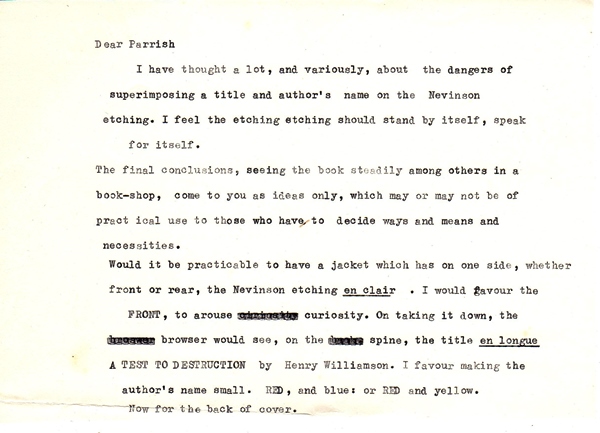
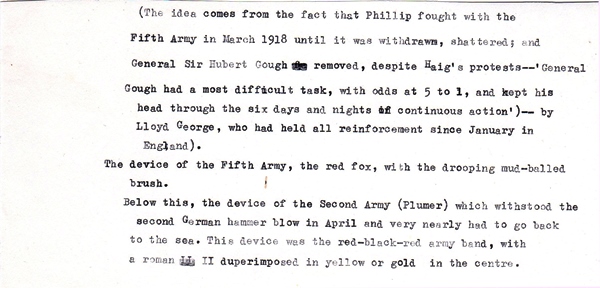
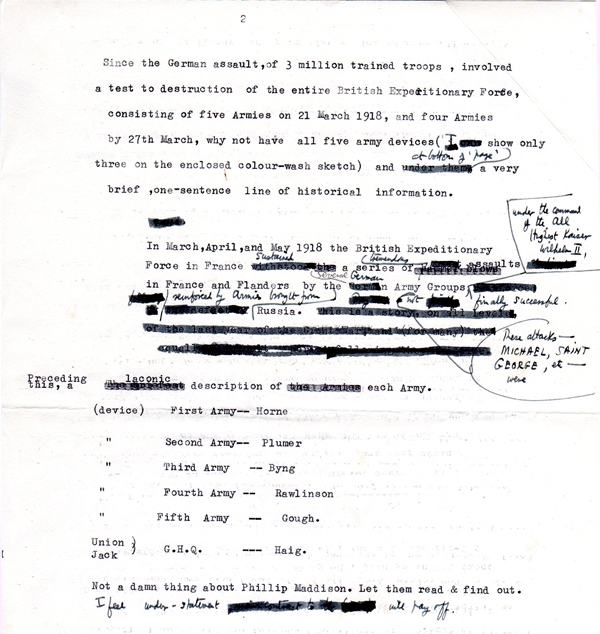
As with the Love and the Loveless cover, HW had his own ideas on the design of the cover for A Test to Destruction, and fragments of draft notes and letters that he sent in July 1960 to Walter F. Parrish, a director at Macdonald, survive, together with Parrish's no-nonsense response. These are shown below.
It is not known who designed the cover – there is no mention of James Broom Lynne in the correspondence, neither is Broom Lynne credited on the dust wrapper. In view of HW's opinion of Broom Lynne's interpretation of the two hands clasped in comradeship for the dust wrapper for Love and the Loveless ('Too insensitive. The Soviet-tractor statistics factory comrades clasp in concrete', HW wrote on his own copy of the book), it may even be that HW asked that Broom Lynne not be involved with this next novel.



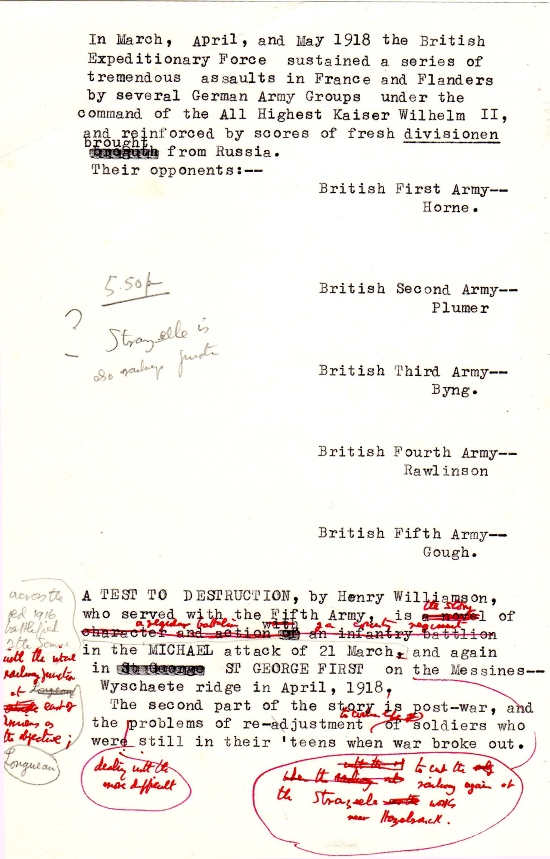


Back to A Test to Destruction main page
The Christmas Truce


The Christmas Truce
Henry Williamson
The First Battle of Ypres was over. The deluge in the second week of November 1914 decided that. Our battalion of the London Regiment (Territorials) was out at rest, leaving a memory of dead soldiers in feld grau (field grey) and khaki lying in still attitudes between the German and British lines. ‘Rest’ meant no more fatigues or carrying parties; it meant letters from home, parcels, hazy nights in the estaminets of Hazebrouck with café-rhum and weak beer, clouds of smoke and noisy laughter.
After 48 hours clear, a daily route march, leading to nowhere and back again, with new faces of the drafts which had come up from the base. The war was now a mere rumour from afar: a low-flashing, dull booming beyond an eastern horizon of flat, tree-lined and arable fields gleaming with water in cart-rut and along each furrow.
In the first week of December 1914 the King Emperor George V arrived at St Omer in northern France, headquarters of the British Expeditionary Force. Orders were given immediately at all units to prepare for a royal inspection.
The King, in the service uniform of a field-marshal, brown-booted with gold spurs, brown-bearded, prominent pouches under his blue eyes, passed with Field-Marshal Sir John French and various general staff officers down the ranks of silent, staring-ahead, depersonalised faces thinking that the gruff tones in which the King spoke to the commander-in-chief were of that other world infinitely remote from what really happened.
Behind the King walked the Prince of Wales, seeming somehow detached from the massive power of red and gold, the big moustaches and faces and belts and boots and spurs all so shining and immaculate between the open ranks of the troops standing rigidly at attention. The slim figure of the Prince, in the uniform of a Grenadier, appeared to be looking for something far beyond the immediate scene – a slight, white-faced boy in the shadow of Father.
The next afternoon the platoon sergeant walked from billet to billet, with orders that we were going into the line that evening. A waning moon rode the sky, memento of estaminet nights, moon-silvered cobble stones, colour-washed house-fronts of the Grande Place. The decaying orb was ringed by scudding vapour; a wet wind flapped the edges of rubber groundsheets fastened over packs and shoulders of the marching men. A wind from the south-west brought rain to the brown, the flat, the tree-lined plain of Flanders.
Going back was by now a prospect of stoical acceptance, since marching in the rain absorbed all personal memory, leaving little for coherent thought beyond the moment. We marched along a road lined with poplars towards the familiar hazy pallor thrown on low clouds by the ringed lights around Ypres – called ‘Ypriss’ by the old sweats who had been out since Mons. As we came nearer, the sky was tremulous with flashes: the night burdened by reverberation of cannon heard with the lisp of rainy wind in the bare branches of trees above our heads.
At last we halted, and welcome news arrived. The company was in reserve. We were to be billeted for the night in some sheds, and thatched lofts around a farm. Speculation ceased when the platoon commander said that we were taking over part of the line the following evening. The Germans, he said, had attacked down south; the battalion was to remain in the brigade reserve. It was a quiet part of the line. There was to be diversionary fire from the trenches, to relieve the pressure.
‘Cushy,’ we said among ourselves as we entered our cottage, to sleep upon the floor. There was a large stove, radiating heat. Bon for the troops!
The damp December dusk of next evening was closing down as No. 1 Company approached the dark mass of leafless trees at the edge of a wood. Through the trees lay a novel kind of track, firm but knobbly to the feet, but so welcome after the mud of the preceding field. It was like walking on an uneven and wide ladder. Rough rungs, laid close together, were made of little, sawn-off branches, nailed to laid trunks of oak trees. As we came near to the greenish-white German flares, bullets began to crack. The men of the new draft ducked at each overhead crack; but the survivors of the original battalion walked on upright, sometimes muttering, ‘Don’t get the wind-up, chum,’ as the old sweats had said to them when first they had gone into the line, many weeks before.
We came to a cross-ride in the wood, and waited there, while a cock-pheasant crowed as it flew past us. Dimly seen were some bunkers, in which braziers glowed brightly. The sight was homely, and cheering. Figures in balaclava woollen helmets stood about.
‘What’s it like, mate?’ came the inevitable question. ‘Cushy,’ came the reply, as a cigarette brightened. These were regulars, the newcomers felt happy again. Braziers, lovely crackling coke flames!
The relief company filed on down the path, and came to the luminous edge of the wood, beyond which the German parachute flares were clear and bright, like lilies. The trench was just inside the wood. There was no water in it, thank God! One saw sandbag-dugouts behind the occupants standing by for the relief. It was indeed cushy!
Thus began a period or cycle of eight days for No. 1 Company: two in the front line followed by two days back in battalion reserve in billets, two in support within the wood and two more again in the front line. It was not unenjoyable: danger was negligible – a whizz-bang arriving now and again – object more of curiosity than of fear – news of someone getting sniped; work in the trench, digging by day, revetting the parapet, and fatigues in the wood by night; for the weather remained fine. One trench had a well-made parapet with steel loopholes built in the sandbags, and paved along a length of 50 yards entirely by unopened tins of bully-beef taken from some of the hundreds of boxes lying about in the wood. These boxes had been chucked away by former carrying parties, in the days before ‘corduroy’ paths. The trench had been built by the regulars, now no longer bearded, though some of their toes showed through their boots. It was said that a cigarette end, dropped somewhere along it, was a ‘crime’ heavily punished.
All form, and shape even, of the carefully-made trenches disappeared under rains falling upon the yellow clay which retained them. One was soaked all day and all night. The weight of a greatcoat was doubled by clay and water. ‘We volunteered for this!’ was an ironic comment among those in water sometimes to the waist.
After the rains, mist lay over a countryside which had no soul, with its broken farmhouse roofs, dead cattle in no man’s land, its daylight nihilism beyond the parapet with never a movement of life, never a glimpse of the Alleyman (Allemand – German) – except those who were dead, and lying motionless in varying attitudes of stillness day after day upon the level brown field extending to the yellow subsoil thrown up from the enemy trench, beyond its barbed wire obstacles.
At night mist blurred the brightness of the light-balls, the Véry lights or flares as they were now generally called. The mists, hanging heavier in the wood, settled to hoar, which rimed trees, corduroy paths, shed and barn; and clarified into keener air in sunlight. Frost formed floating films of ice upon the clay-blue water in shell-holes, which tipped when mess-tins were dipped for brewing tea; the daily ration of tea being mixed in sandbags with sugar. It was pleasant in the wood, squatting by a little stick fire. Movement was, however, laborious now upon the paths not yet laid with corduroy by the sappers. Boots became pattened with yellow clay. Still, we said, it might be worse – for memory of the tempest that had fallen on the last day of the battle for Ypres, of the misery of cold and wet, the dereliction of that time, was still in the forefront of our minds.
One afternoon, towards Christmas, a harder frost settled upon the vacant battlefield. By midnight trees, bunkers, paths, sentries’ balaclavas and greatcoat shoulders became stiff, thickly rimed. From some of the new draft came suppressed whimpering sounds. Only those old soldiers who had scrounged sandbags and straw from Iniskilling Farm at one edge of the wood, and put their boots inside, lay still and sleeping. Lying with unprotected boots outside the open end of a bunker, one endured pain in one’s feet until the final agony, when one got up and hobbled outside, seeing bright stars above the treetops. The thing to do was to make a fire, and boil some water in a mess-tin for some Nestlé’s café-au-lait. There were many shell-fractured oak-branches lying about. They were heavy with sap, but no matter. One passed painful hours of sleeplessness in blowing and fanning weak embers amid a hiss of bubbling branch-ends.
As soon as I sat still, or stood up to beat my arms like a cabby on a hansom cab, the weak glow of the fire went dull. My eyes smarted with smoke, there was no flame unless I fanned all the time. My arms were heavy in the frozen greatcoat sleeves, mud-slabbed and hard as drainpipes; while the skirts of the coat were like boards. I went back to sleep, but pain kept me awake; so I crawled out again and was once more in frozen air, bullets smacking through trees glistening with frost. I was thirsty, but the water-bottle was solid. Later, when it was thawed out over a brazier, it leaked, being split, but there were many lying about in the wood, with rifles and other equipment.
We were issued with shaggy goatskin jerkins. Did it mean that the battalion was intended to be an Officers’ Training Corps? That there would be no more attacks until the spring? The jerkins had broad tapes which cross-bound the white and yellow hairy skins against the chest. Officers and men now looked alike, except for the expression of an officer’s face, and the fact that one appeared to stand more upright; an effect given, perhaps, by the shoulder-high thumbsticks of ash many of them walked about with.
Senior officers also wore Norwegian type knee-boots, laced to the knee and then treble-strapped. I thought of asking my father to send me a pair, but a thaw came at the beginning of the third week of December, and the misery of mud returned. And then, with a jump of concealed fear, orders were read out for an attack across no man’s land to the German lines. It was two days after the new moon. We were in support. The company lay out on the edge of the wood, shivering and beating hands and feet, in support of a regular battalion of the Rifle Brigade. The objectives were a cottage in no man’s land called Sniper’s House, and thence forward to a section of the enemy front line that enfiladed our dangerous T-trench.
The assault of muttering and tense-faced bearded men took place under a serried rank of bursting red stars of 18-pounder shrapnel shells, and supporting machine gun fire. Figures floundering across a root-field in no man’s land, with its sad decaying lumps of cows and men. Hoarse yells of fear became simulated rage; while short of, into and beyond the British front line dropped shell upon shell to burst with acrid yellow fumes of lyddite from the British Long-toms of the South African war of 1902, with their worn rifling.
The order came for the company to carry on the attack. Survivors, coming back through the wood, wet through and covered with mud, uniforms ripped by barbed wire, were stumbling as they passed through us. When they had gone away – away from the line, death behind them – a clear baritone voice floated back through the trees, singing Oh, for the wings, for the wings of a dove – far away, far away would I roam. They were wonderful, remarked a sergeant, a rugger-playing Old Blue in peacetime. Yes, because they were going out, I thought; they were euphoric, hurrying to warmth and sleep, sleep, sleep.
This local attack failed on the uncut German wire; but Sniper’s House was taken. Our colonel, one heard later, had protested against the carrying on of the attack by our company. Later, it was reported in ‘Comic Cuts’, or Corps Intelligence sheets, that the attack had been ordered to aid the Russians, hard pressed on the Eastern front.
We laughed sceptically at that; a beginning of disillusionment with ‘the well-fed Staff’.
I had no fear at night, and used to wander about in no man’s land by myself, to feel some sort of freedom. One night I was sitting down by the German wire when a flare hissed out just by my face, it seemed, followed by another, and another, while machine guns opened up with loud directness, accompanied by the cracking air-shear of bullets passing only a few inches, it seemed, above my neck. Then up and down the line arose the swishing stalks of white lights, all from the German lines, by which one knew that they were not going to attack, but feared an assault from our lines. This was remote comfort, as I felt myself to be large and visible, sweating with fear of sorts, while bullets from our lines thudded and whanged away upwards in ricochet. The sky above me appeared to be lit by the beautiful white lilies of the dead, as I thought of them.
This was an occasion of that phenomenon known as wind-up. As before a wind, fire swept with bright yellow-red stabs of thorn-flame up the line towards the light-ringed salient around Ypres: bullets in flight, hissing, clacking or whining, crossed the lines of the hosts of the unburied dead slowly being absorbed into Flanders field. The wind of fear, the nightly wind of the battlefield of Western Europe, from the cold North Sea to the great barrier of the Alps – a fire travelling faster than any wind, was speckling the ridges above the drained marsh that surrounded Ypres, stabbing in wandering aimless design the darkness on the slopes of the Commines canal, running in thin crenellations upon the plateau of Wytschaete and Messines, sweeping thence down to the plain of Armentières, among the coal-mines and slags of Artois, across the chalk uplands of Picardy, and the plains of the rivers. The wind of fear rushed on, to die out, expended, beyond the dark forest of the Argonne, beyond the fears of massed men, where snow-field, ravine, torrent and crag ended before the peaks in silence under the constellation of Orion, shaking gem-like above all human hope.
It was still freezing hard on Christmas Eve. We had been detailed for what seemed to be a perilous fatigue in no man’s land – going out between the lines to knock in posts in a zigzag line towards the German front line. Around the posts wire was to be wound. On this wire, hurdles taken from a shed were to be laid. Then drying tobacco leaves, hung on the hurdles (as the leaves had been in the shed), would give cover from view should it be necessary, in an attack, to reinforce the front line.
What an idea, I thought. It would draw machine gun fire. It was about as sensible as the brigade commander’s idea for the December 19 attack across no man’s land, for some men to carry straw palliasses, to lean against the German wire and enable men to cross over the entanglements. As for the knocking-in of posts into frozen ground, that was utterly wrong! And in bright moonlight, 40 yards away from the Alleyman!
After our platoon commander, a courteous man in his early 20s and fresh from Cambridge, had outlined the plan quietly, he asked for questions. I dared to say that the noise of knocking in posts would be heard. There was silence; then we were told that implicit directions had come from brigade, and must be carried out. We debouched from the wood, and were exposed. After an initial stab of fear, I was not afraid. Everything was so still, so quiet in the line. No flares, no crack of the sniper’s rifle. No gun firing.
Soon we were used to the open moonlight in which all life and movement seemed unreal. Men were fetching and laying down posts, arranging themselves in couples, one to hold, the other to knock. Others prepared to unwind barbed wire previously rolled on staves. I was one who followed the platoon commander and three men to a tarred wooden shed, to fetch hurdles hung with long dry tobacco leaves, which we brought out and laid on the site of the reinforcement fence.
And not a shot was fired from the German trench. The unbelievable had soon become the ordinary, so that we talked as we worked, without caution, while the night passed as in a dream. The moon moved down to the treetops behind us. Always, it seemed, had we been moving bodilessly, each with his shadow.
After a timeless dream I saw what looked like a large white light on top of a pole put up in the German lines. It was a strange sort of light. It burned almost white, and was absolutely steady. What sort of lantern was it? I did not think much about it; it was part of the strange unreality of the silent night, of the silence of the moon, now turning a brownish yellow, of the silence of the frost mist. I was warm with the work, all my body was in glow, not with warmth but with happiness.
Suddenly there was a short quick cheer from the German lines – Hoch! Hoch! Hoch! With others I flinched and crouched, ready to fling myself flat, pass the leather thong of my rifle over my head and aim to fire; but no other sound came from the German lines.
We stood up, talking about it, in little groups. For other cheers were coming across the black spaces of no man’s land. We saw dim figures on the enemy parapet, about more lights; and with amazement saw that a Christmas tree was being set there, and around it Germans were talking and laughing together. Hoch! Hoch! Hoch!, followed by cheering.
Our platoon commander, who had gone from group to group during the making of the fence, looked at his watch and told us that it was eleven o’clock. One more hour, he said, and then we would go back.
‘By Berlin time it is midnight. A Merry Christmas to you all! I say, that’s rather fine, isn’t it?’, for from the German parapet a rich baritone voice had begun to sing a song I remembered from my nurse Minne singing it to me after my evening tub before bed. She had been maid to my German grandmother, one of the Luhn family of Hildesheim. Stille Nacht! Heilige Nacht!
Tranquil Night! Holy Night! The grave and tender voice rose out of the frozen mist; it was all so strange; it was like being in another world, to which one had come through a nightmare: a world finer than the one I had left behind me in England, except for beautiful things like music, and springtime on my bicycle in the countryside of Kent and Bedfordshire.
And back again in the wood it seemed so strange that we had not been fired upon; wonderful that the mud had gone; wonderful to walk easily on the paths; to be dry; to be able to sleep again.
The wonder remained in the low golden light of a white-rimed Christmas morning. I could hardly realise it; but my chronic, hopeless longing to be home was gone.
The post arrived while I was frying my breakfast bacon, beside a twig fire where stood my canteen full of hot sugary tea. I sat on an unopened 28-lb box of 2-ounce Capstan tobacco: one of scores thrown down in the wood, with large bright metal containers of army biscuits, of the shape and size and taste of dog biscuits. The tobacco issue per day was reckoned to be 5,000 cigarettes at this time, or 24 lbs of tobacco. This was not the ‘issue’ ration, but from the many ‘Comforts for the Troops’ appeals in newspapers, all tobacco being duty free to our benefactors at home.
There was a Gift Package to every soldier from the Princess Royal. A brass box embossed with Princess Mary’s profile, containing tobacco and cigarettes. This I decided to send home to my mother, as a souvenir.
‘There’s bloody hundreds of them out there!’ said a kilted soldier to me as I sat there.
I walked through the trees, some splintered and gashed by fragments of Jack Johnsons, as we called the German 5.9-inch gun, and into no man’s land and found myself face to face with living German soldiers, men in grey uniforms and leather knee-boots – a fact which was at the time for me beyond belief. Moreover the Germans were, some of them, actually smiling as they talked in English.
Most of them were small men, rather pale of face. Many wore spectacles, and had thin little goatee beards. I did not see one pickelhaube. They were either bare-headed, or had on small grey pork-pie hats, with red bands. Each bore two metal buttons, ringed with white, black and red rather like tiny archery targets: the Imperial German colours.
Among these smaller Saxons were tall, sturdy men taking no part in the talking, but regarding the general scene with detachment. They were red-faced men and their tunics and trousers above the leather knee-boots showed dried mud marks. Some had green cords round a shoulder, and under the shoulder tabs.
Looking in the direction of the mass of Germans, I saw, judging by the serried rows of figures standing there, at least three positions or trench lines behind the front trench. They were dug at intervals of about 200 yards.
‘It only shows,’ said one of our chaps, ‘what a lot of men they have, compared to our chaps. We’ve only got one line, really, the rest are mere scratches.’ He said quietly, ‘See those green lanyards and tassels on that big fellow’s shoulders? They’re sniper’s cords. They’re Prussians. That’s what some Saxons told me. They dislike the Prussians. “Kill them all,” said one, “and we’ll have peace”.’
‘Yes, my father was always against the Prussians,’ I told him. One of the small Saxons was contentedly standing alone and smoking a new and large meerschaum pipe. He wore spectacles and looked like a comic-paper ‘Hun’. The white bowl of the pipe bore the face and high-peaked cap of ‘Little Willie’ painted on it. The Saxon saw me looking at it and taking pipe from mouth said with quiet satisfaction: ‘Kronprinz! Prächtiger Kerl!’ before putting back the mouthpiece carefully between his teeth.
Someone told me that Prächtiger Kerl meant ‘Good Chap’ or ‘Decent Fellow’. Of course, I thought, he is to them as the Price of Wales is to us.
A mark of German efficiency I noted: two aluminium buttons where we had one brass button on our trousers. Men were digging, to bury stiff corpses. Each feld grau ‘stiffy’ was covered by a red-black-white German flag. When the grave had been filled in an officer read from a prayer-book, while the men in feld grau stood to attention with round grey hats clutched in left hands. I found myself standing to attention, my balaclava in my hand. When the grave was filled, someone wrote, in indelible pencil, these words on the rough cross of ration-box wood: Hier Ruht In Gott Ein Unbekannter Deutscher Held. ‘Here rests in God an unknown German hero’, I found myself translating: and thinking that it was like the English crosses in the little cemetery in the clearing within the wood.
I learned, with surprise, that the German assaults in mass attack through the woods and across the arable fields of the salient, during the last phase of the Battle for Ypres, had been made by young volunteers, some arm in arm, singing, with but one rifle to every three. They had been ‘flung in’ (as the British military term went) after the failure of the Prussian Guard, the élite Corps du Garde, modelled on Napoleon’s famous soldiers, to break our line. And here was the surprise: ‘You had too many automatische pistolen in your line, Englische friend!’
As a fact, we had few if any machine guns left after the battle; the Germans had mistaken their presence for our ‘fifteen rounds rapid’ fire! Every infantry battalion had been equipped with two machine guns, of the type used in the South African War of 1902; with one exception. That was the London Scottish, the 14th Battalion of the London Regiment, which had bought, privately before the war, two Vickers guns. These also were lost during the battle.
Another illusion of the Germans appeared to be that we had masses of reserve troops behind our front line, most of them in the woods. If only they had known that we had very few reserves, including some of the battalions of an Indian Division, the turbanned soldiers of which suffered greatly from the cold.
The truce lasted, in our part of the line (under the Messines Ridge), for several days. On the last day of 1914, one evening, a message came over no man’s land, carried by a very polite Saxon corporal. It was that their regimental (equivalent to our brigade, but they had three battalions where we had four) staff officers were going round their line at midnight; and they would have to fire their automatische pistolen, but would aim high, well above our heads. Would we, even so, please keep under cover, ‘lest regrettable accidents occur’.
And at 11 o’clock – for they were using Berlin time – we saw the flash of several Spandau machine guns passing well above no man’s land.
I had taken the addresses of two German soldiers, promising to write to them after the war. And I had, vaguely, a childlike idea that if all those in Germany could know what the soldiers had to suffer, and that both sides believed the same things about the righteousness of the two national causes, it might spread, this truce of Christ on the battlefield, to the minds of all, and give understanding where now there was scorn and hatred.
I was still very young. I was under age, having volunteered after the news of the Retreat from Mons had come to us one Sunday in the third week of August 1914. Our colonel had made a speech to the battalion, then in London, declaring that the British Expeditionary Force of the Regular army was very reduced in numbers after the 90-mile retreat which had worn out boots and exhausted so many, and was in dire need of help.
And now the New Year had come, the frost was settling again in little crystals upon posts and on the graves and icy shell holes in no man’s land. Once more the light-balls were rising up to hover under little parachutes over no man’s land with the blast of machine guns, and the brutal downward droning of heavy shells. And the rains came, to fall upon Flanders field, while preparations were in hand for the spring offensive.
HW contributed this memoir (in vol. 2, no.4) to the History of the First World War, edited by Barrie Pitt (Purnell, 1970), which was published in 128 weekly parts. It is reprinted in the collection Indian Summer Notebook: A Writer’s Miscellany (HWS, paperback, 2001; e-book 2013).
Henry Williamson at Felixstowe
Henry Williamson at Felixstowe, 1917–18
Invalided home from the Front in June 1917 after being gassed, and following a period of convalescence and leave, Henry Williamson joined the 3rd Battalion of the Bedfordshire Regiment on 15 October 1917. This was a Home Service battalion stationed at Landguard Fort on the east coast, just outside Felixstowe, and HW remained there until the war's end and the beginning of his Christmas leave on 9 December 1918. Following this leave he was sent to No. 1 Dispersal Unit at Shorncliffe, and then No. 3 Rest Camp at Folkestone, dealing with troops returning from abroad. He was demobilised on 19 September 1919.
There are few details available about the duties that HW undertook while with the 3rd Beds – Phillip Maddison in A Test to Destruction is assistant adjutant in the Orderly Room, and it seems reasonable to assume that this reflects HW's own position there.
There exist a few photographs of his fellow officers and their off-duty activities, and these are reproduced below, among other memorabilia.
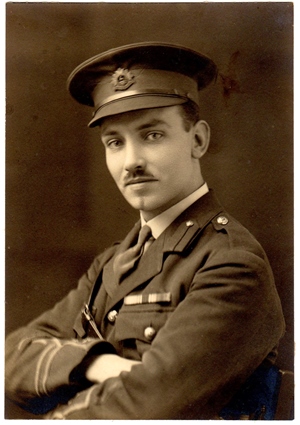 |
|
Captain Charles O. Whitfield 'Witters' and HW remained lifelong friends |
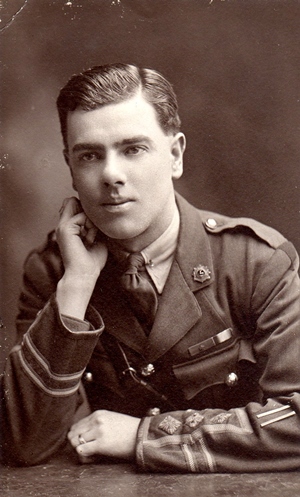 |
| Frank W. Hedges, VC |
 |
| Denis Sisley, MC |
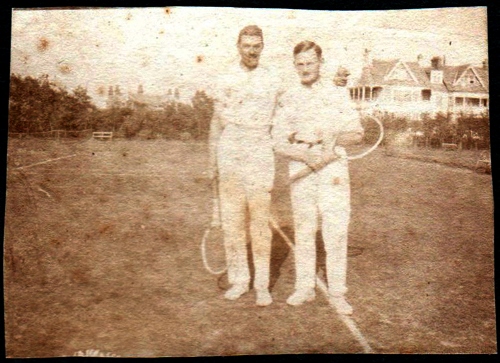 |
|
HW and his doubles partner Milling The photograph is captioned by HW: "Semifinals, Men's Doubles Tournament, Felixstowe, Aug '18" |
 |
| Milling (left) and unknown, holding HW's puppy Billjohn |
*************************
This irreverent postcard to HW's father also survives (note that it was sent to William Leopold's place of work rather than to his home):
*************************
The 3rd Battalion Bedfordshire Regiment took its etiquette seriously, and required its 'temporary gentlemen' to act as officers and gentlemen. To that end it produced a booklet of its 'Rules of the Officers' Mess' in 1916; this copy was issued to HW:



*************************
After the war, in common with other regiments and units, the Bedfordshire and Hertfordshire Regiment (to give it its full name) held annual reunion dinners, until survivors became so few that they ceased. HW attended some of these, though he eventually gave up going to them.
Below are two menus for the 1928 reunion dinner, the first being Charles Whitfield's, which HW has signed for him. The second is HW's menu, signed by others and with additional notes by HW. Of interest too is that he used the menu as an aide-memoire for his forthcoming appointments that week!


HW has noted 'Hedges VC' – Frank Hedges won his Victoria Cross in September 1918. The action is described in Major-General Sir F. Maurice's The 16th Foot: A History of The Bedfordshire and Hertfordshire Regiment (Constable, 1931):
Early on the 24th [September] the battalion was back on the battlefront to support the Northamptons in the attack on the brigade's final objective, the south-western edge of the Mormal Forest. The advance began at 4 a.m.; the country being very enclosed, the barrage was lost, and the two supporting battalions, the 2nd Battalion and the Royal Fusiliers, were soon mixed up with the Northamptons, while the enemy was making a determined stand on the ridge in front of Bousies. The check which resulted was resolved primarily by two men. Lieut.-Colonel A. E. Percival came up and coolly sorted out the confused mass of men in the firing line, reorganising the battlefront. Lieutenant F. W. Hedges of the Bedfords was attached to the 6th Northamptons, and his company was on the right of the brigade front. Crawling up the ridge with one sergeant, and followed at some distance by a Lewis gun section, he got on the flank of the line of German machine gun posts, killed the first German machine gunner and then disposed of two more machine gun posts, taking fourteen prisoners. The Lewis gun section then came up, and all the remaining machine gun posts were captured. This bold and courageous action, for which Lieutenant F. W. Hedges was awarded the V.C., enabled the brigade to sweep forward to its final objective.
HW's diary notes indicate just what a busy week he has planned for this tenth anniversary of the signing of the Armistice:
9. Friday. D Mirror Ticket. Dine Kit W. ? Kit W at 7, Nat Lib Club. [The Daily Mirror ticket was for the service at the Cenotaph the following Sunday, 11 November; HW wrote a piece on this which appeared in the paper the next day. Kit W is the composer Christopher à Becket Williams, who appears as the character 'Becket Scrimgeour' in ACAS.]
10. Sat – dine A.B. 75 Cadogan Gdns, at 8 [This is Arnold Bennett, the novelist and influential critic for the Evening Standard.]
11. Sunday Cenotaph. 10 am.
12. Monday. Lunch Garnett, 19 Pond Place, 1. p.m. [The writer and critic Edward Garnett, who did much to help HW's early career.]
Back to Henry Williamson and the First World War