
The Henry Williamson Society
Uncategorised
Devon Holiday - Critical reception
Back to Devon Holiday main page
Critical reception:

There is an extremely large file of reviews for Devon Holiday, so shorter reviews have been omitted here. The ‘G. B. Everest’ disguise was busted from the start. Indeed, it was mentioned in a couple of papers even before the book was actually published. There had been of course an enormous amount of press attention over TEL’s accident death and funeral (HW kept a big selection of newspapers from that time).
Yorkshire Post, Nottingham Guardian, Southport Guardian and The Star all mentioned this on 20 June 1935.
Liverpool Daily Post (Brother Savage), 22 June 1935: ‘Books and Bookmen’ column. Brother Savage was a regular reviewer of HW’s books. After a 7½ column inches diatribe against Gertrude Stein, Brother Savage turns to HW, fastening on the references to T. E. Lawrence.
North Devon Journal, 22 June 1935: 2 items; the first (14 column inches) by the Editor, grumbles that HW has used and twisted his own words in an article in the Sunday Referee – all to do with spelling ‘Henry’ as ‘Henrny’ (as HW does in Devon Holiday) and obviously feeling hurt at HW’s pastiche of this editor’s previous article, which in Devon Holiday is found lying in the road, very dirty, picked up, casually read and then carefully burnt: NOT the way to make friends even if it was done in fun! This editor points out that all this passage is merely a rehash of the article by HW in the Sunday Referee – ‘whole chunks identical in phraseology’. However, he is happy to include a review.
Review proper, signed A.J.M. (11-inch column), first gives reasons as to why the book should be unreadable, carrying on:
But as a matter of fact, “Devon Holiday” is very much more attractive than its method of compilation would lead us to suppose. . . . The author has once again brought into use those remarkable and penetrating powers of observation and that great gift of descriptive realism which went into [Tarka the Otter] . . .
Sunday Referee (A.V.O.), 23 June 1935 (for which newspaper HW was then writing a regular ‘Nature Lover’s Notebook’ column):

Daily Telegraph, 24 June 1935:
The last thing “Lawrence of Arabia” ever wrote is given in a book which is published today.
Then a full review on 25 June 1935:
Otters, peregrines and ravens move about in Mr. Henry Williamson’s books. . . . He digs up the dialect of Devon warm and coarse and serves it like cottage bread. . . .
It is a strange book, full of odds and ends and whatever seems to strike the author. It begins with the last telegram ever sent by Lawrence of Arabia a few minutes before the end. It closes with a lyrical idyll of a salmon’s life story intertwined with that of a girl. In between is a ghastly story of the Grand Guignol transferred to the tors and heather . . . [i.e. ‘The Story of the Poisoned Hounds’]
Birmingham Post, 2 July 1935: Opening with the ‘Postscript’ incident, the reviewer continues:
Mr. Williamson and his work have, however, little need of adventitious publicity. Both are vigorous and independent, likely to attract the mentally robust, certain to repel the squeamish . . . the last chapter, an exquisite story called “The Maiden Salmon” . . . most important of all, studies of the countryside and of wild life observed with unsentimental sympathy.
John O’London’s Weekly (Osbert Burdett), 6 July 1935:
Mr. Henry Williamson is one of those authors who cast a peculiar spell on people, but a spell that may seem inexplicable to others. His new book . . . is a baffling example of this spell. On the loose framework of a ramble in Devon . . . he strings a collection of all sorts of stories. . . . I do not think the framework very successful, nor the characters of the ramblers, nor the chronicle of their route; but . . . this book is the apparently impossible feat: a book about Devon unlike any other, and inimitable. . . .
The cream of the book is the last chapter . . . a lovely nature story beautifully told. [Then an interesting insight, that the book reveals a strain (or split personality?)]: That which one overhears in his written word is, I suppose, a voice which finds writing as much a barrier as an expression.
Morning Post, 9 July 1935: 13-inch total column headed ‘A QUARTETTE ON THE COUNTRY’, but mainly on Through the Wilderness by H.J. Massingham and Devon Holiday by HW]. Opens with a generalisation about writers on country matters – either ‘sentimental cockneys’ or those who know the countryside; the latter feel regret that its qualities are being lost. Of Massingham:
His book is charming, informative, provocative and provoking . . . because Mr. Massingham’s archaeological-romantic-mystical impulses narrow his vision and clog his analysis.
Mr. Williamson, also, neglects the depth of the human problem . . . This new book describes everything . . . strung together with the string of a long tour on foot . . . The talk and description are as good as ever but . . . Mr. Williamson gives something of the impression of living in a fool’s paradise.
HW replied!

Books of Today, July 1935:

Daily Herald (A.L.H.), 5 July 1935; headed ‘Barking Up The Wrong Tree’. The reviewer opens with a somewhat obtuse and over-clever passage about ‘Demiurge’ quoted from Christopher Morley, and proceeds to judge first a book by John Moore, Country Men (Dent, 7/6d), and then HW against his quoted criteria of ‘marking the wrong passages’: both fail. Basically he is puzzled by HW’s book:
. . . anything but what we expect of him . . . Between them Henry and his Scribe have made a rambling book, in more senses than one.
[He then proceeds to reveal ‘Zeale’ to be S. P. B. Mais and ‘Everest’ to be T. E. Lawrence – and ends:]
It is good only for its rare glimpses of a great naturalist who insists on making the wrong comments in the margins.
(‘Demiurge’ was the creator of the world in Platonic philosophy. But the word ‘demiurge’ comes from the Greek ‘demiourgos’ meaning ‘craftsman’: in trying to be too clever the reviewer missed an opportunity to be really clever!)
Manchester Guardian (G.T.), 8 July 1935: Describes various points of the book but feels the ‘boisterous mirth’ often falls flat.
The Observer, 21 July 1935:
[Likes the fact that HW] has let himself go; and with effect. You never know what is coming next. [Picks out choice items but concludes that surely HW has yet to write best work, for] this little book, for all its virtues, is little more than a sort of impromptu joke, a merry persiflage, a satiric comedy.
The Times, 2 July 1935: under the heading ‘DEVON SCRAPBOOK’ (which would have made a good title for it!):
[HW’s] latest book is a light-hearted affair . . . It is a scrapbook of tales of local character, wild life, and personal anecdotes. [And without actually mentioning TEL by name, notes] the vignette of “G. B. Everest” has a poignant interest since the tragic motor-cycle accident at Bovington earlier this year.
The Times Literary Supplement, 11 July 1935 (11-inch column):
Mr. Williamson surely provides a case for the theory of reincarnation. [His sympathy and understanding of nature is of the highest degree] . . . But Mr. Williamson is far from pointing morals. Indeed, this book is a thoroughly light-hearted affair.
[Of the characters who come and go:] not the least important being “Windles”. [And of course ‘Lawrence of Arabia’ – picking up on the phrase:] ‘future man will be like that after the Final World War’. [While the story of the escaped convict:] shows that Mr. Williamson has a sympathetic understanding of others besides birds and beasts.
The Sunday Times, 14 July 1935 (18-inch column):
NOVELIST POET AND NATURALIST
MR. WILLIAMSON ON HOLIDAY
[Quotes HW’s own phrase re ‘slapstick and knockabout’] . . . Mr. Williamson is an elusive person and these expressions from the jargon of the theatre . . . by no means convey the sum of the qualities of “Devon Holiday”.
[Some length is devoted to the J. B. Priestley passages, although no actual comment is made on them.]
Mr. Williamson’s feelings for Devon are those of a naturalist, novelist, poet rustic – all of which jostle one another in this book of high comedy. . . .
A reviewer can only do summary justice to this fascinating book. Characters two-footed, four-footed, winged and finned crowd its pages. . . .
[The reviewer ends with reference to T. E. Lawrence who:] makes a brief and, in the light of after events, a poignant appearance. . . . the last words Lawrence wrote were in a telegram about this very book (then in proof) . . . Mr. Williamson has never written with more delicate sensibility than in the pages where “G. B. Everest” (as he is here called) talks to him for the last time on the Berengaria.
The Scotsman, 15 July 1935 (9½-inch column):
Mr. Williamson’s many admirers will find in his latest book confirmation of the opinion, frequently expressed, that he is one of the most delightful writers on Nature we have ever had, but not nearly so good on other topics. This “rambling haphazard walk” (real or imaginary) . . . provides literary fare of as mixed a kind as was the company of ramblers. . . .
Truly, Devon Holiday is a mixed bag, but all who dip into it should find something to their liking.
North Devon Journal (again), 18 July 1935:
. . . the writer has left himself untrammelled by any set method or construction and the reader is led through a series of unconventional descriptions of experiences that, whilst of small intrinsic significance, are made enjoyable by the naive manner of their telling. . . .
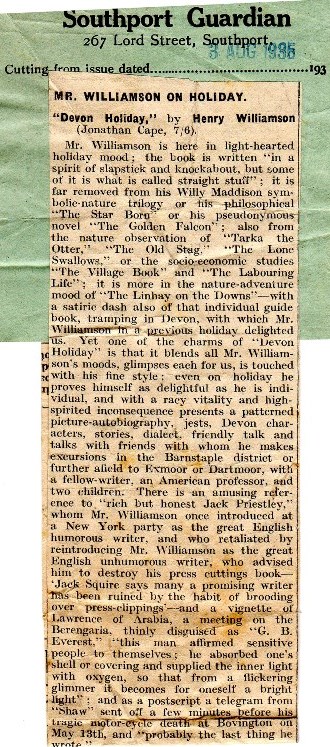
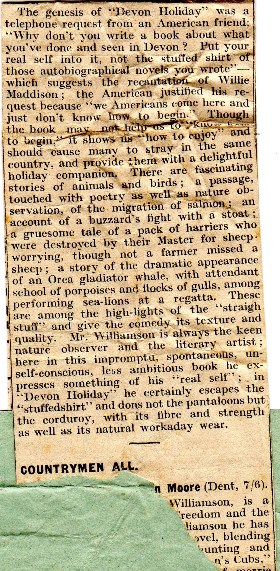
Southport Guardian, 8 August 1935. This reviewer knew HW’s books well:
 |
 |
Irish News, 29 July 1935 (8-inch column):
‘A Book for the Holiday’
. . . in this praiseworthy book a perfect master of the extempore holiday . . . the book is such an unpremeditated affair. . .
[Ending re J. B. Priestley on HW:] The great English unhumorous writer Mr. Priestley will have to read “Devon Holiday” and recant.
Sun (Sydney, Australia), 18 August 1935:

The Courier Mail (Brisbane, Australia), 28 September 1935:
Mr John Moore, the novelist, in a delightful book called ‘Country Men’ issued the other day by Dent, complains that the countryside of England, about which W. H. Davies, Brett Young and Henry Williamson have written so lovingly and well is passing and little is left but “to recollect in tranquillity the beauty and richness of the past.”
Yet in ‘Devon Holiday’ Mr. Williamson has written a book that, like John Moore’s ‘Country Men’ must throw a peculiar spell over readers who like country scenes such as they describe. There is in a Brisbane bookshelf a book about an otter, written many years ago by Mr. Williamson, that deserves the overworked word “unforgettable.” In his latest book, on the framework of a ramble across Exmoor and Dartmoor, he has strung together a series of delightful sketches about otter, salmon, birds, about Devonshire people, J. B. Priestley, Lawrence of Arabia, and a score of other things such as make one think that the English countryside must still be very beautiful. But Mr. Williamson has a genius for that kind of writing.
[This review was found in John Moore’s 1934/36 scrapbook, and provided by Valerie Haworth, Editor of the John Moore Society Journal.]
The Listener, 11 December 1935. This review really picks up on the salient points:

Time and Tide, 23 August 1935:

*************************
Back to Devon Holiday main page
Salar the Salmon - Critical reception
Back to Salar the Salmon main page
Critical reception:
The book attracted a large number of reviews; inevitably many are repetitive, as they give the story line.
The first notices appeared ahead of publication:
Daily Mirror, 26 September 1935:

Observer, 13 October 1935:
Those who know “Tarka the Otter” know also that Mr. Williamson is a born observer of rivers. To these powers of observation we owe “Salar the Salmon” which Faber’s publish on Thursday [17 October].
Sketch, 16 October 1935:

Yorkshire Post, 16 October 1935:
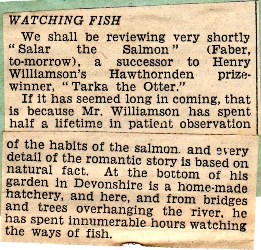
Glasgow Herald, 17 October 1935:
This is the work of a man who knows the life of moor and stream as well as he knows his own craft as a writer. It is a fascinating study of the habits of creatures which live in and around the rivers of the West Country; but it would probably be best decribed as a novel whose hero is Salar the salmon. Not that it should be classed along with the numerous fables and animal stories of either the Æsop or the Kipling tradition; for Mr Williamson never makes the mistake of attributing to the mammals emotions or thoughts which are essentially the monoply of man or of attributing to fish mental processes proper to warm-blooded land creatures. The most successful feature of the story, in fact, is that it makes the reader aware of the salmon as an organism experiencing the tide of life flowing by it, not through ears or prehensile fingers and toes, but along the whole sensitive surface of its being.
We are introduced to Salar, five years old and over twenty pounds in weight, as he is coming into the estuary of the Two Rivers after his yearly sojourn in the cleansing ocean. He is menaced by porpoise, grampus, lamprey, hagfish, eel, otter, heron, owl, by anglers and poachers, by polluted water and ebbing floods; he survives all, even though he bears the wounds of teeth and claws, but, after his life-purpose is fulfilled for the last time, yields to the disease which threatens every salmon during its freshwater stay.
Possibly Mr Williamson would have done better to stick more closely by Salar and cut out the digressions into human and animal affairs on the banks of the stream, but even they, apart from their delaying the action of the story, are excellent thumbnail sketches. He must be a very well-informed naturalist who will find nothing in this book that he had not known already.
The Times Literary Supplement, 17 October 1935 (11-inch column):
Mr. Williamson here does for the salmon what he did for the fish’s deadliest foes in “Tarka the Otter” eight years ago. He weaves a searching and comprehensive knowledge of the life-history and habits of the fish into a tale which for absorbing interest leaves behind many a romance of human character. . . . [Goes through various incidents and characters involved.]
Among these stands out the picture of old Shiner – a masterly study – once a prince of fish thieves, cunning in every nicety of his craft, now a jobbing gardener . . . sympathetic watching of its ways, but with enough of the old Adam to be capable of cheating a poaching gang out of their haul.
Mr. Williamson’s handling of scientific facts . . . is deep [etc.] but is seldom allowed to interfere with the run of the vivid narrative. But in a few places . . . we are perilously near to those controversies which are not yet altogether stilled by recent investigations.
Evening Standard (Howard Spring), 17 October 1935:

Daily Mirror, 18 October 1935:
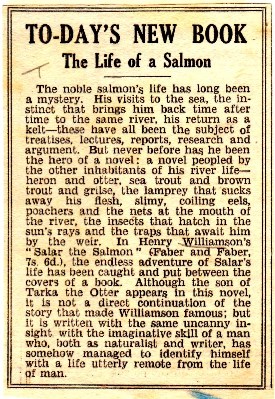
The Times, 22 October 1935:

Evening Chronicle & Evening World (Dr J. M. Bullock), 25 October 1935:
Books of the Week [large column but little to say]
[Four of the books concern the Stuarts & Mary Queen of Scots – possibly history was Dr. Bullock’s subject. Re Salar the Salmon, after opening remarks: ] Mr. Williamson gets into the very skin of Salar – which means the leaper . . . It is a wonderful, vivid, and even moving book.
Yorkshire Post (L. A. G. Strong), 23 October 1935 (large 7”x 11” column with lots of interest):
A PHILOSOPHER AND A MYSTIC
Puritan Ideas and the Habits of a Salmon
[Mainly reviewing The Last Puritan by George Santayana (Constable, 8s 6d) & Salar the Salmon by HW] Santayana (1863-1952) gets pride of place for his (only) novel (it is a philosophical idea novelised). The hero, incidentally, goes numbly through the Great War and is killed in a motor accident after the Armistice. One can see the connections being made in Strong’s mind.]
Mr. Henry Williamson is a mystic, in that he had never once lost sight of the oneness of Nature. Where the vast majority of writers celebrate the human race, Mr. Williamson celebrates life. In [this book] Mr. Williamson has a subject perfectly fitted to his perceptions and his powers. Every statement in this book, even the lightest, is the result of long and passionate observation.
This story will delight countrymen and naturalists, but it will delight even more those who have in their make-up a touch of Mr. Williamson’s own. They will apprehend in him a perfect sympathy for [all the various characters and incidents – especially old Shiner].
Grimsby Evening Telegraph, 25 October 1935:
. . . Mr. Williamson found Salar in the waters of the estuary of the Tor [sic] and Torridge, and follows him in his devious wanderings. There are excitements wilder than those in a novel about human beings. Salar is an adventurer, a hero, and a survivor of many perils. . . .
Aberdeen Press & Journal, 25 October 1935:
. . . In this book he has made of Salar’s life an odyssey. With the language of a poet he has immortalised his wanderings . . . Into the story are packed all the known facts about salmon . . . Salar’s story is [moving and true] . . . It is fact clothed in beautiful garments fashioned as a labour of love by one of the finest craftsmen of today.
Evening Telegraph & Post (Dundee), 26 October 1935:
[Resumé of story-line etc.] . . . Quickening the whole story is the restless purpose of nature, driving Salar to the shallow stream where a new cycle of life is set in motion. Mr. Williamson conveys the grandeur and tragedy of it all in the language of a poet.
Manchester Evening News, 26 October 1935:
. . . It seems a remarkable task to set the hand to . . . here are the perils by which it is beset, and the joys which it must surely experience, woven into a book which holds the interest like a novel. . . . it is also a book about a river, and the author has poured into his pages an extreme knowledge of its moods and the life in and around it.
Shooting Gazette, 26 October 1935 (First mentions Silver: the Story of an Atlantic Salmon by R. L. Haig-Brown for comparison):
“Salar the Salmon” is a great deal more than the bare story of a salmon, It is an absorbing and revealing study of the happenings in, on, and above a West Country stream. Accurate observation of details, amazingly clever descriptive powers and creative ingenuity beyond the ordinary, have enabled Mr. Williamson to produce a brilliant and arresting composition, which will rank high among the best books of this generation. [Then goes through the story-line.] “Salar the Salmon” will appeal to a far wider circle than . . .
John O’London’s Weekly, 26 October 1935:
[Shortish item – opening ‘Eight years since Tarka etc.] Mr. Williamson refuses to humanize the non-human creature [as many do to their detriment] . . . We can only be grateful for the exquisite telling of a fascinating tale.
Current Literature, November 1935 (quirky!):

Cambridge Daily News, 6 November 1935:
All lovers of wild life . . . a worthy companion to [Tarka the Otter] . . . the author is a great, patient, naturalist . . . the book is not only a monument to painstaking observation, but a wonderful example of knowledge and understanding . . . [followed by the story-line]
Herts and Cambs Reporter (Royston), 8 November 1935:
I can think of no one author whose books have consistently given me pleasure as have those of Mr. Williamson, both a naturalist and a literary man . . . [who] stands in a class by himself. [Story-line] . . . The book holds one in its grip as much as the most moving ‘human document’ . . . [This reviewer then moves to the Santayana novel.]
Sunday Times (Robert Hartman), 10 November 1935 (8½-inch column):
“Salar the Salmon” is the work of an all-seeing naturalist who is also a writer of very great merit, and the book is in every way a worthy follower of Tarka the Otter. When Mr. Williamson writes about animals, of which his knowledge is profound, he is content to describe their impulses and responsive actions without endowing them, for the purposes of his book, with human speech and thought. The result is that his animals, for all their intelligence and fore-thought, remain animals, and do not become, like Landseer's pictures of humanised dogs, something which is neither one thing nor the other.
The history of Salar begins with the fish as a 20-pound salmon encountering the difficulties and dangers consequent upon leaving the ocean to ascend the river. . . . The sketches of local fisherfolk working their nets and outwitting the water bailiffs are charged with life and character, and it is interesting to note that these fishermen, so wise in many other ways, subscribe to the belief that salmon spawn in the sea. . . .
In the writing of Salar's sojourn in fresh water, Mr. Williamson reveals a knowledge of river-lore which must have taken years of patient study to acquire. The lives of ephemeridae, sedges, trout, dragon-flies, otters, bats, and numerous birds are intimately and charmingly described, while the mysteries and tragedies of spawning are treated with sympathetic understanding and great beauty. The exploits of Shiner the poacher and his subsequent reformation contribute delightful pages to this fascinating and instructive tale.
It is to be regretted that the map which forms the end papers of the book is not a better one. It has no scale and many places mentioned in the story are not marked on the map, reference to which will consequently irritate rather than help the reader. The wrapper design, which is the work of C. F. Tunnicliffe, deserves a special word of praise.
Observer (Basil de Selincourt), 10 November 1935:
The Scotsman, 11 November 1935:
Mr. Williamson is a fine naturalist with a special knowledge of rivers, their inhabitants and visitors. All know this who have read “Tarka the Otter”: some will prefer “Salar the Salmon” . . . [Story-line]
Naturalists, anglers, and many others will rejoice in this singularly engrossing book, because the author not only knows the life-story of salmon, but he knows how to tell it.
Oxford Times (A.P.D.), 15 November 1935 (9-inch column):
. . . It is unnecessary to report that Mr. Williamson stands alone as a writer of books of this sort. . . . Now instead of the otter we have his prey the salmon, the uncrowned king of fishes [with its mysterious and romantic life history] . . . [Story-line] . . .
So Mr. Williamson tells us the story of Salar, with its joys and troubles, pleasures and dangers . . . in phrases that surprise the reader by the sudden realisation of their truth. . . .
Sunday Mercury, 17 November 1935 (succinct!):
Manchester Guardian (A.W.B.), 19 November 1935 (10-inch column):
. . . Mr. Williamson, who, perhaps alone among modern writers, is capable of doing justice to such a subject. [Notes that descendents of Tarka have a place in this tale of Salar] . . .
No lover of the country can fail to be thrilled by this new history. [Story-line] The author has the power given to few of seeing life from the point of view of the animals he describes . . .
The author introduces a delightful character in old Shiner . . . whose compassion is the last thing encountered by the old sick fish. He brings into the tale a note of pity which contrasts with the ruthlessness of nature . . .
Birmingham Post, 19 November 1935 (10-inch column):
. . . When Mr. Williamson proceeds from observation to imagination, from natural facts to spiritual interpretations, then some [check their step] . . . [But] to most readers it is the tale that matters and here is a fascinating one . . .
Liverpool Daily Post (C.V.C.), 28 November 1935:
Daily Telegraph (E. W. Hendy), 29 November 1935 (9-inch column):
[First compares Salar against Tarka.] . . . However . . . there can be little doubt that “Salar” is a salmon epic. [Story-line, and as an ornithologist, notes a few small bird-fact errors] . . . But these are slight blemishes to one who chooses books for their literary qualities. Such a one will place “Salar” alongside “Tarka”.
St Martin’s Review (E.W.H.), December 1935:
The story of “Salar” the Leaper . . . is indeed a fairy tale, as adventurous and perilous as any saga. The author has spent many hours obtaining his facts but these are but the canvas upon which the picture is painted. It is the imagination of the poet and artist which fascinates and delights. . . .
Property Owners’ Gazette, December 1935 (seems a rather bizarre source!):

Cornhill Magazine, December 1935:
Railway Service Journal, December 1935:

Yorkshire Herald, 5 December 1935:

The Bulletin and Scots Pictorial (Glasgow), 5 December 1935:
. . . a nearly always absorbing tale, the fact is its narrative power does flag sometimes. . . . he is apt now and again to overload his narrative with description which is a little tedious . . .
Irish News, 9 December 1935:
In writing – as only he can do it – the life story of a salmon, Mr. Henry Williamson has given us a new literary creation . . . [his] way of using facts differs as much from the naturalist as poetry differs from prose. Perhaps it is partly a matter of feeling . . .
[Re Shiner’s murmured words to Salar] They are an expression of Mr. Williamson’s own deeper feeling, shown in everything he writes. . . .
There is something tragic and deeply mysterious in the instinct which sends the salmon leaping up the long reaches of the fresh-water rivers to the salmon spawning pools . . .
Mr. Williamson has given us a new knowledge of the life of nature.
Evening Standard (date unreadable):
[Usual comments & story-line] . . . The publishers are right in claiming that here we have a rare combination: the observations of the naturalist recorded by the talent of the novelist.
Fishing Gazette, 21 December 1935:

Methodist Recorder, 19 December 1935:
. . . many gem-like portraits, almost poetry though prose . . . we found it impossible to lay the book down till the whole was told.
Everybody’s Weekly, 28 December 1935 (manages to make the story sound quite sensational!):

Sunday Referee (Hal Brading), 29 December 1935 (large item, 9½” across, 11” deep, plus a photograph of salmon: not so much a review as a pastiche):
SALMON POACHER’S WIFE BLUFFS THE BAILIFFS
In the West-End of London, English salmon cost around £3 apiece. Yet every year thousands of home-caught salmon are sold for a mere song. . . . Poaching.
This article retells HW’s tale of the salmon hidden under the poacher’s wife’s skirts but in the reviewer’s own way: it is quite amusing but too long to reproduce here.
HW wrote regularly for the Sunday Referee at this time. Some of the articles were incorporated by HW into The Linhay on the Downs (1934); the remainder have been posthumously collected and published as The Notebook of a Nature Lover, (HWS 1996; e-book 2013), illustrated by Mick Loates, who illustrated the 1987 Webb & Bower edition of Salar.)
New English Weekly (Paul Beard), 9 January 1936 (Among other books compares Salar particularly with Sajo and her Beaver People by Grey Owl):
Both writers are accurate with an accuracy based on deep love. . . . “Salar the Salmon” is immeasurably the better book. Grey Owl writing in a language not his own . . . [Grey Owl, a Canadian conservationist, presented himself as a member of the First Nations; the fact that he was actually English-born had not been revealed at that time. That is the only comment made on Grey Owl’s book.]
Mr. Williamson projects an extraordinarily complete and cohesive picture of the animal world to the service of which every possible ounce of scientific observation and imaginative vision are devoted . . . In supple, exact and graceful language his story moves steadily to its most moving crescendo . . . the portrait of old Shiner with its tender immemorial quality at once takes its place alongside Will Wimble and Hardy’s yokels. Away from the world of moral perplexities, Mr. Williamson sustains his touch faultlessly and nothing seems more likely than a future appearance in Everyman’s Library of a volume containing Tarka, Salar, and that chronicle of bird-life which Mr. Williamson must certainly not allow to go unwritten.
Scottish Bookman (Bruce Campbell, natural history writer), January 1936:
Raw and Not so Rawhide
[Reviews three books: My Best Animal Story (Faber) – dismissed as only dogs & cats!: Grey Owl & the Beavers: ‘the phenomenal ability of this half-Scot, half-Apache describes a community almost fantastic in its Eden-like serenity, fit for a Virgil to sing . . .’; and Salar.]
Henry Williamson too has taken the world by storm [but picks up on a couple or so factual errors – red-throated divers do NOT nest on Lundy!] . . . Once one has got into Mr. Williamson’s individual style one realises he is building up a picture of the wild life, human and animal, on a magnificent scale, a scale which few other writers would dare attempt. The rhythm of his sentences as much as their matter does convey most vividly the teeming life of the river and estuary.
John o' London’s Weekly, 11 January 1936 (sadly anonymous):
Talks With The Professor
New Series
[The whole page (8” x 11”) is devoted to Salar as in a conversation between two friends about the book which one finds lying on the table in the Professor’s house and asks what it is and questions every comment made: it is very well done.]
This book is an epic in prose . . . describing the heroic life and achievement of a salmon . . . Let us call it science without tears . . . the story of a creature’s life as actually lived . . . he gives them names [not to humanise them] . . . He makes them live for us realistically but he does not try to humanise non-human creatures . . .
I know you are a keen salmon fisher . . . [then ‘reads’ the rather harrowing scenes of the hook caught in Salar’s mouth, but admits he himself likes to eat salmon].
The friend asks to borrow the book . . . the Professor gives him a short précis of its plot and ends:
Salar sheds his life for the future of his race.
(As of course – did all those soldiers who died in the First World War – and would soon do likewise in the Second. This has to have been a central motif of the book.)
*************************
Salar the Salmon was also published in Czechoslovakia in 1936 (see Overseas editions), prompting this newspaper review:
Lidové noviny (Aloys Skoumal), Prague, 2 November 1936 (translated here from the Czech by Vladimíra Šefranka Žáková – our thanks both to him and to Vít Kremlička, who sent it to us):
Is it natural history? Poetry? It’s a bit of both, but it’s not just some stuff that has been carelessly patched together. This book conveys the life of salmon in the sea and in English streams not just with professional thoroughness, but also with the artful, secure well-being typical of English nature observers. (Let us remember, in addition to many others, W. H. Hudson and his loving descriptions of British birds!) It is an extraordinary world indeed, brought to us through a unique lens: the world of the ocean’s depths and river currents, captured from various perspectives. It is a pity that this rare painter and psychologist of fish life falls into philosophical primitivism from time to time. However, there are not too many such disturbing places, so we will forgive him that, just as some of the passages are quite convulsively funny. Altogether, his book reads like a full-blown epic about the element of water, full of natural beauty and brutality. Aquatic animals, birds, beasts – each, in the author’s rendition, has its own individuality, with every nuance captured as aptly as, if not better than, the episodic human characters he draws. This does not, however, add up to a cheap anthropomorphism. Rather, it is a necessary humanization in which the essence of the biological history being described is not corrupted, but merely brought closer to us and made more comprehensible to our perception. The translation is remarkable both in terms of its professionalism and its stylistic work. However, a final revision would have helped, as it would surely have caught some of the oversights and the frequent awkwardness that sometimes make the text hard to understand. I would especially like to reprimand the translator for his deliberate use of transgressive and other participles in Czech, which is a mistake all our English-Czech translators make. They should realize once and for all that the use of the -ing verb form that is so popular in English can and very often must be expressed in Czech by a verb phrase.
*************************
USA edition,1936:
There is only one American review in the archive – though there would actually have been a large number.
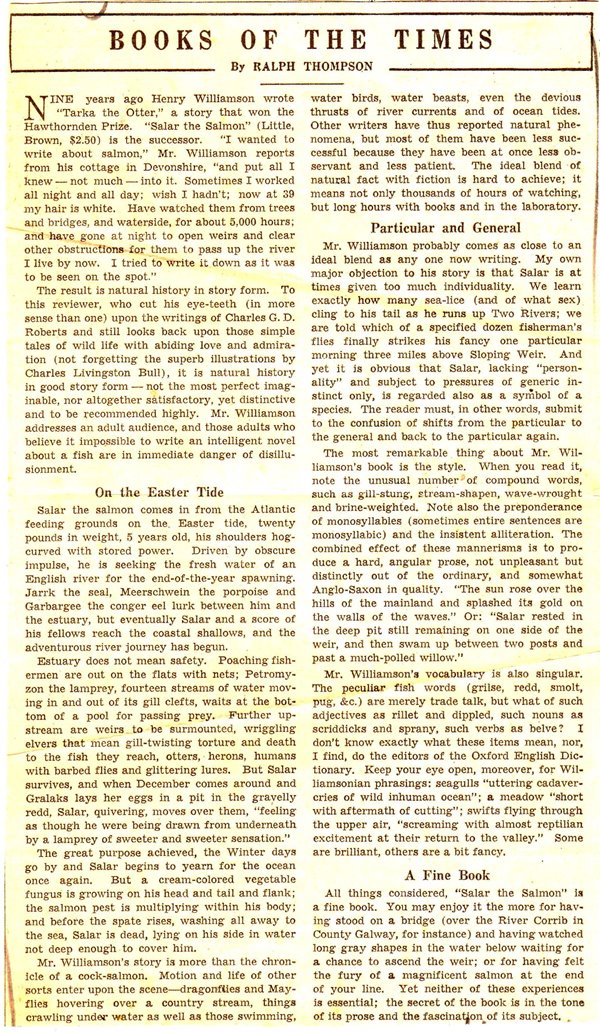
New York Times, 1 June 1936:
*************************
There are no reviews of the Tunnicliffe illustrated edition present in the archive (possibly HW sent them on to Tunnicliffe?).
*************************
The 1959 Faber paperback (5/-) brought forth a small flurry of very short notices – the only one of any length being:
The Daily Worker (Wilfred Willett) (15-inch column, gives a useful breakdown of salmon terms):

Birmingham Post (C. V. Hancock), 14 November 1964 (17-inch column); it begins:

After this the article is more generalised but with frequent mention of Salar. Hancock ends with an interesting description of how the redd is made:

*************************
Extracts from Salar the Salmon have featured in many anthologies.
Country Life, 4 November 1965, notes HW’s inclusion in Best Fishing Stories, ed. John Moore (Faber, 21s.)
Two collections are noted in HW’s book archive:
The Fisherman’s Companion, ed. Kenneth Mansfield (Eyre & Spottiswoode, 1968): a solid compendium, and HW is in very good company. HW’s piece is ‘Tide-Head’ from chapter 7 of Salar.
Gone Fishing, ed. Michael Hordern, (Michael O’Mara Books, 1995): a most delightful collection of extracts. The cover flap blurb states:
There is also Henry Williamson, the author of Tarka the Otter, who wrote of the mystery of fish and fishing in his masterpiece Salar the Salmon.
Sir Michael Hordern (1911-1995) was a well-known stage and film actor, whose passion was fly-fishing. He introduced HW's extract – ‘Black Dog’, Chapter 13 of Salar – as follows:

*************************
Back to Salar the Salmon main page
Salar the Salmon - Overseas editions
Back to Salar the Salmon main page
Overseas editions:
United States
1935. Before the book was published in the US, an abridged version appeared there, serialised over three issues of the Atlantic Monthly; quite a scoop for them:
I: ‘Tideways’, September 1935
II: ‘Spring Spate’, October 1935
III: ‘Winter Star-stream’, November 1935
(Reprinted in Atlantic Tales, edited by John Gregory, HWS, 2007; e-book 2013.) A further condensation of this abridgement was printed in Reader’s Digest (July 1947 and August 1968).
1936. Little, Brown & Company, Boston – an Atlantic Monthly Press book, published in June 1936, illustrated with 32 black and white woodcuts (vignettes for the 25 chapter headings etc.) and 4 full-page black and white illustrations (one as the frontispiece) by Charles F. Tunnicliffe. The cover design is unattributed, but is not by Tunnicliffe:
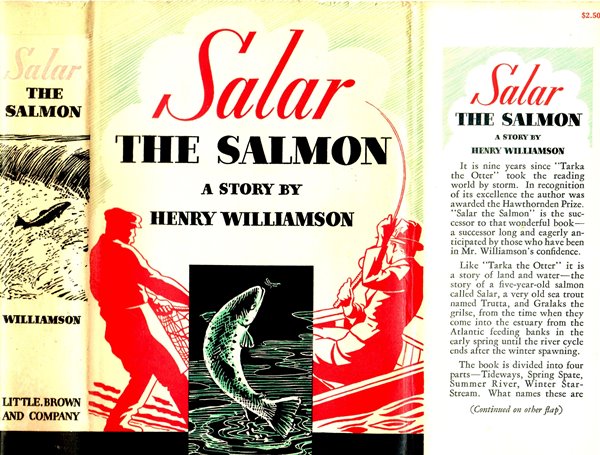
Tunnicliffe's frontispiece:

The publisher also put out its own substantial flyer, advertising the book in form of a small pamphlet:

HW gave a copy of this American edition to his Aunt Belle (Isabelle Adela Williamson, 1863–1944, who never married; she was William Leopold's older sister), inscribing it thus:

Little, Brown reprinted the book in June 1936, October 1936, December 1936, October 1938, and then in 1950 (but possibly there were further reprints in between).
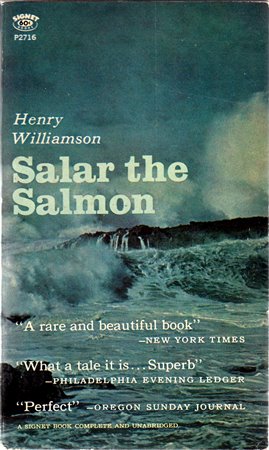
1965. Signet, by arrangement with Little, Brown & Co. and published by the New American Library Inc., New York, paperback; 29 illustrations by Tunnicliffe, including 3 full page. (A note mentions a hard cover issue by Little, Brown & Co. – no details available)
 |
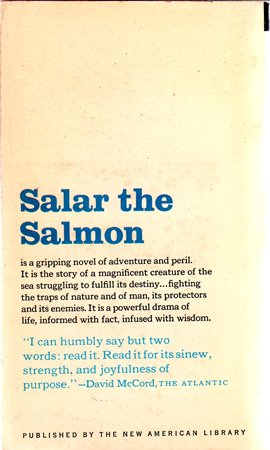 |
Signet's blurb, inside the book, reads as follows:
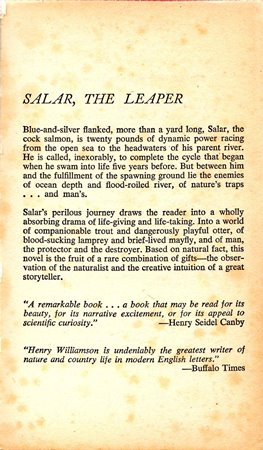
1987. David R. Godine, Boston; an American edition of the 1987 Webb & Bower illustrated edition. The dust wrapper is exactly as the UK edition.
Czechoslovakia
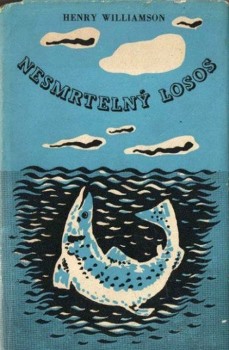
1936. Nesmrtelný Losos (translation by Dr Jaroslav Kolařík), František Borový, Praha, paperback. Two further editions were published by Fr. Borový. The title translates as 'The Immortal Salmon'. There is a contract in the archive dated 1946 for a fourth edition, the advance being £25 on a print run 2,500.

This review by Aloys Skoumal appeared in the newspaper Lidové noviny on 2 November 1936, translated here from the Czech by Vladimíra Šefranka Žáková (our thanks both to him and to Vít Kremlička, who sent it to us):
Is it natural history? Poetry? It’s a bit of both, but it’s not just some stuff that has been carelessly patched together. This book conveys the life of salmon in the sea and in English streams not just with professional thoroughness, but also with the artful, secure well-being typical of English nature observers. (Let us remember, in addition to many others, W. H. Hudson and his loving descriptions of British birds!) It is an extraordinary world indeed, brought to us through a unique lens: the world of the ocean’s depths and river currents, captured from various perspectives. It is a pity that this rare painter and psychologist of fish life falls into philosophical primitivism from time to time. However, there are not too many such disturbing places, so we will forgive him that, just as some of the passages are quite convulsively funny. Altogether, his book reads like a full-blown epic about the element of water, full of natural beauty and brutality. Aquatic animals, birds, beasts – each, in the author’s rendition, has its own individuality, with every nuance captured as aptly as, if not better than, the episodic human characters he draws. This does not, however, add up to a cheap anthropomorphism. Rather, it is a necessary humanization in which the essence of the biological history being described is not corrupted, but merely brought closer to us and made more comprehensible to our perception. The translation is remarkable both in terms of its professionalism and its stylistic work. However, a final revision would have helped, as it would surely have caught some of the oversights and the frequent awkwardness that sometimes make the text hard to understand. I would especially like to reprimand the translator for his deliberate use of transgressive and other participles in Czech, which is a mistake all our English-Czech translators make. They should realize once and for all that the use of the -ing verb form that is so popular in English can and very often must be expressed in Czech by a verb phrase.
1946. Fourth edition, hardback; Vladimír Pour, Nový Bydžov; translated by Jaroslav Kolářík. The Vladimír Pour publishing house was closed down following the Czechoslovak coup d'état by the Communists in early 1948.
|
Image courtesy of Vít Kremlička |
Denmark
1956. Salar, historien om en laks, Aamodts Forlag, Koberhaven. Foreword by Bruno Jensen. Nice edition in green leathercloth with gold lettering & salmon vignette on front. (HW once gave an inscribed copy of this to Father Brocard Sewell – see HWSJ 3, May 1981, p.24.)
1956. Laksen Salar: historien om en laks, Aamodts Forlag, Kobenhavn, paperback, with Tunnicliffe illustrations; taken from the US Atlantic Monthly edition in ‘Reader’s Digest’

France
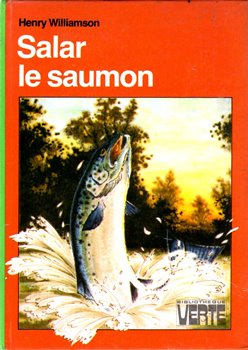
1980. Salar le saumon, Bibliotheque Verte, Hachette (Paris, France) 1980: small hardback edition, translated by Jean Muray, illustrated by Jean-Louis Henriot. (Gives HW's copyright as 1960, from the Macdonald & Jane’s 1960 Animal Saga volume.)
Germany
1936. Bernhard Tauchnitz, Leipzig. Tauchnitz specialised in printing inexpensive paperback books in the English language. Their ‘Collection of British and American Authors’ series was started in 1841, eventually running to over 5000 volumes. To comply with copyright, this particular edition is marked 'Not to be introduced into the British Empire'; boxed edition, plus further paperback edition. There is a contract for this in the archive: advance was £30 with 5% royalty on a print run of 6000 copies.

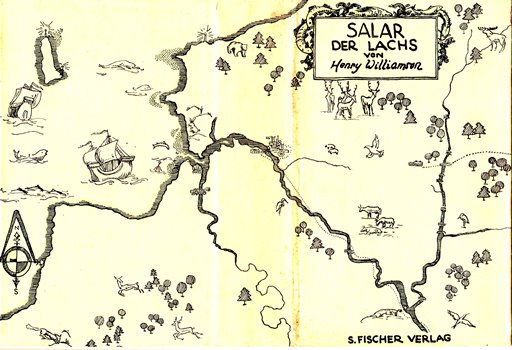
1936. Salar der Lachs, S. Fischer Verlag, Berlin, hardback, no illustrations. Archive contract states 400 Reichsmark advance on 7½% royalty on the first 2000 copies. A version of Tunnicliffe’s map is used as a dust wrapper (but compare the differences – note especially the polar bear and Elizabethan-era ships!); unusually there is no lettering on the spine, which makes it somewhat anonymous on a book shelf:
1953. Salar der Lachs, Fischer Bucherei, Hamburg:

Italy
1956. Contract, but no copy in the archive: Italian edition, l’Editore Selexione dal Reader’s Digest, S.p.A.di Milano: 5.1.1956. Payment 40,000 lira.
1964. Sàlar il salmone, Bompiani, Milan, illustrated by Maria Luisa Goioa. There were certainly earlier Bompiani editions.
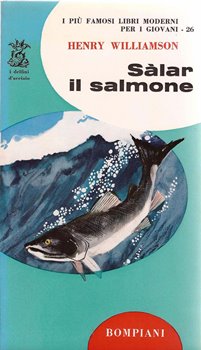
1976. Sàlar il salmone, Fabri Editori, Milan, and reprinted 1979 (from the Bompiani edition) for schools, which contains interesting extra features, such as the life cycle of a salmon:


Sweden
1937. Laxen Salar, Bokförlaget Natur och Kultur. Contract was £20 for 2,500 copies, £10 for every further 1000 copies.

*************************
Back to Salar the Salmon main page
Salar the Salmon - UK editions
Back to Salar the Salmon main page
UK editions:
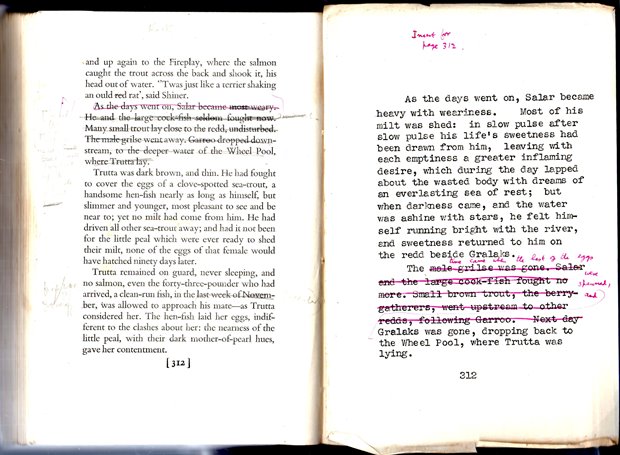
1935. Shallowford Edition: HW had thirteen sets of page proofs of the book (far more than the usual two or three copies) bound up as a special edition. These are chunky volumes (as page proofs, they are printed on one side of the paper only, so doubling the number of pages to be bound). Each copy is individual: half-bound in morocco leather, varying in colour (dark red, blue, green, brown, black) with four raised bands across the spine, and blending matching marbled boards, completed with gold lettering across the spine of title, author, and with ‘Shallowford Edition’ at the bottom. End papers are of a similar matching design. Each copy has an extra typed correction page bound into the text at page 312.



**********
There is a normal paperbound proof copy from which this Shallowford edition was set and which bears a considerable number of corrections and revisions even at this very late stage of production (unfortunately these are almost illegible on the scan of the sample page below):

**********
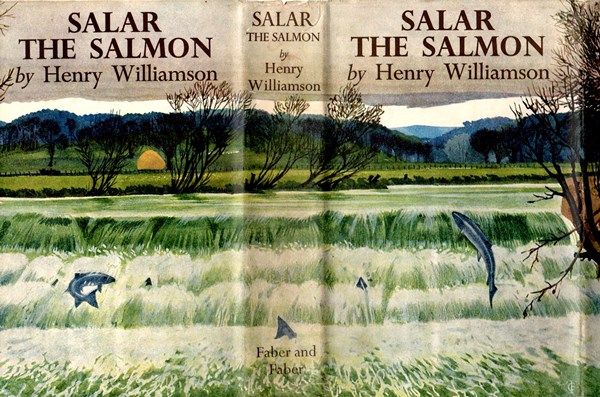
1935. Faber & Faber, 17 October 1935 (actual date taken from reviews), 7s 6d:
The dust wrapper features a superb wrap around cover painting by C. F. Tunnicliffe; there is a striking vignette of a fishtail diving into water on the title page, and a new singular colophon design of a salmon with HW’s initials within its curve on the last page: both designed by Charles Tunnicliffe.


This edition was not illustrated but had charming endpapers of a decorative map covering the area of the book, not attributed, but obviously designed and executed by Tunnicliffe. This map, surely a key feature, was never repeated in future editions.

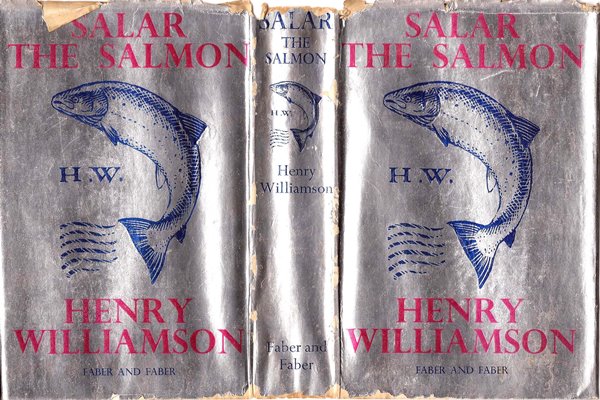
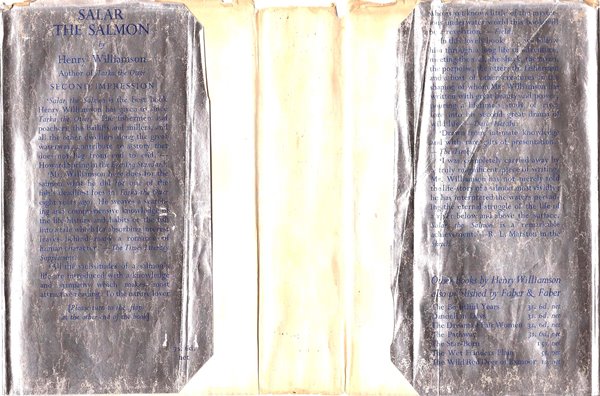
This first edition was reprinted in November 1935 and December 1935, and later in 1941 and 1943. For some unknown and strange reason, considering the very effective cover design of the first edition, the dust wrapper for the November 1935 second impression was laminated with silver foil, with HW's salmon colophon as its centre feature:
There are a large number of other editions of Salar the Salmon, with various changes of text and number of Tunnicliffe illustrations: a selection of those still held in HW’s archive is given here, but further information can be found in Hugoe Matthews, Henry Williamson: A Bibliography (2004).
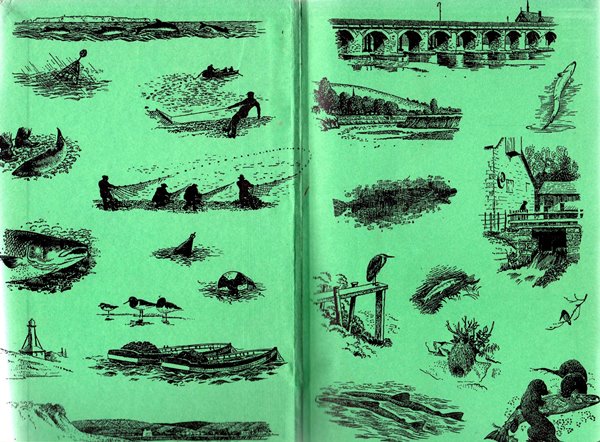
1936. Faber & Faber, new illustrated edition, October 1936, with a new cover design by Charles F. Tunnicliffe and a total of 66 illustrations, including the previous black and white chapter headings (as in the USA edition), but with chapter endings now included, and also 16 superb colour plates, by Tunnicliffe. The endpapers have a design of a selection of the chapter-heading vignettes. The colour plates never appeared in any other edition (a great shame, but the cost would have been a major factor).


1941. Faber, The Faber Library series, July 1941, 3s 6d:

1943. Faber, a reprint of The Faber Library edition, 3s 6d:

1944. Faber, new edition, reprinted 1945, 1948 – 'produced in complete conformity with the authorized economy standards'; this is the dust wrapper for the second impression of July 1945:

1946. Putnam (under licence from Faber): Limited edition of 500 copies, to match a complete set of The Henry Williamson Nature Books (see separate list of New editions published in the 1940s), with black & white Tunnicliffe illustrations: a full-page frontispiece which is unique to this edition, chapter heads & tailpieces. Chapter headings are set in the margins. There was no dust wrapper. It is not a particularly striking limited edition, partly because the blocks from which the illustrations were printed were by now well worn, so that illustrations are not as crisp as they were in earlier editions; though the five books make a nice set.


1948. Faber & Faber, new edition, with 48 illustrations by Tunnicliffe:

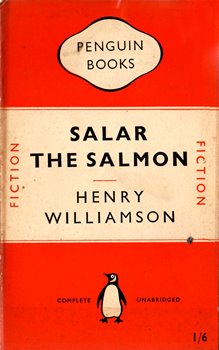
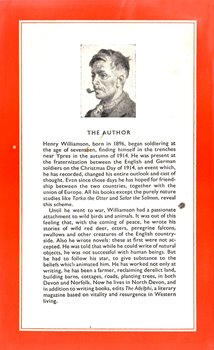
1949. Penguin Books, with their familiar classic orange and white cover design, no illustrations, 1s 6d:
 |
 |
The printing of Salar in The Henry Williamson Animal Saga (Macdonald, 1960) is dealt with in that entry.
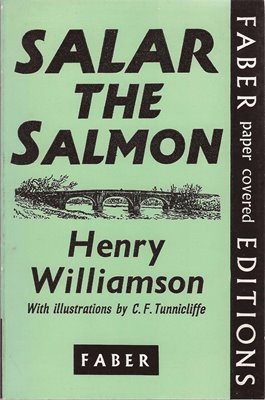
1960s. Faber issued further editions in 1961 and 1967, the latter as one of their 'Faber paper covered Editions', shown below:
1972. Faber, illustrated edition, with cover illustrations reproduced from wood engravings by Elizabeth Trimby:
 |
 |
1986. Faber, a reprint of their 1972 edition, with a different cover (and which gives mention that there is a Henry Williamson Society, with the then current contact address):

1987. Webb & Bower, a completely new hardback edition, £14.95. Lavishly illustrated with cover, 31 colour paintings, and 18 black and white drawings by Mick Loates; Foreword by Mick Loates; Introduction by Richard Williamson (HW’s son, also a naturalist and writer), which gives an ‘insider’ view of HW and his writing:


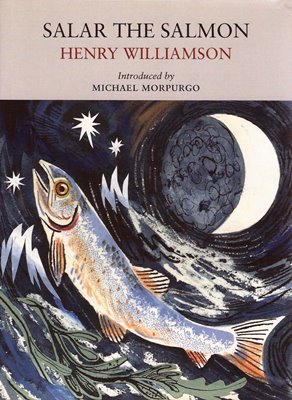
2010. Little Toller Books, with an Introduction by Michael Morpurgo, £10.00; the cover illustration is by Mark Hearld. The latest of the many editions of Salar, this has now gone into a second impression:
 |
 |
************************
Back to Salar the Salmon main page
Salar the Salmon - the book
Back to Salar the Salmon main page
The book:
Salar the Salmon is not a book to hurry through: it is a book which should be read carefully, savouring each scene, absorbing HW’s intense use of words which build up atmosphere layer upon layer. At the end we know not only the intimate details of Salar’s life but also that of the entire river and the creatures that live in and around it.
Many of the places and creatures in Salar have already been met in Tarka the Otter and many other stories already written, and so have an almost comforting familiarity; but they now appear in a fresh guise within this new scenario.
In its use of word pictures Salar presents a tour-de-force even greater than that of the prize-winning Tarka. It was an incredibly difficult task to embark on (one can see it was far harder than Tarka, where HW had Hunt details to support his story line), for to become as a fish means first knowing ‘fishness’, involving many hours of totally concentrated study and then – rarer – having both the ability with words and the imagination to translate that into a story that will capture it all for a public wanting a good tale.
The detail on every page bears witness to those hours of concentrated observation. HW had to find a new way to describe – having to go deeper and deeper into his own psyche. That took its toll and by the end he had become very exhausted.
The end of Salar the Salmon is more harrowing than even Tarka: Salar’s death is completely inevitable, but at the end we are given the idea of hope, of a new beginning. There is new life and the cycle is eternal: the title of the last chapter is ‘End and Beginning’. HW leaves us with hope for the future.
[‘In my end is my beginning’ are words embroidered by Mary, Queen of Scots (1542-87) under an emblem of her mother. The words are echoed by T. S. Eliot in ‘East Coker’ (Four Quartets, 1940):
In my beginning is my end.
(T. S. Eliot, a director at Faber & Faber, was one of those who approved Salar the Salmon for publication, and no doubt he read the book. He had very similar ideas as HW about the Past being part of the Present.)
We find this same cyclical philosophy to the fore at the very end of the last volume of HW’s A Chronicle of Ancient Sunlight, where Phillip Maddison (HW) is about to start writing it.
HW’s own ‘The Sun in Taurus’ (on the main page) has already revealed the basic story of this tale of a year in the life of the five-year-old ‘big keeper, the cock-fish’ who is the central character: the salmon known as ‘Salar the Leaper’, so named by the Romans (Latin ‘salire’: ‘to leap for joy’). How fortuitous to find a name with such resonance to Tarka the Otter! However, a little more (considerable!) detail is needed to capture the full thrust of this quite amazing story. The chapter heading illustrations used below are by Charles Tunnicliffe, drawn for the first illustrated edition published in 1936.
|
|
|
Charles Tunnicliffe's map, used as endpapers in the first edition |
The book is divided into four parts:
Book One: Tideways
Book Two: Spring Spate
Book Three: Summer River
Book Four: Winter Star-stream
BOOK ONE: TIDEWAYS
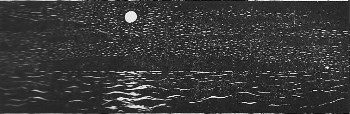
Chapter 1: ‘Sea Assembly’
At full moon the tides swirling over the Island Race . . . the Island Race is a meeting place of currents over a sunken reef, or chain of reefs. The sea is never still there. . . .
This is Lundy Island sitting fifteen miles west off the coast of North Devon from HW’s own Field and Writing Hut. ‘The sun in Taurus rises’: so it is mid-April: Taurus rules from 21 April to 21 May.
With broad brush-strokes the scene is laid. We are given an outline of what it means to be a salmon. Particularly note ‘its first armour of sea-scales’, conjuring up the concept of knightly myth. We are introduced to the predators (those that wage war on others: there is certainly a hidden element of the idea of war present in this book, as in so much of HW’s work), but they demand our empathy in their own right. So we meet porpoises led by Meerschwein – old ‘Sea-hog’ (literal German translation) – who in turn are chased by the deadly gladiators led by Orca (Orca gladiator is the Latin name for killer whale) and Jarrk the seal. Regular HW readers will have met these creatures in previous stories: they are familiar characters now taking part in a new drama.
A tiny detail to bring to your attention: we are told that Salar was born ‘under Snowdon’. Thus HW is placing the source of the river Severn near to the great Welsh mountain (possibly a slight use of poetic licence there – the source of the Severn is on the slopes of Plynlimon in the Cambrian mountains, rather than Snowdonia!). But this surely has an extra hidden meaning. Salar the Salmon is dedicated to T. E. Lawrence so recently killed. HW had once referred to himself in an early letter to TEL as ‘Snowdon’ to TEL’s ‘Everest’. Indeed, there can be no reason for this aberration of Salar’s route other than to bring in this hidden message. But possibly even further than that nuance – if HW was ‘Snowdon’ in that sense, then he is ‘Salar’ in this context? He certainly identified completely with his Atlantic salmon; as he did with every creature and character he ever wrote about.
So in this opening chapter information is gradually built up, background and finer detail, a mini-crescendo and the chapter ends with a detailed and very visual description of Salar (so much of HW’s writing can be likened to painting and music) – now five years old and weighing twenty pounds.
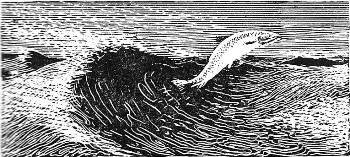
Chapter 2: ‘Reef of Seals’
We meet a particular grilse (a young salmon who has been to sea only once), a maiden salmon named Gralaks who had been born
in one of the streams running down from the moor of the wild red deer, in the gravel redds above the pool called Fireplay.
(See the map: the moor is of course Exmoor: the Fireplay Pool lies below the railway viaduct that towered over the north end of the Deer Park just behind Shallowford – today carrying the main road.)
The story line picks up on the appearance of Jarrk, accompanied by a white (albino) seal and her cub; but this chapter is really about Garbargee, a cannibal conger eel weighing over one hundred pounds (that’s over 45 kilos), a slippery crafty rival of Jarrk. We are living underwater with these denizens of the sea. Salar leaves this melee following the little school made by Gralaks and ten other grilse.
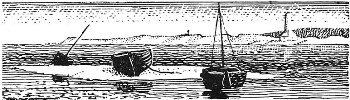
Chapter 3: ‘Coastal Shallows’
We learn why Salar does not return (as his innate senses should have led him) to the river of his birth (the Severn, under Snowdon). Due to a tidal discrepancy he is lost! Recognising their mother stream, Gralaks and the other grilse turn into the ‘water of the Two Rivers’ (the estuary of the rivers Taw and Torridge). Salar goes on alone, getting near to the deadly Morte Stone but the turbulence makes him turn back. He briefly meets Trutta the sea trout (a major character). Then he arrives at Bag Leap (Baggy Point) where we learn of Chak-chek the peregrine and Kronk the raven, familiar friends from past stories.
HW here slips in one of his bon mots:
The gift of sight is the sun’s greatest gift to the world; it is only by the sense of sight that man clears himself; Truth is clarity.
(This has resonance to the well-known collect found in St Paul’s Epistle to the Corinthians. HW transposes ‘charity’ with ‘clarity’ – as he also does in The Phoenix Generation (1965; Vol. 12, A Chronicle of Ancient Sunlight). The concept is rather out of place here, but was obviously in HW’s thoughts and it is interesting to find it at such an early point.)
Salar has caught up with the little school of grilse led by Gralaks, but he is spooked by first the porpoises and then has to take cover from Orca Gladiator (18 feet long) who had been following Meerschwein’s gang.
Fishermen ‘off the North Tail of the estuary of the Two Rivers’ watch the ‘’erring ’ogs’ (the porpoises) and their deadly play with a salmon – like children playing catch and throw: they hate porpoises, which eat salmon when they themselves are stopped by law against netting them.
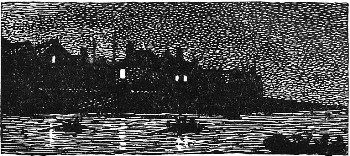
Chapter 4: ‘Estuary Night’
A superb description of fishermen that night going out to net salmon (illegally) and being caught by water-bailiffs, whom they outwit by tying the salmon on a string tied round the waist of the skipper’s wife under her skirt. Their ‘bag’ when tipped out for the bailiff’s inspection only contains an ‘’og’ – in other words, a porpoise. The skipper’s wife cackles her disdain.
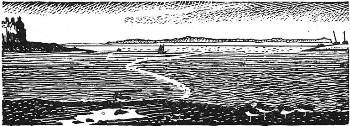
Chapter 5: ‘Lamprey’
Salar goes up and down the estuary with the tide as far as ‘The String’, the agitated area where the water from Taw and Torridge meet, and becomes ‘way-wise’. He avoids a fishing boat with a man spinning for bass. But as he watches the fisherman’s lure so he is being watched by Petromyzon the Stone-sucker: a fearsome lamprey (lampreys are very large creatures). Two pages are given to describing its slow stealthy approach to Salar – then:
It quivered, seeming to shorten and thicken and launched itself at Salar, rearing its head to strike at the scaled side; and instantly clamped itself there.
And whatever Salar does to try and dislodge the parasite, he cannot shake it off, so he gradually becomes used to the drag of its weight. Gralaks and her little school, and Trutta, the old sea-trout of seven spawnings, move up with the tide.
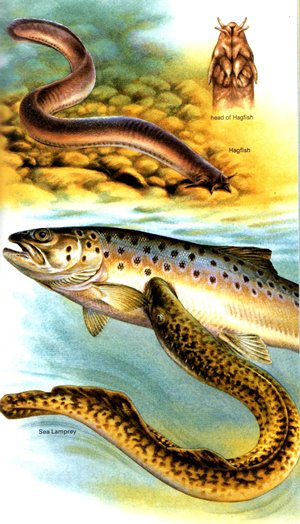
Myzine, the glutinous hag with whisker-like barbels, caught up inside the body of a bass, frightens the fisherman. He throws it over the side in disgust, where it immediately finds the lamprey attached to Salar: problem solved! Salar, free of the blood-sucking impediment but now with a wound on his flank, also moves up-river, passing the Long Bridge of the port (Barnstaple).
 |
|
Lamprey and hagfish (from Collins' Pocket Guide to Fish of Britain & Europe, 1997, illustrated by Mick Loates) |
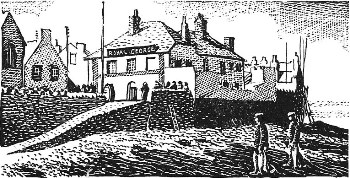
Chapter 6: ‘Salvation’
Spring approaches: the legal fishing season arrives. Old fishermen grumble about the ‘Board of Conservators’ who favour the rich rod-and-line men upriver. They also ‘know’ that salmon spawn in the estuary on the Shrarshook – not upriver. So gravel being removed is ruining the salmon breeding ground! But their fishing to make a living is one more danger for the salmon.
It was the first day of April, and in the estuary and higher salt-water reaches of the Two Rivers the licensed nets were about to shoot their first official draughts of the year. From now until the end of August the passage of salmon and sea-trout in their rivers would be barred in narrow fairway and streaming shallow by thirty-six nets each eighty fathoms long . . . one or another of thirty-six nets was liable to encircle them.
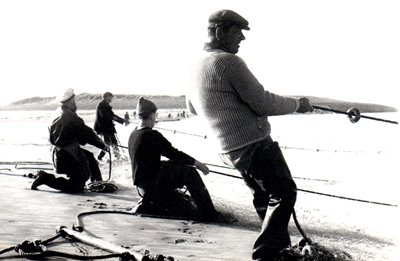 |
| Fishermen netting in the estuary in the 1930s |
Jarrk, skilful and wily catcher of salmon even out of the nets, is also active in the estuary. The first catch of the season, described in detail, promises the famous ‘zeven year glut. Never had they seen so many fish in a single draught.’ As the men slowly, with great skill and care, haul in the net we are told that Trutta, Salar, Gralaks along with her fellow grilse, are all caught inside the net, terrified. But at the last moment Trutta hurls at the net, holes it and escapes, and the others (except a few grilse) all also escape through this hole: ‘only dabs, seaweed, and crabs were in the seine when it was lifted ashore.’
BOOK TWO: SPRING SPATE
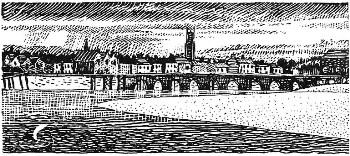
Chapter 7: ‘Tide-head’
Rain washes foul pollutants into the water. Salar had moved up and down the estuary many times during the ‘moon’s wax and wane’, letting the tide take him to the tide-head and return again. Now, once the pollutants clear, the stream becomes alive: Salar goes further up the river, past the railway bridge. Continuing, he has an encounter with a young otter, but Trutta knocks it away and it gets instead a lamprey off one of the remaining six grilse of Gralaks school. Salar has gone on up river.
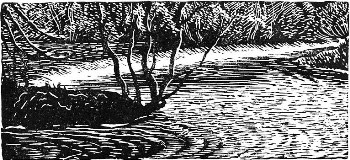
Chapter 8: ‘Valley of Oakwoods’
Salar continues upstream, followed by Trutta. Salar is aware of and comforted by his presence. But Trutta is now a sick fish, injured by the thrust through the seine net. They come to a weir, one of many once made to hold water back for the mills, where there is also a salmon-trap from olden days, made so that salmon could get through the opening of the trap, so avoiding the weir; but then be caught; but the Board of Conservators have stopped the practice. As they journey, so we learn much river lore. Eventually several fish rest behind a rock, where we meet a well-mended kelt (a salmon that has been cleaned by the sea after spawning). And again we have that allusion to a knight’s armour:
The bright deposit was an armour against corrosion [of salt sea water] . . . it was made from an excretion of the body, a kind of solder sweated on each scale.
But Salar is restless and moves on followed by Trutta, Gralaks, and the kelt.
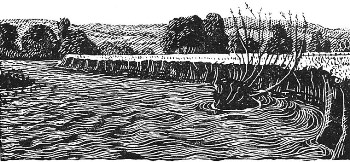
Chapter 9: ‘Clear Water’
Salar rests beneath a massive tree stump: we are told its history through the creatures it has given home to over many years. We read also about the (Himalayan) balsam – a plant redolent of Devon rivers and prominent in Tarka the Otter – which spreads itself so prolifically by catapulting its seeds yards away. (Today it is considered a plant pest and eradicated wherever possible.) The rain eases and all is calm, yet menacingly ‘The river moved with immense power.’ Salar is spooked by a dead lamb floating downriver, drowned in the unusual rush of water: and after the lamb, the ewe. The river is a dangerous place for all.
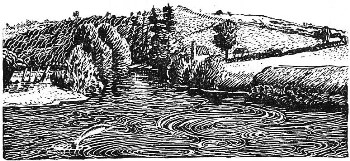
Chapter 10: ‘Junction Pool’
Salar arrives at Junction Pool, so called and made by ‘another river flowing into the main river at right angles’. (This is the river Mole – leading to the Bray.) Junction Pool, and its history and surroundings, are described in great detail. All the other fish are there, plus many newcomers. They wait. Some rest, some are restless.
Gradually the air was growing less cold in the valley. . . . All of a sudden, as though they had been waiting for a signal, all the salmon in the pool began to move, slowly at first, cruising just under the surface; then accelerating, one after another they leapt at the air. Far up and down the river . . . mile upon mile of grey swilling water broke with splashes.
The dun fly have emerged, providing food for the waiting fish.
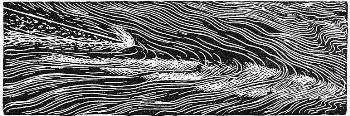
Chapter 11: ‘Mended Kelt’
A boy comes to the river to fish – we read the details of his rod and other tackle. The rod ‘belongs to the boy’s father, who had used it when fishing for black bass in rivers of Florida’. (the boy is the son, of course, of HW – Windles (Bill), then aged eight: HW had visited Florida to fish in spring 1934, the year before writing this book.) The boy’s second cast falls next to Salar, but before he can take the minnow lure the kelt rushes past and grabs it. We see this catch from the kelt’s aspect. But when the proud boy gets the fish home he is mortified to be told it is a mended kelt, and useless to eat. It is buried ‘under an apple tree in the orchard’.
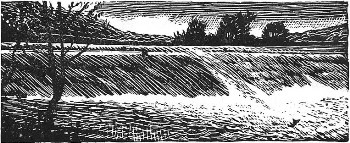
Chapter 12: ‘Sloping Weir’
Salar sets off ‘into the fast water of the new river’ (the Mole, going north) and comes to a
great bubble-churning rush of white water surging down the face of a sloping weir.
Many fish are gathered in the pool below waiting to ascend. But hiding behind an alder is a poacher and above the weir a heron is perched in a pine tree, also waiting.
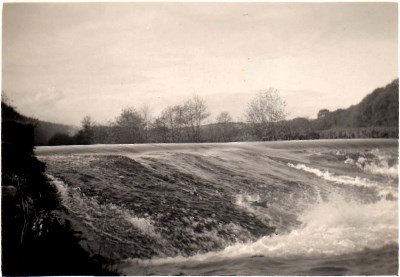 |
| Sloping Weir |
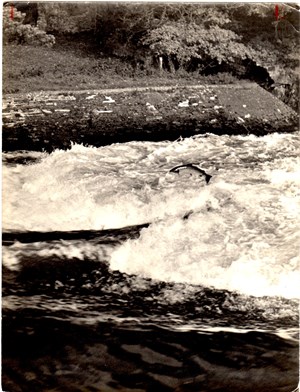 |
|
Another view of Sloping Weir, with a salmon leaping – a fine photo by HW |
Various fish try to jump the weir, including Salar, but the fall of water is too great. The special design of the weir made to help salmon actually makes it extremely difficult for them. The only easy place to ascend puts them within easy reach of poachers.
Heron and poacher wait for the salmon. But the water-bailiff appears. The poacher sees him coming and so is able to throw his home-made gaff into the torrent before he arrives. The bailiff addresses the poacher as ‘Shiner’. He is well-known for his poaching. (We have met Shiner already in Tarka the Otter, and elsewhere.) Crafty Shiner of course comes off best: he has only been after elvers for his dinner!
Chapter 13: ‘Black Dog’
The elvers were running. [Elvers are young eels returning from the Sargasso Sea to the rivers of their birth for the first time.] From blue dusk of ocean’s depth they passed into death: and from darkness the elvers rose again, to girdle the waters of half the earth.
(Sadly this is now a fast diminishing occurrence throughout Europe.)
Salar and Gralaks and many other fish wait for the lessening of the fall of water over Sloping Weir. Old Nog the heron feasts on the elvers and feeds his young on them. (This is a scene also met in a previous story.) More than 200 salmon pass up the weir; Salar making it at his second attempt and soon is three miles above the weir, where he rests.
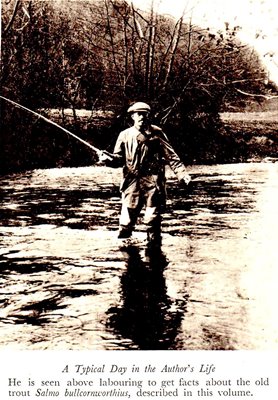
A fisherman ‘with fourteen-foot split cane rod’ is working the water. There is a superb passage describing the various flies that the fisherman tries, which Salar ignores until eventually the fisherman tries a ‘Black Dog’, a rather dilapidated old fly ‘which had belonged to his grandfather’. (No prizes for guessing who this fisherman is! HW has mentioned his fishing exploits in his diary entries.) He carelessly casts and Salar takes it. We experience the catch now from Salar’s suffering. It is quite harrowing reading. At the very end, with his last strength, Salar manages to break free.
 |
 |
|
|
HW fishing - the photograph used as the frontispiece to The Labouring Life |
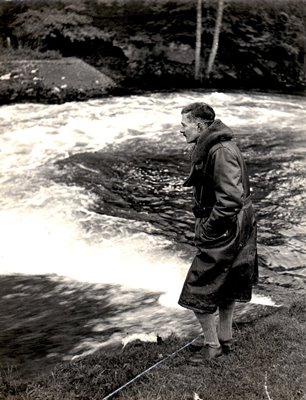
HW watching for salmon and peal ascending a weir (wearing his leather motoring coat) (photograph courtesy of R. L. Knight) |
Chapter 14: ‘Denzil’s Pool’
Salar rests to recover from his ordeal, then moves on with others to Denzil’s Pool (where another river joins: this is the Bray running down from due north – the Mole turns east); but he cannot dislodge the hook from his jaw. He is however now very aware of the danger of ‘lines and lures’.
A gang of six poachers with a lurcher arrive, their leader a ‘mild-mannnered, bespectacled cabinet-maker by day’. They plan to net the pool as was their habit. But they are being watched by Shiner, who holds a personal grudge against them (and they stoop to use of chlorine of lime to poison the water and dynamite to kill everything indiscriminately – against Shiner’s principles). Trutta recognises all the signs of ambush and finds a hiding place, Salar and Gralaks follow him. But this hiding place is the ‘property’ of Garroo, an old cannibal trout of 15 years, who is annoyed but cowed by the others.
The poachers jubilantly count a catch of nine fish ‘the largest twenty-eight pounds’:
It was half an hour to songlight, the shine was already gone from the moon in the great azure glow spreading up the eastern sky. Clouds, hedge, haystacks to the west were black.
They leave, but on return to their car, it will not start. Shiner has done a good job of sabotage! Very annoyed, they eventually hide their sack of salmon under a nearby haystack, abandon the car and disperse. Later Shiner innocently wheels his cart, seemingly laden with horse-dung, through the town (South Molton) and cheeks the policeman who is the local potato prize-winner about the dung:
‘’Tes proper stuff for growing big tetties.’
That night many of the leading citizens of the town, including several magistrates, dined on salmon which had been bought, surreptitiously, at their kitchen doors.
No flies on Shiner! But note HW’s masterly indirect way of telling the story.
BOOK THREE: SUMMER RIVER
Chapter 15: ‘Sisters’
The tone changes to a lyrical description of two sandpipers just arrived back from Abyssinia to spend the summer by the stream. Swallows and swifts also arrive.
Here the stream ran through a park where fallow deer roamed of olden time.
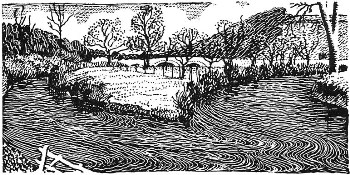
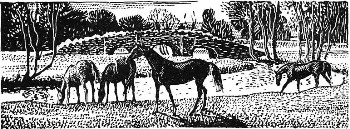
Currently the park is pasture for bullocks, black sheep and horses put out to grass after the fox-hunting season. They are led by a black gelding called Midnight. (Is HW thinking of Black Prince – his horse in the First World War?) The horses use the ford above the bridge to drink.
Salar is still resting but is slowly recovering from his ordeal. He is followed by Gralaks with Trutta in the rear and with some trout they are sheltering by a bridge.
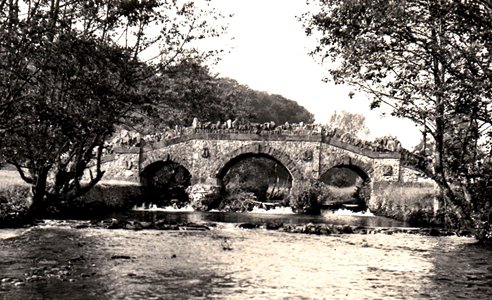
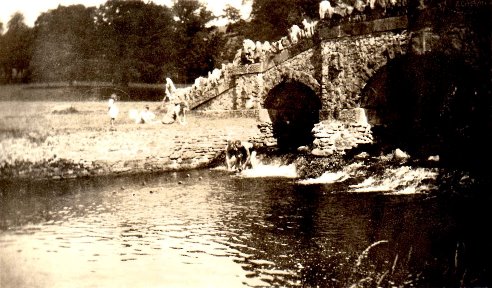
The bridge was hump-backed . . . built in an age of picturesque and landscape ornament . . . Water flowed under its three arches and slid whitely into a deep pit beneath . . .
Shiner, who worked two days a week in the garden of a house just outside the deer park, . . . peered over the northern parapet of Humpy Bridge during his dinner hour.
 |
|
Humpy Bridge, the ornamental bridge over the River Bray in the Deer Park at Shallowford. It is unchanged today. |
 |
|
HW with John Heygate netting fish in the pool below the bridge, with his family on the bank |
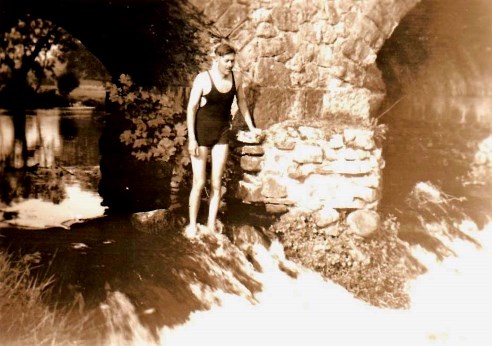 |
| No caption necessary! |
Shiner sees the fish feeding on hatching nymphs and plots how to catch them. But he now becomes sensitive to them as live creatures. We read of a big trout and Graula, a smolt who by chance is a sister of Gralaks.
The smolt are going downstream; they brave Steep Weir and swiftly continue on to the estuary, Shrarshook Ridge, past the lighthouse, braving the tide rip at the Hurly-burlies and over the sand shoals.
There big grey bass, spined of gill-cover and dorsal fin, were waiting; and of the sea Graula knew no more.
Yet another danger, waiting to ambush these vulnerable creatures.
Chapter 16: ‘Shallowford’
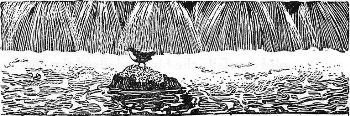
Dippers abound under the bridges of the Two Rivers – and there is a pair under the middle arch of Humpy Bridge. The water is flowing slowly which allows algae to spread. The life of the water is detailed. Salar, Gralaks and Trutta are lethargic: other life is active. Halcyon the kingfisher catches fry for his own young. The horses come to drink. One hoof nearly kills a little squat fish, Gobio, a mullhead (a bullhead or Miller’s Thumb, latin ‘Cottus gobio’), whose life history we are told. Gobio survives on creatures smaller than itself, but is predated on by all other river creatures:
trout, salmon, eel, otter, duck, kingfisher, heron, moorhen, or dabchick. . . . Gobio was the most frightened thing of the Two Rivers.
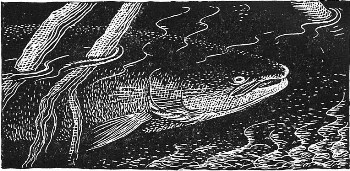
A torpid Salar is seen by Shiner from the bridge. He went back to ‘the garden and told his boss [HW] what he had seen . . . he would be sorry if anything happened to the fish.’ He then, significantly, offers his old netting to protect the greengage tree from bird predators. A subtle way of telling us that Shiner has given up poaching: his nets are no longer needed.
Chapter 17: ‘June Morning’
The water is very low. Salar is sluggish (he is still not fully recovered from the hook wound in his mouth). He shelters beneath a dead alder tree which houses a family of woodpeckers: Hackma, and his mate and six ‘incessantly chissiwissing’ young. He watches a creature haul itself out of the water: he watches it (as does the reader) over several pages slowly turn itself into Libellula the dragonfly.
Salar is bothered by maggots round his gills. His colours have gone dull and he has fungus spreading out from the lamprey wound sustained earlier. He has stopped eating and his whole appearance has changed.
The story balance changes to above ground, the various birds which live round the river and use it, especially Old Nog the heron, who catches a fresh sea-trout with an ensuing skirmish, together with tactics, with a pair of crows. The appearance of Shiner ends the stalemate, and it is Shiner who has the trout for his supper, shared with his thirteen-year-old ‘kitten’.
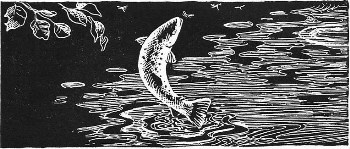
Chapter 18: ‘Mayfly’
Chaffinches take centre stage – ‘Coelebs’ from its latin name. But after several pages of lyrical detail, a sparrowhawk ‘thrust out a talon’d foot’ and flies ‘away with the stricken Coelebs’.
Meanwhile Danica the mayfly hatches (slowly and described in fine detail) along with the whole year’s horde. The mayfly rise – to enjoy the briefest of lives:
To the moon’s pale phantom flew they, to find in sweet shock the everlasting river. Then they were falling, apart, the black drake empty of hope and illusion; the grey drake to the winding gleam below, bearing thither a strange secret joy.
The fish wait on: Salar, Gralaks, and a trout riddled with worms. The colours of all the various trout are painted into a prose poem of words – even Trutta lies in a ‘pink curl of bubbles which stroked his purple head’. Trutta had just bitten a large eel more or less into two parts.
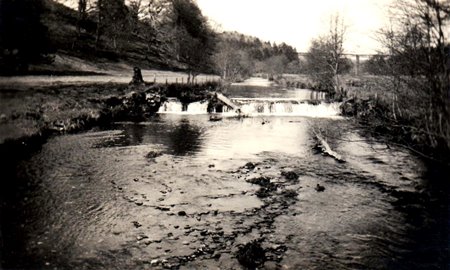 |
| Peal Stone Falls, the railway viaduct in the distance |
The sky, the shadow of the alders, birds flying across the sky, a dipper, a kingfisher: it is all very visual.
In the coppery glow still brimming the floor of the valley the spinners were burnished points until they dropped into shadow: they were thin streaks of sunset fire rising to fall vanishing.
The sun sets, ‘Venus the Evening star’ appears. Danica finally succumbs while Trutta rests:
on a rock within which was a mayfly set in stone a thousand thousand years before.
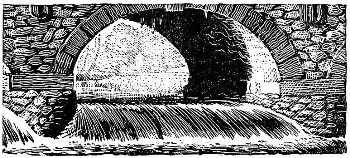
Chapter 19: ‘Night Sun’
Night has fallen and Nirra the water-bat (a noctule species) living on night-flying sedge-flies emerges. Salar, Gralaks, and Trutta cruise up and down lethargically in the shallow water. A wood (tawny) owl arrives and tries to catch a water-vole, but it escapes into the water and so the owl moves on. A wild duck (female mallard) and nine ducklings move upstream but scurry back from the smell of a fox, which comes down to the ford to drink, sniffs around and moves on.
The moon leaned on the hill; Night was come to the valley . . .
Far up the valley, a late train rumbled across the viaduct . . .
At midnight the solar rays reflected from the middle of the Atlantic laid an ocean pallor along the western sky . . . Sky, rocks, water, glowed with the fluorescence of their own dark lives.
A new salmon arrives, Gleisdyn, momentarily exciting the others, but Trutta becomes alarmed and sinks to the bottom; the wild duck alarms but the smallest duckling (which has been shown to be a show off) does not heed her and so is taken by the creature with ‘a low whistle, softer than the cries of flighting curlew’: the otters were about.
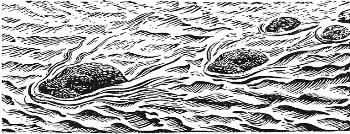
Chapter 20: ‘Water Death’
The otters, a dog and bitch, now take centre stage. Their favourite food is eels which abound in the water running along the bottom of the garden where Shiner worked.
Many times the man living in the cottage, for whom Shiner worked, had heard their soft, water-musical cries . . .
We learn that the bitch otter is the offspring of a dam with a white tip to her tail and a very bold otter who, after being hunted for many hours, had drowned a hound with his last strength – his name was Tarka. (What wonderful crossing-over of plot!) This bitch has cubs and their father is now meeting them for the first time. (And we do of course remember the scene when Tarka’s father meets him for the first time.) They all play in the water, but the adult otters become aware of the salmon hiding and they flush Gleisdyn, whom they chase back and forth, biting at him. The big fish cannot escape. Once he ceases to move the otters are no longer interested and leave: the fox who has been watching everything gets a ‘free’ meal. But we learn that two days later the dog otter is hunted and killed, even as he had killed the salmon.
Salar and Gralaks move downstream to the deepest water at Sawmill Pool, but a hunted stag takes to this water and is at bay. The fish are much agitated by the rushing movement of hounds. As the stag leaves the water so it is shot by the huntsman. Salar flees further downstream back to Junction Pool where other listless fish lie.
A thunderstorm breaks and sends debris rushing down and stirs up gasses. The fish swim down ahead and out into the estuary – where an unheeding summer visitor drowns. The fishermen go out with nets to ‘look for him’, and manage to catch forty salmon! By then Salar is back in the tides of the Island Race.
PART FOUR: WINTER STAR-STREAM
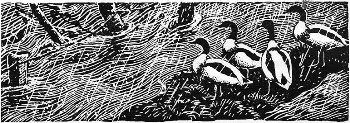
Chapter 21: ‘Drowning World’
Autumn Equinox: rain falls and the water is on the move – the highest tide of the year flooding over the sea-walls into the marsh, creating havoc. Then the rain water from the hills tears down the river. The village behind the Great Field (Braunton) was flooded, and the town by the Long Bridge (Barnstaple) was awash and without electricity. Everywhere was water.
A great run of salmon come in, chased by Meerschwein and other porpoises. (These ‘German torpedoes’ are extraordinarily prescient.) As the flood receded so Salar ‘returned to the stream of the Red Deer Moor’.
Shiner is at Sloping Weir watching the fish (which he no longer catches). It was said to be the greatest run of salmon ever known. We watch the scene of them attempting the weir through Shiner’s eyes.
The water was alive with the spirit of salmon-life. It was the master-spirit which had given salmon their shapely beauty and their speed.
Then finally we watch Salar attempting the fierce climb. When the fish succeeds, it leaps high from the mill pool above: ‘Such was the return of Salar – the Leaper.’
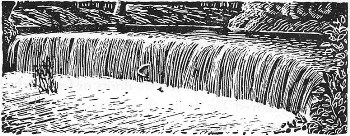
Chapter 22: ‘Steep Weir’
Steep Weir, described in detail, was the most difficult for the salmon on the whole river; and because it was difficult for the salmon it was a good place for poachers. Shiner now totally empathises with the fish: he is against poachers but also the bailiffs, who he ‘knows’ are there for money and not for love of salmon.
Shiner wants to help the salmon up the weir by lifting the ancient fenders at the sides, untended by bailiffs for many years and more or less rotten, which will open an easy path for the fish. We learn Shiner is a ‘solitary’, ‘a grey heron of a man’, living rough and we are told details of his life. But he finds poachers at the weir. He craftily outwits them and while lifting the fenders under their very noses manages to tip all three into the water.
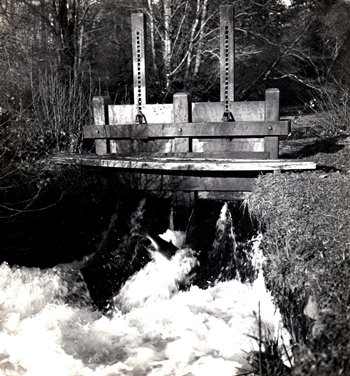 |
|
A salmon fender – note the salmon entering the spray, about to ascend: a remarkable photograph! (photo by HW) |
Then he sees a salmon leap above the easy green glissade he has created, and leap again: Salar.
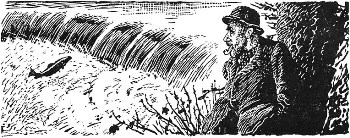
Chapter 23: ‘Sawmills Weir’
Shiner walks up the valley to Sawmills Weir, where he meets a gamekeeper. They see Garroo the cannibal trout fail to take the weir. Shiner tells the gamekeeper how he has released the fenders ‘down to Steep’ and shows his knowledge of fish, and that of his ‘chap’ who is:
‘proper mazed about salmon, writing a book about’m.’
Salar has also arrived at the weir, and after a rest attempts to climb. He finds himself in a line behind Gralaks, with others behind him. Gralaks makes the final effort needed to get up – ‘and then she was gone’. (Gralaks has eggs to lay and an urgency to get to the spawning beds.)
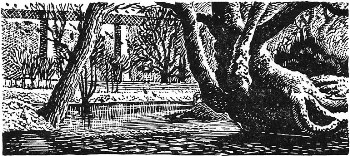
Chapter 24: ‘The Redds’
Autumn, the first pheasant shoot, and many salmon and sea-trout moving up the river. Gralaks is above Fireplay Pool and is ready to shed her eggs. Three males including Salar are in attendance, and also Grai, a salmon parr weighing two ounces. Garroo the cannibal trout waits on.
Gralaks starts to prepare her redd for spawning: sweeping the gravel sideways with her tail fin and making a pit. On the first evening of December (HW’s birthday!) she sheds her eggs. The rival male fish are excited and jostle for supremacy. Salar moves forward and his milt is released to fertilise the eggs. Even tiny Grai fertilises nine eggs! But a rival seizes Salar and bites him. Much egg-eating takes place: Garroo the greatest culprit.
 |
| Fireplay Pool |
Shiner watches all this from up a tree. (Somewhere along the line Shiner the gardener has morphed into HW himself. HW spent many hours up trees hanging over the water to get his material, often, his wife said, making himself ill from the cold. Of course, Shiner, as a product of HW’s mind, is HW anyway, but this is a deeper transformation.)
Shiner, watching from a tree, heard a distinct snapping noise as each egg was sucked into the trout’s mouth.
Salar guards Gralaks and her eggs, especially against Garroo. When the spawning is finished all the fish are exhausted. Trutta had no milt, but guards his ‘mate’, whose eggs are actually fertilised by excited little peal. Now all wait for the rain.
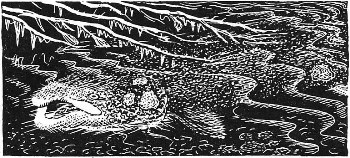
Chapter 25: ‘End and Beginning’
We arrive at the frosty nights of the year’s end and learn of the effect of frost and ice on the water life. It is a difficult time.
The slow solidification of eddies and still stretches by the shallows made the runs faster. New eddies were formed in reaction, new ice affirmed their stillness.
Gralaks lies still in the deepest water. Salar, the great Leaper, lying in Fireplay Pool, is being consumed by salmon-pest and fungus. In his sick state he fights monstrous phantom fish:
black, opening monstrous grampus-mouths to crush him [HW and his own black nightmares]
He flees:
The weir was a flood of red water, and thundering about him.
But:
Salar had hardly moved, except to roll over in the delirium of his sickness.
A steam train had thundered over the viaduct. (Something HW must have seen and felt many times – quite dramatic at night – the red glow of the fire reflected in the water – hence ‘Fireplay’ Pool.)
Now the thaw begins. The empathic Shiner sees Salar, a sorry state covered with creamy fungus.
Every pool in the Two Rivers held dead or dying male fish.
Shiner sees Salar again, lying still in the shallow water over mud and sticks, and puts his hand under him: Salar hardly notices him until the shock of touch moves him slowly on into deeper water. Shiner all the time murmurs soothingly.
The year has turned, with small signs of spring – crowsfoot growing, mistle-thrush singing. But then it snows and the otters return and play, making a snow-slide into the water, but they suddenly hear the noise of a fish jumping.
Salar had leapt, the second time in the New Year. A wild hope of a spate and the sea had stirred in him. Together, the otters slipped into the water.
Trutta is with Salar. Shiner is watching from behind an oak tree. Salar sees the otters and flees: Trutta attacks them and they leave the water, smell Shiner, and vanish. But the next day Shiner returns and finds Trutta, or rather the head and backbone of the great trout, lying on the bank above the Fireplay Pool. The otters had come back late in the night. And below it, in water so shallow he is not covered, is Salar, also dead.
(You will appreciate that brave Trutta and, by effect, Salar the Leaper have been killed by the offspring of Tarka the Otter.)
The spate rose rapidly, and washed all away, to the sea which gives absolution, alike to the living and the dead. . . .
In the gravel of the moorland stream the eggs were hatching . . . each one alone, save for the friend of all, the Spirit of the waters. And the star-stream of heaven flowed westward to far beyond the ocean where salmon moving from deep waters to the shallows of the islands, leapt – eager for immortality.
*************************
Back to Salar the Salmon main page