
The Henry Williamson Society
Uncategorised
Immortal Corn
‘IMMORTAL CORN’
(synopses for a proposed film on farming)
As explained in the entry for A Solitary War, in the spring of 1940 HW received a letter asking him to write a synopsis for a film about farming. Apparently his friend John Rayner, who was the Features Editor of the Daily Express, had suggested HW's name to a film consortium. HW was at that time writing his book The Story of a Norfolk Farm, published in January 1941; the actual writing of that book began in December 1939, with the main part being written during the winter months of 1940, while the 'Epigraph' was written during his brief incarceration in Wells police station over the weekend of 15/16 June 1940.
In that 'Epigraph' HW states:
During that period [i.e. 'the two years (so far) of my occupation of Old Castle Farm' – and in addition to farm and other work] I wrote 400,000 words; and a synopsis and part of a scenario of a film play, based on the idea of my own experiences, called Immortal Corn, which a British producer (if any there be) may one day care to make.
Thereby hangs a tale. However, by making that statement in print HW was quite clearly laying claim to his own material, for he felt very strongly that it had been stolen from him and could (probably would) be used by others.
But let us return to the beginning of this sorry tale.
At the end of February 1940 HW noted that he had received a letter asking him to make a film, and his diary records on 19 March 1940 (having met the film people in London):
P. Soskin wants to make a film with farming as background. And I am exhausted. He asked me to send Mss of Norfolk Farm.
However, in the first week of April HW stayed with Ann Thomas (his long-term secretary and mistress) at her home in Chippenham, where he got on with the task of writing a synopsis for the proposed film.
Monday, 1 April: I went to Bedford on way to stay with A.T. to write synopsis of farm film.
And further:
Wrote scenario synopsis – good stuff. Ann says yes. If I get the job I asked A.T. to help me at £5 a week. She is only one I can work with.
On 6 April he visited his friend the film actor Robert Donat (famous for his portrayal of the teacher Mr Chips in Goodbye, Mr Chips, for which he won an Oscar), and recorded: 'Read him my synopsis of IMMORTAL CORN. He thought it very good.'
(Soskin was aware of HW's connection with Donat and indeed was proposing that Donat should star in the film – but as he was under contract to a major film company at the time, this could never have been a serious option.)
From seeing Donat, HW returned to Bedford, and on 8 April all the family returned to Stiffkey.
His brilliant title 'IMMORTAL CORN' is taken from an essay in Centuries of Meditations by Thomas Traherne (1636-1674 – though the book was not printed until 1908). HW had first used this phrase as the title of an article for the Evening Standard on 26 April 1939 (reprinted in Heart of England, ed. John Gregory, HWS, 2003; e-book 2013). In these items and elsewhere HW always slightly misquotes the words, as the original phrase was 'The corn was orient and immortal wheat' (‘orient’ is used here in its archaic sense of ‘rising’). But he makes it clear how highly he valued this work, calling it the 'finest passage in English prose'.
The general background for this film project is given in the entry for A Solitary War, where it is a major feature of that story, becoming for Phillip (and HW in real life) an irritating time-wasting setback – indeed, a fairly major disaster, especially as he was desperate for the amount of money offered as a fee for the work (a total of £1,500: £1000 for the synopsis to be paid over several months with a further £500 when the film went ahead) to save himself and the 'Norfolk Farm' from bankruptcy. When he realised this money would not be forthcoming, HW sold his debentures in his maternal grandfather's stationery firm raising £750; but was still around £400 in debt (the equivalent of around £24,000 today).
The purpose of this separate page on the 'Immortal Corn' film project is to show HW's actual ideas for, and the various processes he went through in preparing, the synopsis. It is not possible here to analyse or explain the whole process, but rather to give some idea of what was involved, and to note the various documents in his archive, which illustrate the process.
First, there is a large quarto-size envelope with typed notes on both sides, which was presumably intended for Mr Soskin. The material referred to in the opening sentence was not inside the envelope and indeed must have always been separate (the envelope had not ever been actually used), but evidently they were articles that HW had previously written and published. HW does note somewhere that, apart from never handing over any money for the considerable work he had done, Soskin never returned either these articles or his scenario. (These 'farm' articles have all been reprinted and published by the HWS, details can be found in the entry for The Story of a Norfolk Farm, Appendix B.) This interesting and valuable document sets out HW's initial thoughts and provides us with insight into his mind and writing process. Note that here he refers to Traherne's work as 'the most famous passage in English prose wherein he says . . . “the wheat was orient and immortal corn”. . .'


HW's archive also contains a large foolscap folder marked:
The Man who Went Outside
PART FOUR
IMMORTAL CORN
Each line is in a different colour and there are some additional notes that HW made in 1956 about which pages had been sent for typing, some to Mrs Tippett (his main typist) and some to another lady. 'The Man who Went Outside' was a working title that HW used more than once for material connected with the Norfolk Farm period. The 'Part Four' referred to was not actually in that folder – it is almost certainly part of the material that went eventually into the appropriate Chronicle of Ancient Sunlight novels, hence the notes regarding typing. This folder actually contains items to do with the proposed film: a selection of small files of typed material, each clipped together with rusty paper-clips (now removed) and each only consisting of a few pages of ideas – variations on a theme. It is not clear in what order they should actually be, so the order here (after much juggling around) is purely according to my own view of what appears logical. I have also grouped associated material together to make things easier for future research students.
The ideas that they encompass are not perhaps what one might expect, for they are not literally based on HW's own experience of the Norfolk Farm; they have a far wider remit, as the following extracts will reveal, bringing in an historical aspect that goes back to the 1890s in most versions, but also bringing in the Chartists and even Napoleon at one point. The basic theme and purpose was to show the plight of, and problems facing, agriculture over the ensuing years.
This subject was one that was central to HW's ethos and has been shown to occupy and underpin his thinking and writing from the very first book he wrote; it was to become a central theme of the Chronicle of Ancient Sunlight novels (at this point still in the future, although they had occupied his mind from the very beginning). The ideas incorporated into this 'Immortal Corn' material are therefore of great import to our understanding of the 'how and why' of HW's thinking and attitudes.
The basic theme shows two opposing views: 'agriculture', the backbone of England (represented in most versions by Squire Wycherley and family) versus 'industrialisation' and cheap food imports (represented by Frederick Fenton, later 'Sir', and his family). That conflict underpins the story-line, which also encapsulates a love story.
A summary of the material follows – the links will take you to further information and scanned extracts:
A carbon copy typescript in two parts: pages 1-5, followed by pages 4-12, headed:
Rough Synopsis of IMMORTAL CORN
based on Henry Williamson's
STORY OF A NORFOLK FARM
but marked along the side in coloured pencil: 'FIRST rough draft – Superceded'.
Carbon copy only of 14 pages (unfinished), headed:
IMMORTAL CORN
A rough synopsis of Town versus Country Drama freely based
on Henry Williamson's STORY OF A NORFOLK FARM
This opens very differently as can be seen from the first pages – and the main protagonist is now named Squire Wycherley:
This second part consists of a top copy and carbon as from pages 4-12 of the above, renumbered 1-9, with an MS heading in red in by HW stating:
Authentic speeches made by Squire Wycherley, copied from Records … Made in 1888
(I have not tracked down where these were copied from or who made them.)
Seven pages typescript headed:
IMMORTAL CORN
by
Henry Williamson
A typescript of 26 quarto pages with a carbon copy, headed:
IMMORTAL CORN
A rough synopsis of Town versus Country Drama
freely based on Henry Williamson's
STORY OF A NORFOLK FARM
(A phrase on p. 7 indicates this version is not part of the original 1940 script material, as it mentions 'Norfolk Farm, pub. Jan 1941'. Note that the sojourn abroad is here 'Australia'.)
This version consists of 5 quarto typescript pages: and although it is still a variation on HW's overall theme, it is very different in approach.
One page, headed at top 'Second page', but also typed on reverse: this is part of a report to a lawyer recording the details of the debacle surrounding the whole episode, showing that HW had considered the arrangements made with P. Soskin and payment discussed as legal and binding, and wants to get this redressed.
A small file of letters all pinned together, which show that HW then tried to place the film elsewhere. (There are no letters extant pertaining to the original arrangement in the archive. As HW evidently (as in File F) contacted a lawyer over the perceived problem, all such correspondence and papers were probably passed on as evidence.)
Typescript and 2 carbon copies, 10 quarto pages, with an additional MS page:
Germinal ideas for Scenes & Shots of
IMMORTAL CORN
made by H.W. on the Norfolk Farm
1940-41,and left uncompleted.
This typescript is more grounded in the actual farming world (and the dialogue accents would seem Devonian derived!). It is headed:
IMMORTAL CORN
Germinal ideas for Scenes
A typescript, 6 quarto pages (c.2000 words) outlining his envisaged plot. As this really encapsulates the overall essence of HW's theme it is reproduced in full.
Also in this file are carbon copy pages numbered 56 to 61 only of a typed version of an autobiographical farm story, describing the harvest of 1939, and which contains some interesting passages which illuminate HW's thinking.
*************************
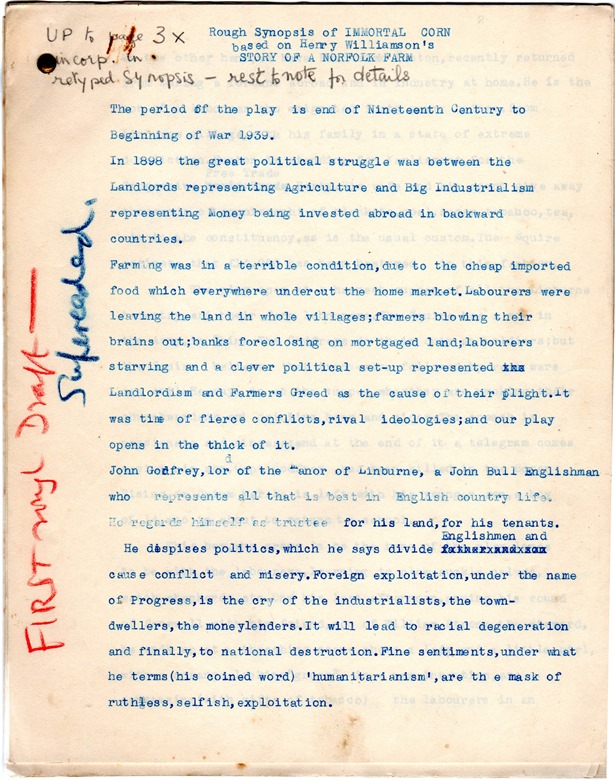
A carbon copy typescript in two parts: pages 1-5, followed by pages 4-12, headed:
Rough Synopsis of IMMORTAL CORN
based on Henry Williamson's
STORY OF A NORFOLK FARM
but marked along the side in coloured pencil: 'FIRST rough draft – Superceded'.
The first part opens in 1898:
Farming was in a terrible condition, due to the cheap imported food which everywhere undercut the home market.
The main character here is John Godfrey, the Squire – a 'John Bull Englishman' who represents the land and its values. His opposite is Frederick Fenton, industrialist and would-be MP for the 'Progressive Free Trade Party'. ('Free Trade' here meaning cheap imported food undercutting English agriculture.)
John Godfrey learns that his oldest son, a soldier in China, has been killed in the Boxer Rising (1900), leaving his fourteen-year-old son as heir – and the hero of this script. (HW also mentions the Boxer Rising elsewhere, but I have failed to discover the raison d'être.) This lad meets the young daughter of Fenton: they like each other but the family barrier of 'sworn enemies' keeps them apart.
At a Corn Hall political meeting Fenton makes a speech about industrialisation and free trade, counteracted most vehemently by Squire Godfrey. A riot ensues and the Squire gets hit on the head by a bottle. He dies from this injury, telling his young son never to forsake the land.
The new young squire, supported by his friend the bailiff William Strong, struggles to keep the estate going in an agricultural depression. He has to sell off farm after farm – all bought up by the now 'Sir' Frederick Fenton, whose daughter marries a 'lordling', leaving our hero bereft.
The Great War breaks out and John Godfrey enlists in the County Regiment as a private, being later promoted on the field for bravery. After the war: 'Land Fit For Heroes’; slump; the family Manor House has to be sold off – again to Fenton. All John Godfrey has left is the Hill Farm. He marries (as second best) the gentle daughter of the Rectory, and they struggle on against all the problems of cheap imports (eggs, mutton, beef, bacon, wheat). They have a son: at the same time a Fenton granddaughter is born. Contrast of their very different life-styles was to be made evident.
The second part reprises the above, but set out in a different way with much more detail, and includes the famous farmers’ march to London (1938 – this is recorded in The Story of a Norfolk Farm).
John Godfrey addresses meetings of the 'All-for-England' party (in slums, South Wales, and other areas), calling for the return of agricultural values to restore the country's prosperity. Meanwhile, rumour of war is circulating. Stones are thrown at him and he falls unconscious.
Then a 'montage' of urgent war preparation over BBC announcement; Godfrey in delirium; scenes of WWI – Lloyd George wants land made fit for farmers. Fenton visits and asks for friendship and offers help to restore the prosperity of the land when war is over.
Young John Fenton now marries the Fenton granddaughter (the heiress) and so he inherits back the land that had ancestrally belonged to his own family.
Ending:
Music, the old oaks in the park, and the Union Jack fluttering from the Church Tower,
fade in to God Save the King.
*************************
Carbon copy only of 14 pages (unfinished), headed:
IMMORTAL CORN
A rough synopsis of Town versus Country Drama freely based
on Henry Williamson's STORY OF A NORFOLK FARM
This opens very differently as can be seen from the first pages – and the main protagonist is now named Squire Wycherley:


This second part consists of a top copy and carbon as from pages 4-12 of the above, renumbered 1-9, with an MS heading in red in by HW stating:
Authentic speeches made by "Squire Wycherley", copied from Records … Made in 1888
(I have not tracked down where these were copied from or who made them.)
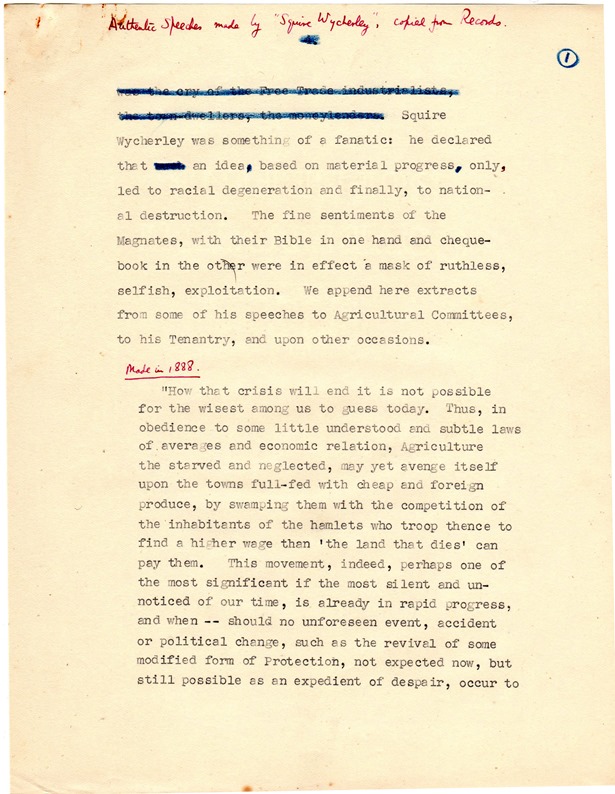
After these speeches Squire Wycherley hears of death of his son in China. There is unrest at the end of the speech and he is hit on the head by a bottle, from which injury he dies.
The carbon copy has some passages of the speeches marked to be deleted.
*************************
Seven pages typescript headed:
IMMORTAL CORN
by
Henry Williamson
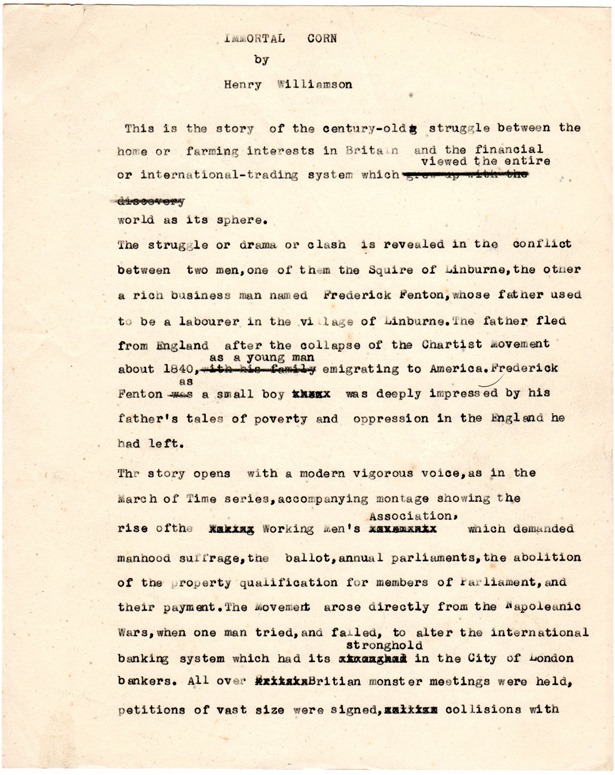
Then the scene moves to 1848, and the Chartist Movement (a British working-class movement for political reform, founded June 1836, drawing up a People's Charter, which was rejected by Parliament, and rejected again in 1848, whereupon the movement collapsed).
Fifty years later Fenton returns, a rich man, to Limburne. The Squire, John Wycherley, a 'John Bull Englishman' . . . Now the story includes elements of File A (as above): his eldest son is killed in China. The young son/heir has a friend, William Strong.
But some elements are different: there is mention of Lloyd George's drive against landlordism; a 'montage' to show rise of Germany's rival trade; shooting is let to (now) 'Sir' Frederick Fenton, MP.
This then moves into the Great War and selling of farms, bought up by Fenton. The Manor House is already sold and used as a hospital in 1916 – to which the wounded Captain Wycherley returns: to be nursed by Fenton's beautiful daughter. But a 'lordling' is also there and her parents favour him; and so inevitably she marries the lordling.

That is the end of this synopsis.
*************************
A typescript of 26 quarto pages with a carbon copy, headed:
IMMORTAL CORN
A rough synopsis of Town versus Country Drama
freely based on Henry Williamson's
STORY OF A NORFOLK FARM
(A phrase on p. 7 indicates this version is not part of the original 1940 synopsis material, as it mentions 'Norfolk Farm, pub. Jan 1941'. Note that the sojourn abroad is here 'Australia'.)
The first three pages follow:


This then continues in similar vein to the previous versions, with Squire Wycherley senior, agricultural depression and Frederick Fenton, industrialist, etcetera. Young Wycherley is here educated at Winchester, and is wounded in the First World War.
On page 7 of this version HW has interpolated:
(The author of Immortal Corn farmed the Hill Farm in the years of depression, and knows all the details of the struggle.) . . .
Appended hereafter are some rough notes & scenes which will indicate the material of the drama & its solution.
The reader's indulgence is asked for any repetitions and overlappings which occur, as the writer at the moment is busy in this spring of 1948 [obviously an error – presumably 1941 is meant] getting his land ready for corn and roots.
The following pages were put together during the writing of The Story of a Norfolk Farm which was published in January 1941 and has sold 50,000 copies and is still in great demand. Crude and disjoined as they are, they may indicate the possibilities of the drama and give an idea of the knowledge of the present writer.
The 'following pages' referred to, apart from p. 8, revert more or less to the original scenario; hence there is some repetition, as mentioned above.

The following page is numbered 9-14: then numbering continues normally to page 26. But, as this is longer than previous versions, there is a great deal more detail. It ends with the death scene of Fenton, when he hands over the Trusteeship of his estates to young Wycherley, now married to his granddaughter. Finally,
we see the air of life in the corn, the waving wheat, and the elms of the hedgerows, the orient and immortal corn waving into the Union Jack and God Save the King.
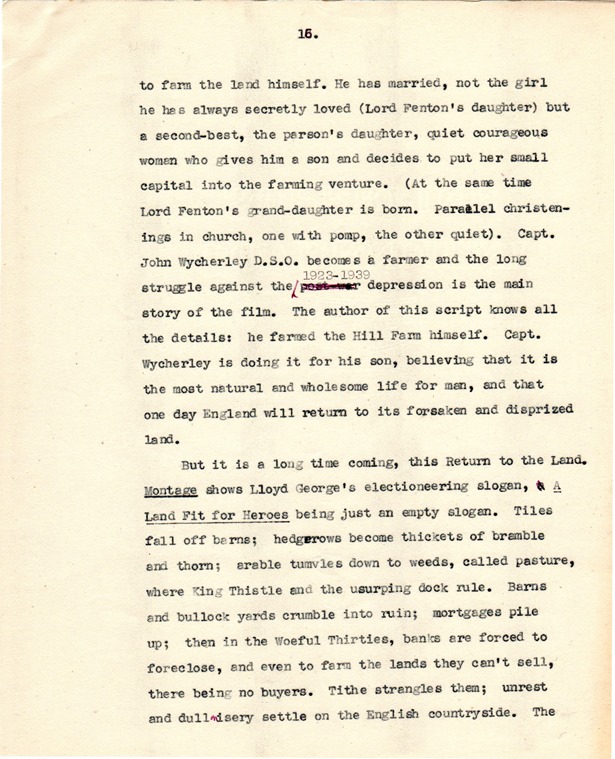
There are extra copies of pages 13, 14, and 17 which have MS corrections and additions: also page 16:
*************************
This version consists of 5 quarto typescript pages: and although it is still a variation on HW's overall theme, it is very different in approach.
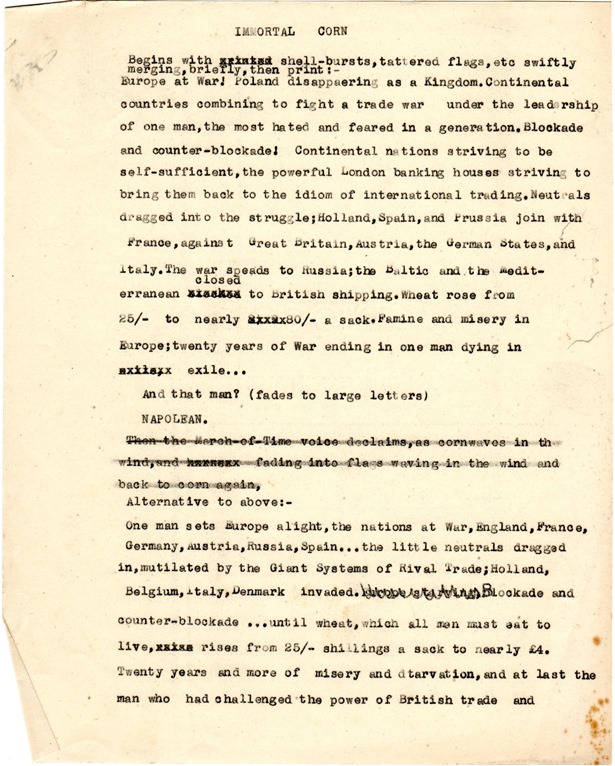
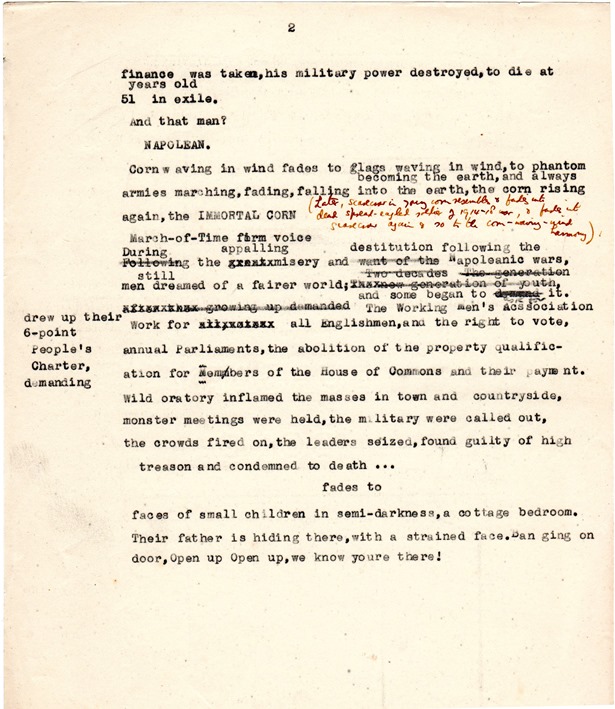
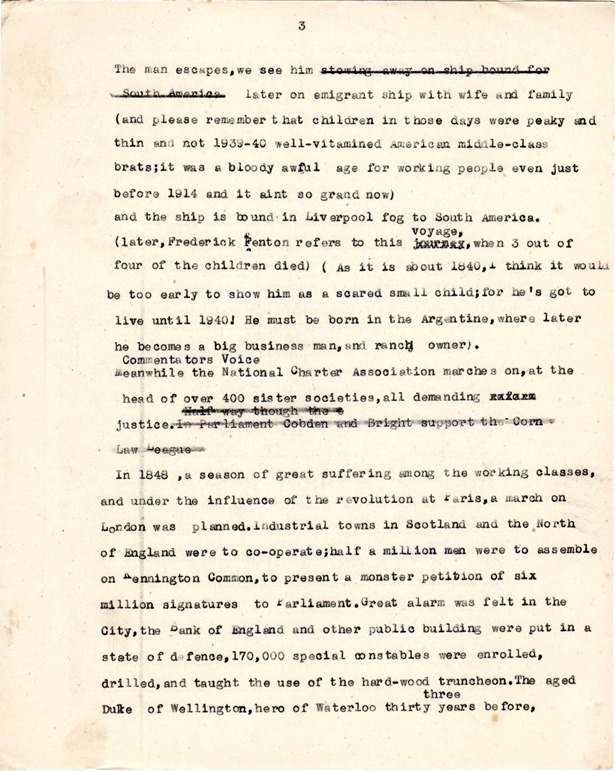

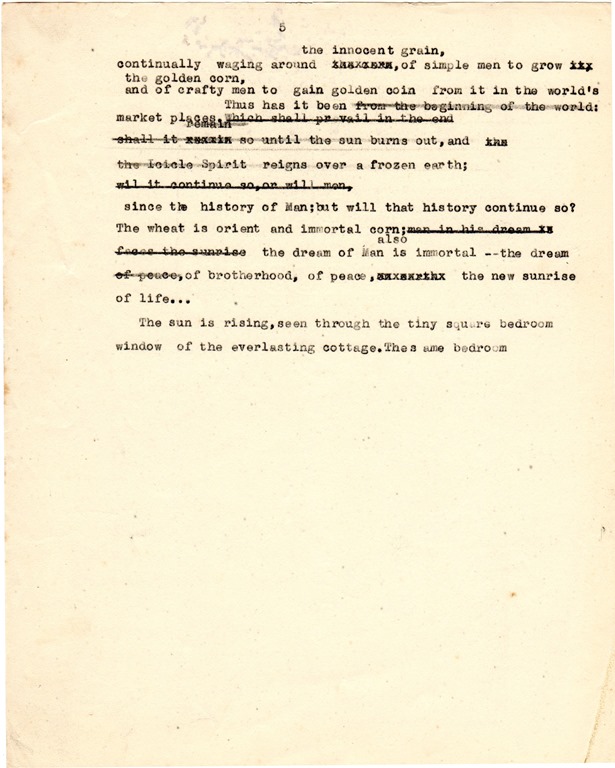
*************************
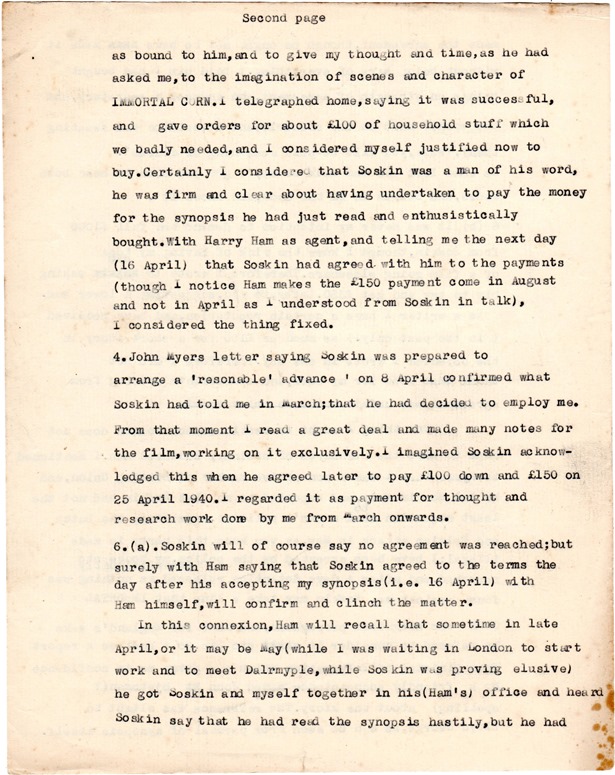
One page, headed at top 'Second page', but also typed on reverse: this is part of a report to a lawyer recording the details of the debacle surrounding the whole episode, showing that HW had considered the arrangements made with P. Soskin and payment discussed as legal and binding, and wants to get this redressed.

*************************
A small file of letters all pinned together, which show that HW then tried to place the film elsewhere. There are no letters extant pertaining to the original arrangement in the archive. As HW evidently (from the letter above) contacted a lawyer over the perceived problem, all such correspondence and papers were probably passed on as evidence.
i) A copy of a letter dated 7 May 1940 from the Director of Films Division of the Ministry of Information offering help for “Wind In the Corn”. This is strange, as Soskin had stated that the Government body had withdrawn funding – which may have been part of his subterfuge.
ii) A carbon copy of letter dated 29 June 1940 from HW to Paul Holt, of the Daily Express, explaining the whole problem and asking for help.

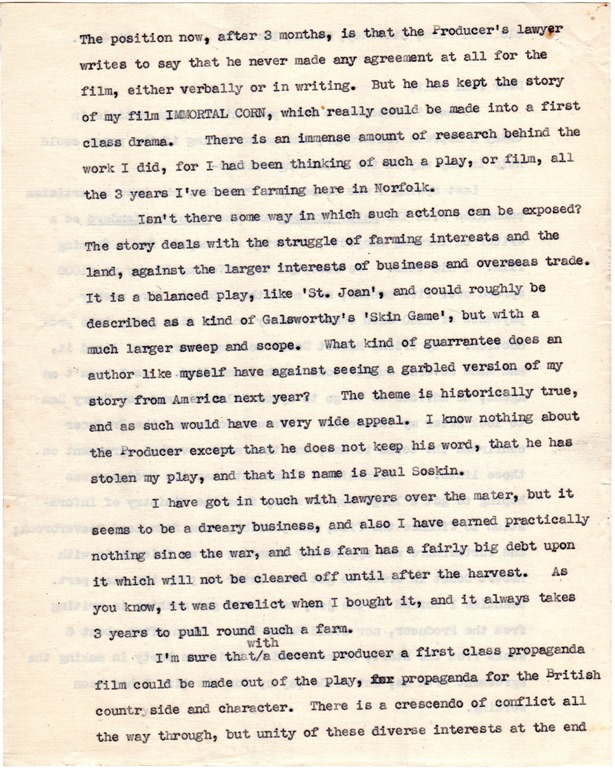

iii) A letter from G. Aird Whyte, dated 26 May 1941, who, having read and enjoyed The Story of a Norfolk Farm, would like to see the synopsis for the film play “Immortal Corn” (as mentioned in the Epigraph of the book) and wonders if HW envisages a full-length film or only 'three or four reels'.
iv) A letter arising from a contact with Mr. G. Goddard Watts, dated 2 May 1941, who had written an agricultural pamphlet that HW had commented on, and who had contacts with 'The Ministry of Information film people'.
v) A second letter from (presumably) Mr Goddard Watts' secretary dated 16 May 1941 shows a problem:
‘Mr. Goddard Watts has been rather disorganised as a result of a direct hit on his office at 90 Ebury Street on Saturday night . . .’ (and giving his home address for immediate use).
vi) A letter dated 15 September 1941 from Goddard Watts, now at 110 St. Martin's Lane, WC2, giving a contact to Donald McCullough of the Ministry of Agriculture.
vii) A charming letter from said Donald McCullough:
I have read so many tributes paid to your abilities by so many people that I hope that I shall soon have the pleasure of meeting you.
This exchange with Donald McCullough brought forth a further version of the 'Immortal Corn' synopsis as shown by HW's TSS and MS notes in the following File H.
*************************
Typescript and 2 carbon copies, 10 quarto pages, with an additional MS page:
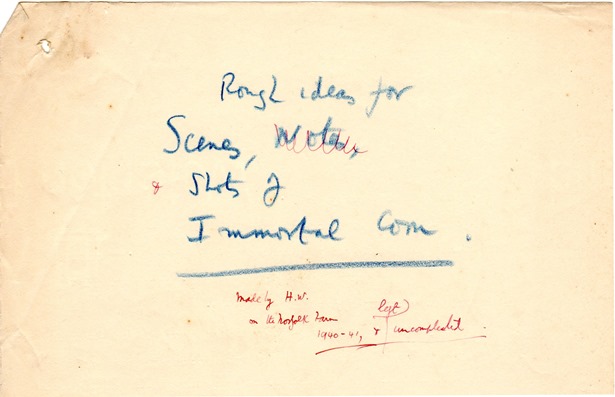
This typescript is more grounded in the actual farming world (and the dialogue accents would seem Devonian derived!):


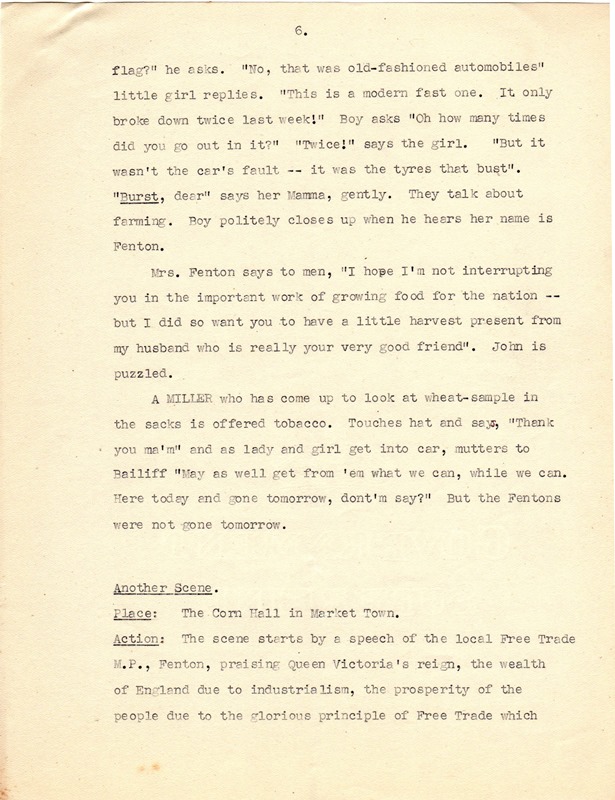
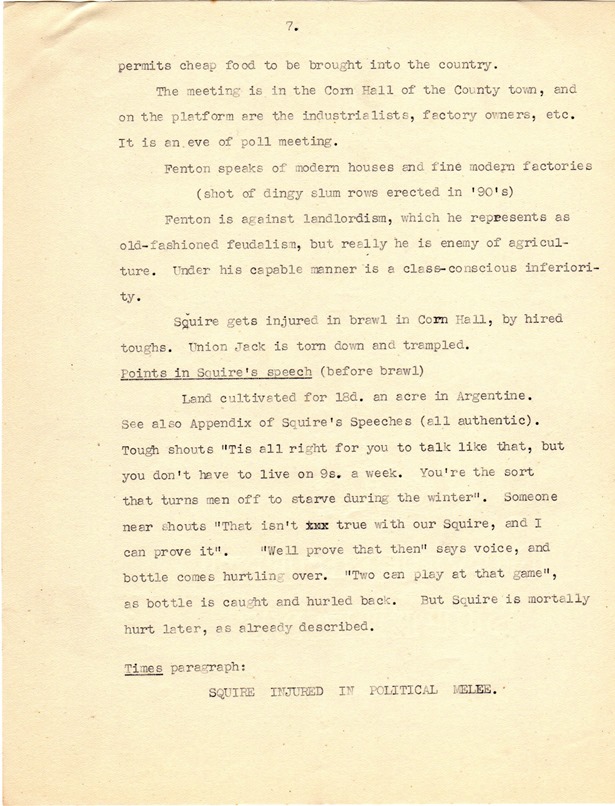
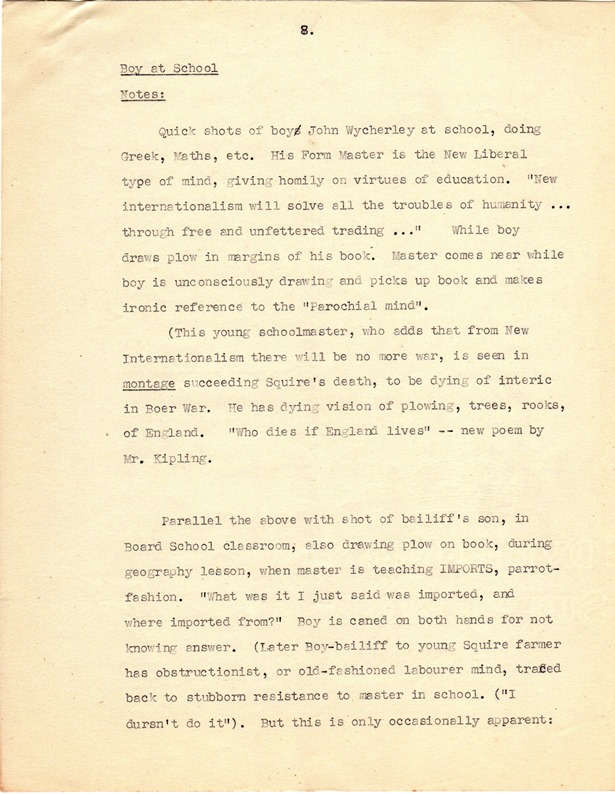

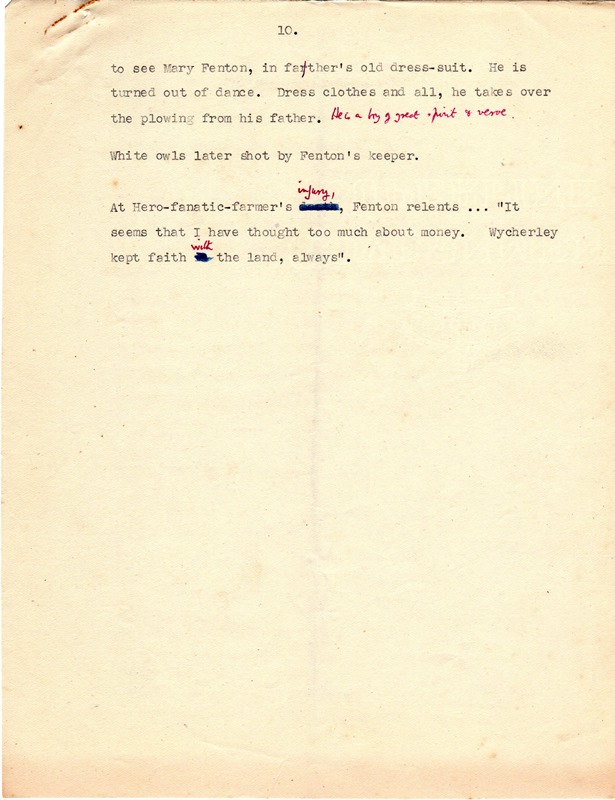
There is a separate corrected p. 11, probably from an earlier source as it has been pinned through with an old-fashioned paper-clip at some point, of material incorporated into the above typescript.

There is then a second letter from Donald McCullough, dated 21 October 1941, equally cordial, asking for a short statement ('not more than 1000 words') that he can show the 'film magnates'. HW's diary notes on 23 October 1941:
I heard from W. Donald H. McCullough of the Ministry of Agriculture, about my film Immortal Corn.
HW complied two days later with the following (File I):
*************************
A typescript, 6 quarto pages (c.2000 words) outlining his envisaged plot. As this really encapsulates the overall essence of HW's theme it is reproduced in full.


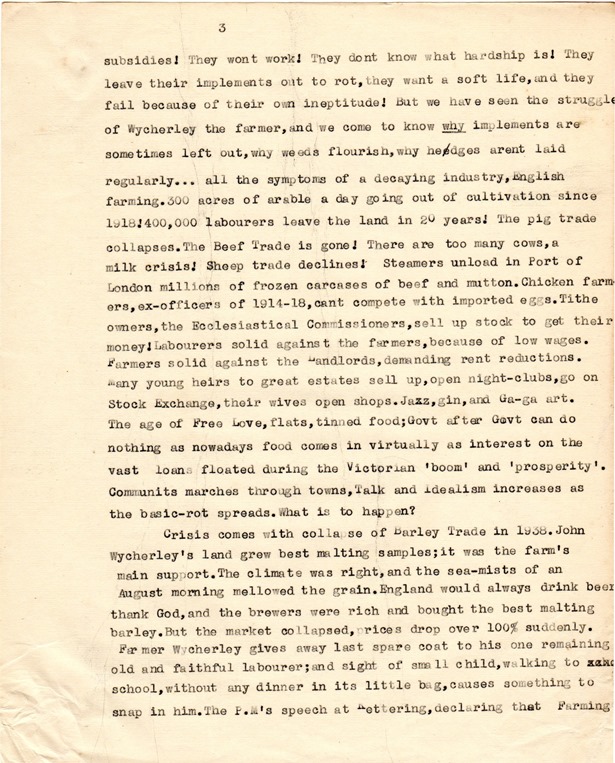

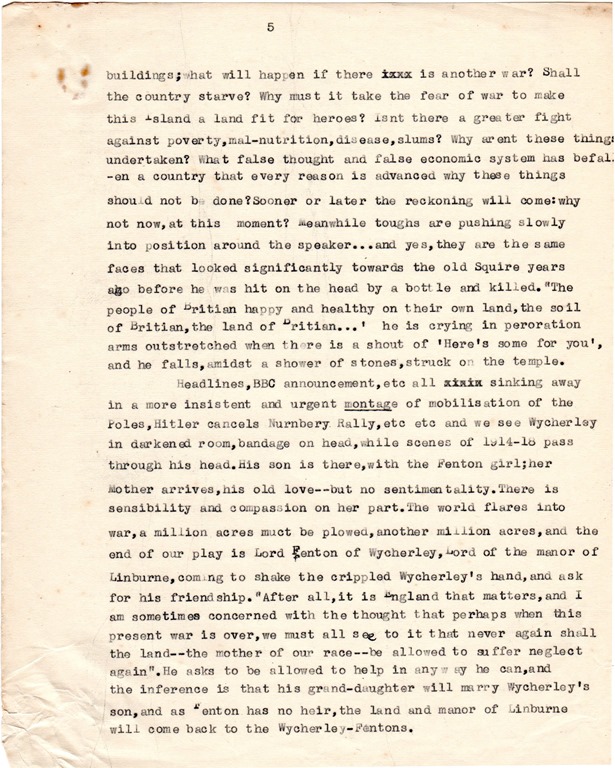

But on 13 November 1941 HW noted:
In London, saw Donald McCullough at Ministry of Agriculture about my proposed film Immortal Corn. “First class. Box office draw. But financial advisers are against it as it may damage British Case”
And that seems to be the end of the project.
HW had taken the train to London the previous day (12 November) and on following day, 14 November, he continued on down to Braunton, where Ann Thomas was temporarily living in his Hut in the Field at Ox's Cross. He recorded that he was writing 'A Norfolk Farm in War-time' (see entry for A Solitary War). He returned to Norfolk on Monday, 1 December:
Birthday – I am 46. A nice tea & all the children to greet me, a tidy & nice house, a warm fire & good electric light – the house looks like home. Ida is very kind to work so happily for me.
However the next day:
Reaction. Felt farm too much for me. Feeling ill.
*************************
Also in this file are carbon copy pages numbered 56 to 61 only of a typed version of an autobiographical farm story, describing the harvest of 1939, and which contains some interesting passages which illuminate HW's thinking.


*************************
There is of course a great deal of further information within selective pages of the 3-volume MS notebooks entitled 'A Norfolk Farm in Wartime', the envisaged sequel to The Story of a Norfolk Farm, which was incorporated into A Solitary War, and is dealt with in that entry.
*************************
As is obvious from the above, the film never was made, of course. But perhaps it is possible to suggest that the eventual superb BBC film The Vanishing Hedgerows, made in 1971/2 and first shown on 20 August 1972, produced and directed by David Cobham – set basically on the 'Norfolk Farm, and acclaimed today as the first film on nature conservation made by the BBC – had its genesis in this 1940s 'Immortal Corn' material – or at least perhaps, as far as HW was concerned, made up for the original disaster.
The possibility of a revival of The Vanishing Hedgerows is currently being explored.
*************************
A Fight against Tithes
A FIGHT AGAINST TITHES
George J. Gill
With an Epigraph by Henry Williamson
 |
|
| Privately published, 1952 |
Privately published 1952; printed by A. A. Tanner & Son, Dorking
Edited by Donald Gill and S. S. Gill
Those who have followed closely HW's problems over the years of his sojourn at Old Hall Farm, Stiffkey (see The Story of a Norfolk Farm), will be aware that one of those problems was the payment of 'tithes'.
A tithe was technically a tax of one tenth of the estimated income of land, based on its supposed yield, including, it seems, an amount for its possible (mythical) rental value.
From Anglo-Saxon times this was payable to the ecclesiastical authority of the area concerned, for the upkeep of both the Church and its clergy. Then in 1936, at the time that HW bought his farm, the Government bought the tithe system from the Church – for a huge sum – and so was able to apply the tithe tax for its own purposes.
Calculation of this tax was basically a mystery wrapped in a conundrum.
George Gill's book covers the subject very thoroughly and in a most readable way. But such are the ramifications of the subject that one feels none the wiser by the end of it (which was part of the problem: the thing was unfathomable!). It is however a very useful analysis of an intrinsic historical aspect of the life of this country, and as such a gem of British quirkiness. (The last vestiges of tithing ended in England and Wales in 1977.)
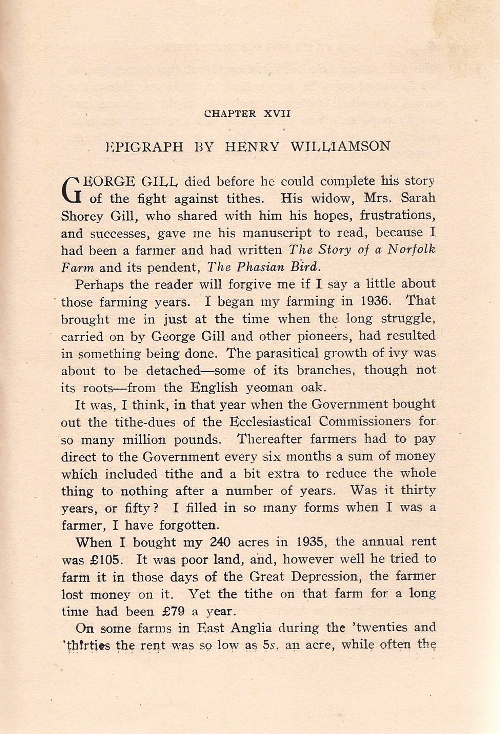
George Gill sadly died in 1947 before he was able to complete the work. His widow approached HW, who stepped in, gave his unstinting help (as in so many such instances), and provided the Epigraph. It is not known how many copies were printed, but it is unlikely to have been more than 1,000.
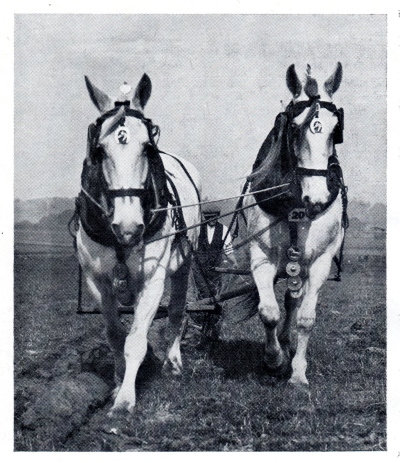
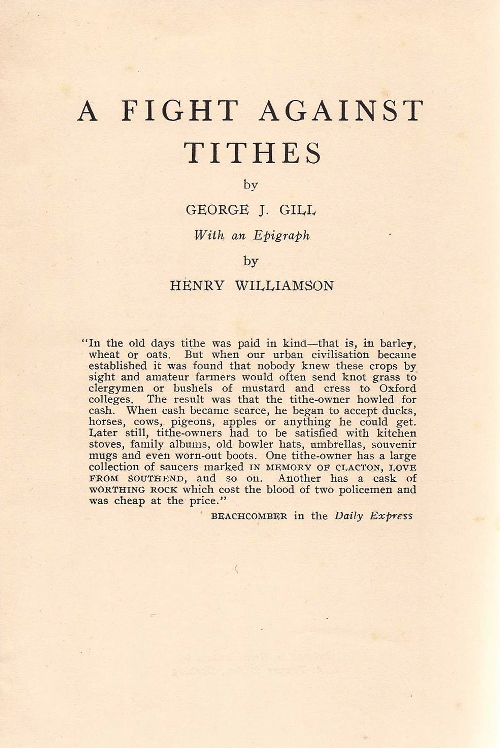
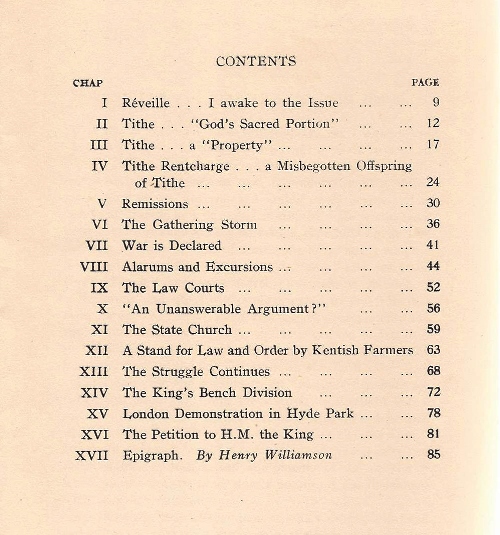
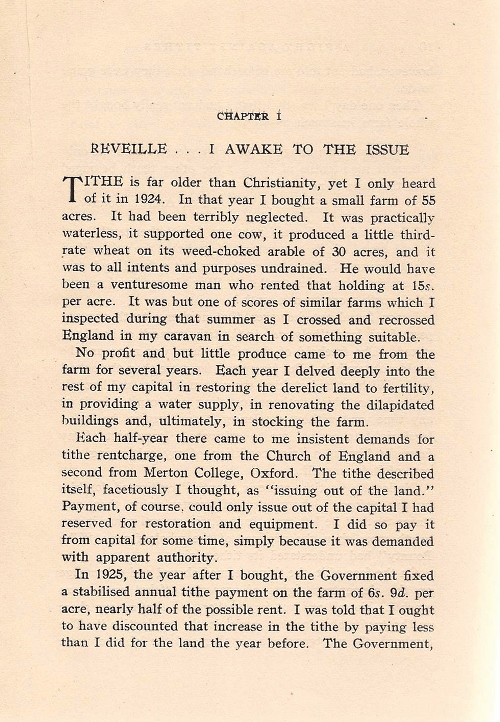
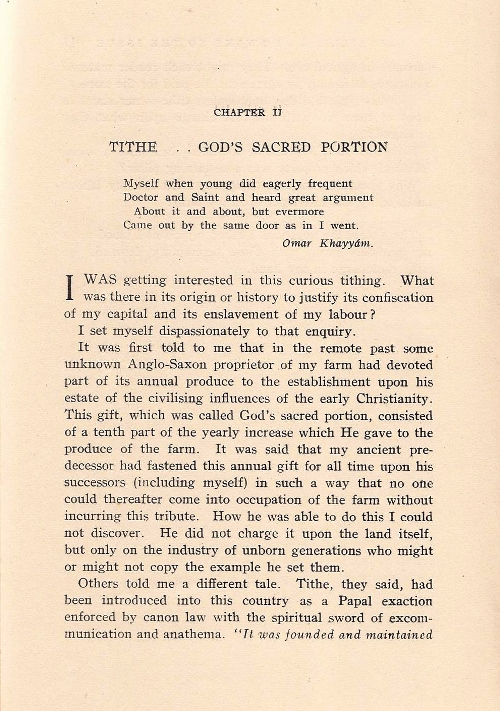
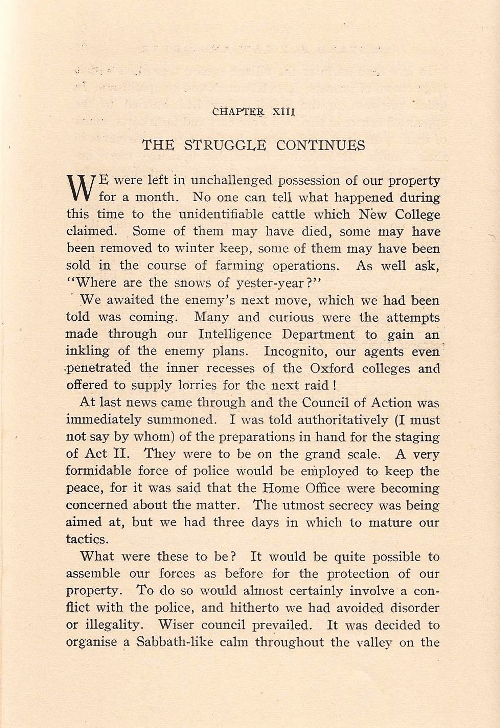
The preliminary information (the frontispiece is uncaptioned), the first pages of the opening chapters and an entertaining chapter XIII are given below as a sample of this interesting and scarce little book.


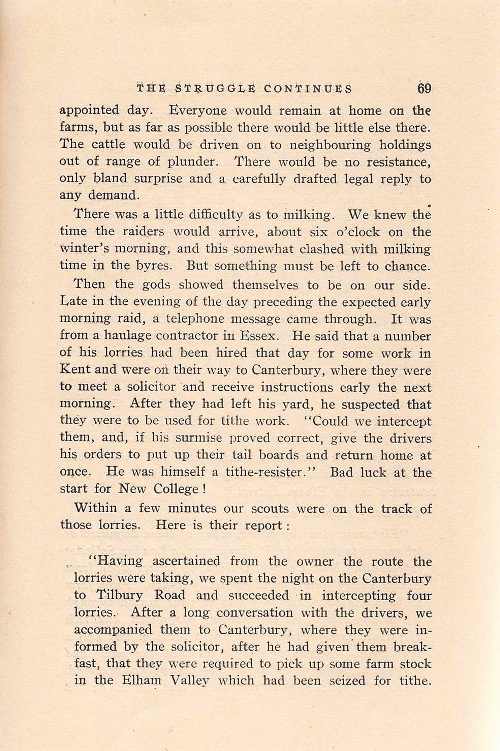
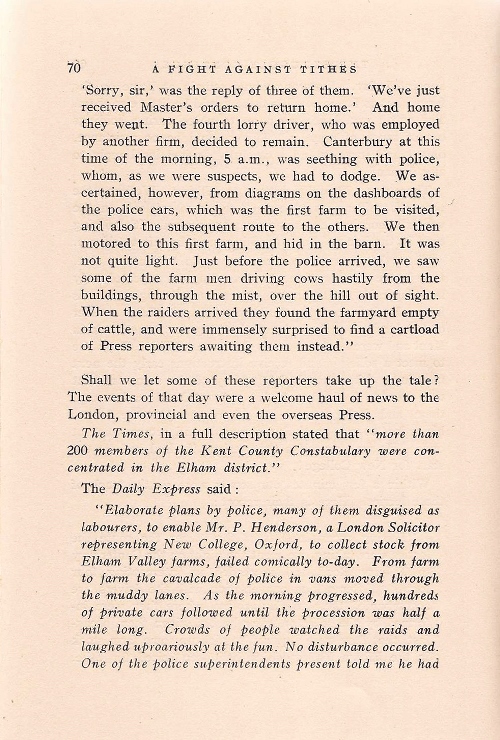
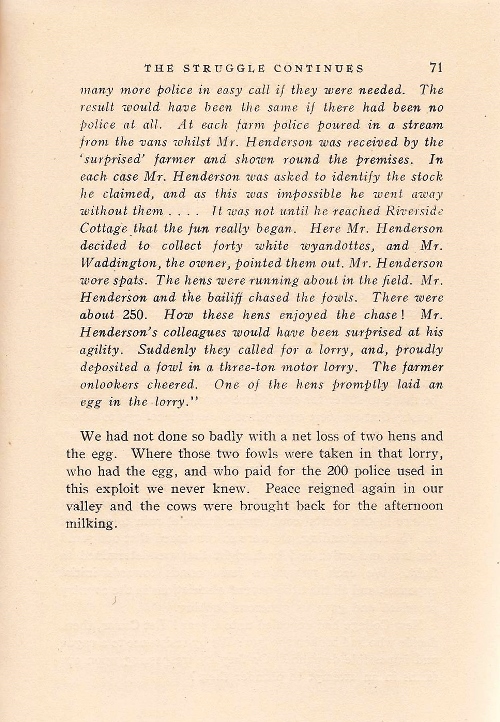
*************************
A Fight against Tithes being a scarce book, many readers may not have come across HW's 4-page Epigraph before. It is given in full below.

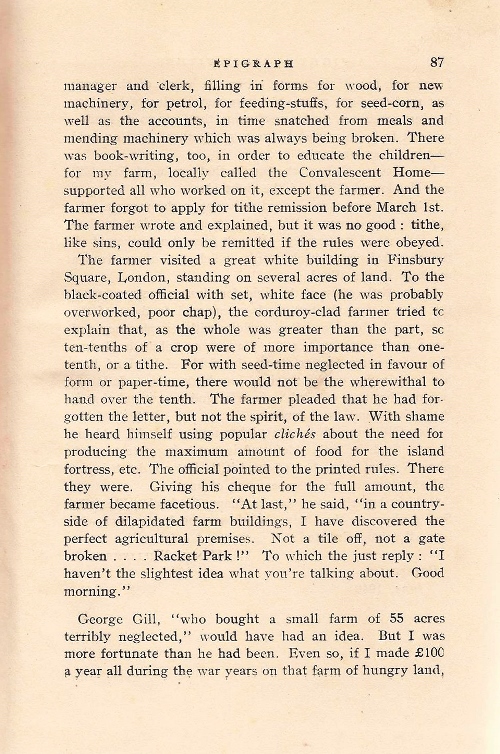
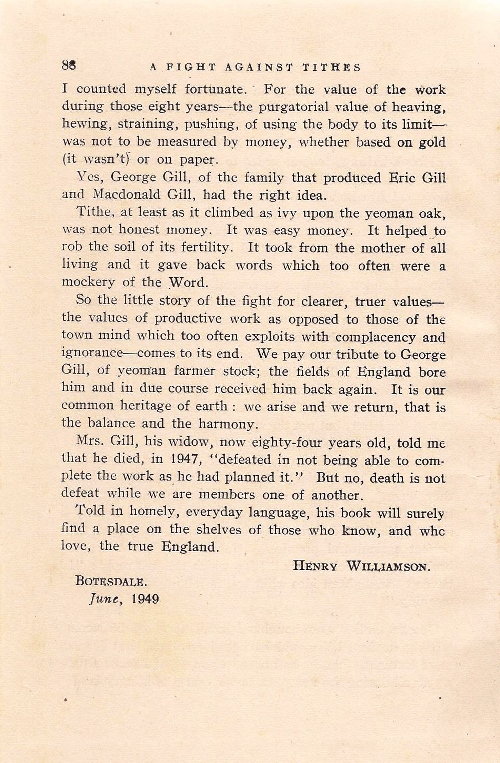
*************************
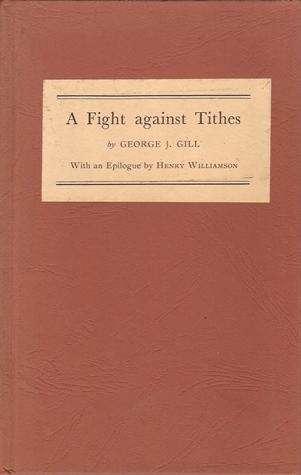
There was no dust wrapper. The binding is of textured paper-covered boards with a paper label on the front; there is no lettering on the spine.
Life on the Norfolk Farm: an essay in photographs
Back to The Story of a Norfolk Farm main page
Life on the Norfolk Farm: an essay in photographs
The first harvest, summer 1938
 |
| Postcard sent to Loetitia by HW from Stiffkey in July 1936. It was raining . . . |
This sequence of photographs, provided through the generosity of the Henry Williamson Literary Estate (as with very nearly all the photographs on this website), includes many that have never been seen before. They form a unique record of the Williamson family's first few years at Old Hall Farm, Stiffkey, from early visits in 1936 through to 1939. They include photographs of working the land and of the first harvest in the summer of 1938, giving an evocative picture of a time and a way of farming long gone – ancient sunlight indeed.
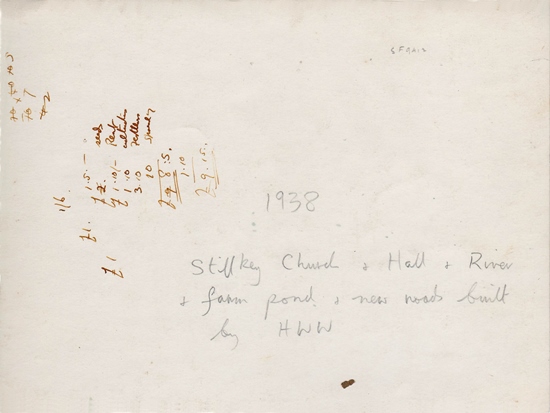
A few of the photographs have captions written on the reverse; these are also shown, both for information and entertainment, although it is not absolutely clear who wrote them – whether HW or his son Richard in later years, aided by the memories of his eldest brother Bill (Windles). Their handwriting is remarkably similar!
HW became the owner of Old Hall Farm on 22 August 1936, although he did not actually take possession of the land until Old Michaelmas Day 1937 (10 October), as the existing tenant, P. F. Stratton, had to be given due notice. A few days after completion of the sale HW, Loetitia and Windles visited the farm, the latter two for the first time.
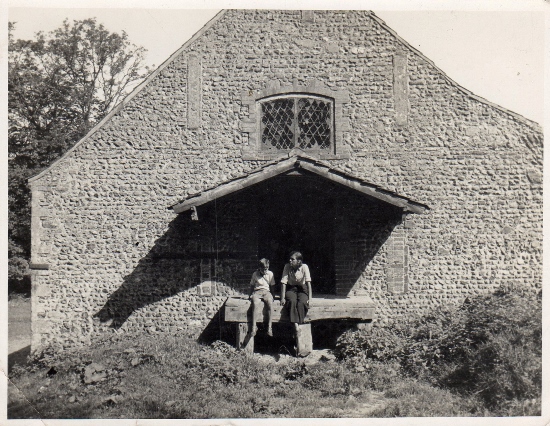 |
| Windles and Loetitia sitting outside the Elizabethan corn barn, August 1936 |
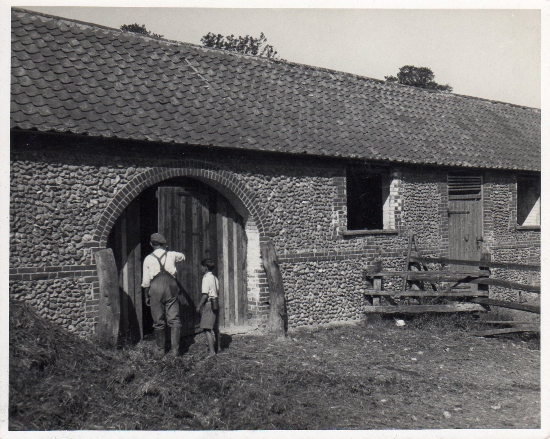 |
| Windles being shown the farm buildings |
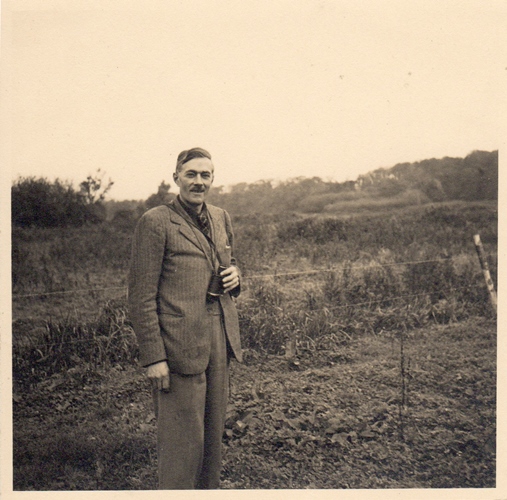 |
| The new owner of Old Hall Farm |
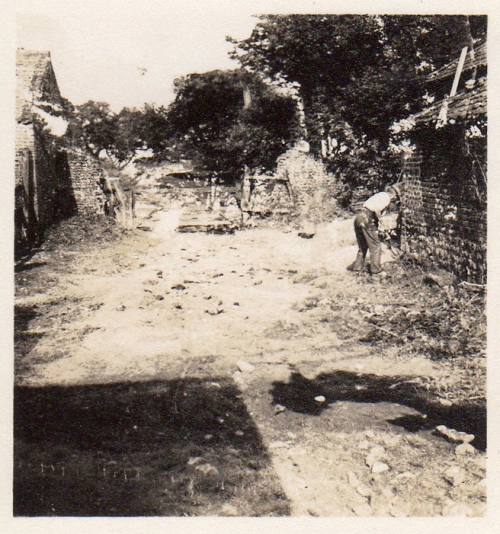
The dilapidation of the premises was only too apparent:
 |
| The pig yard |

 |
| HW captioned this: 'Eccles caravan in wood near Hangman's Copse' [at Hang High] |
 |
| Drilling an artesian well near the chalk quarry |
 |
| HW and Bin Hibbert. HW captioned this 'The ill-fated partnership' |

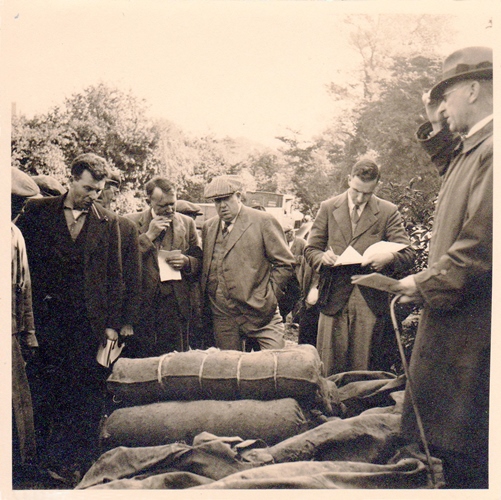
When HW took possession of the farm in October 1937 it was of the land only. It did not include farm animals, machinery or other implements. All these were owned by the outgoing tenant, and, as was customary, an auction was held of his live and dead stock, attended by local and not-so-local people. HW had to bid for whatever he wanted.
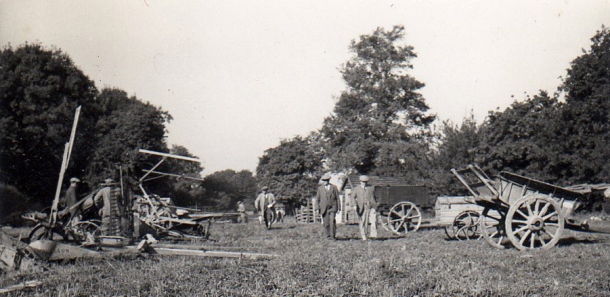 |
| Implements and carts laid out for inspection at the farm auction |
 |
| 'Goitre' Gidney is on the far left, the scarf round his neck hiding the goitre |
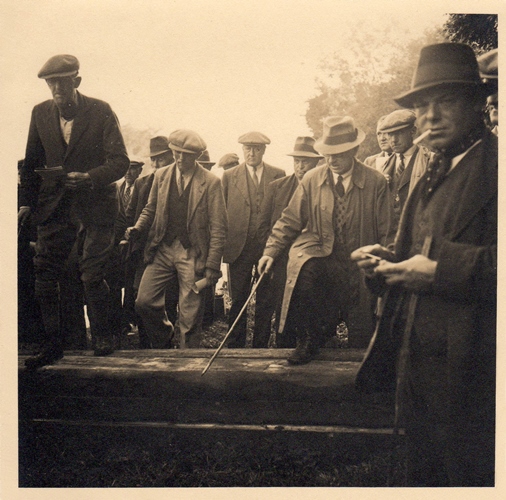
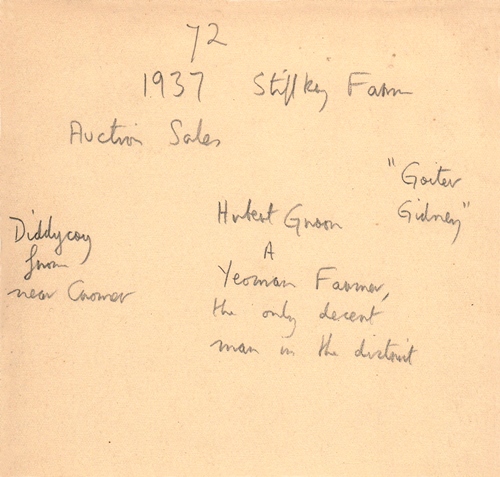 |
|
Rather confusingly the names are written behind the people in the photograph above. Thus 'Goitre' Gidney is actually on the left, while the diddicoy is on the right. |

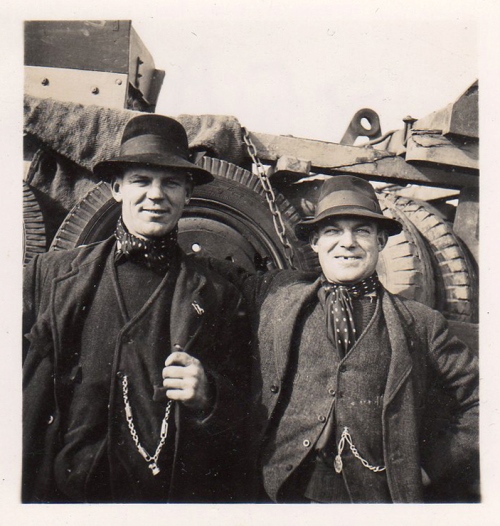 |
| The diddicoys 'from near Cromer', scrap metal dealers |

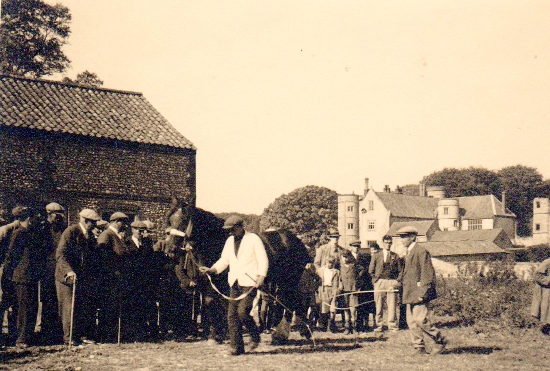 |
| Parading the horses |
HW intended that Walnut Tree Cottage should be the farmhouse. However, it was occupied by sitting tenants who refused to move out. Anxious to find somewhere for the family to live when they moved from Devon to join him, he discovered three dilapidated and condemned cottages next to the chapel, which were not far from the farm. They were owned by Mathew Bugg, and the purchase and renovation by HW of these cottages became a saga all of its own. The three cottages formed an L-shape around a courtyard, which became, after ploughing and cultivating, a vegetable garden. It has since been gravelled over and later still put down to grass.
 |
| The entrance to the condemned Chapel Cottages, taken before renovation |
 |
| North Cottage before renovation, which HW renamed Fox Cottage |
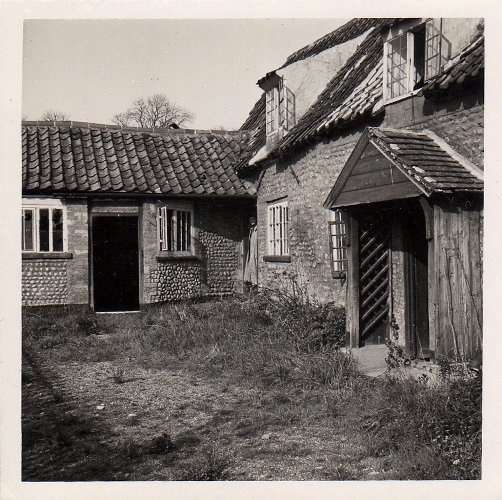 |
| Another view of North Cottage in its original state |
 |
|
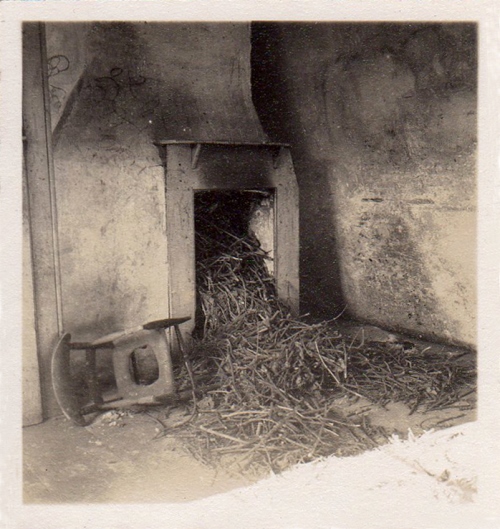
Captioned: 'Jackdaw's nest spilling out of fireplace before the rebuilding of Farm House' [Thought to be North/Fox Cottage] |
 |
| Loetitia from one of the cottage windows. The chapel windows are in the background. |
 |
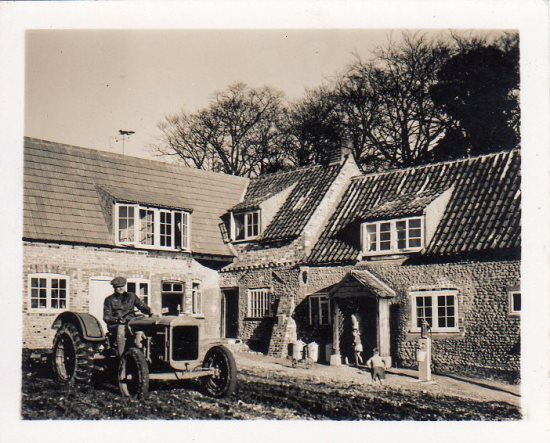
| Cultivating the courtyard garden, with Robbie inspecting the Ferguson |
 |
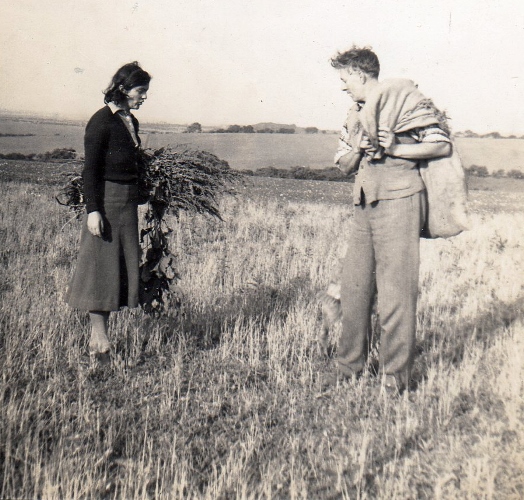
| HW cultivating |

 |
|
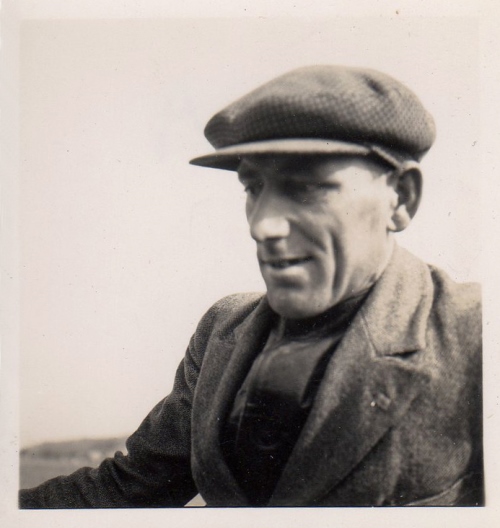
Loetitia and HW in the early months, in a field of weeds (photo © John Fursdon) |
 |
| Bob Sutton, the farm steward |
 |
| Jimmy Sutton, Bob's father, with the Ferguson |
 |
| The bullocks being fed by Jimmy Sutton |
 |
|
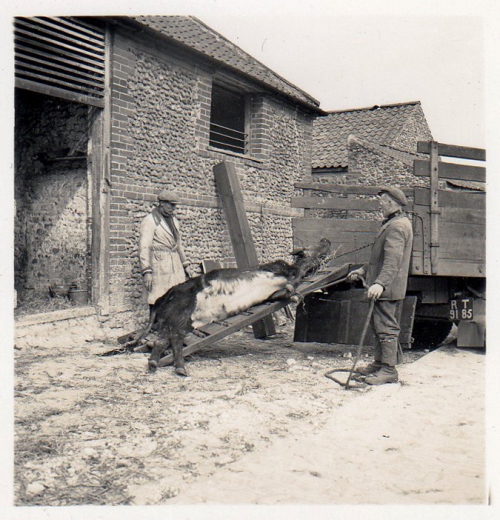
'Lying in the straw of the calf-house was the bullock, dead. I rang up the knackers at Great Wordingham, and they sent a lorry with hauling tackle and lugged the corpse on, and paid me a pound for it – my first sale off the farm.' (The Story of a Norfolk Farm) |
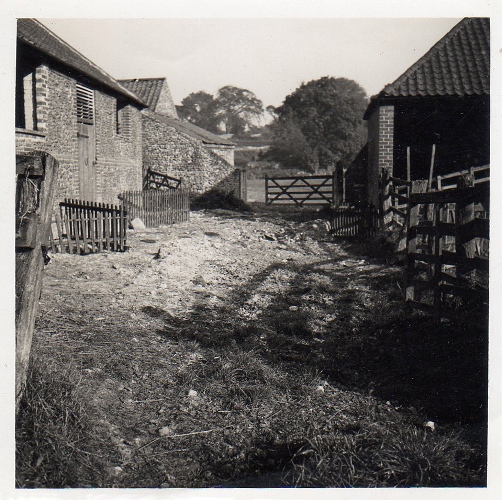
 |
| Bob Sutton and Loetitia drilling Twenty-one Acres |
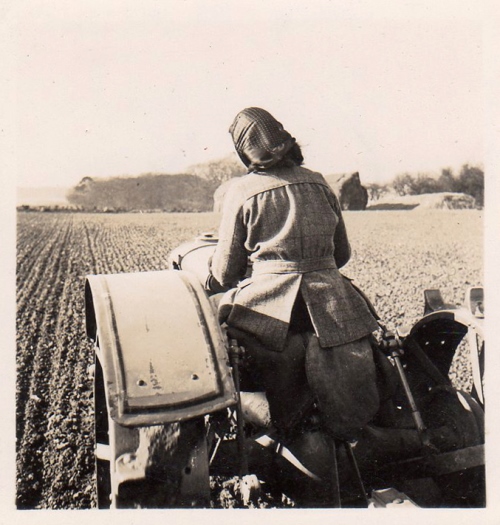 |
| Richard Williamson identifies the driver as Ann Thomas (not sure how he can tell!) |
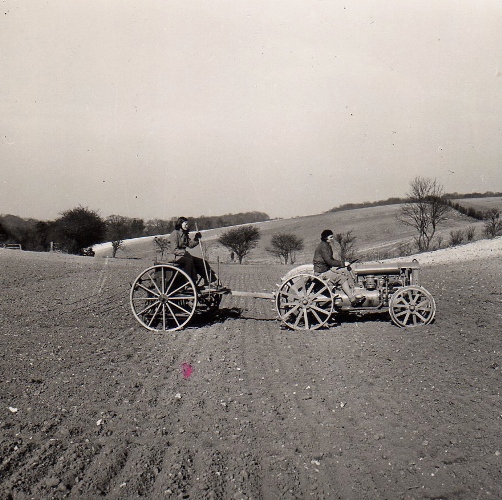 |
| Loetitia driving the Ferguson, with Ann Thomas behind on the drill |
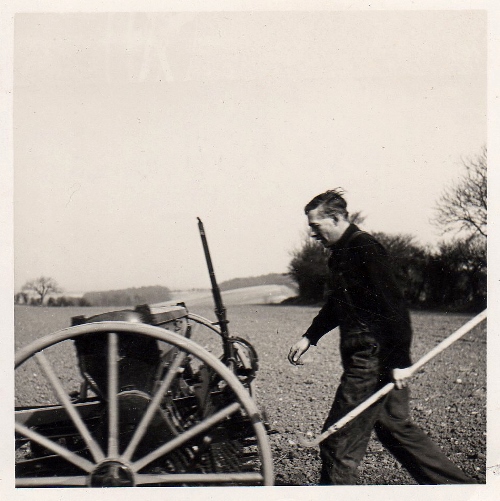
 |
| HW walks behind the drill (and in the photograph below) |

 |
|
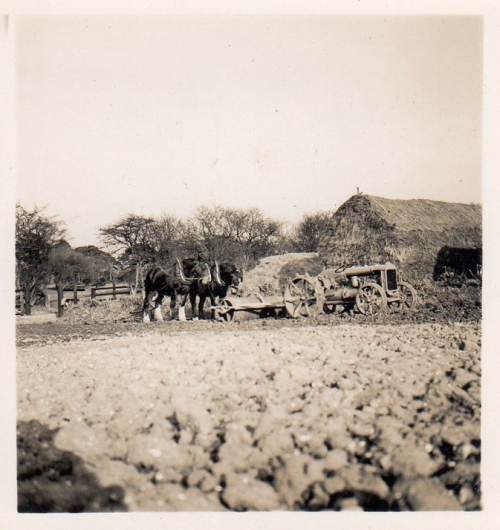
Blossom and Gilbert are ready to pull the worn second-hand seed harrows, following the rib roll hitched to the Ferguson |
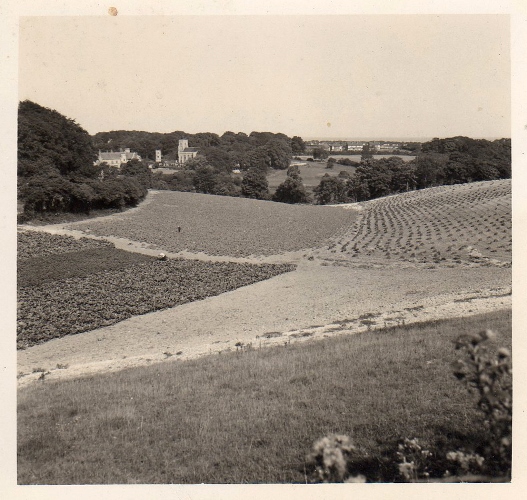 |
| Hilly Piece |
 |
|
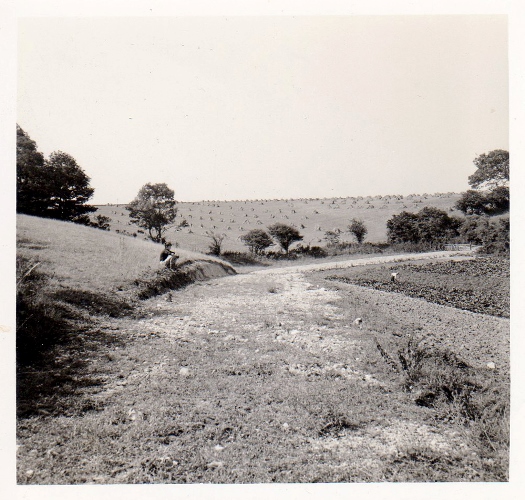
Looking the other way from Hilly Piece, with Windles sitting on the bank; stooks of barley stand in the field behind |
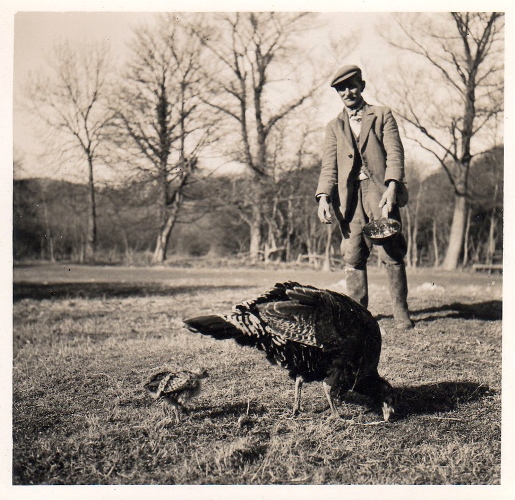 |
| Jimmy Sutton feeds one of the 'Norfolk tarkies' |
 |
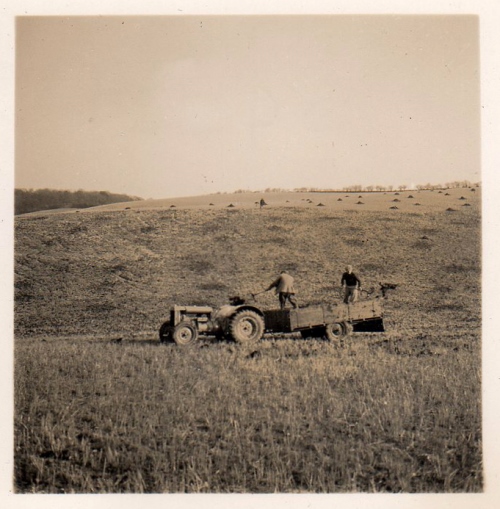
| St John's Pasture – the men break for lunch |
 |
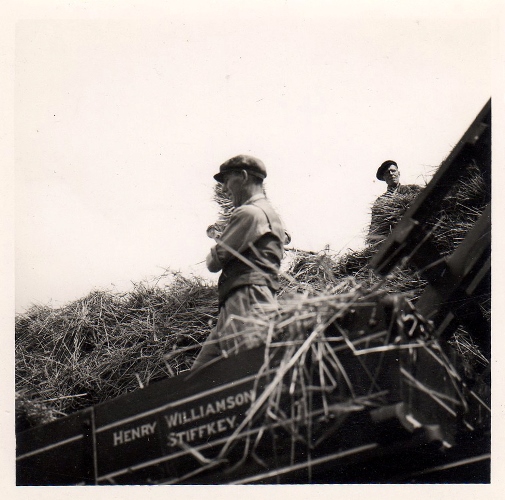
|
One of HW's new tumbrils – 'They looked to be splendid vehicles, shining with varnish over their red and green paint, my name and village in white letters on the side.' (The Story of a Norfolk Farm) |
 |
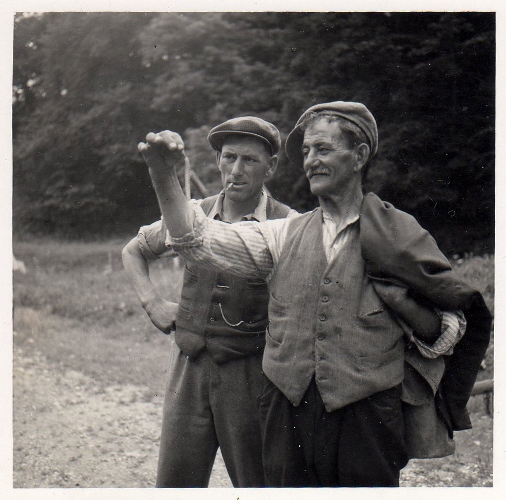
| Bob Sutton, centre |

 |
| Bob and Jimmy Sutton assess a head of barley |
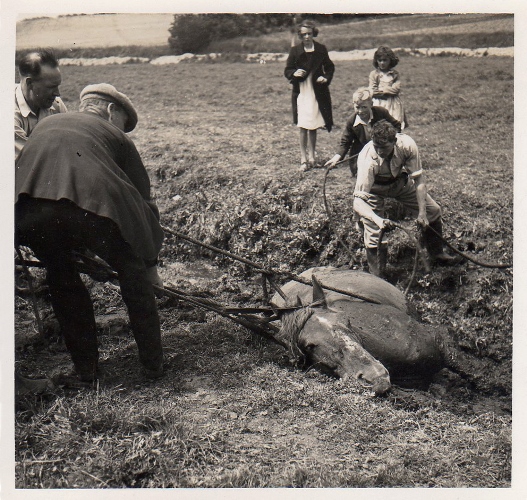 |
|
'A neighbouring farmer's horse had fallen in the dyke . . . the horse lay in black mud, exhausted . . . a team of volunteers from the village, uncaring for their Sunday-best clothes, was about to lug the horse out with ropes. Otherwise it would have died . . .' (The Story of a Norfolk Farm) |
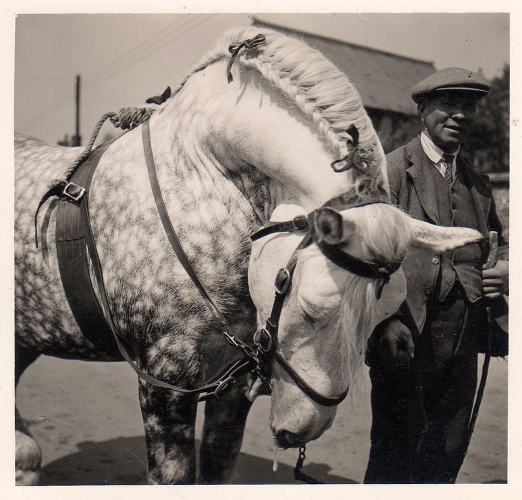 |
| The Percheron stallion Bedlam Viking |
 |
| Bedlam Viking is introduced to HW's mare |
 |
| A cold-looking Windles harrowing Fox Covert |
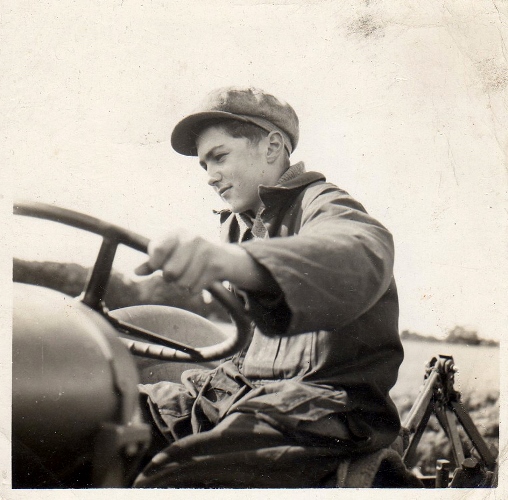 |
| Bill 'Windles' Williamson, tractor driver (and below) |

The four more domestic scenes that follow feature the two youngest children, Robbie and Rikky:
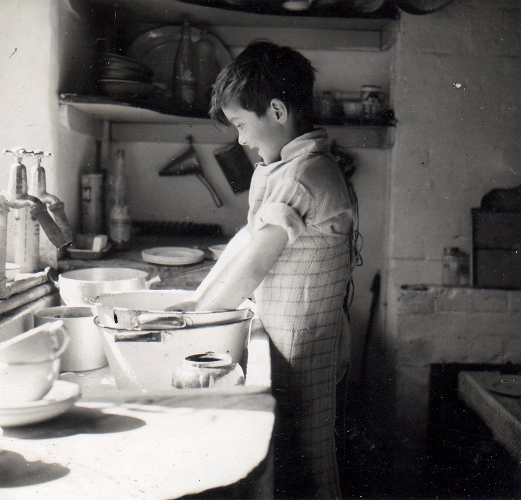 |
| Young Richard tackles the washing up |
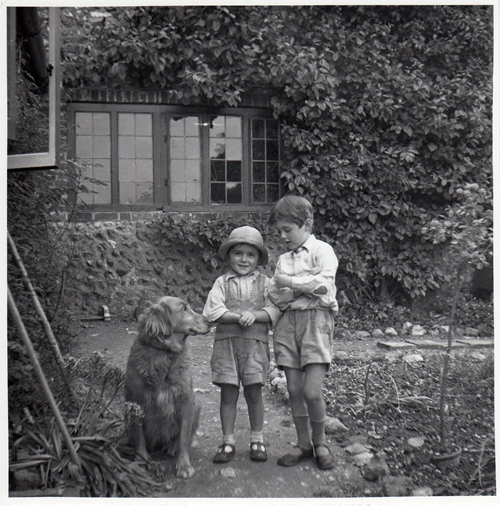 |
| Rikky and Robbie with an unidentified friend, probably outside the Old Hall |

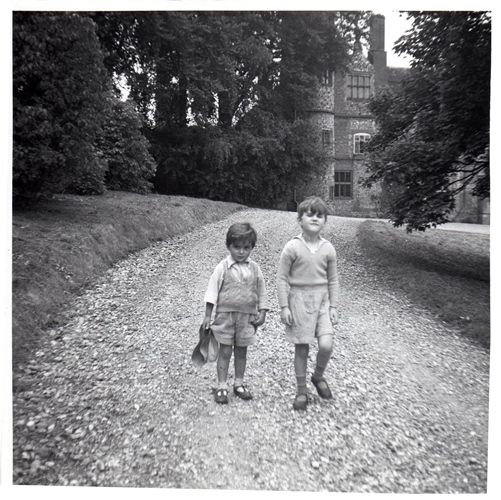 |
| On the Old Hall driveway |
 |
|
In August 1939, shortly after war was declared, Loetitia took their three youngest children with her to stay with her brother Bin Hibbert, then living in Bedford. HW, his nerves frayed by tiredness and depression, had become too difficult to live with. They returned to the farm in April 1940. Left to right: Margaret, Robert, Loetitia, Richard and Bin |
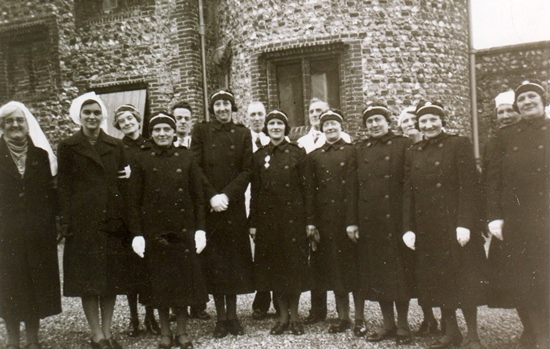 |
|
The Stiffkey branch of the Red Cross – on the extreme left is Mrs Sutton, with Loetitia next to her. Behind Loetitia is Mrs Cafferata, standing beside Billy Gidney, the village blacksmith. The tall woman sixth from left is Mrs Gladys Pearson (known locally as 'Long Polly'), wife of the village builder William Pearson. Others are unknown. |
 |
| A rare day out on the saltmarshes |
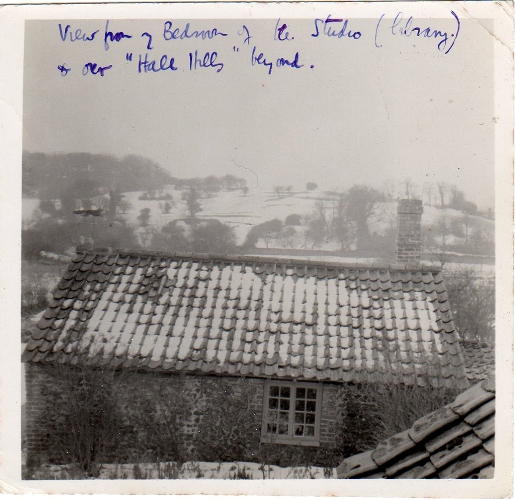 |
|
'The studio' was River View Cottage, next to the family farm house Walnut Tree Cottage. River View Cottage was bought from Mr Cafferata for £82/10/-, 'a bargain!' |
The first harvest, summer 1938:
On the 10th August 1938 we started to cut our first corn, the seven acres of oats on the southern end of Twenty-one Acres. At 7.5 a.m. the tractor began to drive down the four sides of a pale golden, wind-rustling square. Behind the tractor was an old Albion reaper and binder, bought at the auction last Michaelmas for £8. Long since had the paint rusted from the iron of its frame. Its worn three-horse draw-pole was now a chicken-perch in the cart shed. The tractor on rubber wheels pulled the machine on a new oak-and-iron bar.
. . . Nursed along by the tractor, with throttle barely open, the old binder was not allowed to 'het-up', fumble its iron fingers tying the knot around each sheaf, or tangle and break the string. Its new red wooden sails turned gently, as though caressing the blonde corn-heads as they held the sappy stalks upright for the saw-toothed knife below. New canvas rollers hurried the cut corn up to a platform, where metal arms held the stalks until they were gathered sheaf-size; when, tied by those iron fingers, the sheaf was flung off in line with others dropped on the new stubble.
The Story of a Norfolk Farm
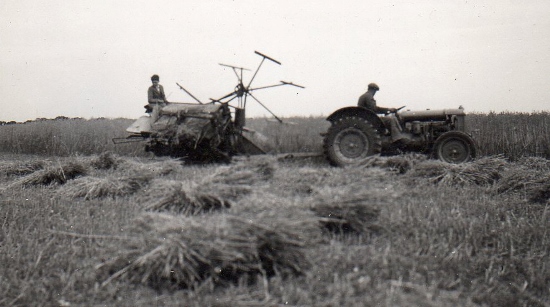 |
|
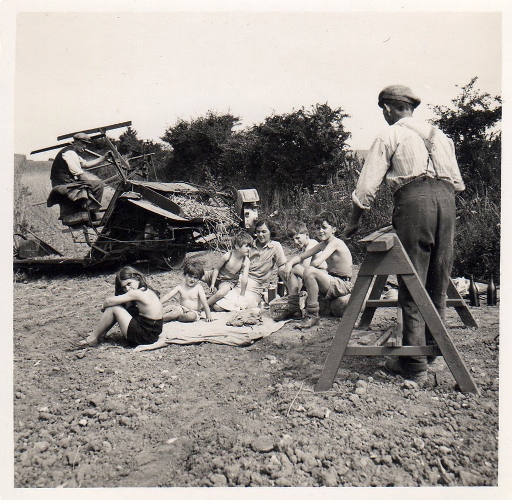
Bob Sutton driving the tractor, while Windles sits on the Albion reaper and binder, watching in case the binding twine breaks or tangles and jams the machinery |
 |
|
Bob sits on the binder while Jimmy sharpens the cutting knives Left to right at the family picnic are: Margaret, Richard, Robert, Loetitia, John and Windles |
 |
|
HW captioned a very similar picture in The Story of a Norfolk Farm: 'Photograph taken from seat on 24-year-old binder, 9 August 1938' The men are setting up stooks from the sheafs of corn |
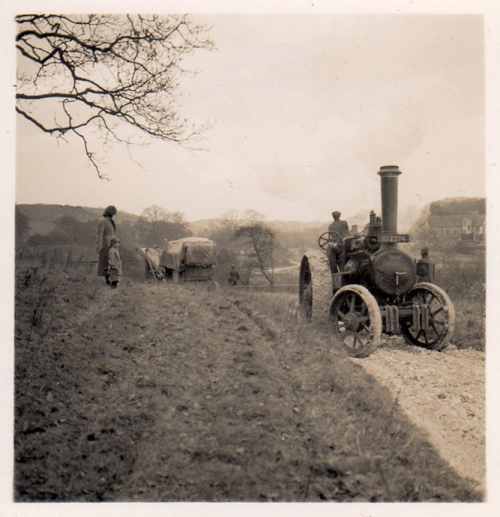 |
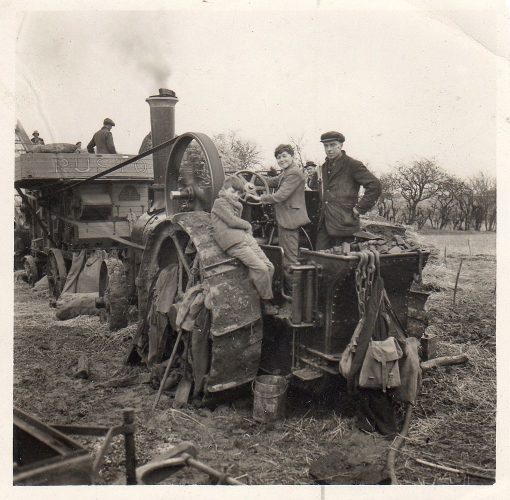
| The threshing machine arrives, winched up the hill by the Burrell traction engine |
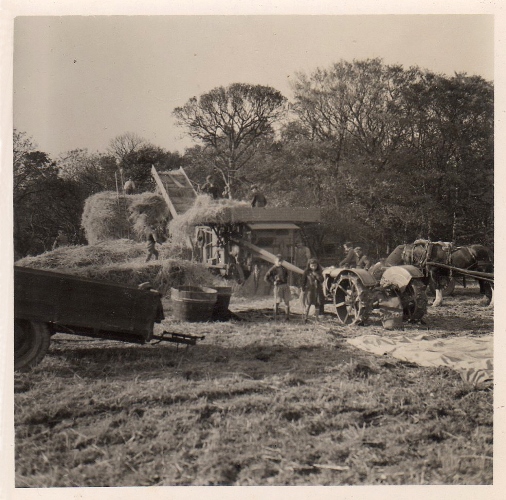 |
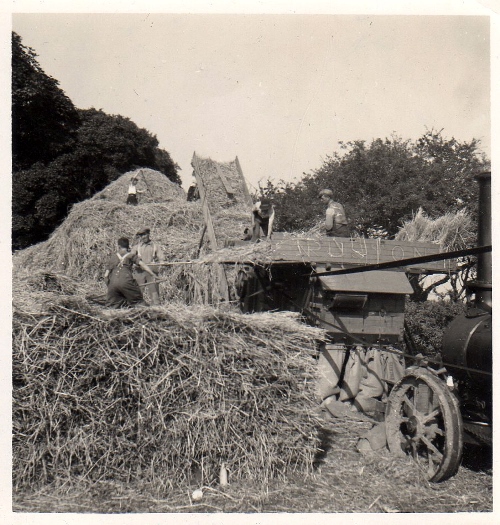
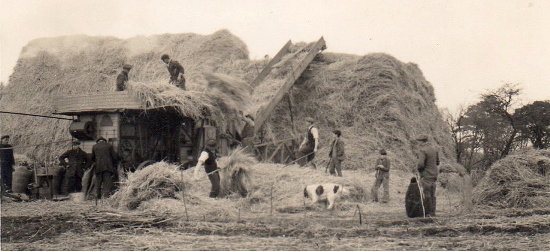
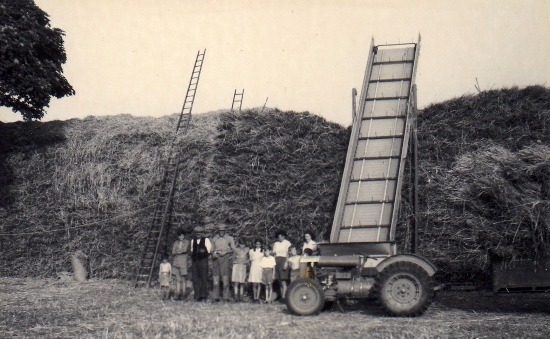
| Threshing Hang High; once the corn was threshed stacks were built of the straw |
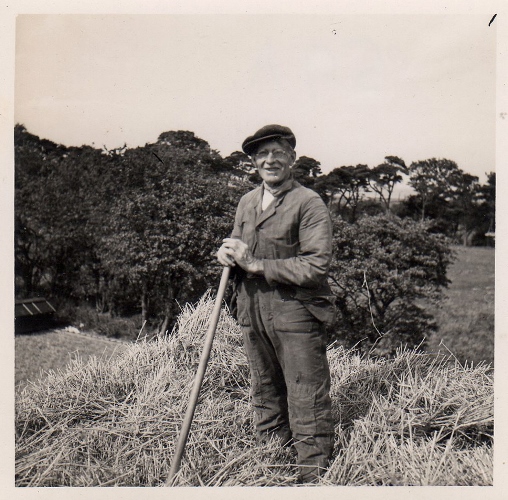 |
| Billy Jarvis on a stack |
 |
| The belt on the traction engine flywheel is driving the threshing machine |
 |
| John, Windles and Bob Bambridge |
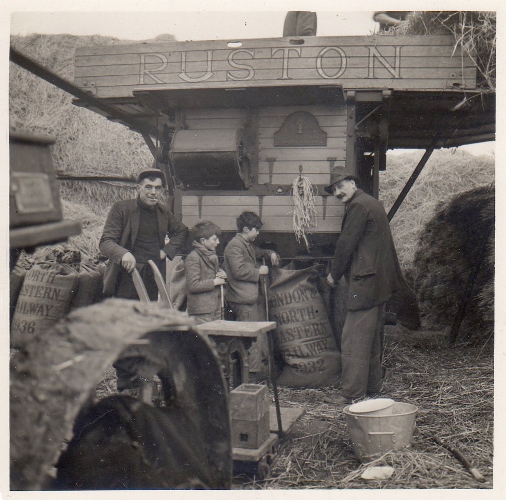 |
| John and Windles help hold the sacks for the threshed barley |


 |
| Loading the cart with sacks of barley. Left to right: —, Bob Sutton, John Coast |
 |
|
The team and some of their 'helpers' line up against a giant straw stack Left to right: Richard, Windles, —, —, John, Margaret, Robert, Poppy, —, Ann Thomas |
Back to The Story of a Norfolk Farm main page
The Story of a Norfolk Farm - Critical reception
Back to The Story of a Norfolk Farm main page
Critical reception:
The Story of a Norfolk Farm attracted a large number of reviews; samples are given below.
Publishers’ Circle, 25 January 1941:

Eastern Evening News, 29 January 1941:
When Henry Williamson uprooted himself from the West Country and came into North Norfolk to the new adventure of farming, he was no doubt aware that he had many difficulties before him. . . . Yet he is able to end with consciousness of a hard and often bitterly discouraging task surmounted, farm land put into good heart again, and a great deal learned in three uphill years.
Birmingham Post, 28 January 1941:
In this semi-autobiographical work Mr. Williamson pictures himself as a man who started farming without any practical knowledge. . . . The pose makes a useful background for a fascinating story of personal achievement. Coke, also of Norfolk [stated men can improve soil with hard work]. Many farmers have forgotten the lesson of Coke; Mr. Williamson has demonstrated . . . all the time he continued to drive his attractive pen as well as his tractor plough.
Here is an attractive book . . . a lively and illuminating searchlight on farming conditions in East Anglia. . . . and an urgent plea for reform. Mr. Williamson wants to see farming regenerated . . . [can only be achieved by discarding the old system].
Eastern Daily Press (Lilias Rider Haggard), 28 January 1941 (12½-inch column):

This review was reprinted in Norfolk News & Weekly Press, 1 February 1941.
Catholic Herald (Peter Thompson), 28 January 1941 (the 4-column review is divided into two sets of two, so that they are legible when resized):


Cavalcade, 1 February 1941 (15-inch column); it opens:

[and continues:] . . . Told in the distinctive Williamson style, vigorously yet with sensitive feeling . . . Author Williamson makes an eloquent appeal for the land and its people. . . .
[But] in his emotional extravagance on the grandeur of life on the land he quite overlooks the fact that . . . he could not have become a successful farmer had he not been able to turn to the B.B.C. and the book market to wipe out the overdrafts and debts. [But surely he does make that clear?]
News Chronicle (Robert Lynd), 3 February 1941 (8½ inches of total 18-inch column covering 5 books):
Mr. Henry Williamson writer of the country with a fine energy of the imagination . . . that of a restless spirit. . . . Mr. Williamson loves the land and is its passionate advocate . . . There are opinions expressed in the book with which many will disagree . . . This hot enthusiasm which makes him wish to indulge in vehement controversy, is one of the qualities which increase his stature as a writer. This autobiography of an initiate farmer is a piece at once sensitive and of heroic literature.
Western Mail (Harold M. Dowling), 4 February 1941:
[Some preliminary waffle] . . . Here the subject matter is obviously of first-rate topical interest. Agriculture is not only in the news: it is getting into the minds of people. .. . Well, all of it is here, absorbingly interesting even to the townsman, because of the splendid way in which it has been told.
News Review, 6 February 1941 (20-inch column):
[Mostly this is a slightly mocking review of HW’s life: Tarka the Otter is ‘the life of a fascinating animal half-way between seal and weasel which plays up and down the rivers of England and lives on salmon and trout.’ The contents of The Story of a Norfolk Farm are similarly treated:]
The whole of British agriculture was suffering because money was being drained from the land, reinvested in competing countries, where labour was cheaper and the scale of living lower. As protest Williamson wrote audacious articles [e.g. against Argentinian beef] . . . indignation thrust the Nature-lover into politics, . . . he runs a passage by Fascist Sir Oswald Mosley on his title page and hopes to publish his missing chapter in ‘happier times. . .’
[The photograph of HW and dead Gilbert is reproduced and captioned:]
FARMER WILLIAMSON, NAG.
Norfolk Chronicle (‘H.J.M.’ ‒ H.J. Massingham, the well-known natural history writer), 7 or 8 February 1941 (16½-inch column):
[The reviewer, who styles himself a ‘Norfolk Dumpling’ was initially worried by the long preamble about HW’s Silver Eagle & in-laws, but when the book actually turns to farming, it:]
. . .truly recreates the atmosphere of life in that corner of Norfolk. [The Story of a Norfolk Farm] is a strong indictment of our farmers and farming system . . . Mr Williamson’s condemnation is based on facts which are well-known to all who have come into contact with agriculture. [and a paragraph is given to tithes]. The Story of a Norfolk Farm is the story of a courageous venture . . . with fine illustrations, [e.g.] ‘The Death of an Old Horse’ . . . The book is worthy of a place on any bookshelf.
Country Life (‘W.G.’), 8 February 1941 (21-inch column):
A BRAVE VENTURE
MR. HENRY WILLIAMSON EMBARKS ON FARMING
There is a vast and growing number of people resolved that the new structure of England shall rest on the foundation of a prosperous and contented countryside, knowing well that only thus can it be secure. [Covers the plight of agriculture over many years: ‘in 1870 the best farm-land in the world’. . .]
Mr. Henry Williamson [in the book] has thought upon all these things and written of them . . . [and acted upon them].
[The reviewer discusses various points within the book (finding too much that is not actual farming) admitting he does not know any other of HW’s books.]
What makes the book worth the writing and the reading, is the undoubted sincerity of its appeal for a restored countryside. We need all possible aid to realise these ideals; as he says ‘a nation neglecting its soil neglects its soul: its people will perish.’
Observer (Sir William Beach Thomas), 9 February 1941 (12-inch column):
[A long chatty lead-in paragraph on why HW ‘meditated a migration from Devon to Norfolk’. There is a great deal of padding in the review: the last (3-inch) paragraph gets down to the meat:]
The records of the purchase of the farm is interspersed with a good deal of autobiographical experiences of an earlier date; but happily those that refer to mental reactions during and after the last war . . . he has few inhibitions. . . .
[On a copy of this HW has written: ‘Badly written review, it tells reader little or nothing.']
East Anglian Daily Times, 10 February 1941 (5½-inch column):

East Anglian Daily Times, 10 February 1941 (in the column ‘The Book Lounge’ by Lounger):
[When HW went to live in Stiffkey, East Anglians looked forward to an illumination on farming life in the tradition already lit by Doreen Wallace, Adrian Bell, and H. W. Freeman.]
They will not be disappointed. . . . [gives a succinct precis of salient background of HW’s struggles] . . . The Story, illustrated with unusual photographs, is told with gusto and with amusing sidelights on the author’s good-natured but feckless ‘in-laws’ the Cobbolds and on farming alarums and excursions in Norwich. And of course there is much about wild life in this stimulating book.
The Lady (Edith Shackleton), 13 February 1941 (10½-inch column):
How rare, how exhilarating, is the writer who can communicate his own excitement as Mr. Henry Williamson does . . . in practised and biting English . . . Mr. Williamson shouts, as Cobbold and Jefferies did before him, for a more complete English life, for the treatment of English soil as essential to that life. . . .
[Relates the dream-vision HW had ‘by a fire in the Barbarian club on the day he bought the farm’ and that a lot of this came true but by ‘what work and hardship, disappointment and discomfort!’]
However: we do put down this book with the conviction that to be a farmer is perhaps a lot more fun than being a farmer’s wife.
Punch, 12 February 1941 (Of course gets it all into a nutshell!):

The Spectator (A. G. Street ‒ farmer turned author), 14 February 1941 (9 x 3½-inch column):
This is the story of an established writer who, of his own free will, chose to become a farmer. . . . [The author never trusted anyone and every incident is tainted with ill-temper.] The only people to come out of this with any credit are Mr. Williamson’s farm employees. . . . [Mr. Williamson should have listened to those who knew about farming but] Mr. Williamson preferred to take his own line. . . .
But [in spite of everything] the end of this book finds the Norfolk farm in much better shape . . . That in itself is no small achievement, and the manner of the accomplishment makes interesting reading. In consequence there is little doubt that town readers will look upon this book as a useful treatise on how to become a farmer, and no doubt at all that country ones will consider it a volume of detailed instructions on how not to accomplish the very same thing.
HW has written alongside the above review words to the effect that the reviewer seems jealous of someone else writing about ‘his’ subject! There is no doubt something in HW’s comment: for Street had rather been pipped at the post. Three weeks later his own book, Wessex Wins (Faber & Faber, 8s.6d), was reviewed in The Times Literary Supplement (6 March 1941):
Following upon the heels of Mr. Williamson’s story of the author turns farmer comes Mr. Street’s account of precisely the reverse process, and it is not unamusing to compare their methods of approach . . . This book tells the background and success of Farmer’s Glory and Strawberry Roan – and so Street delegated his farming to others and broadcast, televised, gave talks to group meetings of the Conservative Party (who were tolerant) and Baldwin (who wasn’t). He went on a lecture tour of Canada but on returning home had a nervous breakdown (his next book being his 13th – i.e. he was superstitious to extreme!). War broke out – and he realised he was in fact what he was condemning – an absentee farmer. So he returned to farming – his reward being: ‘during the summer of 1940 Ditchampton Farm was placed in Class A. Thus Wessex wins.’
(I will repeat here that HW’s Norfolk Farm also achieved ‘A' status – and possibly under far more difficult conditions than Street encountered at that time.)
The Times Literary Supplement, 15 February 1941 (15½-inch column plus photograph); unsigned, as were all TLS reviews, but surely the same reviewer as Street’s book the previous week?
AUTHOR TURNS FARMER
A NORFOLK VENTURE
Mr. Henry Williamson, well known as author . . . found himself a few years ago impelled to become a farmer. It was the reaction of a generous minded man, who had fought in the last war . . . against the sense of aimlessness and frustration that has pervaded English life for the twenty years since the hollow peace had been declared.
[The reviewer likens (in elegantly amusing prose) HW’s purchase of the farm to falling in love with a seemingly totally unsuitable lady.]
Mr. Williamson makes a vivid story of getting the almost derelict farm into order, nothing is hidden, and nothing is set down in malice. . . .
The account of the first year of trial and error makes sorrowful reading from a technical point of view: what is in evidence is the writer’s buoyancy and determination. There is something typically English about the whole enterprise: Mr. Williamson entered upon it from pure romanticism, the gleam of a great purpose had been vouchsafed to him.
[Then a paragraph about ‘white bread’ – which HW denigrated, but the reviewer points out people buy by choice! But HW’s ‘emotional approach’ led him into politics: the slump in barley prices led to farmers’ meetings and a march on London.]
But as he tells us, politics have been excised from his book in deference to the present situation, we may guess that they would have been full-flavoured and out for direct action. These are the qualities that give the charm to his book . . . he makes us share in his delight in the changing seasons, in the humanity of his helpers and in the response of the land to his efforts. [Quotes from the epigraph chapter.] . . .
Determined, dared, and done.
Liverpool Daily Post (‘A.M.A.’), 1 February 1941:

Public Opinion, 21 February 1941 (whole page, unsigned):

[Then quotes the walk around the farm with the valuer.]
Mr. Williamson’s book certainly shows ‘something attempted, something done’ . . . readers will be delighted that the farm does pay its way.
New Statesman & Nation (Geoffrey Trease), 22 February 1941 (17-inch column):
Mr. Williamson possesses the two qualities, not over-frequent in combination, of high sensitivity and courage. The former was immediately revealed in his earliest writings: the latter is displayed on almost every page of this new book, from the Oswald Mosley quotation beneath the title, with which he defiantly nails his colours to the mast, to the declaration of faith on the final page. [Quotes end paragraph.] The intervening four hundred pages tell why, and how, he turned to the plow in the first instance. . . .
[He could have remained the writer of fine prose about wild-life but] . . .
Like his friend, T. E. Lawrence, Mr. Williamson feels he is unusual and craves desperately . . . to achieve normality. . . . So, heroically he becomes a farmer. . . .
The book tells how he discovered the farm, neglected and fit for nothing but shooting . . . today [he] can show a prosperous farm . . . [but he gives too much detail of accounts and legal matters – and a pity the publishers cut out any controversy].
His style is plainer than usual . . . There is the usual intense sincerity . . . and always the abiding impression of courage – the courage of a man who realized that a living artist must never doze in the niche of fame which he has carved . . .
Irish Independent (‘T.O.H.’), 26 February 1941; the review title is a nod perhaps to Richard Jefferies’ The Amateur Poacher?
THE STORY OF AN AMATEUR FARMER
[There have been a spate of ‘ploughshare narratives in recent years’ . . .]
The Story of a Norfolk Farm . . . is the story of a struggle and a success against depressing odds. A passionate lover of the land and the lost glories and customs of the English countryside . . .
Western Daily Press (‘Man O’Mendip’), 27 February 1941 (about 32-inch column)
AT THE SIGN OF THE PLOUGH AND SICKLE
[Written in fairly boisterous style – jollying his readers along: the first 8 inches are fairly amusing nonsense (but establish his credentials to write on farming) – ending:]
. . .read Henry Williamson’s latest and get an idea of the work involved.
[The reviewer has fellow-feeling for HW:]
Apart from the absorbing descriptions of farming routine the book is full of sound thought . . . tells with a pleasing frankness of many of his difficulties and with zest how he overcame them. . . . I think it would have pleased Coke of Holkham and Turnip Townsend who lived in the neighbourhood.
[The reviewer agrees with HW about the total folly of lack of investment in agriculture by the nation (government).]
Hampstead News (Fred Hyman), date unreadable:
SUGGESTIONS FOR YOUR LIBRARY LIST
Another aspect of the home front, the life and struggle of the country people: . . . the author fought in the last war and became a professional writer . . . tiring of city life [?!] he bought a derelict Norfolk Farm . . . One of the most absorbing passages in the book is his attempt to get into politics during the slump of 1938. His description of the countryman’s struggle to keep his head above water against the competition of cheap foreign grain is bitterly Satyrical.
[An interesting take on ‘satirical’.]
Church Times, 28 February 1941 (13-inch column); interestingly perceptive:
This story is the record of a sudden conversion . . . [from writer to farmer] . . . [and of hard work].
Bulking large among the fundamental causes was without question the desire to do something to convert the national outlook on agriculture. . . . In a sense it is the story of Tarka and Salar over again and is written with equal perception, sensitiveness, imagination, and simplicity. [But not an otter or a salmon ‒] they are a man who would be a farmer.
Montrose Review, 28 February 1941 (6½-inch column):
. . . Mr Williamson farmed by day and wrote by night, and almost inevitably became mixed up with politics . . . [and ends by quoting the last passages of the book] . . .
It is an important book, alike for the literary value as for the record of a notable experiment.
Current Literature (‘Tragos’), February 1941 (10-inch column):

Books of Today (‘Mark’), March 1941 (14½ x 3¼-inch column); an extraordinarily enthusiastic yet erudite piece:

British Weekly, 6 March 1941; the review is signed ‘A.R.T.’, against which HW has written: ‘Thank you, dear A. (Rosebud) T.’ ‒ i.e. Ann Thomas. Recollect the problems between these two at that time:

The Weekly Review (Lord Lymington), 6 March 1941 (10½ x 3½-inch column – but largish font size); a rather pedantic, semi-psychological review. Lymington was very right-wing and heavily involved in the Organic Movement:
This book is a not ignoble record of struggle which fairly demonstrates the schizophrenia under which our civilization labours.
[The reviewer finds the author is often irritatingly naive and subjective – but:]
. . . this is a book to be marked and learned . . . There are many excellent incidental things: [pen portrait of Bob, the steward] – a passionate love of the countryside – a moving but irrelevant memory of the Christmas Truce and in the end – ‘expressed in the English way’.
The Scotsman, 8 March 1941 (8-inch column); a fairly standard review and synopsis; the last paragraph reads:

John O’London (H. E. Bates), 7 March 1941 (14-inch column):
(H. E. Bates, 1906-74, was a prolific writer of popular books, many dramatised for TV, notably Fair Stood the Wind for France (1944), The Jacaranda Tree (1949), and The Darling Buds of May (1958). His review here is very grudging and denigrating. HW has written against a copy: ‘This is a very queer review by a country writer of note who seems to be angry with a possible “rival”. He thus couples Bates with the earlier note written against the review by A. G. Street.) The review is headed:
Henry Williamson – Farmer
[The last paragraph sums up the whole:]
In this way The Story of a Norfolk Farm succeeds in being a markedly contradictory affair: energetic but slipshod, well-intentioned but ill-tempered, argumentative but irrational, racy but lazy, readable but skippable. And the hero is, of course, not the farm, or agriculture, or England old and new, but Mr. Williamson itself.
Oxford Mail, 10 March 1941:
. . . written in that vivid prose his admirers know so well and in a fever of indignation against the present system of ‘price-cutting (etc.)’ the book is an absorbing and inspiring chronicle.
Apart from the political aspect on which Mr. Williamson feels and writes so strongly and with so much common sense . . . this is a book which will appeal to all who love the land. . . .
East Anglian Daily Times, 12 March 1941:
Not a review of the book, but ‘Notes About’, in this case the Spring Issue of The Countryman which had printed contributions to a symposium on ‘The Rural School – ‘rural education needs a rural basis’ – including pieces from Adrian Bell, H. W. Freeman, S. L. Bensusan, and HW – all well-known local authors. An interesting side-light on authorial activity! Unfortunately no copy of the original item is in the archive.
The Listener, 13 March 1941 (5½-inch column):
A fairly straightforward appraisal which ends noting that the stated omitted material ‘would have taken the form of support for Sir Oswald Mosley’.
Nature (E. J. Russell), 22 March 1941 (14 x 3-inch column); the reviewer is Sir John Russell, 1872-1965, distinguished agricultural scientist, and much involved in the ‘Organic Movement’ – for whose book English Farming HW had written an Introduction:
. . . All this [the buying of a derelict farm in Norfolk and its problems] and much more is set out vividly by Mr. Williamson. From the outset he was under no illusions as to the magnitude of the task he had undertaken . . . Much of the book is autobiographical . . . He gives sufficient technical detail for the agriculturalist without tiring the general reader. He has much to say about the barley crop of 1938, one of the best of our time . . . but the price nearly the worst . . .
The book will be read with interest by all who think they would like a farmer’s life . . . it shows the trials the beginner encounters and the satisfaction in overcoming them.
Time and Tide (Paul Bloomfield), 22 March 1941 (14-inch column):
Men and Books — Blood and Land
[‘Blood’ being Temperate Zone by Nancy Johnstone (Faber & Faber, 7s. 6d.); ‘Land’ being The Story of a Norfolk Farm . . . 12 of the 14 inches are devoted to ‘Blood’ comparing Temperate Zone to D. H. Lawrence’s The Plumed Serpent in a clever intellectual argument. The remaining 2 inches are given to HW:]
It is an interesting realistic book giving many details of the author’s experiment.
[But Mr Bloomfield is still busy with his clever intellectualism, and one of the two inches quotes four lines of a French poem (not attributed, but it reads like one of Paul Verlaine’s – or maybe Leconte de Lisle) about nature nourishing hunger and thirst. HW wrote a rude word next to this: I’m afraid for once I have broken my cardinal rule – and tippexed it out!]
The Bookseller (John Hadfield), 3 April 1941 (a total of 2 pages):
In the spring a reader’s fancy . . .
‘From a broadcast talk in the series ‘What I am Reading Now’
[Hadfield saunters in his chatty confiding manner through spring days in general and the books brought to mind – The Story of a Norfolk Farm among them. He doesn’t say anything new but he does sum the whole concept up rather nicely:]
I dare say you remember his Tarka the Otter and Salar the Salmon. This new book of his tells how an author, knowing precious little about farming, bought a weed-ridden, neglected farm in Norfolk, and in three years, by sheer hard work and determination, put the heart back into the land and made the farm prosper. Henry Williamson is a queer card – he says so himself. But he doesn’t lack imagination and he doesn’t lack courage.
*************************
Let’s end with a wider look at the literary world of war-torn 1941:
The Scotsman, 27 March1941:

Back to The Story of a Norfolk Farm main page
The Story of a Norfolk Farm - Appendices
Back to The Story of a Norfolk Farm main page
Appendix A: The missing material
Appendix B: Other 'Norfolk Farm' writings
Appendix A: The missing material:

Although there are no diary entries, it is evident that a great deal of discussion had taken place before the book was published. The answer to it all is held in a copy of bound original page-proofs which contain this ‘missing material’, and shows at what a late stage it was all dealt with. The deleted material would have been ‘Chapter Forty-six: Birkin for Britain’, and its ten-page content opens:
One evening Lady Sunne rang up and said that Birkin was coming to speak at the Corn Hall of Fenton, the next Sunday night. Fenton was at the mouth of the main river that drained the fen country.
‘Lady Sunne’, as already stated, was Dorothy, Dowager Lady Downe, and Fenton is King’s Lynn, situated on the mouth of the River Ouse where it drains into the Wash. Birkin is Sir Oswald Mosley. The chapter tells how HW drives across country to the meeting (his diary notes for 29 January 1939: ‘Mosley at Lynn Corn Hall’), passing the Royal residence of Sandringham en route, and so arrives at Fenton Corn Hall.
The Corn Hall stood back from the Square. Motor-cars were parked irregularly before it. The Hall showed the decayed look of the place; it looked too big for the shrunken modern harvests . . .
The chapter describes very factually and straightforwardly the gist of ‘Birkin’s’ background and how HW had already met him at a previous dinner party at Sunne Hall, and that:
Half a tree-trunk burned in the fireplace of the dining-room of Sunne Hall. My waistcoat was rather tight, two years since I had worn it . . .
Regular HW readers will recognise this material as being the same as that in The Phoenix Generation (1965, vol. 12, A Chronicle of Ancient Sunlight), Chapter 14: ‘Birkin for Britain’. The two chapters are not identical, for HW incorporates a complicated fictional scenario for the Chronicle version, which, at 19 pages (pp. 301-319), is longer; but all the material from that deleted Story of a Norfolk Farm chapter can be found there.
There are a few other small deletions: for example, two in connection with Lady Sunne, whose membership of the ‘Imperialist Socialist Party’ on p. 186 is changed to ‘what she and her friends believed’, and on p. 187 (last line) ‘of her party’.
At the head of the deleted chapter HW has written in pencil:
Cut out after months of pleading and ‘sound sensible reasons’ by Dick de la Mare, Geoffrey Faber, & others up there, Ann Thomas, etc etc etc. They thought it would get the book a very bad press . . .
The problem was, of course, that on 23 May 1940 Sir Oswald Mosley had been arrested and imprisoned under Defence Regulation 18B; he was condemned by all and sundry as a traitor, but without real cause or a trial – see the Postscript at end of this Appendix. Lady Mosley was also imprisoned soon afterwards. They were held for the duration of the war, although later released to house arrest due to Mosley’s illness.
On Friday, 14 June, following an official complaint by locals (almost certainly led by Major Hammond, who used ‘Goitre’ Gidney, the local rag and bone merchant, to approach Norman Jordan ‘for evidence to have me put in prison’ (HW’s diary, 12 May), plain-clothes detectives arrived at Old Hall Farm, searching the premises and questioning HW, before taking him to Wells police station He was locked in a cell over the weekend, but treated ‘kindly’ and allowed to write his farm story. He was visited by his wife and Ann Thomas, when they all sat in the yard behind the police-house. On the Monday morning he was taken to Norwich police station for an interview with the Chief Constable, Captain Van Neck, who released him without charge, because, as his diary records, ‘nothing was found against me’. But the Chief Constable warned him to watch his back, as the locals regarded him as a traitor working for the Germans. (HW’s subsequent avowals that he had been actually imprisoned were completely untrue, arising no doubt from an exaggeration of his weekend’s detention for effect.)
In these circumstances it would have surely been folly to have included such direct references to Mosley, although HW indicates in an MS note at the end of the deleted chapter that he feels a traitor for having done so – ‘a damned little Peter . . . over so slight a matter that no one would have heeded it’. But from this distance of time, and with the inclusion of that deleted material in The Phoenix Generation, it has all transmuted into a socio-historical context.
What is of interest (and considerable surprise) is that HW is using the name ‘Birkin’ for Mosley at this early stage (i.e. in 1940). Hitherto the presumption has been that ‘Birkin’ is the product of the fictional Chronicle novel-series; although as the character was always instantly recognisable as Mosley, one wonders why any nom-de-plume was ever used! The use of this name even extended in this first version to HW’s title-page quotation, which in these bound page-proofs is ascribed as:
‘FROM SPEECH BY BIRKIN, MARCH 1936’
The proofs were amended by HW to ‘Sir Oswald Mosley’ for the printed book.
At this point the quotations were actually on a separate page; but HW notes – ‘Transpose to title page’, in order to accommodate his new ‘Author’s Note’, now placed there instead. (With the type being hand set, as little disturbance as possible to already type-set pages was necessary to avoid the extra expense.)
There is no mention of this anywhere that I have found in HW’s archive, but the name ‘Birkin’ is surely taken from the famous racing driver, Sir Henry ‘Tim’ Birkin, one of the Bentley Boys, who took part in Le Mans races in the 1920s and who died in 1933 from septicaemia after burning his arm on the very hot exhaust pipe which ran along outside the car at arm height. He had lived at Blakeney, just along the road from Stiffkey and Old Hall Farm.

By strange coincidence, Birkin's daughter was the first wife of Lord Aubrey Buxton, MC, the owner of Old Hall Farm in recent years and Patron of the Henry Williamson Society until his death in September 2009, a role now taken over by his son James.
The other main (but still slight) omission/deletion in the printed version of The Story of a Norfolk Farm led HW into making a small error. On p. 26, when HW is driving up to Norfolk over the New Year 1935-6 and remembering his 1912 cycle ride, he stops at the mill, ‘now a sombre semi-ruin’, where he saw his first otter. The original page-proof version read:
Some one had white-washed a crude device on the door with the words, Birkin for Britain. This meant nothing to me, beyond a vague idea that Birkin was a revolutionary politician who addressed big open-air meetings which usually ended in fighting.
This was changed in the printed version to:
. . . with the words, Stand by the King. This was probably done in the days before the abdication of Edward VIII.
However, HW was actually making that journey several months before the abdication of Edward VIII. Obviously, in the tension of dealing with these changes, no-one noticed the tiny discrepancy!

Postscript to Appendix A:
Pasted into the front of HW’s C.G.A. ‘Estate Book diary’ for 1940 are some newspaper cuttings referring to Sir Oswald Mosley’s detention. They are of historical interest, and help clarify the situation.
The first, from the Daily Express, is undated – but as it mentions 40 days of detention, one can assume the date was early July; indeed HW’s diary entry for 1 July states: ‘Mosley had his examination today, according to the papers. . . .’

Then from The Times, again undated (but HW has written beside it ‘Monday or Tuesday, Weds, 9-10-11 Dec. 1940’), is a report concerning a session of the House of Commons. (Mr Stokes would appear to have been, from a comment made later in the report, a socialist MP.) HW has written his own comments alongside – basically a despair of fixed ideas, ‘which are all right if the ideas are those of a creative thinker . . .’ (No-one sees their own blind spots!)


Although outside the actual time period of The Story of a Norfolk Farm, this 1940 diary comes within the complications surrounding its writing and publication. It opens:
Monday, 1 January: This is rather a sad beginning of Hope, or a New Year. Our country is at war, though none of the people will it.
It ends on 31 December with:
We are threatened with invasion in 1941, & I fear we shall be terribly mauled, perhaps mortally. . . . England, England, England, disentangle thyself and become again simple unencumbered Albion . . . But I am tired, & can write no more, though hope is still alive in my heart . . .
(Note the ring of William Blake about this – one of HW’s Romantic poet mentors.)
*************************
Appendix B: Other ‘Norfolk Farm’ writings:
The Story of a Norfolk Farm covers only a small part of the total story of HW’s sojourn at Old Hall Farm. In due course he wrote a sequel to this first book, but this was never published as such. Instead it was incorporated into the farm volumes of A Chronicle of Ancient Sunlight, and will be discussed with that context. Vol. 12, The Phoenix Generation, covers the same period as The Story of a Norfolk Farm itself; the series then continues with vol. 13, A Solitary War (1966) and vol. 14, Lucifer before Sunrise (1967).
However, the full story of the farm can only be really understood by reading the large number of articles that HW wrote during that time, which indeed gave him the income with which to keep the farm going; more importantly, they shed light on many areas of his farming years. These are imperative reading for any serious follower of HW’s life and of farming at that time. They also reveal just how large HW’s writing output was during that time. These articles have been gathered together in a series of volumes edited with great dedication by John Gregory and published by the HW Society, and all are currently available either in book form or as e-books from the ‘Online Bookshop’ section of this website. The titles are:
 |
Chronicles of a Norfolk Farmer: Contributions to the Daily Express, 1937‒1939 (HWS, 2004; e-book 2013). The articles cover a wide range of subjects and the book includes not only the original illustrations but also several photographs of the farm. The paperback is now out of print; the e-book is available for download. | |
 |
Heart of England: Contributions to the Evening Standard, 1939‒1941 (HWS, 2003; e-book 2013). Headlines from the paper that appeared in the same issue as each article illustrate the progress of the war and make a stark reminder and contrast to HW’s essays. The paperback is now out of print; the e-book edition is available for download. | |
 |
Green Fields and Pavements: A Norfolk Farmer in Wartime (HWS, 1995; e-book 2013). HW’s contributions to the Eastern Daily Press during 1941-44. It has an introduction by Bill Williamson (HW’s eldest son, ‘Windles’, who worked on the farm throughout the war), and is illustrated by Mick Loates. Both hardback and e-book editions are available. | |
 |
A Breath of Country Air, Part One (HWS, 1990; one-vol. e-book 2013). HW’s contributions to the Evening Standard in 1944, with a Foreword by Richard Williamson (‘Baby Richard’ of the Norfolk Farm – now President of the HWS). The paperback is now out of print; the one-vol. e-book edition is available for download.
A Breath of Country Air, Part Two (HWS, 1991; one-vol. e-book 2013). HW’s contributions to the Evening Standard in 1945; plus the series ‘Quest,’ written for Woman’s Illustrated in 1946, which tells in honest detail family life immediately after the farm. With a Foreword by Robert Williamson. Both paperback and the one-vol. e-book edition are available.
Illustrated is the cover of the e-book edition. |
|
 |
HW’s BBC radio broadcasts made during the farm years, under the series titles of 'Close to Earth', 'Green Fields and Pavements' and 'Still Close to Earth', are collected in Spring Days in Devon and other Broadcasts (HWS, 1992; e-book 2013) and Pen and Plough: Further Broadcasts (HWS, 1993; e-book 2013).
Illustrated are the covers of the e-book editions. |
|
 |
||
 |
HW also wrote an Introduction for Sir John Russell’s English Farming; this is reprinted as ‘English Farming’ in Indian Summer Notebook: A Writer’s Miscellany (HWS, 2001; e-book 2013; both paperback and e-book editions are available). In this essay HW equates the present war as ‘the second phase of the Great War’. The essay neatly encapsulates the Norfolk Farm era in 4 pages! Immediately following this essay is reprinted ‘The Winter of 1941’, first published in The Pleasure Ground, ed. Malcolm Elwin (1947). | |
*************************
Also of this farming era is HW’s collaboration with Lilias Rider Haggard in Norfolk Life (Faber & Faber, 1943). Lilias, daughter of the famous writer Sir Henry Rider Haggard, wrote for the Eastern Daily Press. HW had been reading her articles and contacted Lilias offering to edit them into book form. He contributed the first chapter and sundry notes, but it is not really possible to tell how much work he put into the book as a whole; certainly more than is evident. Lilias was very appreciative at the time but it would appear that friends influenced her against the sequel that HW suggested in due course. They felt HW had interfered too much with ‘her’ work (although it would never have been published in book form without his input into the project).
Rider Haggard had acquired the estate of Ditchingham House (near Bungay on the Norfolk/Suffolk border, the River Waveney) through his marriage in 1880 to Louise Margitson (its heiress). This resulted in his farming activities and the books A Farmer’s Year (1899) and Rural England (1902), a survey of agricultural decline. Lilias inherited the Ditchingham estate from her father, and when HW’s wife moved to Ditchingham after their divorce the two women became friends. HW occasionally met Lilias on his frequent visits to his ex-wife.
*************************
Also see: HW’s ‘Epigraph’ (dated ‘Botesdale, 1946’) in George Gill’s A Fight Against Tithes (1952). Gill had died and HW seems to have taken on the responsibility for getting the book published.
The following cutting is pasted into the front of his 1936 diary:

Back to The Story of a Norfolk Farm main page