
The Henry Williamson Society
Uncategorised
The Children of Shallowford - John's Book
Back to The Children of Shallowford main page
Some family photographs from the Shallowford era
Henry Williamson and Reginald Pound
John's Book
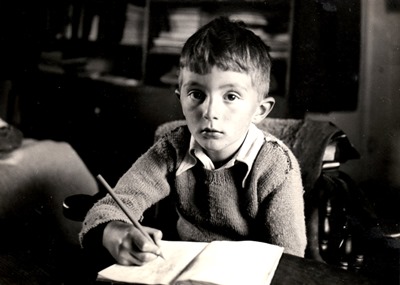
In Chapter 15 of the first edition of The Children of Shallowford, HW tells us:
Windles was teaching himself to use a typewriter . . . John also learned to type; indeed, during this year, the sixth in the valley of the Bray, when he was away from school for the summer term because the pale thin little boy must live in the sun, he wrote his autobiography. I asked him to write a chapter every day, telling him only that he should write the truth, for that was the best kind of writing. That was the only help he got from me. I've half a mind to publish that book, it is quaint and direct, and terse in style. Perhaps I shall, at the end of this book . . .
And then, in Chapter 20:
I have also got permission from the author of About My Life to print his book, or such selections of it as are deemed fit to be published (and one chapter at least is starkly realistic, with ancient Anglo-Saxon words that are not usually printed). In those pages the reader will notice the laconic calm of John's style, compared with my own nervous, multi-detailed prose: contrast between classic and subjective styles.
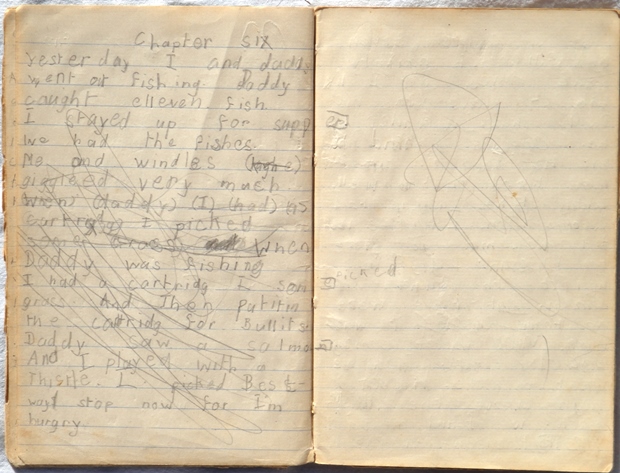
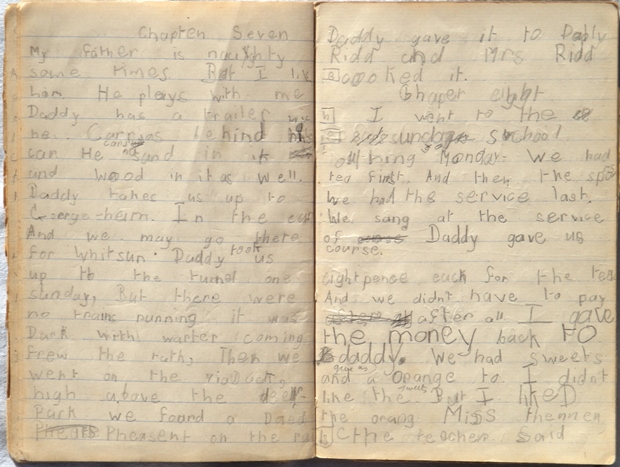
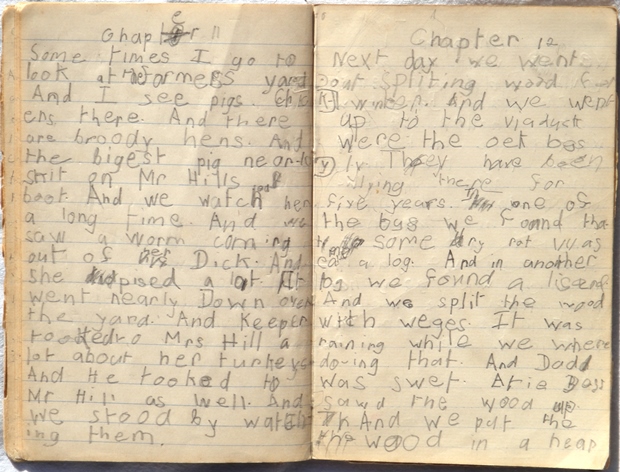
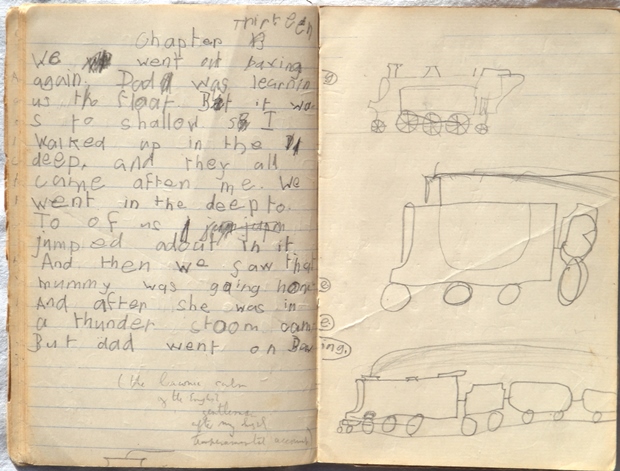
John wrote his book when aged 6½: he had had to have a period away from school in order to recover from a ‘debilitating illness’. This was the period following his pneumonia and a burst eardrum (which left him partially and increasingly deaf). During that time, as an occupation to keep him from being bored, it was suggested that he should write a book – like his father. Here we have the result. It is a charming example of childish story telling. However – it is even more charming in his original handwriting, and so that is appended here. Below each chapter is given HW's transcript as given in The Children of Shallowford's penultimate chapter. Henry writes: 'Here it is, exactly as written.' — Well . . . not quite, as will be seen below.
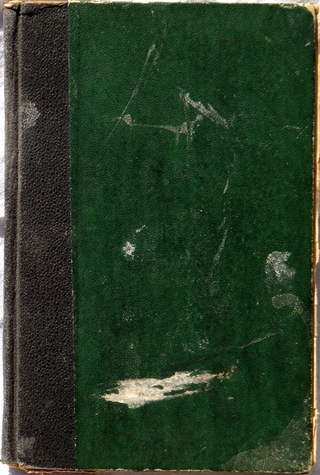
The book itself is a small (4½ x 6½ inches) notebook with dark-green boards, perhaps originally intended for another purpose, as on the inside cover is pencilled:
Proposed by Mrs W
Seconded Mrs S-R
Carried unanimously
And underneath, in red ink HW has written:
This book was written by John Williamson, at Shallowford, North Devon, during the summer of 1935, while home from school owing to debility. He was 6½ years old.
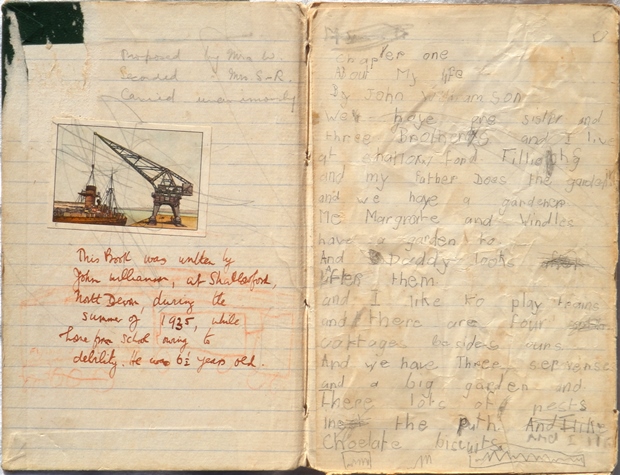
ABOUT MY LIFE
Chapter One
by John Williamson
We have one sister and three Brothers and I live at shallow Ford Filligh and my father Does the gardening and we have a gardener. Me Margrate and Windles have a garden to. And Daddy looks after them.
and I like to play trains and there are Four cottages besides ours. And we have three servenses and a big garden and There lots of nests in the path. And I like Choclate biscuits.
**********

Chapter tow
And we have a river and Daddy has cauthg lots of fish in it. And dad has caught one sea trout and three samons. And we liked them as well. We give them lots of food And we are going to bath to-day. And yesterday when we where bathing I found a candle stick. We thought a fish Jumped up I be-gan to make stones Jump acros the water. And then we sat down in the water. And I sat down in the deep.
Chapter three
And when I first went to school I liked It. But now I don't. And I have to stay home. Because I have a hole in my ear drum.
I don't like sums but I like riting. And Im in standard one. The sums are easy and we have cakes sometimes. I like egg sandwiches.
We say prayers first. And then we must sloot the teacher. I sit be-side charlie Rippon. I go to a village school. And we have Choclate biscuits. And Ginger ones as well. And cheese sandwiches. I don't like them.
**********
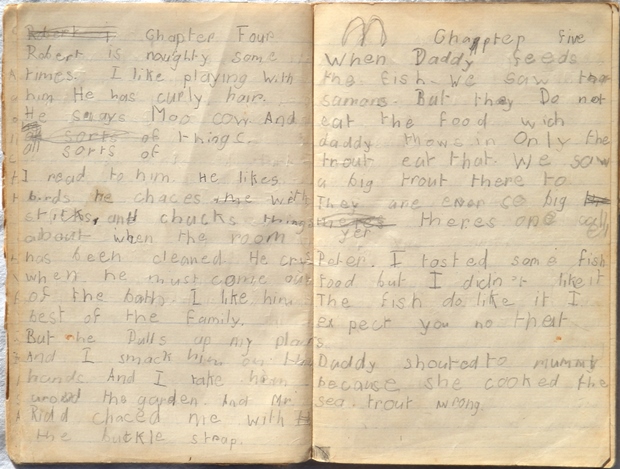
Chapter four
Robert is naughty some times. I like playing with him. He has curly hair. He says Moocow. And all sorts of things.
I read to him. He likes birds. He chaces me with sticks, and chucks things about when the room has been cleaned. He cris when he must come out of the bath. I like him best of the family.
But he Pulls up my plants And I smack him on the hands. And I take him around the garden. And Mr. Ridd chaced me with the buckle strap.
Chapter five
When Daddy feeds the fish—we saw the samans. But they Do not eat the food wich daddy throws in. Only the trout eat that. We saw a big trout there to. They are ever so big theres one called Peter. I tasted some fish food but I didn't like it. The fish do like it. I expect you no that.
Daddy shouted to mummy because she cooked the sea trout wrong.
**********
Chapter six
Yesterday I and daddy went out fishing. Daddy caught elleven fish. I stayed up for supper. We had the fishes. Me and Windles giggled very much. When daddy was fishing I had a cartridg I picked up some grass. And then put it in the cartridg for Bullits. Daddy saw a salmon. And I played with a thistle. I Best-way stop now for I'm hungry.
**********
Chapter seven
My father is naughty some times. But I like him. He plays with me. Daddy has a trailer wich he Carrias behind his car. He carrad sand in it. and wood in it as well. Daddy takes us up to Goerge-ham. In the car. And we may go there for Whitsun. Daddy took us up to the turnel one sunday, But there were no trains running it was Dark with warter coming frew the ruth, Then we went on the diaDuck, high above the deer-Park. we found a Daed Pheasent on the rails. Daddy gave it to Dolly Ridd and Mrs. Ridd cooked it.
Chapter eight
I went to the sunday school out-ing Monday. We had tea first. And then the sports. We had the service last. We sang at the service of course. Daddy gave us eightpence each for the tea. And we didn't have to pay after all. I gave the money back to daddy. We had sweets give us and a orange to. I didn't like the sweets. But I likD the orang. Miss pippercot the teecher said that we must always go to sunday school. But I have eat up all my sweets. [Not quite as written, while the last sentence looks suspiciously like HW's handwriting!]
**********

Chapter Nine
Windles has a stuffed barn owl. And when I went in by car I saw others. One was a heron. I found a dead bird in the Roed. And I took the bird home to Daddy and asked him if I could Have it stuffed. But Dad siad I couldn't have it done like that.
**********

Chapter ten
Mummy widles and I went to land cross. And when we went to bed. We said ee-ee. And it is near the rail-way line. When we heard the wishle we jump out of bed to watch it. In day time Windles and I go up into the packing room to watch the trains their.
**********
Chapter 11
Some times I go to look at the farmers yard. And I see pigs. Chickens there. And there are broody hens. And the bigest pig . . .
Censored
. . . And keeper tooked to Mrs. Hill a lot about her turkeys And he tooked to Mr. Hill as well. And we stood by watching them.
Chapter 12
Next day we went out spliting wood for winter. And we went up to the viaduct were the oak logs ly. They have been lying there for five years. In one of the logs we found that some dry rot was eating a log. And in another log we found a lizard. And we split the wood with weges. It was raining while we where do-ing that. And Dad was swet. Atie Bass sawd the wood up. And we put the wood in a heap.
**********
Chapter Thirteen
We went out baving again. Dad was learning us to float. But it was to shallow. so I walked up in the deep. And they all came after me. We went in the deep to. To of us jumped about in it. And I played with my candle stick. [This last sentence does not appear above.] And then we saw that mummy was going home. And after she was in a thunder stoom came. But dad went on Baving. [At the bottom of the page HW has written: '(the laconic calm of the English gentleman after my highly temperamental account)']
**********
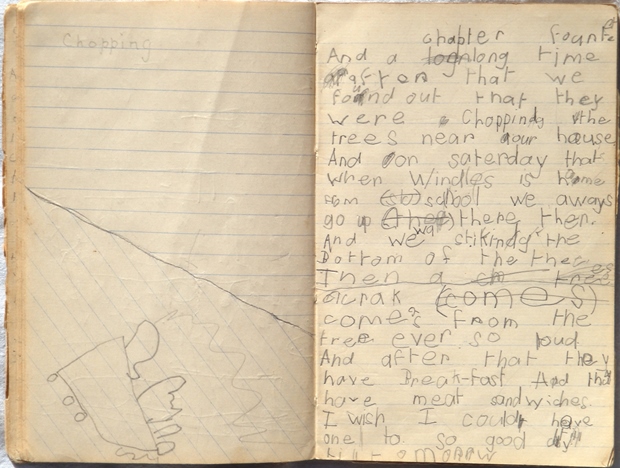
Chapter fourteen
And a long time after that we found out that they were chopping the trees near our house. And on saterday that's when Windles is home from school we always go up there then. And men stiking the Bottom of the tree. Then a crak comes from the tree ever so loud. And after that they have Breakfast. And they have meat sandwiches. I wish I could have one to. so good by till tomorrow.
**********

Chapter 15
In Augest we went for our holadays. Mage and I went to George-Ham. We went to Miss-Johnson's at the barn. And she has two swings. And no meat in the house onle vegtadles and fruit. I like moton and baked botatos. But Miss-Johnson calls Muton bludy cuops. I like bananas. When in the sun. Daddy and Windles where up in the Hut eat-ing eggs and Bakon and cake. And some times we go to the see-sands. When we went home

I [told] Mage adout the rain. When the sun shines thays giges up to the clouds the sun sucks the water up in the clouds and fills them and they burst and we have a storm.
**********
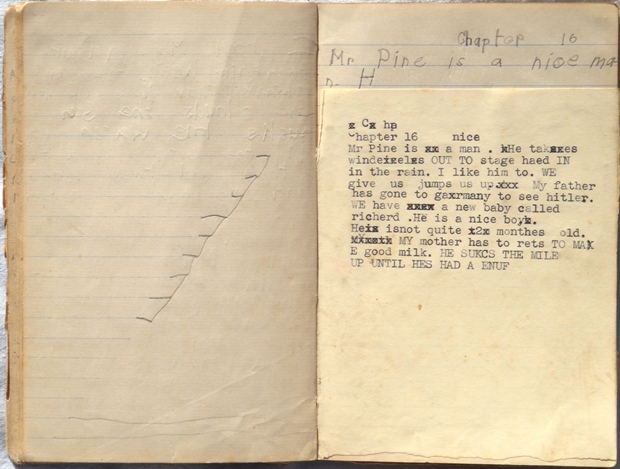
Chapter 16
Mr. Pine is a nice man. He takes Windels out to stage head in the rain. I like him to. He give us jumps us up. My father has gone to garmany to see hitler. We have a new baby called richerd. He is a nice boy. He is not quite 2 monthes old. My mother has to rest to make good milk. He sukcs the milk up until hes had a enuf.
**********
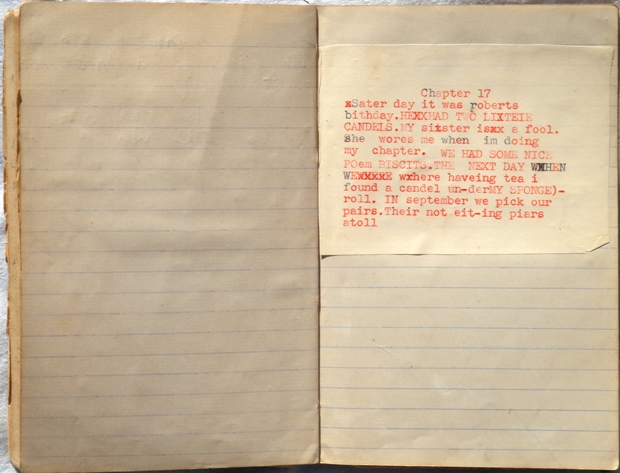
Chapter 17
Saterday it was roberts bithday. He had two litele candels. My sister is a fool. She wores me when im doing my chapter. We had some nice Poem Bicuits. The next day when we where haveing tea I found a candel un-der my sponge-roll. In September we pick our pairs. Their not eit-ing piars atoll.
**********
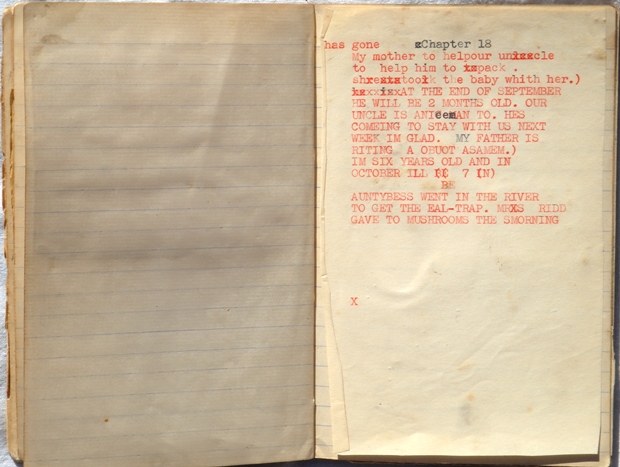
Chapter 18
My mother has gone to help our uncle to help him pack. (she took the baby whith her.) At the end of September he will be 2 months old. Our uncle is anice-man to. Hes comeing to stay with us next week Im glad. My father is riting a buot a samen.
Im six years old and in october Ill be 7.
Auntybess went in the river to get the eal-trap.
Mrs Ridd gave to mushrooms the smorning.
**********
Chapter 19
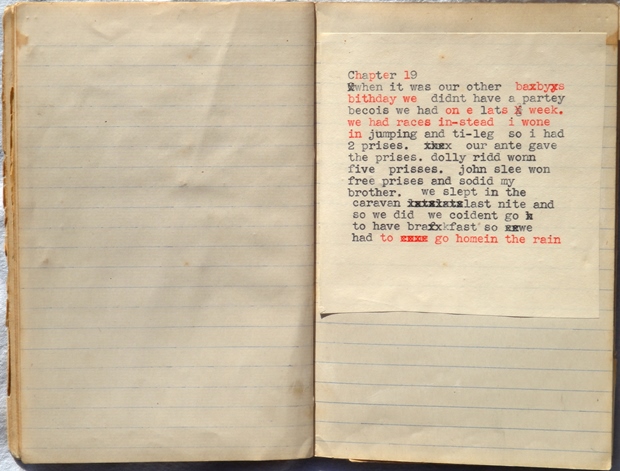
when it was our other babys* bithday we didnt have a partey becois we had one last week. We had races in-stead I wone in jumping and ti-leg so I had 2 prises. our ante gave the prises. Dolly Ridd wonn five prisses. John Slee won free prises and sodid my brother. We slept in the caravan last night and so we did we coident go to have brakfast so we had to go home in the rain.
* Rosemary, who being born a week after Robert, had to share the party.
**********
Capter 20
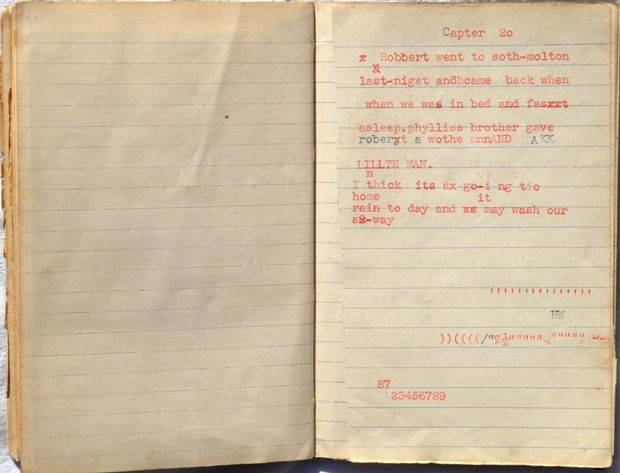
Robbert went to soth-molton last-niget and came back when we was in bed and fast asleep. Phyllis brother gave robert a wothe and a lillte man. I thinck its a go-ing to rain to day and it may wash our home a-way.
**********

Chapter 21
When they kill pig's they cut it's throit I now it's cruel to do that itnst it.
When they kill sheep they nock them down and cut it in hatf I think thay do.
Their is a tree crashed neir our house. Uncle came with his lugege yester-day and we wiar glad. he has made my sister a dolls houes the best you'v ever seen I bet you.
Chapter 22
(We are go-ing to barnstable fair to-morrow.)
**********
Chapter 23
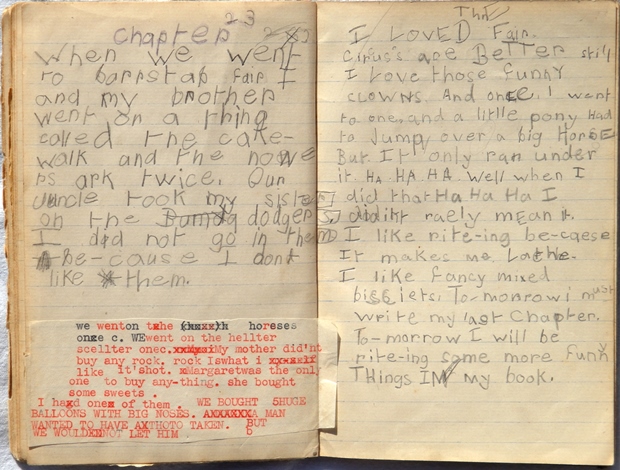
When we went to barnstap fair I and my brother went on a thing called the cake-walk and the nowers ark twice. Our uncle took my sister on the dodgers. I did not go in them be-cause I dont like them. We went on the horeses onec. We went on the hellter scellter onec. My mother did'nt buy any rock. rock is what I like it's hot. Margaret was the only one to buy any-thing. She bought some sweets. I had one of them. we bought 5 huge balloons with big noses. A man wanted to have a thoto taken. But we would not let him.
Chapter 24 [though not headed as such]
I loved the Fair. Circuses are Better still I love those funny clowns. And once I went to one, and a litlle pony had to jump over a big Horse. But it only ran under it. HA. HA. HA. Well when I did that Ha Ha Ha I didn't raely mean it. I like rite-ing be-caese It makes me lathe.
I like fancy mixed bisciets. To-morrow i must write my last chapter. To-morrow I will be rite-ing some more funny things in my book.
**********
Here HW inserts a totally fictitious entry, perhaps for dramatic effect, in which John describes how he pulled Robert out of the river when he fell in. In The Children of Shallowford, Chapter 20, 'River in Flood', he states that 'something happened that I learned of only when I read About My Life. When I questioned Loetitia and John about it, I pieced the facts together . . .' How HW did learn about the accident, and indeed what Loetitia and John thought about his fiction, is not recorded. In The Children of Shallowford the entry is given as follows:
Chapter 25
In January
when I was tak-ing
our two babys down
by the river. We came
to a little bridge by the
saw-mills. I thought I would
go across and get some
saw-dust. Then one
of the babys thuoght that the
water would hold him
so he stepped in. Then with cries
of terror I ran over the bridge and
tried to pull him out at last I managed
to by pulling him to the bank. Then we
started for hom I had two carry the baby
over the boggy parts be-cause he had lost
his wellingtons.
**********
Chapter 26 [though not headed as such]
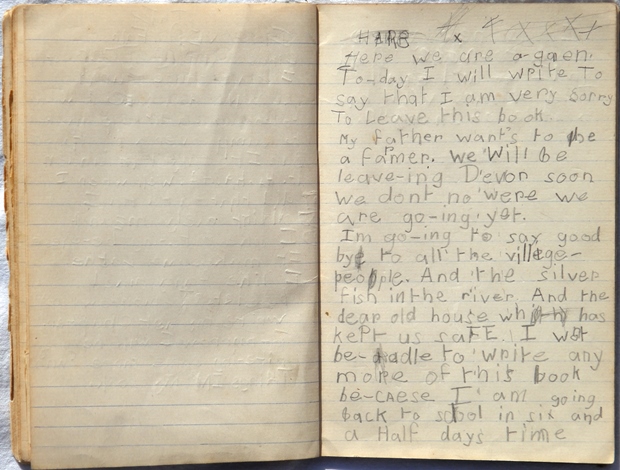
Here we are a-gaen. Today I will write to say that I am very sorry to leave this book.
My father wants to be a farmer. We will be leave-ing Devon soon we dont know where we are go-ing yet. Im go-ing to say good by to all the villige-people. And the silver fish in the river. And the dear old house which has kept us safe. I wont be-adle to write any more of this book be-cause I am going back to school in six and a Half days time
Daddy is go-ing away. To by a farm. [These two sentences do not appear in John's Book. Instead, more poignantly, he writes, 'It is new yeares eve to-nighte.'] Daddy and I and all the others will have a bottle of shampain.
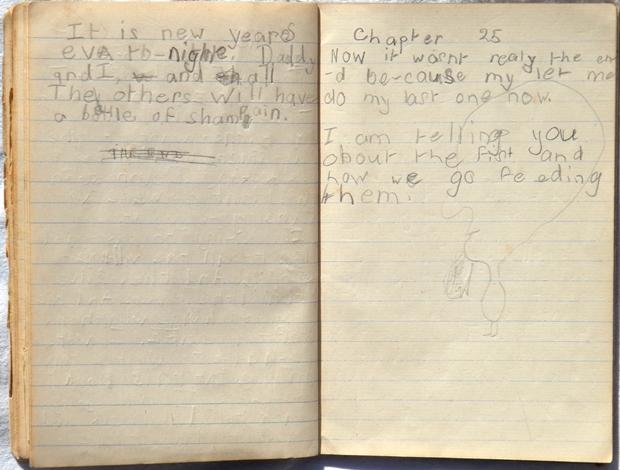
The true Chapter 25 above, the last chapter in John's Book, is not quoted by HW in The Children of Shallowford. It reads:
Now it wasnt realy the end be-cause my let me do my last one now.
I am telling you about the fish and how we go feeding them.
*************************
John made a false start to his book, beginning at the back of the notebook, where the last few pages have been cut out, before starting again at the front:
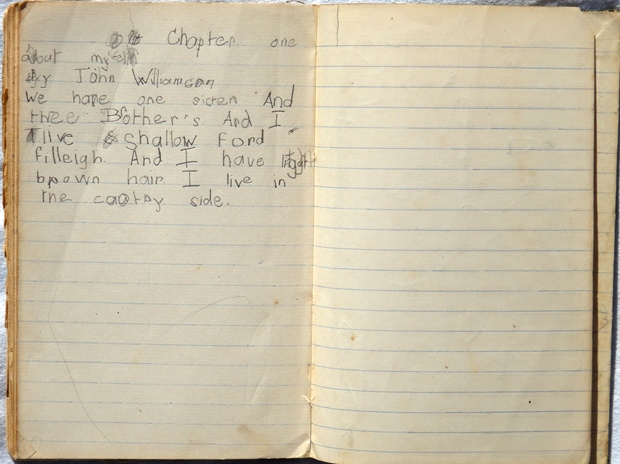
*************************
Back to The Children of Shallowford main page
Some family photographs from the Shallowford era
Henry Williamson and Reginald Pound
Shallowford - some family photographs
Back to The Children of Shallowford main page
Presented on this page are a selection of photographs of the Williamson family from the Shallowford era; more photographs are shown on the main page for The Children of Shallowford. Some of them may already be familiar to readers of the first edition or of the 1978 new edition, which contained a different set of illustrations. Others, however, have never been seen before outside the family. They are (very) roughly in chronological order.
 |
|
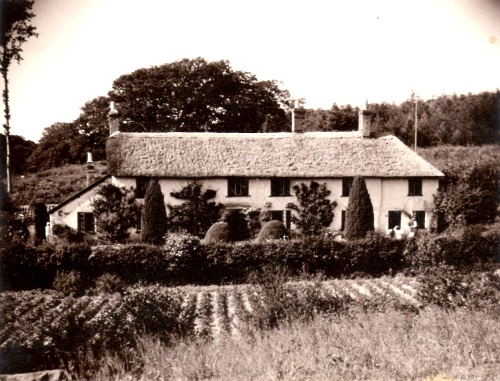
This photograph of Shallowford was used one year by the family as a Christmas card – note the neat garden and vegetable patch |
 |
|
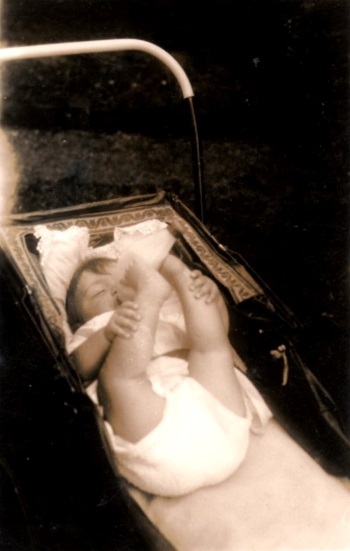
Baby John feeding himself - HW has written on the back of this photograph: 'Sergeant John Williamson, R.A.F., practising gliding in his pram in North Devon' |
 |
|
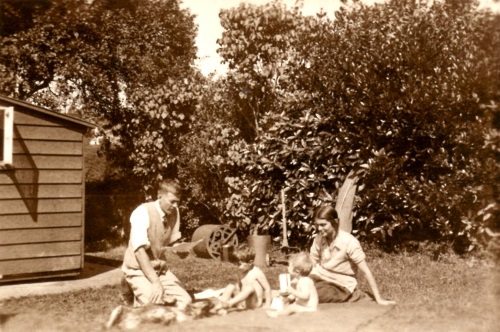
HW and Loetitia with Windles and John – HW looking as though he is reading from his latest work |
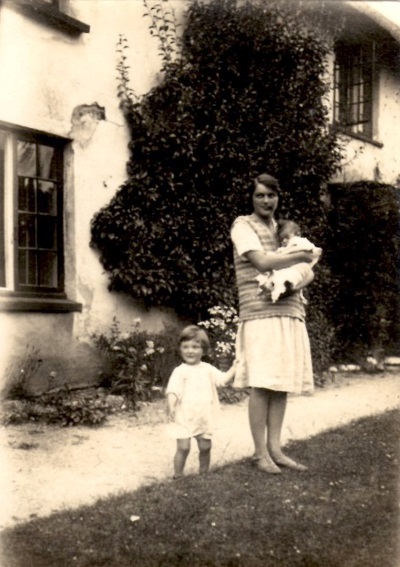 |
| Loetitia with John and baby Margaret |
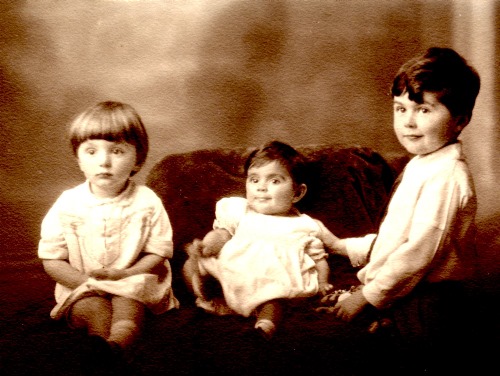 |
| A studio portrait on John, Margy and Windles |
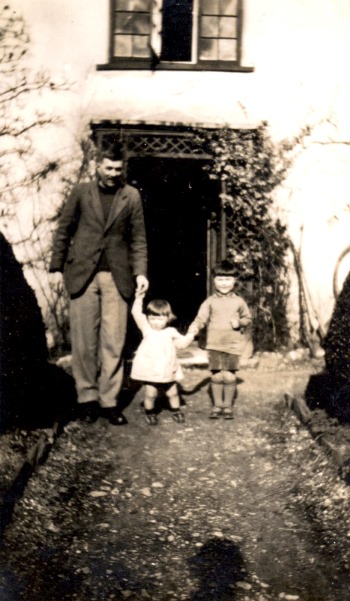 |
| HW with John and Windles |
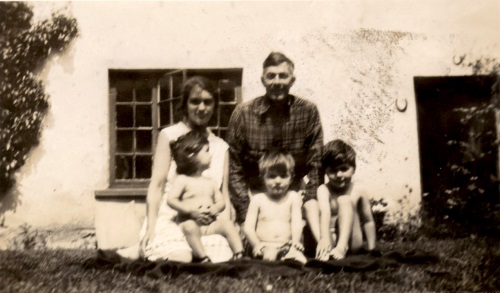 |
| An informal family group |
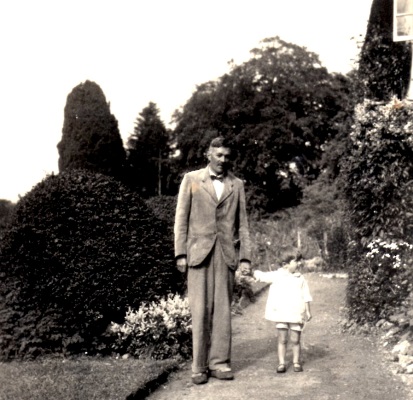 |
| HW with John |
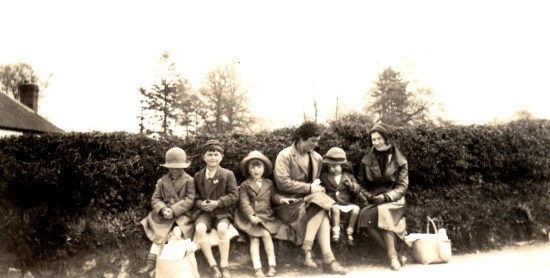 |
| left to right: unknown, Windles, John, Loetitia, Margaret, unknown (perhaps the maid) |
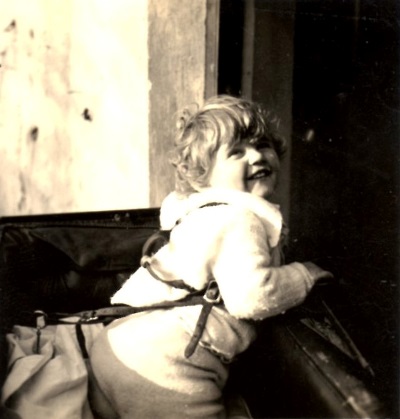 |
| Baby Robert |
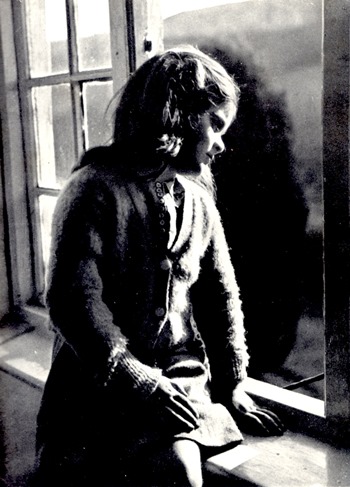 |
| Margaret |
 |
|
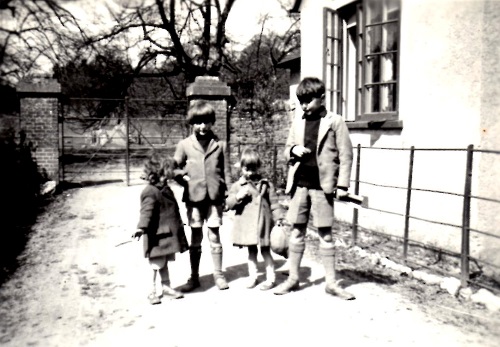
Robbie, John, Rosie and Windles In the background is the gate to the Deer Park (Humpy Bridge can just be made out). The building on the right was demolished in the 1960s. |
 |
|
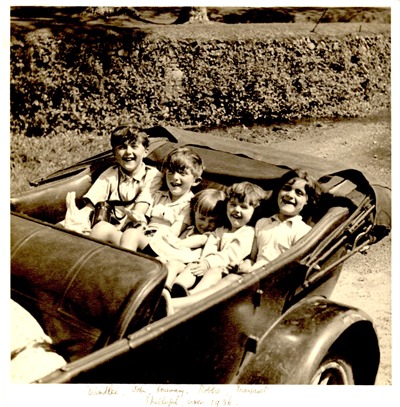
HW has identified them underneath as 'Windles, John, Rosemary, Robbie, Margaret Shallowford area 1936' The 1978 edition adds that: 'Baby Richard was too small to join [them] for a ride in their uncle's car to South Molton' |
 |
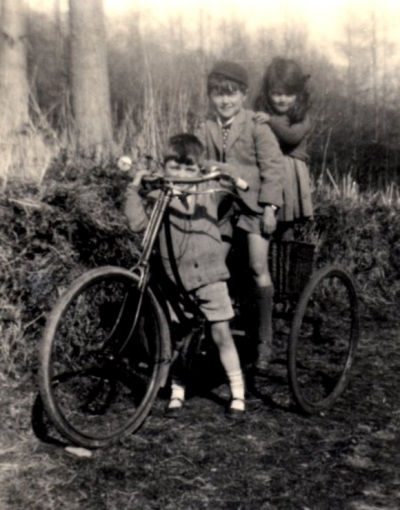
| Haymaking up at the Field |
 |
| John, Windles and Margy on a tricycle to grow into! |
 |
| John at work on his book |
 |
|
The caption in the 1978 edition reads: 'Baby Richard cries, watched benignly by Windles but with indifference by Robbie |
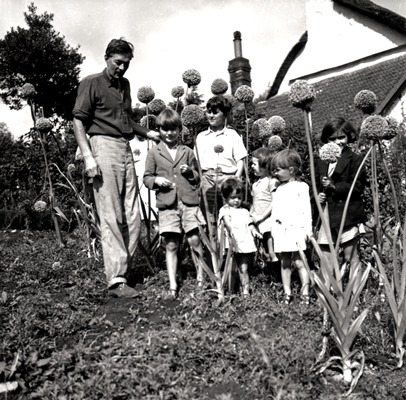 |
| In the onion patch, probably taken by Ann Thomas |
|
|
|
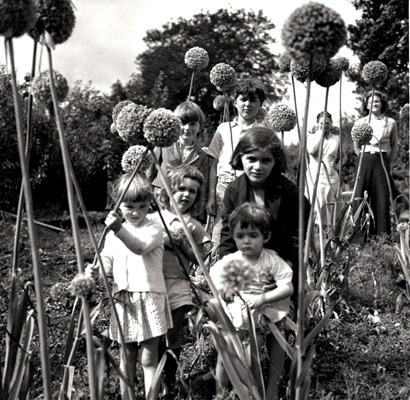
Still in the onion patch Front row, Rosie and Richard; second row, Robbie and Margy; third row, John and Windles; at the back Annie Rawle and Ann Thomas |
 |
|
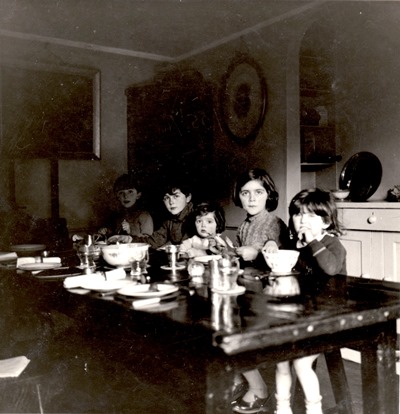
The caption in the 1978 edition reads: 'John, Windles, Richard, Margaret and Robert at the long oak table for Christmas 1936 at Shallowford' The table was removed to the Norfolk Farm, and remains in the family. |
Henry Williamson and Reginald Pound
Back to The Children of Shallowford main page
 |
|
|
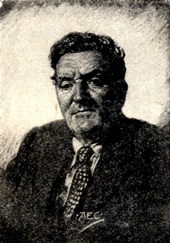
Reginald Pound |
|
The biographical details below are taken direcly from The Times' obituary, published on 28 May 1991, and to which due acknowledgement is made.
Reginald Pound (11 November 1894–20 May 1991) was a journalist and writer who made his name in the different but related fields of journalism and biography. He began contributing to newspapers and magazines in the middle of the First World War while still in uniform – he was in the trenches in February 1915 with the 5th Battalion of the Royal Sussex Regiment and later was commissioned in the King's Shropshire Light Infantry – and after demobilisation freelanced successfully for some years.
In the mid-1920s Beverley Baxter, then editor of the Daily Express, invited Pound to become the first literary editor of the paper and in that role he transformed the leader page into a platform from which the foremost public figures addressed readers on topics of the day. It was a revolutionary editorial move which was followed by every other large-circulation newspaper, including the Daily Mail, where Pound was features editor in the 1930s. His work in Fleet Street brought him a wide aquaintance and some long-lasting friendships [this, perhaps, is how he first met HW].
At the beginning of the Second World War he joined the Ministry for Information, then went to the BBC in the overseas news section at Evesham, where he was a member of the Radio Newsreel team. In 1942 he was appointed editor of The Strand Magazine where one of his many successes was to persuade Winston Churchill to allow him to reproduce in full colour some of Churchill's paintings. It was his last editorial post. [It may be recalled that HW contributed his essay 'When I was Demobilised' to the September 1945 issue of the magazine.] The Strand, with a decreasing circulation and rising costs, folded in March 1950, its final editor being Macdonald Hastings.
The first of Pound's biographies, Arnold Bennett, was published in 1952, earning him the W. H. Heinemann Foundation Award (the heading portrait is taken from this book's dust wrapper). He had met Bennett several times (as had HW) and admired his no-nonsense approach to the craft of letters. His first published work, Illustrated History, had appeared in 1928, based on a series he had contributed to the Daily Express; Their Moods and Mine, a gallery of pen portraits of the famous and not so famous he had met during his time in Fleet Street [including HW, see below], had been published in 1937; Turn Left for England (a title he later regretted as it referred to a direction on the map at the start of a round-England trip and was not a political injunction) had been published in 1939; Pound Notes in 1940 [see below] and A Maypole in the Strand in 1948.
His second biography, Northcliffe (1959), the official life of Lord Northcliffe, was probably his chef d'oeuvre. Pound did all the writing and his collaborator, Northcliffe's nephew Sir Geoffrey Harmsworth, provided the archival material and invaluable liaison with members of the Harmsworth family. While researching and writing this biography Pound was for six years the teleivision critic of The Listener and was writing regularly for the Daily Mail.
Selfridge, a life of the department store magnate, appeared in 1960; The Englishman, a biography of Sir Alfred Munnings the artist, in 1962 [see below]; Evans of the Broke, a life of the legendary destroyer captain Admiral Lord Mountevans, in 1963; Gillies: Surgeon Extraordinary, 1962, and in the same year a First World War study called The Lost Generation.
More books were to follow: Scott of the Antarctic and The Strand Magazine (both 1966); Harley Street (1967); Sir Henry Wood (1969); Queen Victoria (1970); Albert, a biography of the Prince Consort (1973) and finally, in 1976, A. P. Herbert, a life of one he had known and whose friendship he had valued since the early 1920s.
Despite a certain shyness, which never entirely left him, Pound had a great capacity for friendship. He was a member of the Savage Club [as was HW] from 1924 until his death and was elected a Fellow of the Royal Society of Literature in 1953.
He married in 1916 Cicely Margaret Dawes (who died in 1985) and they had seven children.
*************************
As previously stated in the The Children of Shallowford main page, some of the tales that appear there were first published in the little magazine Family, founded and edited by Reginald Pound – he canvassed his wide circle of friends and acquaintances for contributions to this ill-fated and short-lived venture.
I noted in my HW biography, Henry Williamson: Tarka and the Last Romantic (1995), that although they were friends and a small file of letters exists from Reggie (as he was universally known), there is only one mention of him within HW’s personal archive – in 1942, when HW went down to London after a bout of illness and mentions, in passing, seeing Reggie at the Savage Club. He is not, as far as can be ascertained, a character in A Chronicle of Ancient Sunlight; although a fellow 'Savage', Macdonald Hastings, appears in Lucifer before Sunrise, where he is portrayed memorably and hilariously as the journalist Bannock MacWhippett, who visits the farm with a photographer to cover a game shoot for an article.
However RP (his letters tend to be signed thus) mentions HW several times in his anecdotal autobiographical books, Their Moods and Mine (Chapman & Hall, 1937) and Pound Notes (Chapman & Hall, 1940). While these have no relevance to the immediate subject here, they shed an interesting insight on HW during the period of the late 1920s to 1940, and give a clear indication of HW’s intensity of character. The books are very well worth reading in full for their portrayal of contemporary literary and social society (second hand copies are relatively easy to come by).
HW is appears too in his biography of Sir Alfred Munnings, The Englishman (Heinemann, 1962), where Pound relates the following anecdote:
In the first days of September 1939 [Munnings] was enjoying a spell of landscape painting on the north Norfolk coast, staying at the Ship Inn, Brancaster. One of his subjects was Morston Church, 'a place of repose – a place to dream in'. On his third morning out a sheaf-piled harvest waggon passed slowly along by the churchyard wall. A boy on top of the load called out to him: 'The war's started!'
Munnings wrote afterwards that he went on painting, his emotion of the moment perhaps beyong recollection. Later in the day he chose another subject, the Old Hall at Stiffkey. Its land was being farmed by Henry Williamson, then living through the experiences set out in his Story of a Norfolk Farm. Munnings had used up his supply of canvases and was looking round for something to paint on. His exploratory eye noticed a trousers-press in the granary. It contained arectangle of millboard. He took it and started work again. Shortly afterwards a boy of thirteen, on of Williamson's sons, came and stood silently behind him, watching. Henry Williamson noted the ensuing dialogue.
A.J. (roaring over his shoulder:) 'What the hell are you doing here? Go away, boy!'
Boy: 'That's my father's trouser-press! He wants it!'
A.J.: 'Go away, I tell you! Get out of it! I want to paint this before the light changes!'
Boy (resolutely): 'When Dad comes he'll want to know why I let anyone in the granary, you know. You took that, didn't you?'
A.J. (continuing to paint): 'Look at that light – wonderful! Can't you see how beautiful it is? What the hell's all this about trousers? Go AWAY!'
The boy was Windles – Bill – and the episode entered family legend. Munnings is portrayed as Riversmill in the Chronicle, and the occasion is lightly fictionalised thus by HW on the very last page of The Phoenix Generation. Lucy is speaking to Phillip:
'Oh, I forgot – my memory nowadays is like a sieve – Mr. Riversmill the painter came over this morning, and was painting the church across the river when Billy came down from scuffling the stubbles on the Bustard, and saw that he had taken one of the millboards out of your trouser press, and had painted the view on it. Mr. Riversmill turned round and shouted at him to go away. Billy said, "You've got my father's trouser-press board, he wants that." "Who cares?" said Riversmill. "This painting is more important than your father's damned trousers." Billy told him you wouldn't be able to get the picture of the church off, because paint hardened on cloth. "It's my picture, you damned boy," shouted Riversmill. "And it's my father's trouser-press" said Billy. He was quite upset. Anyway, I told him it didn't matter, we could easily get some more board.'
'Good for Billy.'
*************************
It is Pound's two memoirs, Their Moods and Mine (Chapman Hall, 1937) and Pound Notes (Chapman Hall, 1940), that are of particular interest, both books containing several references to HW, giving us an unusual ‘other’ viewpoint. Unfortunately Pound does not date any of his entries (although apparently the originals are dated), which is a little trying from the research point of view, but the HW reader should be able to fix an approximate date to them all.
In Their Moods and Mine Pound relates several contacts. First a letter from HW written from Skirr Cottage (although not literally: HW tended to use the address for some time after he had moved virtually next door to Vale House!).
p. 38:
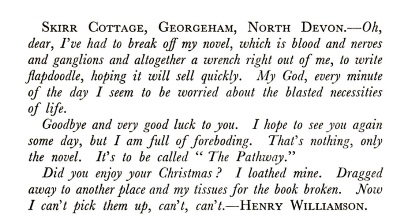
p. 59:
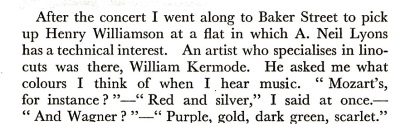
p. 74:
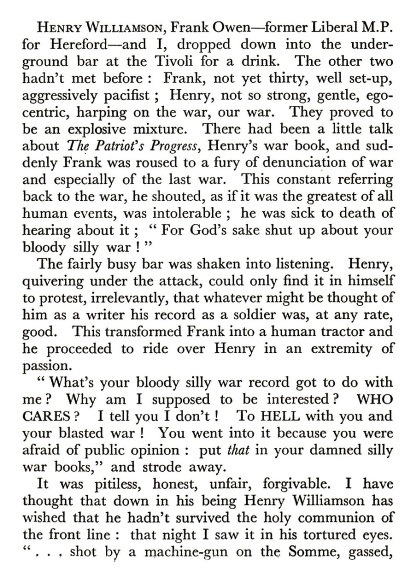

p. 98:
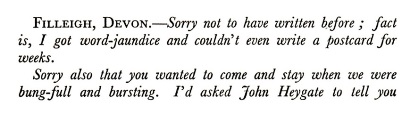

p. 179:
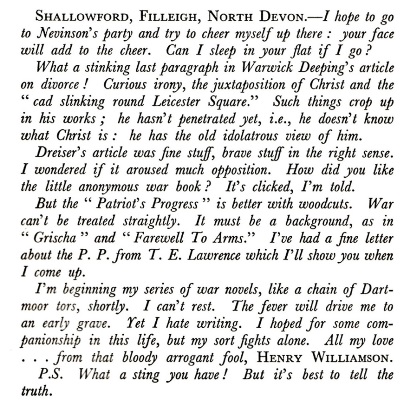
p. 217:
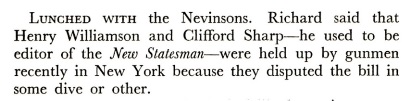
pp. 249-252: extracts from –

*****

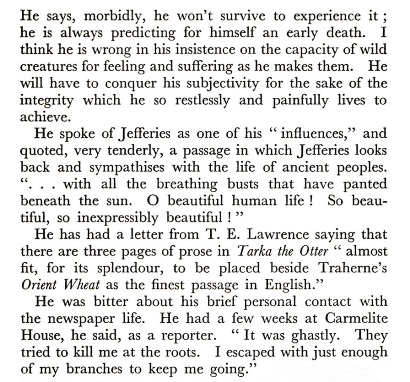
Further extracts from Pound Notes (Chapman and Hall, 1940):
p. 51-2:
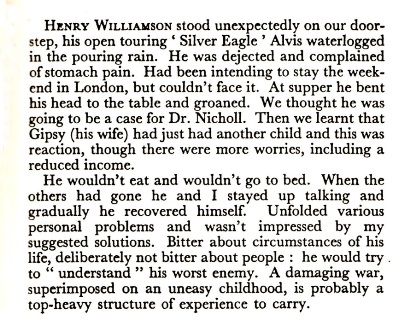
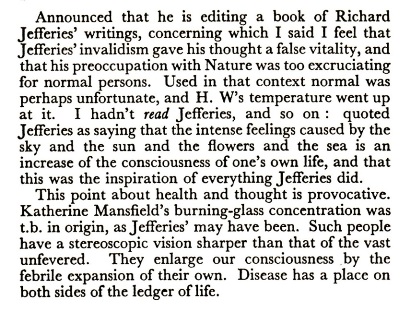
pp. 126-7:
Peremptory knock on the door of my room introduced
Henry Williamson, wearing an old mac and

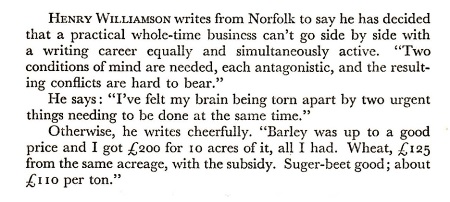
And from Running Commentary (Rockliffe, 1946)
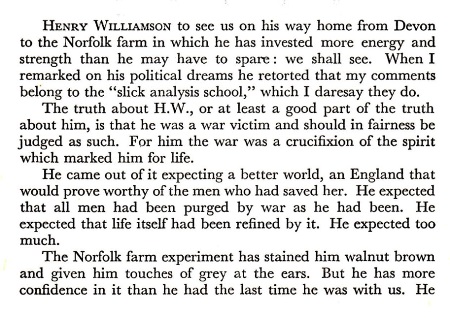
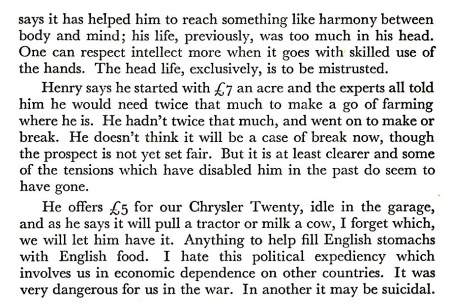
p. 62:
*************************
Back to The Children of Shallowford main page
The Children of Shallowford - The Hut on the Hilltop
Back to The Children of Shallowford main page
There are in the literary archive several typescript and manuscript pages, heavily revised, which describe the purchase of the Field at Ox's Cross, and the building there of the Writing Hut:


*************************
Back to The Children of Shallowford main page
The Children of Shallowford - Critical reception
Back to The Children of Shallowford main page
Some family photographs from the Shallowford era
Henry Williamson and Reginald Pound
I have not found any envelope containing reviews of the first edition of The Children of Shallowford. One has to presume that in the confusion of the beginning of the Second World War and HW’s own intensive work on the farm that autumn they were lost. His diary records that for three weeks from the second week of September he was blasting chalk from the quarry (total 120 tons), which was then spread onto the farm fields, together with a large amount of human manure from London. This was all very hard work. Perhaps he even threw them away in anguish, for at that time Gipsy and the two younger children (John and Margaret were away at school, Windles was now helping on the farm) went off to live with her brother Robin, then living in Bedford. The spirit of the book was broken: killed, at the very time his readers were enjoying in print its seemingly idyllic pastoral happy family scene.
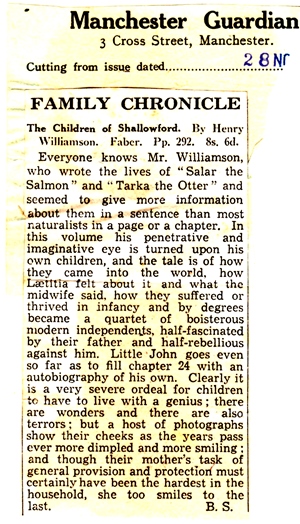
(If anyone knows of any reviews we would be very grateful for copies to post here. For instance Brian Vesey Fitzgerald states in 1959 that he reviewed the first edition – and the Eastern Daily Press review notes that the first edition was rather overlooked due to the outbreak of war.)
There is one review which HW had pasted into the front of his file copy:
And one other loose one:
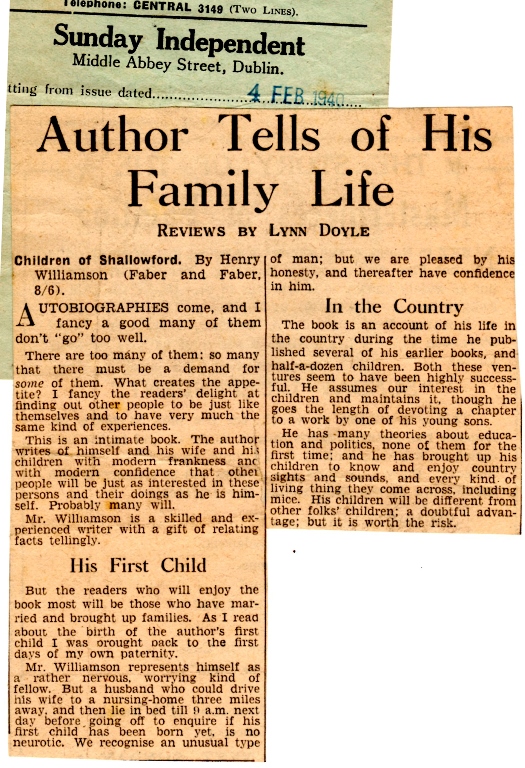
Sunday Independent (Dublin):
1959 revised edition reviews:
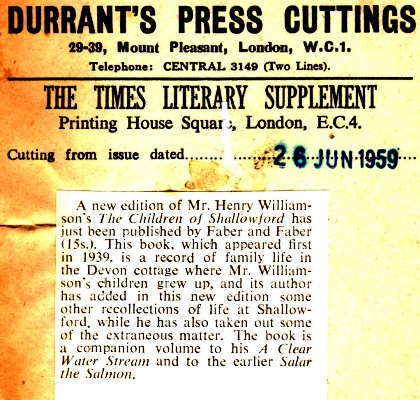
The Times Literary Supplement:
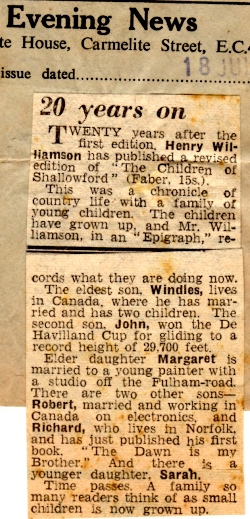
Evening News:
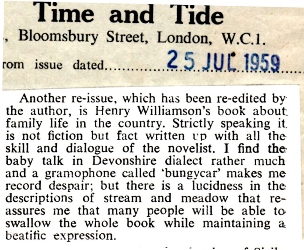
Time and Tide:
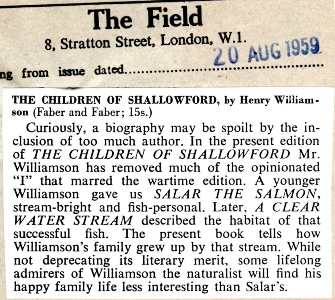
The Field:
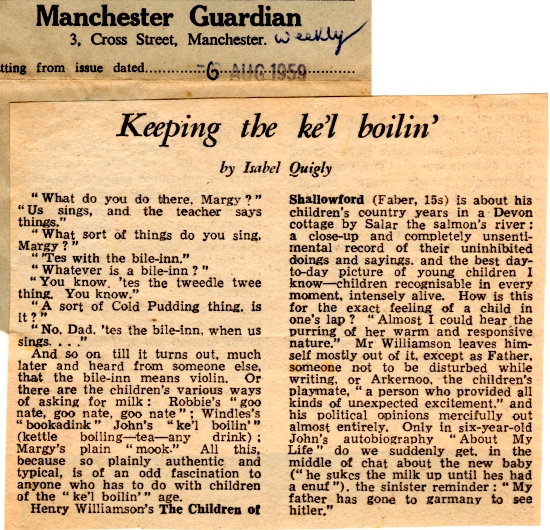
Manchester Guardian (Isabel Quigly), 31 July 1959, and reprinted on 6 August 1959:
The Spectator (Arthur Boyars), 7 August 1959: mainly reviewing T. H. White’s The Godstone and the Blackymor (Cape, 18s) which seems to be a ‘fantastic’ tale (in the original sense): HW gets mention as rooted in the real world (‘the different and good lives have also led to different and good books’):

Birmingham Post (Brian Vesey Fitzgerald), 1 August 1959:

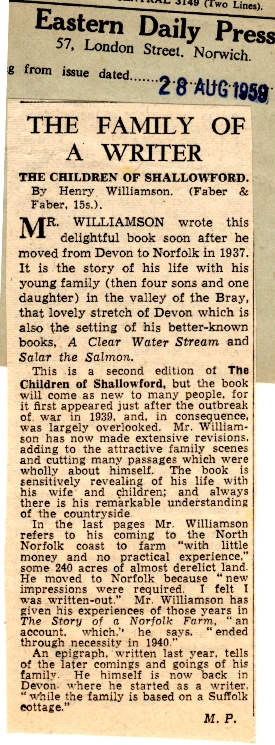
Eastern Daily Press (M.P.), 28 August 1959:
Western Morning News, 11 September 1959:

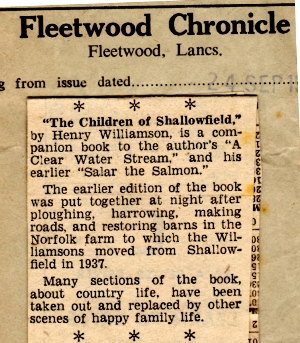
Fleetwood Chronicle, 24 September 1959:
*************************
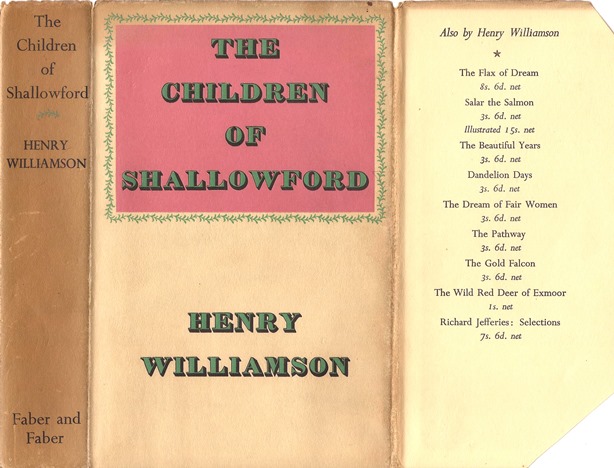
The first edition, 1939, with one of Faber's dustwrappers typical of the period:
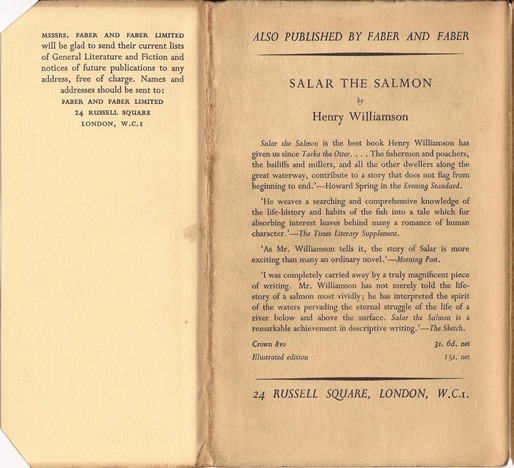
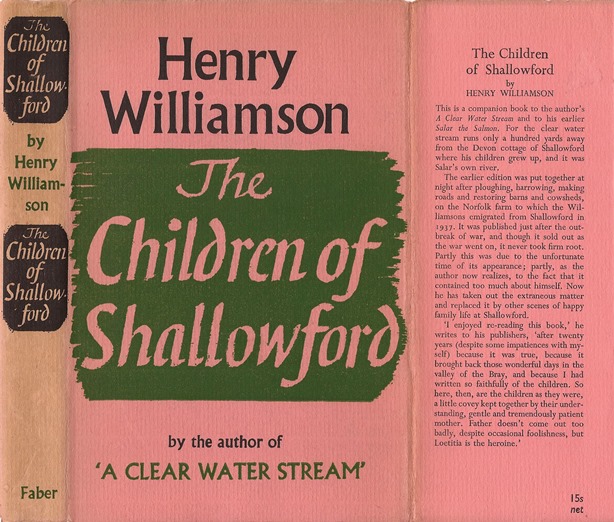
1959, Faber, revised edition:

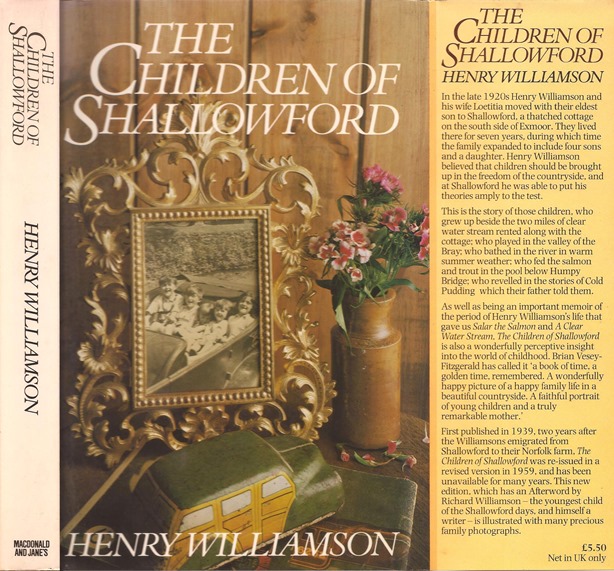
1978, Macdonald and Jane's, with new illustrations and an Afterword by Richard Williamson (note the toy wooden Alvis shooting brake on the table – perhaps the original inspiration for Richard's passion for the car and all things Alvis!):

Back to The Children of Shallowford main page
Some family photographs from the Shallowford era
Henry Williamson and Reginald Pound
*************************